

Ground transportation is so much more than just a ride. For the executives and high-net-worth individuals we work with, it’s a meticulously managed service that functions as a seamless extension of their office. It’s about transforming what used to be dead travel time into a strategic asset, not just another logistical headache.
Beyond The Ride: Understanding Executive Ground Transportation
When I say "ground transportation," your mind probably jumps to hailing a cab or tapping an app on your phone. And while those services get you from A to B, they exist in a completely different universe from professional executive ground transportation.
Here’s an analogy I like to use: a rideshare is like a public bus. It gets you to your destination, eventually, but the route, the timing, and the environment are all out of your control. Executive transport, on the other hand, is like a private jet for the road. Every single detail is pre-arranged, pre-vetted, and perfectly tailored to your itinerary.
For travelers whose most valuable commodity is their time, that distinction is everything. This isn’t just about the car; it’s about the entire support system built around that journey.
The True Meaning of Managed Travel
Managed ground transportation is a proactive, logistics-first solution. It's the art and science of ensuring a professionally trained chauffeur is already waiting for you—even if your flight is two hours late—in a vehicle that is nothing short of immaculate. Behind the scenes, a 24/7 operations team acts like air traffic control, monitoring and coordinating every movement to guarantee flawless execution.
The real difference boils down to one word: control. With standard options, you are forced to adapt to the service's availability. With executive transportation, the service adapts completely to you—your schedule, your needs, and your preferences.
The demand for this level of reliability is skyrocketing. The transit and ground passenger transport market, valued at roughly $706.2 billion in 2025, is on track to hit an incredible $1.48 trillion by 2034. This explosive growth signals a massive global shift toward high-quality, dependable transportation. You can discover more insights about this growing market and see what’s driving it.
The image below really breaks down the key differences between what you get with a standard ride versus a professional service.
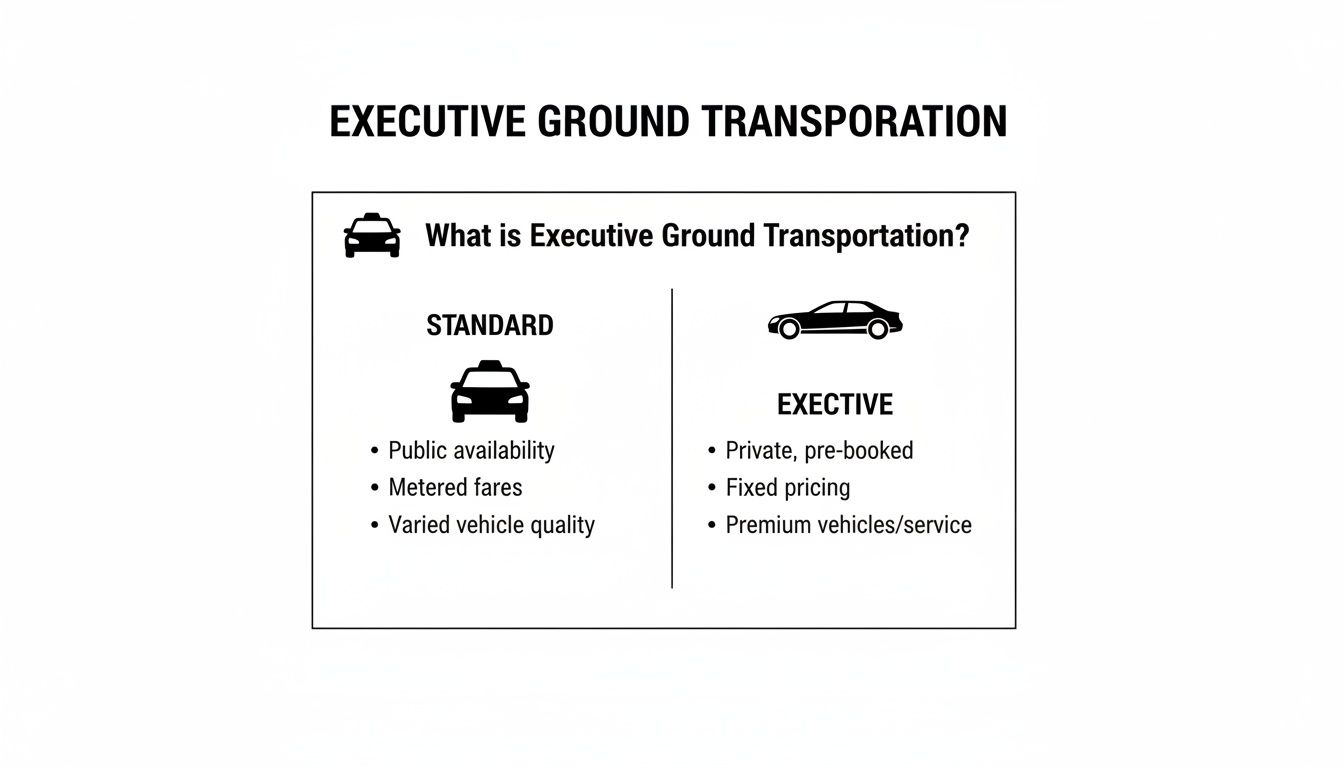
To make it even clearer, let's put these two approaches side-by-side.
Ground Transportation At A Glance
| Feature | Standard Transportation (Rideshare/Taxi) | Professional Executive Ground Transportation |
|---|---|---|
| Reliability | Variable; dependent on driver availability and traffic. High risk of no-shows. | Guaranteed; pre-scheduled with 24/7 dispatch monitoring flights and traffic. |
| Chauffeur | Inconsistent training and vetting. A driver's job is just to drive. | Professionally trained, vetted, and background-checked chauffeurs focused on service. |
| Vehicle | Varies widely in age, cleanliness, and quality. No guarantee of vehicle type. | Meticulously maintained, late-model luxury vehicles. Specific vehicle class guaranteed. |
| Safety | Basic background checks. No centralized "Duty of Care" protocol. | Rigorous safety protocols, comprehensive insurance, and established Duty of Care. |
| Privacy | Minimal. Conversations can be overheard; no guarantee of confidentiality. | Ensured. Chauffeurs are bound by NDAs and trained in client discretion. |
| Service | Transactional. The focus is on completing the trip as quickly as possible. | Personalized. The focus is on the passenger's comfort, schedule, and preferences. |
As you can see, the key differentiators are reliability, professionalism, and the sheer personalization of the service. For anyone whose travel demands absolute precision, these aren't just nice-to-haves; they are mission-critical.
So, what is ground transportation in this context? It's the dependable, high-trust link that holds your entire itinerary together, protecting your time and making sure every journey is safe, efficient, and productive.
The Core Services That Define Executive Transport
When you bring in a professional ground transportation company, you're not just booking a car. You're hiring a dedicated logistics team whose entire focus is on managing your journey from start to finish. The real value isn't just the leather seats; it's the whole suite of services built to tackle the real-world headaches of executive travel.
This approach flips travel time from a necessary evil into a genuine opportunity. It's about being proactive—anticipating needs, solving problems before they happen, and adding a layer of predictability to an otherwise unpredictable schedule. Let's look at the key services that make this premium experience possible.

Seamless Airport and FBO Transfers
Let's be honest, landing at a bustling airport or a private FBO (Fixed-Base Operator) can be the most frustrating part of any trip. You're trying to navigate crowds, find a pickup area, and then wait for a car. It's a huge waste of time and energy.
Professional airport transfer services are designed to cut through that friction completely. Here’s how it works in practice:
- Real-Time Flight Tracking: The operations team isn't just looking at your scheduled arrival. They're watching your flight in real time. If you're early or delayed, your chauffeur’s schedule is adjusted automatically. This guarantees they’re waiting for you the moment you land, not the other way around.
- Meet-and-Greet Services: Instead of you looking for them, they find you. A professionally dressed chauffeur meets you at a specific spot—often right at baggage claim or just past customs. They’ll handle your luggage and walk you directly to your waiting vehicle, letting you bypass the chaos of the public pickup lines.
- FBO Coordination: For those flying private, the chauffeur coordinates directly with the FBO staff. When security allows, they can gain tarmac access and be positioned to meet you right as you step off the plane. It’s a truly seamless handoff from air to ground.
This level of detailed coordination makes arrivals and departures feel smooth and controlled, setting the right tone for the rest of your trip.
The Dedicated Chauffeur Experience
The chauffeur is what truly separates executive ground transportation from a simple car service. They aren't just a driver; they're a highly trained professional who acts as your personal mobile concierge for as long as you've booked them.
A dedicated chauffeur means the vehicle and the professional are yours—whether for a few hours, a full day, or even several days. This "as-directed" model is perfect for executives with schedules that can change on a dime. Picture a day filled with back-to-back meetings all over town. Your chauffeur remains on standby, ready to go to the next location the second you are, easily adapting if a meeting runs long or ends early.
This service transforms the vehicle into a mobile office. The quiet, private cabin of a luxury sedan becomes a secure space to make confidential calls, catch up on emails, or prep for your next meeting. It turns transit time into productive work time.
Corporate Roadshows and Multi-Stop Itineraries
Trying to organize a corporate roadshow—a rapid-fire series of crucial meetings in different locations—is a logistical nightmare. Just one delay can create a domino effect that puts the entire trip in jeopardy. This is where professional ground transportation providers truly shine.
A dedicated roadshow team will work hand-in-hand with your travel manager or EA to map out a precise itinerary. They plan the best routes, account for likely traffic issues, and build in contingency plans. The chauffeur assigned to the roadshow gets a full briefing on the entire schedule, including every address, contact name, and critical time.
Having a single point of contact for every ground movement ensures flawless execution. It frees the executive to focus completely on the meetings, not the logistics of getting to them. The precision involved is a perfect example of what ground transportation really means at the executive level.
Beyond these foundational services, many providers offer another layer of support. To see how these offerings can be customized for unique requests, you might be interested in exploring our specialized concierge services that are designed to handle even the most demanding itineraries. It's this level of personalization that truly defines a first-class travel partner.
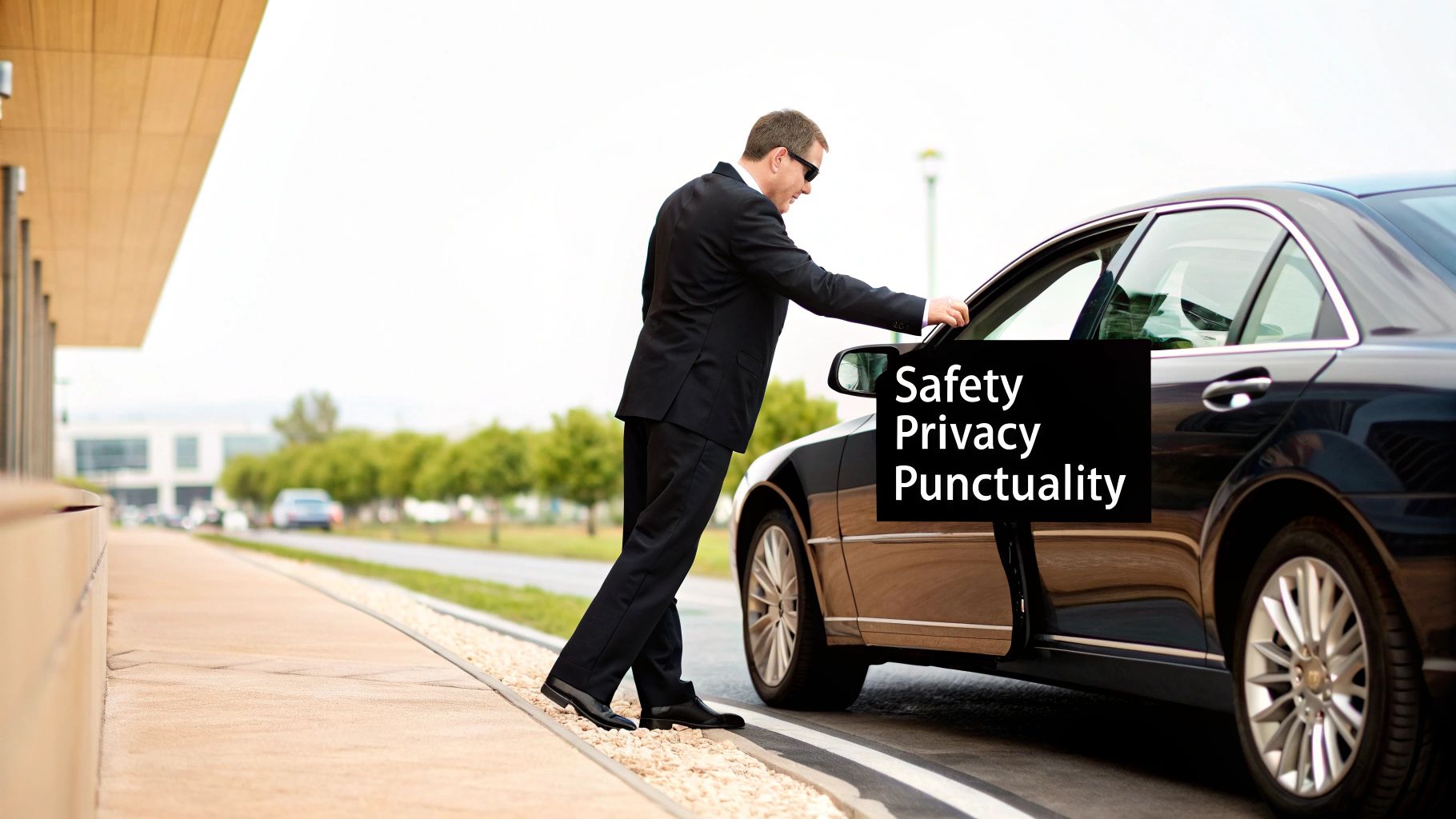
Safety, Privacy, and Punctuality: The Three Pillars of a Premium Service
The luxury vehicle is just the start. Anyone can buy a nice car, but the real value in executive ground transportation comes from the operational bedrock that makes every trip flawless. While a pristine sedan is a given, it’s the intense focus on safety, privacy, and punctuality that truly sets a premium provider apart from a standard car service.
For high-stakes travel, these three pillars aren't just important—they're non-negotiable. A single delay, a security misstep, or a breach of confidentiality is simply not an option. This is the core promise of a professional service: protecting your schedule, your well-being, and your information.
Let's pull back the curtain and look at what it really takes to deliver this level of service.
Uncompromising Safety and Duty of Care
In the world of executive transport, safety isn't a passive assumption; it's an active, multi-layered system. It begins long before you ever set foot in the vehicle. This all-encompassing approach is known as Duty of Care—a provider's fundamental obligation to guarantee a client's safety and security from pickup to drop-off.
This system really rests on two key components:
- Chauffeur Vetting and Training: Every chauffeur goes through exhaustive background checks, from criminal records to driving history. But that's just the beginning. They receive ongoing, rigorous training in defensive driving, situational awareness, and emergency protocols, making sure they’re ready for any road condition or unexpected event.
- Preventative Vehicle Maintenance: The fleet is kept on a maintenance schedule that goes far beyond what the manufacturer recommends. Daily vehicle inspections are standard procedure, covering everything from tire pressure and fluid levels to brake performance and interior hygiene.
This proactive approach means every trip is built on a foundation of the highest possible safety standards.
The Sanctity of Privacy and Discretion
For executives and high-net-worth individuals, the back of a car is often a mobile office or a private sanctuary. Sensitive calls are made, and confidential documents are reviewed. A truly premium service treats client privacy with the same seriousness as a law firm or a Swiss bank.
Confidentiality isn't just a perk; it's a core operational requirement. Chauffeurs are absolute professionals, often bound by strict non-disclosure agreements (NDAs) and trained to be the very definition of discretion. They know their role is to be present but invisible, ensuring conversations and activities inside the vehicle remain completely private.
This commitment also applies to your data. All booking information, itineraries, and personal details are protected with robust digital security protocols to prevent any unauthorized access. It’s all about creating a trusted bubble where you can work or relax with total peace of mind.
Punctuality Powered by Advanced Logistics
In executive travel, being on time isn't the goal—it’s the starting point. Real punctuality means arriving at the right place, at the right moment, every single time, no matter what’s happening with traffic or flight schedules. This isn’t luck; it's the result of some seriously sophisticated logistical planning.
Behind every smooth pickup is a 24/7 operations team that acts as a mission control center. They use a whole suite of advanced tools to make precision a reality:
- Real-Time Flight Tracking: The team constantly monitors commercial and private flights, automatically adjusting dispatch times based on actual wheels-down, not the scheduled arrival.
- Predictive Traffic Analysis: Using advanced GPS and live traffic data, dispatchers can see potential delays before they happen and proactively reroute chauffeurs to ensure the most efficient path.
- Constant Communication: The operations team and the chauffeur have a direct line of communication, allowing them to adapt on the fly to any last-minute changes to your itinerary.
This logistical brain turns punctuality from a hope into a guarantee. It’s a system designed to eliminate stress and deliver a travel experience that feels effortless, reliable, and perfectly in sync with your demanding schedule.
How to Select the Right Ground Transportation Partner
Picking a ground transportation partner isn't like hailing a rideshare on a street corner. It’s a strategic decision that can make or break an executive's entire trip. The right partner becomes a seamless extension of your own team, while the wrong one can inject chaos and risk into a carefully planned itinerary. To find a provider who truly gets the high-stakes nature of executive logistics, you have to look far beyond the price tag.
What you're really looking for is more than just a car and a driver. You need a comprehensive service built on a foundation of reliability, safety, and proactive communication. This means you’ll need to do a little digging into a company's real-world operational capabilities, their global reach, and their commitment to keeping their promises.
Assessing Global Network and Fleet Quality
For executives who travel internationally, a provider’s network is everything. You need a partner who can deliver the same high standard of service whether you're touching down in New York, London, or Tokyo. Trying to piece together a new company for every city is a logistical nightmare that introduces far too much inconsistency.
When you're vetting a potential provider, get specific with your questions about their network and vehicles:
- Global Reach: Do they have a genuinely global, vetted network, or are they just a local operation? Ask them about their presence in the specific markets that matter most to you.
- Fleet Standards: What's the average age of their vehicles? Are the cars owned by the company or by affiliates, and how do they enforce maintenance standards across that entire network?
- Vehicle Options: Can they handle different needs? You might need an executive sedan one day and a sprinter van or even a bus for a group movement the next.
A top-tier partner will be completely transparent about how they manage their global affiliates, ensuring every single chauffeur and vehicle meets their strict criteria. This is exactly why understanding the value of a robust affiliate network is a game-changer when you're making a final decision.
Evaluating Communication and Technology Protocols
In a world of constant flight delays and last-minute schedule changes, a provider’s communication and tech stack is what separates the real professionals from the amateurs. A 24/7 operations center isn't a perk; it's a non-negotiable requirement. This team should be your single point of contact, always on standby to manage any disruption in real time.
A provider's technology is a direct reflection of their commitment to reliability. Modern features like real-time flight tracking and predictive traffic analysis aren't just fancy add-ons—they are the core tools that ensure punctuality.
The entire transportation services sector is seeing incredible growth, with the global market projected to hit a staggering $19.96 trillion by 2035. This boom is powered by technology, and features like real-time passenger information and AI-driven vehicle maintenance are quickly becoming the industry standard. As a client, you should expect nothing less. You can learn more about the trends shaping the transportation market on Precedence Research.
The Provider Evaluation Checklist
To help you systematically compare and vet potential ground transportation providers, use this checklist. Their answers—or lack thereof—will tell you everything you need to know about their operational capabilities and commitment to service excellence.
| Evaluation Criteria | Key Questions to Ask | What to Look For (Ideal Standard) |
|---|---|---|
| Chauffeur Quality | What specific training do chauffeurs receive beyond a standard license? Ask about defensive driving, hospitality, and discretion protocols. | Chauffeurs should have documented, ongoing training in advanced driving techniques, client etiquette, and confidentiality. |
| Safety & Insurance | Can you provide documentation of your commercial insurance coverage and describe your Duty of Care policies? | Look for comprehensive commercial liability insurance (well above minimums) and a clearly defined Duty of Care policy. |
| Contingency Planning | What is your exact protocol for a vehicle breakdown, a chauffeur running late, or a sudden road closure? | A detailed, proactive plan that includes backup vehicles and chauffeurs, real-time monitoring, and immediate client communication. |
| Billing & Reporting | Is your invoicing clear and itemized? Can you provide detailed reporting for corporate travel expense management? | Expect transparent, itemized billing and the ability to generate customized reports that integrate with your expense systems. |
| Global Network | How do you vet and manage your international affiliate partners to ensure consistent service standards? | A rigorous, multi-step vetting process for all partners, including regular performance reviews and on-site inspections. |
By asking these pointed questions, you can cut right through the marketing fluff and get a clear picture of a provider's operational strength. This due diligence is the key to selecting a partner who can consistently deliver the safe, reliable, and professional service that defines high-quality ground transportation.
Weaving Ground Logistics into Complex Itineraries
Modern executive travel isn't just a series of bookings; it's a dynamic puzzle of flights, meetings, and accommodations. Professional ground transportation is the critical thread that ties all those pieces together, turning a collection of separate reservations into a single, seamless mission.
It’s the difference between just booking travel and truly orchestrating a successful trip from start to finish.

Think of your provider's logistics team as a personal air traffic control, but for the road. They don’t just book a pickup. They build a responsive, intelligent system around the traveler's entire schedule, actively managing every transition to preempt problems before they ever arise.
This deep integration is what keeps the whole travel plan on track, no matter what surprises the day throws at you.
Syncing with the Real-Time Flow of Travel
Even the most meticulously planned itinerary can be thrown off by a single flight delay. This is where a truly professional service proves its worth. Instead of an executive assistant scrambling to rebook cars from a different time zone, the provider’s operations team is already on it.
Using real-time flight tracking, they monitor arrivals and departures, automatically adjusting chauffeur dispatch times. The car is there when the plane lands, not when it was supposed to land.
This tight coordination is essential in private aviation, too. At a Fixed-Base Operator (FBO), the ground team communicates directly with the flight crew, ensuring the vehicle is positioned planeside the moment the aircraft is ready. No waiting, no friction—just a swift and discreet transition from the jet to the awaiting sedan.
The Power of a Single Point of Contact
Imagine a multi-city roadshow. An executive has back-to-back meetings across London, Paris, and then Geneva. Juggling three different local car services is a recipe for disaster. You're dealing with potential language barriers, wildly different service standards, and fragmented communication that could derail the entire trip.
A global provider with a single point of contact eliminates this chaos. Your travel manager speaks with one dedicated account manager who oversees every single ground movement, no matter the city. This unified command center delivers huge advantages:
- Consistency: The same high standards for vehicle quality, chauffeur professionalism, and safety protocols are guaranteed in every city.
- Agility: If a meeting in Paris runs late, the logistics for the next leg in Geneva are adjusted instantly. No frantic calls, no crossed wires.
- Simplicity: All billing, reporting, and communication are centralized, dramatically cutting down the administrative headache for the executive's support team.
The real benefit here is total accountability. When one team is responsible for the entire ground logistics chain, they own the outcome. Every handoff is flawless, and the traveler experiences a single, continuous standard of care from door to door.
The demand for this kind of integrated service is exploding. The airport ground transportation market, estimated at $25.8 billion in 2025, is projected to hit $40.5 billion by 2035. Growth is especially strong in the Asia-Pacific region, where India’s market alone is set to expand at an 11.50% CAGR. This trend highlights a major global shift toward more organized, reliable, and professional travel logistics, and you can discover more insights about the global airport transportation market to see the full picture.
Ultimately, weaving what is ground transportation into the wider itinerary elevates it from a simple transfer to a core strategic component of the travel plan. It builds in the flexibility to adapt to an ever-changing schedule while ensuring the entire journey remains efficient, secure, and perfectly on time.
Your Ground Transportation Questions Answered
To help you manage executive travel with total confidence, we've put together answers to the questions we hear most often. This section cuts through the noise, offering clear, direct insights into professional ground transportation and why a dedicated partner is a game-changer.
What Is The Difference Between A Chauffeur And A Rideshare Driver?
Think of it this way: a chauffeur is a career professional trained in hospitality, security, and absolute discretion. They're part of a managed service where the entire experience—from the pre-booked arrangement to the meticulously maintained luxury vehicle—is designed around personalized, reliable care.
A rideshare driver, on the other hand, offers a simple, on-demand lift from point A to B. The experience can be a mixed bag. Vehicle quality, driver vetting, and overall service levels vary widely because the focus is on a quick transaction, not a secure, holistic service.
The real difference comes down to professionalism and accountability. A chauffeur is an expert in executive service; a rideshare driver’s role is purely about the ride itself.
How Do You Handle Flight Delays Or Last-Minute Changes?
This is where a professional service truly shines. We’re built to expect the unexpected. Using real-time flight tracking software, we constantly monitor your flight's status. If you're early or delayed, your chauffeur's arrival time is automatically adjusted—no calls needed.
For any other sudden changes to your itinerary, our 24/7 operations team is your lifeline. One quick call or email is all it takes to shift plans, guaranteeing your chauffeur is exactly where you need them, right when you need them. This proactive, always-on management is what sets premium services apart.
Who Uses Executive Transportation Services?
While C-suite executives are frequent users, these services are invaluable for anyone who can't afford to waste time or compromise on safety and productivity. We regularly serve key clients, guest speakers for major events, high-net-worth individuals, and large groups attending conferences or functions.
Essentially, if the situation demands absolute reliability and a polished, professional image, this is the right choice. If you have specific questions about your own travel needs, please contact our logistics team for a consultation.
What Safety Measures Are Considered Standard?
Comprehensive safety protocols aren't optional; they're the foundation of the service. Here's what should always be in place:
- Chauffeur Vetting: Every chauffeur must pass exhaustive background checks and receive continuous professional training.
- Vehicle Maintenance: The fleet must follow a strict, preventative maintenance schedule that goes above and beyond manufacturer recommendations.
- Full Insurance: Providers carry robust commercial insurance coverage, far exceeding the legal minimums.
- Regulatory Compliance: There is zero tolerance for anything less than strict adherence to all local and national transportation laws.
These aren't just bullet points; they're commitments that create a secure and controlled travel environment from beginning to end.
Enhanced by Outrank