

At 18 minutes into an arrival hold, the flight department knows the principal is late. The FBO adjusts its expected wheels-down time, the chauffeur is already staged, and dispatch has to move quickly before the security detail reaches the ramp. An email can sit unread. A push notification can be muted. The operational question is simpler and harsher: did the alert reach the driver's phone in time to change the outcome?
For corporate travel managers, an SMS notification service isn't primarily a marketing tool. It's an operational alerting layer for the handoff between flight watch, FBO, dispatch, chauffeur, crew, and principal. SMS messages are usually read almost immediately, with industry sources reporting open or read rates around 90% to 98%, roughly 90% read within 3 minutes, and about 74% of consumers checking notifications within 5 minutes according to SimpleTexting's SMS notification statistics. Those characteristics make SMS useful for itinerary changes, airport pickup updates, dispatch coordination, and other time-sensitive service notifications.
The risk is silent delivery failure. Carrier filtering, unregistered A2P traffic, segment inflation, throttling, and missing delivery telemetry can turn an apparently successful API request into a missed pickup. This guide treats SMS as mission-critical infrastructure and focuses on the controls that keep alerts moving.
When a Delayed Flight Becomes a Dispatch Problem
A Gulfstream inbound to KTEB is held in a stack for 18 minutes. The FBO pushes wheels-down back by 22 minutes, leaving a chauffeur at the ramp with a 12-minute gap before the principal's security detail arrives.
Flight watch sees the change first. Dispatch pings the chauffeur, the chauffeur repositions, and the ground team adjusts the meet point. That sequence works only if the alert lands on the phone being carried in the vehicle. If the driver checks email between assignments, the message arrives too late. If a push alert is silenced by Do Not Disturb, the application's status may change without anyone acting on it.
SMS fits this handoff because it reaches the native messaging channel without requiring an app installation. Its historical design also supports this role. The first SMS was sent in 1992, Radiolinja offered person-to-person service in 1994, and the GSM-7 standard was built around a 160-character limit, as documented in the history of SMS. Standardization and broad carrier support made SMS dependable for notifications before smartphones existed.
Operational rule: Treat a dispatch text as a control signal, not as a courtesy message.
The failure modes deserve more attention than message composition. A platform can accept the API request while the carrier delays, filters, throttles, or drops the message. An unregistered A2P campaign can also be blocked rather than merely delayed, according to this SMS compliance guide for business messaging.
The missed pickup is the visible consequence. The hidden cost includes a principal waiting curbside, a security team losing its movement window, a dispatcher making manual calls, and an FBO handoff that no longer matches the flight plan. The rest of the system should be designed around preventing that chain from breaking.
What an SMS Notification Service Actually Does
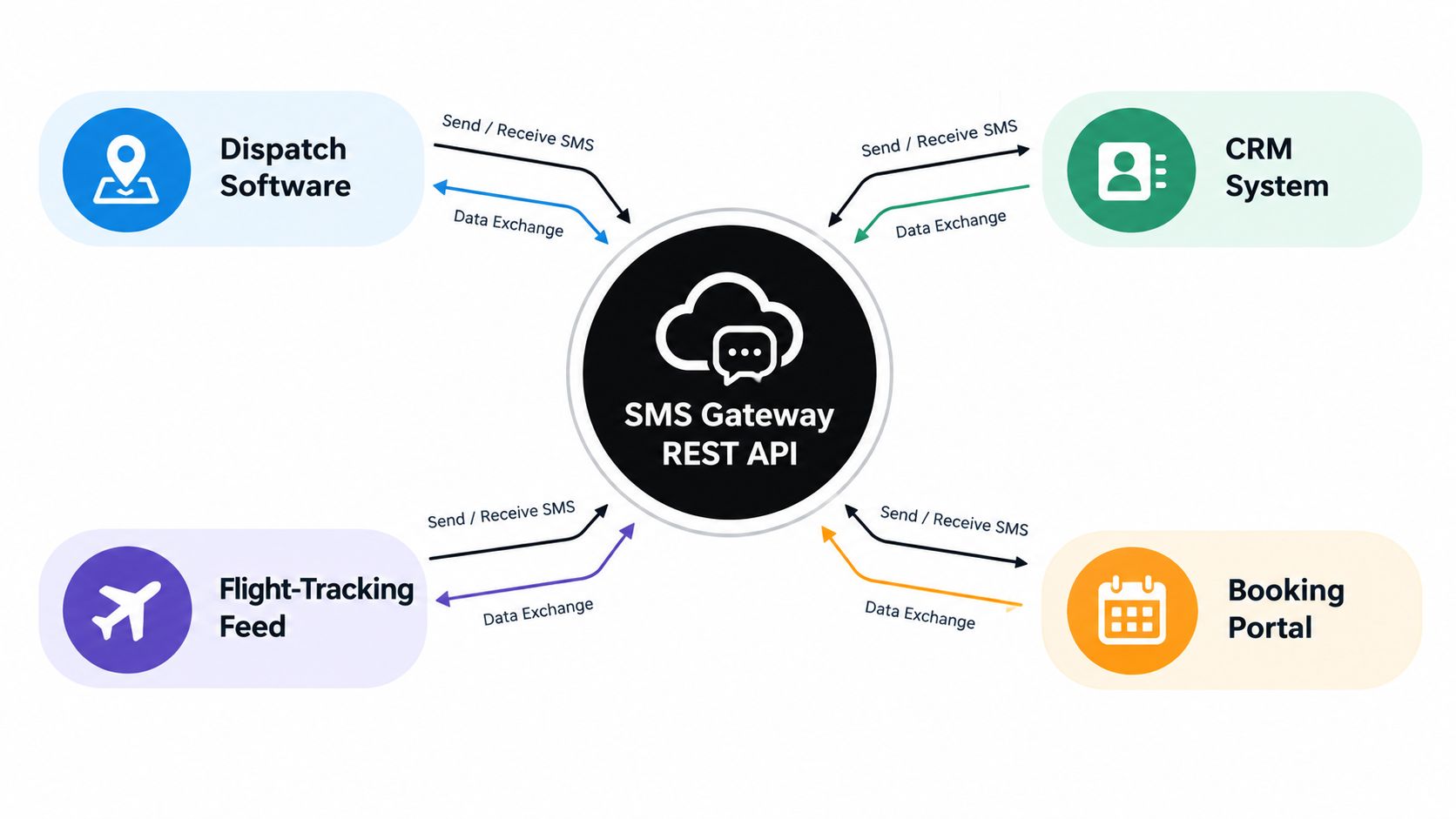
An SMS notification service connects an operational event to a mobile text message. A dispatch platform, flight-tracking feed, booking portal, or CRM creates a trigger. The service formats the message, assigns the approved sender identity, submits it through carrier routes, and returns status information to the originating system.
That sounds straightforward, but the service has several distinct jobs. It must accept messages through an API, queue them during bursts, route them through compliant pathways, receive carrier responses, and expose delivery events through receipts or webhooks. It also needs to process inbound replies and opt-out keywords rather than treating SMS as a one-way pipe.
Email and push notifications remain useful supporting channels. They shouldn't be the only path for a time-critical chauffeur update. Email depends on the recipient opening an inbox, while push depends on an installed application, a functioning token, current operating-system permissions, and notification settings. A driver who can receive a normal text but has muted an application isn't an edge case. It's a predictable operational condition.
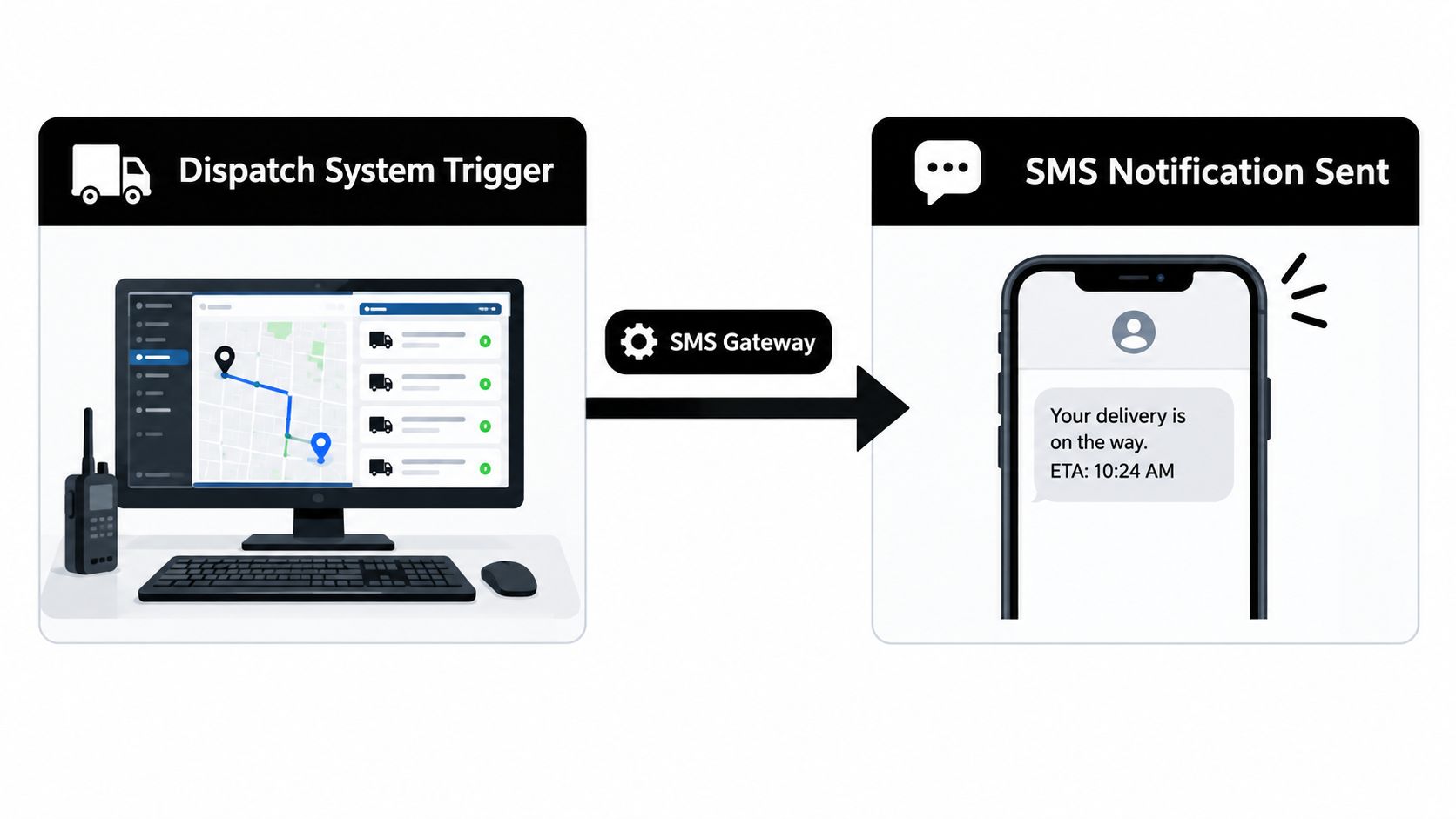
Think of the service as the radio bridge between dispatch and the vehicle. A dispatcher wouldn't leave an urgent change on a desk phone and assume the chauffeur will check it while driving. The digital equivalent needs a direct route, a clear recipient, and a visible acknowledgement.
The components buyers should inspect
- Short-message API endpoints: These receive event data from dispatch or flight systems and return a submission result.
- Sender identity registration: This connects the traffic to an approved brand and use case, especially for U.S. A2P 10DLC messaging.
- Delivery receipts: These distinguish an accepted submission from a carrier-delivered message and, where available, a handset-level event.
- Inbound message handling: This lets a driver reply with a status such as “on scene” and lets the system capture STOP or HELP responses.
- Queue and retry controls: These manage transient failures without duplicating an alert or overwhelming a carrier route.
The buyer's job is to verify that each component appears in an operational dashboard and an integration contract. A green API response alone doesn't prove that the chauffeur received the instruction.
Operational Use Cases in Executive Ground and Private Aviation
The right SMS layer supports event-driven operations, not broad promotional campaigns. Each alert should originate from a defined change in the itinerary, vehicle state, flight status, or passenger handoff.
For ground transport, the first priority is the chauffeur's movement. An ETA recalculation should identify the booking, revised pickup time, location, and required action. A vehicle swap should name the replacement vehicle or chauffeur through the approved operational process. A traffic-driven reroute notice should reach the driver and dispatcher without forcing either person to search through a long thread.
Private aviation adds a second stream of events. Flight watch may need to send an inbound status change, an FBO arrival confirmation, a crew movement ping, a customs update, a slot change, or a gate and tail-number revision. Those messages should be role-specific. A dispatcher may need the full operational context, while a chauffeur needs the pickup instruction and the revised time.
Alert types by operating domain
| Alert Type | Operational Domain | Typical Trigger | Recipient |
|---|---|---|---|
| Chauffeur ETA update | Ground transport | Traffic or route recalculation | Chauffeur, dispatcher |
| Vehicle replacement notice | Ground transport | Vehicle or driver reassignment | Chauffeur, dispatcher |
| Meet-and-greet handoff | Ground transport | Credential or personnel change | Chauffeur, security contact |
| Inbound flight alert | Private aviation | Flight status change | Flight watch, dispatcher |
| FBO arrival confirmation | Private aviation | Updated arrival or ramp instruction | Dispatcher, FBO contact |
| Crew movement alert | Private aviation | Crew check-in or repositioning | Crew coordinator, driver |
| Gate or tail-number update | Private aviation | Aircraft or stand change | Flight department, ground team |
| Principal deplaning confirmation | Cross-modal | Passenger handoff confirmed | Chauffeur, dispatcher |
| Baggage transfer update | Cross-modal | Handler confirms movement | Ground coordinator, dispatcher |
The consequence of each missed alert is operational. A missed ETA can produce a missed pickup. A missed slot or gate change can force the ground team to wait at the wrong location. A missed crew movement can expose the operation to an avoidable aircraft-on-ground disruption.
Build the alert catalog before choosing a vendor. For every event, define the trigger, recipient, message template, acknowledgement path, escalation rule, and audit record. If the vendor can't support that workflow without manual copying, it isn't ready for VIP transport.
Must-Have Features for Time-Critical VIP Alerts
A vendor earns trust through observability, not through a polished send button. The platform should show what happened from the originating system to the carrier and then to the handset, with timestamps that let an operations director identify the delay domain.
Internal processing deserves its own budget. High-performance enterprise systems typically target sub-50 ms API response time and queue processing below 100 ms, including during traffic spikes, according to enterprise SMS delivery platform criteria. Those figures apply to the platform's internal path, not to guaranteed handset delivery. Carrier filtering and routing can still introduce variable delay after submission.
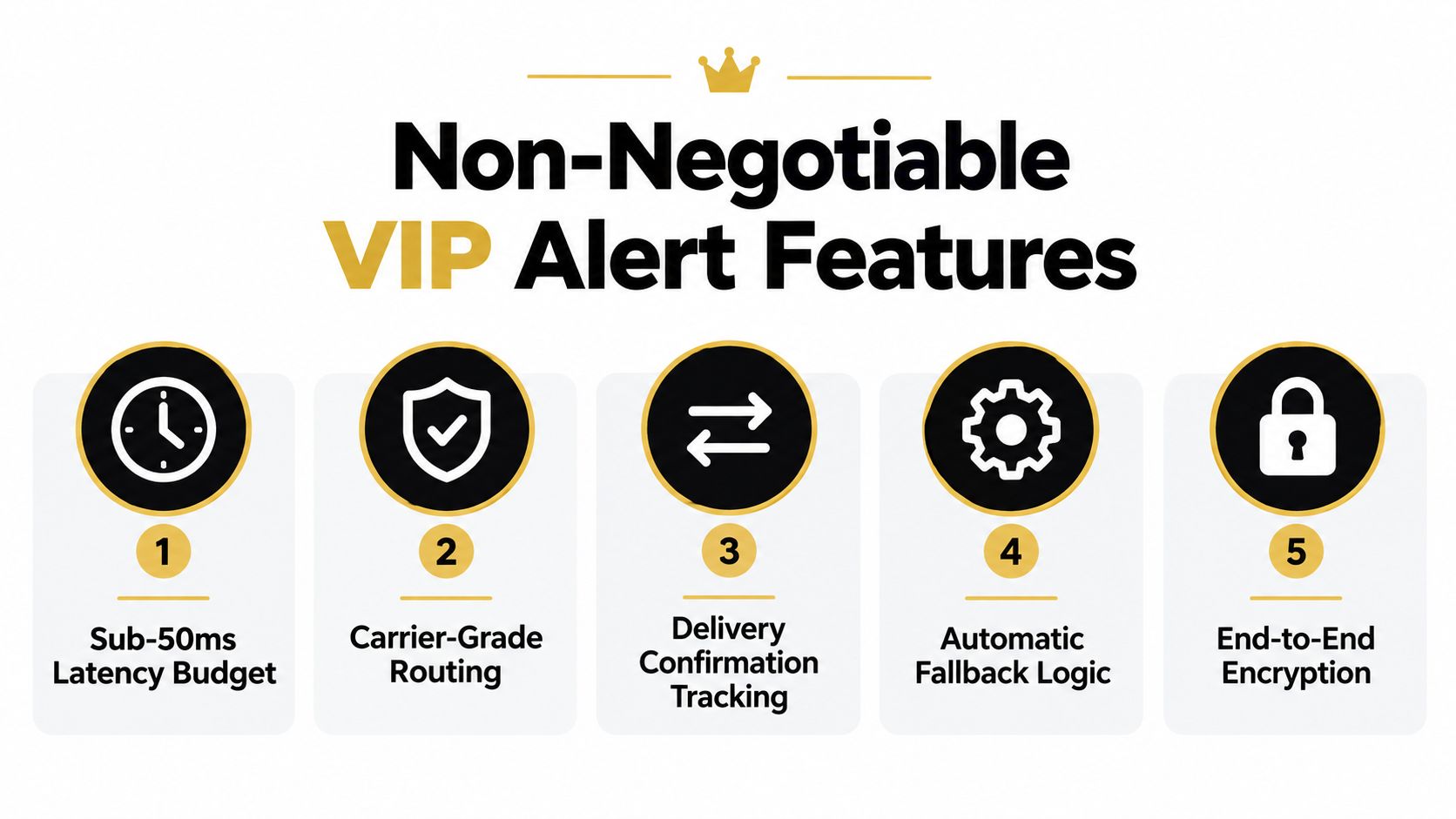
The non-negotiable controls
Latency instrumentation should timestamp trigger creation, API submission, queue entry, carrier acceptance, and delivery status. If a message arrives 30 to 60 seconds late, the team needs to know whether the delay occurred in its own queue or on the carrier route.
Carrier-grade routing matters because a single route doesn't provide consistent performance across every destination. Adaptive routing can select an appropriate path, while rate controls prevent one burst from overwhelming the weakest link.
Delivery confirmation must go beyond “submitted.” A submitted message has entered the vendor's process. A delivery event provides evidence that the downstream network reported success. Where handset-level reporting isn't available, the platform should state that limitation clearly.
Two-way replies turn the alert into a working operational channel. A chauffeur can reply “on scene,” “delayed,” or “vehicle issue,” while dispatch records the response against the booking. Role-based routing prevents a principal from receiving internal driver instructions and keeps crew alerts separate from passenger communications.
Security and access controls protect itinerary details, passenger identity, and movement information. Keep templates concise, expose only the information each recipient needs, and restrict sending rights by role.
Carrier variability across major U.S. networks makes adaptive routing and jitter-aware monitoring practical requirements. The buyer should test the complete path with real recipient devices, not just an API sandbox.
Compliance and Carrier Rules You Cannot Skip
U.S. business messaging over 10-digit long codes now depends on registration and carrier approval. A2P 10DLC means application-to-person traffic sent through standard ten-digit numbers. Carriers evaluate the sending brand, campaign purpose, and message behavior before granting the traffic an approved path.
The process should be owned by operations and compliance together. Don't leave it until a weather event creates a message burst and the carrier starts blocking traffic.
Configure the program in sequence
- Register the brand. Submit the legal business identity and the information required by the messaging provider.
- Describe the campaign. State that the use case covers operational travel alerts, such as booking confirmations, pickup changes, flight coordination, or crew movement.
- Match content to the approved use case. A dispatch template shouldn't suddenly include unrelated promotional content.
- Capture consent during booking. Record who agreed to receive messages, what purpose was disclosed, and which number was provided.
- Route STOP and HELP replies. The CRM or messaging layer must process opt-outs quickly and prevent future sends to the opted-out contact.
Throughput is measured in message segments per second, and the assigned rate depends on sender identity, trust score, campaign type, and carrier policy. Longer messages, emojis, and special characters can consume multiple segments, reducing effective capacity. The A2P 10DLC throughput guidance also makes clear that throughput doesn't guarantee delivery. A carrier can still filter content that violates policy or resembles spam.
Compliance is a delivery control. Registration protects the route, while accurate consent and opt-out handling protect the relationship.
Operations managers should maintain an approval record for every production template. Review sender identity, declared use case, consent language, STOP behavior, and escalation contacts before launch. For broader privacy controls, document how messaging data is retained and accessed alongside the organization's GDPR compliance measures.
Integrating SMS Into Dispatch, CRM, and Booking Workflows
Integration should begin with events, not with message copy. Identify which system owns each truth: the flight tracker owns aircraft status, the dispatch platform owns vehicle assignment, the booking portal owns passenger and itinerary data, and the CRM owns contact preferences and consent.
A REST API is usually the clean starting point for event-triggered messages. High-volume fleet operations may also evaluate SMPP, particularly when they need a persistent connection and direct control over message submission. The choice matters less than the surrounding controls. Every send should carry a booking or event identifier, a recipient role, a template version, and an idempotency key.
Build the event path deliberately
A flight-tracking feed can trigger an arrival change. The gateway receives the event, checks the recipient and consent record, renders the approved template, submits the message, and posts delivery updates back through a webhook. Dispatch then sees the event history in the same operational record as the flight and vehicle assignment.
Use retries carefully. Retry a transient API or queue failure, but don't resend blindly after an uncertain carrier response. The idempotency key should prevent duplicate texts when a source system repeats the same event. A dead-letter queue or exception list should give dispatchers a clear manual recovery path.
Design for message limits
GSM-7 messages use a 160-character limit, while concatenated messages can have a smaller per-segment capacity when additional encoding information is required. Special characters and emojis can therefore increase segment count and reduce effective throughput, as described in A2P messaging guidance. Keep operational templates short enough that the recipient can understand them at a glance.
A practical format is:
- Identity: Company or service name.
- Event: What changed.
- Action: What the recipient must do.
- Time and place: Include the relevant local time zone.
- Reply path: State how the recipient confirms or requests help.
Test the fallback logic before launch. If SMS fails, the system can escalate to a voice call, dispatcher intervention, email, or application notification, depending on the urgency and the recipient role. Real-time transportation visibility should sit alongside, not replace, this alerting path, as shown in real-time transportation visibility workflows.
Choosing a Vendor for Reliable Global Delivery
Vendor selection is an operational risk decision. A low message price is irrelevant if the route changes without notice, the carrier blocks an unregistered campaign, or support responds after the chauffeur has missed the movement window.
Start by understanding the route model. A direct-to-carrier connection may offer tighter control and clearer escalation, while an aggregator can provide broader geographic reach through multiple carrier relationships. Neither model is automatically reliable. The buyer must verify coverage in the markets where clients fly and the countries where chauffeurs, crew, and dispatchers carry phones.
Score the vendor against failure modes
| Criterion | Why It Matters | What to Verify |
|---|---|---|
| Carrier coverage | Local policy and routing affect delivery | Named carrier relationships in active markets |
| Route redundancy | One failed path shouldn't stop alerts | Alternate routes and documented failover behavior |
| Delivery telemetry | Submission isn't proof of delivery | Timestamps, carrier status, and webhook detail |
| A2P 10DLC tooling | Unregistered traffic can be blocked | Brand and campaign registration support |
| Opt-out handling | Delayed suppression creates compliance risk | STOP, HELP, and CRM synchronization |
| Throughput controls | Bursts can trigger throttling | Segment-aware rate limits and queue behavior |
| Support coverage | Incidents don't follow office hours | Named escalation contacts and global support windows |
| Data governance | Travel data requires controlled access | Retention, permissions, and audit documentation |
Ask the vendor to demonstrate a complete test. Trigger an arrival change, confirm the API response, inspect queue timing, view carrier acceptance, verify the handset event, and send a reply from the chauffeur's phone. Then repeat the test under a controlled burst and with a message containing characters that may create extra segments.
Watch for problems that appear after implementation. Silent throttling during busy periods is difficult to detect without queue and delivery trends. Opaque route changes make performance comparisons impossible. Time-zone-naive support windows leave overnight operations without an escalation path.
Buyer's test: If the provider can't explain where a delayed message paused, it can't manage the risk professionally.
Tie each requirement to an operational measure. Carrier coverage affects message survival through filtering. Routing and queue design affect time-to-alert. Two-way messaging affects pickup confirmation. Escalation support affects recovery time. Put those obligations into a documented service-level agreement with clear ownership and evidence requirements.
KPIs and Templates That Keep VIP Notifications on Track
Measurement should answer one question: did the right person receive and act on the right alert in time? Four indicators provide a useful operating view.
Delivery rate shows how often messages receive a downstream delivery status. It shouldn't be confused with API acceptance. Time-to-alert measures the interval from the source event to the handset delivery event. Pickup or gate-change confirmation rate shows whether recipients acknowledge the operational instruction. Opt-out rate acts as a compliance and message-quality signal, especially when it rises after a template or workflow change.
For time-critical traffic, set 99% delivery and sub-10-second time-to-alert as the floor for internal operating targets, not as assumptions about universal carrier performance. These are management benchmarks for the operation, not statistics that a vendor can guarantee without qualification. Track them by carrier, country, sender identity, alert type, recipient role, and time zone.
Keep templates readable under pressure
A chauffeur reading at a roadside stop needs a message that can be understood immediately.
- Identify the sender: Use a recognizable company or operation name.
- Give one action: Tell the recipient to reposition, confirm, call, or wait.
- State local timing: Include the time zone when the trip crosses regions.
- Avoid decorative content: Remove emojis, unnecessary links, and long explanations from urgent alerts.
- Provide a reply path: Make “on scene” or “unable” an explicit operational response.
- Keep opt-out language consistent: Apply the approved STOP process to the relevant message program.
Review the dashboard monthly. A rise in segment count can reveal deteriorating templates. A carrier-specific delivery change can indicate routing or registration trouble. A fall in confirmation rate can show that the alert reaches the handset but lacks a clear action.
MLR Worldwide Service provides executive chauffeur transportation, airport and FBO support, corporate roadshow logistics, VIP secure transport, and airline crew movement coordination, with a 24/7 operations team for last-minute bookings and itinerary changes. Visit MLR Worldwide Service to discuss how its ground operations can support the air-to-ground handoffs that your notification workflows must protect.