

A travel manager is reviewing three chauffeur quotes for the same executive airport transfer. One vendor quotes a flat amount, another prices by the hour, and a third shows a low mileage rate with separate airport, gratuity, and waiting charges. All three appear reasonable until the invoices arrive and the “cheapest” option produces the highest effective cost per mile.
That problem is common because executive transportation isn't priced like a simple fleet fuel calculation. The vehicle may travel empty before pickup, wait beside an aircraft, pass through an FBO with access charges, or make several unplanned stops. A credible cost per mile comparison must account for the complete trip economics, not just the distance shown on a routing app.
For context, published vehicle benchmarks also vary sharply by use case. The IRS 2026 business standard mileage rate is 72.5 cents per mile, while AAA's 2025 figures put a small sedan at 55.87 cents per mile, a medium sedan at 66.37 cents per mile, and a half-ton pickup at 98.54 cents per mile. Those figures describe vehicle ownership and operation, not chauffeur invoices, but they demonstrate why the denominator and assumptions matter.
Why Executive Cost per Mile Comparison Is Harder Than It Looks
A travel manager benchmarking a CEO's quarterly board visit may receive three completely different pricing structures for what appears to be one identical trip. One provider may quote a fixed airport transfer, another may apply a minimum hourly booking, and a third may show a mileage rate before adding waiting time, tolls, gratuity, and airport charges.
The first issue is that chauffeur companies often quote against trip totals, booked hours, service zones, or vehicle classes, not a universally published mileage rate. A sedan, premium SUV, and executive van may each carry a different service tier, with the price reflecting capacity, luggage, interior specification, chauffeur assignment, and availability. The mileage line alone rarely describes the service being purchased.
The quote usually describes only the visible portion
A headline figure may exclude or separately list:
- FBO pickup rules, including escort or ramp-access charges
- Meet-and-greet fees, especially at airports and private terminals
- Per-stop charges for roadshows, client visits, or split itineraries
- Airport surcharges, parking, and terminal access costs
- Deadhead mileage, where the vehicle travels to or from the pickup without a passenger
- Wait time, including grace periods and billing increments
Corporate-account pricing, agency bookings, and direct retail rates can also diverge. A negotiated corporate account may receive a different minimum, while an agency booking may carry a booking-channel markup or a separate service fee. Even within the same metro area, operators can apply different airport surcharges and deadhead policies.
Procurement rule: If two quotes don't define the same mileage, time, vehicle, and surcharge assumptions, they aren't comparable yet.
The solution is to normalize the inputs before judging the rate. Confirm the passenger miles, repositioning policy, booked time, vehicle class, stop count, gratuity treatment, toll handling, airport or FBO fees, and cancellation terms. Once those items are visible, the apparent price gap usually becomes easier to explain.
The rest of the analysis should use one formula, one trip definition, and one treatment for every quote. That lets a travel manager compare vendors like-for-like and defend the resulting spend internally instead of relying on a low headline number.
The True Cost per Mile Formula for Ground Transport
For executive chauffeur procurement, the practical formula is:
Cost per mile = total client-billed trip cost ÷ revenue miles billed to the client
“Revenue miles” means the passenger or service miles the vendor bills to the client. Operator deadhead belongs in the numerator only when the vendor passes it through as a charge. If the provider absorbs repositioning, the mileage denominator should not include it, because doing so would make one vendor's rate look artificially lower than another's.
Build the numerator completely
The numerator should include every cost attached to delivering the trip:
- Base fare, whether quoted by mile, hour, zone, or flat trip
- Time charges, including booked service time and excess wait
- Fuel surcharge, if applied as a percentage or mileage add-on
- Gratuity, whether included or added after the quote
- Tolls and parking
- Airport, terminal, or FBO fees
- Meet-and-greet charges
- Additional stops or address changes
- After-hours, holiday, or special-event premiums
- Booking-channel or agency markup
Ask the dispatcher or account manager a direct question: “Is this total all-in, or will fuel, tolls, parking, gratuity, and terminal charges be added later?” Don't accept “usually included” as a pricing definition. A quote needs a written treatment for each item.
| Component | Treatment in Formula | Example Value |
|---|---|---|
| Base fare | Add to total trip cost | Vendor's quoted amount |
| Passenger mileage | Use as revenue-mile denominator | Confirmed route miles |
| Deadhead | Add only if passed through | Vendor's stated repositioning charge |
| Wait time | Add billed waiting or hourly extension | Confirm grace period and increment |
| Tolls and parking | Add actual, estimated, or capped amount | Written pass-through policy |
| FBO and airport fees | Add separately unless explicitly included | Terminal-specific fee schedule |
| Gratuity | Add if not included | Confirm whether calculated before or after fees |
| Stops | Add per-stop charges | Contracted stop schedule |
| Vehicle uplift | Reflect in base or class-specific quote | Sedan, SUV, van, or specialty vehicle |
Apply the formula identically to every vendor. If a quote covers 24 passenger miles but includes a separate repositioning charge, add that charge to the numerator while keeping the denominator tied to the agreed revenue miles. If the vendor gives an all-in flat amount, divide that full amount by the same revenue-mile estimate.
For annual benchmarking, multiply the normalized rate by expected annual mileage. That creates a consistent planning basis, although actual executive travel should still be reviewed by trip type because short transfers, roadshows, and FBO movements behave very differently.
Hidden Cost Drivers Most Comparisons Miss
The most damaging pricing errors occur when the buyer compares a visible rate against an incomplete invoice. The following items deserve a written answer in every RFP response.
Deadhead changes the economics
Suburban pickups, private aviation terminals, and one-way airport transfers often require a vehicle to travel empty before or after the passenger trip. Deadhead can represent 15% to 40% of billed miles on those runs, depending on the market and operating policy. Some operators bill it one way, some use a round-trip assumption, and others incorporate it into a minimum fare.
A low passenger-mile rate can therefore conceal a significant repositioning charge. Ask whether the vendor calculates deadhead from the vehicle's dispatch point, the chauffeur's home base, a garage, or a defined service area.
Waiting time rewards disciplined itineraries
Many services offer a 15-minute grace period, then bill waiting at approximately 1.5 times to 2 times the hourly rate. A delayed flight, slow baggage retrieval, or roadshow meeting that runs long can turn a short transfer into a costly time-based trip.
Tolls and congestion pricing also need a clear treatment. Urban legs commonly carry $8 to $25 in tolls, while airport and FBO charges can include a $5 to $15 pickup surcharge, $25 to $75 for FBO escort or ramp access, and parking. These amounts should appear as separate lines, not disappear inside an unexplained adjustment.
Small itinerary changes create large invoice differences
Additional addresses may cost $10 to $25 per stop. Split trips can trigger a second minimum, a vehicle release and re-dispatch charge, or a full-day hourly conversion. Vehicle class matters too. An SUV may price at roughly 1.3 to 1.5 times a sedan, while a Sprinter can reach approximately 1.8 to 2.5 times the sedan rate.
After-hours and holiday service commonly adds 20% to 50%. Fuel surcharges may be percentage-based or fluctuate as a per-mile add-on, so the contract should state the calculation method rather than naming the surcharge.
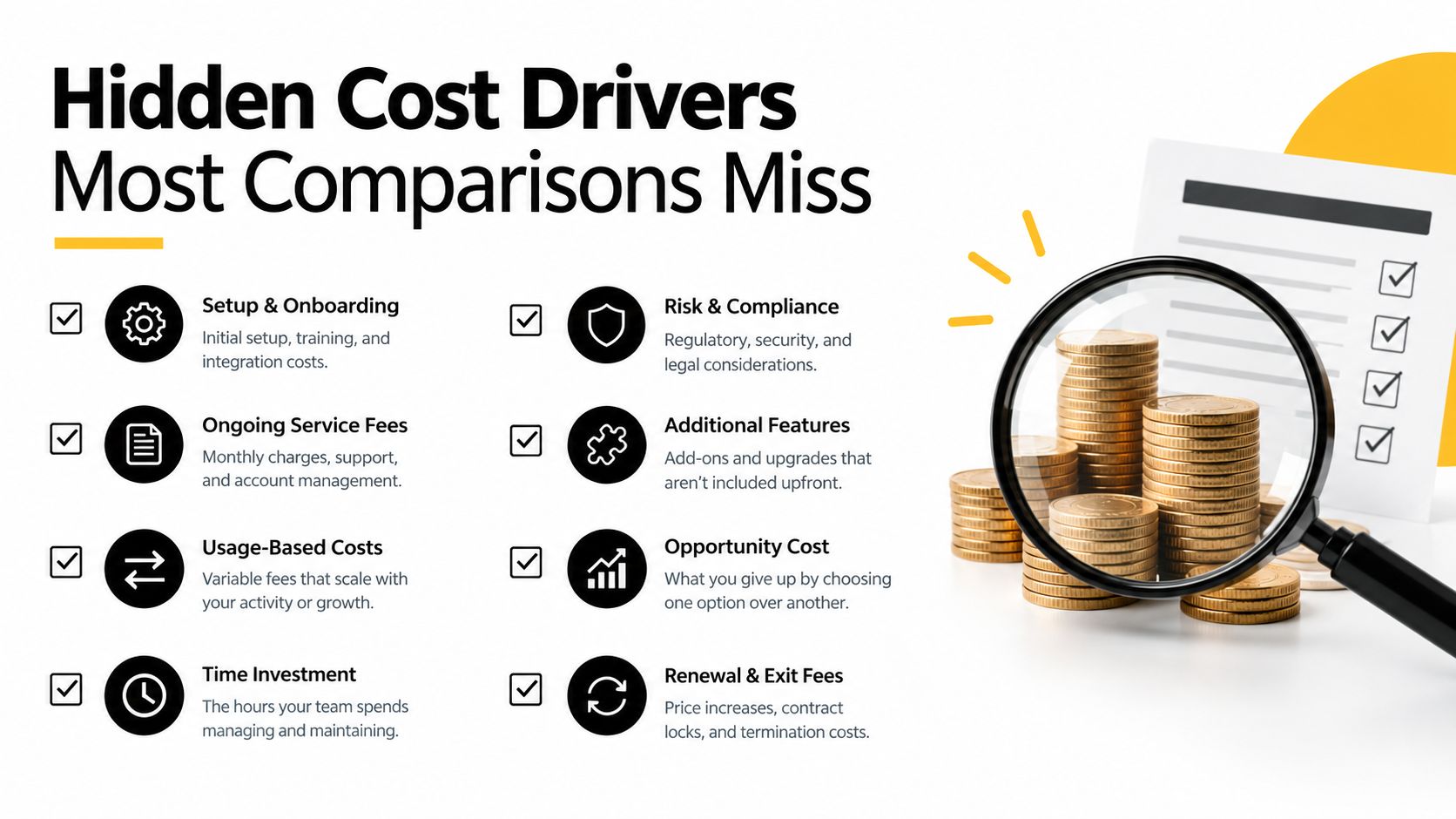
Use a checklist when reviewing every quote:
- Deadhead policy: Is repositioning absorbed, billed one way, or billed round trip?
- Wait terms: What is the grace period, hourly rate, and billing increment?
- Terminal access: Are airport, FBO, escort, ramp, and parking fees included?
- Stops: What counts as a stop, and what does each added address cost?
- Vehicle substitution: What happens if the reserved class is unavailable?
- Gratuity: Is it included, optional, or automatically added?
- Timing premiums: Which hours, holidays, and events trigger an uplift?
- Invoice evidence: Will the vendor provide trip time, GPS miles, toll records, and fee detail?
Fleet condition also affects operational risk, so procurement teams can use fleet maintenance best practices as a separate review point. A low rate doesn't compensate for substitutions, avoidable delays, or inconsistent vehicle presentation.
Scenario Calculations Across Three Trip Types
The same formula produces very different results when the trip includes waiting, repositioning, or terminal access. The examples below use illustrative values only, so the method can be reproduced on an invoice without treating the figures as market benchmarks.
Airport transfer
Assume a 24-mile point-to-point airport transfer. The client receives 20 minutes of meet-and-greet, and the vendor quotes the following:
- Base transfer: $180
- Meet-and-greet: $35
- Deadhead passed through: $60
- Airport fee: $10
- Gratuity: $55
- Tolls and parking: $15
Total trip cost is $355. Dividing $355 by 24 revenue miles produces a normalized cost per mile of $14.79.
The passenger sees a short route, but the supplier is charging for service readiness, airport access, and repositioning. Comparing this invoice with a vendor quoting only the base transfer would produce a false conclusion.
Multi-stop roadshow
Now assume three client visits across 48 miles, with 90 minutes of curbside wait:
- Base roadshow service: $420
- Wait time: $225
- Tolls and congestion charges: $30
- Three additional stops: $60
- Gratuity: $110
The total is $845. Divided by 48 revenue miles, the normalized cost per mile is $17.60.
The roadshow demonstrates why an hourly meter isn't automatically expensive. If the itinerary includes long periods of vehicle retention, an hourly structure may be easier to forecast than a mileage quote with repeated waiting and stop charges. The buyer should model both methods against the same schedule.
Crew movement with FBO access
For a two-passenger crew movement with four checked bags, assume 35 miles of deadhead repositioning and these charges:
- Passenger movement base: $240
- FBO escort and access: $50
- Parking: $20
- Deadhead repositioning: $140
- Baggage handling: $40
- Gratuity: $80
- Tolls: $12
Total cost is $582. If the client-facing route is 35 revenue miles, the normalized cost per mile is $16.63.
| Line Item | Airport Transfer | Roadshow | Crew Movement |
|---|---|---|---|
| Revenue miles | 24 | 48 | 35 |
| Base service | $180 | $420 | $240 |
| Waiting or meet-and-greet | $35 | $225 | $0 |
| Deadhead | $60 | $0 | $140 |
| Access, tolls, parking, or stops | $25 | $90 | $122 |
| Gratuity and handling | $55 | $110 | $80 |
| Total trip cost | $355 | $845 | $582 |
| Normalized cost per mile | $14.79 | $17.60 | $16.63 |
The pattern is clear. Distance alone doesn't explain the invoice. Waiting, deadhead, and access requirements can dominate the result even when the passenger route is straightforward.
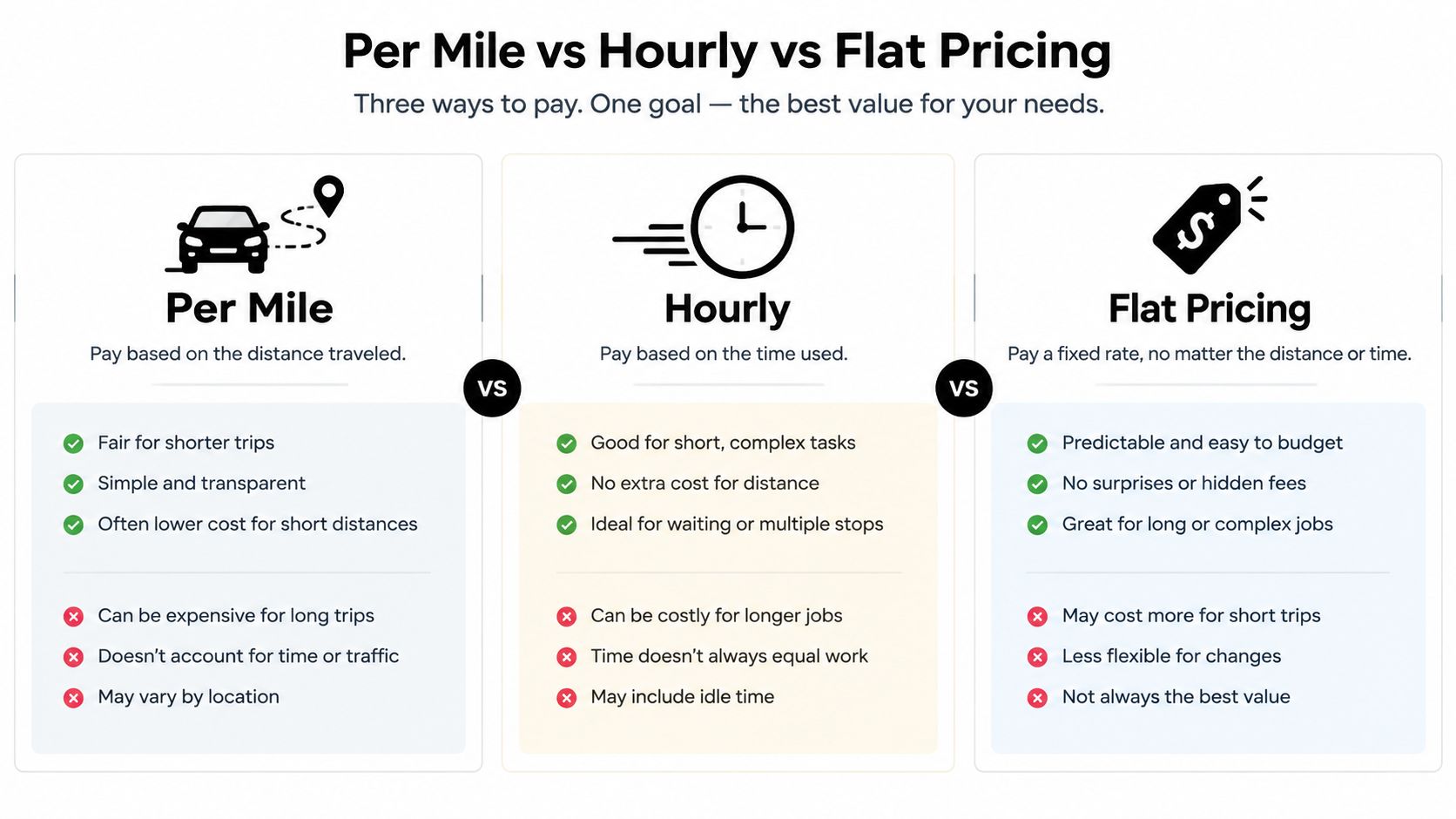
Per Mile vs Hourly vs Flat Pricing
Per-mile pricing works best when the route is long, predictable, and unlikely to require extended standby. A highway transfer with one pickup and one drop-off gives the buyer a clean distance basis. It becomes less attractive when the provider imposes a minimum-hour trigger, because a short airport transfer can inherit a large time charge.
Hourly pricing absorbs more of the operational uncertainty. The client pays for vehicle availability, so deadhead and waiting are easier to incorporate into one planned block. That structure can cost less when traffic doubles the drive time or when an executive needs the chauffeur to remain curbside between meetings. It can cost more when the vehicle is booked for a long period but spends most of that time unused.
Flat pricing is attractive for a simple, point-to-point itinerary. The buyer gets budget certainty and doesn't need to debate every mile. The risk appears on multi-stop days. A flat quote may exclude idle time, additional addresses, parking, FBO access, or a return leg.
Contract details decide which model wins
Before approving any structure, document:
- Minimums: State the minimum hours, miles, or fare.
- Rounding: Specify whether time rounds to a quarter hour, half hour, or another increment.
- Grace period: Define when waiting begins and how the dispatcher records it.
- After-hours rules: Identify the exact conditions that trigger a premium.
- Stop treatment: Cap included stops or state the added-address charge.
- Audit rights: Require trip records that reconcile scheduled and actual service.
For an hourly agreement, add language such as: “Vendor will provide a per-mile audit showing GPS-tracked route miles, deadhead miles, wait time, tolls, parking, and all access fees for each trip.” For a flat quote, request: “The price includes the stated vehicle, route, stops, waiting allowance, toll treatment, gratuity, and airport or FBO charges, with additional costs limited to the listed exceptions.”
A useful rule of thumb is simple. Choose per mile for predictable long runs, hourly when wait and vehicle retention are central, and flat pricing for uncomplicated point-to-point work with known access conditions. If the itinerary has several stops or an uncertain wait ratio, don't approve a flat number until the exceptions are written down. Guidance on comparing chauffeur service prices is useful only when the quote definitions match.
Procurement Questions That Surface the Real Numbers
A strong RFP forces the vendor to expose the invoice before the first trip. Ask questions in four blocks, then score every response against the same template.
Pricing and minimums
Request the base rate by vehicle class, the mileage or hourly minimum, the billing increment, and the treatment of partial hours. Ask whether the vendor calculates miles from the garage, dispatch point, pickup location, or the route shown in its trip-management system.
Require a sample invoice for a sedan airport transfer, an SUV roadshow, and an FBO movement. A sample invoice reveals more than a rate sheet because it shows how the provider labels fees and whether gratuity is embedded or added later.
Surcharges and operational exceptions
Put these questions in writing:
- Deadhead: When is repositioning billed, and how is it measured?
- Waiting: How long is the grace period, and what increment follows?
- Access: Which airport, FBO, escort, ramp, and parking fees pass through?
- Tolls: Are tolls billed at cost, estimated, marked up, or capped?
- Fuel: What triggers the surcharge, and how does the methodology change?
- Gratuity: Is it included, optional, or automatically calculated?
- Stops: How many addresses are included in each quote?
- Substitution: What vehicle age, class, and replacement rules apply?
Service levels and reporting
Ask how the vendor handles flight tracking, late aircraft, chauffeur substitution, vehicle cleanliness, and last-minute itinerary changes. Require a documented escalation path, not just a general operations phone number.
For reconciliation, request GPS-tracked trip data showing scheduled pickup, actual arrival, passenger miles, total route miles, wait time, stops, tolls, parking, and access fees. A vendor that can't produce usable trip records makes a reliable cost per mile comparison difficult.
Travel managers reviewing the broader business travel expenses should also define how ground transportation data enters the expense workflow.
Score each vendor on price clarity, surcharge disclosure, service-level commitments, vehicle compliance, reporting quality, and exception handling. Require every RFP response to include the rate card, fee schedule, service-level agreement, sample invoices, vehicle list, insurance documentation, cancellation terms, and reporting specification. The lowest quoted rate should not win if the supplier leaves the most cost variables unresolved.
Matching Pricing Models to Each Travel Persona
Different travelers create different cost patterns. The right model follows the itinerary, not the client's title.
| Persona | Dominant Trip Pattern | Recommended Pricing Model | Top Cost Drivers to Audit | Fallback Model |
|---|---|---|---|---|
| Corporate executives | Airport transfers, meetings, occasional standby | Flat for simple transfers, hourly for retained vehicles | Airport fees, wait time, vehicle class, gratuity | Per mile for predictable long routes |
| HNW private clients | Customized transfers, FBO service, itinerary changes | Hourly for discretion and availability | Deadhead, FBO access, waiting, last-minute changes | Flat for fixed point-to-point movements |
| FBO coordinators | Flight-linked arrivals, crew and passenger movements | Flat with written access terms | Ramp access, parking, flight delays, baggage handling | Hourly for uncertain aircraft schedules |
| Corporate travel managers | Repeated trips across markets and service types | Hybrid contract with standardized rules | Minimums, deadhead, reporting, substitutions, markups | Flat rate cards by route and vehicle |
Corporate executives
Use flat pricing for a straightforward airport or office transfer when the route and vehicle are stable. Move to hourly pricing when the executive needs the chauffeur retained between meetings. The protection is a written inclusions schedule covering wait, stops, tolls, gratuity, and airport charges.
HNW private clients
Hourly pricing is usually the safer default when privacy, flexibility, and vehicle availability matter more than a narrow distance calculation. The fallback is a flat quote for a fixed itinerary, but it should state the change policy, standby treatment, and FBO access rules before confirmation.
FBO coordinators
Choose a flat movement price when the flight schedule, passenger count, bags, and terminal access requirements are known. Use hourly pricing when the aircraft timing is uncertain or the chauffeur must remain available. Deadhead and access fees deserve separate approval because they can overwhelm a short passenger route.
Corporate travel managers
A hybrid agreement usually works best. Standardize flat route rates for recurring transfers, hourly blocks for roadshows, and an audit clause for every invoice. Require GPS and fee reporting so the program can compare actual trips across cities instead of trusting inconsistent vendor terminology.
The one-minute triage rule is straightforward. Few miles and no waiting usually favor flat pricing. Several stops or meaningful standby favor hourly pricing. Long, predictable routes with little operational uncertainty favor per-mile pricing. If the itinerary doesn't fit cleanly into one category, use a hybrid structure and require the vendor to show the normalized cost per mile.
MLR Worldwide Service coordinates executive chauffeur service, airport transfers, FBO support, roadshows, event logistics, VIP transport, and airline crew movements through a 24/7 concierge operations team. To compare an upcoming program with clearly defined vehicle, mileage, operating-time, and access-fee assumptions, visit MLR Worldwide Service.