

A chauffeur booking advertised at $65 an hour can become a $390 invoice once a three-hour minimum and empty repositioning are applied. That's the central problem with comparing chauffeur service prices: the visible rate often describes only the vehicle and driving time, not the minimum billable window, waiting, airport access, tolls, gratuity, or the chauffeur's return trip.
For executives, family offices, private aviation teams, and corporate travel managers, the right question isn't “What's your hourly rate?” It's “What will this complete itinerary cost, and what conditions can increase it?” The sections below focus on that total-cost question, because a low published rate can be the most expensive choice when the booking structure doesn't fit the trip.
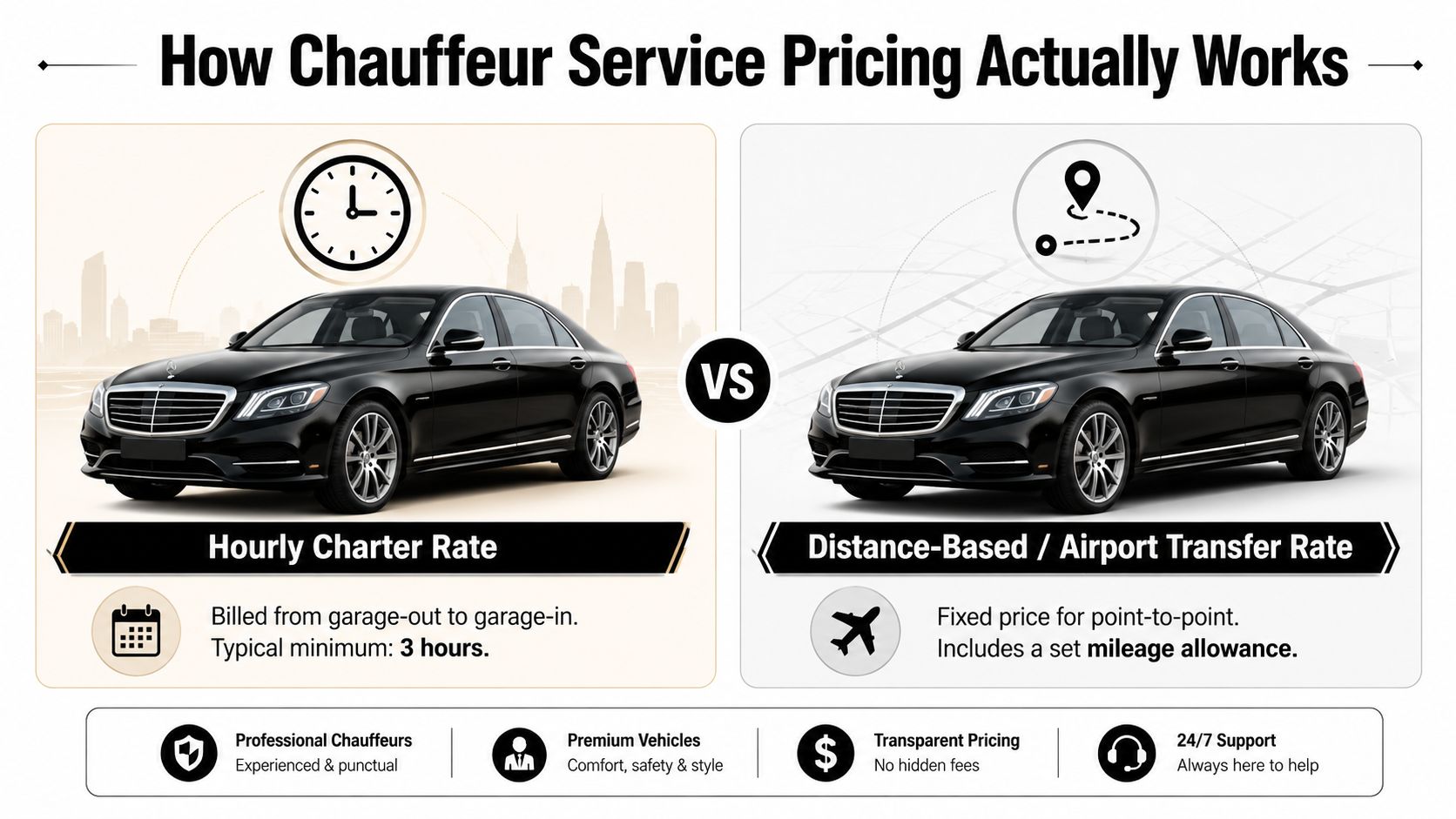
How Chauffeur Service Pricing Actually Works
A travel manager arranging a Gulfstream FBO pickup for four executives usually has two practical quote formats to evaluate. The first is an hourly charter, where the provider reserves the vehicle and chauffeur for a defined service window. The second is a point-to-point transfer, where the operator quotes a flat fee between a stated origin and destination.
Hourly charter pricing generally follows the vehicle from garage-out to garage-in. That can include the drive to the pickup location, the passenger itinerary, waiting between stops, and the chauffeur's return or repositioning. Providers often attach minimum booking requirements, so a brief airport transfer may be billed for several hours even when the passengers are in the vehicle for much less time. The executive chauffeur service guide is useful background when comparing how operators define service scope and quote inclusions.
Point-to-point pricing works differently. The provider prices the route, operating conditions, vehicle class, and expected mileage as one transfer. This model often makes more sense for a predictable airport or FBO journey because you're buying the movement, not an open block of chauffeur availability.
Why the minimum matters
A $65 hourly quote sounds attractive until the operator applies a three-hour minimum and charges for deadhead miles, meaning the distance the chauffeur drives empty to reach you or leave the assignment. The resulting bill can reach $390, even though the passenger's actual ride may last less than an hour. That isn't necessarily an unreasonable charge for reserving a professional vehicle and driver, but it's a poor comparison if you're judging the service against a flat airport-transfer quote.
Use this rule before accepting any rate:
Practical rule: Compare the all-in price for the itinerary, not the hourly figure printed at the top of the quote.
For a 45-minute FBO run, request both formats. Ask for the flat transfer price and the hourly price after minimums, deadhead, wait provisions, and access fees. Choose the structure that matches the itinerary, not the one with the more impressive headline.
The Four Cost Drivers Behind Every Quote
Every chauffeur quote reflects four variables: vehicle, time, distance, and market. Providers may display them as one bundled price, but each still affects the final number.
Vehicle class creates the first major separation. A sedan for one executive costs less than a van with conference seating, while an SUV may carry more luggage and passengers without requiring the capacity of a Sprinter. Time then determines whether you're purchasing a transfer or reserving a chauffeur for standby. A short, fixed route can suit a flat fee, but a schedule with meetings, security holds, and uncertain departure times requires paid availability.
Distance affects fuel, toll exposure, repositioning, and the operator's ability to place the vehicle on another assignment. Market conditions matter just as much. A major business center typically carries higher operating costs than a secondary market, while airport congestion and limited curb access can make a seemingly short route operationally demanding.
The published 2026 pricing guides cited in the brief place executive luxury sedans around $175 to $185 per hour, premium luxury SUVs around $155 to $165, executive Sprinter vans around $185 to $195, and luxury minibuses or coaches around $200 to $350 per hour. These are guide ranges, not universal tariffs, and the quote still depends on minimums, itinerary design, and local charges. See the 2026 professional chauffeur cost guide for the cited vehicle-tier benchmarks.
How each cost driver moves the quote
| Cost Driver | Typical Impact | 2026 Example |
|---|---|---|
| Vehicle class | Changes the base rate, passenger capacity, luggage space, and service tier | Luxury sedans, SUVs, Sprinters, and coaches occupy distinct hourly bands in current industry guides |
| Time | Adds minimum-hour billing, standby, wait time, and overtime exposure | A brief transfer can cost more than expected if the operator bills a multi-hour minimum |
| Distance and route | Influences mileage, tolls, parking, deadhead, and repositioning | A fixed airport route may price differently from an open-ended charter |
| Market and operating conditions | Reflects local labor, insurance, congestion, airport access, and demand | New York and Chicago daily service has been listed around $600 per day, while several Florida markets have shown roughly $35 to $40 per hour and $390 to $420 per day in public pricing snapshots, as documented by Thumbtack's chauffeur pricing reference |
Peak travel periods and congested schedules can push the quote higher, but don't assume a surcharge without asking for the trigger. A provider should identify whether the increase comes from demand, after-hours service, airport access, or a longer reserved window.
Vehicle Tiers and Their 2026 Price Bands
The correct vehicle isn't the most luxurious one available. It's the vehicle that protects the itinerary without charging you for capacity you won't use.
A current 2026 industry guide places executive luxury sedans at approximately $175 to $185 per hour, premium luxury SUVs at $155 to $165 per hour, executive Sprinter vans at $185 to $195 per hour, and luxury minibuses or coaches at $200 to $350 per hour. New York market guides show a broader structure, with standard sedans around $35 to $55 per hour, luxury sedans around $75 to $150, SUVs around $100 to $200, and stretch limousines around $100 to $300 or more, according to the same professional chauffeur pricing guide.
Those ranges show why vehicle comparisons must include the service tier. A basic sedan may be appropriate for one traveler with limited luggage, while an SUV can be more practical for a small executive delegation leaving an FBO with cases and equipment. For larger groups, a Sprinter can keep passengers together and reduce the need for multiple cars.
2026 vehicle tier price bands
| Vehicle Tier | Hourly Range | Point-to-Point Range | Best For |
|---|---|---|---|
| Executive sedan | $175 to $185 in current industry guides | Quote varies by route and market | Solo executives, small delegations, light luggage |
| Premium SUV | $155 to $165 in current industry guides | Quote varies by route and market | Small groups, FBO pickups, heavier luggage |
| Executive Sprinter van | $185 to $195 in current industry guides | Quote varies by route and market | Corporate roadshows and group movements |
| Luxury minibus or coach | $200 to $350 in current industry guides | Quote varies by route and market | Larger groups, events, and coordinated transfers |
Don't assume a larger vehicle always costs more per passenger. If four or more travelers would otherwise need multiple sedans, a group vehicle can improve coordination and reduce duplicated minimums. Review the operational differences between conventional and lower-emission fleets in this guide to eco-friendly chauffeur vehicles before requesting a premium vehicle category.
Sample Pricing Scenarios You Can Plan Against
The most useful quote is a line-item estimate tied to a real itinerary. Generic hourly pricing doesn't show how the invoice behaves when a flight arrives early, a meeting runs late, or a chauffeur waits at an FBO.
Scenario one, a short New York airport transfer
A sedan transfer from Manhattan to JFK has been publicly shown around $135, within a listed market band of $130 to $185. A fixed route can be economical when the pickup and drop-off are clear, but an hourly booking may trigger a three-hour minimum, early-morning provisions, tolls, and gratuity. The decision that controls cost is the booking model. Request a flat transfer quote first when the trip is point-to-point. The relevant New York chauffeur price index illustrates the difference between flat sedan transfers and hourly benchmarks.
Scenario two, a multi-stop roadshow
A four-meeting roadshow across two cities is not a mileage problem first. It's a vehicle-availability problem. The SUV remains reserved while executives move through meetings, so idle time can exceed driving time. An hourly charter normally fits better than repeated transfers because the team avoids ordering a new car for each leg, but the quote must state the full service window, parking treatment, toll handling, and overtime rule.
Scenario three, an FBO holding assignment
A family office reserving a Sprinter at Teterboro for 8 hours is paying for controlled availability, not just the miles driven. Security-trained chauffeur requirements, FBO access, parking, after-hours return, and a larger vehicle can all change the invoice. A shorter confirmed window or smaller SUV could reduce the cost if the passengers don't need onboard space and the aircraft schedule is firm.
| Scenario | Vehicle | Hours Billed | Key Cost Driver | Approx. Total |
|---|---|---|---|---|
| New York airport transfer | Executive sedan | Minimum may apply | Flat route versus hourly minimum | Request an itemized quote |
| Multi-stop roadshow | Premium SUV | Full reserved window | Idle time and schedule uncertainty | Depends on itinerary |
| Teterboro FBO hold | Executive Sprinter | 8 hours | Standby, security, FBO, and after-hours terms | Depends on provider terms |
These are planning scenarios, not invented invoice totals. The only defensible total comes from the provider's written quote after it receives the route, passenger count, luggage requirements, pickup time, and waiting instructions.
Hidden Fees That Change Your Final Bill
Published chauffeur service prices rarely tell you what the invoice includes. The largest surprises usually come from time rules and access conditions, not from the vehicle itself.
Wait time is the first place to look. After a stated grace period, operators may bill waiting in 15-minute increments. That matters at airports and FBOs, where baggage, aircraft servicing, security procedures, and passenger coordination can delay curb departure. Ask whether the clock starts at scheduled pickup, actual arrival, or the end of the included grace period.
FBO and airport facility fees can also appear separately. The brief identifies examples ranging from $15 to $75 per stop, while after-hours premiums commonly sit at 15% to 25% above the base rate. Tolls, parking, congestion-zone charges, and administrative fees may pass through at cost or with a markup, so a route comparison that excludes them isn't complete.
The invoice lines to confirm
- Wait time: Confirm the grace period, billing increments, and whether flight tracking changes the waiting rule.
- Airport and FBO access: Ask whether facility, staging, or permit charges are included in the transfer price.
- After-hours service: Identify the time window that activates the premium and whether it applies to the full booking.
- Road costs: Clarify tolls, parking, congestion charges, fuel treatment, and administrative markups.
- Gratuity: Verify whether gratuity is included, optional, or added automatically. Some pricing guidance describes gratuity around 18% to 20%, while other arrangements may use a different policy.
- Special requirements: Security-trained chauffeurs, child seats, meet-and-greet signage, extra stops, and additional luggage handling may each create a separate line item.
The booking-minimum trap deserves special attention. A two- or three-hour minimum applied to a 35-minute airport run can make the effective hourly cost several times higher than the advertised rate. That's why short point-to-point transfers are often the worst place to compare hourly prices.
How to Estimate and Manage Your Total Cost
Use a simple estimate before you ask a provider to quote. Start with the posted hourly rate, multiply it by the greater of the booking minimum or actual service window, then add the charges the itinerary is likely to create.
Base cost = hourly rate × the greater of the booking minimum or service window
Then add expected wait time, tolls, parking, fuel or mileage charges, gratuity, FBO fees, and after-hours premiums. Don't use the formula to produce false precision. Use it to expose which assumptions the provider must confirm.
A pre-booking checklist
- Confirm the minimum: Ask whether the assignment has a two-hour, three-hour, or longer minimum, and whether deadhead time counts.
- Define the service window: State when the chauffeur must arrive, when the final stop ends, and whether return positioning is included.
- Request all-in pricing: Have the operator separate base fare, access fees, tolls, parking, wait time, gratuity, and cancellation exposure.
- Clarify waiting: Ask how flight delays, early arrivals, and meeting overruns are billed.
- Lock the vehicle: Confirm the exact class, passenger capacity, luggage fit, and substitution policy.
For cost control, right-size the vehicle and consolidate meetings into contiguous windows. Use point-to-point pricing when the route is predictable and short enough to avoid unnecessary standby, but choose hourly charter for a roadshow where repeated dispatches and uncertain delays would create more volatility.
Build a 10% to 15% budget buffer for itinerary changes, based on the planning guidance in the brief. The buffer isn't a substitute for an itemized quote. It's protection against adding a stop, extending a hold, or triggering another minimum.
Chauffeur Service vs Ride-Hailing and Rental With Driver
The cheapest transport option depends on how much control the itinerary requires. A ride-hailing black car can work for a simple transfer, but it isn't a substitute for a reserved chauffeur when executives need a vehicle, driver, and schedule held together throughout the day.
Ride-hailing services price dynamically and may provide less certainty around vehicle assignment, driver credentials, curb coordination, and waiting availability. A chauffeur service generally gives the travel manager a confirmed vehicle class, a scheduled professional driver, and a defined service window. That difference matters for FBO pickups, roadshows, board meetings, and movements where a missed connection has consequences.
Rental with driver occupies a different position. It can suit regional travel over multiple days when the group wants one vehicle and broad flexibility, but it may involve mileage limits, insurance questions, fuel treatment, and responsibility for changes. For one executive transfer, that structure can create unnecessary administrative work.
Which option fits the itinerary
| Factor | Chauffeur Service | Ride-Hailing Black Car | Rental With Driver |
|---|---|---|---|
| Price predictability | Stronger when quoted as a fixed or all-in rate | Can change with demand and availability | Depends on mileage, duration, and contract terms |
| Driver continuity | Assigned service window and operator oversight | Driver may change between trips | Usually continuous for the rental period |
| FBO and airport coordination | Designed for scheduled pickup and meet-and-greet requirements | Capabilities vary by driver and market | Must be arranged through the rental provider |
| Multi-stop roadshow | Well suited to standby and itinerary control | Can become fragmented across multiple bookings | Flexible for extended travel, less efficient for a single move |
| Corporate administration | Written confirmation and centralized billing are available | Receipts and service quality can vary | Contract and insurance review require attention |
Use a ride-hailing black car for a straightforward point-to-point trip when flexibility and low commitment matter more than continuity. Choose a chauffeur for a day with multiple stops or an FBO movement where timing, credentials, and vehicle control matter. For multi-day regional travel, rental with driver can be the more practical structure. The chauffeur versus rideshare comparison for executives provides additional context for that decision.
Smart Negotiation Tactics and Final Takeaways
Travel managers should negotiate the invoice structure, not just the rate. Ask every provider for an all-in quote tied to the exact vehicle, service window, pickup instructions, stops, waiting expectations, and cancellation terms. An hourly rate without those conditions is incomplete information.
Request a written breakdown of FBO fees, gratuity, after-hours treatment, tolls, parking, deadhead, and minimum billing. If the operator can't explain a line item before the booking, the invoice won't become clearer afterward.
Tactics that reduce avoidable cost
- Trade recurring demand for better terms: If your organization books regular service, ask about volume pricing rather than negotiating every ride independently. The brief identifies 40 or more monthly hours as a typical threshold for discussing discounts of 10% to 15%, but the provider must confirm whether that applies to your market and vehicle class.
- Block recurring routes: Repeated airport or office transfers may be easier to price as block hours, reducing the impact of separate minimums on short assignments.
- Choose capacity deliberately: A Sprinter may be more economical per passenger than several sedans when a delegation needs to travel together. Don't pay for that capacity when the group doesn't need it.
- Measure idle time: Track scheduled service, actual passenger movement, waiting, and overtime on every roadshow. Idle hours often explain the invoice better than mileage.
- Benchmark route density: A provider with vehicles already operating near your destinations may offer a better total cost than a cheaper operator that must reposition from elsewhere.
Before signing, verify fleet condition, chauffeur vetting, uniform standards, insurance documentation, vehicle substitution rules, and the written cancellation policy. Then audit invoices against the original itinerary. If a provider's quote keeps changing because basic assumptions weren't stated, switch providers. Transparent terms are more valuable than a low rate that leaves the major cost drivers unresolved.
MLR Worldwide Service handles executive chauffeur bookings, FBO support, airport transfers, corporate roadshows, VIP secure transport, and group logistics through a coordinated operations team and vetted affiliate network. Visit MLR Worldwide Service with your route, passenger count, vehicle needs, and service window to request a quote built around the complete itinerary rather than a misleading headline hourly rate.