

You're already late, the calendar is stacked, and the day has started with a flight arrival, a board meeting, and a client dinner that all hinge on one thing, nobody can afford a transportation mistake. In that kind of day, an executive chauffeur isn't a status symbol, it's a control point. The question isn't whether the car looks premium, it's whether the ride keeps the schedule intact, protects private conversations, and takes pressure off everyone coordinating the move.
What Executive Chauffeur Service Actually Delivers
A deal team lands at the airport, the lead executive has a confidential call to take on the way in, and the assistant is watching the clock because the next meeting is across town in 40 minutes. A rideshare can show up fast and still be the wrong tool. It may not be pre-briefed, it may not be tracking the flight, and it definitely isn't built around the itinerary.
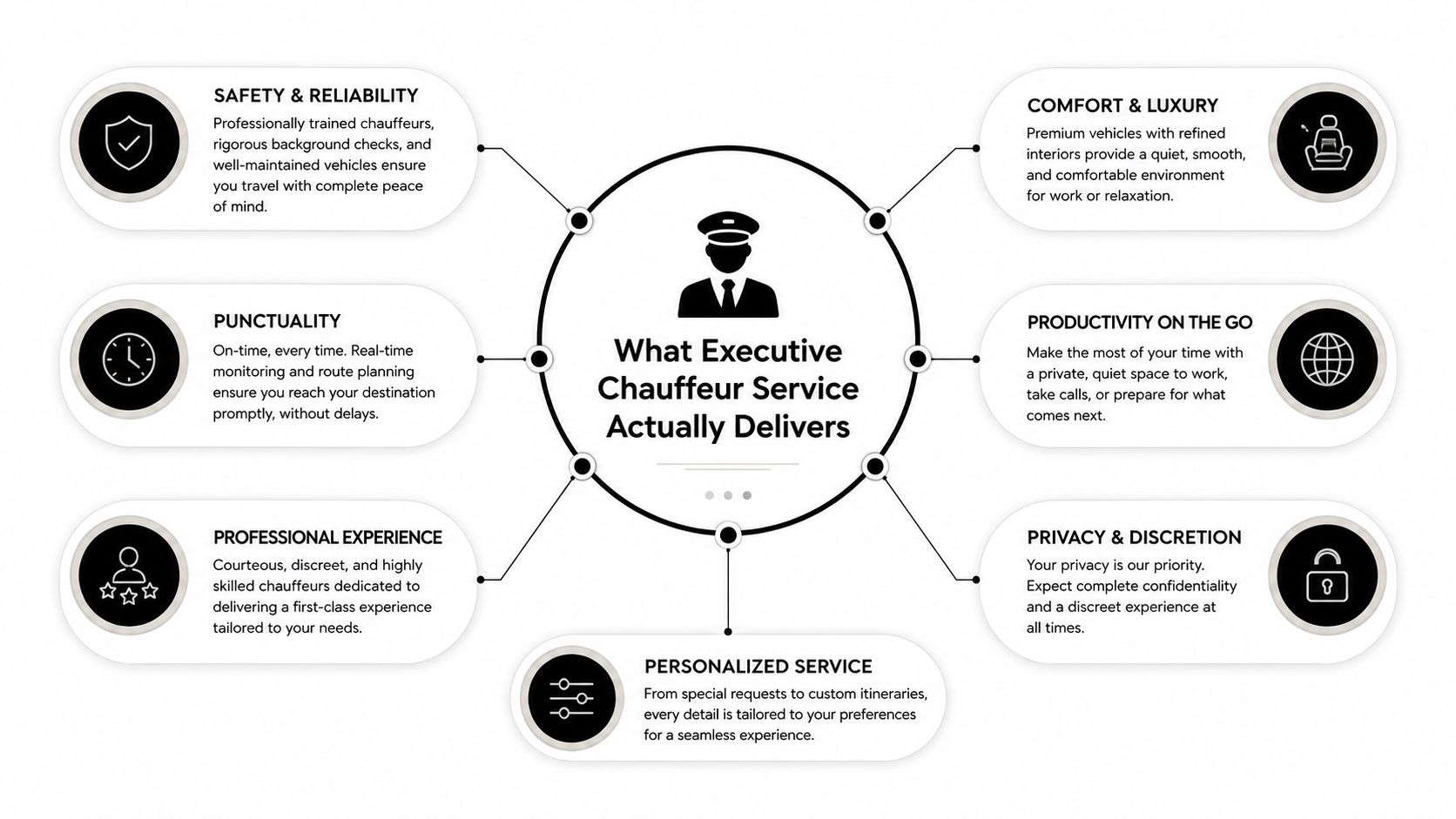
An executive chauffeur service is pre-scheduled, itinerary-driven ground transport where the driver functions as a time-critical mobility operator. That means route planning, waiting, timing, passenger handling, and contingency work are built into the assignment before the vehicle ever moves. If you want a plain-language primer on the broader category, this ground transportation overview is a useful reference point.
The operational difference
The point is not just “a nicer car.” The point is a service model that absorbs schedule volatility instead of pushing it back onto the passenger. Corporate travel buyers use this model for executives, high-net-worth clients, private aviation arrivals, and event logistics because it's designed to run on a plan, not on improvisation.
The premium price makes sense because the market is mature and concentrated around real business demand. A 2026 industry summary puts the global limousine and chauffeur market at USD 10.57 billion in 2022, with projected growth at 7.2% CAGR from 2023 to 2030 and over 35% of revenue in North America in 2022 (industry summary). It also cites about 250,000 professional chauffeurs in the United States and a median annual wage of $37,500 for that workforce (same source).
Practical rule: if the trip has one hard failure point, a missed flight, a sealed meeting, or a tight multi-stop sequence, book managed chauffeur service. If it's just a casual point-to-point ride, you're probably overbuying.
Core Services That Define Premium Ground Transportation
The mistake most buyers make is treating every black car as the same product. It isn't. The service category should match the mission, because airport work, investor roadshows, VIP movement, and group logistics all stress the operation differently.
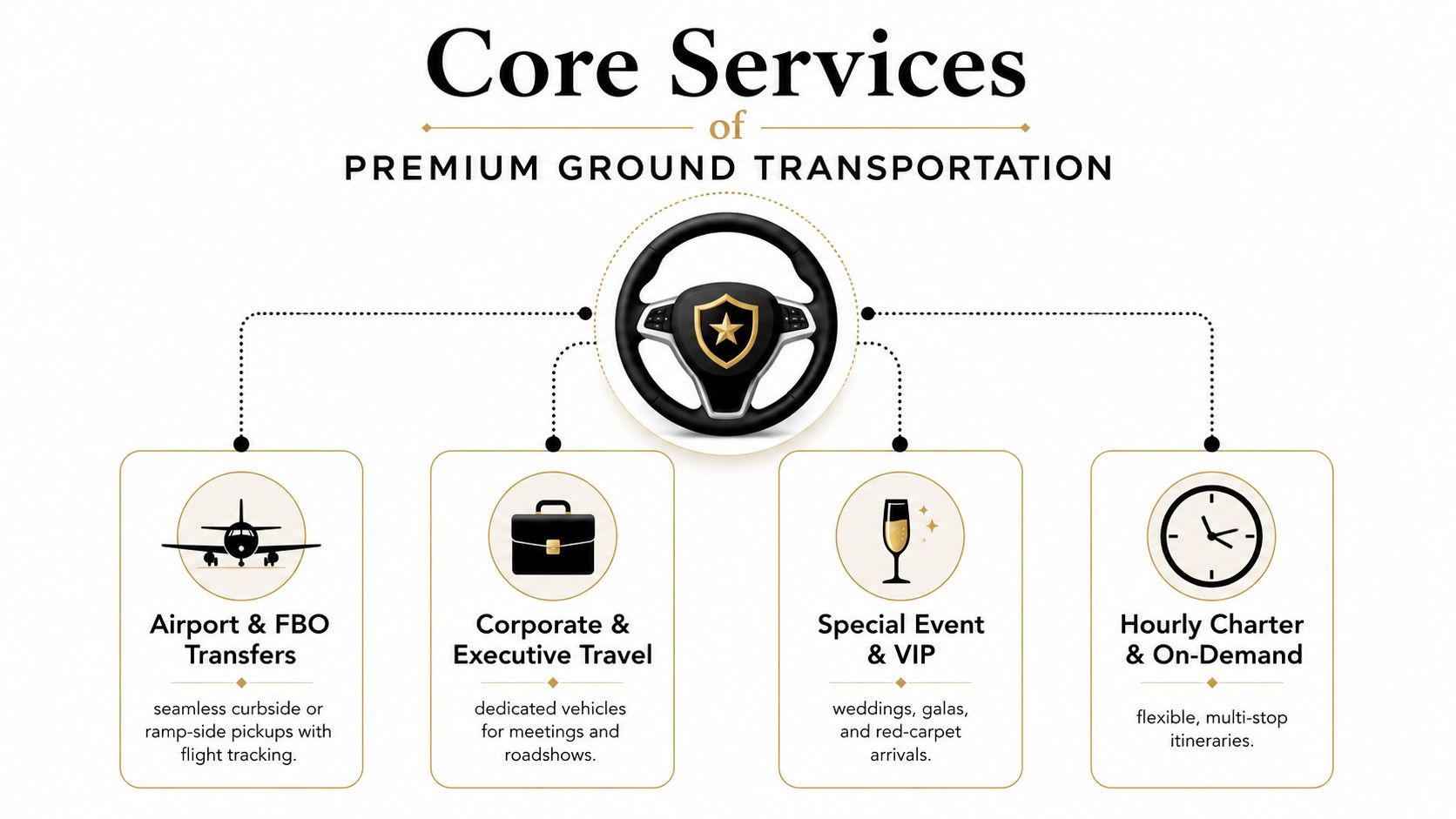
Airport and FBO transfers
Airport transfers are the cleanest use case. A real provider monitors flights, stages pickup timing correctly, and handles curbside or meet-and-greet handoffs without making the passenger chase anyone. For private aviation, FBO coordination matters even more because the ground leg has to sync with the aircraft, not just the landing time.
Corporate roadshows and executive meetings
Roadshows are where weak providers get exposed. One late turn, one bad dispatch decision, one missed pickup sequence, and the whole day starts slipping. Managed chauffeur service exists to keep multi-stop itineraries moving in order, which is why it's used for investor meetings, site visits, and C-suite calendars that can't absorb even modest variance.
VIP secure transport and event logistics
VIP transport is about discretion, route choice, and coordination. Event logistics is about moving groups without creating a mess at the curb, at the entrance, or in the hotel lane. One is privacy-heavy, the other is coordination-heavy, but both need a provider that treats timing as a hard requirement, not a suggestion.
Airline crew movements
Crew transport is its own category because the schedule is irregular and fatigue matters. Crews need reliable pickups, straightforward communication, and a dispatch operation that can absorb changes without making the airport operation harder. That's a very different job from a casual city ride.
Bottom line: ask what the provider actually specializes in. If they answer with “all luxury transport,” keep digging.
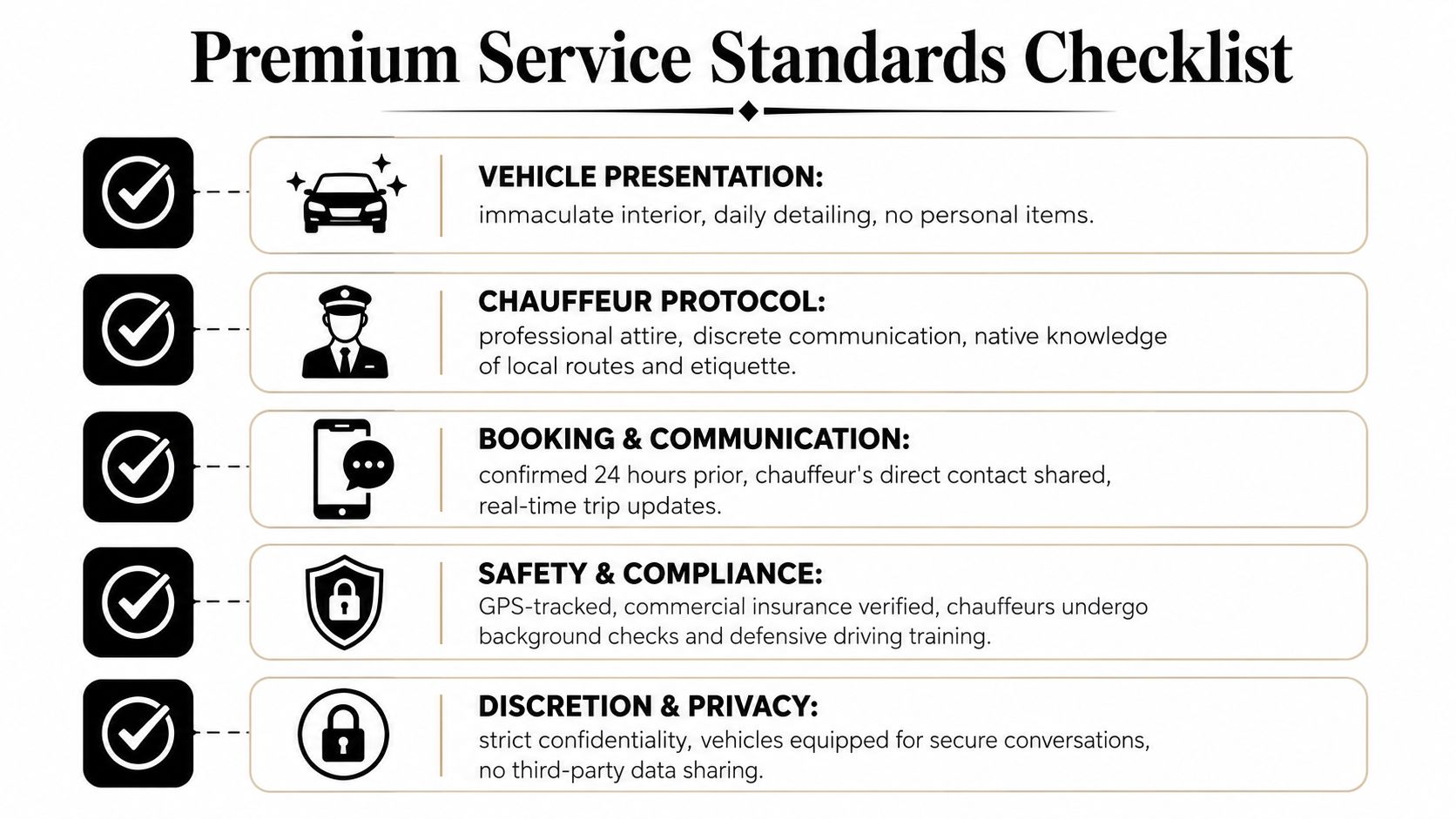
Service Standards That Separate Premium From Ordinary
A premium provider should be able to show you the standards, not just describe them with polished marketing language. The chauffeur's job starts with safety, local knowledge, and professional conduct, then extends to punctuality, route awareness, and discretion under pressure. That's the baseline, not the upgrade.
Training and readiness
Job specifications for executive drivers commonly call for a clean license, strong local navigation knowledge, clear time management, professional conduct, defensive driving training, and first aid/CPR readiness (role standards). Those requirements matter because the chauffeur isn't just steering a vehicle, they're absorbing live traffic shifts, weather changes, and last-minute route edits while keeping the passenger calm and on time.
Discretion and punctuality
Discretion is operational, not decorative. A chauffeur should know when to speak, when to stay quiet, and how to handle overheard conversations without becoming part of the conversation. Punctuality depends on real-time traffic awareness, alternate routing, and buffer management, because a late passenger is usually the result of a bad system, not a bad road.
Dispatch support and coordination
A real chauffeur operation also has backup behind the driver. Last-minute changes, delayed arrivals, and schedule reshuffles should be handled by a live concierge or dispatch team that can update the driver without making the assistant play traffic controller. If a provider doesn't have a 24/7 coordination layer, they're not built for executive work.
A good test is simple.
Ask how they handle a delayed flight, a venue change, and a same-day extra stop. If the answer is vague, the service is too.
Fleet Options and What the Cabin Provides
Vehicle choice matters because the cabin is part of the work product. If the passenger needs to take calls, finish notes, or decompress between meetings, the wrong vehicle turns travel time into dead time. If the passenger is moving with luggage, materials, or a small team, the wrong vehicle creates friction before the workday even starts.
| Executive Fleet Comparison by Use Case | |||
|---|---|---|---|
| Vehicle Category | Key Features | Ideal Use Case | Typical Capacity |
| Executive Sedan | Rear-seat legroom, air suspension, active sound cancellation, driver-assist systems, low NVH | Solo executive travel, confidential calls, airport transfers | 1 to 3 passengers |
| Premium SUV | Multi-zone comfort, advanced infotainment, air purification, lane-keeping assistance, automated emergency braking | Small teams, extra luggage, weather-sensitive travel | 3 to 6 passengers |
| Luxury Van | Group seating, luggage space, flexible boarding, coordinated loading | Roadshows, event shuttles, team transfers | 6+ passengers |
| Specialty Vehicle | Specialized configuration for VIP or event needs | High-profile arrivals, special logistics | Varies |
Why the cabin specs matter
Fleet descriptions for premium executive sedans and SUVs emphasize rear-seat legroom, multi-zone comfort, air suspension, lane-keeping assistance, automated emergency braking, 360-degree camera systems, air purification, and advanced infotainment (fleet spec reference). One sedan example cited there pairs a twin-turbo V-8 with 4Matic AWD, rear-wheel steering, active sound cancellation, and a 30-speaker Burmester audio system. A premium SUV example includes three rows, 13.1-inch and 13.7-inch curved displays, wireless charging, and a 29-speaker Meridian system. For providers that want to keep those vehicles in dependable condition, fleet maintenance best practices is worth reading before you sign anything.
Those details are not trivia. They affect comfort, cabin quietness, and the passenger's ability to work or rest. They also matter for safety in dense urban traffic, where driver-assist tech reduces workload and helps protect against avoidable mistakes.
What to inspect before you book
Use the fleet the way you'd inspect any business tool.
- Rear-seat usability: Make sure the back seat supports laptop work, note-taking, or a confidential phone call.
- Noise control: Quiet cabins are not a luxury for executives, they're where the work happens.
- Maintenance discipline: Late-model vehicles and clean interiors tell you a lot about the operation.
- Vehicle fit: Don't send a sedan to a luggage-heavy or team-heavy itinerary and pretend it's efficient.
A provider's fleet discipline shows up in the condition of the cars, the consistency of the cabin setup, and the way they match the right vehicle to the itinerary. That is what separates a service built for executive work from one that only looks premium in a brochure.
Understanding Pricing and What Drives Cost
Pricing is where buyers get distracted and make bad decisions. The cheapest quote is rarely the cheapest outcome once you account for delays, replacements, service failures, or weak support. Buy the outcome, not the headline number.
How the numbers usually work
For executive transport in the U.S., the reported average hourly rate for a standard executive chauffeur is $85, and premium SUV service typically costs 30% more than sedan service (industry summary). In corporate ground transportation, a corporate travel spend review says Fortune 500 firms spend an average of $2.4 million annually on executive ground transportation, with 35% of that total tied to C-suite trips.
Those figures are not just pricing trivia. They show that executive transport is a managed business expense, not an ad hoc ride. If a provider is quoting far below the market, the gap usually shows up somewhere else, weaker dispatch, older vehicles, poor coverage, or a chauffeur pool that cannot handle real executive itineraries.
What should raise the price
Airport transfers in major U.S. markets cost more than a simple local errand because the operation has to absorb monitoring, staging, and timing sensitivity. The same review puts a typical major-market airport sedan transfer at about $95-$195, while an SUV transfer is about $125-$250 (same review). That spread matters. An SUV is not just a bigger vehicle, it gives you more capacity, more flexibility for luggage, and a cabin layout that can be more workable for a team or a traveler carrying materials.
What pushes the price up is operational complexity. A flight arrival with baggage timing, a tight meeting window, or a multi-stop itinerary takes more dispatch work than a point-to-point local ride. If the quote does not reflect that, the provider is probably underpricing the job and planning to make it up somewhere you will not like, usually on service quality.
If a quote comes in far below market, ask what is missing. The usual gaps are insurance quality, fleet condition, driver training, or dispatch depth. For the liability side of that equation, review insurance coverage details before you approve a vendor.
What to benchmark against
The better question is not how low the price can go. It is what you are paying to remove risk. Reliability, insurance coverage, chauffeur quality, vehicle age, and operational support all belong in the cost equation. A provider that looks expensive on paper can be cheaper in practice if it prevents missed pickups, protects privacy, and keeps an executive moving without distraction.
Privacy and Security as Operational Risk Control
Privacy is not a decorative feature for executives. It's part of risk management. If a client is moving between sensitive meetings, handling deal chatter, or traveling under public scrutiny, the vehicle becomes a mobile environment that has to support discretion by design.
What real privacy protocols should look like
You want explicit confidentiality practices, secure communication habits, and a clear non-engagement norm. If a provider works with high-profile clients, they should be able to explain how route plans are handled, how passenger data is protected, and how the chauffeur avoids predictable patterns when a route needs to stay low-profile. For a deeper look at how insurance and liability fit into that picture, see insurance coverage details.
When the issue gets serious
Executives, family offices, and private aviation travelers have different risk profiles, but the same principle applies. Sensitive conversations should not be interrupted, passenger names should not be handled casually, and itinerary details should not leak into informal channels. If a provider can't tell you how they handle non-disclosure expectations, they're not ready for serious business travel.
Questions to ask before you commit
- How is passenger information stored and shared? You want a direct answer, not a slogan.
- Do you coordinate with security teams when needed? High-risk movements sometimes require it.
- How consistent are your protocols across cities? Cross-border consistency is the difference between a real network and a loose brokerage setup.
- What happens when the route changes suddenly? Secure handling matters most when the plan changes.
Privacy is about reducing exposure, not creating drama. That's the standard worth paying for.
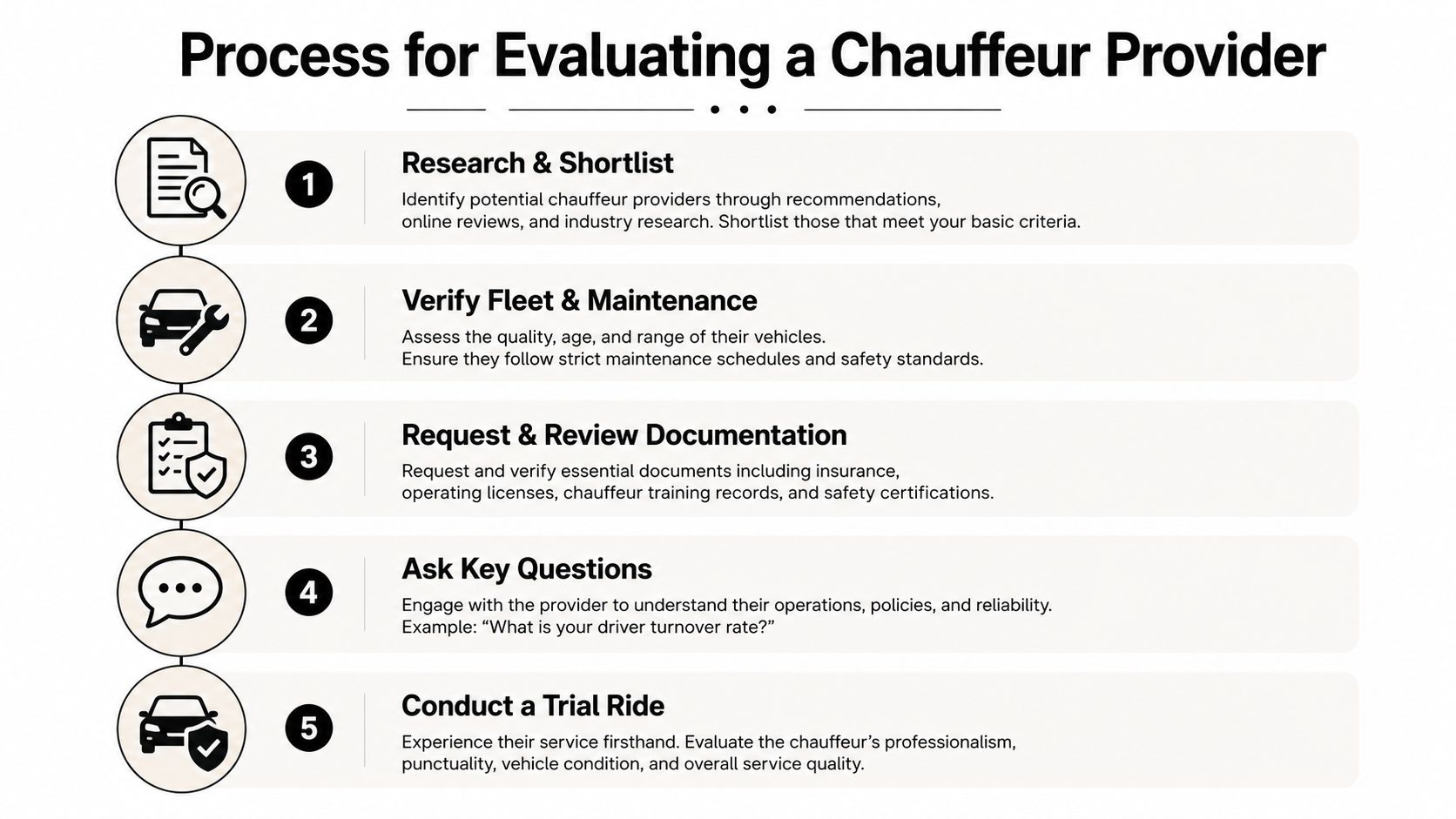
How to Evaluate and Choose the Right Provider
The buyer mistake is treating this like a commodity purchase. It isn't. A real executive chauffeur provider should be able to prove fleet quality, chauffeur quality, insurance discipline, dispatch support, and service consistency across locations. If they can't show that clearly, move on.
The questions that matter
Start with the basics. Ask about fleet age, maintenance process, chauffeur screening, commercial insurance, and how the company handles itinerary changes. Then move to dispatch depth, live tracking, flight monitoring, and whether the same service standard holds in every city or only in one home market.
Simple filter: if they can't explain their process without leaning on adjectives, the operation is thinner than it sounds.
Ask for references from business travel managers, not just testimonials. Ask how they handle cancellations, delayed flights, and extra stops. Then ask the question many providers hate: what is your driver turnover rate? A stable operation usually knows the answer and can discuss it without hiding behind sales language.
What a serious provider looks like
MLR Worldwide Service fits the kind of model buyers should be looking for, a vetted global affiliate network, 24/7 concierge operations, and a curated late-model fleet built for executive work. That combination matters because consistency across time zones is harder than it looks, and brokerage-style outsourcing usually falls apart when the trip gets complicated. If a provider can't run the same playbook in multiple hubs, it's not a true executive solution.
The final test
Book one trial ride before you move any important calendar onto the account. Watch the communication, the vehicle presentation, the driver's timing, and the dispatch response to any change you introduce. If the first ride is sloppy, the account will be worse when the stakes go up.
Making the Case for Managed Ground Transportation
The right question isn't whether an executive chauffeur is cheaper than a rideshare. It isn't. The right question is whether your itinerary can tolerate avoidable variance, weak discretion, or poor coordination. If the answer is no, managed ground transportation is the rational choice.
Use premium chauffeur service when the day includes confidential conversations, tight meeting chains, airport connections, roadshows, or any movement where delay compounds. Use standard options when the trip is low-stakes and the cost of a hiccup is trivial. Finance and procurement usually accept the spend when you frame it as risk control, executive productivity, and duty of care, not comfort for comfort's sake.
If you need a provider that handles executive transfers, airport coordination, VIP movement, and multi-stop schedules with a single operations team, MLR Worldwide Service is built around that model. Visit MLR Worldwide Service to review the service categories, compare fleet options, and request a plan for the trips that can't afford to go wrong.