
You're probably staring at a fleet brief that looks simple on paper and messy in practice. The board wants sustainability language, the travel team wants fewer disruptions, and your chauffeurs still need to make the second pickup after a gate change, a rain delay, and a client who is already late. That is where eco friendly vehicles stop being a branding decision and become an operations decision.
The right answer is not “buy the biggest battery.” It is to match the powertrain to the mission, the depot, and the charging behavior of your routes. For executive ground transport, that means judging uptime, dwell time, route flexibility, and cabin experience before you judge badge value or brochure range.
Why Executive Fleets Are Rethinking Eco Friendly Vehicles
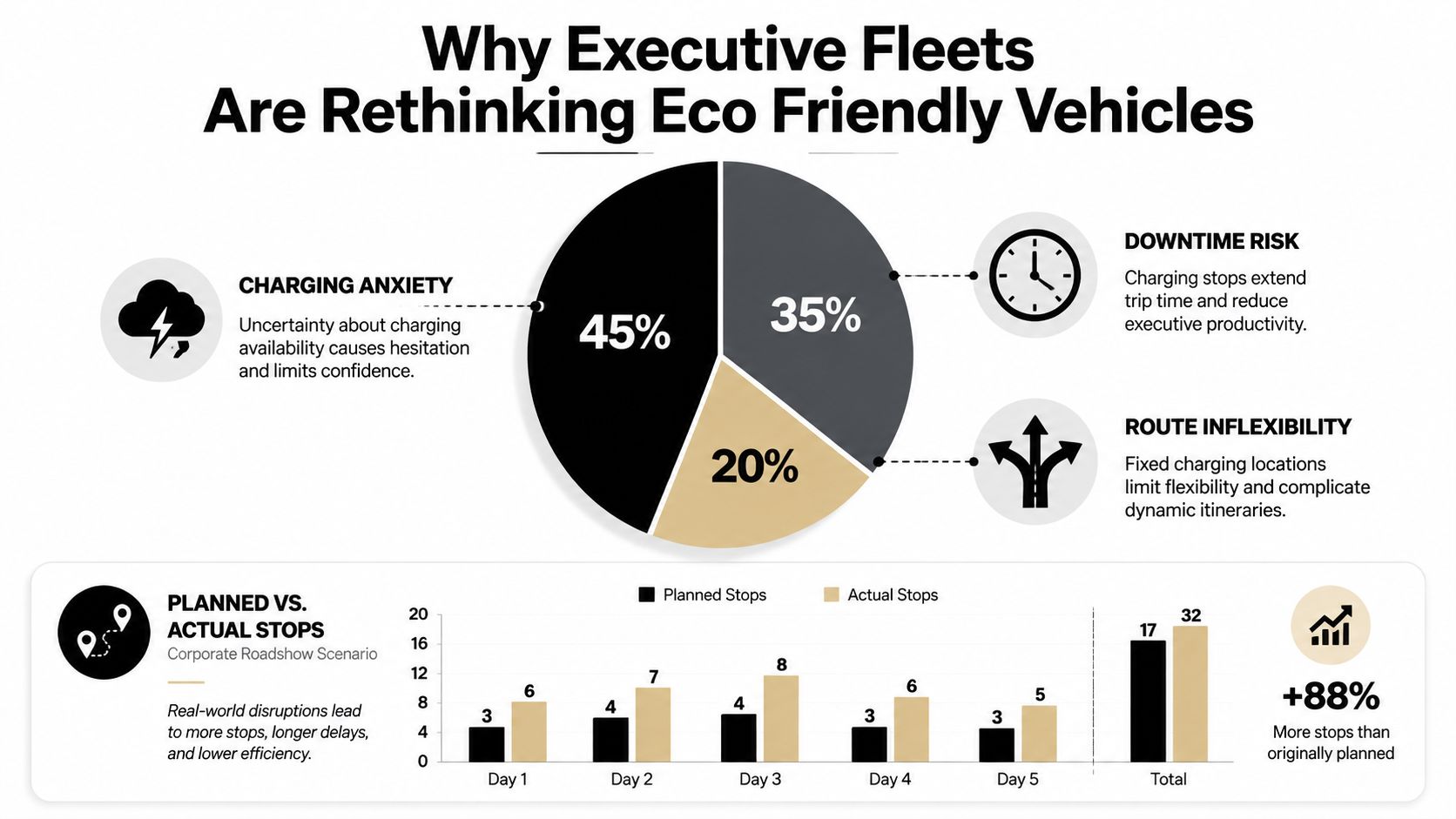
A corporate roadshow can expose a bad vehicle choice in one afternoon. The chauffeur leaves the FBO in a quiet premium EV, clears the first meeting on time, then loses the next handoff because the route changed, the charger at the hotel was blocked, and the client's assistant moved the final stop across town. The car itself may be fine. The operating plan wasn't.
That's why eco friendly vehicles have moved from CSR decks into fleet playbooks. Buyers are no longer asking only whether a vehicle is low-emission in theory. They're asking whether it can serve a chief executive, a family office principal, or a VIP air passenger without creating friction at the curb. Sustainability now arrives inside the RFP, but it shows up alongside quiet cabin expectations, privacy, and punctuality.
The service standard changed before the fleet did
The pressure is coming from clients who expect greener travel without any reduction in polish. That means the fleet operator has to deliver an electric or hybrid answer that still behaves like a white-glove transport product. The vehicle has to feel calm, the dispatch has to be predictable, and the charger plan has to survive weather, traffic, and last-minute itinerary edits.
Practical rule: if a vehicle choice forces your team to add backup cars everywhere, the sustainability win is being eaten by operational waste.
The smartest operators now treat the powertrain as one component of service quality. A quiet cabin matters. So does the ability to stage vehicles correctly, protect privacy, and avoid public charging chaos before a critical pickup. In other words, the question is not whether eco friendly vehicles belong in executive transport. They already do. The question is which ones can keep the promise you sell to the passenger.
The Four Powertrains That Count as Eco Friendly Vehicles
The term eco friendly vehicles gets used loosely, so the first step is to define it properly. For executive fleets, the label should be judged on well-to-wheel impact, not just what comes out of the tailpipe. That matters because a vehicle can look clean at curbside and still rely on a dirty charging mix, or it can look conventional and still reduce total emissions meaningfully through hybrid operation and better efficiency.
Four powertrains, four different operating logics
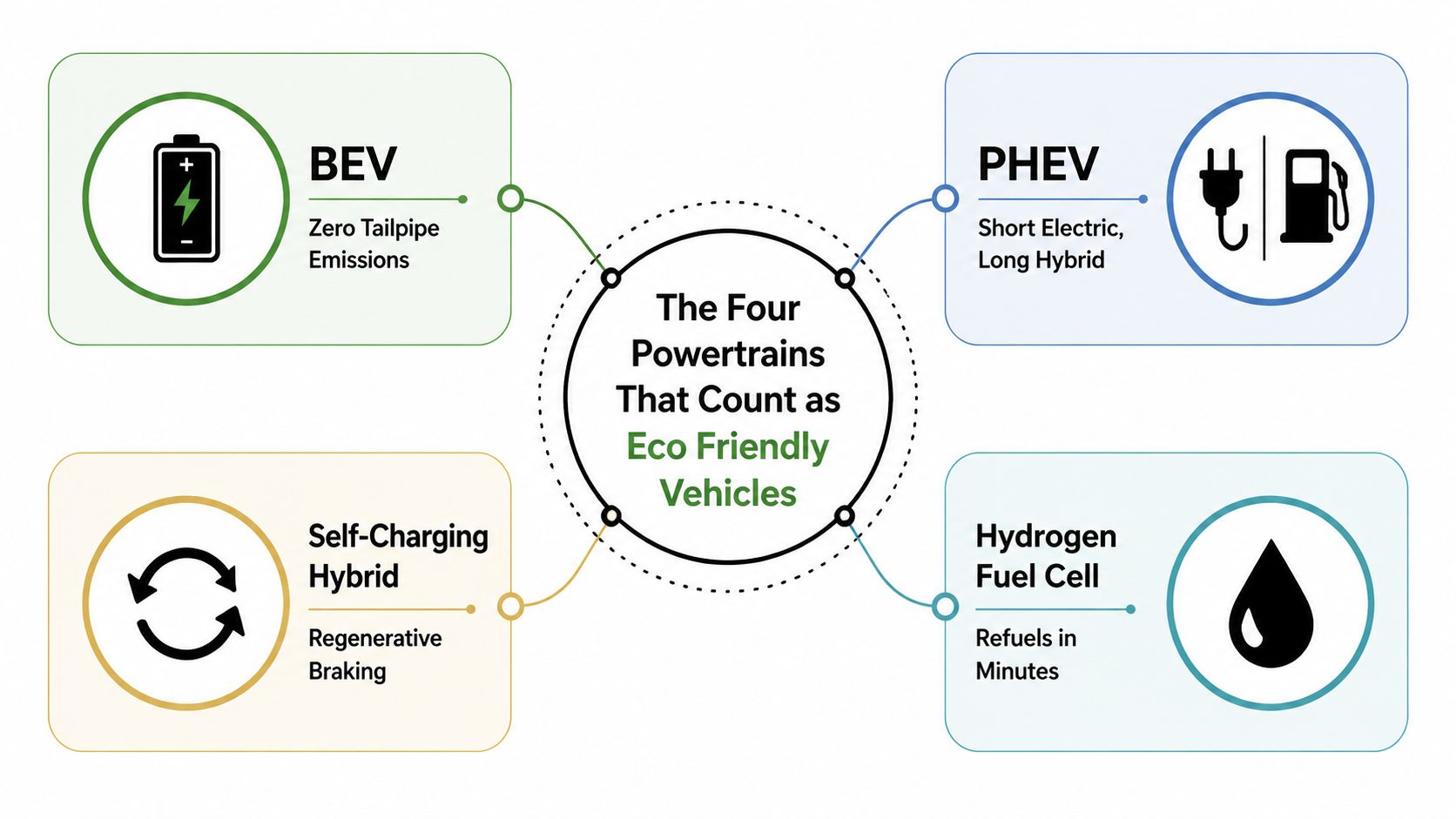
A battery-electric vehicle, or BEV, is the full-electric option. Think of it as the vehicle that runs entirely on plugged-in energy, with zero exhaust emissions at the point of use. It's the cleanest answer in cities and on depot-based routes where charging is controlled.
A plug-in hybrid, or PHEV, is electric with training wheels. It can run on battery power for short trips and fall back to gasoline when the route gets longer or charging isn't convenient. That makes it a practical hedge, not a pure sustainability solution.
A self-charging hybrid, or HEV, is electric-assist. It doesn't need a plug, it recaptures energy through regenerative braking, and it stays attractive when infrastructure is thin or unpredictable. For some affiliates and satellite markets, that simplicity still matters.
A hydrogen fuel-cell vehicle, or FCEV, refuels quickly and produces electricity onboard from hydrogen. It sounds elegant, but the infrastructure reality is narrow, which makes it a niche choice for most global chauffeur networks.
Eco friendly does not mean “lowest tailpipe number only.” The better question is whether the vehicle reduces total environmental impact in the market where it actually operates.
What counts, and what doesn't
The U.S. EPA frames green vehicles around lower overall environmental impacts, and Green NCAP evaluates vehicles across Clean Air, Energy Efficiency, and Greenhouse Gas performance rather than tailpipe output alone. That's the right mindset for procurement. A PHEV that spends most of its time on gasoline won't beat a well-run hybrid on real-world benefit, and a BEV can look excellent or mediocre depending on the grid and usage pattern.
For executive fleets, the practical translation is simple. BEVs fit depot-controlled, urban, and repeatable schedules. PHEVs buy flexibility. HEVs protect uptime where charging access is weak. FCEVs remain a long-horizon bet, not a mainstream procurement answer for 2026.
Matching Powertrains to Executive Trip Profiles
The decision gets clearer when you stop talking about “the best eco friendly vehicle” and start talking about the actual trip profile. Airport transfers, roadshows, city meetings, and intercity runs do not punish the same weaknesses. A vehicle that works beautifully for one can be the wrong tool for another.
| Powertrain | Real-world range | Refuel/recharge time | Infrastructure dependency | Best executive use case |
|---|---|---|---|---|
| BEV | Strong for urban and regional duty, limited by charging plan | Longer than fueling, best when staged at depot or hotel | High | Airport transfers, city roadshows, fixed-route executive service |
| PHEV | Flexible, because it can switch to fuel when needed | Fast fill-up plus plug-in option | Moderate | Transitional fleet roles, mixed urban and suburban missions |
| HEV | Good for continuous operation without plugging in | Fast fueling | Low | Affiliate markets, backup service, thin charging environments |
| FCEV | Depends on local hydrogen access | Quick refuel where stations exist | Very high | Specialized pilot use, not broad 2026 deployment |
Where each powertrain actually wins
For airport transfers and city roadshows, BEVs are the cleanest operational fit if you control charging. The route is usually repeatable, dwell windows are more predictable, and the client benefit is immediate, a quiet cabin and no exhaust exposure at pickup. That combination matters in premium service because it preserves the white-glove feel without sacrificing sustainability.
For mixed-duty days, PHEVs make sense as a bridge. They are not the end state, but they reduce risk when your team is still learning route behavior or when public charging is unreliable. For corporate travel managers who need a smoother transition rather than a hard cutover, they're the sensible compromise.
For thin-network affiliate cities, HEVs remain the conservative choice. They are harder to market as a bold ESG move, but they're easier to keep on the road. If your promise to the client is “the car will be there,” simplicity beats ideology.
Bottom line: choose BEV where you can control charging, PHEV where you need flexibility, HEV where infrastructure is weak, and leave FCEV for markets with real hydrogen access.
Operational Impact on Range, Uptime, and Total Cost
The biggest mistake in fleet procurement is treating range as the master metric. Executive transport lives or dies on uptime, not brochure ambition. A vehicle with more range on paper can still create more operational friction if it is heavier, slower to charge, or more dependent on high-capacity depot planning.
Real-world EV efficiency spans roughly 167 Wh/km for lighter models to 278 Wh/km for heavier vehicles, with curb weights ranging from about 1,095 kg to 2,760 kg (EV Database). That spread is not academic. It changes how often a chauffeur has to recharge during a multi-stop day, how much power the depot needs at once, and how many standby units you need when the schedule slips.
What efficiency means in the field
A lighter, more efficient vehicle is easier to cycle through a demanding day. It consumes less energy per kilometer, spends less time plugged in, and keeps your dispatch team from building unnecessary buffer into every booking. A heavier vehicle can still be the right answer for passenger comfort or luggage volume, but you should treat that as a deliberate trade-off, not a default upgrade.
The knock-on effect is real. More energy use means more charging windows, and more charging windows usually mean more fleet slack. That slack shows up as extra vehicles, extra drivers, or extra waiting time, all of which cost money and damage the premium experience.
The same logic applies to maintenance planning. EVs can reduce some service burdens, but they do not eliminate operational complexity. Tires, brakes, and depot power management still need discipline, and connected systems bring data handling questions that travel managers can't ignore. If your procurement team assumes “less moving parts” automatically means “less fleet oversight,” they're underestimating the job.
Security and privacy deserve their own line item
Executive mobility is sensitive. Connected chargers, app-based vehicle access, and OEM data collection can expose movement patterns if nobody writes clear controls into the operating model. If your chauffeurs, dispatchers, and vendors use different apps and different access rules, you've created a data trail that doesn't belong in a high-discretion transport program.
Maintenance discipline matters when you're managing higher-utilization premium vehicles, because every missed inspection or delayed rotation ends up costing you service reliability. For a corporate travel manager, the question is not whether an EV is cheaper to own in some abstract sense. It's whether the vehicle can stay ready, stay discreet, and stay on schedule across the full duty cycle.
Regulatory and ESG Considerations for Corporate Fleets
For corporate fleets, sustainability claims now need to survive an audit. That means the conversation has moved beyond good intentions and into reporting, procurement language, and operational proof. If your travel team says a fleet is greener, someone in finance, legal, or a client ESG review will eventually ask what that means in practice.
Transportation accounts for 28% of U.S. greenhouse gas emissions, and light-duty vehicles are responsible for 57% of that transportation-sector share (Energy Center). That's why fleet electrification is not cosmetic. It can affect corporate scope 1 footprints directly, which makes the fleet manager part of the ESG reporting chain whether they asked for it or not.
Align the claim with the accounting
The first rule is simple. Don't market a vehicle as eco friendly unless your accounting method matches the claim. Tailpipe-only accounting is too narrow for modern fleet planning. Well-to-wheel evaluation is the better standard, and it's especially important when a vehicle's environmental value depends on how often it runs electric, what grid powers the charger, and whether the use case suits the powertrain.
The second rule is jurisdictional discipline. City rules, airport access policies, and low-emission zones can change what you can deploy where. A vehicle that works perfectly in one hub may become a poor fit in another because of local access restrictions or charging availability. Global operations teams need a standards document, not just a vehicle list.
The third rule is procurement language. ESG clauses are showing up in RFPs, which means suppliers need to explain not only the vehicle they offer, but the service model behind it. If the affiliate can't document charging access, emissions posture, or driver training, the fleet standard is incomplete.
A green fleet that can't be verified will eventually create a reputational problem. Operations teams should build the proof into the vendor file before they build the sales deck.
These sustainable travel practices are easiest to defend when the fleet policy and the supplier policy match. That's the real test for travel managers. The goal isn't to sound greener. It's to produce a fleet that can stand up to client scrutiny, internal reporting, and route-by-route operational reality.
Why the Biggest Battery Is Often the Wrong Choice
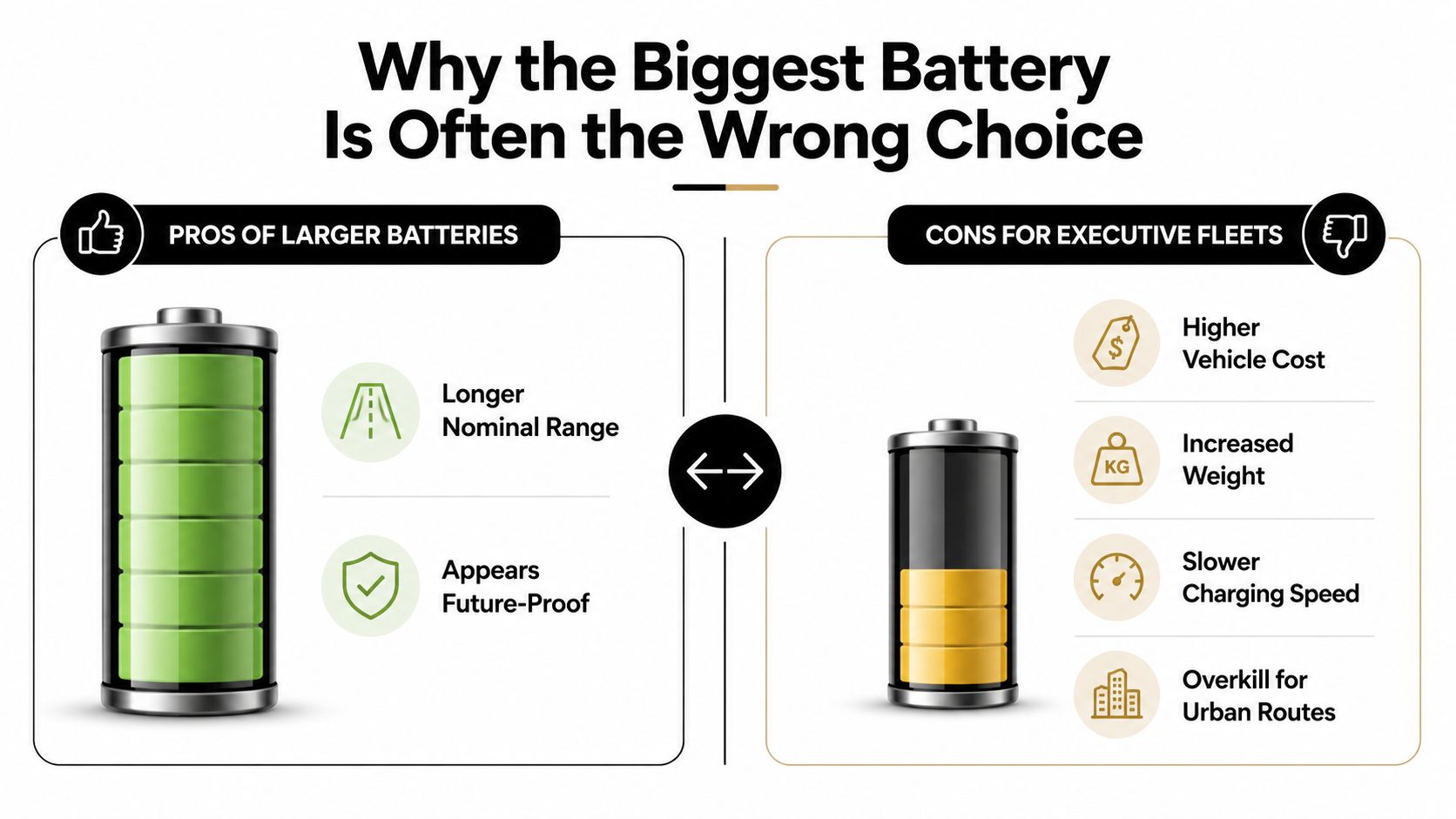
The popular instinct says more battery equals more readiness. In executive transport, that's often wrong. A bigger battery can help on paper, but it also adds weight, slows charging, and pushes the fleet toward overbuilding infrastructure that the actual route mix doesn't require.
IEA tracking showed global EV sales rose 35% year-on-year in the first quarter of 2025, with more than one in five new cars sold worldwide in 2024 already electric and over 20 million units projected for 2025 (IEA). That mainstream momentum matters because it means buyers now have real choice, not just a few compliance models. The better choice, though, is still the one that matches the job.
Right-sizing beats bragging rights
A long-range flagship looks impressive in a procurement deck, but it can be overkill for urban executive duty. If most of your trips are airport runs, hotel transfers, and multi-stop city appointments, you want a vehicle that can complete the day efficiently, not a mobile monument to unused range.
Practical rule: specify for duty cycle first, passenger profile second, and range last.
That order matters because heavier vehicles consume more energy, place more demand on chargers, and can create local friction in premium arrival zones. They also make depot planning harder when multiple cars return at once. In practice, one oversized vehicle can create a larger operational footprint than three well-matched cars running on a disciplined schedule.
There's also a usability issue that gets overlooked. Home charging and easy public charging remain close to a virtual necessity for many EV users, especially in apartment, rental, or multi-family situations. If your chauffeurs can't charge where they live or reliably where they park, the whole transition becomes fragile. That's why right-sized vehicles and realistic routing matter more than peak battery size.
Use case should drive the spec
For a chauffeur-driven fleet, the best spec often looks boring. Lower mass, better efficiency, and enough range for the actual duty cycle usually beat headline range and oversized battery packs. If the vehicle can stay available, charge predictably, and fit the client's expectations, that's the winning formula.
The wrong approach is to buy the most impressive EV and hope the operating model catches up. The right approach is to design around the route first and let the vehicle follow that logic.
A 12-Month Fleet Transition Roadmap and Affiliate Vetting Checklist
A fleet transition succeeds when someone owns the calendar. Without a phased plan, EV adoption becomes a collection of pilot stories, charger excuses, and inconsistent affiliate behavior. Corporate travel managers need a roadmap that can survive procurement, finance, and local operator variation.
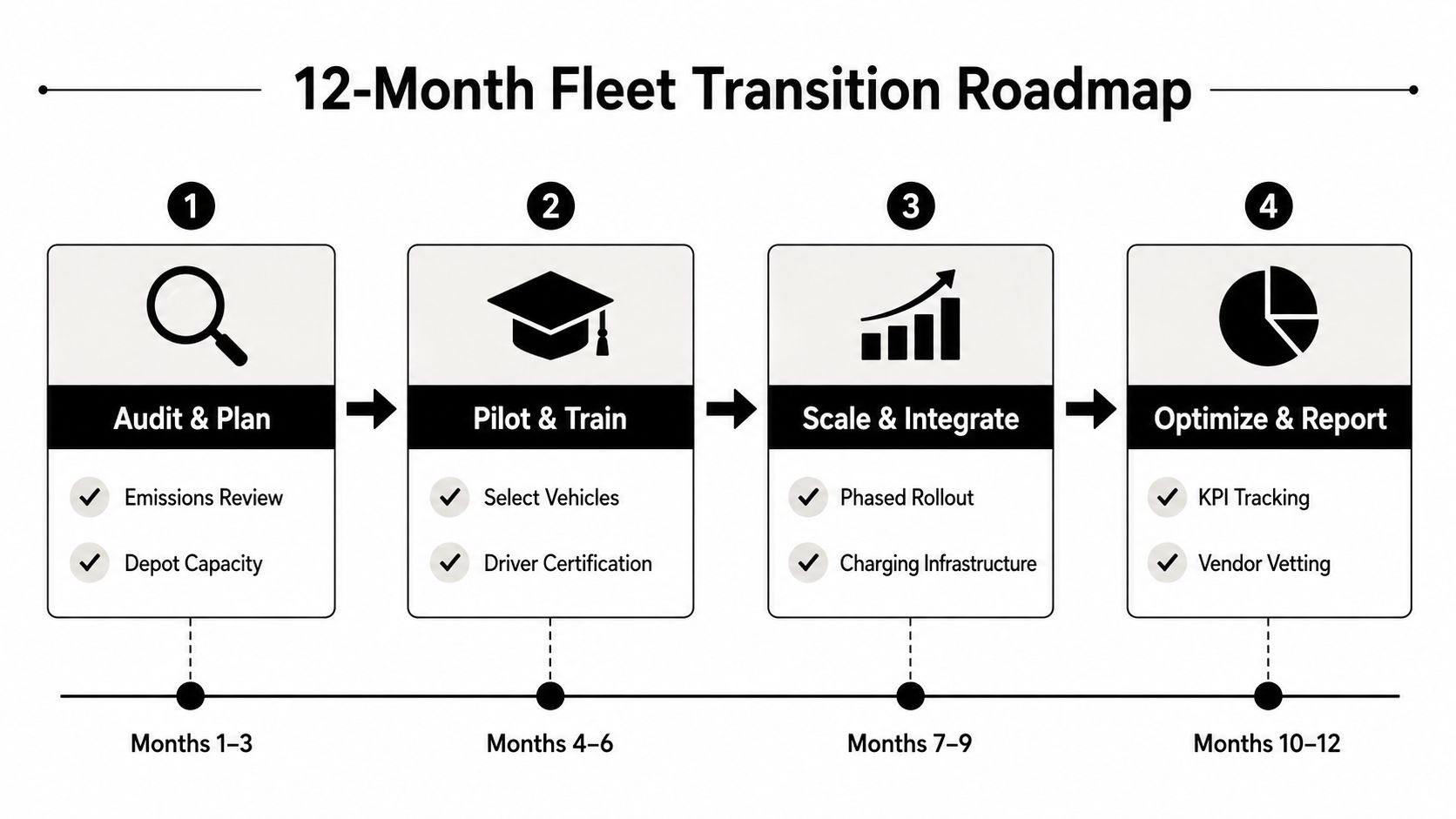
Build the rollout in four phases
Months 1 to 3, Audit and plan. Review current emissions, map duty cycles, and check depot electrical capacity. If you don't know which routes are predictable and which ones are chaotic, you can't choose the right powertrain mix.
Months 4 to 6, Pilot and train. Put 2 to 3 BEV models and 1 PHEV on your highest-utilization routes, then track daily uptime. Train chauffeurs on regenerative braking, silent cabin habits, and how to avoid client discomfort during one-pedal driving.
Months 7 to 9, Scale and integrate. Roll out the winning models more broadly and negotiate depot charger installation. This is also when procurement should tighten vendor terms and document who owns charging access, maintenance response, and telematics controls.
Months 10 to 12, Optimize and report. Publish a reporting template for affiliates, track service KPIs, and standardize the handoff process across cities. Preferred vendor agreements only work when the service standard is written before the first booking goes live.
Use KPIs that a CFO will respect
Track on-time performance versus your ICE baseline, mean charging dwell, road-call rate per 10,000 km, TCO per kilometer, and scope 1 emissions reduction. Those metrics tell you whether the transition is improving the program or just changing the badge on the vehicle.
The affiliate vetting checklist should be just as strict. Require EV-specific chauffeur training, data-handling clauses for connected-car telemetry, and minimum charging access in every affiliate city. If a partner can't support those conditions, they're not ready for a premium eco fleet standard.
Close the gap between intent and execution now by building your next fleet policy around route fit, charging access, and service reliability. If you want an executive transport partner that already understands discretion, uptime, and multi-city coordination, visit MLR Worldwide Service and start the conversation with a team that treats fleet quality as seriously as you do.