
Most sustainable travel advice breaks down the moment an executive lands at a private terminal, needs three city meetings in one afternoon, and can't risk a missed connection. So what does sustainable travel practices look like when public transit isn't realistic, walking isn't relevant, and service standards still matter?
For corporate travel managers, aviation teams, executive assistants, and procurement leaders, that gap is where the essential work begins. Tourism accounts for approximately 8.8% of global greenhouse gas emissions, and 83% of global travelers believe sustainable travel is vital for environmental protection, while 75% actively seek sustainable choices for their next trip, according to sustainable travel statistics compiled here. Pressure is coming from both sides. Leadership wants measurable ESG progress. Travelers still expect privacy, punctuality, and comfort.
In premium ground transport, sustainability isn't about pretending a chauffeured trip can become a bike ride. It's about designing journeys with less waste, lower energy intensity, tighter routing, better vehicle selection, stronger vendor standards, and cleaner reporting. That is where credible programs are built. Not from slogans, but from operating discipline.
Redefining Sustainable Executive Travel
Executive travel has always been judged by reliability first. The car has to be there. The chauffeur has to know the route, the backup route, the terminal procedure, and the security constraints. The traveler has to arrive composed and on time. None of that changes when a company adopts sustainable travel practices.
What changes is how the trip gets designed.
The conventional sustainability narrative in travel often centers on choices that don't map well to executive reality. A board member moving between investor meetings won't take a bicycle. A security-sensitive passenger won't improvise on public transit. A family office principal arriving through an FBO isn't looking for generic mobility advice. Premium ground transport needs its own framework.
Sustainability in this segment means lower waste per mission
In practice, a greener executive transport program focuses on a few hard questions:
- Vehicle fit: Is the vehicle matched to the trip, or is a larger category dispatched by habit?
- Trip design: Are multiple stops sequenced intelligently, or is the day built around unnecessary backtracking?
- Fleet quality: Are operators using late-model, lower-emission vehicles where mission requirements allow?
- Dispatch discipline: Are empty repositioning miles and idle time controlled?
- Proof: Can the provider document what it's doing, or is sustainability only appearing in marketing language?
That is a more honest definition of sustainable travel practices for chauffeured service. It doesn't ask travelers to accept avoidable inconvenience. It asks operators and buyers to remove avoidable inefficiency.
Sustainable executive travel isn't the absence of cars. It's the disciplined use of the right cars, on the right routes, for the right reasons.
There's also a market reason to take this seriously. Buyers are no longer treating sustainability as a fringe preference. They expect it to be built into mainstream travel choices, and they increasingly notice when the premium end of the market offers comfort without accountability.
Precision beats symbolism
In ground operations, symbolic gestures usually don't survive contact with a live schedule. Precision does. A well-run program can reduce waste through dispatch planning, cleaner fleet mix, and tighter supplier management while preserving the standards executives need.
That makes sustainable travel practices highly operational. They belong with duty of care, service level management, and procurement standards. When they sit there, alongside punctuality and safety, they become durable.
The Business Case for Greener Ground Transport
The business case isn't limited to environmental values. It sits inside revenue, procurement, brand positioning, and client trust. The broader sustainable tourism market is projected to grow from $2.3 trillion in 2026 to $17.8 trillion by 2036, with a 22.6% CAGR, and nearly 80% of travelers are prepared to pay at least 10% more for sustainable travel features, according to ecotourism and sustainable travel market projections.
For executive transport buyers, that matters because ground service is no longer invisible. It shapes the first and last impression of a trip, and it increasingly reflects the standards a company claims to hold.
Brand credibility improves when operations back the message
A company can't publish ESG commitments and ignore how its executives move on the ground. Stakeholders may never ask for the dispatch sheet, but they will notice whether the travel program is aligned or disconnected.
That doesn't mean every trip needs a headline. It means travel managers need a provider mix and operating standard that can withstand scrutiny. If you're defining what ground transportation includes in a corporate context, sustainability now belongs in that definition alongside service coverage, vehicle classes, and security protocols.
Efficiency gains are usually the fastest win
Cleaner transport programs often begin with efficiency improvements rather than fleet overhauls. That's good news for finance teams. Route discipline, reduced idle time, right-sizing vehicles, and fewer empty repositioning legs tend to improve both environmental performance and operating cost control.
A premium service model doesn't become sustainable by sacrificing service. It becomes sustainable when dispatchers stop solving every requirement with the largest vehicle and the least planning.
What usually works
| Focus area | What works in practice | What usually fails |
|---|---|---|
| Fleet policy | Matching vehicle class to mission | Defaulting to larger vehicles for convenience |
| Scheduling | Grouping nearby meetings into one vehicle plan | Booking each leg as a separate unmanaged segment |
| Procurement | Requiring proof, reporting, and policy detail | Accepting broad green claims without evidence |
| Traveler experience | Offering sustainable options that preserve comfort | Forcing unrealistic alternatives that users reject |
Internal adoption rises when the program is practical
Executives won't support a program that creates friction. They will support one that keeps standards intact while reducing waste and improving reporting. That is why the strongest business case is operational, not moralistic.
Practical rule: If a sustainability policy makes executive movement harder to manage, adoption will stall. If it improves visibility and trip efficiency, it usually sticks.
Measuring What Matters KPIs for Sustainable Ground Transport
Most travel programs fail on sustainability for one simple reason. They try to manage it with intentions instead of metrics. Ground transport needs the same discipline finance teams apply to cost control. If it isn't measured, it won't improve consistently.
The strongest reference point is the UNWTO Statistical Framework for Measuring the Sustainability of Tourism, which identifies "Net domestic energy use by tourism industries per inbound visitor overnight" as a critical environmental benchmark for sustainable transport, as outlined in the UNWTO sustainability measurement framework. For executive ground service, that principle translates into a simpler operating question. How much energy and emissions are required to deliver each trip, each passenger movement, and each service day?
Build a dashboard like an operations team, not a marketing team
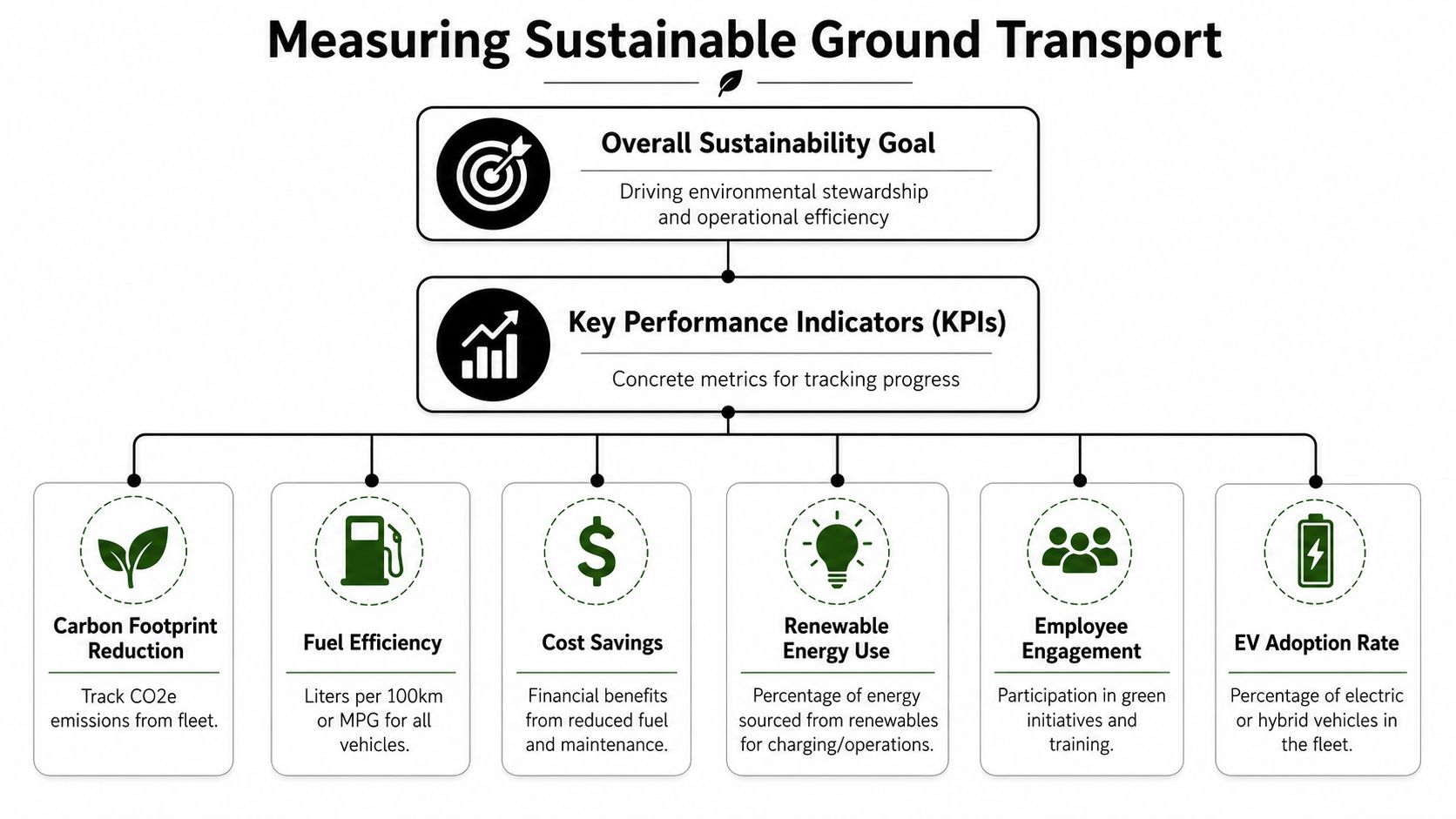
A good dashboard for premium ground transport doesn't need dozens of vanity metrics. It needs a small set of indicators that operations, procurement, and leadership can all understand.
Start with these:
- Carbon intensity per trip: Track emissions relative to trip delivery. This is the clearest way to compare different service patterns over time.
- Fleet mix: Measure the share of low-emission vehicles available and utilized for eligible trips.
- Empty miles ratio: Capture how often vehicles reposition without passengers. This is one of the biggest hidden waste factors in chauffeured service.
- Idle time: Monitor wait periods with engines running. Airport and venue operations often hide more waste here than buyers expect.
- Energy use trend: Follow fuel and charging consumption across the operating period, then compare it against service volume.
For companies managing multiple providers, the dashboard should also standardize reporting definitions. If one supplier counts standby time differently from another, the results won't be comparable.
A useful benchmark framework also helps when evaluating ground transportation companies for service quality and operational maturity. A provider that can report cleanly is usually a provider that manages cleanly.
Separate controllable metrics from background noise
Not every sustainability outcome is fully under the provider's control. Traffic, city infrastructure, charging availability, and venue access rules all affect results. That doesn't make measurement less important. It means travel managers should distinguish between what can be managed directly and what has to be planned around.
A practical KPI split
| KPI type | Best use |
|---|---|
| Direct control | Empty miles, idle time, vehicle assignment, routing discipline |
| Shared control | Charging windows, pickup access, wait policies, event scheduling |
| Strategic | Fleet transition pace, supplier standards, traveler booking behavior |
Here's a useful visual summary of how those layers fit together.
A sustainability dashboard should answer three questions quickly: what we used, what we avoided, and where waste is still hiding.
Report progress in operational language
Leadership teams rarely need technical transport jargon. They need concise reporting. Show whether the program reduced unnecessary mileage, increased use of lower-emission vehicles, tightened dispatch performance, and improved supplier transparency. Keep the language tied to outcomes people already value: efficiency, control, reliability, and auditability.
That is what turns sustainable travel practices from a policy statement into a managed program.
Building a Greener Fleet and Vetting Suppliers
A sustainable executive transport program is only as credible as the fleet behind it and the vendors running it. That sounds obvious, but supplier review is where many programs go soft. Buyers ask whether a provider has hybrids or EVs, hear "yes," and stop there.
That isn't enough. The harder question is whether the operator has built a system around those vehicles.
Recent buyer expectations make this impossible to ignore. 68% of corporate travelers now demand proof of sustainability from vendors, yet only 12% of luxury ground operators publish transparent climate action plans, according to responsible travel guidance highlighting the vendor proof gap. In other words, demand for proof is mainstream. Supply of proof is still limited.
A credible fleet review goes beyond vehicle badges
An executive sedan with a cleaner powertrain helps, but the badge on the trunk tells you very little on its own. Buyers should examine how the fleet is maintained, assigned, and cycled through service.
These are the questions that separate substance from greenwashing:
- Fleet composition: Which low-emission vehicle categories are in service, and in which cities?
- Dispatch logic: On what types of trips are those vehicles assigned by default?
- Maintenance standards: Are tire pressure, engine performance, braking systems, and battery health managed tightly enough to preserve efficiency?
- Charging readiness: Can the operator support EV usage without creating trip risk?
- Driver training: Are chauffeurs coached in smoother acceleration, reduced idling, and energy-aware route execution?
Maintenance matters more than many procurement teams realize. A neglected vehicle wastes fuel, performs inconsistently, and undermines every sustainability claim around it. That is why fleet maintenance best practices for commercial vehicles belong in any sustainability review, not in a separate technical silo.
What to ask in a supplier audit
A useful supplier audit should feel closer to an operations review than a branding exercise.
Supplier due diligence checklist
- Ask for policy documents: If the provider claims sustainability leadership, request the written policy, not a brochure line.
- Review vehicle deployment by market: A global promise doesn't help if cleaner vehicles are available in one city and absent in the cities you use.
- Examine exception handling: Ask what happens when a low-emission vehicle isn't available. Good operators have fallback rules. Weak operators improvise.
- Request reporting samples: You want to see how trip-level or account-level environmental data is presented.
- Check chauffeur standards: Training should include eco-driving behavior, not just etiquette and local knowledge.
If a provider can't explain how its greener vehicles are assigned, maintained, and reported on, the sustainability claim is probably too thin to trust.
What works and what doesn't
The strongest providers don't oversell. They explain trade-offs clearly. EVs may fit airport transfers, city meetings, and many day-to-day executive moves very well. Some long-range, high-security, or heavy luggage requirements may still call for other vehicle types. Honest operators say that directly and focus on reducing waste across the whole service model.
Weak providers usually do the opposite. They use broad language, avoid reporting detail, and lean on isolated vehicle examples that don't reflect actual fleet operations.
Smarter Journeys with Route and Itinerary Optimization
Fleet strategy matters, but trip design often creates faster gains. A well-planned day with a conventional late-model sedan can outperform a poorly planned day with a cleaner vehicle. In executive transport, waste usually hides in miles that never needed to be driven.
The EPA identifies Vehicle Miles Traveled (VMT) per capita as an established performance measure in sustainable transportation, and notes that a 10% shift from private car or taxi modes to public or active transport can reduce per-capita CO2 emissions by approximately 15% to 20% in major urban hubs, while reducing VMT through optimized routing directly lowers carbon intensity, according to the EPA sustainable transportation performance measures document. In the executive segment, the public-transit comparison isn't the operating model. The relevant lesson is simpler. Lower VMT means lower emissions.
The roadshow example shows the difference
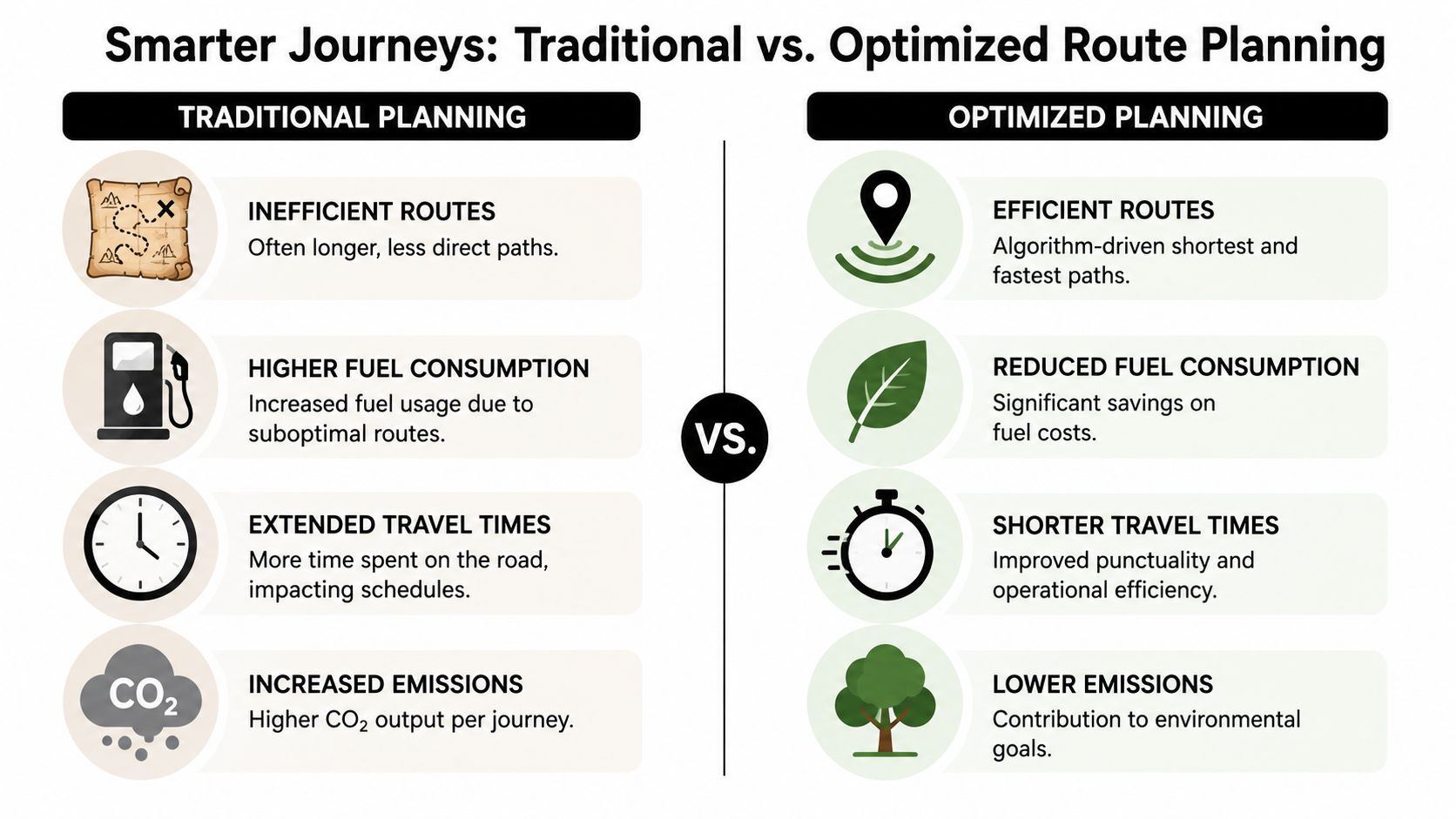
Consider a common corporate roadshow pattern. One executive needs airport pickup, a hotel stop, three meetings across a city, a lunch transfer, and an evening return. Traditional planning often books the day as a series of separate legs. Each leg gets handled competently, but not strategically. The result is duplicated repositioning, unnecessary circling, and inflated standby time.
Optimized planning starts earlier. Dispatch reviews the full sequence, clusters stops by geography, aligns vehicle dwell points with real schedule risk, and reduces backtracking. If two executives have overlapping destinations, the plan may consolidate some movement. If a meeting is likely to run long, the operator adjusts before the idle time stacks up.
Traditional versus optimized execution
| Planning style | Common result |
|---|---|
| Separate trip booking | More empty miles, fragmented visibility |
| Sequence-aware planning | Fewer repositioning moves, cleaner dispatch |
| Static routing | More traffic exposure and idle time |
| Live route management | Better punctuality with less waste |
The biggest gains often come from simple discipline
Buyers sometimes assume route optimization requires complex technology to be useful. Advanced systems help, but some of the best improvements come from straightforward operational habits:
- Consolidate multi-stop agendas: Keep one managed vehicle plan instead of multiple disconnected bookings.
- Reduce deadhead miles: Position vehicles intelligently before the service window opens.
- Use live traffic decisions: Static directions age badly in congested business districts.
- Avoid oversized vehicle assignment: Extra capacity often means extra fuel use without a service benefit.
- Coordinate meeting schedules: A small calendar adjustment can eliminate a major routing inefficiency.
Better routing doesn't just cut emissions. It usually improves punctuality because the trip is being managed as a system, not as a string of isolated rides.
Route optimization is a service issue, not just an environmental issue
This point matters. Many executive travelers will support sustainable travel practices when they see that the result is a sharper journey. They don't want abstract virtue. They want less wasted time, fewer avoidable delays, and cleaner execution.
That is why route optimization tends to be one of the most bankable parts of a premium sustainability program. It improves environmental performance by reducing unnecessary movement, but it also improves the service itself.
From Carbon Neutral to Climate Positive Offset Strategies
Even after tighter routing, better fleet mix, and stronger supplier standards, some emissions remain. That is normal. Executive travel includes unavoidable movement, time-sensitive transfers, and duty-of-care requirements that can't always be engineered away.
Offsets belong at the end of the reduction sequence, not at the beginning.
Use offsets to close the residual gap
A credible offset strategy starts after the operator or travel program has already reduced what it can control. That means first addressing vehicle selection, idle time, routing, and empty miles. Only then should the remaining footprint be balanced through external projects.
That distinction matters because buyers can spot performative offsetting quickly. If a provider talks about carbon neutrality but can't explain its operating controls, the claim won't hold up under review.
How to evaluate offset quality
For corporate buyers, the practical questions are straightforward:
- Verification: Is the project independently verified through a recognized standard?
- Traceability: Can the buyer see what project type is being supported?
- Relevance: Does the offset sit inside a broader reduction program, or is it the entire strategy?
- Reporting: Can the provider show how residual emissions were calculated and matched?
Some organizations also aim beyond neutral balancing and support projects intended to produce broader positive climate outcomes. That can be part of a stronger brand story, but it should never be used to mask weak transport operations.
A clean offset hierarchy
- Avoid what you can through trip elimination and better planning.
- Reduce what remains through fleet and operating improvements.
- Offset the residual with verified, transparent projects.
- Communicate carefully so the claim matches the actual program.
Offsets are most credible when they finish a serious reduction effort, not when they replace one.
Keep the language disciplined
Terms like carbon neutral, net zero, and climate positive are often used loosely in vendor marketing. Procurement teams should insist on plain explanation. What emissions were reduced directly? What emissions remained? How were they accounted for? What was offset, by whom, and on what basis?
That level of clarity protects both brand reputation and internal trust.
Your Implementation Checklist for Sustainable Transport
Most programs don't need a grand relaunch. They need a disciplined start. The fastest progress comes from turning sustainability into a working transport standard that procurement, operations, travel management, and executive support teams can all use.
Use the checklist below as an operating agenda, not a branding exercise.
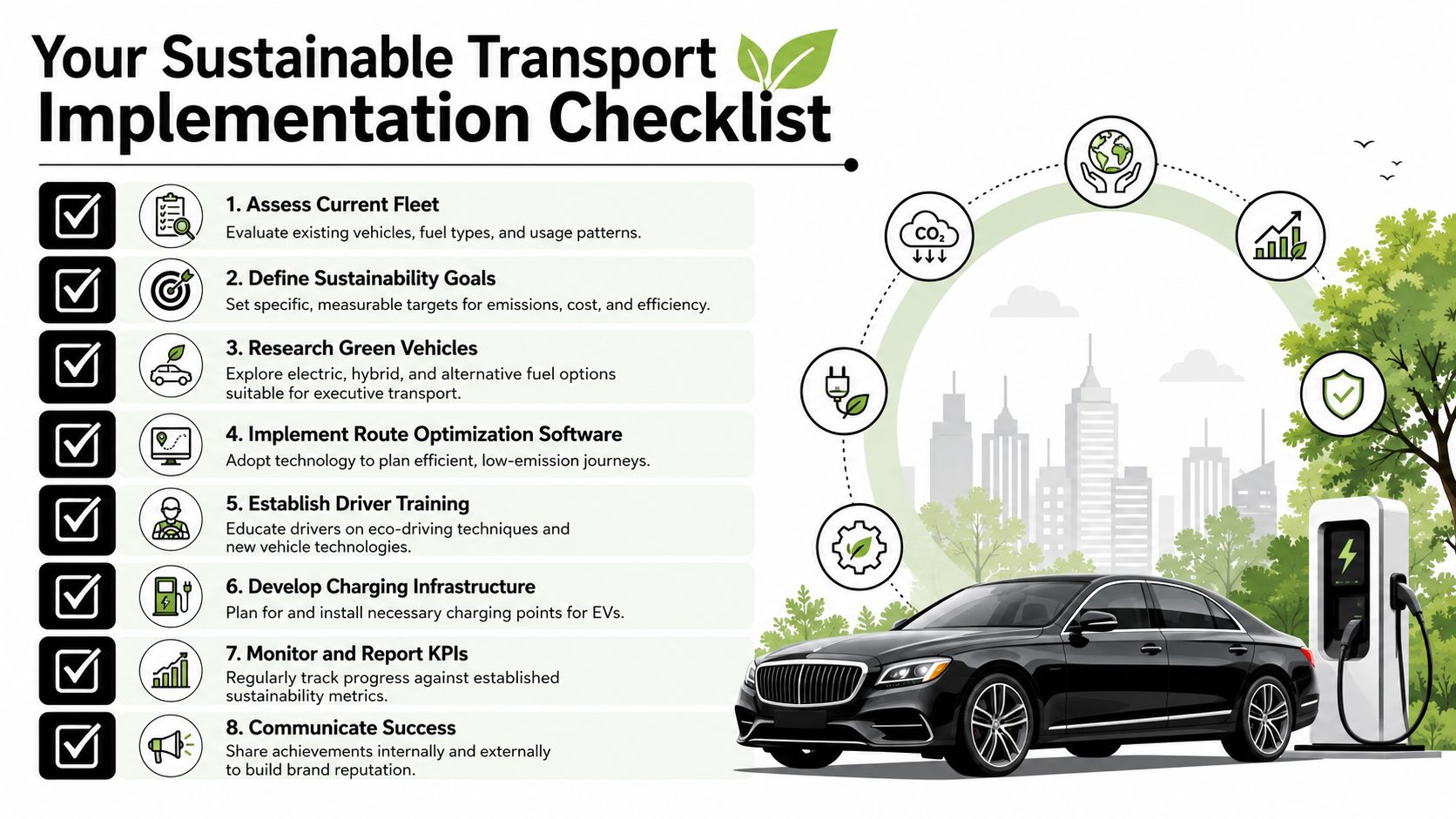
Seven moves that create momentum
Audit current ground activity
Pull trip records by city, vehicle class, service type, and vendor. Look for recurring waste patterns such as oversized vehicles, duplicate bookings, long waits, and repeated short-notice changes.Set operating priorities
Decide what matters most in your environment. For some teams it's emissions visibility. For others it's cleaner routing, supplier proof, or better use of low-emission vehicles on eligible trips.Standardize supplier questions
Give every provider the same sustainability questionnaire. Ask for fleet detail, maintenance standards, vehicle assignment logic, chauffeur training, and reporting samples.Create trip design rules
Define how roadshows, airport transfers, FBO pickups, and multi-stop executive days should be planned to reduce waste without increasing traveler friction.
Make reporting and governance part of the program
A sustainability initiative fails when it lives only in sourcing. Ground transport is an operating category, so ownership has to be shared.
Governance essentials
- Assign accountability: One team should own reporting integrity, and one team should own supplier performance.
- Review monthly: Don't wait for annual ESG reporting to discover problems.
- Escalate exceptions: If a provider can't meet your reporting or fleet standards, treat that as a service issue.
- Show progress internally: Executives are more likely to support the program when results are visible and practical.
Keep the first version simple
Don't try to perfect everything in one cycle. Start with the routes, vehicle choices, and vendors you use most. Tighten those. Build the reporting discipline. Then expand.
The best sustainable travel practices in executive transport are rarely dramatic. They're repeatable.
A mature program usually looks calm from the outside. Trips run on time. Travelers aren't inconvenienced. Procurement has evidence. Leadership has something credible to report. That is the right outcome.
If your team needs executive ground transportation that aligns service precision with modern sustainability expectations, MLR Worldwide Service can help you build a more accountable travel program. From airport transfers and FBO coordination to corporate roadshows, VIP transport, and global multi-city logistics, MLR delivers the operational control, vetted fleet standards, and 24/7 support that demanding travelers expect.