

A principal lands early. The crew is ahead of schedule, the assistant is still on the previous meeting, and the car service has the right tail number but the wrong FBO note. Nothing is technically broken, yet the trip is already drifting.
That's how the international gateway of the Americas stops being an abstract trade term and becomes an operations problem. For executive travel, the highest-risk window often isn't the flight itself. It's the handoff between wheels-down, border processing, baggage control, secure pickup, and the onward drive to the boardroom, hotel, residence, or helipad.
Travel managers and FBO coordinators usually inherit this problem after someone else has simplified it too much. A route looks straightforward on paper. A major hub has plenty of infrastructure. A vehicle is booked. Then the actual variables show up. Customs holds the arrival longer than expected. The chauffeur is staged at the wrong access point. The principal wants curbside discretion, but the airport requires a different pickup flow. A land crossing that works for freight timing doesn't work for a security-sensitive road movement.
A gateway only performs well when every handoff is aligned. If one party treats it like a destination and another treats it like a transfer node, delays multiply fast.
The Moment a Gateway Defines Your Mission
A CEO flying a multi-leg itinerary across the Americas doesn't care which airport ranks highest by tonnage, passenger throughput, or trade value. The concern is simpler. Can they get off the aircraft, clear the right controls, enter the right vehicle, and reach the next commitment without friction?
That sounds basic until a gateway day starts compressing. An early arrival can be as disruptive as a late one if the receiving team isn't live. A customs inspection can be manageable when everyone has the final manifest, but messy when updates sit in three inboxes. An FBO pickup can look smooth from the traveler's perspective while the operations side is juggling access permissions, driver positioning, and alternate routing because the original exit path has tightened.
Where trips usually break
The common failure point isn't the big strategic decision. It's the small assumption.
A coordinator assumes the FBO will notify the ground team at the right moment. The ground team assumes the aircraft will park where it usually parks. The assistant assumes baggage will move directly from aircraft to vehicle. The principal assumes privacy protocols are already understood. None of those assumptions are safe at a major gateway.
Practical rule: If a transfer depends on one party “letting the others know,” it isn't coordinated yet.
In high-stakes travel, the mission isn't complete when the aircraft lands. It's complete when the traveler is delivered to the final stop on time, briefed on any changes, and protected from avoidable exposure.
What operators learn quickly
Large gateways create a false sense of security because they have so much infrastructure. More gates, more handlers, more options, more access points. But scale also means more room for misalignment. Different terminals operate differently. Different FBOs on the same field run different procedures. Different principals require different visibility, pace, and security posture.
What works is disciplined handoff planning. One control point. One live manifest. One named contact for airside coordination. One named contact for landside execution. That's the difference between a gateway that supports the trip and one that puts it at risk.
What Truly Makes an International Gateway
An international gateway of the Americas is not just a large airport, a busy port, or a famous border crossing. It's an ecosystem that aggregates movement and redistributes it. People move through it. Cargo moves through it. Data moves through it. Decision-making has to move through it just as cleanly.
That's why the telecom analogy matters. In telecommunications, an International Gateway links domestic networks to international submarine cable systems, and lower latency improves real-time synchronization for logistics platforms, as outlined by the International Telecommunication Union's gateway definition. Physical gateways operate the same way. They collect traffic, route it, and punish delay at every handoff.
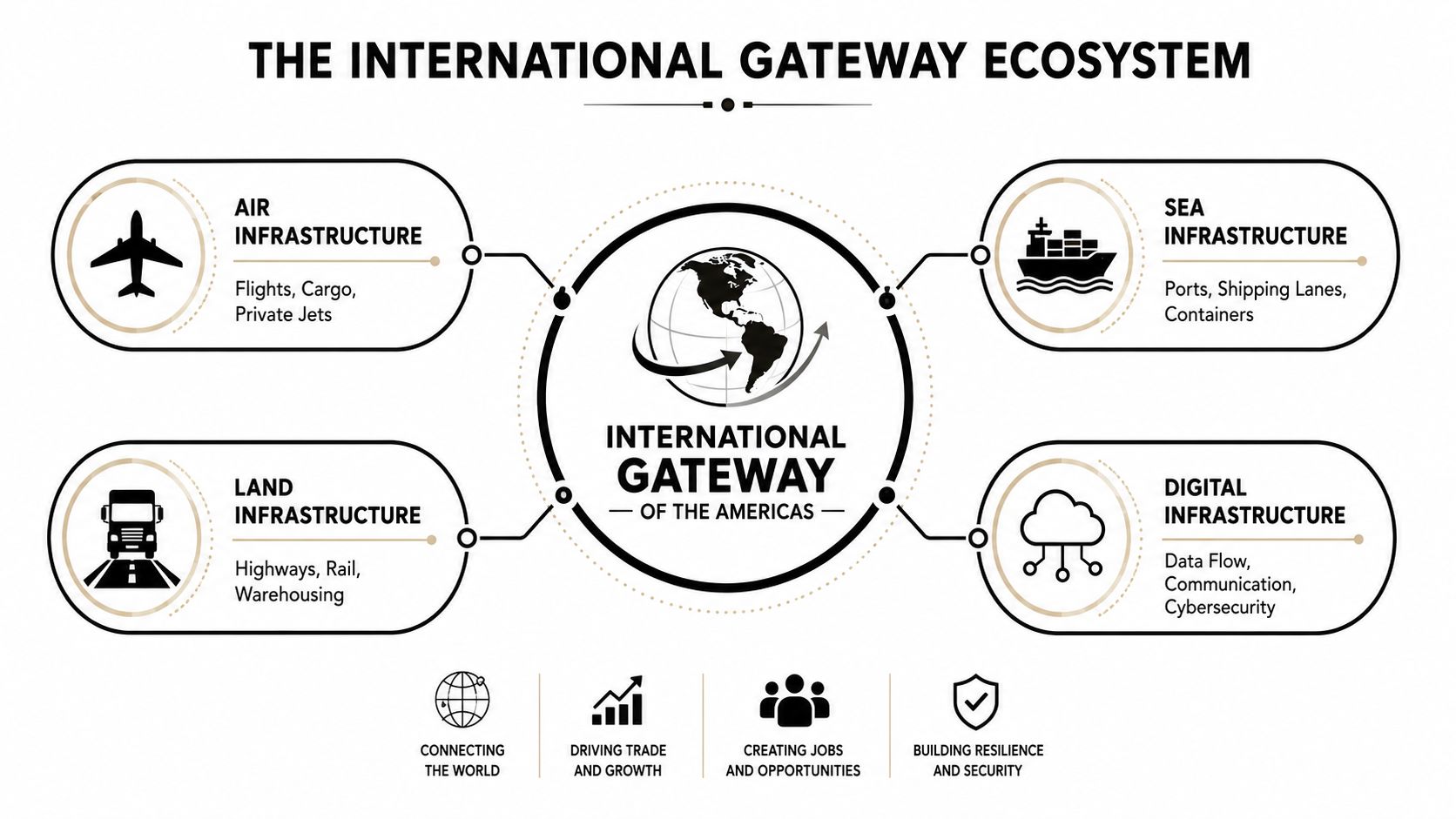
The four parts that matter
A gateway only earns the name when several systems work together.
- Air infrastructure matters because scheduled carriers, cargo operators, private aviation, FBOs, and border agencies all converge there.
- Sea infrastructure matters because ports shape regional trade patterns, trucking demand, congestion, and customs workflows well beyond the waterfront.
- Land infrastructure matters because highways, rail links, warehouses, and bridge crossings determine whether an arrival can continue.
- Digital infrastructure matters because modern movement depends on fast, accurate information flow between dispatch, handlers, security teams, and travelers.
When one of those layers is weak, the whole gateway slows down. The airport may be excellent while the road access is poor. The bridge may carry huge trade volumes while executive vehicle routing remains exposed to delay. The port may dominate freight while passenger support services lag behind.
Why size alone is the wrong test
People often use “gateway” as shorthand for “big.” That misses the operational point. A location becomes a gateway when it concentrates enough movement that routing decisions for an entire region start to depend on it.
For executive transport, that changes how you plan. You don't just ask where the aircraft lands. You ask where the principal exits controlled space, who controls that handoff, which route remains viable at the actual arrival time, and how quickly the ground side can adapt if one link fails.
A gateway is a routing environment, not a pin on a map.
The practical definition
In operations terms, a gateway has three traits:
| Trait | What it means on the ground | Why it matters |
|---|---|---|
| Concentration | High volumes and multiple users share infrastructure | Small disruptions spread quickly |
| Interdependence | Air, land, border, and digital systems rely on each other | One bad handoff affects the next |
| Consequence | Delays hit meetings, deals, security posture, and onward travel | Recovery gets harder by the minute |
That's the useful way to think about the international gateway of the Americas. Not as branding. As a live transfer environment where complexity is normal and precision is the only reliable control.
Profiling the Key Gateways Air Sea and Land
An aircraft can touch down on time, the principal can clear the airport quickly, and the trip can still fail in the next 45 minutes because the wrong city was treated as a generic “gateway.” That mistake shows up when planners use one label for very different operating environments.
The phrase international gateway of the Americas only becomes useful when it helps a travel manager predict what happens after arrival. Air hubs, seaports, and land crossings move people and goods in different ways. For executive transport, that difference affects timing, staffing, vehicle staging, security posture, and recovery options when the schedule shifts.
Miami as the passenger gateway
Miami is the clearest passenger gateway in the region. In 2024, the airport handled nearly 56 million passengers and 3 million tons of cargo, figures recorded by Miami-Dade County through Miami International Airport's 2024 traffic summary. It also serves as a major U.S. connection point for Latin America and the Caribbean.
For ground operators, Miami's value is not just scale. It is concentration. International arrivals, commercial pressure, private aviation activity, hotel demand, and downtown traffic all collide in one market. That changes the margin for error between wheels-down and curbside contact. Pickup points have to be exact. Buffer time has to reflect the actual arrival bank, not an optimistic estimate. If the traveler is connecting to Brickell, Coral Gables, Miami Beach, or a yacht transfer, the route plan needs a primary and backup option before the aircraft lands.
Houston as the freight and business gateway
Houston plays a different role. The city's gateway status comes from trade, industry, and regional business access more than passenger identity. The Gateway 2023 report published by PROPANAMA identifies the Port of Houston as the top U.S. port by tonnage and places Houston among the leading business gateways tied to Latin America.
That matters because Houston trips often expand after arrival. A straightforward airport transfer can turn into a refinery visit, a ship channel meeting, a downtown stop, and a dinner movement across a very large metro area. The operating risk is not only congestion. It is distance, dispersion, and agenda drift.
Vehicle planning in Houston usually benefits from longer duty assumptions, clearer standby terms, and tighter communication with the assistant or security lead. Teams comparing gateway models across cities can use this USA gateway travel overview for major American hubs to see why Miami-style planning does not transfer cleanly to Houston.
Laredo as the land gateway
Laredo proves that a gateway is not limited to airports and ports. The city's role comes from cross-border movement, inspection activity, and the dependence of U.S.-Mexico trade on a small number of high-consequence links. Wikipedia's overview of the Gateway to the Americas International Bridge describes it as one of the key international crossings in that corridor.
For high-stakes travelers, land gateways are less forgiving than they look on a map. Border processing times can change the viability of a same-day meeting. Documentation errors surface later and cost more. Service design may require one vehicle, one driver team, and one security arrangement on the U.S. side, then a separate handoff after crossing. Freight volume does not guarantee executive mobility. It often means the opposite. More scrutiny, more staging constraints, and fewer recovery options if a crossing window is missed.
Major American Gateways Compared
| Gateway Location | Type | Primary Function | Key Metric |
|---|---|---|---|
| Miami International Airport | Air | International passenger gateway with major cargo role | Nearly 56 million passengers in 2024 |
| Houston | Sea and air network | Freight, trade, and Latin America business connectivity | Port of Houston ranked #1 in U.S. tonnage |
| Laredo | Land border crossing | Cross-border U.S.-Mexico trade movement | Major international bridge corridor for border traffic |
The practical question is specific. Which gateway environment is the traveler entering, and what does that require in the first hour after arrival? Teams that answer that well usually protect the meeting, the timeline, and the client experience.
The Private Aviation Gateway Experience FBOs and CBP
Your aircraft lands on time. The meeting is still at risk.
For private aviation arrivals, the mission is decided in a narrow window between shutdown and vehicle departure. At an international gateway, that window runs through the FBO, the ramp rules, and the CBP process tied to that arrival. If those pieces are not aligned in advance, the principal feels the failure immediately.
Miami makes the point without repeating the headline numbers noted earlier. Heavy international volume affects more than the commercial terminal. It shapes ramp congestion, handler workload, escort timing, and pickup restrictions across the field. For executive assistants, travel managers, and FBO coordinators, the practical question is simple. Where will the traveler be released, and who is controlling each handoff until they are in the vehicle?

What the handoff actually requires
Loose instructions create predictable failures. “Meet aircraft.” “Handle customs.” “Coordinate pickup.” None of that tells an operations team where to stage, when to move, or what exception path applies if the arrival changes.
A private aviation transfer at an international gateway usually requires four confirmed items:
- Final aircraft details including tail number, operator, revised ETA, passenger count, and baggage notes.
- Named FBO confirmation so the chauffeur is sent to the correct facility, not a generic private aviation pickup point.
- CBP readiness with accurate passenger data and a clear expectation for where the principal exits after inspection.
- Pickup protocol based on that airport's rules for airside access, curbside collection, or escorted handoff.
The quality gap is rarely transportation alone. It is control of the release point.
What works better than generic dispatching
Good operators build the transfer before departure. They do not wait for wheels-down and hope the local team can sort it out.
Use one live itinerary. Identify who can approve changes. Confirm whether the principal wants a visible meet-and-greet, a low-profile pickup, or a protected transfer with security involvement. Each option changes staging, staffing, and timing.
Specialized gateway travel centre coordination for private aviation transfers is particularly useful when assistants, handlers, security teams, and chauffeurs are all working the same arrival from different systems.
Operational note: “Wheels-down” helps planning, but it is not the pickup signal. The correct trigger is release from the aircraft and any border controls into the agreed transfer point.
The CBP trade-off no one should ignore
Travel managers often want speed, privacy, and certainty at the same time. Some gateways can support all three. Many cannot, at least not on every arrival.
A discreet pickup may require staging farther from the most direct exit. A faster vehicle departure may mean using a busier collection point. Aircraft-side access may be possible for one operator, one facility, or one arrival type, then unavailable a few hours later because staffing, security posture, or airport rules changed. The right plan protects the principal's objective first, then optimizes the service experience within those limits.
That is why FBO and CBP planning has to be specific. Good gateway execution is not about premium language. It is about controlling handoffs, reducing exposure, and getting the traveler off the field without avoidable delay.
Mastering Ground Logistics for Seamless Transfers
A gateway proves its value after release, not at touchdown. An assistant may have the aircraft, hotel, and meetings perfectly arranged, then lose twenty minutes because the wrong vehicle was staged at the wrong exit, the baggage load was underestimated, or the onward leg was planned as a simple airport pickup instead of a controlled arrival.
That is the operating window that matters to executive travel teams. Trade policy, infrastructure programs, and airport investment shape the environment, but the traveler experiences the gateway through handoffs, timing, exposure, and route control. I judge a gateway by one question. Can the local plan move the principal from aircraft release to final destination with minimal delay, clear accountability, and no avoidable confusion?
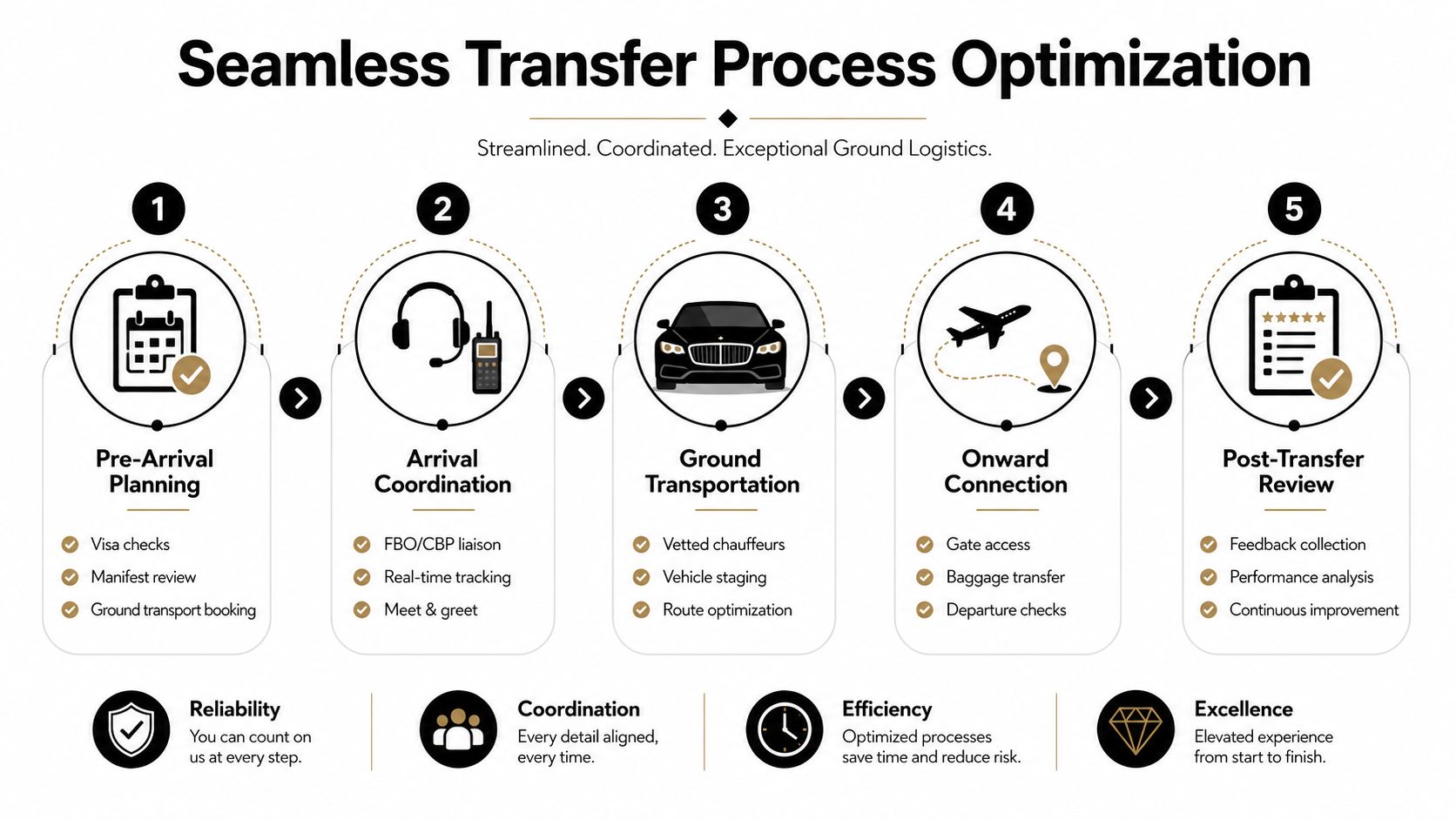
The five control points that matter
Reliable gateway execution usually comes down to five control points.
Pre-arrival planning
Confirm entry requirements, passenger names, manifest alignment, arrival facility, and vehicle type. If the principal is traveling with staff, family members, or a security detail, set the seat plan and baggage assumptions before departure.Arrival coordination
Assign one operations lead to the flight side and one to the ground side. That split reduces lag and keeps updates from getting trapped in one overloaded contact chain.Vehicle staging
Stage the vehicle at the release point most likely to hold if conditions shift. The best pickup position is rarely the one that looks best on paper. It is the one that still works after a gate change, a delayed bag release, or a revised exit instruction.Onward connection management
Many gateway movements continue to a board meeting, heliport, residence, port facility, or another aircraft. Ground timing has to protect the next commitment, not just complete the airport leg.Post-transfer review
Record what changed and why. A movement that felt smooth to the traveler can still expose weak assumptions that will fail on the next arrival.
Teams that need a stronger operating framework usually benefit from more detailed international ground transportation planning for major gateways.
Here's a short visual reference that aligns with the operating sequence discussed above.
What smart teams do differently
Strong teams build timing around uncertainty in the process, not around optimistic estimates. They do not promise an exact curb departure before they know the release path. They also avoid assuming customs, baggage availability, principal readiness, and vehicle access will all line up at the same moment. At major gateways, they often do not.
They also prepare by failure type, because each disruption needs a different response.
- If the aircraft is early, dispatch needs an accelerated activation path and the chauffeur needs updated staging instructions before the principal is released.
- If border processing runs long, the assistant needs revised arrival messaging early enough to protect the next appointment.
- If the pickup point changes, the chauffeur needs one final instruction from one source, not a stream of partial updates from multiple parties.
- If the security posture changes, the route, vehicle placement, or convoy order may need to change before the traveler leaves the field.
Build the movement around the handoff most likely to fail.
What doesn't work
Three habits create avoidable problems at gateways. Treating the ground leg as a commodity is the first. For a high-stakes traveler, the car service is not just transportation. It is the control layer between border release and the next hard commitment.
The second is distributing too much operational detail to too many people. That creates conflicting instructions, especially when assistants, flight teams, chauffeurs, and security contacts all react to the same delay from different systems.
The third is withholding the details the on-site operator needs. If the chauffeur or dispatcher does not know the traveler profile, baggage volume, release method, or whether the destination is time-sensitive, they cannot make good decisions under pressure.
At the international gateway of the Americas, macro importance gets headlines. Operational control gets the traveler home, to the meeting, or onto the next aircraft without avoidable friction.
A Travel Managers Gateway Operations Checklist
Travel managers don't need more theory once the trip is live. They need a checklist that catches the handoff risks before the principal feels them.
The most useful version is chronological. It should sit next to the itinerary, not in a separate planning file no one opens under pressure.
Before booking is finalized
- Confirm the gateway type. Is this primarily an air arrival, a sea-adjacent business movement, or a land-crossing schedule with border sensitivity?
- Validate entry requirements for every traveler, including transit points, support staff, and any last-minute additions.
- Match vehicle plan to mission. An airport sedan booking may be the wrong answer for a roadshow, family office movement, or protective detail.
- Identify the actual arrival endpoint. Don't stop at “airport transfer.” Define whether the mission ends at a hotel, office, residence, port facility, or onward aircraft.
Within 72 hours of travel
- Lock the operating version of the itinerary with final tail number, FBO, passenger names, and contact chain.
- Confirm border handling assumptions. If there's any ambiguity about release point, resolve it before departure day.
- Test communication paths between assistant, flight department, ground provider, and on-site security if used.
- Review fallback options for route changes, delayed arrival, extra baggage, or a revised passenger count.
A gateway plan is ready when each party knows who gives the final instruction for the next handoff.
On the day of travel
- Track live status rather than relying on the original schedule.
- Reconfirm chauffeur staging once the actual arrival profile is clear.
- Protect the principal from noise. The traveler should receive concise, decision-ready updates, not a stream of raw operational messages.
- Close the loop after drop-off. Confirm completion, note any deviations, and store lessons while they're still fresh.
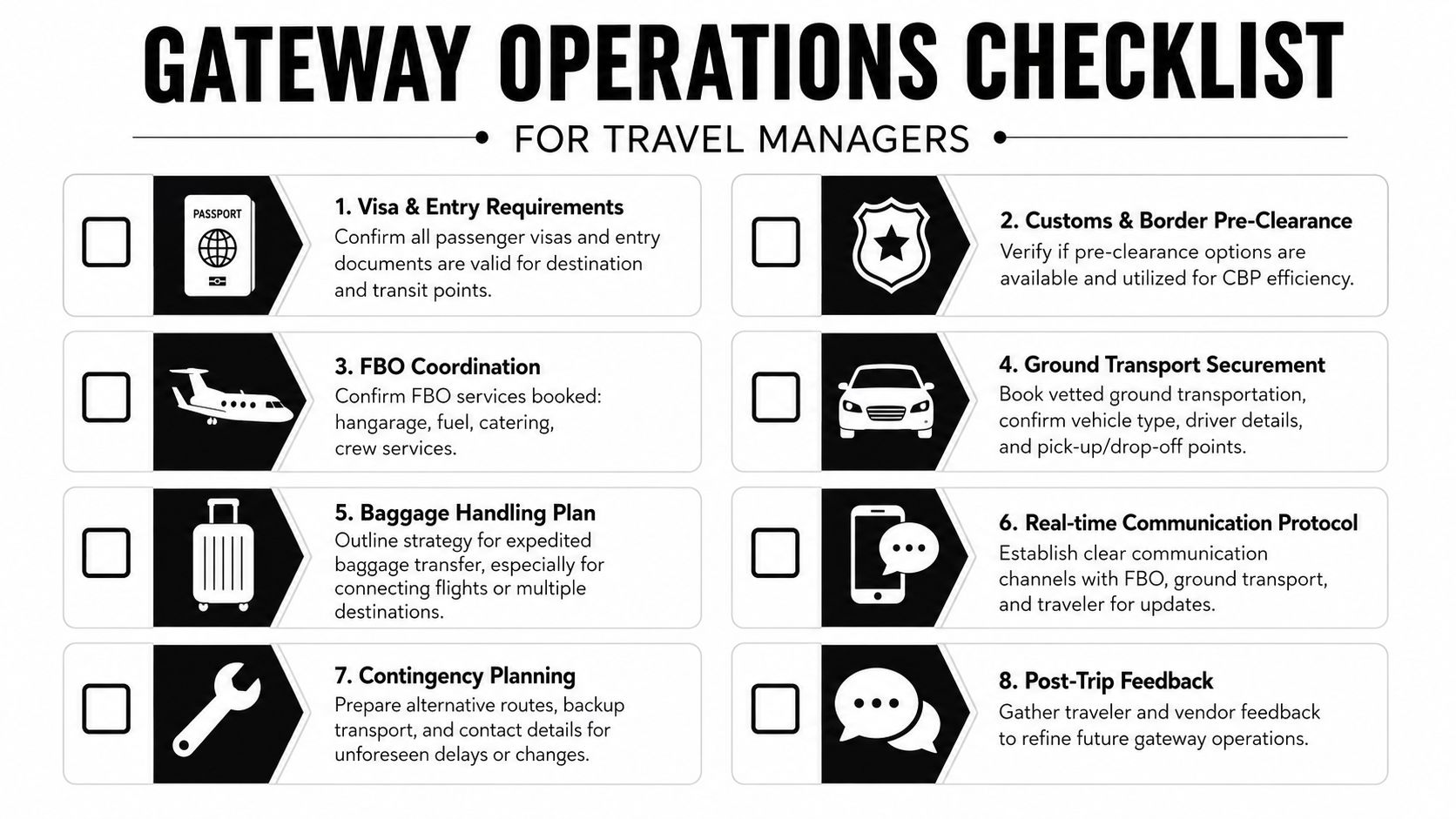
Used properly, a checklist does more than prevent mistakes. It gives everyone a common operating picture during the most compressed part of the journey.
When executive travel runs through the International Gateway of the Americas, the difference between smooth and stressful usually comes down to ground execution. MLR Worldwide Service supports that critical window with discreet chauffeur operations, FBO-aware airport transfers, real-time coordination, and global consistency for complex itineraries. If your team needs a transport partner that understands how gateways work on the ground, MLR is built for that job.