
Your traveler lands after an overnight flight, walks into a crowded arrivals hall, and can't confirm which car is theirs. The driver's name doesn't match the booking note. The local dispatcher isn't answering. The meeting starts in less than an hour, and your executive is now burning time, attention, and trust before the workday even begins.
That's not a transportation problem. It's a business failure.
Most new travel managers make the same mistake. They treat international ground transportation like a line item to be minimized instead of an operational function to be controlled. That mindset creates missed meetings, security exposure, billing chaos, and avoidable friction for the people your company can least afford to slow down.
If you need a basic primer on the category itself, start with this overview of ground transportation services. Then move past the basics quickly. Executive transport across borders isn't about getting a car. It's about protecting schedule integrity, duty of care, and executive productivity at every handoff.
Beyond the Black Car Redefining Ground Transportation for Global Business
A black sedan at the curb means nothing if the operation behind it is weak.
The executive travel teams that perform well think differently. They don't ask, “Who can pick up at the airport?” They ask, “Who can manage the full chain of custody from wheels down to final destination without creating risk?” That's the correct question, especially when the traveler is a board member, private aviation client, investor, or regional leader moving through multiple jurisdictions.

The market reflects that reality. The global corporate ground transportation market reached $128.4 billion in 2026 and is projected to reach $167.2 billion by 2030, according to this 2026 corporate ground transportation market report. Companies don't invest at that scale because cars are glamorous. They invest because reliable air-to-ground connectivity protects business continuity.
What leaders are actually buying
They're buying outcomes:
- Time protection: The executive arrives ready, not rattled.
- Operational control: Dispatch, routing, and schedule changes stay coordinated.
- Liability reduction: Providers follow documented procedures instead of improvising on the curb.
- Brand discipline: Clients, investors, and partners see a company that operates cleanly.
Practical rule: If a provider can't explain its process for flight monitoring, driver assignment, identity confirmation, and exception handling, you're not buying a service. You're buying hope.
Travel managers who understand this stop comparing premium international ground transportation to commodity ride-hail. That's the wrong benchmark. The right comparison is between a managed logistics program and a loosely connected set of local bookings.
Why this matters at the strategy level
A missed pickup before a negotiation. A confused arrival in a non-English-speaking market. A route change handled badly during a political protest. These aren't edge cases. They're the exact moments when transport quality shows up on the P&L through lost time, distracted executives, and preventable exposure.
Ground transportation sits in the middle of security, mobility, and executive effectiveness. Treat it accordingly.
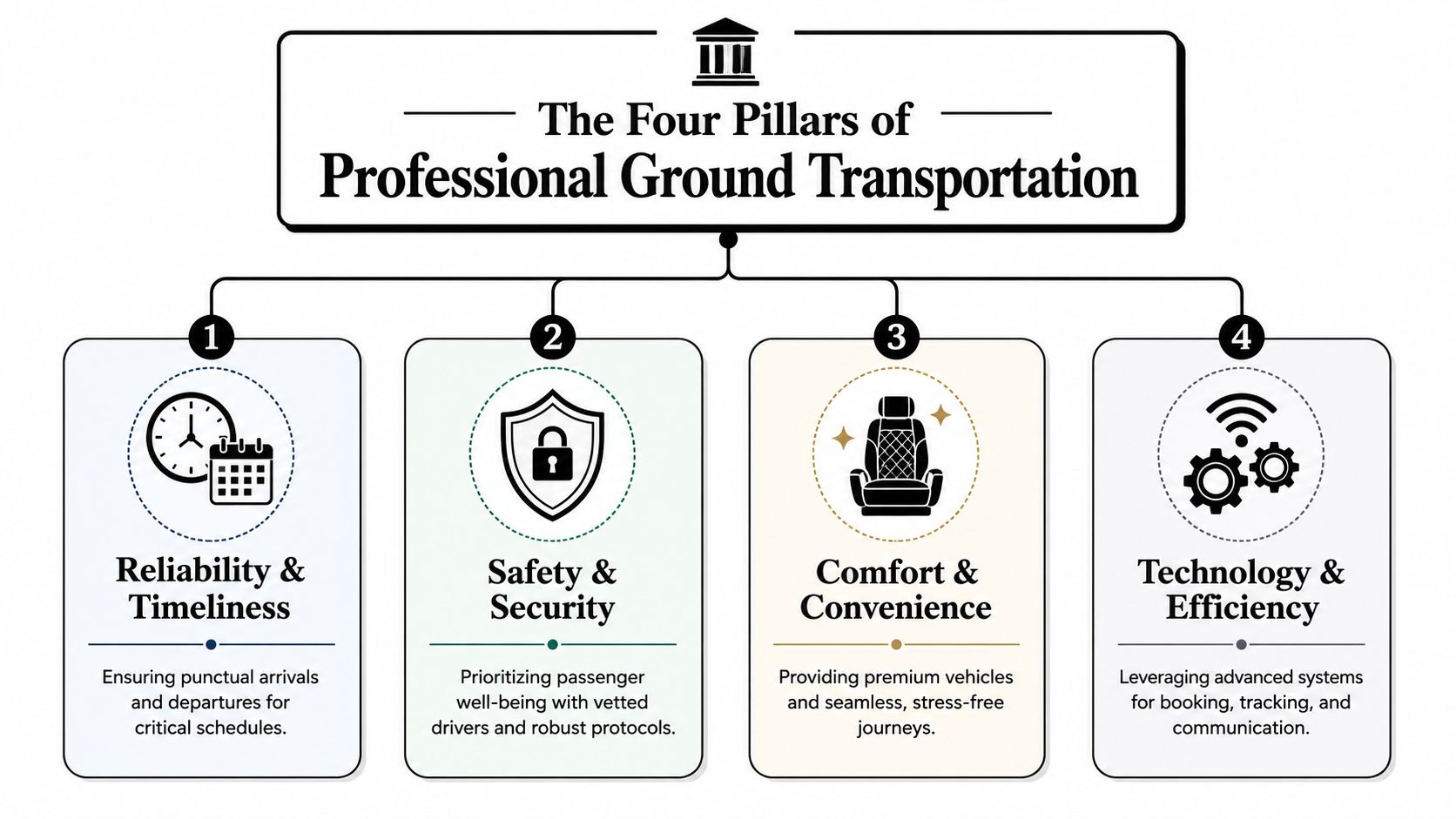
The Four Pillars of Professional Ground Transportation
Professional international ground transportation rests on four pillars. If one fails, the whole program degrades. Reliability without security is reckless. Security without communication is unusable. Comfort without operational discipline is cosmetic.
The market is moving toward premium, managed service for a reason. The airport ground transportation sector is projected to grow from $25.8 billion in 2025 to $40.5 billion by 2035, and cars held 40.0% of the sector's value in 2025, according to this airport ground transportation sector analysis. Executive travelers still prefer controlled sedan and SUV service because predictability beats novelty.
Executive chauffeur services
A chauffeur isn't just a driver in a suit. In a well-run program, that person functions like a mobile extension of the traveler's office.
The best chauffeur services handle timing buffers, discreet arrivals, luggage flow, route familiarity, and client preferences without being asked twice. That matters on roadshows, investor days, and multi-stop itineraries where small delays stack quickly.
A rideshare driver gets someone from point A to point B. A professional chauffeur supports the schedule.
Airport and FBO transfers
Airport pickup sounds simple until it isn't. Commercial terminals create congestion, delayed baggage, customs variability, and pickup-zone confusion. FBO work adds tail number coordination, ramp access protocols, and tighter timing windows.
This pillar is about controlled handoff.
- Commercial airport transfers: Need flight tracking, terminal awareness, and curbside contingency planning.
- FBO transfers: Need precision, discretion, and coordination with private aviation teams.
- International arrivals: Need extra attention to immigration timing and communication methods.
A clean airport transfer should feel uneventful to the passenger. That calm experience comes from heavy operational work behind the scenes.
VIP secure transport
Inexperienced buyers often get into trouble. They assume “VIP” means a nicer vehicle. It doesn't. It means the transport plan reflects the traveler's profile, destination risk, route conditions, and exposure level.
Secure transport may require stricter driver vetting, hardened communication protocols, advance route review, reduced curbside dwell time, and a tighter chain of accountability. Not every trip needs that level. High-value or high-visibility travel often does.
Corporate and crew movements
Moving one executive is different from moving a team, and both are different from moving airline crew under irregular operations.
Here's the distinction:
| Service type | Primary challenge | What a professional operator manages |
|---|---|---|
| Executive movement | Time sensitivity and discretion | Individual preferences, direct routing, schedule protection |
| Corporate group movement | Sequencing and coordination | Staggered arrivals, manifests, venue timing, communication |
| Crew transportation | Operational continuity | Fatigue awareness, dispatch accuracy, irregular event response |
If a provider can't handle all four pillars with documented consistency, it isn't ready for serious global work.
Navigating Global Operations and Cross-Border Compliance
Most transport failures happen before the vehicle ever arrives.
They happen in vendor onboarding, local affiliate oversight, insurance gaps, dispatch handoffs, weak passenger data handling, and poor coordination between air and ground teams. A new travel manager usually sees the booking interface. The underlying work sits behind that interface.
Duty of care is operational, not theoretical
When your company sends an employee, executive, or contractor across borders, you take on a duty-of-care burden whether you discuss it internally or not. You need to know who's moving the traveler, how that provider was vetted, what happens when plans shift, and who can intervene in real time.
That means your transport program needs documented answers to questions like these:
- Who owns the booking after hours? A web form isn't an answer.
- Who monitors the flight and local conditions? If no one does, the traveler absorbs the failure.
- Who has authority to reroute or replace the vehicle? Delay kills productivity when nobody can make a decision.
This is why strong travel teams prefer centralized control over fragmented local bookings. You want one accountable operating model, not five local interpretations of service.
Mode changes create friction and delay
Transfers break down when travelers have to stitch together too many modes on the fly. That's not just inconvenient. It's inefficient and risky.
Industry analysis found that eliminating the need to change travel modes can reduce transit latency by up to 35%, and airports with high-capacity freeways and dedicated transit systems achieve 50% faster ground-to-air connections, according to this transport planning analysis on mode transitions and airport access.
The lesson for a travel manager is simple. Choose providers that can build direct, controlled itineraries around the airport environment instead of forcing passengers into improvised transfers.
Cross-border compliance is where amateurs get exposed
An international operator has to manage local licensing, insurance expectations, subcontractor standards, passenger data handling, and communication protocols across very different legal environments. You don't need to become a transportation lawyer. You do need to ask the right questions.
Use this checklist when evaluating operational maturity:
- Insurance scope: Ask whether local operating partners meet required coverage standards in each market served.
- Data handling: Confirm how traveler names, itineraries, phone numbers, and driver details are stored and shared.
- Affiliate governance: Require a clear process for vetting and monitoring local partners.
- 24/7 control room capability: Confirm that live humans can intervene when flights divert, meetings run late, or border crossings slow down.
For teams managing recurring international travel, this broader guide to international corporate travel is useful context. The point isn't to create bureaucracy. It's to reduce avoidable volatility.
The traveler should experience simplicity. The operator should carry the complexity.
The Critical Role of Security and Risk Mitigation Protocols
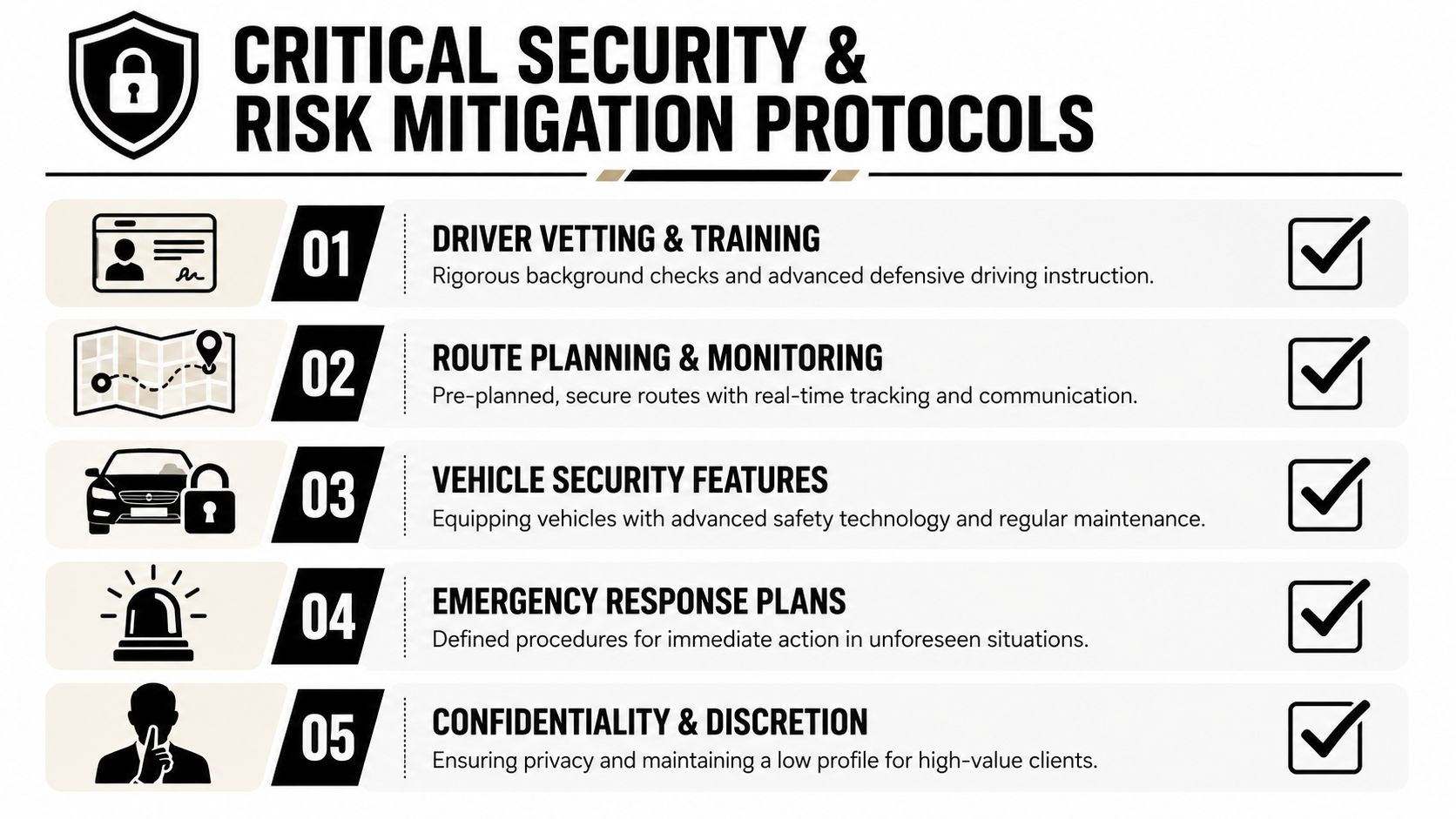
If you remember one thing, remember this. Security is not an add-on in international ground transportation. It is the foundation.
Comfort matters. Vehicle quality matters. None of it matters if your traveler gets into the wrong car, waits exposed at a curb, or rides with a provider that can't prove its operating controls.
The benchmark you should enforce
Security experts use a three-part benchmark for provider selection: threat-pattern assessment, verification of trusted provider status, and thorough operational vetting. They also state that failing to confirm driver and vehicle details before arrival increases the risk of security breaches by 40%, as outlined in this NBAA guidance on international ground transportation security.
That gives you a practical procurement standard.
Threat-pattern assessment
Don't book transport in a sensitive market as if it were a routine suburban airport run. Review destination conditions, protest activity, crime patterns, airport pickup norms, and route sensitivity.Trusted provider verification
“Known locally” is not enough. You need documented provider status, named operating entities, and a chain of accountability if the local affiliate underperforms.Operational vetting
Many providers struggle at this stage. The traveler should receive the driver name, vehicle type, color, and plate details in advance whenever the operating environment requires it.
What proper vetting looks like
A secure transport program goes beyond basic driver assignment.
- Driver readiness: Experience, professionalism, and training appropriate to the route and traveler profile.
- Vehicle control: Late-model, well-maintained vehicles with clean presentation and no surprise substitutions.
- Communication discipline: Real-time contact between dispatcher, driver, and passenger support team.
- Contingency planning: Alternate routes, escalation paths, and replacement procedures.
- Discretion: No unnecessary signage, chatter, or exposure of passenger identity.
Don't ask a provider if it is “safe.” Ask how it verifies the driver, confirms the car, monitors the route, and escalates irregular events.
For travelers who need a tighter protection model, this overview of VIP transportation service standards outlines the difference between premium transport and controlled movement.
Where companies get this wrong
They over-focus on visible luxury and under-focus on invisible process. Leather seats don't mitigate risk. Verification does. Dispatch discipline does. Pre-arrival confirmation does. So does having an operator that can make fast decisions when the local environment changes.
If your company moves senior leadership internationally, security protocol isn't a premium feature. It's part of corporate responsibility.
How to Vet Vendors and Understand SLAs
You don't need more vendor pitches. You need a filter.
A ground transportation provider should survive a hard operational review before it gets anywhere near your travelers. If the vendor can't answer directly, move on. Polished sales language usually hides weak process.
What to ask before you sign
Start with capability, not price.
- Global coverage model: Ask which cities are served directly, which rely on affiliates, and how those affiliates are vetted.
- Dispatch structure: Ask whether live operations support is available around the clock and who owns escalations.
- Vehicle standards: Ask how vehicle age, cleanliness, substitution policy, and class consistency are managed.
- Flight monitoring: Ask who tracks delays, early arrivals, diversions, and rolling customs timing.
- Billing controls: Ask whether billing is centralized, itemized, and auditable across markets.
Then push into the uncomfortable questions. Those answers tell you whether the operator is real.
What to require in the SLA
An SLA without specifics is decoration. Put the commitments in writing.
Here's a practical framework:
| SLA area | What to require |
|---|---|
| Pickup execution | Defined wait-time rules, meet-and-greet procedure, and flight-monitoring responsibility |
| Driver and vehicle confirmation | Advance delivery of booking details, escalation path for mismatches, substitution policy |
| Service recovery | Replacement timeline, dispatch escalation, and communication protocol when service breaks |
| Data and privacy | Clear handling of traveler information and restricted sharing with local partners |
| Reporting | Regular service reviews, incident logs, and billing transparency |
What strong operators do differently
They document everything that weaker providers leave vague. They define exception handling. They standardize affiliate oversight. They know that consistency matters more than theatrical hospitality.
One option in the market is MLR Worldwide Service, which offers executive chauffeur service, airport and FBO support, crew transport, and a vetted affiliate network coordinated by a 24/7 concierge operations team. That's the kind of operating model worth evaluating because it addresses control, not just booking volume.
Buy against failure modes. Don't buy against the brochure.
Red flags that should end the conversation
Watch for these immediately:
- No clear operating owner: If nobody owns the trip once booked, service will break under pressure.
- Loose affiliate language: “We know people everywhere” is not a compliance model.
- Vague security answers: If the provider can't explain pre-arrival verification, don't hand over executive movements.
- Inconsistent billing logic: If finance can't reconcile charges cleanly, the relationship won't scale.
- Overreliance on app convenience: Visibility is useful. It doesn't replace accountability.
A good SLA protects time, safety, and governance. That's why it matters.
International Ground Transportation in Action The MLR Worldwide Approach
Theory is easy. The test is what happens when the trip stops being routine.

Multi-city roadshow under schedule pressure
A senior commercial team is moving through three cities in two days. The calendar changes twice before lunch. One meeting runs over. Another gets moved across town. The wrong transport setup here creates a domino effect of delays, missed prep time, and executives taking calls from curbs and back seats.
The right setup looks different. Dispatch monitors each leg, updates chauffeurs in sequence, and preserves direct routing without forcing the travelers to manage logistics themselves. The traveler experiences continuity. Operations absorbs the volatility.
CEO arrival in a sensitive market
A CEO lands at a private aviation facility in a market where curbside ambiguity isn't acceptable. There's no room for improvisation, no tolerance for driver confusion, and no benefit in making the arrival visible.
The trip succeeds because the pickup chain is tight. Driver identity is confirmed in advance. Vehicle details are transmitted early. Route planning is handled before wheels down. The chauffeur knows the protocol, and the operations team stays reachable if conditions shift.
That's the difference between premium appearance and actual executive transport discipline.
Airline crew movement during disruption
A weather event compresses timelines and scrambles standard movement plans. Crew still need to get where they're going, and they need to do it without adding fatigue or operational confusion.
Process matters more than presentation. Dispatch works from a live manifest, sequences vehicles by priority, updates arrivals in real time, and manages substitutions when the plan changes. The objective isn't elegance. It's continuity.
What these situations have in common
Each scenario punishes weak systems. Each one rewards centralized control, vetted local execution, and real humans who can solve problems quickly.
The lesson for a travel manager is straightforward:
- Routine trips hide weak vendors
- Irregular operations expose them
- Executive travel needs an operator, not just a booking tool
That's why international ground transportation belongs inside your broader corporate mobility strategy. It's one of the few travel categories where a quiet success usually means serious operational discipline was present from start to finish.
Your Questions on Global Ground Transport Answered
How do I reduce confusion at arrival in non-English-speaking markets
Require pre-arrival transparency as a standard, not a favor. That means confirmed driver name, vehicle description, and a communication method the traveler can use on arrival. 45% of executive arrivals in non-Western hubs experience ambiguity or uncertainty at the terminal due to mismatches between promised and actual vehicles, based on the verified data provided for this article.
If a provider can't reliably deliver that information, don't use it for executive travel.
Is a global network better than booking local providers city by city
Yes, if the network is governed. A managed network gives you one operating standard, one escalation path, and one billing structure. Piecing together local vendors can work for low-risk trips, but it creates inconsistency fast. That inconsistency usually shows up in communication, vehicle quality, and accountability when plans change.
What belongs in every executive transport policy
Keep it tight. Require vetted providers, advance confirmation of driver and vehicle details when appropriate, live operational support, documented escalation procedures, and centralized billing review. If any one of those is missing, your policy has a hole in it.
When should I upgrade from standard chauffeur service to secure transport
Upgrade when the traveler profile, destination risk, visibility level, or local operating environment justifies tighter controls. Don't wait for a bad incident to make that call. If there's meaningful uncertainty around the arrival, route, or provider chain, move to a more secure operating model.
A transport policy should protect the traveler before the trip feels difficult, not after something goes wrong.
International ground transportation isn't a commodity purchase. It's a control function that protects time, reduces exposure, and helps your executives stay productive across borders. Treat it like strategy, write requirements like operations, and buy it with the same discipline you'd use for any other business-critical vendor.
If your organization needs a tighter standard for executive mobility, MLR Worldwide Service is worth reviewing for international chauffeur travel, airport and FBO coordination, VIP transport, group logistics, and airline crew movements managed through a centralized global operations model.