
The email lands first. The CEO's flight is early, the FBO has moved the arrival stand, security wants a tighter curbside plan, and the chauffeur booked through a one-off provider hasn't checked in. Your executive assistant is calling operations, the traveler is texting from the air, and you're left solving a problem that should never have reached your desk.
That's the moment many corporate travel managers decide ad-hoc ground transport isn't a strategy. It's a gamble.
For routine airport transfers, you can sometimes absorb inconsistency. For executive transport, you can't. FBO movements, board meetings, roadshows, sensitive itineraries, and cross-border VIP movements require a supplier relationship that's already defined, tested, and accountable before the first wheels touch the ground.
Beyond Ad-Hoc Bookings The Case for Strategic Partnerships
A missed pickup for a junior employee is inconvenient. A missed pickup for a board member arriving at a private terminal is an operational failure.
In executive transport, the risk isn't limited to lateness. It includes traveler safety, privacy, misaligned meet-and-greet procedures, weak affiliate handoffs, billing disputes, and a service team that disappears the moment the booking gets complicated. That's why experienced travel teams move away from one-off sourcing and toward preferred vendor agreements.
A preferred vendor agreement is a formal, legally binding contract that creates an exclusive or prioritized relationship between the buyer and a pre-approved supplier. In practice, that means the company doesn't start from scratch every time a trip is booked. The vendor is already vetted, service standards are documented, pricing logic is established, and escalation paths are clear. For a broader primer on the category itself, this overview of what ground transportation includes is a useful reference.
Control is the primary value. A well-written PVA sets obligations, payment terms, pricing structures, and termination rights in advance. It also reduces unauthorized off-policy buying because travelers and assistants already know which provider to use. Sirion's vendor agreement guidance notes that benchmarking clauses tied to external market indices can reduce cost volatility by 12–18% over multi-year contracts when compared with static pricing models, which is one reason strategic buyers treat these agreements as risk management tools rather than simple rate sheets (Sirion on vendor agreement structure).
What changes when the vendor is pre-approved
Instead of reacting trip by trip, the travel manager can operate from a defined playbook:
- Service obligations are documented: Pickup windows, status updates, chauffeur standards, and billing rules are agreed before problems occur.
- Compliance is handled upfront: Insurance, certifications, data handling, and supplier onboarding are completed once, not reinvented under pressure.
- Continuity improves: The provider has a commercial reason to protect the relationship because the work is recurring, not incidental.
Practical rule: If the transport plan matters enough to brief security, legal, or the executive office, it matters enough to put under contract.
The strongest preferred vendor agreements don't just buy rides. They buy reliability under pressure.
Evaluating the Benefits and Hidden Risks of Exclusivity
Exclusivity can make a travel program cleaner, faster, and more predictable. It can also create blind spots if the contract is poorly designed.
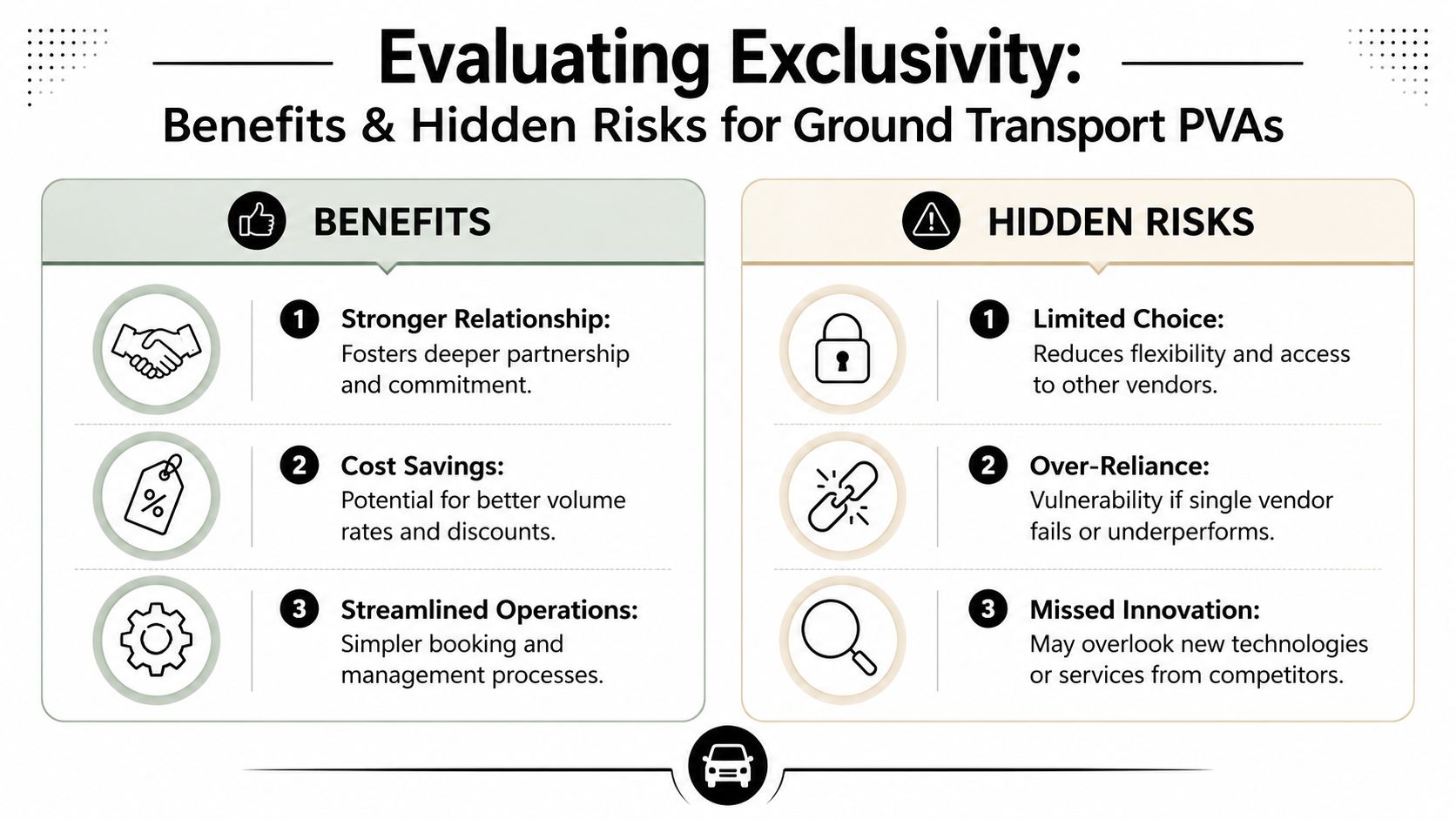
The upside is obvious to anyone managing frequent executive movements. One vendor means fewer booking pathways, fewer billing formats, and one standard for chauffeur conduct, vehicle quality, airport procedures, and after-hours escalation. That consistency matters when assistants are booking for multiple leaders across different cities and time zones.
Where exclusivity helps
A preferred relationship usually improves day-to-day execution in three ways:
| Area | What works in practice |
|---|---|
| Booking control | Coordinators know exactly which provider to use and what service levels to expect. |
| Service consistency | Chauffeur etiquette, airport signage protocol, and vehicle standards become repeatable. |
| Commercial leverage | Volume can be exchanged for better terms, softer cancellation treatment, and stronger support. |
Those gains are especially valuable in executive transport because the service isn't just logistical. It's reputational. The traveler judges your program by whether the handoff from air to ground feels effortless.
The hidden exclusivity trap
The problem appears during disruption, not during ordinary weekdays.
Research on preferred vendor agreements in ground transportation points to a hidden exclusivity trap. 68% of service failures in ground transportation occur when preferred vendors cannot meet demand due to over-commitment, and many agreements don't include clear force majeure or capacity override clauses (analysis of preferred vendor agreement risks). That's the scenario corporate travel teams underestimate. They believe they have a preferred vendor, but the contract effectively punishes them for sourcing outside the agreement when the vendor has no cars left.
That risk is sharper in executive transport than in commodity categories. FBO peaks, major conferences, weather events, high-security movements, and citywide sellouts can consume capacity quickly. If your agreement grants exclusivity without an operational escape hatch, the contract can protect the vendor more than the traveler.
Don't ask only, “What discount do we get?” Ask, “What happens at 10:30 p.m. when the flight diverts, the arrival terminal changes, and your local fleet is full?”
How to protect the buyer
A practical exclusivity model includes guardrails:
- Define emergency release rights: The buyer must be able to use a non-preferred provider during capacity shortages without breach.
- Set priority-service language carefully: Priority should mean real dispatch preference, not a marketing promise.
- Test reliability, not just coverage claims: A broad footprint on paper means little if local delivery is inconsistent.
- Require backup planning: The vendor should explain how it handles overflow, affiliate substitutions, and high-demand windows.
A preferred vendor can absolutely be the right model. It just has to be exclusive in a controlled way, not in a fragile way.
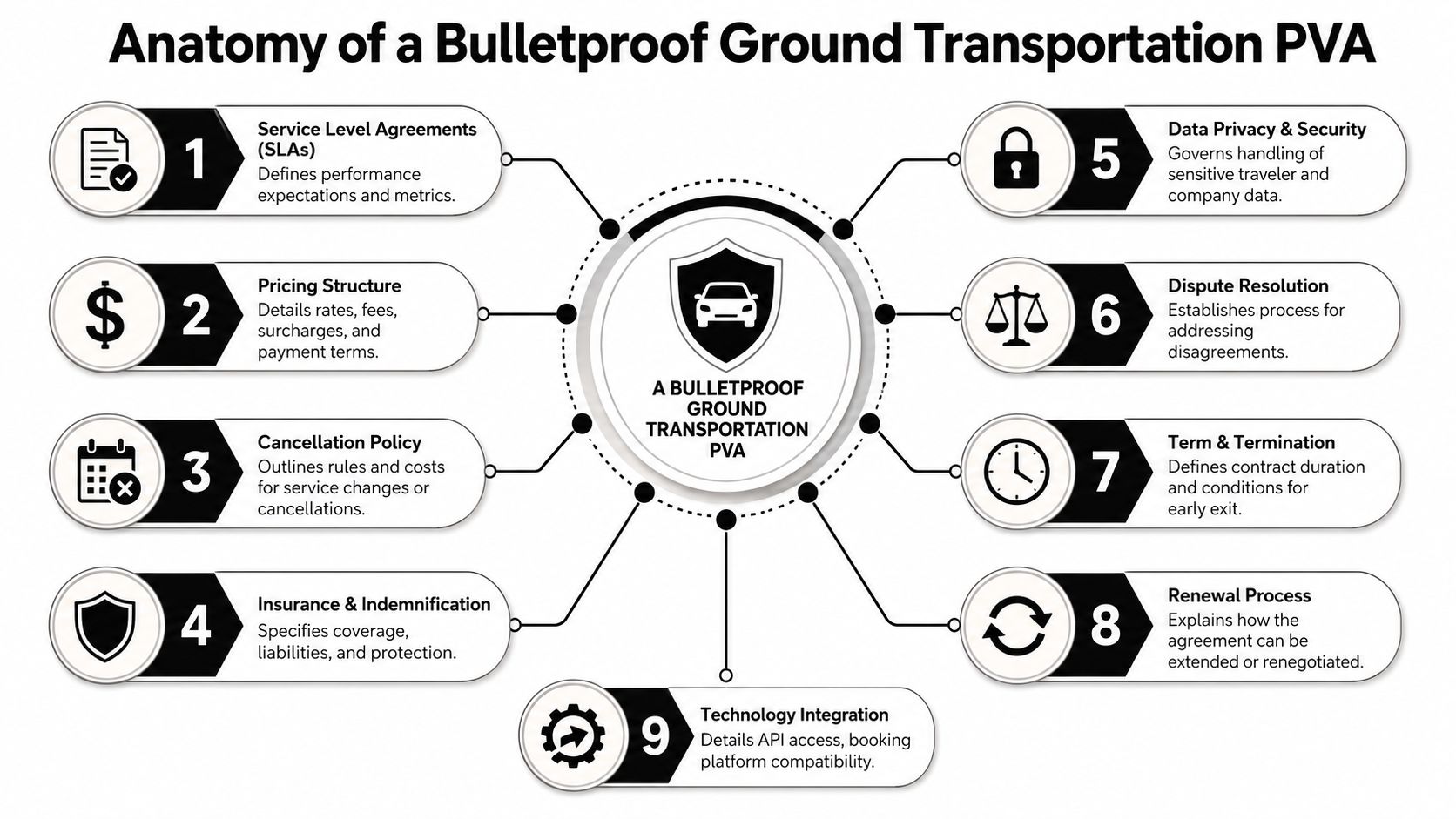
Anatomy of a Bulletproof Ground Transportation PVA
Most transport contracts fail in familiar places. The service description is vague. Pricing looks simple until wait time, airport changes, and overtime show up. The vendor promises global capability, but the affiliate standard is undefined. Then the first high-pressure itinerary exposes every loose clause.
A strong agreement fixes that before launch.
If you're comparing providers, this guide to evaluating ground transportation companies helps frame the commercial and operational questions before they become contract language.
Scope of services
This clause should describe exactly what the vendor will deliver. “Ground transportation services” is not enough.
Spell out airport transfers, FBO pickups, as-directed hourly service, roadshows, event transport, secure transport support, meet-and-greet procedures, and any special handling for minors, family office travelers, or executive protection teams. If the program is global, define whether service is delivered directly, through owned operations, or via affiliates.
A good scope section also identifies what is excluded. If armored vehicles, multilingual chauffeurs, or medical support vehicles require separate quoting, say so.
Service level agreements
SLAs are where a PVA becomes enforceable rather than aspirational.
Define what counts as on time, how chauffeur status updates are delivered, who confirms airport tail tracking, and how quickly the operations desk must respond to itinerary changes. In executive transport, service quality also includes softer but critical standards such as attire, discretion, route discipline, and passenger communication.
Use plain language. If a missed FBO meet creates immediate escalation, the contract should say that directly.
Operational note: If an SLA can't be measured by the buyer or evidenced by the vendor, it usually won't be enforced.
Pricing structure
This is the clause buyers often underestimate.
Base rates are only one part of total spend. The agreement should define wait time, grace periods, no-shows, airport parking, tolls, extra stops, late-night charges, holiday treatment, affiliate markups, and billing for security-driven route changes. For high-variance services, static discounting isn't enough.
Include benchmarking clauses so rates can be reviewed against external market conditions instead of staying frozen until one side forces a reset. In preferred vendor agreements, these clauses can reduce cost volatility by 12–18% over multi-year terms when compared with static pricing models, according to Sirion's contract analysis. In transport categories exposed to fuel, congestion, and event pressure, that's a practical safeguard, not a legal flourish.
Cancellation policy
This section needs more nuance than many templates provide.
An executive charter arrival can move suddenly. A board dinner can run late. A principal can decide to add a security vehicle after landing. If the cancellation language is rigid, your company pays for operational reality twice.
Address:
- Standard cancellations: What happens for routine itinerary changes.
- Airport and FBO delays: Whether flight movement changes reset cancellation windows.
- Roadshow scheduling shifts: How same-day revisions are priced.
- Weather and disruption events: Whether penalty relief applies when the traveler cannot reasonably proceed.
Insurance and indemnification
This clause should be reviewed with legal and risk teams, but procurement still needs to drive the operational specifics.
Require evidence of relevant insurance and define indemnity obligations around driver conduct, vehicle incidents, subcontracting, and third-party claims. In executive transport, the key question is simple: if something goes wrong during a sensitive movement, does the contract clearly state who is responsible for what?
Data privacy and security
Ground transport vendors often receive more sensitive information than buyers realize. Passenger names, mobile numbers, tail numbers, hotel details, private residence addresses, and executive schedules all move through the booking chain.
The agreement should define how booking data is stored, who can access it, how long it's retained, and what happens if an affiliate is involved. If the traveler profile includes protective intelligence concerns, generic privacy wording won't be enough.
Dispute resolution
If the only dispute mechanism is “parties will confer in good faith,” you don't have much of a mechanism.
A workable clause sets a sequence. First operational review, then management escalation, then formal dispute handling if needed. That structure matters because many transport conflicts are small individually but corrosive over time: recurring billing disputes, repeated late statuses, affiliate substitutions without notice, or charges outside the agreed schedule.
Term and termination
Longer terms can support better pricing and stronger service commitment, but only if exit rights are real.
Define termination for cause, termination for repeated service failure, and termination for compliance breaches. If the vendor changes ownership, loses key licenses, or materially alters the affiliate network, the buyer should have review rights and, if necessary, an exit path.
Renewal process and technology integration
Renewal shouldn't be automatic because nobody noticed the date. The process should trigger a structured review of service performance, stakeholder feedback, pricing, and geographic coverage.
Technology language matters too. If your company books through an online booking tool, expense platform, API, or concierge desk, the vendor should support the workflow you use. Require clarity on booking channels, traveler profile handling, status messaging, invoice formatting, and service data needed for reporting.
A bulletproof PVA doesn't try to predict every possible trip. It defines enough detail that the unusual trip can still be handled without improvising the contract in real time.
Negotiation Strategies for True Partnership
The worst transport negotiations focus on one number and ignore everything that makes the service usable.
A lower base rate won't help if the vendor is inflexible on airport wait time, slow on after-hours support, or vague about affiliate standards in the cities your executives visit. Good negotiation treats price as one term among many. The better question is what total operating value the agreement creates.

Trade volume for usable concessions
If your program has meaningful volume, ask for benefits that remove friction for coordinators and travelers:
- Extended wait time: Especially for commercial arrivals, customs variability, and FBO delays.
- More flexible cancellation treatment: Useful for board calendars and private aviation changes.
- Vehicle class protection: If the booked class is unavailable, the upgrade path should be defined.
- Dedicated escalation access: Named contacts or direct operations pathways for high-priority trips.
These terms often matter more than an aggressive headline discount because they prevent exception costs and internal firefighting.
Negotiate dynamic pricing directly
Many corporate buyers still try to force executive ground transport into a fixed-price structure even when the demand pattern is anything but fixed. That's where disputes start.
Persuadius notes that 54% of corporate ground transport spend occurs in volatile scenarios requiring surge pricing, while only 12% of sampled agreements include tiered pricing models tied to real-time demand data (preferred vendor program guidance on dynamic pricing). In practice, that means many contracts are written for the easy trips and break down on the expensive ones.
A better approach is to negotiate the rules, not deny reality. Define which scenarios can trigger pricing adjustments, what data inputs are acceptable, whether caps apply, and which services stay fixed no matter what. Emergency chauffeur deployments, event peaks, and multi-city roadshows should not be left to goodwill.
Ask questions vendors can't answer with marketing
At the table, avoid broad prompts like “Tell me about your global network.” Ask narrower questions:
| Better question | Why it matters |
|---|---|
| How do you approve and monitor affiliates? | It exposes whether consistency is managed or assumed. |
| Who can authorize a substitution? | It prevents silent service downgrades. |
| What happens when an FBO arrival changes with little notice? | It tests real operational depth. |
| How are VIP and security-sensitive bookings flagged internally? | It reveals whether discretion is procedural or informal. |
Partnership doesn't mean being soft in negotiation. It means both sides leave with terms they can actually perform.
The strongest deals aren't the ones where the buyer squeezes hardest. They're the ones where the contract reflects how executive transport really operates.
Successful Rollout and Program Governance
Signing the agreement is the easy part. Getting travelers, assistants, event teams, finance, and security stakeholders to use it correctly is where preferred vendor agreements either work or fade into policy shelfware.
A preferred vendor program succeeds when the approved supplier becomes the path of least resistance. That requires communication, system alignment, and regular governance. Preferred vendor programs support compliant, efficient purchasing and create better pricing, standardized terms, and stronger supplier relationships when the approved vendor catalog is centrally accessible and easy to use (GEP on preferred vendor program execution).
Roll out the program like an operational change
Don't circulate the contract and assume adoption will follow.
Build a launch package for the people who place bookings. That usually includes executive assistants, travel coordinators, office managers, event planners, procurement, accounts payable, and any security or aviation desk involved in traveler movements. A practical reference point is a documented corporate travel policy template that states when the preferred provider must be used, who can approve exceptions, and how urgent requests are escalated.
Use a short rollout checklist:
- Clarify booking channels: State whether travelers book through a portal, app, email desk, phone line, or approved arranger.
- Publish service scope: Tell users what the program includes and when they need special authorization.
- Explain exception handling: If the preferred vendor can't serve a trip, users need a clear backup process.
- Align finance rules: Invoice coding, cost centers, and reconciliation methods should be standardized from day one.
Govern performance, not just spend
A mature program reviews whether the vendor is meeting the service standard promised during the sourcing process.
Procurement teams often get the best results from scheduled business reviews with a fixed agenda. That agenda should include service failures, root causes, resolution speed, invoice accuracy, traveler complaints, recurring itinerary pain points, and affiliate performance in critical cities. The conversation should be specific. “Service was inconsistent in Europe” is too vague. “Status updates broke down on late-night arrivals routed through affiliates” is actionable.
GEP's analysis also notes that preferred vendor programs rely on rigorous vetting, including a minimum reliability score of 95%, which correlates with a 30% decrease in supply chain disruptions and a 15% improvement in overall service quality. In ground transport, that principle translates well. Prefer vendors whose reliability can be demonstrated, not merely claimed.
Keep the catalog current
Programs drift when the approved supplier list becomes stale.
Review whether the vendor still fits your traveler profile, city mix, security expectations, and booking technology. If executive travel patterns shift toward new hubs, heavier FBO usage, or more event-driven demand, the preferred program should adjust. Governance isn't bureaucratic overhead. It's how you stop a once-good agreement from becoming misaligned with the trips your company needs to move.
Your Essential Executive Transport PVA Checklist
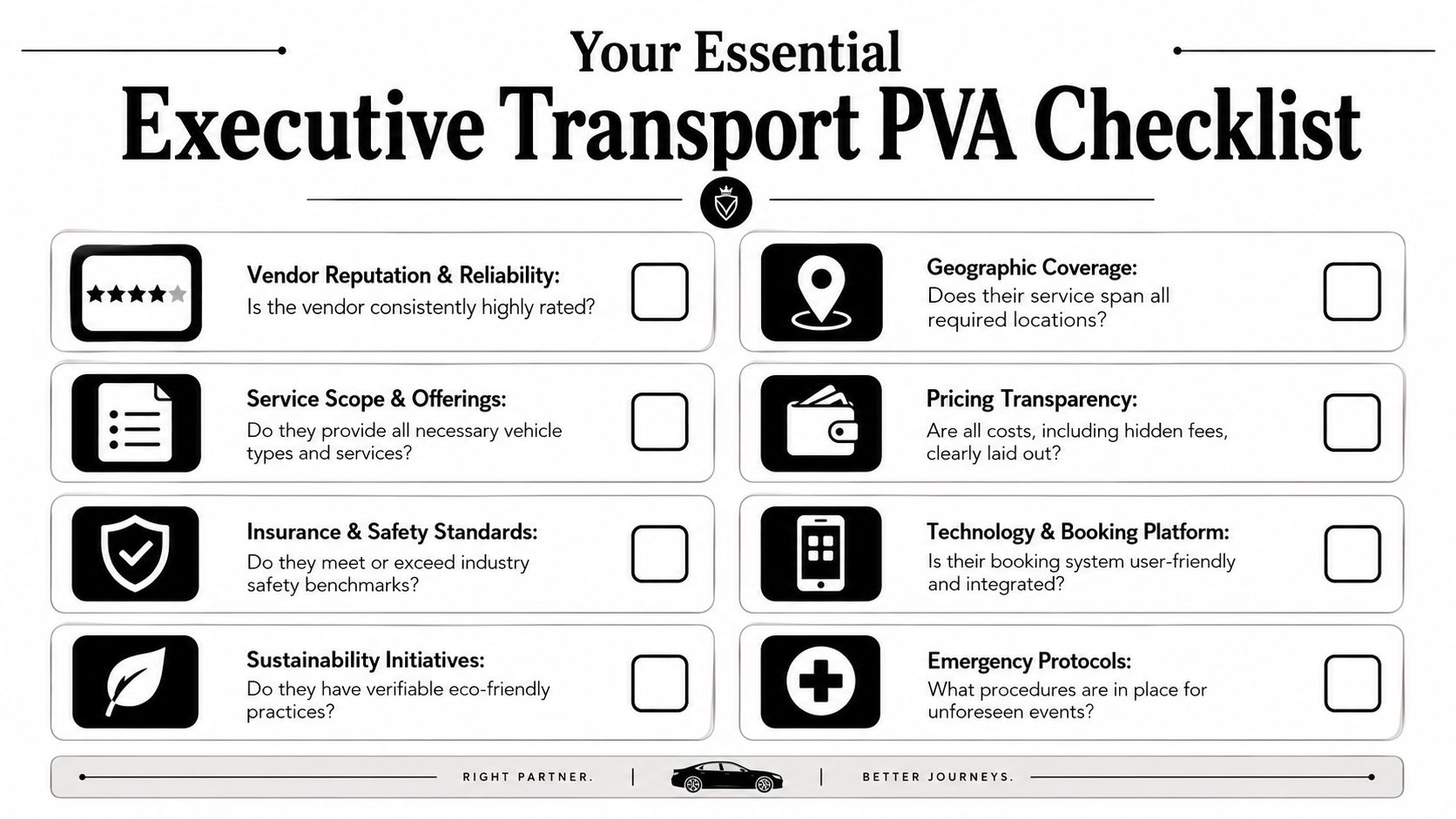
A strong transport contract is easier to assess when you stop reading it as legal prose and start reading it as an operating manual. The checklist below is the one I'd use before approving any executive ground transportation PVA.
What to verify before signature
- Reliability threshold is defined: The vendor should meet a 95% reliability score benchmark for preferential status, a level associated with a 30% decrease in disruptions and a 15% improvement in service quality in preferred vendor program analysis.
- Geographic coverage is real: Confirm where the vendor operates directly and where it relies on affiliates.
- Service scope is explicit: Airport transfers, FBO support, hourly service, roadshows, events, and secure transport protocols should all be named if they matter to your program.
- Pricing is transparent: Review wait time, parking, tolls, cancellation treatment, out-of-area charges, affiliate pricing, and event-related surcharges.
- Safety standards are documented: Verify driver screening, training expectations, vehicle maintenance practices, and incident reporting procedures.
- Data handling is spelled out: Traveler profiles, phone numbers, tail numbers, and executive itineraries should not move through a vague privacy clause.
- Emergency procedures exist: Check escalation paths for flight changes, missed meets, security concerns, vehicle substitutions, and citywide disruptions.
- Technology fit is practical: Make sure the booking method, status communication, and invoicing format work for your coordinators and finance team.
What often gets missed
The biggest misses are usually operational, not legal.
Buyers forget to ask who controls affiliate quality. They don't test the after-hours number before launch. They approve “equivalent vehicle” wording without defining what equivalent means. They accept exclusivity but fail to secure release rights when capacity disappears.
A transport PVA is only as strong as the clause you need at midnight in a city you don't control.
If a draft agreement can't answer how the vendor handles FBO changes, VIP privacy expectations, billing exceptions, and overflow demand, it isn't ready for executive use.
Building a Resilient Corporate Travel Program
Corporate travel programs break at the edges. They break on late changes, capacity shortages, global handoffs, security-sensitive itineraries, and vague supplier accountability. That's why preferred vendor agreements matter so much in executive transport. They turn a fragile booking process into a governed operating model.
The right agreement balances cost discipline with the things that can't be compromised: reliability, duty of care, privacy, and service consistency. It also accepts a basic truth about executive travel. The cheapest structure on paper can become the most expensive one in practice if it fails during a critical movement.
Resilience comes from design. It comes from defining service properly, negotiating real-world pricing logic, protecting the buyer against exclusivity risk, and governing the program after launch. Travel managers who do that well usually spend less time chasing exceptions and more time improving the traveler experience.
In an unpredictable operating environment, transactional buying isn't enough. Executive ground transportation works best when the vendor relationship is structured as a partnership with clear rules, measurable expectations, and room to respond when plans change fast.
If your team needs a ground transportation partner that understands executive travel, FBO coordination, VIP privacy, global affiliate consistency, and around-the-clock operational control, MLR Worldwide Service is built for that level of service. Reach out to discuss a preferred vendor agreement that supports your travel policy, protects your travelers, and performs reliably in the moments that matter most.