

Your CEO lands in Houston in two hours. The arrival time has already shifted once. The assistant wants a meet-and-greet, the security lead wants discretion, and the board dinner added an extra stop. If you're still comparing providers based on who has the shinier black sedan, you're solving the wrong problem.
A corporate buyer doesn't need a ride. You need a ground operation that protects time, absorbs disruption, and executes without forcing your team to babysit the trip. That's what separates a real luxury chauffeur service in Houston from a dressed-up car service.
Defining True Luxury Chauffeur Service in Houston
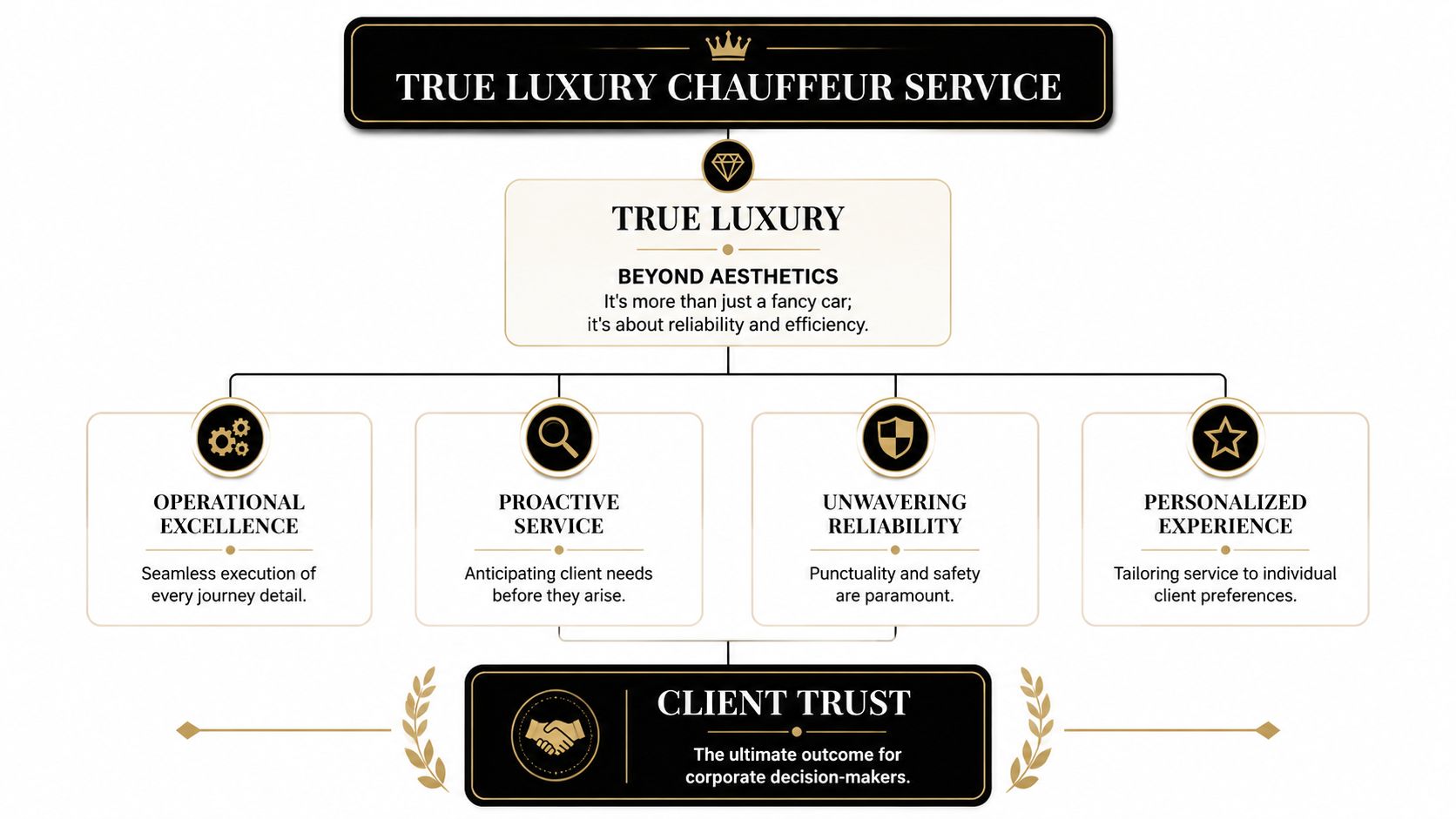
Your traveler does not care whether the cabin has bottled water if the pickup fails, the chauffeur misses a change, or dispatch goes quiet during a delay. In Houston, luxury starts with control. A top-tier provider protects the itinerary, communicates clearly, and keeps service standards intact when the day gets messy.
That distinction matters for corporate travel managers, executive assistants, and family office teams. Many of them use "luxury" as shorthand for a premium vehicle and a polished exterior. In practice, the standard should be much higher. You are buying judgment, discipline, discretion, and the ability to recover fast without creating more work for your team.
When a senior executive, investor, or VIP moves through a metro as large and traffic-sensitive as Houston, the vehicle is only one part of the service. The operating model matters more. You need punctual staging, accurate pickup instructions, route awareness, chauffeur professionalism, and a dispatch team that treats changes as routine work, not a disruption.
What genuine luxury looks like
A well-run luxury chauffeur service Houston program should deliver four things at once:
- Reliable execution: The chauffeur is early, the assigned vehicle matches the reservation, and the traveler receives clear pickup instructions before asking.
- Professional discretion: The chauffeur reads the room, communicates with restraint, and handles sensitive passengers without drawing attention.
- Operational awareness: Dispatch tracks flights, traffic, venue timing, and itinerary updates in real time.
- Consistent standards: Service quality holds up across airport runs, roadshows, client dinners, and multi-vehicle movements.
Consistency is where weak operators lose credibility. A local car service may handle a single airport transfer well on a light day. The test is whether the same company can support three executives, two schedule changes, a late-night return, and exact pickup coordination without missed messages or a drop in standards.
Practical rule: If a provider leads with vehicle photos and upgrade language, ask harder questions. Serious operators talk about chauffeur standards, dispatch coverage, communication protocols, safety procedures, and service recovery.
Stop buying a vehicle category
A black SUV is an asset. It is not a service model. Corporate buyers should evaluate the provider's operating discipline, because that is what determines whether the trip runs cleanly under pressure.
Use this lens when reviewing any vendor:
| What weak providers sell | What strong providers deliver |
|---|---|
| A premium vehicle | A controlled itinerary |
| A driver assignment | A trained chauffeur with clear standards |
| A scheduled pickup | Active trip monitoring and adjustment |
| A confirmation email | Dispatch oversight before, during, and after service |
Houston is too large, too busy, and too important a corporate market for executive transportation to be treated like a commodity purchase. If the traveler carries risk for your business, the ground transportation partner should be selected with the same discipline you apply to air, lodging, and security.
Key Houston Services for Corporate and VIP Clients
Your CEO lands at Bush after a weather delay. Another executive needs an FBO pickup on the west side. A board guest now requires a return trip after dinner. This is the point where a Houston chauffeur company either proves it runs a real operation or turns into a string of apology texts.
Houston demands range, control, and dispatch discipline. The city stretches corporate travel across airports, energy corridors, downtown towers, medical campuses, and private aviation terminals. Buyers should assess service lines based on execution under pressure, not on whether the website says "luxury."
The market has long supported true executive ground transportation, not occasional premium rides. InnovationMap's report on drvn in Houston reflected that expectation with round-the-clock availability and executive sedan pricing that sits well above app-based transport. That tracks with what corporate travel managers already see in practice. In Houston, premium service means managed transportation with real staffing behind it.
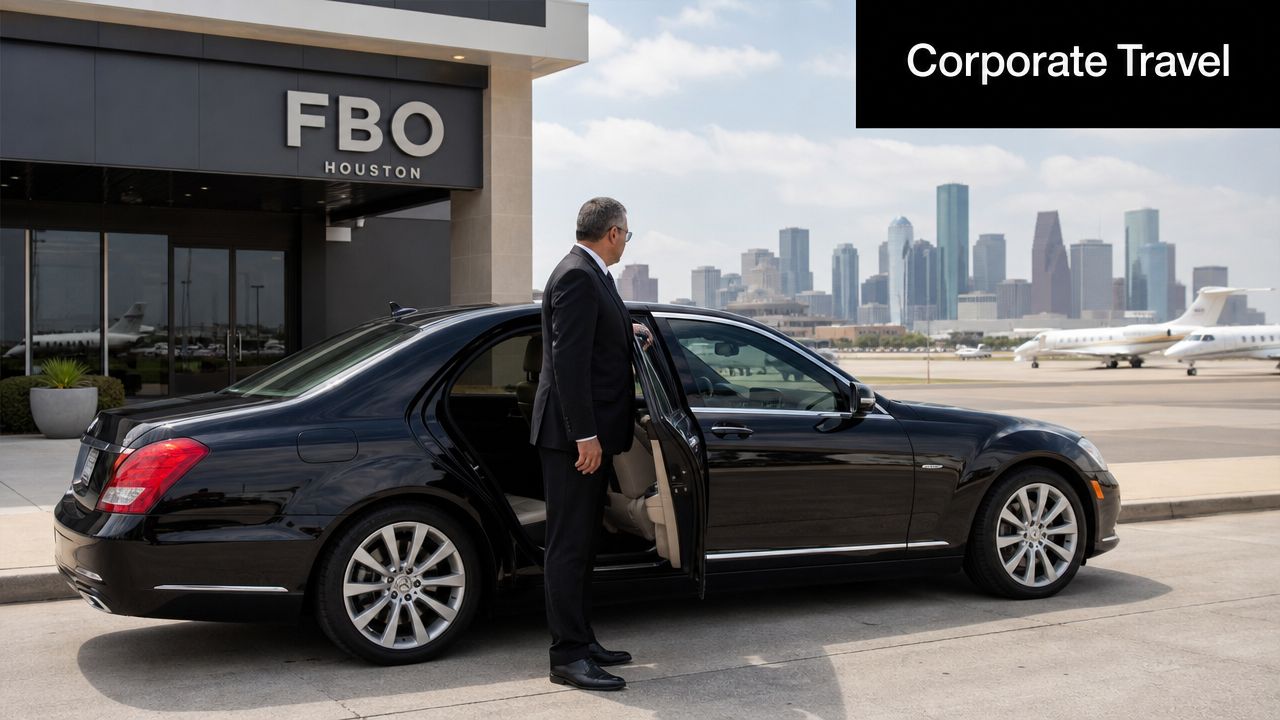
Airport and FBO transfers
Airport service is the first stress test.
A capable operator tracks the flight, confirms the correct terminal, adjusts the pickup plan when arrival times move, and keeps dispatch involved until the passenger is in the car. For private aviation, standards rise fast. The handoff has to match the FBO's procedures, the chauffeur has to stage in the right place, and the operations team has to coordinate with the assistant, flight desk, or security contact without confusion.
Houston also pushes providers beyond the airport run. Corporate accounts often need transfers between downtown, The Woodlands, Energy Corridor, Galveston, Sugar Land, and private terminals outside the city core. Ask how the company handles long-distance scheduling, driver hours, and backup coverage across the region. If the answer is vague, the service model is too thin for executive use.
Corporate roadshows
Roadshows expose weak operating systems within an hour.
Meeting times slide. Building access changes. One passenger wants silence and another needs to make calls. The executive assistant should not have to babysit each leg. The transportation provider should manage manifest updates, route changes, and chauffeur communication in real time, while keeping the traveler on schedule.
Ask direct questions. Who owns the trip from first pickup to final drop-off. How are updates pushed to the chauffeur. What happens if a stop is added mid-route. How does dispatch monitor timing across multiple meetings. You are not buying a car for the day. You are buying schedule control.
A provider with mature operating standards will usually have documented dispatch procedures and fleet readiness practices behind that service promise. Reviewing its fleet maintenance and readiness process for executive transportation helps show whether the operation is built for repeated corporate use or just selling availability.
Special event and VIP movement
Events create compressed risk. Everyone wants the same narrow arrival window. Access points change. Guest lists shift. Security may tighten the pickup zone with little notice.
Strong providers run events through a command structure, not driver improvisation. Require one accountable operations lead, a finalized movement plan, vehicle assignments based on passenger count and luggage, and reserve capacity for changes. For VIP guests, ask how they separate principal movements from general attendee traffic and how they handle discreet departures.
Use this checklist before approving event service:
- Single command contact: One named person owns manifests, changes, and dispatch decisions.
- Staging plan: Exact pickup points, holding areas, and release timing are defined in advance.
- Vehicle assignment logic: Sedans, SUVs, sprinters, or minibuses are matched to movement needs, not upsold by category.
- Overflow coverage: Backup vehicles and alternate chauffeurs are available if the schedule expands.
- Communication chain: Assistants, security staff, venue contacts, and dispatch know who to call and when.
If a Houston provider cannot explain how it handles airport transfers, roadshows, and event movements as three different operating environments, do not treat it as a transportation partner. Treat it as a vendor for basic rides.
Vetting Fleet Vehicles and Chauffeur Standards
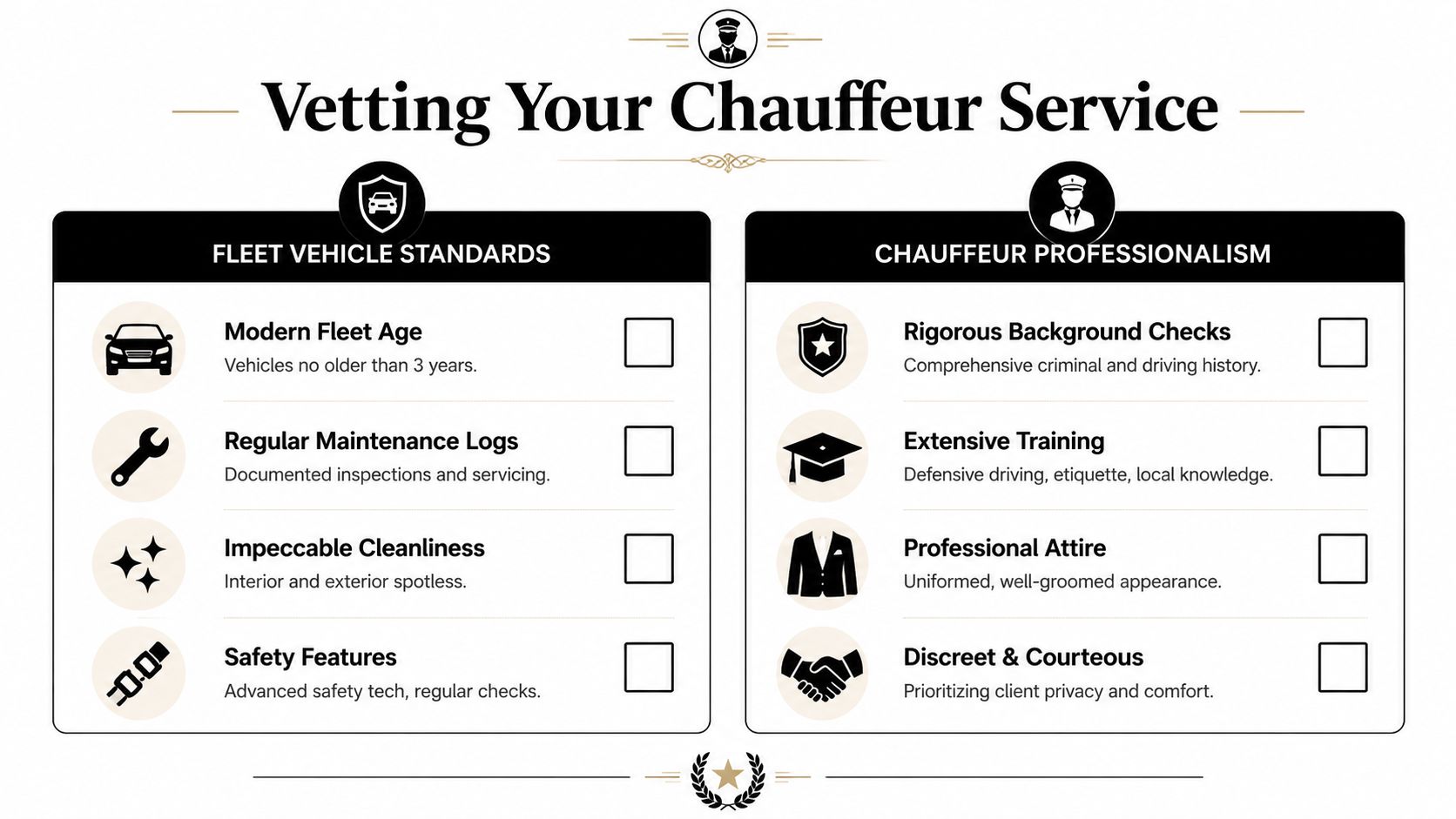
Buyers often ask the wrong first question. They ask, "What vehicles do you have?" Ask, "How do you manage them?" Fleet quality isn't about brand badges. It's about age, maintenance discipline, cleanliness, and replacement policy.
A useful benchmark comes from operational guidance in the industry. Many luxury chauffeur operators target vehicles under 3 years old and retire them around 75,000 to 100,000 miles to protect reliability and preserve current safety features, according to this luxury chauffeur fleet guide.
What to ask about the fleet
Don't settle for "late-model luxury vehicles" in a sales deck. Ask for specifics.
- Vehicle age policy: Ask what age range they target across sedans, SUVs, and vans.
- Retirement threshold: Ask when they remove vehicles from executive service.
- Maintenance documentation: Ask whether they can provide documented inspection and service routines.
- Backup availability: Ask what happens if the assigned vehicle is taken out of service on the day of travel.
If you want a deeper operational baseline, compare their answers against practical fleet maintenance best practices for chauffeur operations. You don't need every vendor to have the same playbook. You do need proof that they have one.
What to ask about the chauffeur
The chauffeur is the service. Everything else supports that person.
A polished vehicle with an unprepared driver is a failure waiting to happen. Your standard should include background screening, clean driving history, defensive-driving training, local route familiarity, professional attire, and client confidentiality.
A chauffeur for executive work should be calm, precise, and forgettable in the best possible way. The client should remember the smooth day, not the driver trying to impress them.
Use this checklist in procurement calls:
- Screening: How are chauffeurs vetted before they carry executive or VIP passengers?
- Training: What formal instruction covers defensive driving, etiquette, and service protocol?
- Discretion: How do they train for confidential conversations and sensitive passenger profiles?
- Local execution: How do chauffeurs learn venue access points, airport procedures, and business districts?
- Performance control: Who monitors punctuality, complaints, and repeat service quality?
Red flags you shouldn't ignore
| Red flag | Why it matters |
|---|---|
| No clear fleet rotation policy | Reliability declines and downtime risk rises |
| Sales team can't describe chauffeur training | Standards likely vary by driver |
| Provider won't discuss backup procedures | You're buying a single-point failure |
| Vehicle quality is emphasized more than operating process | Presentation is covering weak execution |
One useful example in the market is MLR Worldwide Service, which offers executive sedans, SUVs, vans, and managed chauffeur coordination for corporate and VIP travel through a 24/7 operations model. That doesn't exempt any provider from scrutiny, including them. It reflects the type of service structure you should look for.
The Unseen Value Safety and Contingency Planning
Houston punishes weak planning. Traffic stacks up fast. Weather changes the day. Distances between appointments are larger than many out-of-town planners expect. The buyer who focuses only on comfort misses the point.
The harder question is this: what happens when the trip stops being clean and predictable?
That question matters in any U.S. city, but especially in a car-dependent environment. The U.S. recorded 40,901 traffic deaths in 2023, and that broader risk context is part of why a serious chauffeur service should be judged on how it reduces uncertainty, protects schedules, and builds contingency planning into daily operations, as discussed in this Houston chauffeur safety perspective.
What contingency planning actually means
It doesn't mean a dispatcher says, "We'll do our best."
It means the provider has a system for:
- Monitoring flights and route conditions before the traveler asks for an update
- Adjusting pickup timing when congestion or weather changes expected drive time
- Holding backup vehicles or chauffeurs when a service failure would be unacceptable
- Managing alternative routing for multi-stop itineraries under live conditions
- Escalating quickly to a supervisor when a VIP movement is at risk
A lot of vendors promise flexibility. Very few can describe the mechanics behind it.
The operational questions that expose the truth
Ask these in the sales meeting and stay quiet after each one:
- If a chauffeur has a vehicle issue an hour before pickup, what's the replacement process?
- Who watches active trips during the day?
- How do you handle a flight diversion and a changed destination on the same reservation?
- When traffic conditions deteriorate, who decides whether to re-time the route?
- What information does the assistant receive, and how quickly?
Buy the provider that plans for disruption before disruption happens.
Why this matters more than luxury language
An executive doesn't care whether the sales copy says "white-glove" if the provider can't recover from a bad traffic event. A family office principal doesn't care about polished branding if the company goes silent during a flight delay.
The strongest operators think like control rooms, not car brokers. That's the threshold. In Houston, schedule protection is the product.
Decoding Pricing and Contracts for Corporate Accounts
If you're managing a budget, don't ask which quote is cheapest. Ask which quote is complete.
Luxury chauffeur pricing in Houston usually falls into a few structures: point-to-point, hourly charter, and full-day or event-based coverage. None of these is universally better. The right model depends on how much uncertainty sits inside the itinerary.
How to compare pricing correctly
Use this simple decision table:
| Booking type | Best use case | Main risk if quoted poorly |
|---|---|---|
| Point-to-point | Clean single transfer | Surprise wait-time or extra-stop fees |
| Hourly charter | Meetings, dinners, flexible schedules | Minimum-hour rules hidden in the fine print |
| Day coverage | Roadshows, executive hosting | Overtime and usage boundaries misunderstood |
When a provider says "all-inclusive," don't accept the phrase without details. Ask what is included. You want the quote to spell out billing treatment for wait time, tolls, parking, gratuity, airport fees, and itinerary changes. If those items aren't defined, the comparison is useless.
Contract terms that matter
The contract should protect service consistency, not just payment terms.
Look for language around:
- On-time expectations: What standard is the provider committing to operationally?
- Vehicle substitution rules: When can they swap classes, and how is that approved?
- Chauffeur standards: Is there any written commitment around professionalism and conduct?
- Billing clarity: How are extras documented and approved?
- Service recovery: What happens when the provider misses the mark?
Your travel policy should also line up with the service model. If your organization hasn't formalized those rules, this corporate travel policy template is a practical starting point for defining booking authority, approval flow, and service categories.
What I recommend in procurement
Don't negotiate only on rate. Negotiate on definitions.
For recurring Houston service, insist on a simple written service schedule that defines:
- Booking channels and response expectations
- Accepted change windows
- Airport and FBO pickup procedures
- Billing contact and invoicing cadence
- Escalation contacts for same-day issues
The cleanest invoice usually starts with the clearest booking rules.
Cheap-looking quotes often get expensive after the trip. Strong contracts make pricing predictable because they remove ambiguity before wheels move.
The Concierge Workflow Booking and Itinerary Changes
A booking platform can confirm a reservation. It can't manage a travel day with moving parts. That's where concierge workflow separates a transportation vendor from an actual service partner.
The broader business travel environment is moving toward managed reliability. The U.S. business travel market is projected to reach $374.5 billion by 2030, which supports demand for providers that can handle last-minute coordination instead of just basic transfers, according to this business travel outlook discussion.
A simple booking
An assistant sends a reservation for a single airport arrival. The flight is stable, luggage is standard, and the destination is a downtown hotel. A competent operator confirms the trip, assigns the right vehicle, tracks the flight, and sends chauffeur details before arrival.
That should feel effortless. No back-and-forth. No ambiguity around where the traveler will be met. No confusion on billing.
A complex itinerary change
Now the test.
An executive's flight diverts. The first meeting moves later. A colleague is added for a dinner leg. The assistant sends one urgent email with three changes. In such situations, weak providers start dropping details.
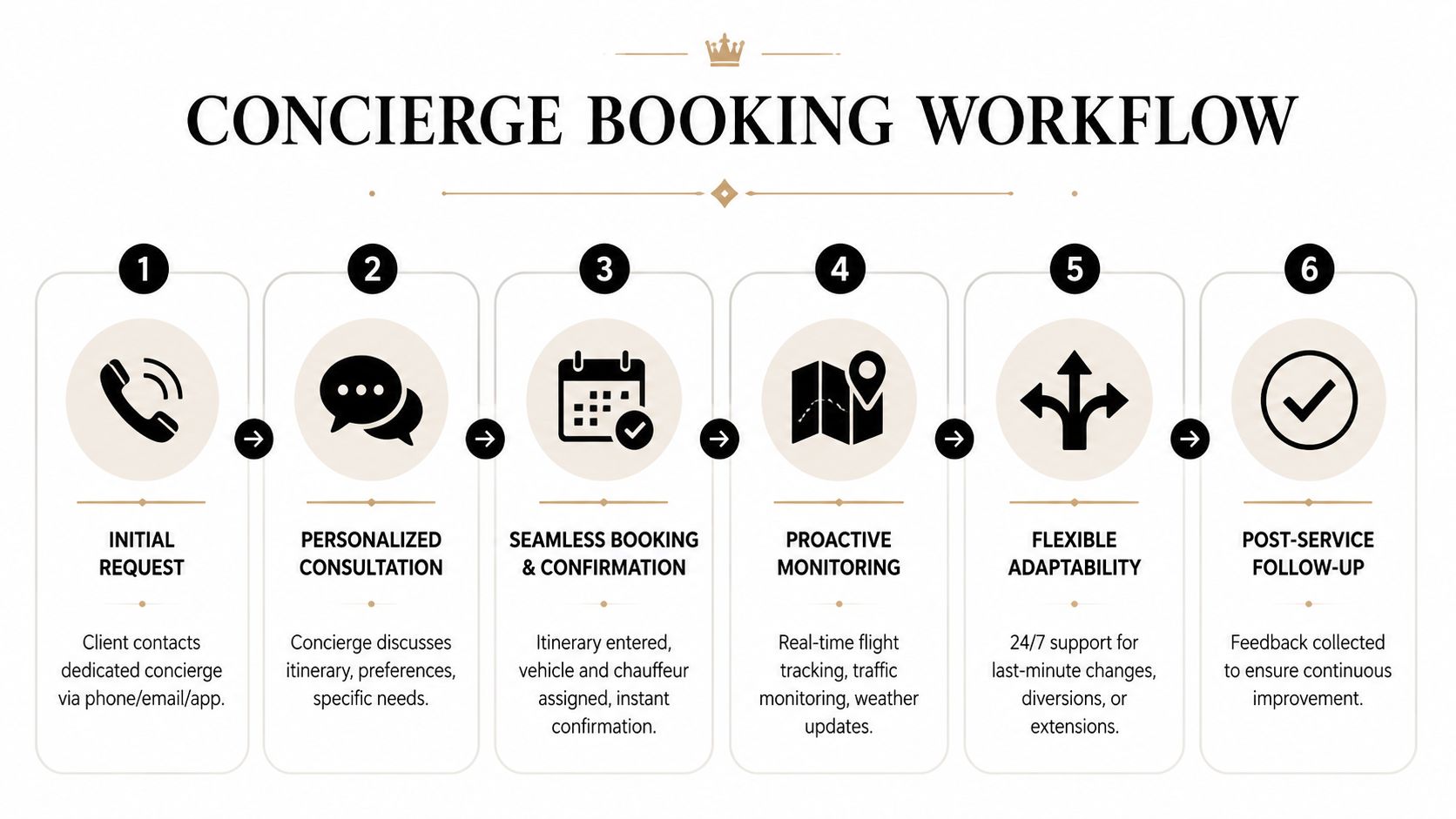
A strong operations team does the following in sequence:
- Updates the live trip record: The reservation isn't treated like a static booking.
- Rechecks vehicle fit: Added passenger or luggage changes may require a different vehicle.
- Confirms revised timing: The assistant gets a clean, updated plan instead of fragments.
- Pushes changes to the chauffeur: The driver doesn't rely on stale notes.
- Monitors the rest of the day: The operation keeps watching because one change often triggers another.
If you want to understand what that coordination layer should look like, this overview of luxury travel concierge services for complex itineraries is a useful benchmark.
Good dispatchers react. Great ones preempt the next problem before the client sees it.
What to ask before you award the account
Don't ask whether they offer concierge support. Everyone says yes.
Ask this instead:
- Who handles changes after business hours?
- Can one contact manage all legs of a multi-stop itinerary?
- How are revised confirmations sent?
- Does dispatch communicate directly with the chauffeur in real time?
- Can your assistant reach a human immediately during an active trip?
If the answers sound scripted, they probably are. In executive travel, workflow quality is service quality.
Houston Luxury Chauffeur Service FAQs
How far in advance should I book a Houston chauffeur service?
Book as early as you can for high-stakes travel. For a single executive airport transfer, a strong provider can often handle shorter notice if capacity exists. For roadshows, conferences, private aviation support, or multi-vehicle movements, don't wait. The more coordination the job needs, the more lead time you should give.
The issue isn't only vehicle availability. It's whether the provider has time to assign the right chauffeur, confirm access details, build backup coverage, and align with your internal team.
Can I request the same chauffeur for a recurring executive?
Yes, and you should ask if the traveler values familiarity and discretion.
Recurring assignments work well when the executive has fixed preferences, sensitive routines, or a strong need for consistency. The provider still needs backup plans, because no chauffeur should become a single point of failure. The best setup is preferred-chauffeur status with a documented secondary option.
What should a provider know before handling FBO pickups?
They should know the exact facility, arrival procedure, passenger identity protocol, baggage expectations, and who the ground-side contact is if the schedule moves.
For private aviation work, generic airport experience isn't enough. The chauffeur and dispatch team need to understand access rules, staging expectations, and how to coordinate without slowing down the handoff from air to ground.
Should I choose an hourly booking or point-to-point service?
Choose point-to-point when the itinerary is fixed and clean. Choose hourly when the traveler has meetings, uncertain dwell times, or likely schedule changes.
Corporate buyers often try to save money by forcing a point-to-point structure onto a fluid day. That usually backfires. When the day is likely to move, hourly service gives your team more control and less billing friction.
What documents or proof should I ask for during vetting?
Ask for a written service description, billing terms, vehicle class definitions, and a clear explanation of chauffeur screening and training. You should also ask how they handle substitutions, delays, and same-day changes.
You don't need marketing language. You need operational proof.
What makes a luxury chauffeur service in Houston worth the premium?
Simple answer. It protects time, reputation, and executive focus.
A standard ride can move a passenger from one address to another. A real luxury chauffeur service Houston program manages risk, communicates clearly, and keeps the day on track when conditions change.
If you're evaluating providers for executive travel, private aviation support, roadshows, or complex VIP itineraries, MLR Worldwide Service is one option to review. The company provides managed ground transportation with executive sedans, SUVs, vans, and a 24/7 concierge operations model designed for schedule-sensitive travel.