
Your CEO lands in the Bay Area, needs to get to Napa without friction, take a confidential call on the way, make a tasting on time, then get to dinner with no driver confusion, no vehicle mismatch, and no chatter. That's the actual transportation problem. It has nothing to do with “treating yourself” and everything to do with protecting schedule, privacy, and optics.
Too many Napa trips get planned like leisure weekends. Someone assumes a rideshare will be fine. Someone else figures the hotel concierge can solve it on arrival. Then the day starts slipping. The pickup point isn't clear, the driver doesn't know the winery gate, reception drops on back roads, and the passenger who needed a controlled environment gets a random car with zero discretion.
That's why executive car service in Napa should be treated as a logistics decision first. If the traveler is a principal, board member, investor, family office client, or high-visibility guest, transportation is part of the risk plan. A proper chauffeur operation doesn't just move a person from one address to another. It manages timing, route control, on-the-fly changes, and the kind of quiet competence that keeps the entire day intact.
Why Your Napa Trip Demands Executive Transportation
A travel manager's worst mistake is assuming Napa is simple because it looks relaxed.
The calendar says one meeting, one private tasting, one dinner. Easy. In practice, it's a chain of dependencies. The arrival has to go smoothly. The vehicle has to fit the client's profile. The driver has to know where to stage, when to stay silent, when to move fast, and how to handle a late change without creating visible stress.
The real failure points
Standard transport breaks down in predictable ways:
- Pickup uncertainty: Airport arrivals are messy if nobody's managing the exact handoff.
- Weak local execution: Not every driver understands winery access points, restaurant arrival flow, or country-road timing.
- No privacy discipline: A premium traveler doesn't need a friendly driver. They need a discreet one.
- Zero schedule protection: Once the itinerary changes, casual transport usually falls apart.
A lot of clients start by shopping for “luxury.” That's the wrong filter. Start with control. A polished sedan means nothing if the operation behind it can't support the day.
Executive transportation isn't indulgent in Napa. It's operational insurance.
If you're comparing options, think in the same terms you'd use for any high-touch itinerary: chain of custody, communication protocol, route familiarity, and responsiveness. That's why many planners move quickly from generic black-car options to providers that operate like a managed service, similar in concept to a luxury private car service for structured high-touch travel.
What changes when you book correctly
The difference is obvious the moment the trip begins. The passenger doesn't have to direct the day. The chauffeur already has the manifest, knows the timing windows, understands whether the client wants conversation or silence, and can absorb itinerary changes without making them feel like disruptions.
That's the standard you want. Napa may be leisure-coded, but executive travel there is still executive travel.
Deconstructing Executive Service in Napa
Most providers can show you a nice vehicle photo. That tells you very little.
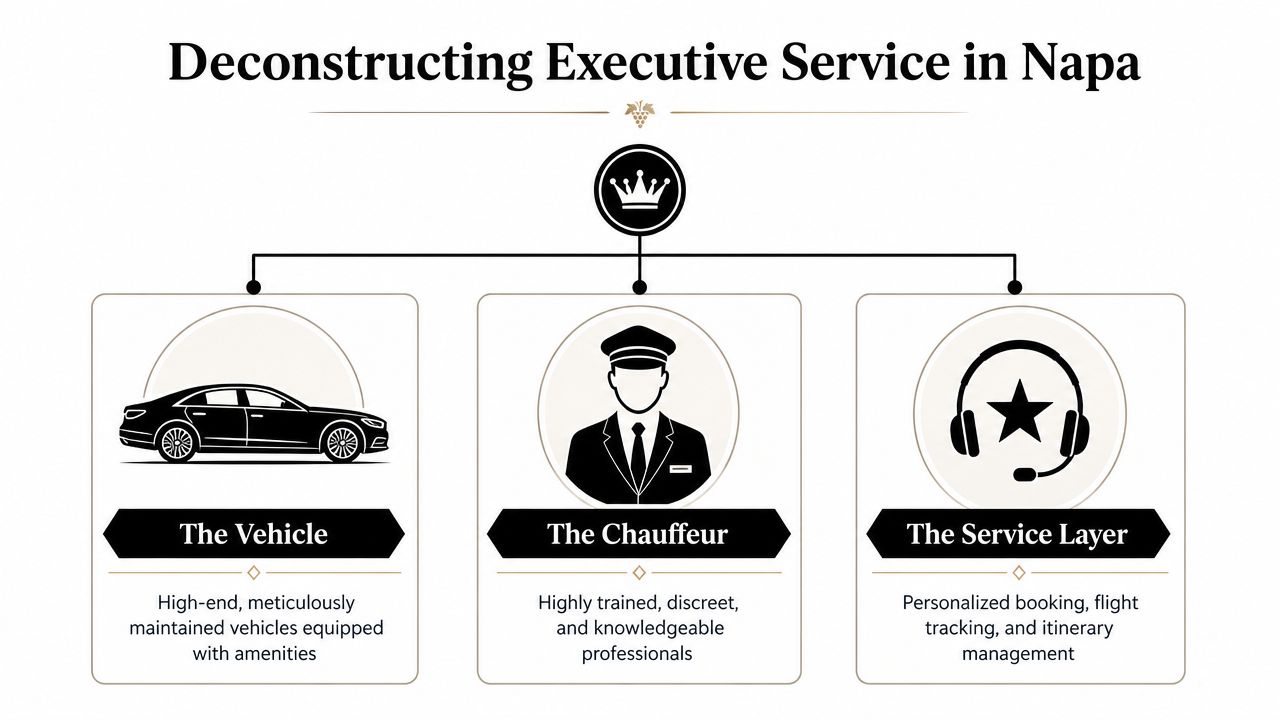
A real executive car service in Napa has three layers: the vehicle, the chauffeur, and the service layer behind the booking. If one of those is weak, the whole experience degrades fast.
The vehicle
The car is the most visible piece, but it's still just one piece. Executive Car Service Napa presents itself as a Napa-based luxury operator with small-group private tours, sedan and SUV service, and a fleet that includes the Lincoln MKZ hybrid Town Car and Cadillac Escalade ESV. It also lists service extending into the greater Bay Area, including airport service to SFO, Oakland, Sacramento, Napa, and Sonoma, according to the company's official service pages.
That tells you something useful. A proper Napa operator isn't built only for short local hops. It's structured for regional movement, mixed-use itineraries, and travelers who may need airport access, winery routing, and urban transfers under one booking.
When you vet a provider, inspect the vehicle standard in practical terms:
- Cleanliness: No odors, no clutter, no visible wear.
- Configuration: Sedan for low-profile executive movement, SUV for luggage, gear, or added presence.
- Passenger function: Charging access, climate control, and room to work without feeling cramped.
The chauffeur
Most services either validate their pricing or reveal their shortcomings.
A chauffeur for executive travel isn't just a licensed driver in a dark suit. The role requires restraint, local competence, and situational judgment. In Napa, that means understanding winery sequencing, service roads, gate procedures, and the pacing of a day that may swing from formal meeting to hospitality setting without warning.
The best chauffeurs do three things well:
- They read the cabin correctly. Some clients want silence. Some want timing updates only.
- They protect transitions. Door-to-door movement should feel controlled, not improvised.
- They stay invisible when needed. No oversharing, no performance, no social familiarity.
Practical rule: If a company sells “personality” before it sells discretion, keep looking.
The service layer
This is the part buyers ignore, then regret ignoring.
The service layer is dispatch, booking precision, schedule management, and communication discipline. It's what allows a provider to absorb a late tasting, move a dinner pickup, shift airport timing, or update a multi-stop route without creating confusion for the passenger.
Here's a simple benchmark table.
| Layer | What to look for | What to avoid |
|---|---|---|
| Vehicle | Well-maintained executive sedan or SUV matched to itinerary | Generic car assignment with no fit to trip type |
| Chauffeur | Discreet, locally knowledgeable, professionally restrained | Overly talkative or unfamiliar with Napa routing |
| Service layer | Clear confirmations, live coordination, rapid itinerary handling | “Call the driver directly” as the whole system |
If you remember one thing, remember this: executive service is not a car category. It's an operational standard.
Navigating Airport and FBO Logistics
Napa logistics start long before the first winery.
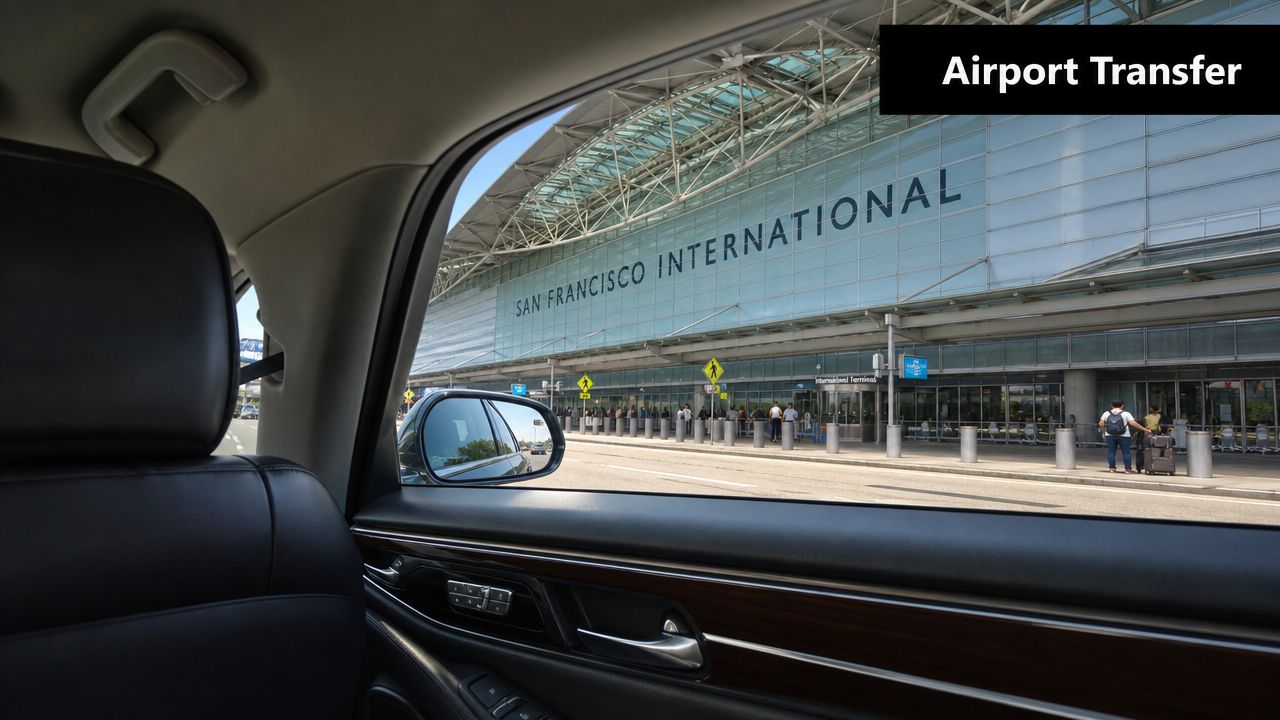
The first real test is the airport transfer. If that handoff is sloppy, the rest of the day usually follows the same pattern. This is particularly important because Napa isn't sitting next to the major Bay Area gateways. Executive Car Service Napa highlights transfers to SFO, Oakland, and Sacramento, and notes Napa Valley is about 1.5 hours from SFO or Oakland without traffic, which makes transfer planning central to the service itself, as described on its airport and transportation information.
Commercial airport transfers
The route from a major airport into Napa is where amateur planning gets exposed. The passenger may be tired, carrying sensitive materials, or heading straight into a meeting environment. They don't need uncertainty about where the driver is, whether the bags fit, or how long the car will wait.
A strong airport transfer process includes:
- Flight monitoring: The provider adjusts pickup timing based on the arrival reality, not the original schedule.
- Clear pickup protocol: Curbside and meet-and-greet are different experiences. The provider should define which one applies.
- Luggage handling: This sounds basic. It isn't. Efficient loading changes the feel of the arrival immediately.
- Routing discipline: The chauffeur should know when a direct route is best and when Bay Area congestion justifies an alternate approach.
FBO and private aviation handling
Private aviation clients usually care less about “luxury” language and more about control. They want fast tarmac-side coordination where permitted, low-visibility transfers, and minimal dwell time between aircraft and vehicle.
For that type of movement, ask sharper questions:
- Can the provider coordinate directly with the FBO desk?
- Can the chauffeur stage for a flexible wheels-down window?
- Can the company support last-minute passenger additions or a second vehicle?
- Can baggage, wine purchases, and personal effects be moved without confusion?
A premium Napa transfer should feel pre-cleared, not improvised.
Where planners go wrong
The common error is treating the airport leg as a commodity and the wine tour as the premium piece. That's backward. The airport leg carries the most timing risk, the most fatigue, and often the highest visibility.
If the client is arriving from SFO, Oakland, or Sacramento and heading into a layered Napa schedule, use a provider that's built for regional transfer work first. Then confirm it can handle the hospitality side of the day. The companies that do both well tend to run tighter operations overall.
Essential Considerations for Corporate and VIP Travel
For corporate and VIP travel, the right question isn't “How nice is the car?” It's “What risks does this provider remove?”
That shift matters. A board member, founder, entertainer, diplomat, or family office principal doesn't just need transport. They need controlled movement. In Napa, where business meetings, private tastings, and social obligations often blur together, privacy and secure handling stop being optional.
Privacy is a service standard
A good chauffeur understands that the cabin is not a social space. It's often a mobile office, a confidential briefing room, or the only quiet window in a packed day.
Demand these basics:
- Discreet conduct: The chauffeur shouldn't ask probing questions or volunteer personal commentary.
- Information discipline: Passenger names, destinations, and routines should be handled with restraint.
- Social media silence: No photos, no passenger mentions, no casual posting culture.
- Low-friction communication: If updates are needed, they should go through the designated assistant or planner when appropriate.
That's the floor, not the ceiling.
Secure transport means more than a dark SUV
Security in Napa usually isn't about dramatics. It's about reducing exposure and avoiding needless variables. The provider should be able to support low-profile arrivals, coordinate with an existing close-protection team, and adapt routes or staging based on the client's visibility.
Use this decision lens:
| Need | What a capable provider should do |
|---|---|
| Confidential conversation | Keep the cabin quiet, controlled, and interruption-free |
| High-visibility client | Manage discreet pickup and drop-off positioning |
| Security team involvement | Coordinate cleanly with external personnel |
| Sensitive property | Handle luggage, wine, and personal items carefully and consistently |
Multi-stop Napa itineraries expose weak operators
Napa days look simple on paper and become complicated in motion. Tasting appointments run long. A lunch gets added. A buyer wants to ship wine, but not all of it. Dinner moves by half an hour. One passenger leaves early while another continues.
Indeed, executive service earns its fee.
A capable operation will keep the vehicle positioned properly, maintain communication without pestering the traveler, and handle purchased wine or other items in a way that doesn't create clutter, delay, or loss risk. It will also understand that a multi-stop itinerary is not just transportation. It's controlled sequencing.
If a provider struggles to explain how it handles itinerary changes, baggage custody, and communication hierarchy, it isn't ready for VIP work.
If your traveler has a profile to protect, or if one delayed arrival can affect meetings, hosts, or other guests, pay for the operational depth. That's not overbuying. It's basic risk management.
Understanding Pricing and Billing Models
Most confusion around Napa transportation comes from buyers comparing quotes that aren't structured the same way.
One provider quotes hourly. Another gives a transfer rate. A third presents a package that looks clean until extra charges appear later. If you don't understand the billing model, you can't compare providers intelligently.
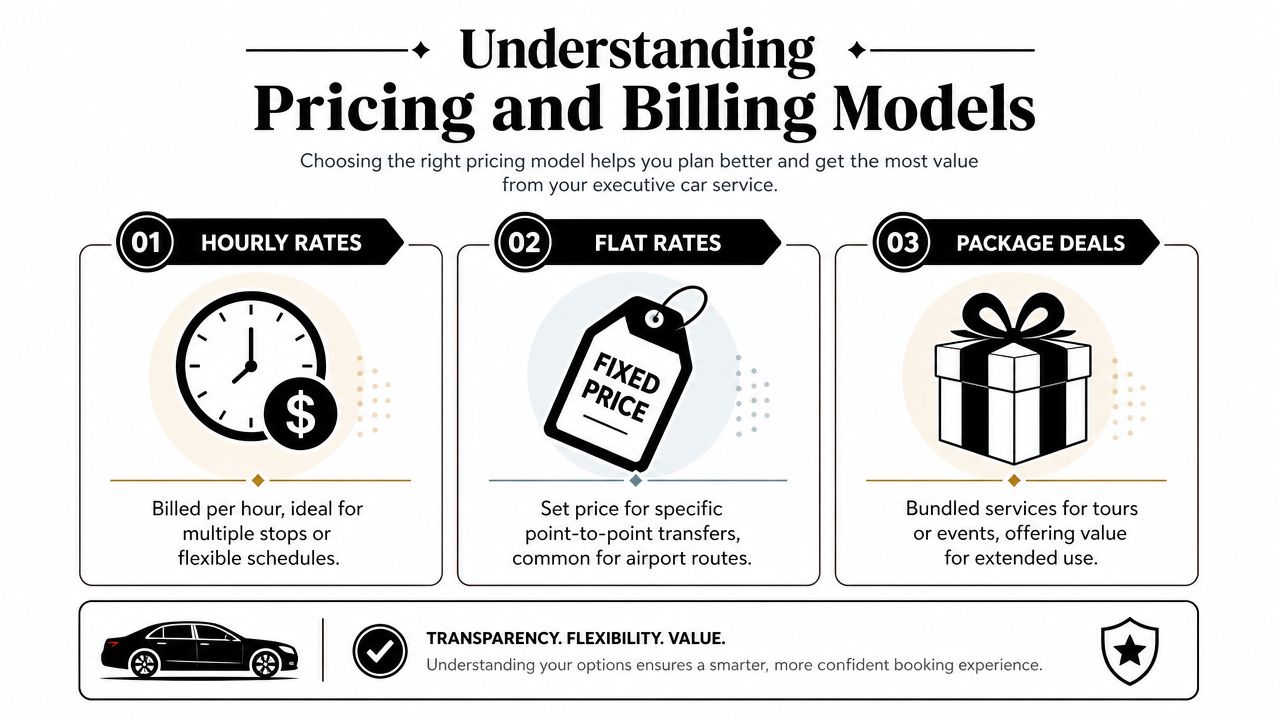
The three models you'll encounter
Hourly service works best when the day has multiple stops or uncertain timing. It gives you flexibility, but only if you know the minimum booking block.
Flat-rate transfers are cleaner for simple one-way moves, especially airport runs or direct hotel-to-dinner transportation.
Packages are common for wine-country use cases where the provider is selling a block of service tied to a tour or event structure.
A key fact in Napa is that many specialized car services run 24 hours a day by appointment and often require a four-hour minimum for events and wine tours, according to the company details listed on Executive Car Service Napa Valley's TripAdvisor profile. That minimum tells you the provider is reserving dedicated vehicle and chauffeur time for a longer itinerary, not treating the booking like a casual local ride.
How to read a quote properly
Don't focus only on the headline number. Focus on what exposure remains.
Use this checklist:
- Ask what's included: Waiting time, chauffeur time, fuel, and standard amenities should be clarified.
- Identify variable charges: Tolls, parking, extended waiting, or itinerary overages may sit outside the initial quote.
- Check the minimum block: A four-hour minimum changes the math for a short tasting or lunch transfer.
- Match vehicle to mission: A sedan might suit a solo executive. An SUV may be smarter for airport luggage, security presence, or wine purchases.
All-inclusive versus plus-plus
Think of all-inclusive pricing as a fixed event budget. You know the rough perimeter up front.
Think of base rate plus fees as an airline fare. The starting point may look attractive, but it doesn't reflect the actual spend until the extras are attached.
The cheapest-looking Napa quote is often just the least transparent one.
When you request pricing, ask for the quote in writing and ask the provider to state, plainly, what would trigger additional billing. Serious operators answer directly. Weak ones stay vague.
How to Select and Book the Right Napa Provider
Booking executive car service in Napa shouldn't feel like shopping for a commodity. You're selecting an operator that may end up controlling the most fragile parts of the traveler's day.
That means your process should be closer to vendor vetting than casual reservation booking.
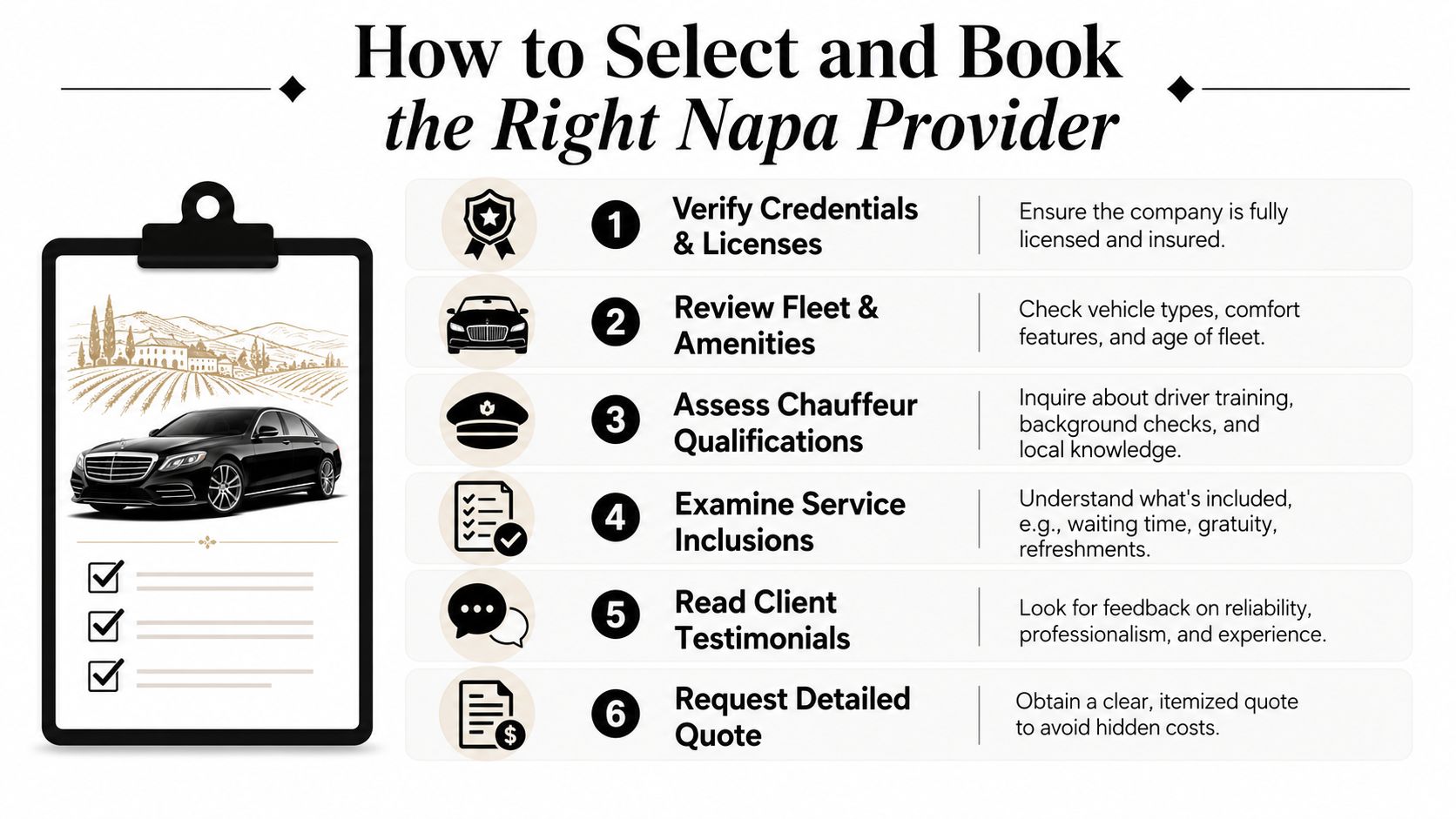
Ask questions that expose operational depth
Most buyers ask what kind of SUV is available. That's fine, but it won't tell you whether the provider can execute.
Ask these instead:
- Who owns and manages the ride? If the company uses affiliates, ask when and how that happens.
- How are itinerary changes handled? You want a process, not “just text the driver.”
- What chauffeur standards are in place? Ask about discretion, professionalism, and Napa familiarity.
- How is passenger information handled? This matters for executives and public-facing clients.
- What is the cancellation policy? Get it before you place the trip, not after plans change.
A provider that answers clearly is usually easier to work with throughout the trip.
Build the booking like a manifest
The more precise your input, the cleaner the service.
Send this level of detail:
| Booking detail | Why it matters |
|---|---|
| Flight number and arrival details | Supports accurate timing and pickup planning |
| Full passenger names | Reduces handoff errors |
| Mobile contact and assistant contact | Keeps communication controlled |
| Exact winery, hotel, and restaurant addresses | Prevents routing assumptions |
| Luggage count and special items | Ensures correct vehicle assignment |
| Preferred communication style | Helps the chauffeur match expectations |
My recommendation for serious planners
If the itinerary includes executive airport handling, multiple stops, VIP privacy concerns, or group coordination, choose a provider with clear dispatch support and a documented service process. That can be a local Napa specialist or a broader operator with executive chauffeur capability, such as an executive car service built for managed travel logistics. The key isn't the label. It's whether the operation can hold standards when the plan shifts.
Book the provider that asks better questions before the trip. That's usually the provider that solves more problems during it.
Don't wait until the last minute if the trip matters
Napa has periods when premium vehicles and strong chauffeurs get booked quickly. If the traveler is high priority, reserve early, confirm all details in writing, and reconfirm before wheels-up or hotel departure.
A weak booking process creates downstream friction. A strong one makes the service feel effortless. That difference is never accidental.
Frequently Asked Questions for Napa Travel Planners
How do you handle last-minute changes to a wine tour itinerary
A serious provider should be able to adjust stops, timing, and sequencing without making the passenger manage the change personally. The planner or assistant should have one clear contact point, and the chauffeur should receive updates without repeated calls into the vehicle.
Can one company manage multiple vehicles for a corporate group
Yes, if the operator has real dispatch control. The test is whether it can coordinate staggered arrivals, different passenger priorities, and separate departure windows without losing communication discipline. Ask how manifests are handled and who controls live changes.
What should the privacy policy look like
It should be simple and strict. No social media posting, no casual discussion of passengers, no unnecessary collection or sharing of trip details, and no chauffeur behavior that turns the ride into a conversation exercise.
Are executive vehicles suitable for business discussions en route
They should be. The vehicle needs to be clean, quiet, and professionally driven. The more important requirement is the chauffeur's judgment. A discreet driver creates the environment. A chatty one ruins it.
Can the service handle wine purchases and personal property securely
It should, but ask the question directly. You want to know how the company tracks items placed in the vehicle, how it handles multiple stops, and how it reduces the chance of loss or mix-ups when passengers are moving in and out throughout the day.
What's the smartest booking approach for assistants and travel managers
Send a full itinerary, designate one decision-maker, confirm the billing structure in writing, and make privacy expectations explicit before the trip begins. That prevents most problems before they start.
If you need transportation that supports executive schedules, airport and FBO coordination, VIP discretion, and complex multi-stop itineraries, MLR Worldwide Service is one option to evaluate. The company provides executive chauffeur services, airport transfers, corporate roadshow support, event logistics, and secure transport coordination for high-touch travel programs.