
Most advice about corporate event planning starts in the wrong place. It starts with the venue shortlist, the menu tasting, the stage set, or the speaker lineup. Those matter, but they rarely determine whether a C-suite event feels controlled or careless.
The decisive moments usually happen in the gaps. The airport pickup that isn't waiting when the plane lands. The board member who reaches the hotel but can't check in because the rooming list is wrong. The keynote who arrives at the venue through the same congested entrance as general attendees. Senior guests notice those handoffs immediately, and once confidence drops, everything else has to work harder.
For executive audiences, corporate event planning is closer to operational command than hospitality. The event has to run on time, protect privacy, absorb change, and make each attendee feel that someone has thought three steps ahead.
Rethinking Corporate Event Planning Success
Treating corporate event planning as a soft service function is one of the biggest planning mistakes I see. Serious organizations don't run investor meetings, executive retreats, leadership summits, or client events as social gatherings with a business wrapper. They run them as business initiatives with reputational exposure.
That's not just a matter of taste. It reflects the scale and professionalism of the field itself. The U.S. Bureau of Labor Statistics reported 155,800 meeting, convention, and event planners in 2024, with a median annual wage of $59,440, about 15,500 openings per year, and projected 5% growth from 2024 to 2034, which it classifies as faster than average for all occupations. That data from the Bureau of Labor Statistics occupational outlook for meeting, convention, and event planners makes one point clear: this isn't a niche side function. It's a large, professional labor market.
The visible event is only half the job
Guests see registration, sessions, meals, and networking. They don't see the production schedule, stakeholder approvals, revised manifests, contract clauses, arrival sequencing, backup drivers, speaker holding rooms, or escalation tree. That invisible layer is where event quality is built.
For corporate travel managers and executive assistants, this distinction matters because your success often depends on problems attendees never know existed. If a flight changes, a VIP decides to skip a reception, weather slows surface traffic, or a security protocol shifts, the event team has to adapt without exposing friction to the guest.
Practical rule: If attendees can see your recovery process, your planning process was too thin.
What actually defines success
A polished ballroom doesn't prove control. A premium menu doesn't prove precision. Success in corporate event planning comes from four things working together:
- Clear intent: The event has a business reason to exist.
- Operational discipline: Timelines, ownership, and approvals are defined early.
- Risk containment: The team has backup plans for transport, timing, staffing, and communication.
- Consistent attendee experience: Every touchpoint feels deliberate, especially arrivals and departures.
That last point gets underrated. Senior attendees rarely judge an event only by content. They judge it by whether the day respected their time. A delayed airport meet-and-greet, a chaotic curbside arrival, or a confused transfer to dinner can outweigh an otherwise excellent agenda.
That's why the best planners think like operators. They don't ask only, “Will this look good?” They ask, “Where can this break, who owns the fix, and how do we keep the guest insulated from the disruption?”
Defining Objectives and Financial Guardrails
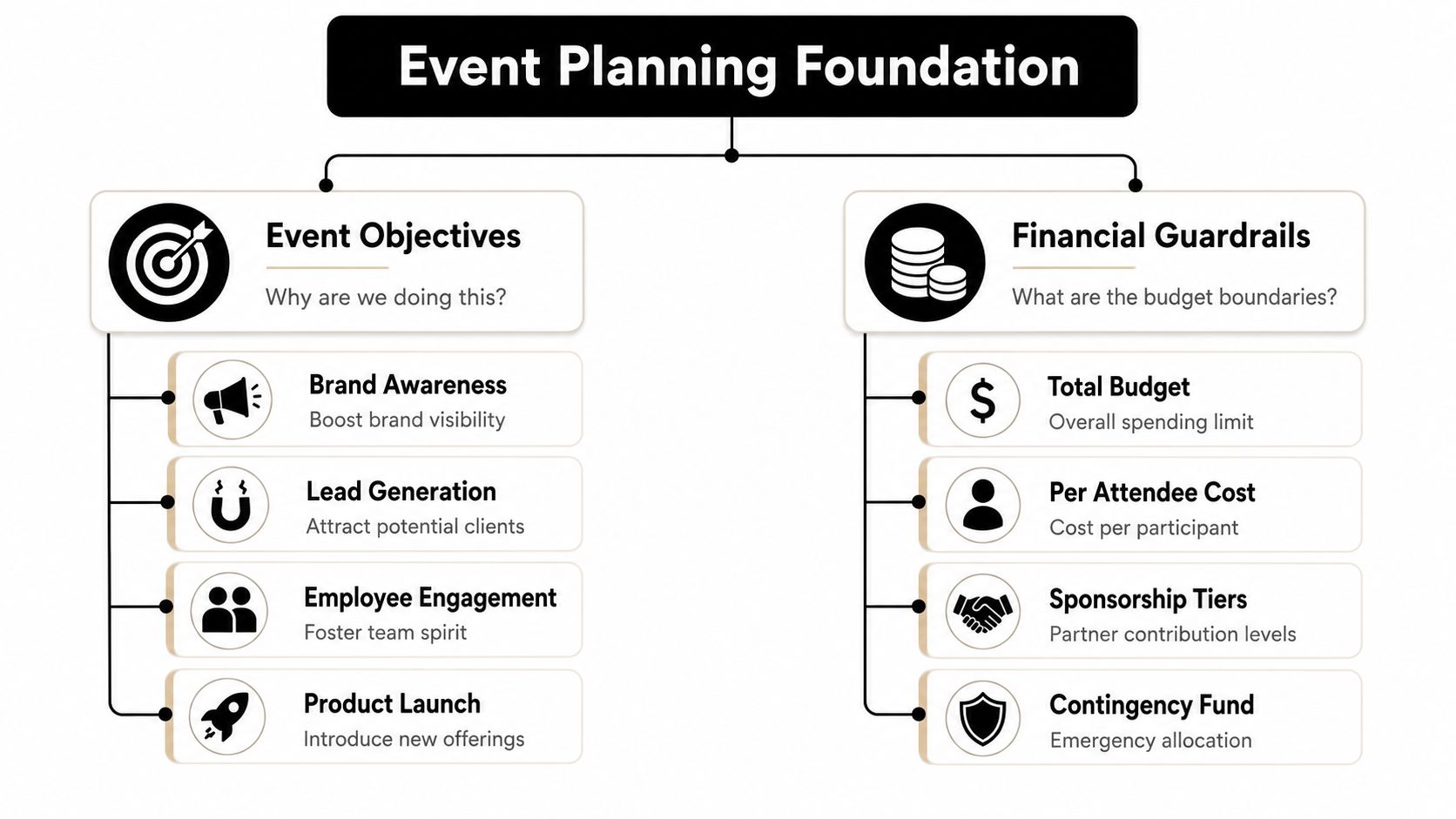
Before anyone requests proposals or reviews a venue deck, pin down two decisions: what the event must accomplish, and what financial boundaries can't move. If those aren't clear, every later choice becomes subjective. That's how teams overspend on the wrong things and then cut corners where precision is essential.
Industry data cited in the market overview for party and event planners shows that 91% of planners measure success by attendee satisfaction, 61% by specific objectives, and 60% by budget adherence, as referenced in the IBISWorld U.S. Party and Event Planners market summary. That combination tells you exactly how professionals think. They don't separate experience from cost control. They manage both from the outset.
Start with a business objective, not an event format
“Leadership offsite,” “client dinner,” and “annual kickoff” are labels, not objectives. They describe the shell, not the reason.
Use sharper language internally. Examples include:
- Decision alignment: The executive team needs time to resolve a specific set of issues.
- Revenue support: The event must advance active relationships already in the pipeline.
- Partner confidence: The business wants to reassure strategic partners after a period of change.
- Internal cohesion: A dispersed leadership group needs face time to restore speed and trust.
When the objective is specific, budget decisions get easier. A board retreat aimed at confidential decision-making may justify private meeting space, tighter arrival control, and discreet transport sequencing. A client-facing event may justify more spend on arrival experience, host staffing, and venue impression.
Build guardrails before the spend starts
A budget isn't just a spreadsheet of categories. It's a decision filter. It tells the team what gets protected when costs move.
I recommend setting guardrails in layers:
Total event ceiling
This is the number finance cares about most. Lock it early.Protected categories
Decide what can't be diluted without hurting the event. For executive programs, this often includes transport reliability, staffing, security-sensitive access, and rooming accuracy.Flexible categories
Decor, gifting, upgraded furniture, and nonessential entertainment usually belong here.Contingency logic
Don't treat contingency as spare cash. Assign it to probable pressure points such as itinerary changes, weather adjustments, extended vehicle time, or last-minute room moves.
A written policy helps here, especially when multiple approvers are involved. Teams that already manage traveler approvals and booking standards often benefit from aligning event controls with an existing corporate travel policy template, so exceptions don't get invented in the final week.
The budget should answer one question clearly: if plans change, what do we protect first?
Translate objectives into line items
A good line item has a reason behind it. If it doesn't support the event objective, challenge it.
A practical review sounds like this:
- Venue premium: Does the location improve attendance quality, privacy, or schedule control?
- Transport coverage: Does it reduce missed connections, waiting time, or arrival confusion for key guests?
- Additional staffing: Does it protect executive time by shortening check-in and reducing handoffs?
- Technology spend: Does it improve data capture, attendee flow, or real-time communication?
This approach also helps when stakeholders push on cost. You're no longer defending a luxury item. You're defending an operational requirement tied to the event's purpose.
Architecting Your Event Timeline and Milestones
Teams get into trouble when they confuse a date list with a timeline. A real event timeline shows dependencies, decision deadlines, and where delay in one area will damage another. It is built backward from the event date, not forward from today.
Industry guidance recommends planning timelines of about six months for large conferences and about six weeks for smaller corporate meetings, while stressing backward planning and buffers for registration monitoring, staffing, and catering cutoffs, as outlined in the Momentus event planning guide. Those benchmarks are useful, but the core discipline is understanding what can't slip.
Build the timeline in reverse
Start with the immovable date, then identify the critical path. In most corporate events, the critical path includes venue commitment, attendee communications, rooming list deadlines, transport manifest collection, speaker confirmation, registration status, and final headcount.
A reverse-built schedule forces honest sequencing. You quickly see that you can't finalize transport blocks if flight data is still missing, and you can't issue polished guest instructions if venue access and check-in procedures are still in flux.
Three timeline mistakes cause most last-minute friction:
- Late approvals: A stakeholder wants options until the week when decisions should already be locked.
- No buffers: Every task is scheduled at its latest possible moment.
- No owner assignment: The timeline says what should happen, but not who has to deliver it.
Use milestone reviews, not passive status updates
Weekly planning calls often waste time because they focus on general progress rather than decision readiness. Replace “Where are we on this?” with milestone reviews that force action.
A useful milestone review asks:
- What must be approved this week?
- What slips if approval is delayed?
- What data is still missing?
- Which vendors need final counts or revised instructions?
- What needs a backup plan now, not later?
If a deadline can move without consequence, it wasn't a milestone. It was a reminder.
Sample corporate event milestone timeline
Here's a practical 12-week view you can adapt for a leadership summit, client event, or executive offsite.
| Milestone | Timeline (Weeks Before Event) | Key Actions |
|---|---|---|
| Event brief approval | 12 | Confirm objective, audience, format, budget guardrails, decision owners |
| Venue and date lock | 11 | Execute venue agreement, confirm room sets, access windows, VIP routes |
| Core vendor sourcing | 10 | Review proposals for AV, catering, staffing, security, transport |
| Attendee list freeze for first outreach | 9 | Segment VIPs, speakers, staff, and general attendees |
| Registration and invitation launch | 8 | Send invitations, open RSVP or registration flow, define response tracking |
| Hotel and rooming coordination | 7 | Establish rooming process, cutoffs, executive handling notes |
| Agenda working draft | 6 | Confirm session order, speaker needs, timing assumptions |
| Transport planning begins | 5 | Collect flight details, build manifests, map airport and venue movements |
| Operational review | 4 | Check staffing plan, signage, check-in design, catering counts, contingency gaps |
| Final attendee communications | 3 | Issue arrival instructions, dress code, app or contact details, escalation numbers |
| Vendor confirmation sweep | 2 | Reconfirm timing, loading access, billing contacts, on-site leads |
| Final production lock | 1 | Publish run-of-show, staff briefing notes, manifest updates, emergency protocols |
Protect the last two weeks
The final stretch should be for refinement, not invention. If major decisions are still open then, the team will start trading quality for speed.
In practice, the last two weeks should focus on confirmation work: verifying manifests, tightening run times, checking dietary notes, validating arrival sequences, and preparing for changes. That's also when executive transport details need extra scrutiny, because travel changes become more common as calendars shift.
Sourcing Venues and Vetting Key Vendors
A venue should do more than hold the guest count. It should support the event's operating model. That means the right access points, sensible movement between spaces, adequate holding areas, reliable technical infrastructure, and enough control over who enters where and when.
Teams often choose venues with their eyes first. They remember the lobby, the view, the ballroom, and the food presentation. Then they discover the freight elevator is shared, the VIP arrival route crosses general registration, the breakout rooms are too far apart, or the loading schedule leaves no room for delay.
What to test during a site visit
A serious site visit should feel like a rehearsal for failure points, not a hospitality tour.
Look closely at these areas:
- Arrival flow: Where do cars queue, where do guests step out, and what happens in bad weather?
- Access control: Can executives, speakers, and general attendees enter through separate paths if needed?
- Back-of-house practicality: Where do staff stage, store materials, and solve problems out of sight?
- Technical readiness: Power, internet reliability, screen placement, acoustics, and room lighting all affect confidence in the room.
- Timing friction: Measure actual walking time between spaces. Don't rely on what the sales team says is “just around the corner.”
If the event includes senior leadership, inspect curbside operations as seriously as the ballroom. A polished interior doesn't compensate for a chaotic entrance.
Vendor selection is really risk selection
Price comparison alone is a weak procurement method for event vendors. Two proposals can look similar and still carry very different execution risk.
When reviewing AV, catering, security, registration, or transport partners, test how they think under pressure. Ask how they handle schedule changes, attendee additions, early arrivals, bad weather, missing information, and after-hours issues. The answer matters more than polished branding.
A reliable proposal usually contains:
- clear service scope
- named assumptions
- escalation contacts
- billing rules
- change-order handling
- realistic timing windows
- defined cancellation terms
A weak proposal often hides behind vague language like “as needed,” “subject to availability,” or “final logistics to be confirmed later.” Those phrases create disputes when the event is already live.
The contract doesn't just buy service. It allocates pain when plans change.
Contract clauses worth slowing down for
Experienced planners save money and stress. Don't skim the legal and operational details because the event date feels close.
Review these carefully:
| Clause area | Why it matters | What to look for |
|---|---|---|
| Cancellation | Protects the organization if plans move | Clear dates, penalties, and what counts as cancellation versus reschedule |
| Liability | Defines who absorbs losses if something goes wrong | Reasonable allocation, especially for damage, delays, or access issues |
| Insurance | Confirms the vendor is actually covered for the service provided | Current certificates and coverage that fits the assignment |
| Overtime and waiting time | A common source of surprise billing | Triggers, rates, approval process, and who can authorize extensions |
| Force majeure and disruption handling | Important when travel or operations change suddenly | Practical procedures, not just generic legal wording |
| Staffing substitutions | Affects service consistency | Notice rules and qualification standards for replacement staff |
Good corporate event planning protects the organization twice. First in execution. Then in the paperwork.
Curating the Attendee and VIP Transport Experience
Transport is where many otherwise capable event plans fall apart. The team secures a strong venue, a sharp agenda, and polished communications, then treats ground movement like a commodity. For C-suite audiences, that's a mistake.
A commonly overlooked planning issue is ground transport logistics, particularly for executives. The quality of the handoff between air and ground can affect perceived event quality as much as session content itself, according to the planning analysis in this overview of corporate event planning challenges. That observation matches what experienced assistants and travel managers already know. If the arrival feels exposed, late, confused, or generic, confidence in the entire program drops fast.
The event starts at the curb
A senior guest doesn't separate “the event” from the trip into it. If the car isn't there, if the chauffeur doesn't have the right name, if the route wasn't checked, or if the hotel arrival is congested and unmanaged, the event has already started poorly.
This is why airport and FBO pickups need event-level planning, not travel-desk improvisation. The variables are different. You're not moving isolated passengers. You're sequencing people whose timing, privacy, and decision-making authority can affect the entire program.
The strongest transport plans account for:
- Manifest accuracy: flight details, mobile contacts, assistant contacts, baggage expectations, and special handling notes
- Arrival segmentation: speakers, board members, sponsors, general executives, and staff often need different handling
- Routing logic: primary route, alternate route, and venue access instructions should all be set in advance
- Real-time change management: delayed landings, early arrivals, gate changes, and last-minute additions happen constantly
What good executive transport coordination looks like
The standard isn't “a car was booked.” The standard is that the movement feels calm and controlled even when the itinerary shifts.
That usually requires a provider with live dispatch visibility, experienced chauffeurs, and a process for handling executive preferences discreetly. Some teams centralize this through their travel function. Others work with specialist providers for high-touch programs, such as corporate chauffeur services for executive and event travel, when airport transfers, roadshows, or multi-stop schedules need tighter operational control.
Common failures that damage the guest experience
These aren't dramatic disasters. They're small misses that make the event feel amateur.
- The pickup is technically on time, but poorly placed. The chauffeur is in the wrong terminal zone or waiting where the guest can't find them quickly.
- The car assignment ignores the passenger profile. A senior executive with luggage, security concerns, or work-in-transit needs gets sent a mismatched vehicle.
- The venue arrival isn't staged. Several VIP vehicles arrive at once with no curbside plan, causing delay and visibility issues.
- The return leg is an afterthought. Departure manifests, bag pull timing, and hotel checkout coordination aren't integrated with the transport schedule.
For executive audiences, punctuality alone isn't enough. The movement has to feel discreet, intentional, and adaptable.
Design the handoff, not just the route
This is the difference between ordinary logistics and polished corporate event planning. The handoff includes every transition point:
- aircraft to greeter or chauffeur
- vehicle to hotel or venue
- venue to off-site dinner or meeting
- final departure back to air
Each handoff needs an owner, a communication method, and a fallback. If the executive changes plans en route, the team shouldn't start making calls from scratch. The decision tree should already exist.
For roadshows and investor days, I also recommend building separate operational notes for the principal traveler and the support team. The executive needs a simple experience. The assistant or travel manager needs visibility into timing, contacts, and contingencies. Mixing those two layers creates noise.
Managing On-Site Operations and Contingencies
Event day exposes every planning shortcut. If the team didn't lock responsibilities, test assumptions, and prepare alternatives, the cracks appear immediately. The irony is that attendees often won't remember the source of the problem. They'll just remember that the event felt disorganized.
The best operational tool on the day is still the run-of-show. Not a high-level agenda. A real production document with timing, ownership, contact names, cues, room resets, VIP movements, and escalation notes.
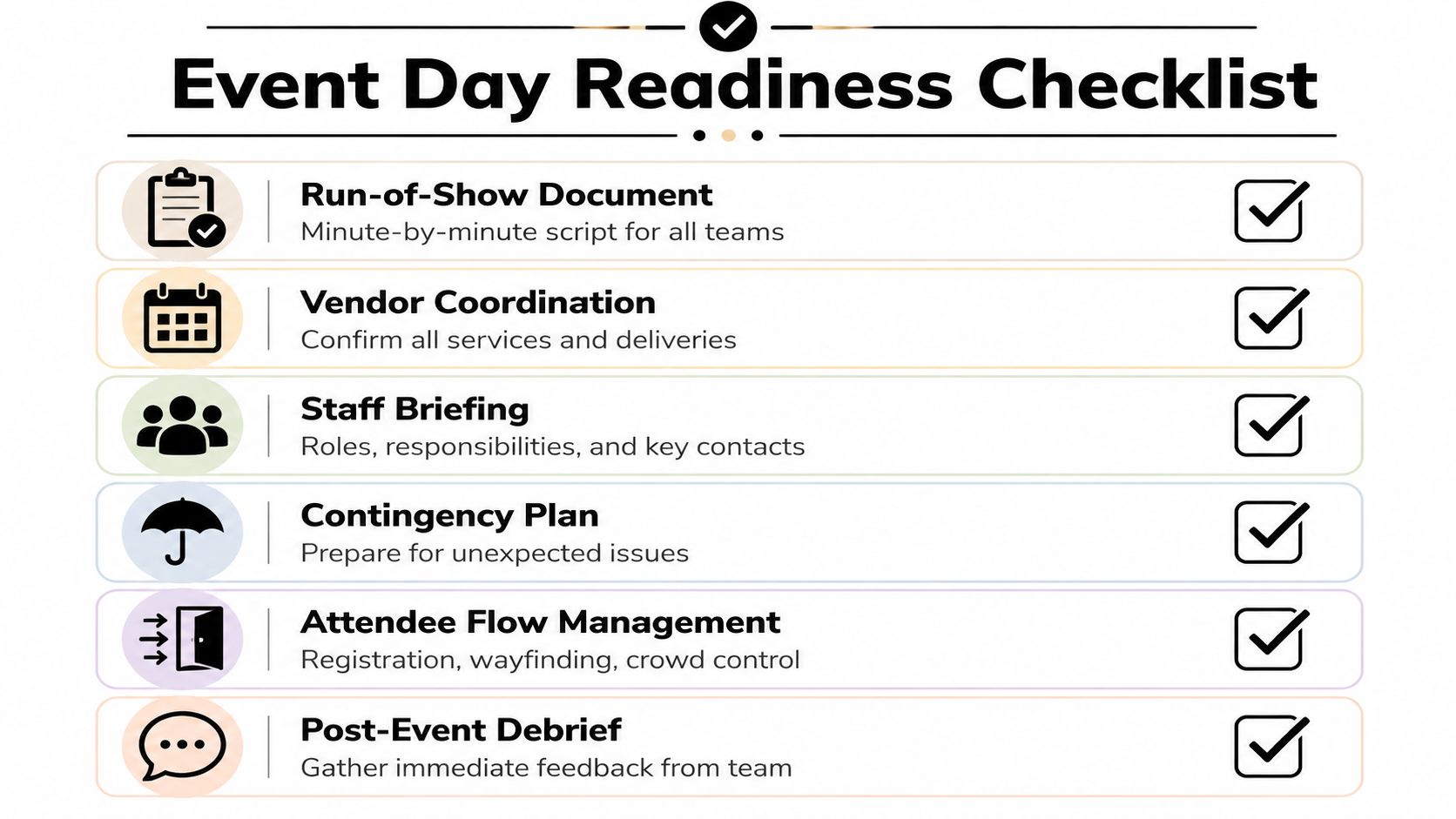
A run-of-show should read like an operations script
A useful run-of-show answers practical questions fast:
- Who opens registration, and when?
- Who decides if a session starts late?
- Who meets the speaker at arrival?
- Who can authorize a room change?
- Who contacts transport if a dinner ends early?
- Who handles a guest issue that should not reach the principal host?
That document only works if every team lead has reviewed it before the day begins. Last-minute distribution doesn't create alignment. It creates silent confusion.
Two common day-of scenarios
An AV lead walks over ten minutes before a keynote and says the presentation file is incompatible with the room setup. In weak teams, everyone starts improvising. In strong teams, the chain is already defined. The AV lead fixes the playback issue, the stage manager adjusts the start cue, the host is briefed, and front-of-house slows room seating without explaining the problem publicly.
A speaker gets stuck in traffic on the way from the hotel. If no one planned for that, the agenda stalls. If the team built contingencies, the moderator shortens an intro, a sponsor message moves forward, and the transport lead keeps operations informed with live timing until the speaker arrives.
Neither situation is rare. Both are manageable.
Build a communication tree before doors open
Most event stress comes from too many people trying to solve the same problem at once. The fix is a simple command structure.
Use a communications tree with clear lanes:
| Function | Primary owner | Escalates to | Typical issues |
|---|---|---|---|
| Front of house | Registration lead | Event director | Check-in flow, badge issues, attendee questions |
| Production | Stage manager | Event director | Session timing, room cues, speaker readiness |
| Venue liaison | Venue lead | Event director | Space access, catering timing, room resets |
| Transport | Transport coordinator | Operations lead | Vehicle arrival, departure changes, VIP routing |
| Security or sensitive access | Security lead | Senior event owner | Restricted movement, privacy concerns, incident handling |
Keep the attendee-facing team calm by keeping the decision-making team small.
Staff briefing is where confidence gets built
A short, disciplined pre-event briefing does more than share information. It sets tone. Staff need to know where to stand, what to say, what not to say, who has authority, and how to escalate discreetly.
Cover names, timing, guest sensitivities, room priorities, communications tools, and what happens if the plan changes. If executive guests are involved, remind teams that discretion matters as much as speed. A fast answer delivered publicly can still be the wrong answer.
Measuring Success and Proving Event ROI
Many teams stop measuring too early. They collect feedback, total the invoices, and write a short recap. That captures whether the event happened. It doesn't prove whether the event worked.
A more rigorous workflow defines KPIs before the event, monitors attendance and engagement in real time, captures immediate post-event survey feedback, tracks short-term pipeline impact over 1 to 4 weeks, and evaluates long-term business outcomes over 3 to 12 months, as described in this event success measurement workflow. That approach matters because it separates operational success from commercial success.
A clean framework helps stakeholders understand that distinction.
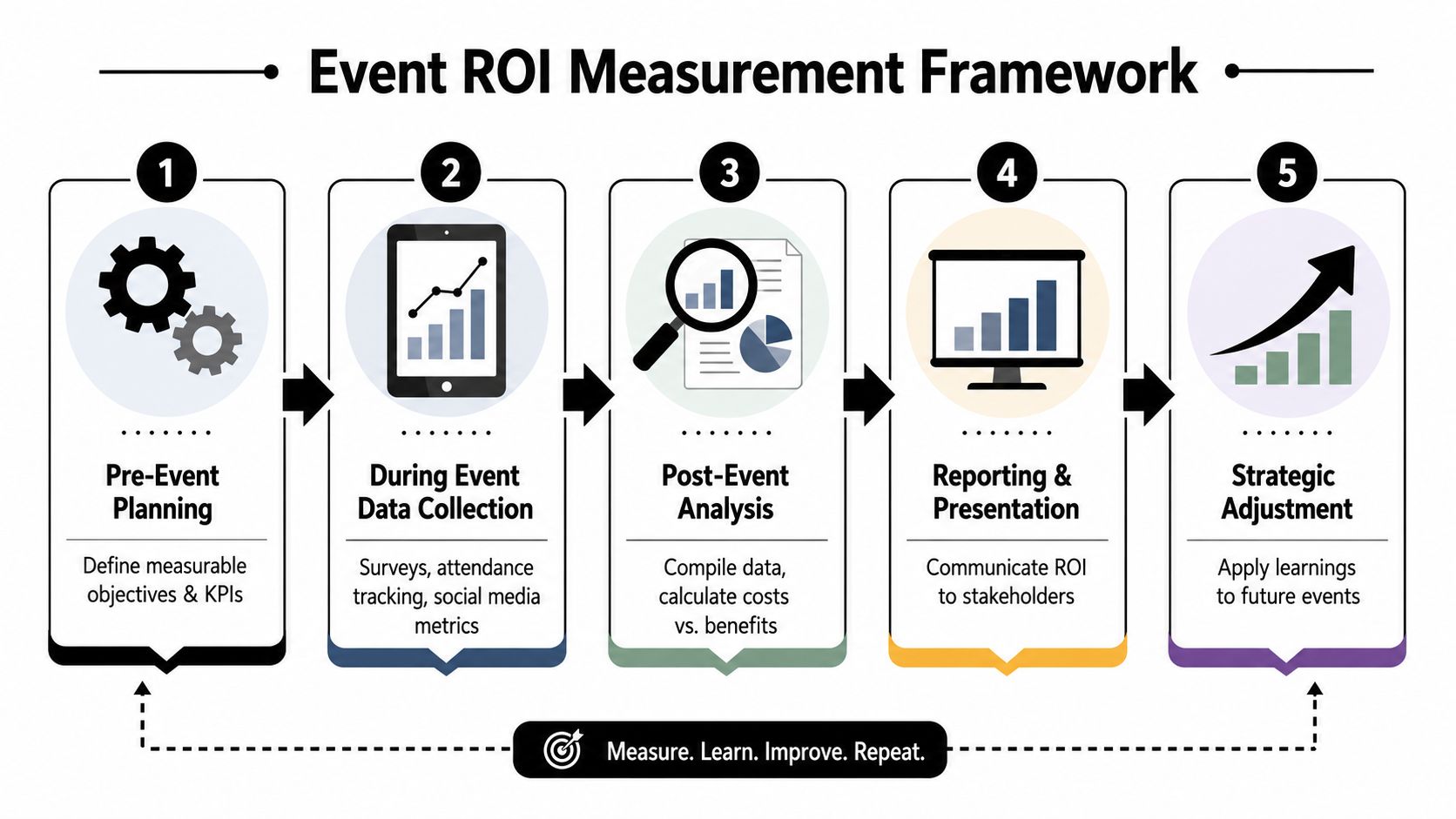
Measure in stages, not all at once
Right after the event, you can measure execution quality. Later, you can measure business effect. Those are related, but they aren't interchangeable.
I break post-event measurement into four practical layers:
Operational delivery
Did the event run on time, maintain service quality, and avoid visible breakdowns?Attendee response
Did the right people attend, stay engaged, and report that the event met expectations?Commercial movement
Did conversations, opportunities, or stakeholder relationships advance in the near term?Strategic value
Did the event contribute to decisions, partnerships, retention, or revenue over time?
This prevents a common reporting mistake. Teams often present satisfaction data as proof of ROI. Satisfaction matters, but by itself it only shows that attendees liked the experience.
Connect the data back to the original objective
Your post-event report should mirror the event brief. If the event objective was executive alignment, report against decisions made, follow-up actions assigned, and stakeholder feedback quality. If the objective was client development, connect attendance and engagement to CRM movement and follow-up meetings.
A useful post-event report usually includes:
- original event objective
- budget versus actuals
- attendance and no-show patterns
- attendee survey themes
- operational issues and how they were resolved
- short-term business impact
- recommendations for future events
To strengthen future planning, some teams also benchmark specialist partners and routing performance against broader options in the ground transportation companies category they use for sourcing and review.
Here's a helpful reference point before building the report:
Don't bury transport performance in general logistics
This matters more than many reports acknowledge. If executive transport shaped first impression, punctuality, privacy, and day-of control, it deserves its own reporting line.
Review transport separately from generic vendor performance. Assess whether arrivals were smooth, whether manifest management held up under change, whether departures stayed on time, and whether any VIP movement created avoidable friction. Even qualitative notes here are useful because transport quality often influences attendee satisfaction more than teams realize.
A strong event report doesn't just say the event succeeded. It shows why, where the plan held, and where operational risk still leaked through.
The post-event review should change your next event
A debrief that produces no changes is just documentation. The value of measurement is that it sharpens the next brief, the next vendor shortlist, the next timeline, and the next arrival plan.
That's especially true for recurring executive programs. If one hotel entrance created bottlenecks, change the routing. If the check-in desk was overstaffed but transport coordination was thin, reallocate labor. If attendee satisfaction was high but business follow-through was weak, the event may have been pleasant without being productive.
Corporate event planning gets better when reporting is honest enough to challenge assumptions, not just polished enough to reassure stakeholders.
For organizations that need tighter control over executive arrivals, airport handoffs, roadshows, and event transport logistics, MLR Worldwide Service provides coordinated ground transportation support for corporate events, executive travel, FBO pickups, and multi-stop schedules with a 24/7 operations team and a vetted global network.