
You're usually not looking for a travel agency in New York Chinatown when everything is simple. You're looking when the trip has already outgrown a booking site.
An executive is flying from New York to multiple cities in Asia, the assistant needs fare options that work around investor meetings, a family office wants native-language coordination for relatives joining from different airports, or a private aviation team needs hotel and transfer support that can survive schedule changes without drama. That's where Chinatown agencies still matter. The right one can do what broad consumer platforms often don't handle well: language-sensitive communication, document-heavy itineraries, and the kind of human follow-through that keeps complex travel moving.
A good Chinatown agency also fits a specific New York reality. You can walk in, ask hard questions, test responsiveness immediately, and see whether you're dealing with a ticket seller or a real travel operator. For corporate, HNW, and FBO-related travel, that distinction is often underestimated.
Why Choose a Travel Agency in Chinatown
The usual failure point isn't booking a flight. It's everything around the flight.
A traveler can reserve business class online in minutes. What they can't always solve online is a routing that keeps one principal on schedule, lets a family member join from another city, supports Chinese-language communication on confirmations, and leaves enough flexibility for a changed meeting or a missed connection. A travel agency in New York Chinatown is often built for exactly that kind of work.

Manhattan's Chinatown isn't a novelty retail strip. It's one of New York City's densest Asian immigrant commercial districts, with between 90,000 and 100,000 residents, and the surrounding Lower East Side and Chinatown area has a foreign-born share of around 40%, according to the Chinatown neighborhood profile and related community data. That concentration explains why many agencies there are oriented toward cross-border family and business travel instead of only local leisure demand.
Where generic platforms usually fall short
For straightforward travel, online booking works. For layered travel, it often creates hidden labor for the person managing the trip.
A few examples come up repeatedly:
- Mixed passenger needs: One traveler wants refundable flexibility, another needs the lowest practical fare, and a third needs help understanding confirmation details in their preferred language.
- Documentation-heavy trips: Travelers may need more support around names, routing consistency, and itinerary paperwork than a booking engine is designed to provide.
- Multiple moving parts: Flights, airport pickups, hotel timing, and local contact instructions need to line up without forcing the assistant to stitch everything together manually.
Practical rule: If the trip involves more than one decision-maker, more than one language, or more than one arrival pattern, human coordination usually beats self-service booking.
Why trust matters here
In this market, people often choose the advisor before they choose the fare. That's especially true when the traveler is booking for parents, senior executives, or VIP guests who don't want to troubleshoot in transit.
The strongest agencies in Chinatown tend to win because they can explain options clearly, spot avoidable mistakes early, and communicate in a way that feels culturally fluent rather than merely transactional. That makes them useful not because they're old-fashioned, but because they're specialized.
For high-touch travel, that specialization has real operational value. The booking is only the first task. The real work starts when plans shift.
Locating the Right NYC Chinatown Agency
Travelers often start too wide. They search for “travel agency near me,” skim a few ratings, and end up comparing businesses that don't offer the same level of service.
A better approach is to treat Chinatown like a field market. Look for agencies that are visibly set up for international itinerary work, not just bus tickets, sightseeing flyers, or one-off discount sales. Manhattan Chinatown rewards in-person observation because storefront cues still tell you a lot.
Start with Canal Street and the surrounding blocks
Local directories surface hundreds of Chinatown-related travel-agency results, and one visible example is Fei Yang Travel at 195 Canal St., Ste. 203, listed in Chinatown travel agency results on Yelp. That same listing context also reflects why the area has stayed useful for walk-in travel planning. Canal Street is accessible through nearby stations serving the A, C, E, 6, W, Q, J, and Z lines.
That matters in practice. If you're vetting two or three agencies in one afternoon, Chinatown is efficient.
Look for these signs on first pass:
- Clear service positioning: Asia travel, international air, tours, documentation support, family travel, or corporate booking.
- A professional front desk flow: Someone should be able to explain what the agency handles without confusion.
- Recent materials: Updated notices, current fare boards or promotional posters, and active contact methods signal a live operation, not a legacy storefront running on inertia.
Use directories, then verify by conversation
Online discovery is useful, but it's only the start. Use listings to build a shortlist, then call or visit.
A strong first contact sounds organized. Staff should be able to answer what destinations they regularly service, whether they handle complex international itineraries, and how they communicate itinerary changes. If the conversation drifts immediately to price and nothing else, that usually tells you the service model is transactional.
For travelers comparing different neighborhood ecosystems, this guide to a travel agency in Flushing NY is also useful because it highlights how local immigrant-market agencies can differ by customer base, language mix, and service style.
The right agency doesn't just say yes. It asks better questions before it gives you a quote.
Separate retail travel from true itinerary support
Some agencies are set up for volume and convenience. Others are set up for problem-solving. You need to know which one you're talking to.
| What you hear | What it often means |
|---|---|
| “We can book that today” | Fast retail transaction |
| “Who is traveling, what flexibility is needed, and who needs updates?” | Real advisory intake |
| “Send passport names exactly as shown” | Attention to detail |
| “We'll figure it out later” | Risk |
If you're arranging executive or family-office travel, don't mistake a convenient location for capability. In Chinatown, access is easy. Discernment is the primary task.
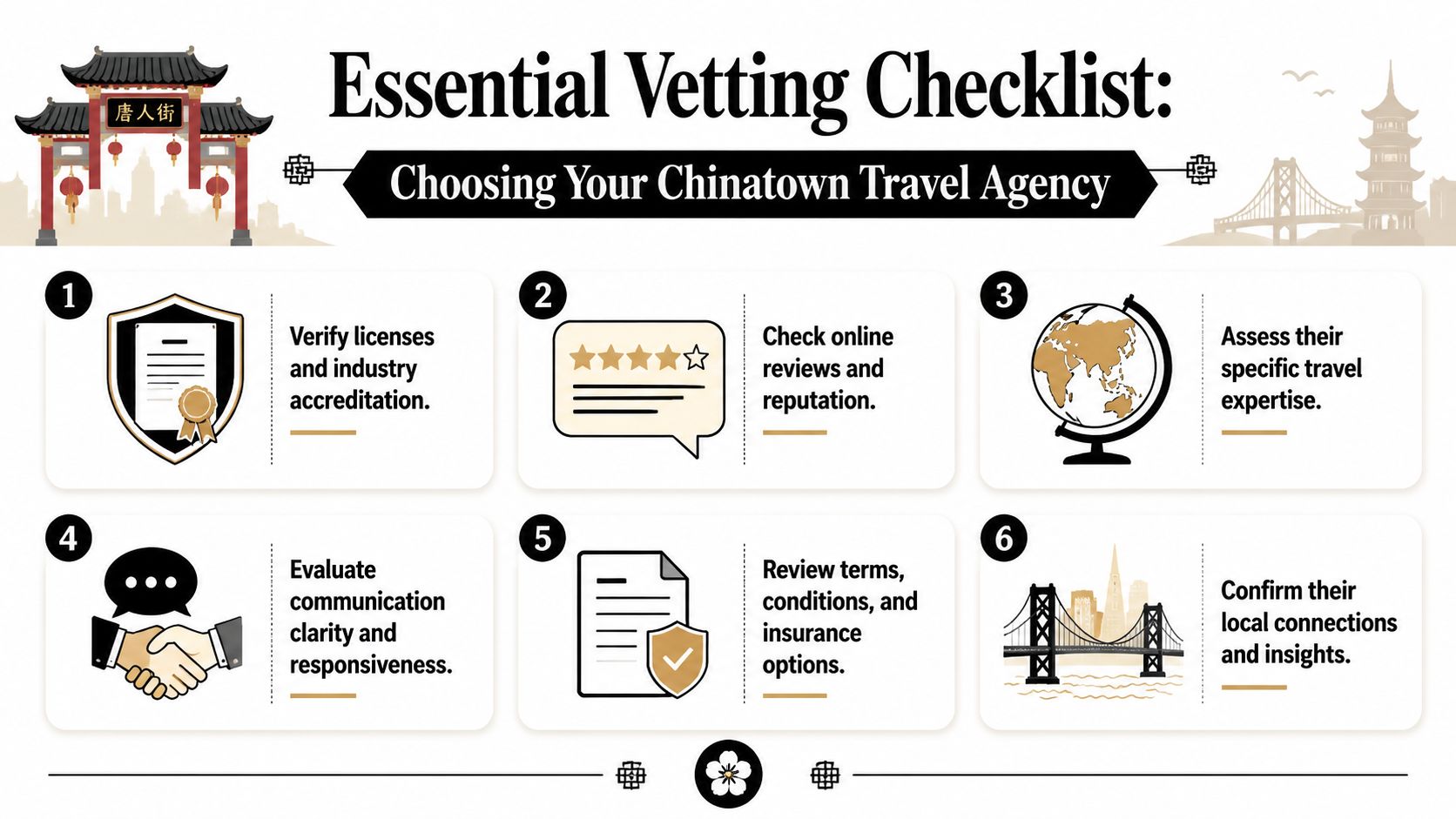
Your Essential Vetting Checklist Before You Commit
A polished storefront doesn't tell you whether the agency can manage a difficult trip. The vetting happens in the questions you ask and the answers you get back.
Chinatown travel businesses often win on trust and cultural-linguistic specialization, and native-language communication or long-standing community reputation can matter more than broad digital brand visibility, especially for complex itineraries that involve documentation support, as reflected in Chinatown Online's travel positioning. That changes how you should evaluate them. You're not only buying access to inventory. You're testing judgment, communication, and reliability.
What to verify in the first meeting
Start with the basics, but don't stop there.
- Identity and accountability: Ask who will manage the booking after payment. A named point of contact matters when flights change outside normal hours.
- Language capability: Don't ask vaguely whether they “speak Chinese.” Ask which language or dialect support they can provide for traveler communication.
- Destination familiarity: Ask what kinds of routes and traveler profiles they handle most often. You want specific, confident answers, not general enthusiasm.
What separates a useful agency from a risky one
In such instances, experienced assistants and travel managers usually spot the difference.
Responsiveness under pressure
Send a follow-up with a small correction or an added traveler requirement. Watch how they reply. The quality of that response often predicts how they'll handle a real disruption.Clarity on booking scope
Some agencies are strong on air but weak on hotels, local transport, or post-ticketing support. That's fine if they say so clearly. It's a problem if they imply full service and deliver partial execution.Comfort with premium workflows
If you handle executive, HNW, or aviation-related travel, ask how they gather transfer details, hotel checkpoints, arrival instructions, and traveler preferences. Premium travel needs a disciplined intake.
For buyers who want to understand how professional agents structure inventory access and booking workflows, this overview of GDS travel agents gives useful context.
Operational note: The best agency for your trip may not be the one with the flashiest online presence. It's the one that documents details accurately and communicates without ambiguity.
A practical shortlist framework
Use this quick matrix after each consultation:
| Criteria | Strong signal | Weak signal |
|---|---|---|
| Communication | Specific, prompt, organized | Slow, vague, inconsistent |
| Cultural fit | Understands traveler preferences and communication needs | Treats all requests as generic |
| Complex-trip handling | Asks about changes, names, timing, coordination points | Focuses only on initial ticketing |
| Confidence level | Explains constraints and options | Overpromises |
If an agency can't hold a precise intake conversation, don't trust it with a complicated trip. In this niche, precision is part of service.
Sample Services and Itineraries They Excel At
The easiest way to judge a Chinatown agency is to look at the trips where generic platforms create friction and a specialized operator removes it.
Multi-generational family travel to Asia
A family booking often looks simple from the outside and becomes complex fast. One group departs from New York, another joins from a different U.S. city, grandparents want fewer airport changes, younger travelers want to extend the trip, and someone needs itinerary details explained in Chinese.
A capable Chinatown agency can keep those needs under one roof. The value isn't only ticketing. It's making sure names, dates, connections, and communication chains stay aligned.

That same family may also want more than flights and hotels. Agencies with stronger advisory instincts can help shape experiences that feel culturally coherent, such as food, heritage, or local-interest activities that fit the group rather than a generic package.
Corporate roadshows and executive travel
For business travel into China or across Asia, a specialist agency often earns its keep before the first boarding pass is issued.
A roadshow usually involves:
- Meeting-driven routing: Flights must support presentation schedules, not just fare logic.
- Hotel selection with purpose: Proximity, late arrivals, and privacy can matter more than lifestyle branding.
- Communication discipline: Travelers, assistants, and local hosts need the same itinerary version.
I've found that the best agencies in this category ask for the executive calendar early. They don't wait for problems to emerge. They reverse-engineer the travel around the business objective.
Good business travel planning starts with meeting times, not airline preferences.
FBO and crew-adjacent support
This is the under-discussed use case. Some Chinatown-oriented agencies can be surprisingly useful for private aviation support, especially when schedules shift and travelers need pragmatic help fast.
A repositioning crew may need last-minute hotel rooms, ground transfer timing may change with aircraft movement, and passenger support may require discreet handling with clear language instructions. This isn't luxury leisure. It's operations.
What matters most here is adaptability:
- one call point
- accurate manifest-level attention to names and timing
- willingness to update bookings as flight status changes
- comfort coordinating with external transport or concierge teams
A small agency can do this well if its process is disciplined. A large brand can do it badly if it treats every request like a standard retail reservation.
Booking, Payments, and Premium Transport
Once you've chosen the agency, the next risk is sloppy confirmation. Many travel issues that look like service failures are documentation failures. The agency heard one thing, the traveler assumed another, and nobody reconciled the details in writing.
What to get confirmed before you pay
Ask for a written summary before ticketing or deposit collection. It should be clear enough that another assistant could pick it up and manage the trip without guessing.
Include these points:
- Traveler names exactly as provided
- Full routing and date sequence
- Fare conditions in plain language
- Baggage assumptions, if relevant to the trip
- Who receives updates and in what language
- What the agency will handle after booking
- What it will not handle
If the booking involves senior executives or family principals, I also recommend asking for a single consolidated itinerary format. Fragmented confirmations create avoidable mistakes, especially when multiple suppliers are involved.
Payment and cancellation discipline
Smaller neighborhood agencies don't all operate like large corporate travel desks. That isn't automatically a problem. It just means you need to align on process early.
Confirm:
Accepted payment methods
Don't assume the card workflow will match a large OTA or global TMC.Deadline rules
Ask when the fare or reservation can change, and what happens if the traveler delays approval.Change handling
Find out whether the same agent who books the trip also manages post-ticketing changes.
A travel confirmation isn't complete until cancellation terms, change responsibility, and after-hours contact expectations are written down.
This is also the point where premium ground planning should be locked in. If the air booking is complex, the airport transfer should be simple.
Integrating executive ground transport
A Chinatown agency can book the core trip. It may or may not be the right operator for high-touch ground execution. For executive arrivals, FBO pickups, roadshows, and VIP airport movements, many travel managers separate those functions on purpose.
That's because premium transport has its own requirements:
| Need | Why it matters |
|---|---|
| Meet point accuracy | Prevents missed handoffs at JFK, LaGuardia, Newark, or private terminals |
| Real-time coordination | Keeps the car aligned with late wheels-up or early arrival changes |
| Vehicle fit | A sedan, SUV, or van should match the traveler, luggage, and privacy needs |
| Chauffeur brief quality | Drivers need names, contact rules, and stop sequence before pickup |
For that layer, a service such as executive car service in New York is often paired with agency-booked air and hotel planning so the travel advisor handles itinerary design while the chauffeur team handles on-the-ground timing and execution. MLR Worldwide Service is one example of that kind of partner, with executive chauffeur service, airport transfers, FBO support, roadshows, group logistics, and a 24/7 operations team managing schedule changes and coordination.
The workflow that works best
The cleanest setup for refined travel usually looks like this:
- The agency manages flights, itinerary structure, and traveler-facing booking support.
- The assistant or travel manager controls approvals, passenger data, and communications.
- The ground transport partner handles airport, hotel, meeting, and FBO movements with real-time oversight.
That division reduces confusion. It also keeps each provider inside its strongest lane.
Finalizing Your Trip with Confidence
The smartest use of a travel agency in New York Chinatown isn't nostalgic. It's strategic.
For simple travel, online tools are fine. For multi-party, multilingual, cross-border, or high-touch travel, Chinatown agencies can offer something that broad booking platforms still struggle to match: context, trust, and live problem-solving. Those strengths matter most when the traveler is important, the schedule is tight, or the cost of miscommunication is higher than the cost of the ticket itself.
That's also why vetting matters so much. You're not choosing a storefront because it's nearby. You're choosing a booking partner that can communicate clearly, respect cultural expectations, and stay steady when the itinerary changes. In this market, those traits often matter more than glossy branding.
The role of these agencies is also changing. In a digital-first market, their relevance depends on value beyond simple transactions, including culturally specific advisory support, curated experiences, and human service that digital platforms don't easily replicate, as reflected in this Chinatown travel and experience trend context on Tripadvisor.
The best results usually come from combining specialized planning with premium execution. Let the right agency handle the itinerary logic. Let the right transport partner handle the ground movement. That's how complex travel starts to feel controlled again.
If your trip requires polished airport transfers, FBO pickups, executive roadshow routing, or discreet VIP ground coordination to complement agency-booked travel, MLR Worldwide Service provides a structured option for door-to-door execution across New York and other major hubs.