
A senior executive lands at Austin-Bergstrom, phone already buzzing. The first meeting moved up. Dinner shifted across town. Someone on the team is asking whether the car can stop at the hotel first, and the rideshare app keeps changing the wait time and fare estimate. In Austin, that problem gets worse when the city is full for a conference, festival, or race weekend.
That's when ground transportation stops being a convenience and becomes an operations issue. If the pickup is loose, the rest of the itinerary starts to unravel. If the price isn't stable, the travel manager can't control budget exposure. If the driver is just reacting in real time, the traveler absorbs the stress.
A professional executive car service solves that by removing uncertainty before the aircraft door even opens. The vehicle is assigned in advance. The chauffeur is briefed. The pickup process is planned. For business travelers, that difference is the whole point.
Your Arrival in Austin Deserves Predictability
Austin can feel smooth or chaotic depending on one variable: whether your ground transportation was arranged properly before arrival.

A common scenario goes like this. An executive lands at AUS during a citywide event. Baggage claim is crowded, curbside space is tight, and the rideshare pickup zone is full of travelers all trying to solve the same problem at the same time. The traveler doesn't need “a ride.” They need a managed handoff from air to ground, with no guessing.
That's where Executive Car Service in Austin, TX earns its value. The service is reservation-based, itinerary-driven, and built around the reality that business travelers rarely have slack in their schedule. Airport pickup, downtown transfer, hotel check-in, client office, dinner reservation. Those movements need to connect cleanly.
The category itself is far from niche. IBISWorld projects the U.S. limousine and town car services industry at $11.6 billion in 2026, with 196,000 businesses nationwide and revenue growing at an 11.1% CAGR from 2021 to 2026. That matters because it shows this isn't a fringe luxury product. It's a mature transportation sector built around pre-booked service, airport transfers, and time-sensitive travel.
What changes when the car is pre-arranged
A professionally dispatched pickup changes the arrival experience in a few practical ways:
- The route is planned in advance: The chauffeur isn't deciding whether to accept the trip after landing.
- The service fits the itinerary: If there's a hotel stop, a second passenger, or a later return, operations can build that into the booking.
- The traveler keeps momentum: They move from gate to vehicle to destination without negotiating the next step at the curb.
Business travelers usually don't remember the smooth pickup. They remember the one that created friction before the day even began.
If you're comparing options, it helps to understand what an airport transfer actually includes in a professional service model. The term sounds simple, but in practice it means active coordination, not just vehicle dispatch.
What Truly Defines an Executive Car Service
A lot of listings look similar online. Black vehicle. polished photos. promises of comfort. That doesn't tell you whether the service is built for executives or just marketed that way.
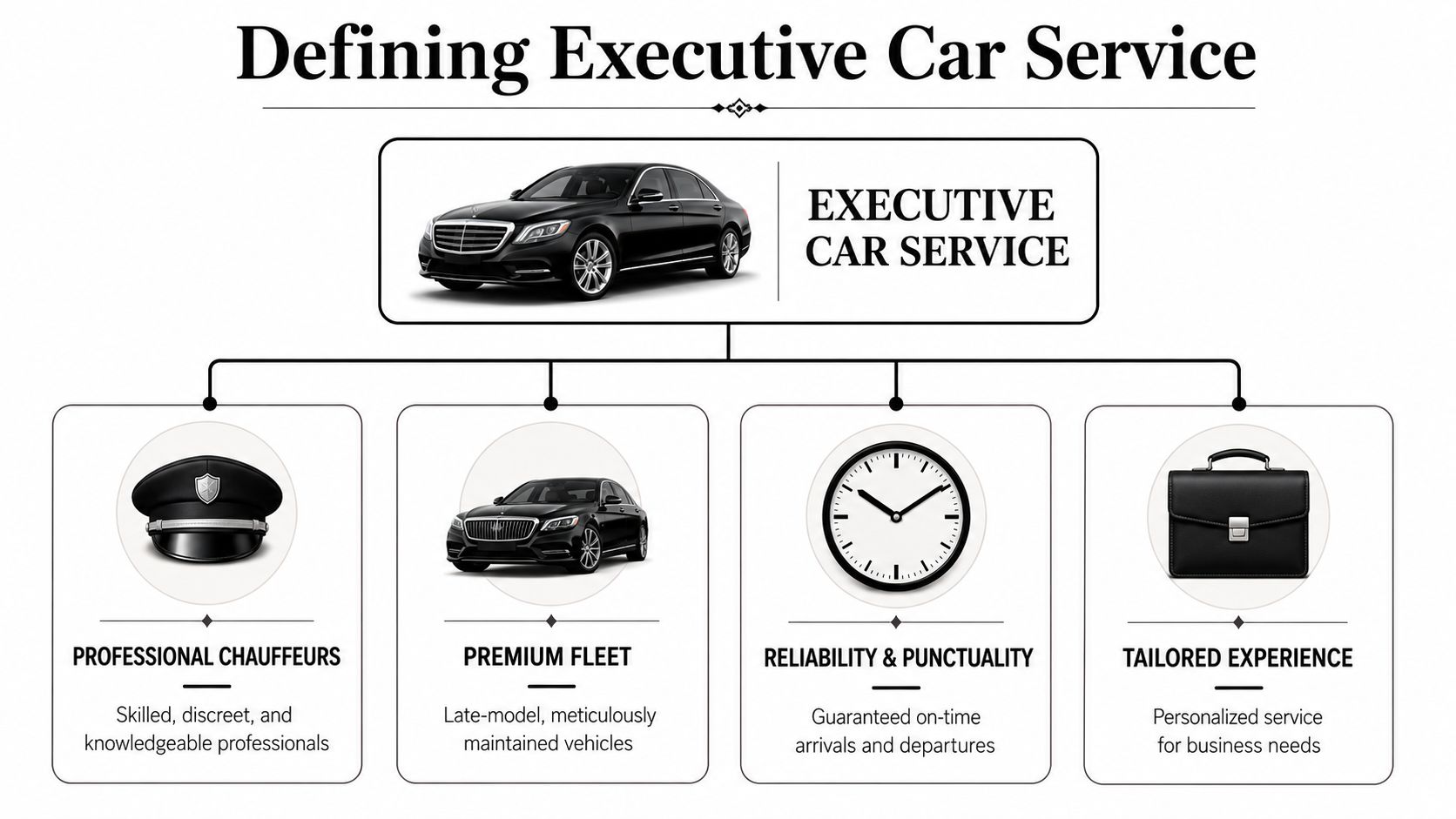
The difference comes down to three things: the chauffeur, the fleet, and the operating system behind the ride.
The chauffeur is more than a driver
In executive service, the chauffeur isn't just transporting a passenger from point A to point B. They're handling timing, discretion, guest interaction, luggage, curbside judgment, and sometimes schedule changes that happen while the vehicle is in motion.
Austin's own rules reinforce that this is a professional role. The City of Austin requires a chauffeur permit for drivers of vehicles-for-hire, and the process includes application approval plus a written test. The city also states that applicants must be approved before scheduling the test, may receive the permit the same day if they pass, and can retake the test once per day for up to three days before a 30-day reset after three unsuccessful attempts.
That local structure matters. It tells a corporate client that chauffeur-driven transportation in Austin operates inside a formal credentialing framework, not a casual one.
The fleet has to support the assignment
A true executive fleet is selected for the assignment, not just whatever vehicle happens to be available nearby. Sedan, SUV, or van should match passenger count, luggage profile, and the tone of the trip.
For corporate travel, the vehicle has to do more than look clean. It needs to arrive in proper condition, present well at a hotel or FBO, and support a quiet, interruption-free cabin. That matters when the passenger is taking calls, reviewing notes, or decompressing between meetings.
A simple comparison helps:
| Service element | Luxury-tier rideshare | Executive car service |
|---|---|---|
| Vehicle consistency | Varies by driver and availability | Assigned to fit the booking |
| Service standard | Driver-dependent | Company-managed |
| Presentation | Uneven | Expected to be uniform |
| Trip context | Single trip focus | Full itinerary focus |
Logistics are what clients actually buy
Most service failures don't come from the drive itself. They come from poor coordination. Wrong terminal. weak communication. no support when a meeting runs late.
That's why the operational side matters more than the marketing. A good executive car service has dispatch coverage, schedule oversight, clear passenger notes, and privacy discipline. If there's a pickup name change, delayed bag claim, or added stop, the system should absorb that change without turning it into the traveler's problem.
A quick explainer is useful here if you're sorting through terminology and expectations around what qualifies as executive car service.
A short visual overview is below.
Operational reality: The client sees one trip. The provider is managing vehicle assignment, chauffeur timing, passenger notes, routing judgment, and contingency planning behind the scenes.
Key Offerings for Corporate and VIP Travelers
Corporate and VIP bookings usually fall into a few repeat patterns. The details change, but the service logic stays the same: reduce friction, protect time, and keep the itinerary under control.
Airport and FBO transfers
This is the most common entry point, and it's also where weak providers get exposed quickly. Flights move. bags are delayed. private aviation schedules can change with very little notice. A standard booking confirmation isn't enough.
Austin-focused premium providers highlight 24/7 availability, real-time flight monitoring, and concierge-style support for same-day changes, early arrivals, and commercial-to-private aviation coordination. For corporate clients, that's the right baseline. The provider should be able to handle commercial arrivals, private terminal pickups, and amended routing without making the traveler start over.
A reliable airport transfer should account for:
- Flight movement: Arrival changes shouldn't create confusion at pickup.
- Terminal precision: The chauffeur needs the correct meeting point, not a general airport assumption.
- Luggage and passenger profile: A solo executive with carry-on has different needs than a team with checked baggage and presentation materials.
Roadshows and multi-stop business days
Roadshows are where amateur service breaks down. The challenge isn't driving. It's sequencing.
An executive might need hotel pickup, two offices, a lunch stop, a return to the hotel for a wardrobe change, and an evening dinner across town. The value of a dedicated chauffeur in that setting is continuity. The traveler doesn't need to rebook, re-explain, or renegotiate each leg of the day.
For that kind of work, clients should expect:
- One vehicle for the schedule block
- A chauffeur who stays with the itinerary
- Flexibility for timing drift
- Communication through live operations, not just app alerts
Event and team transportation
Conferences, board meetings, investor events, and hosted dinners create a different challenge. Now the issue is coordination across multiple passengers, arrival windows, and venues.
One executive may only need a sedan. Another movement may require an SUV or van because the group must arrive together. Event transport works best when someone is actively managing manifests, pickup order, venue access, and communication with planners or assistants.
Good event transportation feels invisible to the passengers because the difficult parts were solved before pickup.
Private and discreet transport
Some assignments require a lower-profile approach. That may mean a chauffeur who understands when conversation should be limited, a route choice that avoids unnecessary exposure, or a service team that protects itinerary details tightly.
In these cases, discretion isn't a slogan. It's a behavior standard. The client should never have to ask twice for privacy, calm handling, or professional restraint.
Navigating Austin Logistics and Event Pricing
Austin is manageable on an ordinary day and unforgiving during major event windows. That's the distinction corporate travelers need to understand.
If you're booking transportation for a quiet weekday arrival, several options may seem interchangeable. During SXSW, ACL, or Formula 1 weekend, they aren't. Availability changes. downtown traffic patterns tighten. pickup zones get crowded. The real difference becomes pricing stability and operational control.
Event demand changes the booking math
Austin's largest events put pressure on every transportation channel. In that environment, the question most travel managers ask isn't whether premium service exists. It's whether the quote will still hold when the city gets busy.
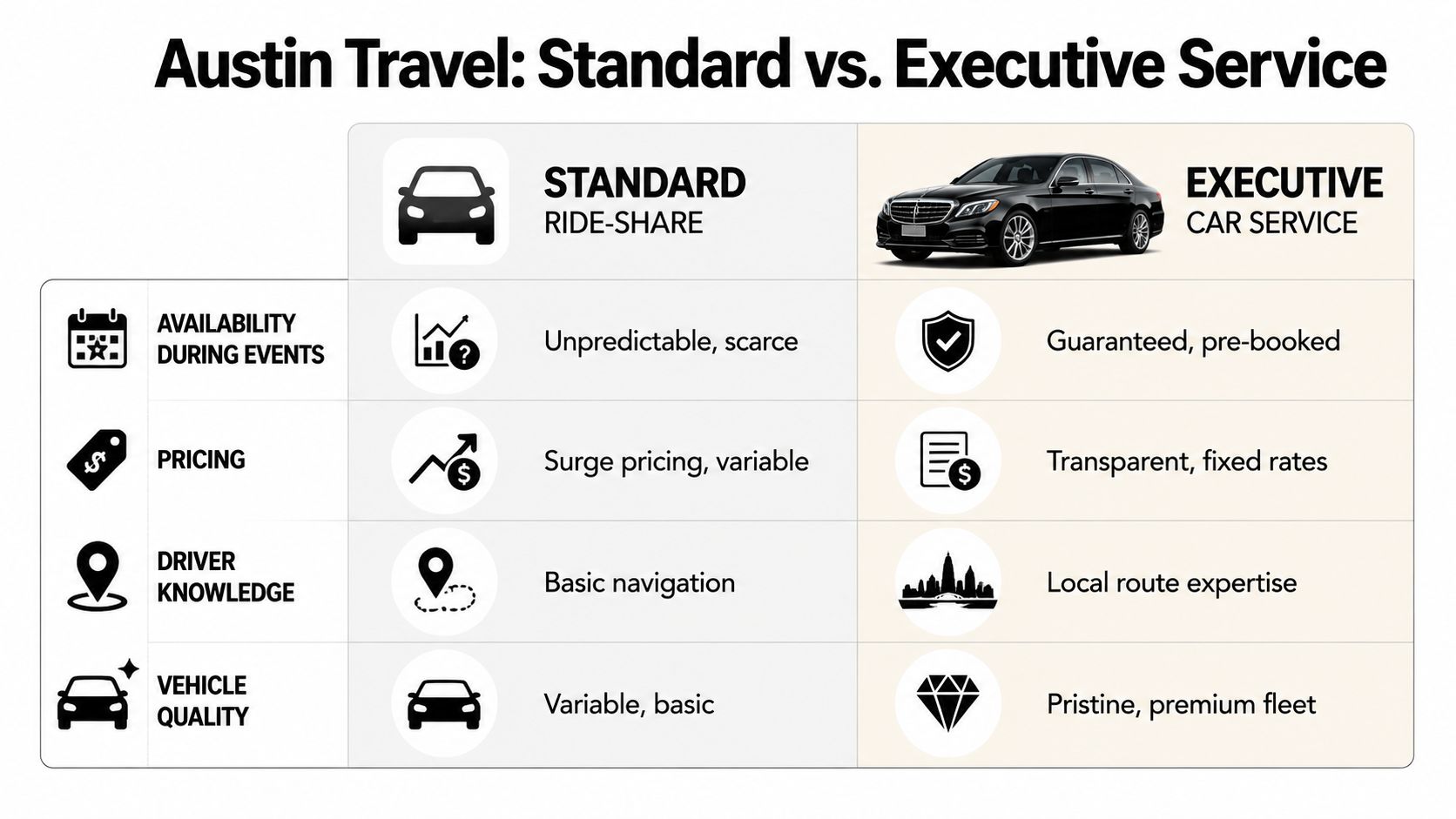
One Austin provider page addresses that directly. During SXSW, ACL, and Formula 1 periods, executive fleets list flat-rate pricing such as $100 per hour for Executive Sedans and $120 per hour for First Class SUVs, while noting that Uber Black may surge to 3.0 to 5.0x in downtown Austin during those same periods. The same page also notes a 2-hour minimum for sedans and a 3-hour minimum for 10 to 14 passenger Sprinter vans, with minimums starting at $120 for sedans and $540 for vans.
That's the practical difference between a pre-booked professional model and app-based dynamic pricing. One is built around reserved capacity and planned utilization. The other reacts to supply and demand in real time.
Why fixed pricing matters more during SXSW, ACL, and F1
These aren't ordinary high-traffic days. Austin event periods combine visitor volume, venue clustering, road closures, and compressed pickup windows. The transportation problem isn't just cost. It's uncertainty.
Here's the side-by-side logic:
| Booking factor | Rideshare during peak events | Professional executive service |
|---|---|---|
| Fare structure | Variable | Fixed or pre-quoted |
| Vehicle access | Depends on live availability | Reserved in advance |
| Pickup experience | Queue and app dependent | Managed by dispatch and chauffeur |
| Budget planning | Hard to lock in | Easier to approve ahead of time |
SXSW brings 400,000+ attendees, ACL draws 75,000 per day, and Formula 1 at COTA brings 440,000 over three days, according to the same Austin service references that discuss flat-rate black car and chauffeur availability during major events. Those numbers help explain why surge pricing becomes such a problem for last-minute transportation planning.
If the itinerary matters, event-week transportation should be treated like hotel inventory. Book it early, lock the terms, and don't assume curbside options will behave normally.
What works in Austin and what doesn't
What works:
- Pre-booking for key windows: Airport arrivals, speaker movements, executive dinners, and venue transfers should be reserved before the city hits peak demand.
- Hourly service for multi-stop days: If the traveler has several appointments, one assigned vehicle is usually cleaner than trying to source separate point-to-point trips.
- Clear passenger notes: Hotel entrance, event credential status, and assistant contact details save time at pickup.
What doesn't work:
- Treating event weekend like a normal travel day
- Assuming a premium rideshare tier will behave like a chauffeur service
- Waiting until landing to solve ground transportation
For corporate travel managers, this is the strongest argument for Executive Car Service in Austin, TX. You're not just buying a nicer vehicle. You're buying predictability under stress.
How to Evaluate and Book a Provider in Austin
Most providers sound polished online. Effective vetting happens when you ask operational questions.
The goal isn't to find the cheapest option or the fanciest homepage. It's to find the provider least likely to fail when the itinerary changes, the client is demanding, or the city is under pressure.

Questions worth asking before you book
Start with specifics. If a provider answers vaguely, that usually means the process behind the service is vague too.
- Who is operating the trip: Ask whether the ride is handled by the company directly or through an affiliate. Neither model is automatically wrong, but you should know who controls service delivery.
- What support exists after hours: For executive travel, 24/7 live operational support matters more than a generic confirmation email.
- How are schedule changes handled: Ask what happens if the flight lands early, a meeting runs late, or a second stop is added.
- What are the chauffeur standards: You want a direct answer about permitting, professionalism, and guest-facing expectations.
- How is privacy handled: Passenger names, itineraries, and pickup details should be treated as sensitive information.
What to inspect on the website
A provider's website often reveals whether the business is set up for serious corporate work or mostly casual retail bookings.
Look for these signals:
- Clear service categories such as airport transfers, roadshows, group logistics, and VIP transport
- Actual fleet visibility rather than only generic stock language
- Booking terms that make operational sense for hourly service, waiting time, and changes
- A credible corporate account process for repeat travelers, assistants, and centralized billing
If you're comparing local and broader service models, this guide on choosing an executive car service near you is a useful reference point for the questions that separate polished marketing from dependable operations.
A practical shortlist for travel managers and EAs
When I evaluate providers operationally, I want confidence in three areas:
| Evaluation area | What to confirm |
|---|---|
| Dispatch control | Can someone intervene fast if the itinerary changes? |
| Service consistency | Will the client get the same standard every time? |
| Billing clarity | Can the company support organized invoicing and account management? |
A provider doesn't need the flashiest branding. They need disciplined dispatch, clear communication, and the ability to stay calm when the plan changes.
The best booking process is usually simple. Send the itinerary early, include passenger mobile contact, specify luggage and any meet-and-greet needs, note whether the traveler is commercial or private aviation, and confirm who has authority to approve changes during service.
Investing in a Flawless Travel Experience
Ground transportation is easy to undervalue when it works. The car arrives. the passenger gets in. the meeting happens. Nothing dramatic occurs, which is exactly the point.
When it fails, though, it affects more than convenience. It can delay a client meeting, create a poor first impression, expose a VIP to unnecessary friction, or force an assistant to spend half the day fixing avoidable problems. That's why Executive Car Service in Austin, TX should be evaluated as a productivity and risk-control decision, not just a line item.
The hidden cost isn't the ride
The bigger cost is usually time lost to bad coordination. A canceled pickup, a chaotic airport curb, or an unpredictable event-week fare can unravel a tightly planned schedule. For executives, that lost focus is expensive even when it never appears on an invoice.
Professional service protects against that by building structure around the movement itself. The vehicle is reserved. The chauffeur is prepared. The itinerary is understood. If something shifts, there's a system behind the trip that can absorb the change.
Reliability is part of brand representation
For companies hosting clients, moving leadership, or supporting speakers and investors, transportation also reflects the organization. A well-run car service signals control, discretion, and respect for the traveler's time.
That's especially important in Austin, where event demand can turn a normal transfer into a curbside scramble. During those periods, fixed pricing and managed service aren't indulgences. They're a way to keep the schedule intact and the experience professional.
The smartest booking decision is usually the least dramatic one. Reserve the service early. Choose a provider that can handle complexity. Prioritize reliability over improvisation.
If you need a transportation partner that handles executive travel with precision, MLR Worldwide Service offers airport transfers, FBO support, roadshows, VIP transport, and event logistics with the kind of planning and live coordination that keeps Austin itineraries on track. For corporate travel managers, executive assistants, and discerning travelers, the value is simple: fewer surprises, better control, and a smoother day from pickup to final drop-off.