
Your executive lands in a new city, a flight cancellation wipes out the original plan, the board dinner is still on, and three people are texting for updates at once. For a reactive assistant, that kind of day becomes a scramble of vendor calls, apology emails, and preventable mistakes. For a strategic EA, it's a system test.
That difference matters more now because the role itself has expanded. Updated 2025 industry data reports a 12% increase in executive-assistant job listings, average pay around $75,000 annually, and average pay rising as high as $90,000 in major cities. The same reporting says many EAs now own work that used to sit elsewhere, including project management, event planning, and HR support. The best executive assistant best practices reflect that shift. They treat the role as operational leadership, not polished administration.
The fastest way to become indispensable is to build a support model that removes friction before your executive ever sees it. That includes calendar discipline, tighter communication rules, smarter use of automation, and a stronger vendor ecosystem than most assistants ever formalize. Ground transportation is one of the clearest examples. When your chauffeur partner understands your executive's standards, routing preferences, security expectations, and escalation rules, transport stops being a line item and starts becoming a strategic advantage.
1. Master Proactive Travel Coordination and Logistics Planning
Most executive travel problems start before the trip. They begin when an assistant books point A to point B and ignores everything in between. Elite support means planning the handoffs, not just the reservations.
A strong travel plan connects air, ground, venue access, security preferences, and timing buffers into one operating picture. If your executive regularly flies private, attends roadshows, or stacks multiple meetings in one day, ground transport can't be an afterthought. It has to sit inside the itinerary from the start.
Build the route before the request arrives
The best setups are usually repeatable. If your executive takes the same airport corridor, office route, or client circuit often, pre-build it. Keep a rolling view of recurring travel, note vehicle preferences, and make sure your preferred chauffeur provider can support changes without forcing you to start over.
Use a working document, not scattered notes. A strong executive travel itinerary template should include flight details, pickup windows, terminal or FBO notes, venue contact names, backup routing, and after-hours escalation contacts.
Practical rule: If a missed handoff would embarrass the executive, it belongs in the itinerary.
That includes the transition no one talks about enough: airport to meeting. A delayed arrival with no ground plan can wreck the day faster than a late departure.
What works in practice
- Map recurring patterns: Pre-book repeat airport runs, investor meeting routes, and office-to-dinner transfers when the executive's schedule is predictable.
- Store direct contacts: Keep the primary vendor line, secondary contact, and concierge escalation path where you can reach them fast.
- Plan the backup route: If traffic, weather, or a flight shift changes the sequence, know the next move before you need it.
At the highest level, travel coordination isn't about moving someone around. It's about protecting their presence, energy, and punctuality.
2. Establish and Maintain Comprehensive Preference Profiles
A preference profile is one of the clearest signs that an EA thinks strategically. Without it, you repeat the same instructions forever. With it, you create consistency across cities, vendors, and pressure situations.
Most assistants document obvious items first: airline, hotel brand, seat preference. That's useful, but incomplete. The details that matter most are often operational and behavioral. Does your executive want silence in the car before a keynote? Do they prefer the chauffeur to text on arrival or coordinate only through you? Do they get impatient when pickup windows feel vague? Those are the details that prevent friction.

Document what the executive won't think to say twice
A useful profile covers more than comfort. It should include route preferences, communication rules, timing expectations, dietary issues, privacy concerns, and exception handling. If your executive hates being asked avoidable questions mid-trip, your profile should answer those questions before the vendor asks them.
I also recommend separating preferences into two layers:
- Core preferences: Vehicle class, pickup timing, contact method, pacing, and confidentiality expectations
- Situational preferences: Roadshows, board meetings, family travel, international arrivals, or high-security movements
That distinction matters because executives often behave differently depending on the context.
Keep the profile alive
Review it regularly. Preferences drift. A vehicle type that felt right last year may not fit current travel patterns. A communication style that worked in-office may be wrong for a distributed leadership team.
Good preference profiles reduce instructions, reduce mistakes, and quietly raise service quality across every vendor touchpoint.
If you work with a premium chauffeur company, send a simplified operational brief before high-stakes travel. Your provider doesn't need everything. They need the right things, delivered clearly.
3. Implement Real-Time Communication and Status Tracking Systems
Silence is expensive in executive logistics. When no one knows whether the vehicle has arrived, whether traffic is moving, or whether a revised ETA has been communicated, the assistant becomes the manual relay system. That's where mistakes multiply.
A real-time tracking setup gives you one source of truth. It lets you monitor pickups, see changes early, and decide who needs an update and who doesn't. That's especially useful when you're coordinating multiple moving parts across time zones.
A visual dashboard helps most when it removes noise rather than adding more of it.

Decide update rules before the disruption
Not every change deserves an executive interruption. That's the point. Build a communication protocol in advance. If the chauffeur is on site and the executive is still in a meeting, you may need no update at all. If a route issue changes arrival timing for a client dinner, then the executive, venue, and internal stakeholders may all need different versions of the same update.
Set thresholds that trigger action. Your version might be simple:
- Minor change: Internal note only
- Meaningful delay: Update EA and affected stakeholders
- Schedule risk: Escalate with alternatives, not just the problem
Premium providers distinguish themselves. A capable concierge team can monitor ride progress, route around issues, and help you coordinate changes instead of waiting for you to discover them.
For a look at how teams think about live logistics, this short video is useful context.
Visibility should reduce executive load
The executive doesn't need a flood of alerts. You do. Then you translate only the meaningful changes into action. Real-time status tools are valuable when they help you stay ahead, not when they turn every movement into another notification stream.
4. Develop Strategic Vendor Relationships and Partnership Management
At 10:40 p.m., a flight lands early in one city, runs late in another, and your executive adds an unscheduled client dinner before wheels down. In that moment, the difference between a vendor and a partner becomes obvious. One waits for instructions. The other already knows the standards, the preferences, the escalation path, and who to call.
That distinction matters because the EA role now stretches across more functions, more locations, and more external stakeholders than it used to. As noted earlier, assistants are often carrying project, event, and coordination work alongside core support. That wider scope exposes weak vendors quickly. Every vague handoff, missed detail, or slow response comes back to the EA as cleanup work.
Ground transport is one of the clearest tests. A premium global chauffeur company should do more than accept bookings. It should protect timing, discretion, and client experience across cities and time zones. If the service is inconsistent in Singapore, New York, and Paris, the relationship is not mature enough for high-stakes travel.
Transactional vendors create friction. Strategic partners reduce decision load.
That shift requires structure. Set one primary contact, one after-hours path, and a short list of service expectations that matter to your executive. For chauffeur service, I look for consistency of meet-and-greet standards, clean billing, fast confirmation, local market knowledge, and calm problem-solving during live changes. Courtesy matters, but reliability under pressure matters more.
Use upcoming milestones to strengthen the relationship before the pressure hits. If board meetings, investor travel, or a multi-city roadshow are on the calendar, share the pattern early so the provider can staff properly and flag any constraints. This is the same discipline behind strong transport contingency planning and escalation paths. The best partners do better work when they can see the shape of the week, not just the next pickup.
Review performance after meaningful engagements, not only after failures. A short debrief can reveal useful patterns. Did the provider recover well from changes? Did local teams deliver the same standard in every city? Did your executive feel looked after without being overhandled?
A smaller bench usually performs better than a long vendor list you barely know. Keep enough coverage for risk control, but invest real time in the partners who protect the executive experience when timing, visibility, and reputation are all on the line.
5. Create Contingency Plans and Risk Mitigation Protocols
If your executive's travel plan works only when every piece behaves perfectly, you don't have a plan. You have optimism.
Real contingency planning means identifying the moments that can cause reputation damage, missed commitments, or executive stress, then deciding in advance what happens next. Ground transport deserves special attention because it sits at the intersection of timing, visibility, and client-facing experience.
Build fallback paths for critical movements
Not every trip needs a full risk playbook. A board day does. So does a media appearance, investor meeting, private aviation arrival, or multi-city roadshow. For those movements, document backup providers, alternate routes, after-hours contacts, and decision authority. If your executive's aircraft diverts or lands late, your ground provider should already know how to adapt.
A practical framework helps. This corporate travel risk management guide is a useful reference point for thinking through transport contingencies and escalation paths.
Operational warning: The time to choose a backup vendor is not when the primary plan is already failing.
Keep backup plans usable
The common mistake is overbuilding. A contingency plan that lives in a buried folder won't help you during a live disruption. Keep the version you need concise and accessible.
Include:
- Primary risk points: Flight shifts, traffic congestion, vehicle issues, venue access problems
- Named alternatives: Backup chauffeur provider, alternate pickup location, secondary route
- Approval rules: What you can activate on your own, and what requires executive signoff
Your executive should feel the result, not the machinery. If a disruption happens and they step into a revised vehicle with no drama, the system did its job.
6. Master Calendar Management and Scheduling Optimization
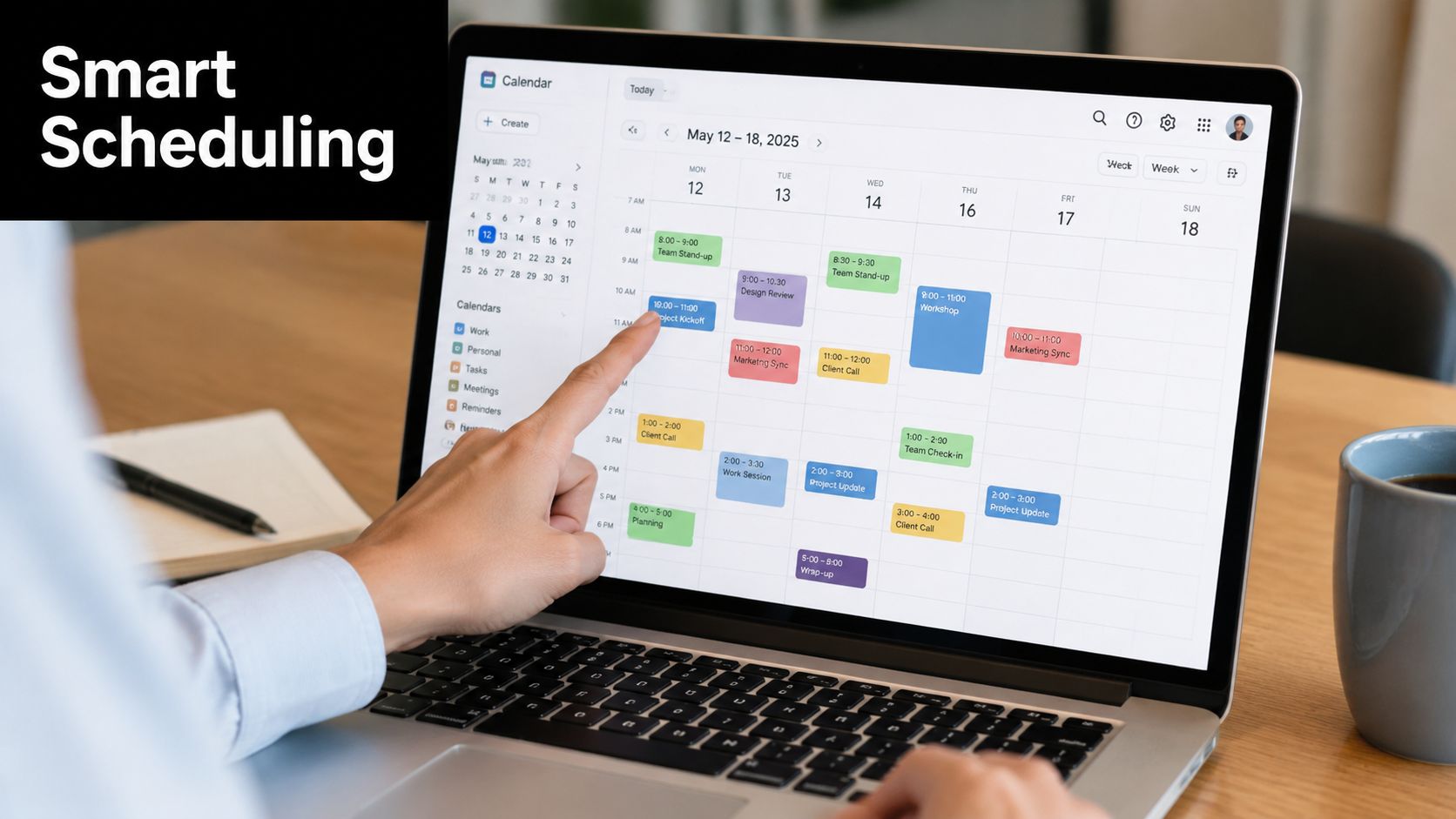
Calendar management is where many executive assistant best practices either come together or fall apart. A calendar isn't just a list of meetings. It's a resource allocation tool for executive attention, preparation time, travel flow, and recovery space.
The strongest guidance I've seen on this is unusually concrete. Practical EA productivity advice recommends blocking 90-minute focus sessions three times per week, limiting recurring internal meetings to 45 minutes, and sending a one-page agenda at least 24 hours before meetings. It also recommends tracking hours reclaimed, meeting-count reduction, and the percentage of protected focus time preserved.
Put transport inside the calendar, not beside it
Assistants often manage transport in a separate workflow and only update the calendar once travel is final. That's backwards. Travel time, pickup windows, venue access, and buffer periods need to live inside the schedule itself or your executive will be overcommitted on paper and late in real life.
A clean calendar entry should answer basic operational questions without forcing the executive to hunt:
- What is this meeting for
- Where exactly is it
- When does pickup happen
- Who is the driver or service contact
- What prep needs to happen before departure
Protect executive focus aggressively
If everything can move, nothing is protected. Build recurring rules around focus blocks, transit buffers, and pre-meeting prep windows. Then defend them.
Calendar discipline takes on a strategic dimension. You're not just organizing time. You're deciding whether the executive arrives prepared, rushed, or depleted.
7. Build Strong Stakeholder Communication and Expectation Management
Most travel breakdowns are communication breakdowns wearing a logistics costume. The car was booked, but the venue didn't have the right entrance. The meeting moved, but the driver wasn't updated. The executive was informed, but the event lead wasn't. None of those are transportation failures alone.
Strong EAs create communication lanes before the movement begins. They decide who gets what information, in what format, and at what point. That matters most when multiple parties are involved, such as an event team, security contact, chauffeur company, and internal stakeholders in different cities.
Send one clean version of the truth
For high-stakes movements, I prefer a consolidated brief over fragmented updates. One pre-travel message should cover the who, where, when, contact chain, and contingency note. If plans change, update the same chain or document instead of spawning multiple versions.
This doesn't need to be elaborate. It needs to be unmistakable.
- Executive brief: Only what the executive needs to know
- Vendor brief: Pickup details, timing, service standards, and escalation contact
- Internal brief: Stakeholder-facing timing, handoff points, and any schedule sensitivities
Match communication to audience
Executives usually want the conclusion. Vendors need instructions. Internal teams need timing and dependencies. Problems start when assistants send all three audiences the same message.
A globally distributed support environment makes this more important. Remote executive support has expanded quickly, and distributed teams need tighter rules to avoid duplicated updates and missed approvals. Clear communication beats constant communication every time.
8. Develop Data-Driven Decision Making and Performance Analytics
If you want more authority over how executive support runs, bring evidence. Not vague impressions. Measurable operational patterns.
That doesn't mean you need a giant reporting stack. It means you should know which routes create recurring delays, which vendors require too much follow-up, and which meeting patterns are wasting executive time. The strongest calendar guidance already points to useful metrics such as reclaimed time, meeting-count reduction, and preserved focus windows, as noted earlier.
Track what changes decisions
Your reporting should help you answer practical questions. Which transport partner handles last-minute changes smoothly? Which venue corridors repeatedly cause arrival stress? Which days are too packed to support thoughtful meeting prep?
For premium chauffeur providers, review the data that affects service decisions: on-time consistency, communication quality, billing clarity, route reliability, and issue resolution.
Measure what helps you renegotiate, simplify, or eliminate. Ignore vanity metrics.
Use market shifts as a signal, not decoration
The broader market is moving toward more outsourced and virtual support. Independent industry reporting says the virtual assistant services market has grown about 475% since 2020, while the enterprise segment of organizations with 500 or more employees has the lowest adoption rate at 28%. For EAs, that suggests large organizations still have room to improve how they adopt support systems, vendor integrations, and governance.
That matters because analytics only help when the process around them is mature enough to act. If your organization is still running travel through scattered emails, rideshare receipts, and ad hoc vendor calls, start by centralizing the basics.
9. Cultivate Executive Time Protection and Strategic Priority Management
Time protection is the center of the role. Everything else supports it.
A capable EA doesn't just keep the executive busy. They protect the executive from low-value interruptions, prevent decision fatigue, and make sure logistics don't leak into strategic time. That requires judgment, not just responsiveness.
Decide what deserves the executive's attention
Many assistants over-escalate because they want to be safe. In practice, constant escalation makes executives less safe because it drains attention from the issues that need judgment. If the car class needs to change, the route needs to shift, or a vendor issue can be resolved within agreed standards, handle it.
What should reach the executive? Material trade-offs. Reputation-sensitive decisions. Relationship calls. Anything that meaningfully affects priorities, not just motion.
Protect cognitive space, not just open slots
AI and automation require adult supervision. Advice for EAs increasingly says to use automation, but the harder question is where to stop. A helpful industry piece points out that the gap is understanding what tasks are safe to automate, how to verify outputs, and how to preserve judgment and confidentiality. It also notes that Microsoft's 2024 Work Trend Index reported 75% of knowledge workers use AI at work, and McKinsey's 2024 research found 65% of organizations were regularly using generative AI, up from 33% in 2023.
Use AI for drafting, scheduling support, meeting prep, and summaries. Keep human review on sensitive communications, unusual travel exceptions, and anything involving executive voice or relationship nuance.
The best time-saving system is the one that removes executive decisions without removing executive judgment.
10. Maintain Discretion, Confidentiality, and Professional Boundaries
Discretion isn't a personality trait. It's an operating standard.
Executives notice confidentiality failures long before they comment on them. A too-detailed vendor email, an overshared schedule, a casual hallway remark, or an unvetted chauffeur can damage trust faster than almost any calendar mistake. If you manage elite travel, your vendors become part of your confidentiality perimeter.
Share the minimum necessary information
A chauffeur usually needs pickup time, location, service notes, and a contact protocol. They do not need the full context of the meeting, the business issue under discussion, or sensitive attendee information unless there's a real operational reason. The same discipline applies to hotels, event staff, and external coordinators.
For executive transport specifically, this perspective on how VIP transport stays discreet aligns with what high-functioning EAs already know. Privacy depends on training, process, and restraint.
Boundaries protect the executive and the EA
Professional boundaries matter internally too. Being trusted with private information doesn't make all information yours to circulate. Create access tiers for schedules, travel details, and preference profiles. Limit who can view what, and keep especially sensitive movements on secure channels only.
The virtual executive assistant market itself shows how quickly this support model is professionalizing. Market reporting values the segment at $3.68 billion in 2025 and projects it to reach $10.29 billion by 2034, implying a 12.10% CAGR from 2026 to 2034. As more support work becomes digitally coordinated, confidentiality standards have to become more formal, not looser.
Executive Assistant Best Practices: 10-Point Comparison
A strong EA operating model shows up in the handoffs. A key test is whether the executive moves through a packed day with control, clear communication, and vendors who perform under pressure. Ground transport is a useful benchmark because it exposes weak planning fast. If the chauffeur partner misses context, if live updates fail, or if fallback options are vague, every other system around the trip starts to strain.
This comparison frames each practice by effort, resources, and payoff, with an eye toward how top EAs build a dependable partner ecosystem rather than a loose collection of vendors.
| Item | 🔄 Implementation Complexity | ⚡ Resource Requirements | 📊 Expected Outcomes | 💡 Ideal Use Cases | ⭐ Key Advantages |
|---|---|---|---|---|---|
| Master Proactive Travel Coordination and Logistics Planning | High, predictive scheduling, multi-vendor sync | High, continuous monitoring, vendor and concierge integrations | Reduced last-minute costs, stronger punctuality, better executive experience | Frequent multi-leg travel, executive roadshows, VIP transfers | Smooth white-glove delivery, fewer disruptions |
| Establish and Maintain Detailed Preference Profiles | Moderate, initial data capture plus regular updates | Moderate, secure records, audits, vendor briefings | More consistent personalized service, fewer repeat instructions | High-net-worth executives, recurring routes, onboarding new staff | Better consistency across vendors, faster setup |
| Implement Real-Time Communication and Status Tracking Systems | Moderate to high, integrations and alerting logic | High, tracking platforms, connectivity, training | Faster responses, stronger on-time performance, clearer accountability | Time-sensitive pickups, convoys, distributed operations | Better visibility, faster disruption response |
| Develop Strategic Vendor Relationships and Partnership Management | Moderate, relationship governance and review cycles | Moderate, account management time, negotiated agreements | Priority service, negotiated rates, faster issue resolution | Organizations with regular volume or multi-city needs | Access to premium capacity, more flexibility during disruptions |
| Create Contingency Plans and Risk Mitigation Protocols | Moderate to high, scenario planning and testing | Moderate, backup vendors, budgets, activation procedures | Less travel disruption, protected executive time | Critical meetings, investor roadshows, high-risk travel | Rapid activation of alternatives, lower reputational risk |
| Master Calendar Management and Scheduling Optimization | Moderate, discipline, automation, and synced rules | Low to moderate, calendar tools, integrations, rules | Fewer conflicts, better buffers, stronger punctuality | Tightly scheduled executives, multi-meeting days | Prevents double bookings, protects realistic travel windows |
| Build Strong Stakeholder Communication and Expectation Management | Moderate, templates and communication cadences | Low to moderate, time, standardized briefings, concierge support | Fewer misunderstandings, quicker escalations, faster resolutions | Multi-party events, group logistics, event rollouts | Clear expectations, stronger stakeholder confidence |
| Develop Data-Driven Decision Making and Performance Analytics | High, data pipelines, dashboards, KPIs | High, analytics tools, data management, reporting cadence | Cost control, vendor optimization, measurable ROI | Large programs, cost-control initiatives, vendor management | Evidence-based improvements, stronger negotiating position |
| Cultivate Executive Time Protection and Strategic Priority Management | Moderate, policy plus judgment frameworks | Low, decision trees, delegation protocols, trust | More executive focus, fewer interruptions, stronger productivity | C-suite executives, high-value decision makers | Preserves strategic time, reduces decision fatigue |
| Maintain Discretion, Confidentiality, and Professional Boundaries | Moderate, secure workflows and vendor vetting | Moderate, secure channels, NDAs, vetting processes | Protected privacy, legal compliance, maintained trust | Sensitive travel, high-profile executives, security-conscious organizations | Lower risk, preserved reputation, stronger trust |
No team implements all ten at the same depth on day one.
The practical order usually starts with calendar control, preference records, and live communication. Then it expands into vendor governance, analytics, and formal contingency planning. EAs supporting senior leaders with frequent travel often see the clearest return by tightening one premium vendor relationship first, especially with a global chauffeur company that can deliver consistent standards across cities. That gives the EA fewer variables to manage, cleaner escalation paths, and a partner who can support the executive at the level the role requires.
Integrate These Practices, Become Indispensable
The best executive assistant best practices don't live in isolated tricks. They work because they reinforce each other. A protected calendar is easier to defend when you have strong preference profiles. Preference profiles become more useful when your transport partner understands them. Real-time tracking becomes valuable when you already know who should be informed and who shouldn't. Contingency plans work because you built vendor relationships before the crisis, not during it.
That's the shift from gatekeeper to strategic partner. You're no longer managing tasks as they appear. You're building a support infrastructure that carries the executive through complex days with less friction, fewer avoidable decisions, and better use of time. That is the primary advantage of the role.
Ground transportation is a surprisingly strong test case for this. It touches punctuality, security, discretion, communication, stakeholder management, and executive experience all at once. If your transport setup is weak, you feel it everywhere. If it's strong, it improves everything around it. Meetings start cleaner. Airport transitions feel controlled. Roadshows stop consuming unnecessary mental energy. The executive shows up composed, not depleted.
This is why strategic vendor management matters so much. Premium providers aren't valuable because they're expensive or polished. They're valuable when they reduce operational noise, adapt under pressure, and execute consistently enough that you can stop supervising every handoff. The same principle applies to every high-impact vendor in your ecosystem. You want fewer vendors that perform at a higher standard, with clearer accountability and a deeper understanding of how your executive works.
There's also a career angle here. The EA role keeps moving upward in scope. More assistants are being asked to own projects, orchestrate distributed workflows, manage outside partners, and use automation intelligently without increasing risk. The assistants who stand out won't be the ones who respond fastest. They'll be the ones who build reliable systems, measure what matters, and make excellent judgment look effortless.
Start with one area that creates repeat friction. For many teams, that's travel. For others, it's calendar discipline or stakeholder communication. Tighten that system first. Write the playbook. Clarify the approval rules. Formalize your preferred partners. Track what improves. Then repeat.
Indispensable EAs aren't magical. They're structured, trusted, and difficult to surprise because they've already thought through the next move.
If executive ground transportation is one of the pressure points in your support model, MLR Worldwide Service is the kind of partner worth building into your operating system. MLR supports executives, high-net-worth travelers, EAs, travel managers, and event teams with chauffeur service, airport and FBO coordination, roadshows, VIP transport, and global itinerary support backed by a 24/7 concierge team. When you need reliability, discretion, and smooth handoffs across cities, MLR helps turn travel from a recurring risk into a managed advantage.