

A traveler has just landed after an overnight flight to Tokyo. The meeting is in less than an hour. Their assistant made the booking days ago, but there's no driver at arrivals, no proactive message, and no one answering the support line. At that point, the problem isn't transportation. It's lost control.
That's the difference most buyers miss. A car can be booked in seconds. A high-stakes journey can't be left to a booking confirmation alone. When an itinerary spans borders, time zones, security expectations, and executive schedules, the core offering is operational certainty.
An international luxury car service only earns that label when it protects the traveler's time, focus, and privacy from the moment wheels touch down to the final stop of the day. The vehicle matters. So does the chauffeur. But the deeper value sits behind the scenes in dispatch protocols, affiliate standards, rerouting authority, airport coordination, and live problem-solving.
Demand for premium ground transportation keeps rising alongside the broader luxury vehicle ecosystem. The global luxury car market was valued at USD 486.4 billion in 2025 and is projected to reach USD 676.8 billion by 2034, growing at a CAGR of 3.74%, according to IMARC's luxury car market analysis. That growth reflects a wider expectation for comfort, technology, and high-standard travel experiences.
What matters on the ground, though, isn't the market headline. It's whether the service can still perform when a flight lands early, the route closes without notice, the principal adds two stops, and a sensitive call starts the moment the door closes.
When Seamless Travel Is Non-Negotiable
The failure usually starts small. A missed name sign. A chauffeur parked at the wrong terminal. A dispatcher who didn't notice the inbound flight changed gates. For leisure travel, that's frustrating. For a CEO, board member, family office principal, or private aviation guest, it can compromise the entire day.
In practice, the first transfer often sets the tone for everything that follows. If the arrival pickup is shaky, the traveler starts burning attention on logistics instead of using the ride to prepare, decompress, or take confidential calls. The damage isn't abstract. It shows up as a late arrival, a rushed entrance, a poor first impression, and unnecessary stress before a critical meeting.
What a managed service changes
A managed international service doesn't treat the ride as an isolated task. It treats the journey as an operation with dependencies. The team handling it should already know the flight status, terminal, pickup protocol, luggage profile, onsite contact, fallback route, and what happens if the traveler's plans change on arrival.
That's why experienced travel coordinators don't buy “a luxury car” in the simple sense. They buy:
- Time protection: Buffer planning, live monitoring, and direct intervention when the schedule shifts.
- Focus protection: Quiet handoffs, clean communication, and no need for the passenger to troubleshoot in transit.
- Reputation protection: A service standard that reflects the seriousness of the traveler and the organization they represent.
Practical rule: If the provider only talks about vehicle class and not about contingency handling, you're not buying managed transport. You're buying a nicer ride.
The strongest operators understand that uninterrupted flow isn't visible when things go right. It becomes apparent when something goes wrong and the passenger remains unaware.
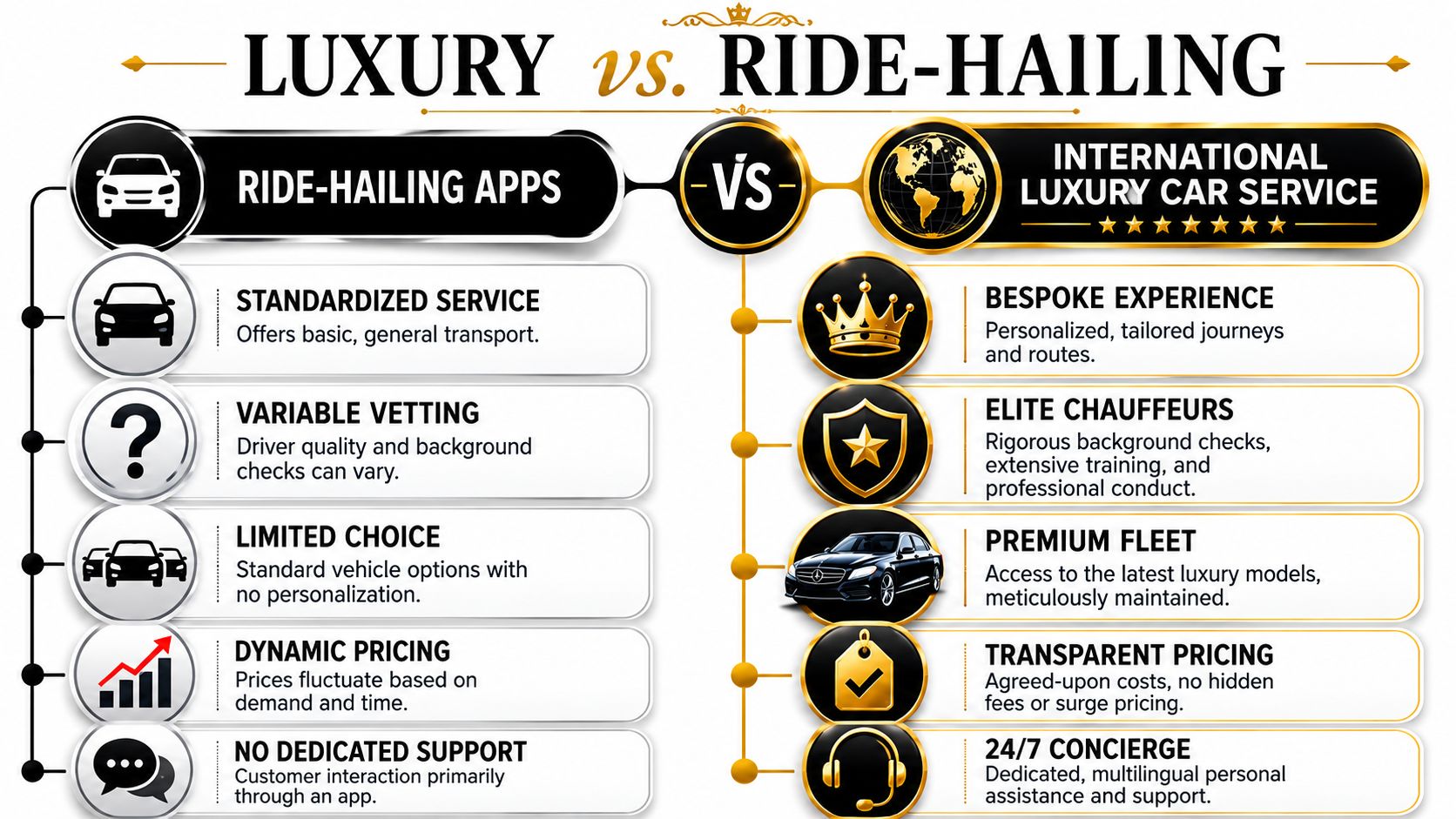
Beyond Ride-Hailing What Defines a True Luxury Service
Premium app rides and a true international luxury car service may look similar on a receipt. Operationally, they're different products.
One is built for transactional convenience. The other is built for controlled execution. The easiest analogy is commercial travel versus private charter. Both move passengers from one place to another. Only one is designed around the traveler's timing, confidentiality, and changing requirements.
The professional chauffeured sector is far bigger and more structured than many buyers assume. The global chauffeur services market was valued at $52.4 billion in 2025 and is forecast to grow at a CAGR of 7.3% through 2034, while the U.S. limousine and town car services industry included 196,000 businesses in 2026, according to IBISWorld's limousine and town car services industry research.
The vehicle is only one layer
A late-model sedan or SUV doesn't create white-glove service by itself. The service layer sits on top of the car.
A real luxury operation typically includes:
- Professional chauffeur standards: Commercial presentation, route discipline, local knowledge, and measured communication.
- 24/7 operations support: A live team that can intervene before the passenger has to call.
- Flight and itinerary monitoring: Not just airport pickup, but active oversight.
- Client profile handling: Preferences that follow the traveler across bookings.
- Duty of care: Clear responsibility for who is monitoring the trip and who acts when plans change.
That's the operational meaning behind white-glove service in executive transportation. It isn't decorative. It's procedural.
What works and what fails
What works is a controlled chain of responsibility. The booking team confirms details. Dispatch verifies execution. The chauffeur receives the correct notes. Operations watches the live movement. If one variable changes, someone owns the correction.
What fails is fragmented delivery. The booking is accepted by one party, passed to another, then subcontracted again with weak oversight. That's where pickup confusion, communication gaps, and inconsistent standards usually appear.
A buyer should ask a simple question: who is accountable at 2:10 a.m. when the flight diverts, the passenger changes destination mid-route, or the arrival shifts from commercial terminal to FBO handling? If the answer is vague, the service model is too thin for executive travel.
Luxury ground transport isn't defined by leather seats. It's defined by whether the passenger ever has to manage the ride themselves.
Key Use Cases for Global Business and VIPs
The value of an international luxury car service becomes obvious when the itinerary has consequences. Simple transfers matter, but the ultimate test comes when the ride is tied to aviation timelines, investor meetings, venue security, or public exposure.

Airport and FBO transfers
Many providers look polished online but unravel in real life. Airport work requires more than showing up near arrivals. The operator has to manage flight tracking, terminal changes, signage protocol, wait-time discipline, luggage expectations, and backup communication if the passenger can't immediately connect.
For private aviation and FBO support, the bar is higher. Timing can shift with little notice. Access procedures vary by airport. The chauffeur may need exact ramp-side coordination rules, security instructions, and a communication chain that includes handlers, assistants, or flight departments.
What works in this environment is precision. The chauffeur knows where to stage, operations knows who to call, and the traveler moves from air to ground without friction.
Corporate roadshows
Roadshows expose weak operators fast because the schedule is fluid by design. Meetings run over. Stops are added. The passenger may need to leave one venue early, reroute to another office, then hold the car for uncertain standby time.
A managed provider's services justify its fee. A single point of contact should be able to update the day in motion without forcing the traveler to renegotiate each segment. The service should also preserve continuity. Same profile, same billing structure, same communication style, even when the itinerary crosses cities.
Event and group logistics
Moving one executive is straightforward. Moving a group of principals, speakers, board members, or VIP guests is logistics.
The failure points are predictable:
- Staggered arrivals: Different flights, different terminals, same destination window.
- Venue congestion: Limited curb access and compressed pickup windows after an event.
- Manifest drift: Last-minute substitutions, changed escorts, or revised guest lists.
- Brand sensitivity: The transport experience reflects on the host organization.
Strong operators build manifests, assign vehicle sequencing, maintain a live command structure, and separate principal movement from general guest movement when needed.
Field note: Group transportation fails most often at the handoff points, not on the drive itself. The fix is better staging, better manifest control, and one decision-maker who can change the plan in real time.
Secure VIP movement
For public figures, family offices, and high-net-worth travelers, the requirement isn't only comfort. It's controlled exposure.
That means discreet pickup points, limited public waiting, restrained chauffeur conduct, and route handling that reduces unnecessary visibility. The best secure movements also avoid overproducing the experience. Flashy execution often draws the exact attention the client wants to avoid.
In these use cases, the service isn't a convenience. It's a risk-control tool.
How Operators Ensure Global Consistency and Security
Consistency across New York, London, Dubai, and Tokyo doesn't happen because a website says “global.” It happens because someone has built a system that can hold the same service line across different legal environments, airport rules, traffic cultures, and affiliate partners.
The first component is network discipline. A provider with international reach usually relies on local operators in many markets. That model works only when the central company sets mandatory standards for chauffeur presentation, vehicle age and condition, arrival procedure, communication, and incident escalation.
The affiliate network has to be managed, not merely assembled
The weakest global programs treat affiliates like a directory. The strongest treat them like an extension of operations.
That means checking:
- Vehicle suitability: Not just category names, but actual fleet condition and executive appropriateness.
- Chauffeur protocol: Meet-and-greet conduct, discretion, dress, luggage handling, and communication style.
- Operational responsiveness: Whether the local team answers quickly, confirms correctly, and escalates problems early.
- Service recovery: What they do when a route collapses, an address is wrong, or a principal changes plans in motion.
A centralized operations desk ties those pieces together. It acts as mission control for schedule changes, airport updates, reroutes, and client communication. Without that layer, a global network becomes a collection of local bookings.
For buyers who care about live movement management, real-time route optimization for executive transport is one of the clearest signs that the provider thinks operationally rather than transactionally.
Privacy claims need verification
This is the most overlooked part of the category. Nearly every premium transport company promises discretion. Very few can explain how they verify it.
That gap matters because the car often becomes a mobile meeting room. According to Forbes reporting on privacy concerns in luxury chauffeur travel, a 2023 internal audit found 18% of premium passengers still had anxiety about conversation privacy. The same reporting notes that the industry lacks a universal standard, while Privacy-by-Design fleet certifications have been adopted by 12% of providers and include scans for hidden recording devices.
That's a useful distinction. “Our chauffeurs are discreet” is a claim. A verifiable privacy protocol is an operating standard.
A serious provider should be able to describe, in plain language, how it handles:
| Issue | Weak answer | Strong answer |
|---|---|---|
| In-car privacy | “We value discretion” | Specific policies on devices, data handling, and inspection protocols |
| Data sharing | Unclear vendor chain | Defined access controls and need-to-know handling |
| Chauffeur conduct | General professionalism | Formal instructions on silence, confidentiality, and non-disclosure boundaries |
| Escalation | Ad hoc | Named process for incidents, concerns, and immediate intervention |
Security in luxury transport doesn't always mean visible protection details. Often it means disciplined invisibility. Correct car. Correct route. Correct handoff. No surprises.
How to Evaluate an International Luxury Car Service Provider
Most buyers ask the wrong opening question. They ask what the fleet looks like. The better question is what happens when the day stops looking like the original booking.
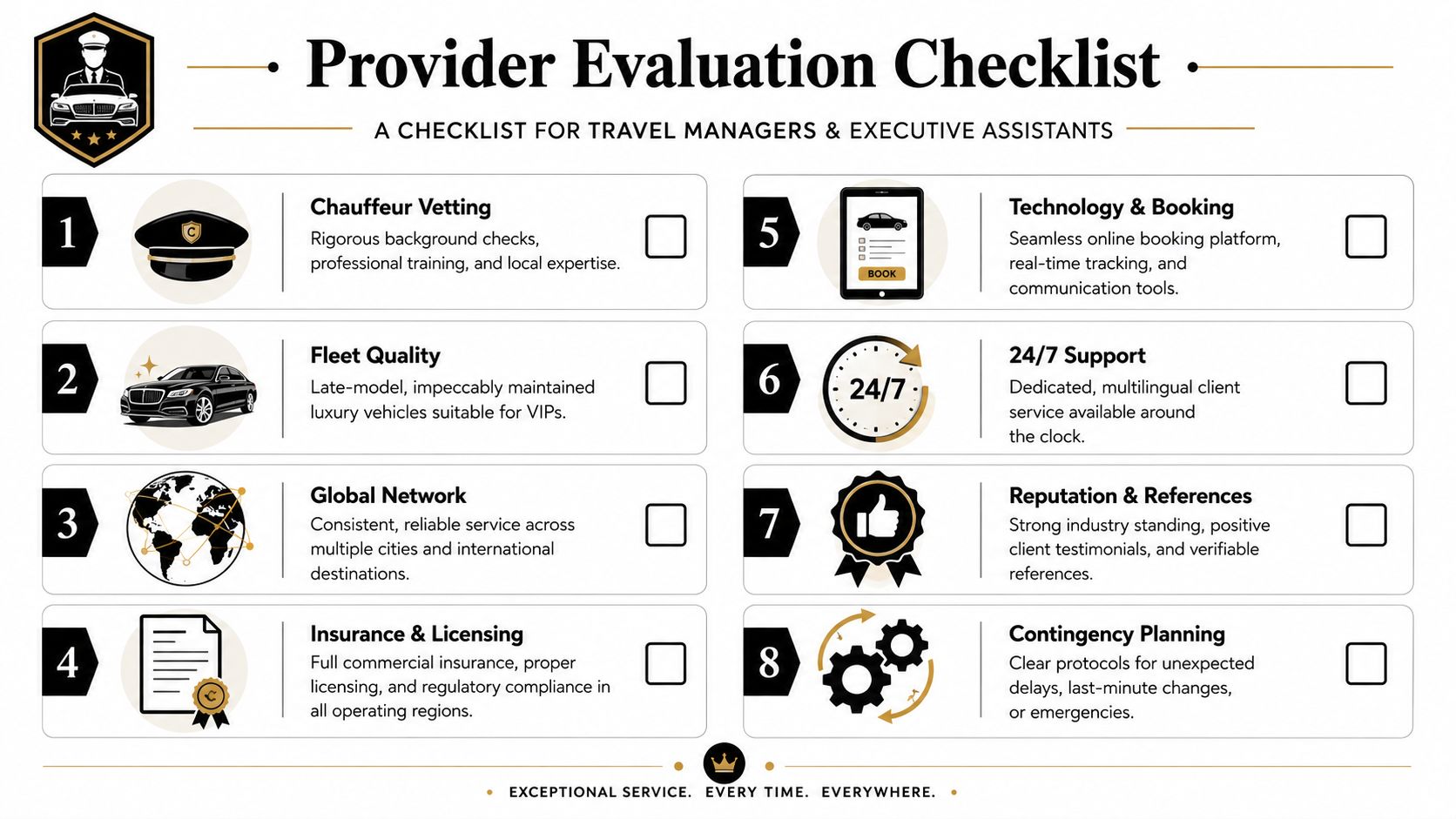
A provider should be evaluated like an operating partner, not a vendor with nice sedans. That means testing whether the company can hold standards under pressure, across borders, and without constant supervision from the client's assistant or travel desk.
Ask for evidence, not assurances
Start with the fleet, but don't stop there. Reliability matters because every maintenance issue becomes a service risk. According to Edmunds coverage of luxury car brand reliability, Lexus ranks as the top luxury brand with 166 problems per 100 vehicles. That doesn't mean every provider should run only one marque. It does mean buyers should pay attention to whether fleet choices support punctuality and low downtime.
Then move into operating proof:
- How are chauffeurs vetted and trained? Ask beyond background checks. You want to hear about defensive driving, executive etiquette, airport procedure, and confidentiality expectations.
- Who runs support after hours? If the answer sounds like a generic call center, keep digging.
- How are affiliates approved? A real global standard should include onboarding, quality checks, and performance review.
- Can they provide commercial insurance and licensing documentation? Serious operators won't hesitate.
- What's their disruption protocol? Ask what happens in a flight diversion, vehicle issue, late release, or route closure.
Listen for operational maturity
The strongest providers answer in process language. They'll explain who monitors flights, who updates chauffeurs, who contacts the client, and how revised manifests are distributed.
The weakest providers answer in marketing language. They'll repeat “premium,” “luxury,” and “VIP” without describing the machinery underneath.
A quick buyer scorecard helps separate the two:
| Question | Strong sign | Warning sign |
|---|---|---|
| Support model | In-house 24/7 operations | Outsourced or undefined support |
| Network quality | Vetted affiliate standards | Broad coverage with unclear controls |
| Chauffeur standard | Formal training and protocol | “Experienced drivers” with little detail |
| Documentation | Readily available | Slow, partial, or evasive |
| Change handling | Named escalation process | “We'll do our best” |
One provider that fits this type of operational evaluation is MLR Worldwide Service's VIP transportation service, which describes executive chauffeur work, airport support, event logistics, and global coordination in practical service terms. That kind of scope matters only if the company can document how it executes it.
Buy for consistency under strain. Anyone can look polished on a routine transfer.
Questions worth sending before onboarding
Send these before signing a corporate account:
- Who owns the trip in real time once it's confirmed?
- What are your affiliate vetting and audit standards?
- How do you verify vehicle condition and replacement readiness?
- What privacy controls apply to chauffeurs, dispatch, and trip data?
- How do you handle consolidated billing across cities and currencies?
- What client details are stored, and who can access them?
If a provider can't answer those cleanly, they're not ready for executive travel at scale.
Understanding Pricing Models and Contract Terms
Luxury transport pricing shouldn't be cheap, but it should be legible. If the quote is hard to decode, the billing will be worse.
Most international luxury car service programs use a mix of point-to-point transfers, hourly bookings, and day-based availability for roadshows or event work. No one model is universally better. The right one depends on how fixed the itinerary is and how much idle time the passenger will create between stops.

Where cost usually comes from
The cleanest transfer pricing works when the route is stable. Hourly pricing makes more sense when the schedule is fluid and the client needs control over timing. Day rates are often the practical choice for roadshows because they reduce constant recalculation while keeping the vehicle and chauffeur committed.
What changes the quote most often:
- Vehicle category: Executive sedan, premium SUV, luxury van, or specialty vehicle.
- Service window: Early morning, late night, holiday, or high-demand operating periods.
- Local market conditions: Airport rules, city restrictions, parking realities, and chauffeur availability.
- Operational complexity: Multiple stops, waiting time, manifest coordination, or security-sensitive handling.
Client expectations also shape price pressure. The ultra-premium vehicle segment, defined as cars over $200,000, is a key driver for luxury services, and the overall market is projected to grow at a CAGR of 7.4% through 2036, according to Future Market Insights on the luxury car market. In practical terms, clients increasingly expect late-model, high-end fleet options, and those expectations affect capital cost and maintenance standards.
What to review in the contract
A corporate agreement should answer operational and financial questions before the first ride is booked.
Focus on these terms:
- Cancellation rules: Especially for airport work, standby bookings, and special events.
- Wait-time policy: Commercial arrival, FBO standby, and meeting overruns shouldn't become billing surprises.
- Damage and cleaning clauses: They should be specific, not open-ended.
- Consolidated invoicing: Important for multi-city travel programs.
- Payment terms and authorized bookers: Prevents disputes and informal bookings outside policy.
If a provider can explain pricing clearly, they usually run a cleaner operation behind the scenes.
Your Pre-Travel Checklist for Flawless Execution
The best provider in the world can't protect a trip if the brief is incomplete. Most service failures begin with missing details that seemed minor when the booking was made.
Before any high-stakes itinerary goes live, confirm the trip like an operator would, not like a casual passenger would.
Confirm the execution details
Use a working checklist, not memory.
- Flight and arrival data: Airline, flight number, terminal if known, and whether the traveler is commercial or private aviation.
- Exact addresses: Building names, entrances, security gates, and where pickup should occur after meetings.
- Passenger contacts: Principal, assistant, onsite contact, and who has authority to change the trip.
- Luggage profile: Important for vehicle assignment, especially when roadshow materials or extra bags are involved.
Define the service preferences
Preferences only help if they're given in advance and attached to the profile.
Include items such as:
- Cabin environment: Temperature, water choice, music off, or total quiet.
- Conversation level: Silent ride, minimal confirmation only, or flexible based on client cues.
- Route preference: Fastest route, smoothest route, or low-visibility route for sensitive movements.
- Arrival style: Meet inside, curbside coordination, or discreet no-sign pickup.
A flawless ride often depends on small instructions that never appear on a standard booking form.
Lock the communication chain
Communication planning is a common oversight for many teams. Decide before travel begins how updates will move.
A clean protocol should identify:
- Who receives operational updates
- Who can approve changes
- Whether the traveler should be contacted directly
- What the fallback is if the primary contact is unreachable
Also confirm the contingency plan. If the flight diverts, the meeting runs late, or the traveler adds a stop, everyone should already know who acts first. That's how you avoid the worst outcome in executive travel: a client standing still while three different parties figure out who owns the problem.
If your team needs a managed partner for airport transfers, roadshows, VIP movement, or multi-city executive travel, MLR Worldwide Service provides globally coordinated ground transportation with 24/7 operations support, a vetted affiliate network, and service protocols built for high-stakes itineraries.