
You can feel it on a busy travel day before anyone says a word. The aircraft is on stand, passengers are waiting for bags, a fueling truck is moving in, and someone in operations is checking whether boarding can still hold its slot. That moment sits at the center of aviation ground services, the work that decides whether a flight feels controlled or chaotic.
The ramp is often seen as a short checklist of tasks. In reality, it's a governed operating system that ties together aircraft servicing, passenger flow, baggage, cargo, security, and the handoffs between every vendor touching the trip. In 2023, the global ground handling industry generated US$64 billion in turnover, about 7% of the commercial aviation value chain, with 1.1 million direct workers and nearly 3 million jobs when supply-chain and induced employment are included, according to the industry assessment published by the Airports Services Association. That scale is why decisions made on the ramp shape punctuality, safety, and the passenger experience.
What Aviation Ground Services Actually Cover
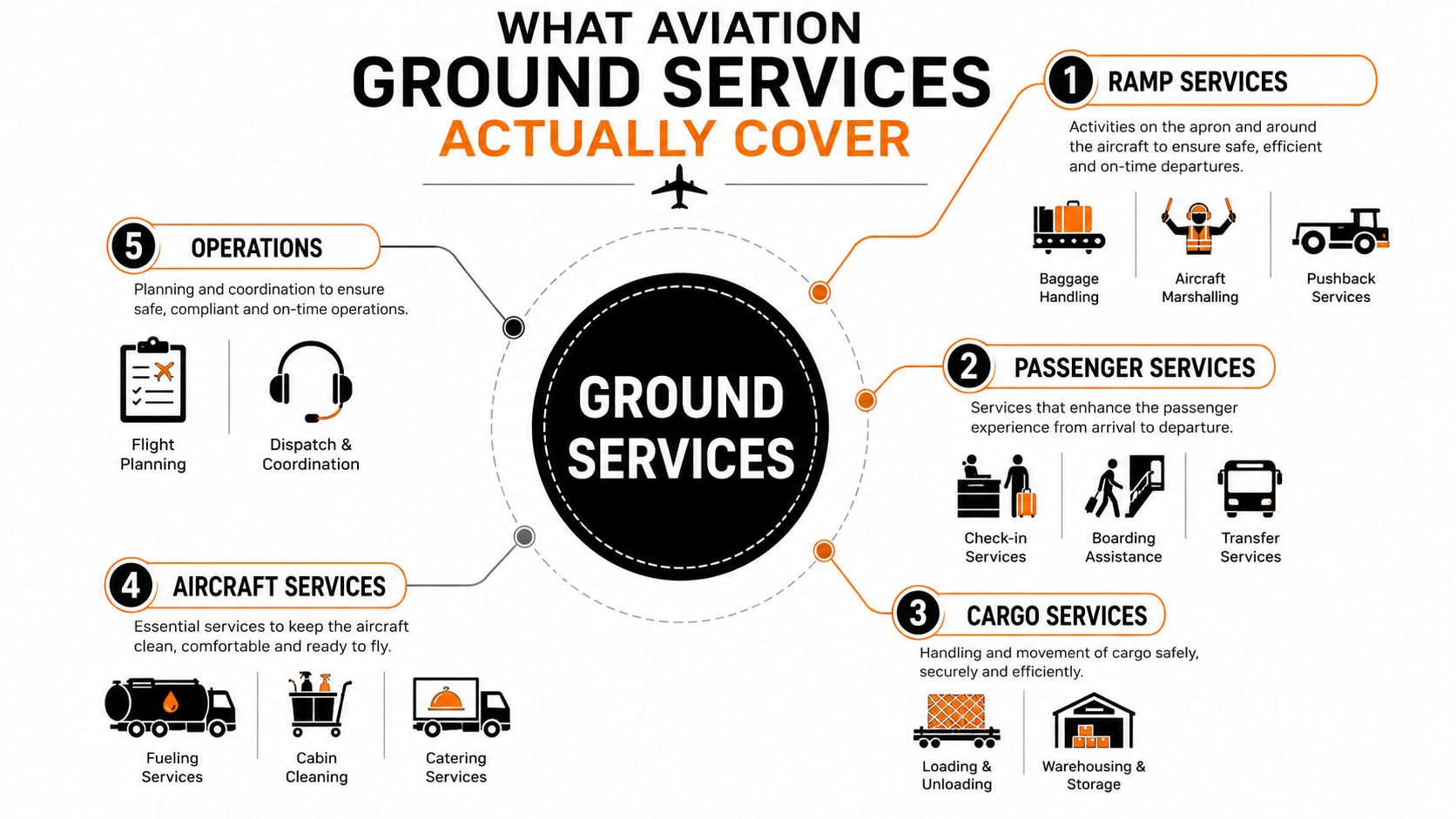
A flight doesn't begin or end at the door of the aircraft. It begins when the airplane reaches the stand, and it ends when the next departure is cleared to push back. Aviation ground services are the set of activities that make that interval work, from marshalling and towing to baggage flow, passenger assistance, fueling, cleaning, cargo transfer, and the coordination that keeps every one of those tasks from colliding.
The easiest way to understand the category is to think of it as the airport's connective tissue. Air traffic control keeps aircraft separated in the sky, catering prepares meals, and the cabin crew manages the onboard experience. Ground services are different. They're the people, equipment, and procedures that let the aircraft accept the next leg without delay, damage, or confusion.
The core idea behind the category
At a standards level, the industry has become more specific about what can be connected to an aircraft at the stand. ISO 10842:2017 defines the interface locations for seven core services, including 400 Hz electrical power, preconditioned air, pneumatic engine-start air, potable water, lavatory service, aircraft refueling, and interphone through aircraft ground service connections, which helps handlers match equipment to the aircraft interface correctly (ISO 10842:2017 reference catalog). That matters because the wrong connector, hose, or service point can interrupt a turnaround or force manual rework.
A practical definition helps avoid a common confusion. Ground services are not the same as in-flight catering, and they're not the same as air traffic control. They also aren't just “ramp work.” On a complex movement, the category reaches from the apron into the terminal interface and out into cargo bays, fueling lanes, and operations offices.
The cleanest way to judge ground services is simple. Ask whether the work touches the aircraft on the ground, or whether it exists to keep that aircraft moving on schedule.
For executive and private travel, this distinction matters because a short itinerary can still rely on several layers of support at once. A passenger may never see baggage sorters, fueling coordination, or load control, but those functions determine whether the aircraft leaves on time and whether the trip stays private, calm, and recoverable if plans change.
The Main Service Categories on the Apron
On a live apron, the work tends to cluster by location. Some tasks happen directly at the aircraft stand, some happen inside the terminal interface, and some happen in the cargo and fueling lanes that sit behind the scenes. Reading the ramp this way makes it easier to see how the system works.
Start with the aircraft stand
The most visible category is aircraft handling. That includes marshaling, parking, chocking, pushback, towing, GPU hookup, pre-conditioned air, lavatory service, potable water service, and exterior checks that keep the aircraft safe during the turn. The people doing this work are usually ramp agents, line technicians, tug drivers, and marshallers. Their tools are the ones travelers almost never notice until something goes wrong, wheel chocks, towbars, belt loaders, tugs, and ground power units.
Passenger-facing work happens at the terminal edge. Check-in, boarding, transfer assistance, gate coordination, and special assistance services all sit in this layer. For scheduled airline operations, it's the interface that shapes the passenger experience before the cabin door closes. For executive and private aviation, the same logic shows up in smaller form through FBO reception, secure arrivals, and the handoff to ground transport.
Cargo and baggage flows sit in their own lane. Bags move between sort facilities, carts, belt loaders, dollies, and the aircraft hold. Cargo teams deal with loading, unloading, warehousing, and documentation, often in parallel with passenger services. When that handoff is smooth, the aircraft leaves with the right load in the right place. When it isn't, delay starts to accumulate in ways passengers only notice later.
Services that matter most by travel pattern
Fueling and energy support deserve their own mention because they shape both timing and risk. Refuelers, hoses, bonding gear, and service checks aren't glamorous, but they're central to dispatch readiness. Cabin cleaning and catering swaps sit nearby in the workflow, often running while baggage and fuel are still being handled.
Practical rule: if a service affects aircraft weight, cabin readiness, or dispatch paperwork, treat it as a turnaround-critical function, not a courtesy.
For corporate and private travelers, the most relevant categories are usually aircraft servicing, passenger transfer, FBO coordination, and ground transport. For scheduled airline operations, the highest-volume categories are passenger handling, baggage, cargo, and fuel support. Different programs need different depth, but they all depend on the same apron ecosystem.
How a Turnaround Actually Unfolds
A turnaround looks simple from the terminal window. The airplane arrives, the people get off, the cabin gets ready, the bags move, the fuel truck leaves, and then the next passengers board. In practice, those tasks overlap, and the timing only works if the team respects the sequence.
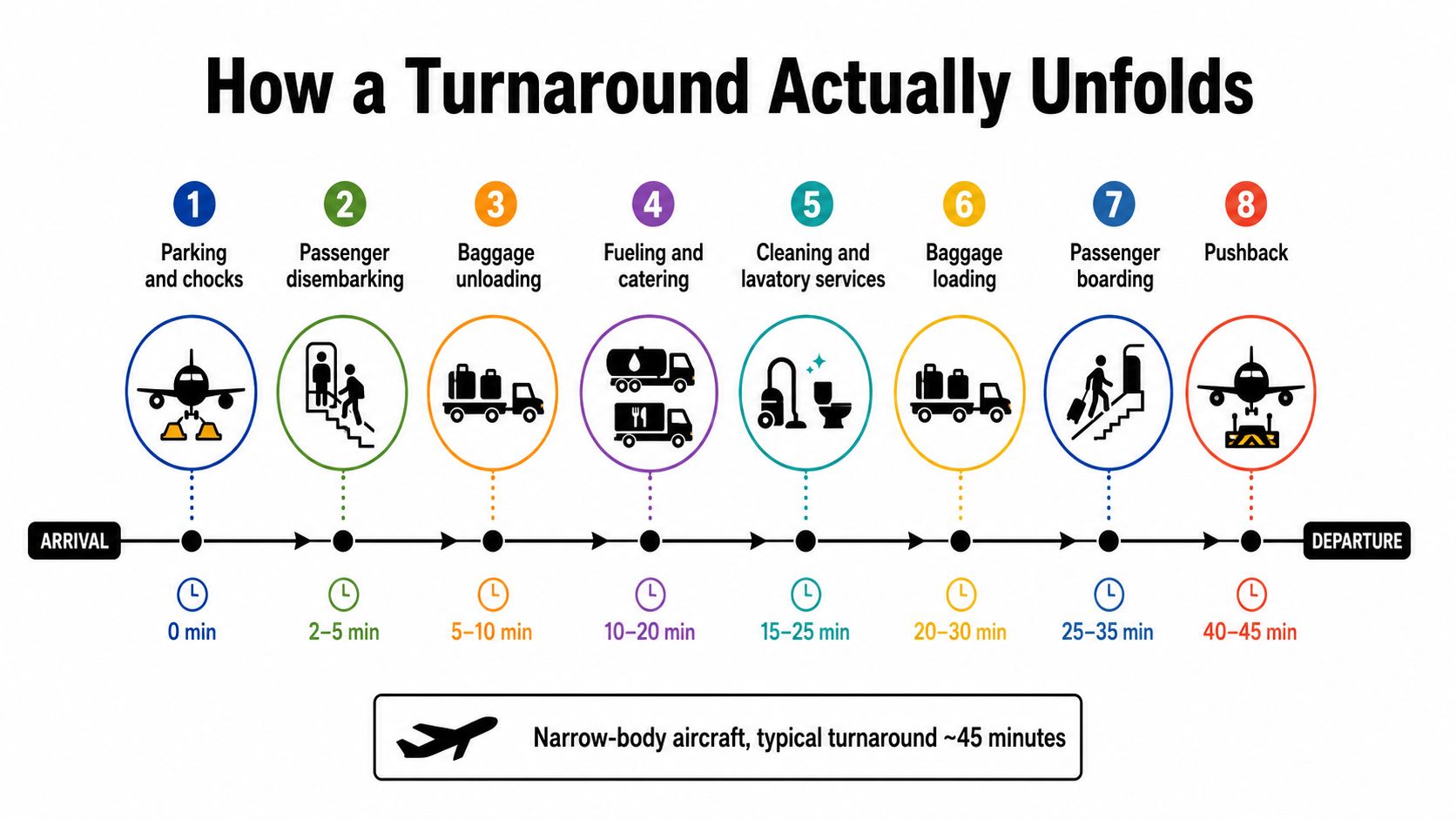
At block-in, the marshaller guides the aircraft to the stop point and the crew sets the chocks. Only after the aircraft is secure do doors open and passengers begin to disembark. That first handoff is where ground teams establish control of the stand, because every later activity depends on the aircraft staying exactly where it's supposed to be.
The overlap is where risk lives
While passengers are leaving, baggage offload starts. Fueling may begin at the same time, depending on the station's procedures. Catering and lavatory servicing often run in parallel too, which is why ramp coordination matters so much. The crew isn't completing one neat task after another, it's managing several moving parts that all need the same physical space.
A narrow-body turn often runs on a compressed clock, and the biggest mistake is assuming that a single delay stays isolated. If the loader arrives late, boarding waits. If fueling pauses for a procedure issue, departure planning slips. If a connector or hose doesn't match the aircraft interface, the stand crew has to stop and reset.
The turnaround also becomes the point where adjacent services join the aviation workflow. Corporate roadshow transport, FBO vehicle staging, and crew movements all plug into the same timing window. If the ground transport team misses the handoff, the aircraft may still depart, but the traveler's day gets harder to recover.
Here's the part many newcomers miss. A turnaround isn't a checklist, it's choreography. The best teams make it look quiet because they've already decided who owns each handoff, who confirms each clear, and who stops the sequence if something doesn't match the plan.
KPIs and Service Standards That Matter
Ground services are measured, but the trick is choosing the right measurements. A handler can look busy and still create fragile performance. Another team can move more calmly and deliver better punctuality, fewer reworks, and fewer service errors. The metrics you track decide which behavior gets rewarded.
What mature operators watch
The most useful operational measures are on-time performance, turnaround time against schedule, baggage mishandling, fueling accuracy, safety incidents per movement, and customer-facing service scores. These metrics give you a clearer view of whether the operation is stable or just fast in the good moments. In vendor discussions, they often sit alongside quality frameworks such as IATA AHM, IGOM, ISAGO, and related standards that shape how handlers describe procedures and evidence.
The standards ecosystem matters because it gives buyers a shared language. It also makes comparison possible across vendors who otherwise talk about service quality in very different ways. A handler that can show consistent procedures, training, and audit history is easier to assess than one that only speaks in general promises.
Turning airport metrics into travel decisions
For corporate travel and private aviation programs, the question isn't just whether a flight departed on time. It's whether a delay compromised a meeting, created a missed connection, or forced a cascade of rebooking and vehicle changes. That's why service-level reviews should link ramp performance to the itinerary, not just the airport report.
If a vendor can't explain how it measures handoffs, recovery time, and exception handling, it probably can't manage them well either.
The market side of the business also shows why standards matter. Ground handling has moved from a back-office function to a major cost center, and the global airport ground and cargo handling services market is projected to keep expanding, with estimates ranging from US$32.4 billion in 2023 to US$83.8 billion by 2033 at a 10.1% CAGR, and another study placing it at US$51.23 billion in 2025 and US$88.17 billion by 2034 (industry market review). That growth makes disciplined KPI selection even more important, because bigger markets usually produce more vendors, more variation, and more noise.
Compliance, Security, and the Hidden Risks
The usual mistake is to treat ground services as a purchase problem. Buy the equipment, pick the cheapest provider, and the ramp will take care of itself. That view misses the two risks that cause the most trouble in practice, fragmented oversight and workforce fragility.
Regulation is part of the operating model
EASA's ground-handling operational requirements say service providers must follow the operator's procedures, or their own management system and ground handling manual when operator instructions are absent. They also require current GSE, tools, maintenance, calibration, and accuracy checks, which makes equipment condition a governance issue as much as a technical one (EASA operational requirements draft). That framing is important because a well-maintained tug doesn't solve a weak procedure, and a strong procedure doesn't survive poor equipment control for long.
ICAO's own material is blunt about the bigger structural issue. It says ground handling is mission-critical, but Annexes contain only limited references to these activities and there's no unified global oversight structure (ICAO working paper). In plain language, the rules are real, but they aren't uniform enough to make every airport or country feel the same to a buyer.
The human side is where delays often start
Workforce fragility is the other blind spot. Industry research notes that ground crew roles are less acknowledged than pilots and cabin crew, while broader labor literature points to hiring, scheduling, retention, and digitalization as recurring pain points (airport ground operations workforce review). That combination matters because ramp quality depends on who's on shift, how well they've been trained, and whether the schedule gives them enough margin to work carefully.
The risk is bigger than a single late bag. A fatigued or undertrained crew can create service errors, safety events, and turnaround disruption that spread across the bank of flights. A single missed handoff at a dense hub can ripple into slot issues, crew connections, and ground transport delays.
The practical lesson is simple. Don't judge a handler only by fleet size or branding. Judge the operating model, the audit trail, the training depth, and the way the provider handles staffing pressure when the ramp gets busy.
Choosing a Ground Services Partner
Choosing a ground services partner is closer to vendor risk management than to a simple rate comparison. The buyer may be an airline, a corporate travel team, or a family office arranging private movement, but the same decision still comes down to how well the provider controls risk, communication, and execution across the ramp.
A useful way to evaluate vendors is to separate the conversation into four questions. The first is capability and network coverage. A provider can perform well at one airport and struggle at another, so ask where it operates, what it keeps in-house, and where it relies on subcontractors.
The second question is safety and compliance evidence. A presentation tells you little. Training records, audit summaries, and certification history show how the operation is managed in practice, especially when pressure rises and shortcuts become tempting.
The third question is technology and reporting. Strong teams do more than claim efficiency. They can show how they record turnaround performance, exceptions, and service recovery, which matters because the ramp runs on coordination, not promises.
The fourth question is cultural fit. A provider may cover the route and still be the wrong fit if it cannot communicate clearly with dispatchers, concierges, or crew schedulers. In ground services, poor handoffs often come from mismatched working styles rather than a single dramatic failure.
A site visit, a reference check, and a pilot service window help expose those differences before a longer commitment is signed. That sequence shows how the provider behaves under real operational pressure, which is the part no pitch deck can fully capture.
How to frame the RFP
The RFP should ask direct questions in plain language. Who owns the stand on arrival? How are fueling, loading, and passenger handling coordinated when the schedule tightens? What happens when a vendor partner misses the handoff? The answers reveal how the team thinks about disruption, and that is usually more useful than the pricing sheet.
For teams building broader travel support around ground operations, a preferred vendor agreement framework and the related preferred vendor agreements tag page can help define service scope, escalation, and responsibility at the handoff point.
Good vendor selection is mostly about failure handling. The provider you want is the one that can explain what happens when the plan breaks, not only when everything runs on time.
A layered model can also make sense. A global handler may cover the airport surface, while a specialized transport or FBO-support partner manages the passenger side. In some programs, that split works better than asking one vendor to do everything.
Where Ground Services Meet Corporate Travel and FBO Operations
A corporate arrival can look simple from the terminal side and still be fragile underneath. The aircraft lands on time, yet the itinerary can stall if the vehicle is late, the passenger meet point is unclear, or the FBO brief does not match what is happening on the ramp. Executive roadshows, group arrivals, and crew repositioning all depend on the same basic condition, the handoff between air and ground has to be clear enough that time is not lost to confusion.
The handoff is the product
For executive travel, the value usually comes from privacy, predictability, and room to recover when something shifts. The aircraft may be ready, but if the sedan is not staged, the route has not been confirmed, or the escort plan changes at the last minute, the schedule begins to leak minutes. Group logistics work differently. The challenge is to keep bags, vehicles, and passengers moving in step across a larger footprint without making the group wait for preventable reasons.
That is why a vetted affiliate network and a 24/7 coordination function matter in practice. Most failures do not come from one provider forgetting a task, they come from two providers assuming the other one owns the handoff. Ground services are therefore less about a single asset and more about continuity across vendors, cities, and time zones.
Ground transportation sits inside the same operational picture. An itinerary that spans multiple cities, late changes, or crew duty windows needs the ground layer to absorb variation instead of amplifying it. The connection between airport transfer design, FBO support, and operational communication becomes obvious once you look at how many small decisions have to line up before the passenger ever reaches the vehicle.
A practical view for travel programs
For programs that connect airport movement with private terminal support, the handoff often includes more than transport. A Gateway Travel Centre style arrangement, where passenger-facing support, timing, and local coordination sit close to the aircraft side, helps show why the ground layer has to be managed as part of the trip plan rather than as a separate afterthought.
MLR Worldwide Service fits into that ecosystem as one option for executive chauffeur services, airport transfers, FBO support, corporate roadshows, event logistics, VIP secure transport, and airline crew movements. That kind of support matters in programs where the ground side has to stay aligned with the air side, especially when schedules shift and the next handoff cannot wait for a callback.
The broader lesson is easy to miss. Aviation ground services are not a back-end checklist. They are the layer that makes the rest of the itinerary feel either controlled or fragile, and the quality of that layer shows up most when the day becomes complicated.
If you are building a travel program that depends on clean airport handoffs, coordinated executive transport, and reliable FBO support, visit MLR Worldwide Service to review how its ground transportation, airport transfer, and crew movement services can fit into your operation. Their team works around tight schedules, last-minute changes, and multi-stop itineraries, which is exactly where ground services matter most.