
The car looked right on paper, the proposal read well, and the routing plan seemed airtight. Then the pickup slipped, the chauffeur took a wrong turn, and the team arrived with just enough delay to make everyone in the meeting room notice. That's the cost of unreliable transport, it rarely shows up as one dramatic failure, but as a chain of small misses that damage time, confidence, and the credibility of the person who booked it.
For corporate buyers, flight crews, and executive assistants, that's why reliability ratings matter. They turn a vague promise like “premium service” into something you can compare, question, and verify before a vehicle is ever dispatched. In ground transport, the right rating doesn't just help you choose a vendor, it helps you avoid betting a board meeting, airport transfer, or crew rotation on a provider that performs well only when conditions are perfect.
The High Cost of Unreliable Transport
A late vehicle at an airport is more than a nuisance. It can trigger a missed briefing, a rushed handoff, or a chain reaction across a full day of meetings. In executive travel, the buyer often learns about the failure only after the impact is already visible, because the traveler is the one standing on the curb while the calendar keeps moving.
Procurement teams should judge transport providers by what they can verify, not by brochure language or a polished sales call. A provider can look strong in a proposal and still struggle with route knowledge, vehicle readiness, or response time when the day gets messy. Reliability ratings help separate operators that deliver consistently from those that only appear dependable in ideal conditions.
What failure actually looks like
In ground transport, failure is rarely one dramatic breakdown. It usually shows up as a pattern.
- Late pickup: The car arrives after the schedule has already narrowed.
- Wrong vehicle standard: The promised class of vehicle doesn't match what is on the curb.
- Driver mismatch: The chauffeur lacks local familiarity or isn't prepared for the itinerary.
- Inconsistent experience: One city feels premium, the next feels improvised.
Practical rule: If a provider's pitch sounds excellent but the service is hard to verify, treat that as risk, not polish.
The buyer's mistake is usually assuming transport is interchangeable. It isn't. A reliable airport transfer provider, a strong roadshow partner, and a competent crew-movement operator all need repeatable execution under pressure, not just decent reviews from a few smooth jobs. That is why a structured rating is more useful than anecdotes.
That is the actual cost of unreliable transport. It shows up as lost time, lost confidence, and a booking decision that looks fine until the first schedule change exposes weak execution.
What Reliability Ratings Mean in Executive Transport
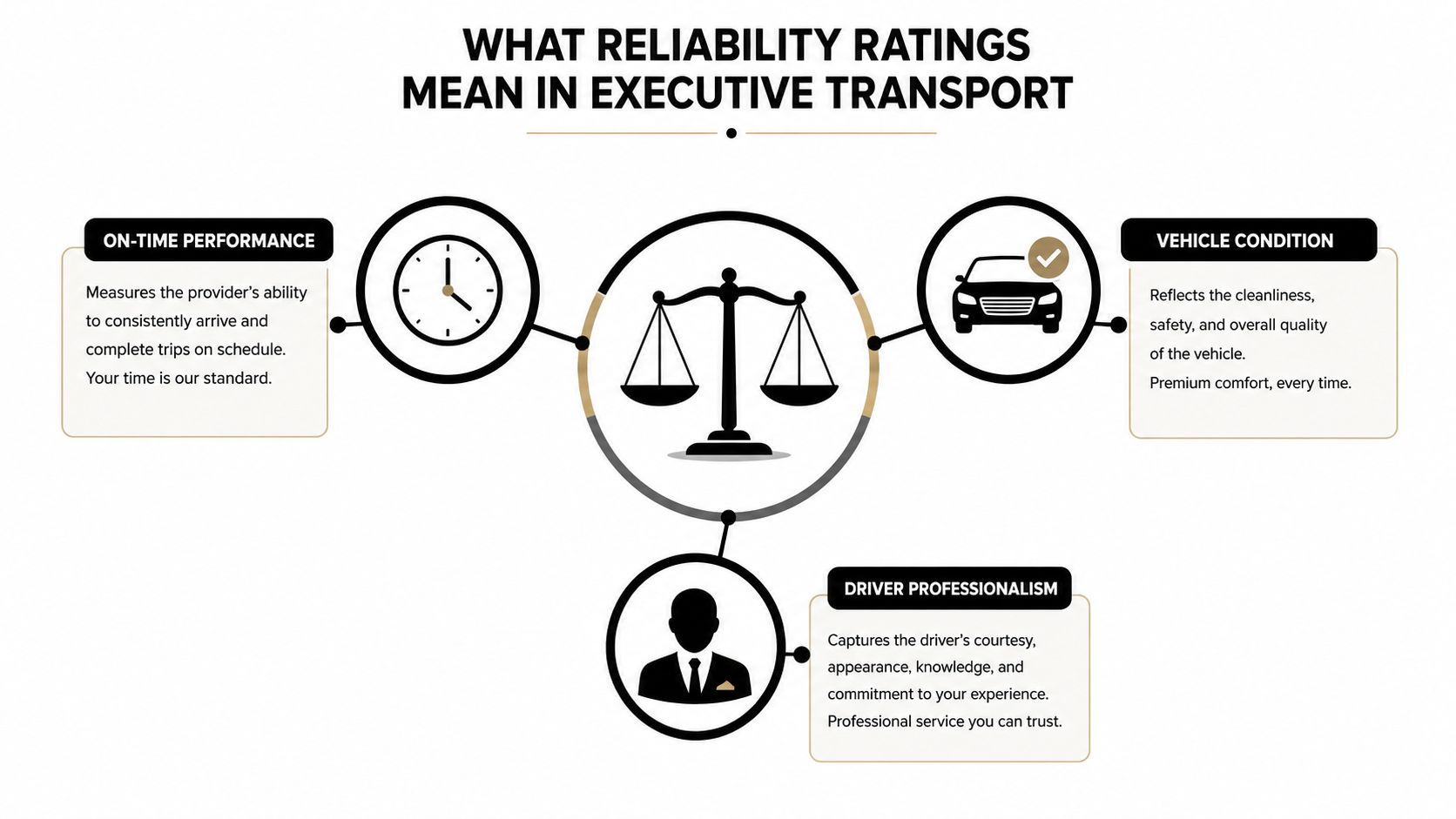
A reliability rating in executive transport measures whether a provider keeps delivering the same standard across repeated trips, different cities, different drivers, and changing conditions. A traveler can leave satisfied after one ride. A corporate buyer needs evidence that the service holds up when the itinerary changes, the weather shifts, or the pickup window tightens.
What failure looks like
In ground transport, failure rarely appears as one dramatic breakdown. It usually shows up as a pattern.
- Late pickup: The car arrives after the schedule has already narrowed.
- Wrong vehicle standard: The promised class of vehicle does not match what is on the curb.
- Driver mismatch: The chauffeur lacks local familiarity or is not prepared for the itinerary.
- Inconsistent experience: One city feels premium, the next feels improvised.
Practical rule: If a provider's pitch sounds excellent but the service is hard to verify, treat that as risk, not polish.
For corporate travel managers, the question is whether the provider stays steady when the day becomes less predictable. A polished brand can still be operationally fragile. A quieter operator with disciplined processes can be the safer choice because its performance is more repeatable. The value of reliability ratings is that they help buyers separate those two cases before a disruption exposes the difference.
The CMS technical notes define reliability as the fraction of observed variation that reflects real differences in quality rather than random sampling error, and the metric is bounded from 0 to 1. CMS also notes that for CAHPS measures, a reliability value below 0.6 means 40% or more of the observed variation is random noise, which is a useful warning sign when judging whether a difference is stable enough to act on (CMS Star Ratings technical notes). That logic translates well to executive transport. If a vendor's strong performance rests on thin data, the score may describe noise rather than dependable execution.
What to look for in transport language
A useful rating in this category should point to three things.
- On-time behavior across trips, not one lucky week.
- Vehicle condition over time, not a single polished inspection.
- Driver consistency, including how well the operator handles schedule shifts and multi-stop days.
Consumer Reports uses a comparable logic in its rating methods. It estimates problem rates at the brand level within a product category, then derives the score from the expected frequency of reported problems over a defined time frame. In its car-reliability framework, the score is based on the percentage of survey respondents reporting problems across up to 20 trouble spots, with the overall reliability verdict compared against the average for vehicles of the same year (Consumer Reports rating methods). The point is not that cars and chauffeur services are identical. The point is that reliability becomes more trustworthy when the score reflects repeated patterns instead of a single event.
A corporate buyer should also ask whether the provider can show how those patterns are measured in practice. If a ground transport company can point to clear operating standards, route discipline, and service checks, its rating has more value than a marketing claim built around one strong client story. For a closer look at how providers frame those standards, see this overview of ground transportation companies.
Key Metrics That Define Transport Reliability
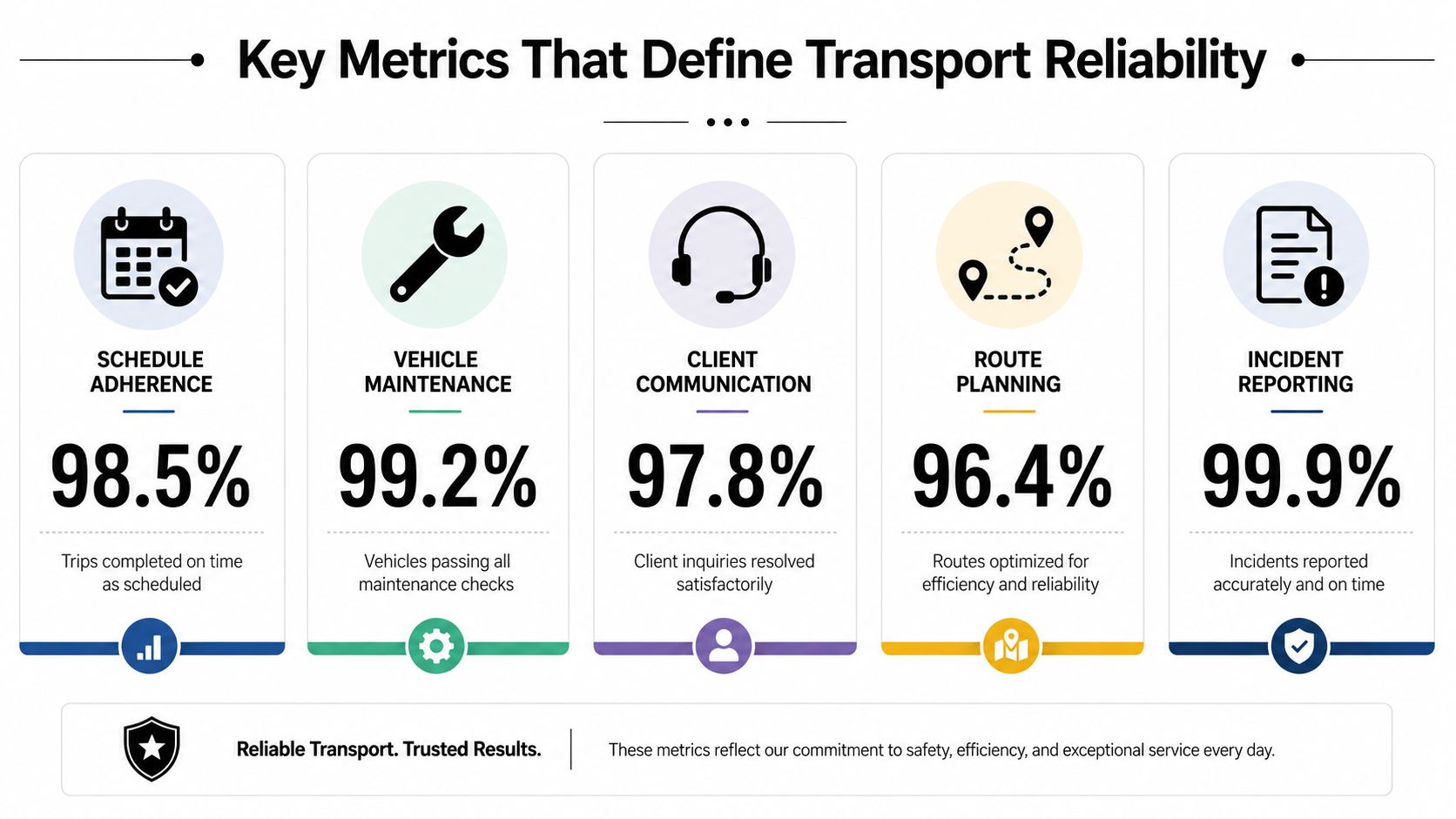
The strongest reliability ratings in executive transport usually combine several operational signals, because no single metric tells the whole story. A provider can be punctual but sloppy, or polished but inconsistent. Buyers need a fuller picture.
Five metrics that deserve attention
Schedule adherence is the most visible one. It measures whether pickups and drop-offs happen within the promised window, but the key question is whether the provider stays dependable when the schedule changes.
Vehicle maintenance matters because reliability fails fast when a fleet isn't kept in rotation properly. Clean interiors are part of it, but so are readiness, roadworthiness, and how often the provider has to substitute a vehicle at the last minute.
Client communication is the hidden metric many teams forget. A provider that alerts you early, confirms details clearly, and responds quickly to changes reduces uncertainty before it turns into operational friction.
Route planning is critical for roadshows, FBO support, and city transfers with tight handoffs. A chauffeur who understands traffic patterns and pickup sequencing reduces the chance that one delay bleeds into the next stop.
Incident reporting tells you whether the operator tracks and learns from failures. A mature provider doesn't just absorb mistakes, it documents them and corrects the process.
A strong transport rating usually reflects how well these pieces work together, not how perfect any single trip looked.
For buyers comparing vendors, a composite score is useful only if the underlying components are visible. A provider with strong maintenance but weak communication can still produce avoidable disruptions. Another with excellent route planning but inconsistent vehicle condition can leave the traveler with a poor experience that never shows up in a one-line marketing claim.
A practical way to review these metrics is to ask which ones are measured internally, which ones are independently verified, and which ones are self-reported. That distinction often matters more than the headline score.
How Reliability Ratings Are Calculated
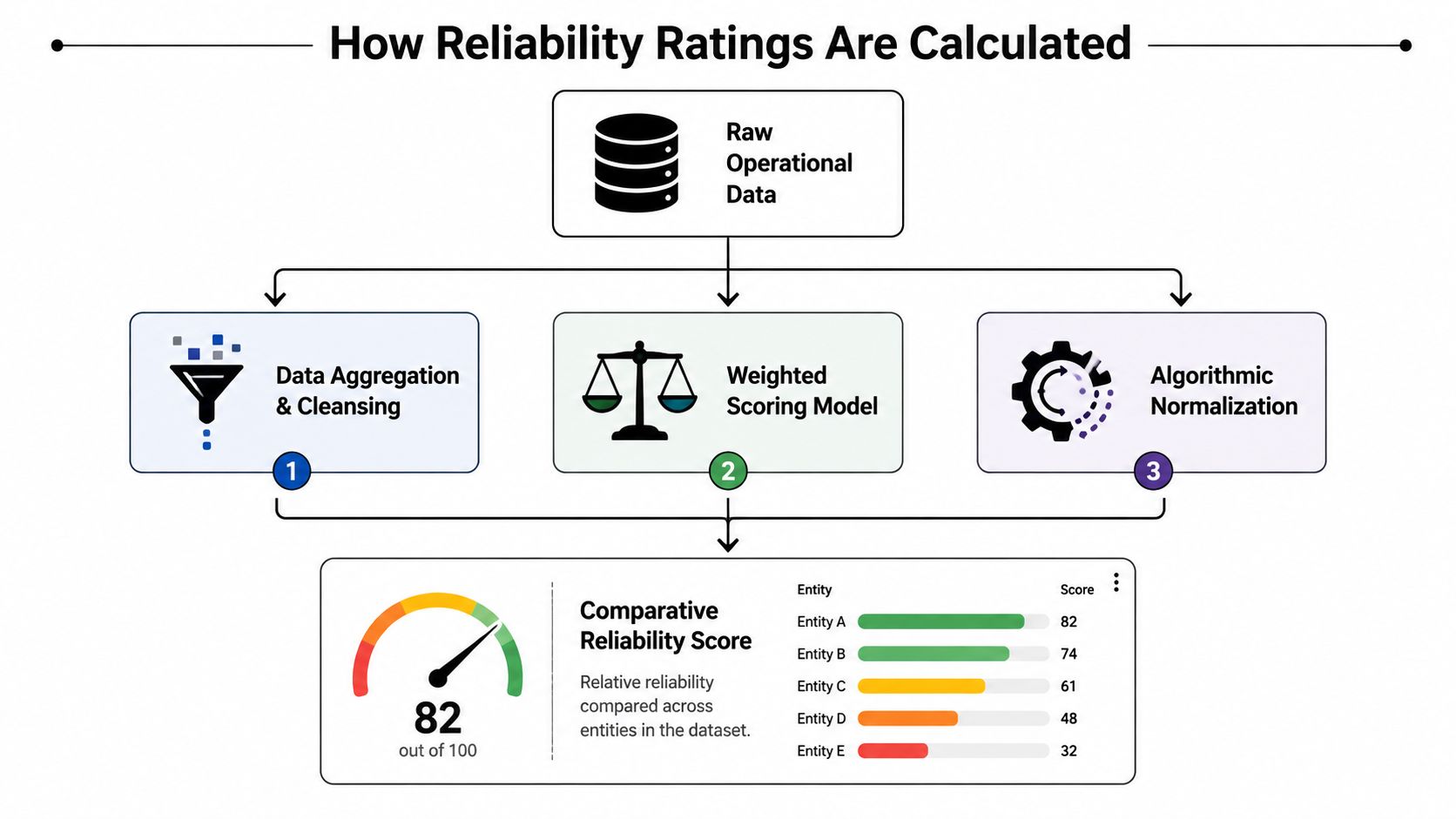
A trustworthy reliability score starts with raw operational data, then filters out the noise that can distort judgment. That same logic helps buyers separate a dependable transport operator from one that had a good month. In executive and ground transport, the point is to distinguish patterns that repeat from isolated runs that went well.
The basic calculation logic
First, a provider needs a consistent data set. That usually means dispatch records, pickup timing, incident logs, maintenance checks, and client feedback collected over a defined period. Without a stable time frame, a score can react too strongly to a storm, a clustered schedule, or a few unusually difficult trips.
Second, the data has to be aggregated in a way that makes comparison possible. Consumer Reports' methodology shows why that structure matters, because it evaluates problem frequency at the brand level and compares the overall verdict against vehicles of the same year. That approach reduces the influence of one odd model or one unusually small sample (Consumer Reports rating methods).
Third, the result needs normalization. Raw events are converted into a score that can be compared across providers, markets, or vehicle classes. The score should smooth out outliers without hiding meaningful differences, especially where service conditions vary by city or itinerary.
Route planning often has the biggest effect on the final number because timing failures rarely happen in isolation. A provider using real-time route optimization can reduce avoidable delays before they show up in punctuality data, which means the calculation reflects operational control rather than traffic alone.
Why the noise threshold matters
CMS provides a useful technical boundary here. A reliability value below 0.6 means 40% or more of the observed variation may be random noise rather than real quality differences. For buyers, that is a cue to treat small gaps between providers with caution. If the sample is thin, the score may be too unstable to support a contract decision.
That matters in executive transport because many programs are low-volume by nature. A roadshow operator in one market may only handle a limited number of high-value trips. A fleet used for VIP transfers may have a narrow service profile. In those cases, the score can still inform the discussion, but it should not be treated as final proof of quality.
Using Reliability Ratings to Choose Providers
A good procurement decision starts with a cutoff, not a sales pitch. If a provider's rating is weak, the conversation should shift from “Why do they look good?” to “What evidence would make this safe enough to use?” That's a more realistic standard for executive transport, where one missed pickup can create a visible problem.
A practical buying framework
Start by comparing providers only within the same market. A strong operator in London isn't automatically the right choice in Dubai, Tokyo, or a secondary city with different traffic patterns and operating conditions. The local context matters.
Then separate the composite score from the component metrics. Two providers can look similar on paper while one is far better on punctuality and the other is stronger on vehicle condition. For flight crews, that distinction matters because a provider that keeps consistent timing across rotation cities is easier to trust than one that only performs well at home base.
Buying rule: If the score looks high but the supporting data is vague, ask for the breakdown before you move forward.
Weight the metrics according to the job. A board-level airport transfer program may care most about punctuality and communication. A premium client itinerary may care more about vehicle condition and chauffeur professionalism. A crew movement program may care most about consistency across locations and rapid response to changes.
If you're evaluating vendors for a complex trip, don't accept a global average as a substitute for route-specific data. A provider can have a respectable overall reputation and still underperform on a particular corridor, airport, or service class. That's the gap procurement teams should close before signing.
Pitfalls and How to Validate Rating Claims
Many transport ratings look more objective than they really are. The problem is not the existence of ratings, it is the way buyers sometimes accept them without checking how the score was built. In executive transport, that matters because a published rating can reflect the operator's reporting habits more than the traveler's actual experience.
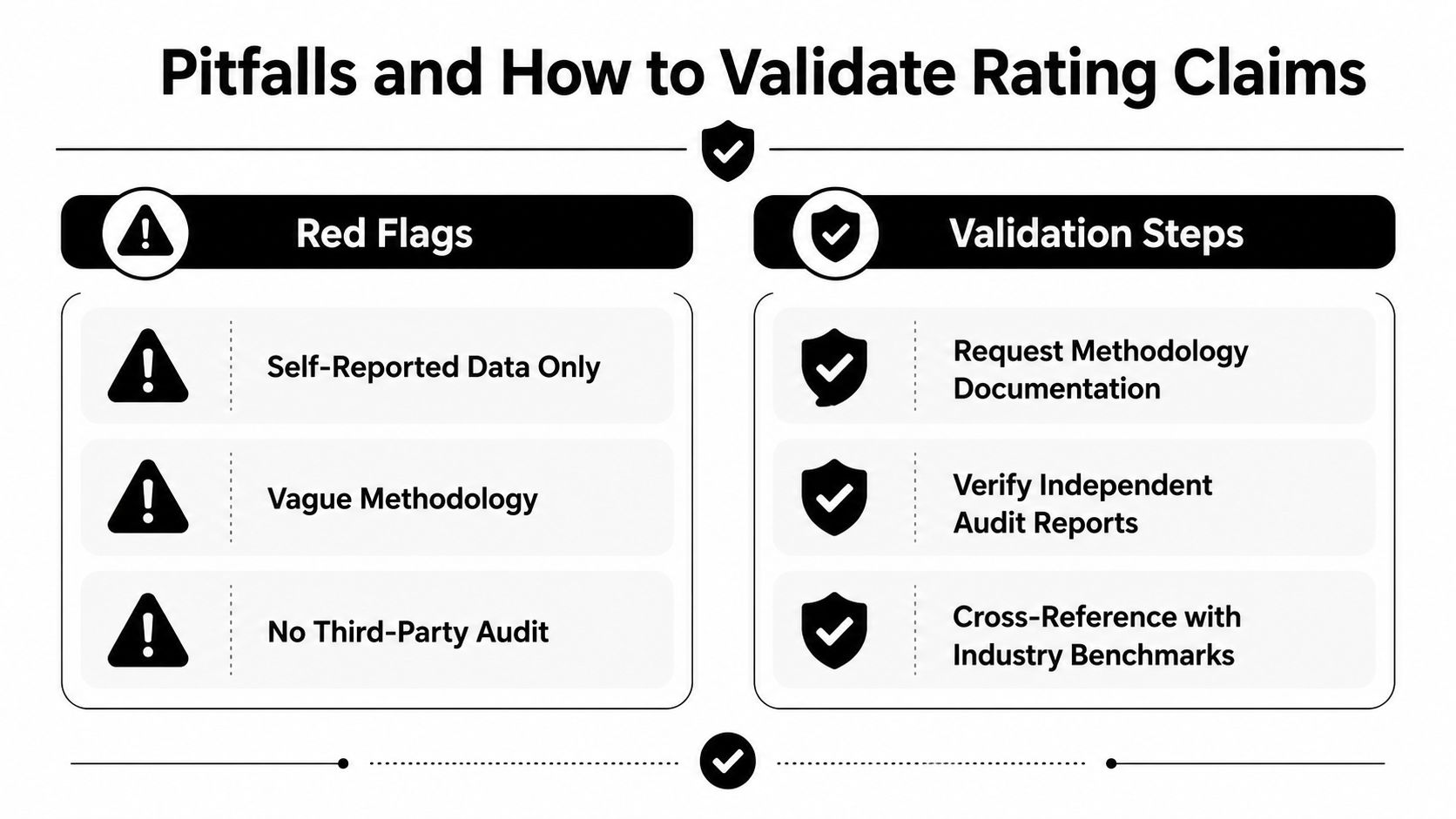
Common warning signs
Self-reported ratings are the first warning sign. If the provider collects, scores, and interprets its own data without outside review, the result can lean positive by design.
Small samples create another risk. A provider can post a favorable result from only a few service events in one market. That does not make the rating false, but it does make it fragile.
Methodology gaps matter just as much. If the operator will not say what counts as on-time, how incidents are defined, or what time frame was used, the rating is hard to trust.
The most useful way to read a rating is to ask what it omits. A score that sounds precise but hides the inputs gives procurement teams very little to work with.
How to validate the claim
- Request methodology documentation: Ask how the score is calculated, what data sources are included, and what gets excluded.
- Verify independent audit reports: Look for outside confirmation instead of relying on vendor summaries alone.
- Cross-reference with industry benchmarks: Compare the claim against other credible sources and verified client feedback.
- Check the maintenance record behind the fleet: In ground transport, vehicle upkeep shapes reliability, so fleet maintenance best practices should support the claim rather than sit apart from it.
The smartest buyers treat reliability ratings as an ongoing control mechanism rather than a one-time filter. If a provider can explain the rating clearly, it usually understands the operating discipline behind it. If the explanation stays vague, the score may be more marketing than measurement.
For readers comparing providers in ground transport, the dedicated overview of ground transportation companies is useful as a market-level reference point, especially when you are separating broad claims from verifiable operating standards.
How MLR Worldwide Service Sustains High Standards
High reliability in executive transport doesn't happen by accident. It comes from systems that protect the trip before the traveler ever sees the car. The operators that hold up best tend to do four things well, and each one maps directly to the reliability metrics buyers should care about.
The operating structure behind consistency
First, a 24-hour concierge operations team manages last-minute bookings, itinerary changes, and real-time coordination between air and ground. That kind of control helps protect punctuality and service consistency because changes don't sit unanswered in an inbox. They get handled while the schedule is still salvageable.
Second, a vetted global affiliate network keeps standards aligned across cities such as New York, London, Dubai, and Tokyo. That matters because buyers don't just need one strong home market. They need the same service expectations wherever the itinerary goes.
Third, fleet discipline matters. A curated mix of late-model executive sedans, premium SUVs, luxury vans, and specialty vehicles supports the condition standard that clients expect, and a disciplined maintenance program is part of that promise. The link between fleet upkeep and reliability is hard to ignore, which is why fleet maintenance best practices are so central to premium ground operations.
Fourth, professionally trained chauffeurs reduce avoidable friction by anticipating preferences and managing complex multi-stop schedules. That influences incident risk, but it also supports a smoother experience when the day changes fast.
What matters here is the structure, not the slogan. Reliable service is the product of repeatable processes, disciplined oversight, and a willingness to treat each trip as part of a larger operating system.
Making Reliability Ratings Work for Your Organization
The smartest buyers treat reliability ratings as an ongoing control, not a one-time filter. A provider that performed well six months ago may need fresh validation after a market expansion, a different vehicle mix, or a staffing change. In executive transport, trust has to be confirmed trip by trip.
A simple decision discipline
Set a minimum standard that matches your risk tolerance. A board transfer, an airline crew run, and a discretionary VIP outing do not call for the same threshold.
Build your own comparison matrix around the metrics that matter most to your operation. If your travelers care most about timing, weight schedule adherence more heavily. If the trip is image-sensitive, vehicle condition and chauffeur professionalism may deserve more influence.
Ask for the methodology every time. You do not need to become a statistician, but you do need to know what the rating reflects and what it leaves out. That one question often separates a credible partner from a polished vendor deck.
Schedule periodic reviews of current providers. Reliability is not static, and procurement should not treat it that way.
When a route or market is new, ask for local evidence, then compare it with what the provider claims about broader performance. A short local track record is more useful than a national average that says little about the conditions you need to cover. That is the difference between a useful rating and a misleading one.
MLR Worldwide Service supports executive travel, airport transfers, crew movements, and VIP logistics with the kind of disciplined operations this topic demands. If you are evaluating transport partners on reliability instead of promises, visit MLR Worldwide Service to see how a structured, global approach can help protect your schedule, your travelers, and your reputation.