

Your flight landed on time, but the day still went sideways. The car was waiting at the wrong door, the assistant was still texting the chauffeur, and the meeting room changed after you were already on the road. That gap between a booked ride and a personalized travel itinerary is where executive travel either feels composed or starts leaking time.
For premium clients, the difference shows up fastest at the curb. A generic transfer moves a person from one point to another. A personalized itinerary coordinates the arrival, the handoff, the vehicle, the route, the timing, and the next disruption before the client even feels it.
The market signal is clear. One estimate values the global personalized travel and experiences market at $91.2 billion in 2020 and projects $447.3 billion by 2030 with a 17.8% CAGR from 2021 to 2030, while another places it at $169.33 billion in 2025 and $370.73 billion by 2030 with a 16.9% CAGR (Allied Market Research). That growth matters on the ground because the more customized the trip, the more moving parts have to connect cleanly.
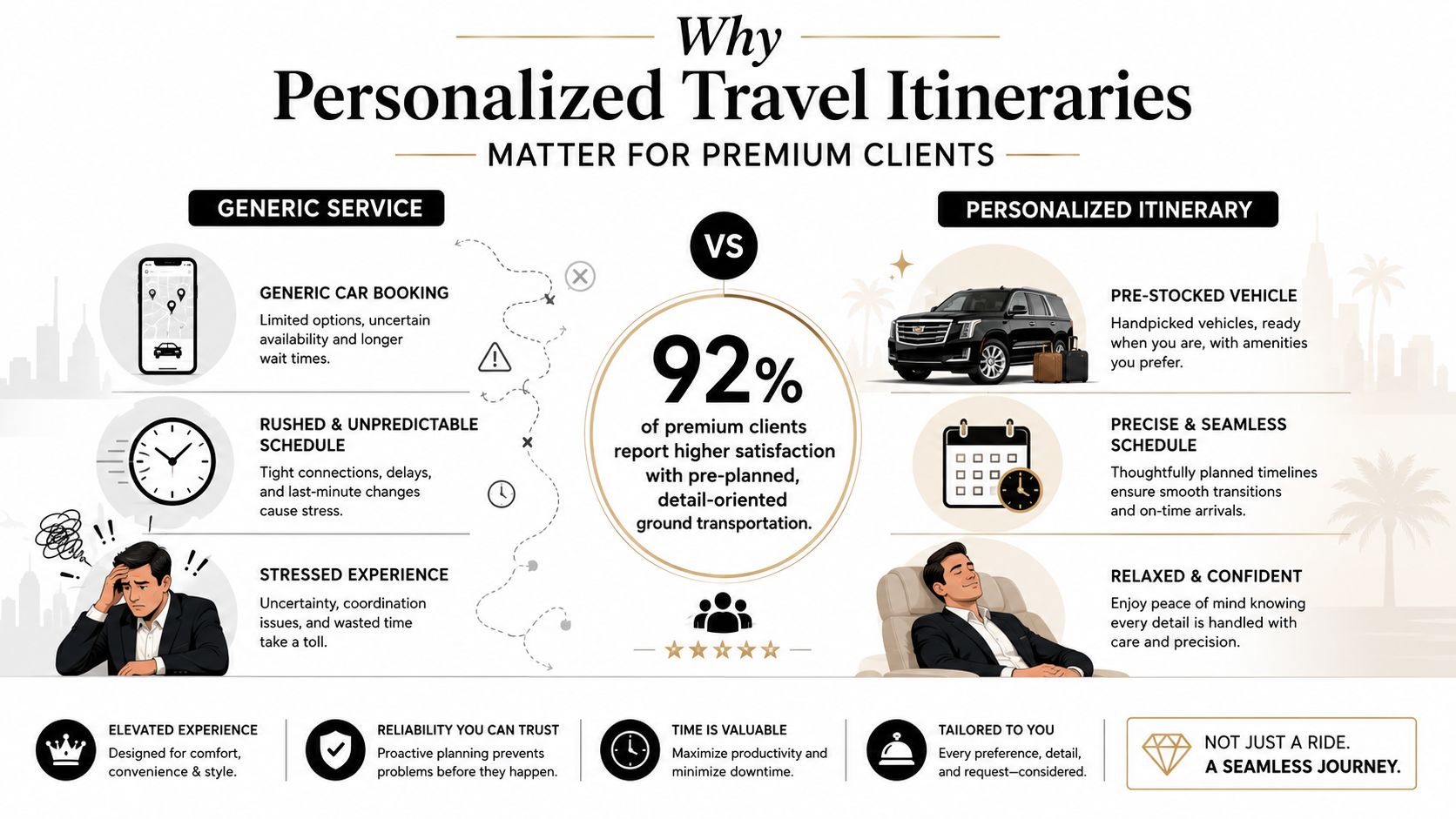
Why Personalized Travel Itineraries Matter for Premium Clients
An executive steps off a private jet at an FBO, checks the time, and has one clean window before a board meeting. If the car is only a name on a dispatch board, somebody still has to guess the right door, the right vehicle class, the right route, and the right buffer. If the plan is built properly, that same arrival feels quiet, fast, and almost invisible.
That's why premium travel has moved away from simple point-to-point booking. The booking choice itself now reflects that shift, because a Travel Market Report survey found 92% of leisure travelers felt overwhelmed by the number of choices, more than half said they would pay extra for a personalized itinerary, and 40% said finding a perfect travel experience was harder than finding a perfect significant other (Travel Market Report). Those are leisure findings, but the logic is even sharper for executives, family offices, and corporate roadshows, where missed timing carries a heavier cost.
Where generic logistics break
Point-to-point transport assumes the day stays still. Executive travel rarely does. A standard booking doesn't tell the chauffeur that the client wants low conversation, a colder cabin, a quiet rear seat, or no branded vehicle at the curb. It also doesn't protect the schedule when one meeting slides into the next or when the passenger leaves through a different entrance than planned.
Practical rule: premium clients judge the itinerary by the weakest handoff, not the strongest ride.
That's why personalized travel itineraries matter most when the trip becomes operationally dense. Multi-stop days, FBO arrivals, hotel changes, event circuits, and back-to-back meetings all need a single plan that can absorb pressure without forcing the client to manage it. Standard logistics can move people. Personalized logistics keeps them composed.
Client Intake and Preference Mapping
A solid itinerary starts before anyone confirms a pickup. The first conversation should separate what the trip needs from what the traveler prefers, because those two things are not the same. If you treat them as the same, the profile gets noisy, and the next trip starts from scratch.
A useful intake begins with five questions. What is the primary goal of the trip. What is the preferred vehicle class. Which amenities matter in transit. How much schedule flexibility exists. And what security or discretion requirements have to be respected. That simple frame keeps the intake focused without turning it into an interview.
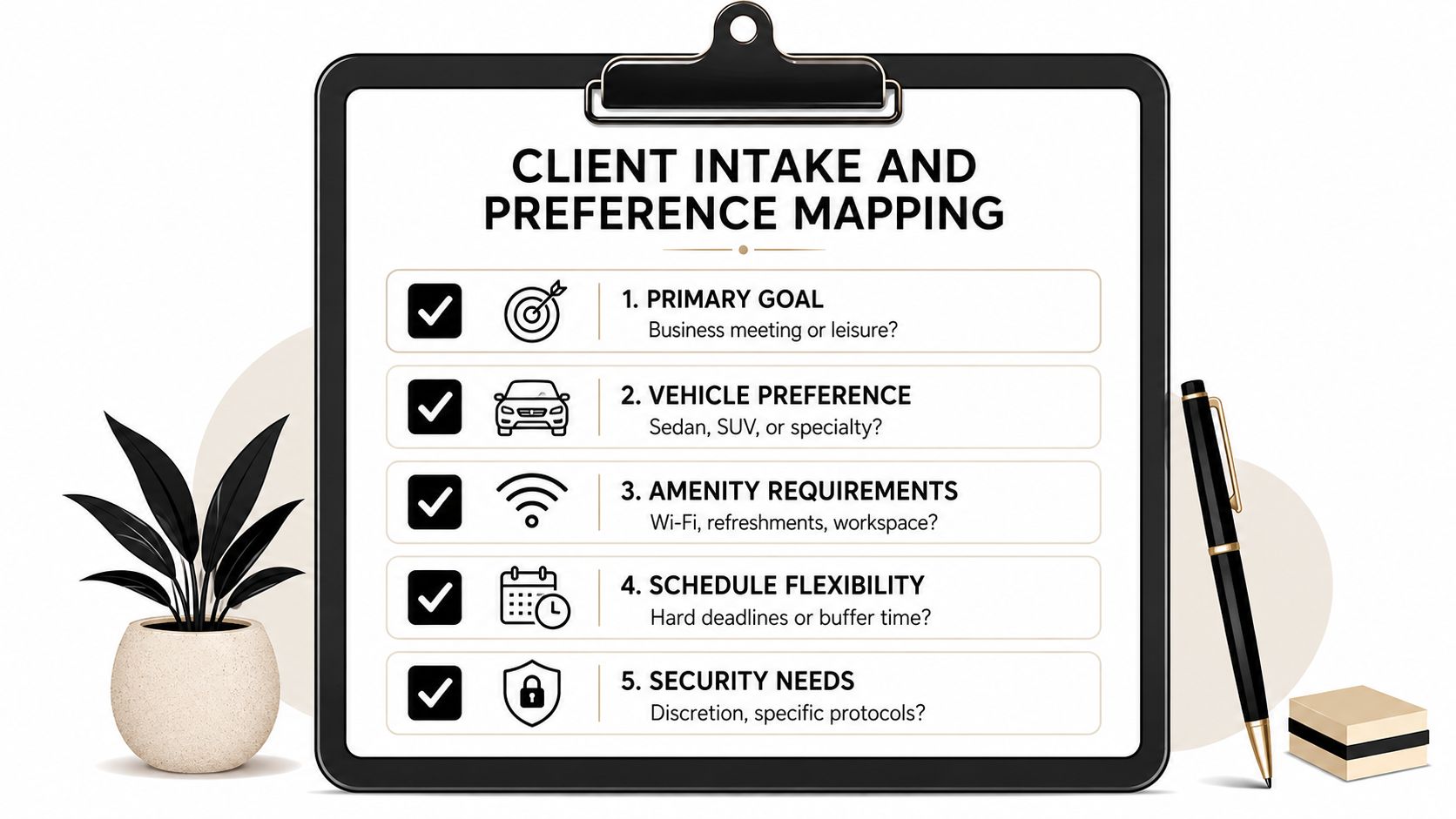
Hard constraints and soft preferences
Hard constraints are essential. Flight numbers, meeting start times, wheelchair access, privacy requirements, baggage volume, and fixed pickup windows all belong there. Soft preferences are everything that improves comfort but can be adjusted if the day changes, such as cabin temperature, refreshment choices, music, or whether the client wants status updates by text or through an assistant.
A reusable profile works only when those categories stay separate. I've seen teams bury a “likes quiet rides” note next to “must arrive 15 minutes early,” and then the dispatch team treats both as equal. That's how mistakes happen. The hard constraints should drive the movement plan, while the soft preferences shape the experience around it.
What to store for the next trip
The most useful profile fields are the ones operators check under pressure. Keep the client's usual airports or FBOs, preferred vehicle type, typical passenger count, privacy level, communication channel, in-car refreshment preferences, and any recurring no-go items. If the traveler is repeat business, the profile should also hold who is allowed to approve changes.
Good intake makes the next booking faster, but good memory makes it better.
That's where structured collaboration with executive assistants matters. A clean intake handoff, like the kind discussed in executive assistant travel planning, helps the ground team collect the right facts once and reuse them well. The goal isn't to know everything. It's to know the few details that consistently change the ride.
Multi-Stop Scheduling and Ground Transportation Coordination
Multi-stop days are where the work shows up. A single airport transfer is forgiving. A roadshow with an FBO arrival, a board meeting, a lunch stop, and a return transfer is not. Every leg has to connect, and every handoff has to protect the next one.
The operational sequence should always start with the arrival source. Track the inbound flight or aircraft movement, confirm the landing point, assign the right vehicle, and brief the chauffeur before the client arrives. Then build the route around the day's fixed commitments, not around whatever is easiest to dispatch at the last minute.
Vehicle selection is part of the itinerary
A luxury sedan and a premium SUV solve different problems. A sedan fits a cleaner, lower-profile profile when luggage is light and the schedule is simple. An SUV gives more breathing room for bags, additional passengers, or a client who expects a more substantial cabin. Specialty vehicles belong in the same decision tree when the itinerary includes crews, groups, or unusual equipment.
The chauffeur briefing should not be generic. It needs the client's preferred name format, communication style, luggage count, expected privacy level, the exact pickup point, and any route sensitivities. If the client dislikes conversation, that should be in the briefing, not left to intuition. If the assistant wants confirmation after each leg, that belongs in the workflow too.
A clean timeline template
A usable roadshow sequence usually looks like this:
- Arrival monitored from the moment the aircraft is inbound.
- Vehicle staged at the correct terminal, FBO, or curb point.
- Passenger handoff confirmed by name and location.
- Chauffeur receives the route, the stop order, and the client profile.
- Buffer time protects the transition between meetings.
- The operations team watches the next leg before the current leg ends.
Practical rule: if the chauffeur learns the next address after the client is already seated, the itinerary is late.
For teams building this workflow in practice, real-time route optimization is most useful when it sits inside the schedule instead of being treated as an afterthought. The coordination layer is what turns air and ground into one trip. Without it, the client has two separate services and one very stressful day.
Building Contingency Plans for Real-Time Disruptions
The biggest mistake in personalized travel is assuming the first plan survives contact with the day. Flights move, meetings overrun, weather shifts, and venue access changes without warning. A strong itinerary doesn't try to prevent every disruption. It makes sure the next move is already defined when the first one changes.
Research on itinerary generation makes the reliability problem obvious. One benchmark found GPT-4 achieved only a 0.6% success rate when it had to satisfy all itinerary constraints, while GPT-4o reached only 21.5% feasibility or rationality on the same benchmark with complete POI information; adding external structure and constraints raised success to 97% (ACL findings paper). That's a strong signal that unconstrained planning breaks fast, and constraint checking matters more than fluent output.
Build the fallback before the delay
The contingency layer should be attached to each critical leg. If the client is coming from an FBO, define where the car stages if the landing gate changes. If the meeting runs long, define the next pickup and the waiting threshold. If the venue changes the entrance, define who is responsible for notifying the chauffeur and how quickly that message has to move.
A second study reported a 92% Constraint Satisfaction Rate across budget, duration, and interest constraints, but the failures clustered in ultra-low-budget cases where accommodation pricing became unrealistic (IJCT study). The lesson for ground transport is simple, unrealistic assumptions break the plan faster than preference mismatch does. Price realism, travel-time realism, and access realism all need a check before the client is told the itinerary is final.
Use a phased verification loop
A phased workflow works better than a single final review. First confirm the schedule. Then confirm travel time and access points. Then confirm the vehicle assignment. Then confirm the chauffeur briefing. The last pass should test whether a delay in one leg would damage the next one.
That approach lines up with current guidance that travel planning should stay back-and-forth rather than one-and-done, because recent research notes that many systems still fail to incorporate real-time updates and travel-time constraints (IJSAT paper). In the field, that means the operations team should never wait for a client to report the problem. The team should already be moving the backup plan.
Persisting Preferences Across Repeat Trips
The most valuable itinerary data lives after the trip ends. If you don't capture what worked, the next booking starts colder than it should. Repeat premium travelers notice that immediately, especially when the provider forgets the details that made the last trip feel easy.
The post-trip debrief should be short and specific. What vehicle did the client prefer. Which pickup point worked best. Did the chauffeur style fit the traveler. Did any route or timing assumption fail. Did the client's assistant want updates in a different format. Each answer should update the reusable profile, not stay trapped in an email thread.
What should carry forward
Store the preferences that affect consistency, not trivia. That includes preferred FBOs, vehicle categories, chauffeur assignments when relevant, communication style, activity tolerance, hard constraints, and room categories for hotel-linked moves. If a traveler always needs early departures or dislikes tight connection windows, that should sit at the top of the profile.
The strongest guidance I've seen on this comes from AI travel-planning advice that treats the post-trip debrief as the most underused tool and recommends maintaining a reusable preference profile with airports, room categories, activity tolerance, and hard constraints (Rockport Tours). That matches what operations teams already know. Memory is part of service.
Make the profile usable, not decorative
A profile only helps if dispatch can read it quickly. That means concise fields, clear labels, and no buried notes. I'd rather see a short profile with six accurate preferences than a long one padded with details nobody checks. For repeat roadshows and family office travel, the profile should be ready before the assistant calls.
A good repeat-trip system doesn't ask the client to explain themselves twice.
That's where personalized travel itineraries become a relationship tool. They stop being a one-off planning exercise and become an institutional memory for the traveler, the assistant, and the operations desk. The more accurately the profile carries forward, the less time the next trip spends re-learning the client.
Sample Itinerary Templates and Implementation Checklist
A working itinerary should fit on one page and travel with the client. It needs the timing, the pickup point, the vehicle, the chauffeur contact, the backup plan, and the notes that matter if the day shifts. If the document can't survive a fast handoff between an assistant, an ops desk, and a chauffeur, it's too loose.
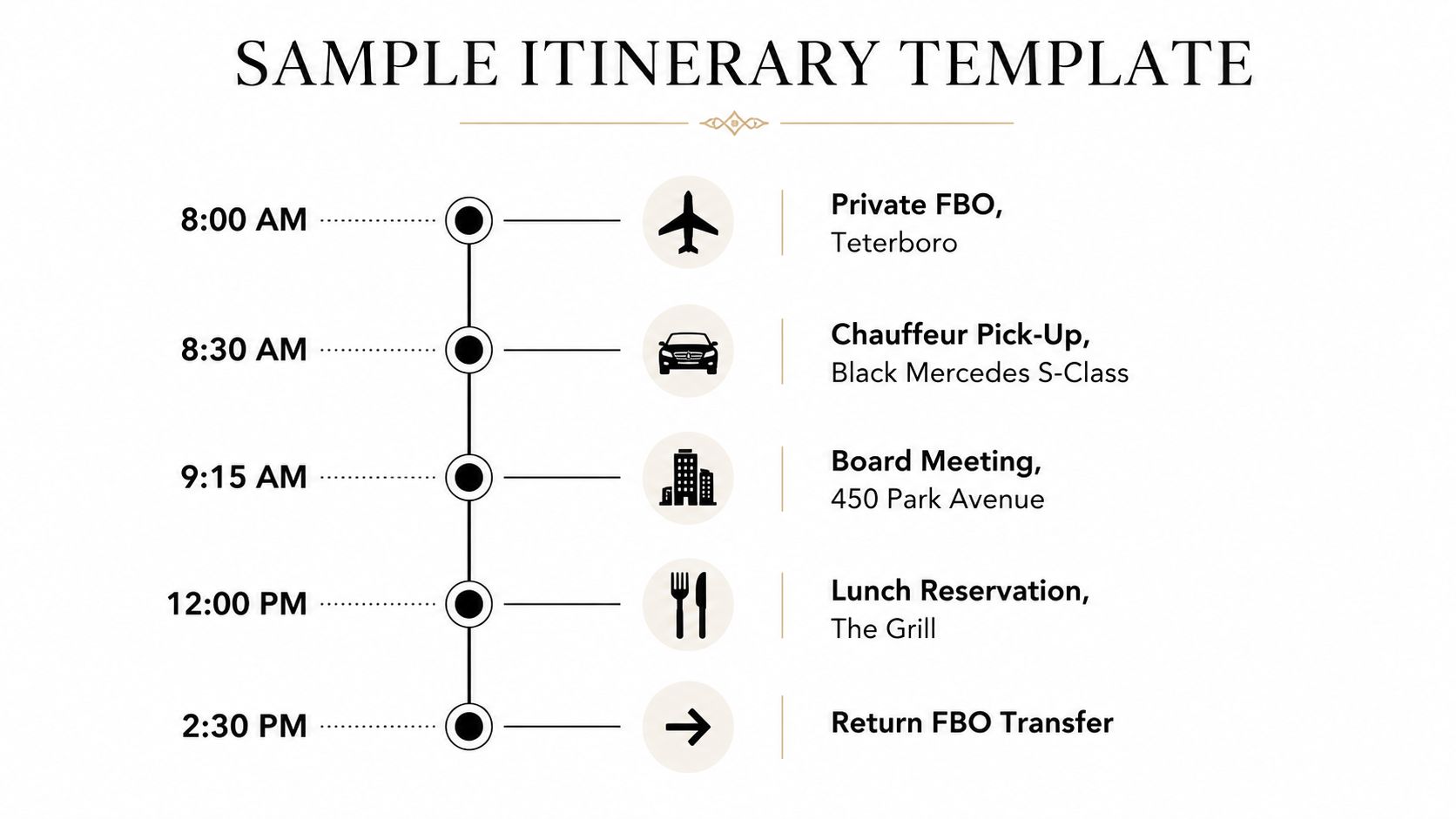
A simple executive template can be built like this:
- Trip owner: client name, assistant name, and emergency contact.
- Arrival point: flight number or FBO name, plus exact door or ramp location.
- Vehicle assignment: sedan, SUV, van, or specialty vehicle.
- Chauffeur details: name, direct number, and briefing notes.
- Schedule blocks: meeting times, lunch, hotel check-in, return transfer.
- Contingency notes: backup pickup point, alternate routing, and escalation contact.
Checklist for live operations
Start with the intake, then validate the hard constraints, then map the route sequence, then assign the vehicle, then brief the chauffeur, then confirm the client-facing version. After the trip, send the debrief and update the profile. That is the full loop. If one step gets skipped, the next trip inherits the miss.
For a practical structure you can adapt, the executive travel itinerary template is most useful when it holds both the schedule and the operational notes in one place. A clean template should make the day easier to execute, not just easier to read.
What to verify before wheels roll
- Timing: every stop should have a realistic buffer.
- Access: FBO door, hotel entrance, venue entrance, or loading area.
- Ownership: who confirms each change if the day shifts.
- Contact flow: client, assistant, dispatcher, chauffeur.
- Backup path: the alternate move if the first plan fails.
The best itineraries aren't fancy. They're readable under pressure, flexible when the day moves, and specific enough that nobody has to guess what happens next.
MLR Worldwide Service supports executives, assistants, and travel teams with 24/7 last-minute bookings and itinerary adjustments that fit the pace of complex ground movements. If you need personalized travel itineraries that connect FBO handoffs, chauffeur briefing, and real-time changes without adding friction, visit MLR Worldwide Service and see how their operations team handles time-sensitive travel.