

A door-to-door private transfer from LCY to Heathrow is the safest choice when you're connecting to a flight or carrying multiple bags, with a typical journey of 48 to 75 minutes depending on traffic and terminal. The airports are about 41–44 km apart, yet public transport usually takes around 69 minutes to 1 hour 9 minutes, with route changes adding operational risk. Uber's LCY-to-Heathrow route guidance reflects the central issue: this is a short corridor on a map, but not always a predictable one on the ground.
You've landed at London City Airport after a morning meeting in Europe. Your next flight leaves from Heathrow, your checked bag is somewhere behind the arrivals doors, and the connection is international. The distance looks manageable. The decision is not.
For a leisure traveler with a light bag and plenty of time, rail can work. For an executive, family office principal, crew member, FBO passenger, or roadshow team, the correct question is different: which option protects the connection when traffic, luggage, transfers, or delays go against you?
Why the LCY to Heathrow Run Is Trickier Than It Looks
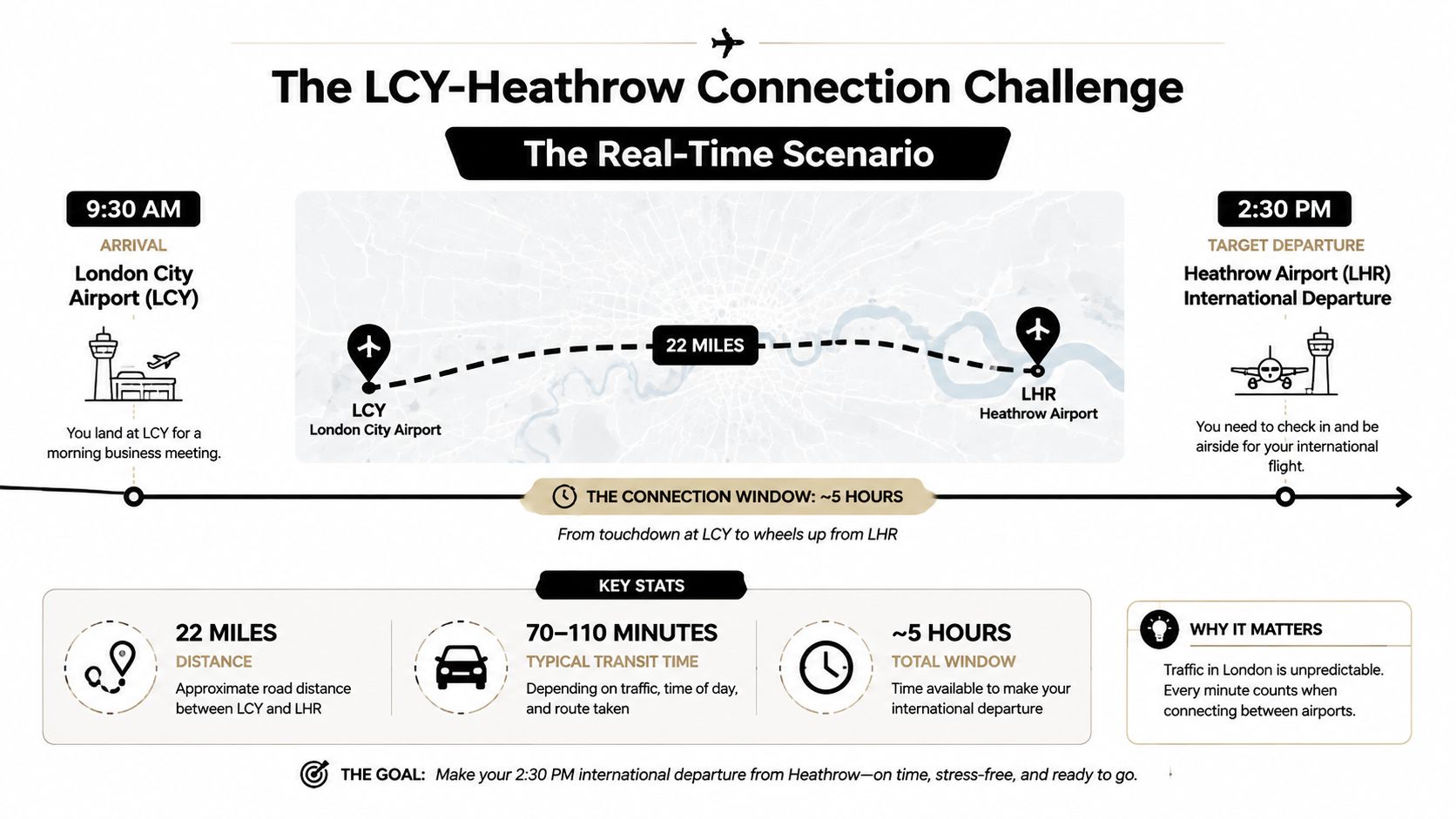
You have landed at London City Airport after a client meeting. Your checked case is still in arrivals, the onward flight leaves from Heathrow, and the connection is international. The route covers roughly 41–44 km, or 25.6–27 miles, but distance is the least useful measure of reliability.
Route calculations for LCY to Heathrow commonly put normal driving time at around 48–56 minutes. That estimate does not account for a late bag, a slow pickup, terminal access, or a traffic hold on the wrong side of the network. For a corporate traveller, the question is whether the transfer can absorb those problems.
The road crosses London's eastern and western approaches. Conditions on the A12, M11, and M25 can alter the arrival time sharply, especially when congestion builds across several links. An experienced chauffeur should monitor the live road position, select a workable alternative, and confirm the Heathrow terminal before departure. That matters for an FBO passenger heading into a fixed flight window, airline crew working to report time, and a family-office principal travelling with staff and luggage.
Rail creates a different set of risks. There's no direct rail link between London City Airport and Heathrow, so the journey combines the DLR with further rail or Underground services. Passengers then manage platforms, escalators, luggage, crowding, service intervals, and interchanges themselves.
Heathrow changes the risk calculation
Heathrow is a major international connection hub, not just the endpoint. The Greater London Authority's Heathrow passenger data records that 27% of Heathrow passengers were transfer passengers in 2023, compared with 37% in 2013, a 10 percentage-point decline across the decade.
A missed road estimate can still mean rebooking, extra ground costs, missed meetings, and a disrupted itinerary. Those consequences make reliability more important than a best-case journey time.
Operational rule: Choose the mode that gives you the most control over luggage, pickup timing, route decisions, and recovery options. Don't choose on mileage alone.
Public transport can suit a passenger with one small bag and a generous schedule. Several cases, children, an FBO handover, or a fixed departure window reduce the margin quickly. LCY to Heathrow is short enough to invite optimistic planning and complicated enough to punish it.
Comparing Your Transport Options From Chauffeur to Coach
For a same-day LCY to Heathrow connection, choose transport around reliability, luggage control, and recovery options. A private vehicle takes passengers from the LCY pickup point to the correct Heathrow terminal. Rail can work, but passengers manage every interchange, platform, escalator, and bag themselves. Taxis and ride-hailing vehicles provide direct road travel, although pickup control and service support vary.
The table below gives the practical comparison. Detailed buffer rules belong in the timing section.
LCY to Heathrow Transport Options at a Glance
| Mode | Typical Door-to-Door Time | Indicative Price | Best For |
|---|---|---|---|
| Executive chauffeur | 48–75 minutes, depending on traffic and terminal | Quoted fixed fare | Flight connections, executives, luggage, FBO and crew movements |
| London black taxi | Traffic-dependent road journey | Metered fare | Travelers wanting an official taxi rank and direct vehicle |
| Pre-booked minicab | Traffic-dependent road journey | Fixed quote may be available | Price-conscious travelers who still want a direct car |
| Ride-hailing service | Traffic-dependent road journey | Dynamic quote | Flexible travelers comfortable with variable pickup conditions |
| Elizabeth line, Jubilee line and DLR | About 60 minutes on the fastest listed combination | Public-transport fare | Light luggage and travelers comfortable with changes |
| Piccadilly line variant with connecting services | About 75 minutes | Public-transport fare | Travelers prioritizing a rail-based itinerary |
| Coach | Route and traffic dependent | Operator-dependent fare | Travelers with flexible schedules and lower service expectations |
Heathrow's airport-to-airport guidance identifies a fastest rail combination using Heathrow Express, Bakerloo, Jubilee, and DLR, alongside an Elizabeth line, Jubilee, and DLR route at about 60 minutes. A Piccadilly line variant is listed at about 75 minutes in the London airports data pack.
Rail brings several handoffs into the journey. Paddington, Green Park, Stratford, and Canning Town can become pressure points when trains are crowded, lifts are busy, or luggage is difficult to manage. A delay at any interchange also leaves the passenger responsible for finding the next workable connection.
Where each mode works
An executive chauffeur is the operational choice for a fixed flight, multiple bags, senior passengers, and discreet handling. It also suits an FBO handover, an airline crew movement, or a family-office principal travelling with staff. The booking team can brief the driver on the passenger, luggage, terminal, and required handoff.
A black taxi is a dependable direct alternative from the official rank. It does not provide the same pre-arranged flight monitoring or passenger brief. A pre-booked minicab can offer a fixed quote, provided you confirm its pickup process, waiting terms, and support coverage before travel.
Ride-hailing works for flexible plans where the traveller accepts variable vehicle allocation and curbside collection. Use it cautiously for a principal who needs a named driver, controlled handoff, or operations team support after a delayed LCY arrival.
Rail remains suitable for light travellers with time to spare. The airport-transfer planning guide explains why a scheduled journey can demand more personal handling than its fare suggests. Coaches suit passengers with flexible schedules and lower service expectations, but they offer less control over departure timing, luggage handling, and recovery when traffic or the onward flight changes.
Booking a Chauffeur or Taxi the Right Way
A professional booking begins with the onward flight, not just the pickup airport. Give the provider the LCY arrival flight number, expected landing time, passenger count, luggage profile, destination terminal at Heathrow, and any child-seat or accessibility requirement.
That information lets the operations team plan the vehicle and pickup properly. A sedan may suit one executive with hand luggage. A larger vehicle may be necessary for several passengers, cases, garment bags, or event equipment. Guessing at vehicle size is one of the easiest ways to create avoidable delay.
What the provider should manage
The driver should be linked to the arrival flight and the booking should include a clear waiting and contact procedure. If LCY arrival timing changes, the operations team should adjust the pickup rather than leave the passenger trying to coordinate from the arrivals hall.
At London City Airport, confirm whether the service is inside-terminal meet-and-greet or curbside collection. These are not interchangeable. Inside-terminal collection usually requires precise meeting instructions and discreet signage. Curbside pickup may be faster, but it places more responsibility on the passenger to reach the correct collection point.
For a high-profile client, use initials or a discreet identifier rather than a prominent full-name board. The right driver will confirm the vehicle, help with luggage, and move the passenger directly toward the planned route without turning the airport exit into a public negotiation.
Booking standard: If the provider hasn't asked about bags, terminal, flight number, and passenger details, the booking brief isn't complete.
Taxi, minicab, and chauffeur are different products
A black taxi from the official rank is an immediate, regulated taxi option. You generally get a vehicle without advance coordination, and the fare and route experience depend on the journey conditions.
A pre-booked minicab gives you an arranged vehicle and may provide a fixed quote. Check where the driver will meet you, how delays are handled, and whether you can contact an operations desk.
An executive chauffeur adds planning around the passenger, itinerary, vehicle specification, and onward connection. For clients who need this level of coordination, the chauffeur car-service booking process should confirm every operational detail before the vehicle is dispatched.
Luggage, Families, FBO Clients, and Airline Crew
A family with pushchairs, a corporate passenger with presentation cases, or crew travelling against a report time changes the LCY to Heathrow decision. The practical question is whether every person and bag can complete the transfer together, with clear responsibility at each handoff.

Families with bags and young children
Families may need a child seat, pushchair space, and capacity for several suitcases. Rail changes add work at every interchange. One adult watches the children, another handles the luggage, and the group must stay together through crowded stations.
I recommend a pre-booked private vehicle for this profile. The benefit is control: the family leaves LCY together, loads once, and travels directly to the correct Heathrow terminal. Confirm the child-seat requirement, luggage volume, and pushchair size before dispatch.
FBO passengers and private aviation teams
An FBO movement has a higher handoff standard. The passenger could be travelling from a private aviation facility at LCY to a Heathrow FBO, or from commercial arrivals to a private departure. Facility access, vehicle positioning, passenger identification, and discreet communication all need to be agreed in advance.
Use a chauffeur provider that can confirm the exact facility, terminal or FBO instructions, identity protocol, and luggage volume. Public transport becomes unsuitable when the itinerary depends on a controlled airside-to-ground transition. For a family office or private aviation team, one operations contact should own the movement from pickup confirmation through arrival.
Airline crew
Crew transfers run against fixed reporting times and may include uniform cases, flight bags, and hotel movements. A delay can affect the wider operation, so the provider needs a live contact process and clear instructions for schedule changes.
Choose a pre-arranged vehicle with a named pickup point and an operations contact available throughout the transfer. A taxi rank can suit an unpressured hotel journey. I would not use it as the default for airport positioning or crew-base movements.
Corporate roadshows and event teams
Roadshow teams may carry presentation cases, samples, branded materials, or equipment that cannot be divided across rail carriages. They also need to arrive together, often with a meeting scheduled soon after landing.
Book around the equipment, not just the passenger count. For multiple stops, confirm whether the provider can hold the itinerary and coordinate changes. Each case should have a place in the vehicle, and one person should retain authority for route or timing decisions.
Timing Rules, Buffer Time, and What to Do When Plans Slip
A same-day LCY to Heathrow connection should be managed as a risk-and-reliability exercise, not a speed contest. As covered earlier, normal road estimates run 48–56 minutes, while public transport typically takes 69 minutes to about 1 hour 9 minutes. The buffer you add here matters more than the base estimate. Heathrow rail combinations can also take approximately 60 minutes or 75 minutes, depending on the route.
Build the schedule backward from the onward flight's check-in, baggage, security, and boarding requirements. Add time for LCY disembarkation, baggage collection, vehicle loading, road disruption, and Heathrow terminal access. For an FBO client, airline crew member, or family-office principal, the plan must also cover discreet handover instructions, crew reporting requirements, or family luggage and child equipment. A short connection needs an assigned operations contact, not just a vehicle booking.
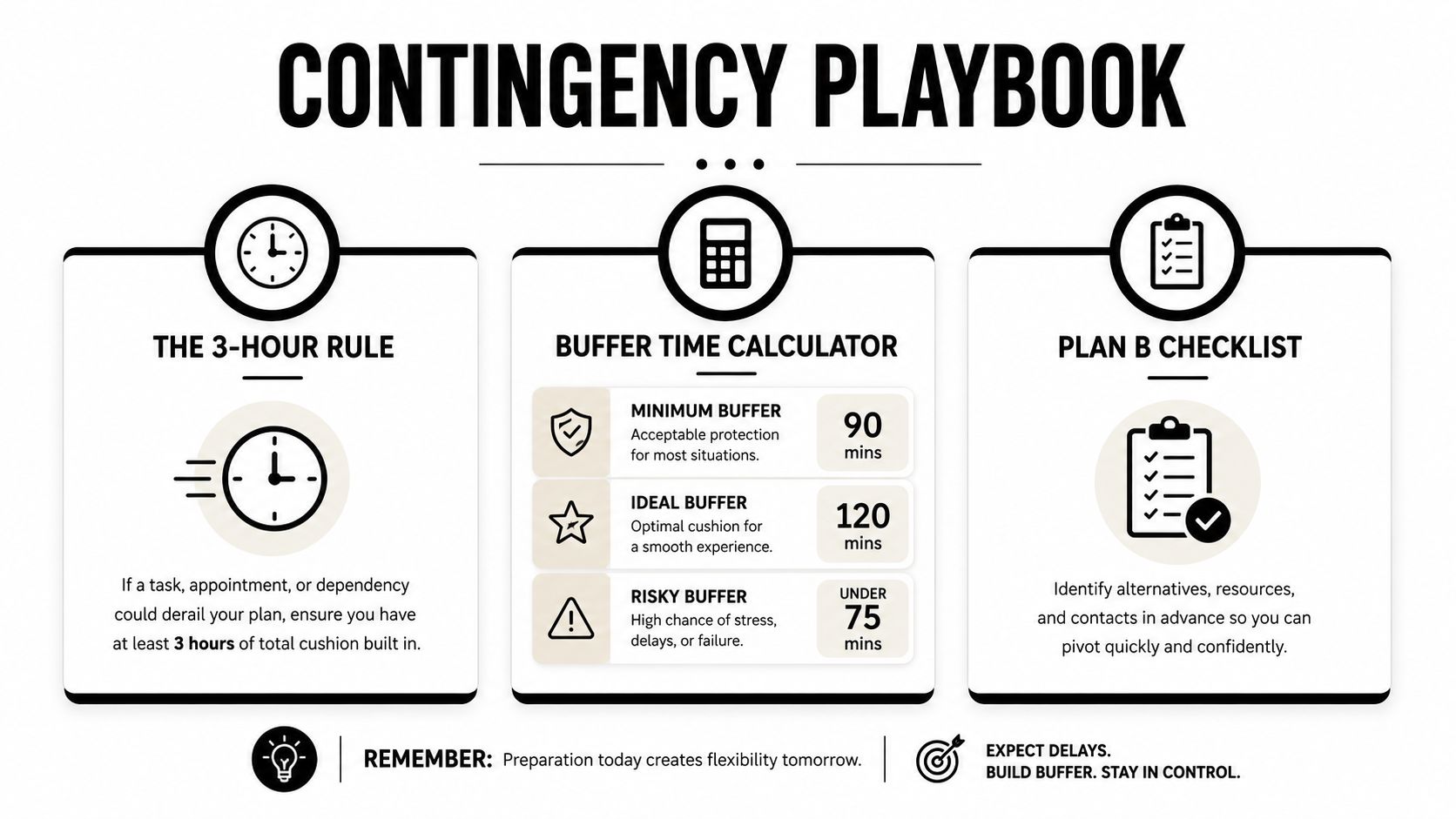
Three rules I use operationally
Treat a tight connection as a managed movement. Confirm the Heathrow terminal, airline cutoff, luggage requirements, pickup point, and any FBO or crew instructions before the LCY flight departs.
Use live road information. The A12, M11, and M25 can differ from the route shown at booking. Providers using real-time route optimisation can change the approach before congestion affects the passenger. That decision has value early, not after the vehicle stops.
Escalate as soon as the plan slips. Report an LCY delay, missing baggage, or late meeting to the operator immediately. Request a revised vehicle time, updated route assessment, and a clear decision on whether the onward flight remains realistic.
Before booking, ask how delays are monitored, how passengers contact the operator, and what fallback process applies. If the provider cannot answer, the service carries avoidable risk. Confirm the flight number, terminal, luggage plan, and support contact before arrival day.
Picking the Right Option and Booking With Confidence
A fixed onward departure changes the booking decision. For an international itinerary, choose a private vehicle with monitored coordination and a named operations contact. Rail remains suitable for light luggage and flexible timing, provided the passenger can manage station changes and the possibility of disruption.
Luggage also determines the practical choice. Several cases, pushchairs, garment bags, uniforms, or roadshow materials are easier in a direct car. A black taxi or pre-booked minicab provides direct travel, while a chauffeur booking usually adds planned monitoring, meet-and-greet, luggage assistance, and a clearer response if the itinerary changes.
Use this checklist before confirming an executive transfer:
- Flight details: LCY arrival flight number and scheduled landing time.
- Passenger profile: Names or discreet identifiers, passenger count, and accessibility needs.
- Luggage information: Number and type of cases, pushchairs, garment bags, or equipment.
- Destination: Heathrow terminal, airline, and any FBO or special-access instruction.
- Communication plan: Passenger mobile number, driver contact process, and operations desk availability.
- Contingency preference: Whether the provider should hold the vehicle, change the route, or advise on alternatives after a delay.
Give the operator the full movement plan, including any FBO, crew, or family-office requirements. These passengers often need discreet handling, precise access instructions, or coordinated support beyond a standard airport pickup. Confirm the vehicle type and who owns the decision if the LCY arrival changes.
Request the quote and service details in writing. Check whether the fare includes waiting, flight monitoring, meet-and-greet, luggage assistance, and terminal drop-off. A low headline fare can leave the traveller managing delays, bags, and terminal logistics alone.
Choose the service that matches the connection, luggage, and required support. On this corridor, prioritising reliability over headline price protects a fixed flight connection.
MLR Worldwide Service coordinates executive airport transfers, FBO support, crew movements, roadshows, and group ground transportation with a 24/7 operations team for last-minute bookings and itinerary changes. For a planned or time-sensitive LCY to Heathrow movement, visit MLR Worldwide Service with your flight, terminal, passenger, and luggage details.