
At 4:30 in the morning, a chauffeur can complete every obvious preparation and still miss the problem that matters. The sedan is clean, the passenger details are confirmed, and the airport route is open. Then a warning light appears, a tire has lost pressure overnight, or a rear brake light fails during the first stop.
That's why vehicle safety inspections in executive transport can't be treated as a once-a-year compliance task. A formal inspection may establish a legal baseline, but a professional fleet needs a living system that verifies condition before every assignment, records defects clearly, and removes uncertainty before a client enters the vehicle.
Why Executive Fleets Need a Higher Inspection Standard
The passenger stepping into a VIP vehicle usually doesn't see the inspection process. They see the result. The door opens, the cabin is immaculate, the climate is comfortable, and the chauffeur is ready before the scheduled pickup. Behind that experience is a chain of decisions about tires, brakes, lighting, fluids, communications, privacy equipment, and vehicle presentation.
A mechanical problem during an ordinary private trip is inconvenient. During an executive airport transfer, corporate roadshow, or secure movement, it can disrupt an itinerary, expose a client to unnecessary risk, and force several teams to react under pressure. A late vehicle replacement can affect a flight connection, a board meeting, a security plan, or an event arrival that has been coordinated across multiple vendors.
Reputation travels with the vehicle
Executive transport operators sell reliability as much as they sell transportation. A single breakdown in front of a hotel, airport terminal, government facility, or event venue can become a client's lasting impression of the entire operation. The failure may involve one component, but the client often experiences it as a failure of planning and judgment.
That exposure is especially serious when the passenger is a high-net-worth individual, senior executive, public figure, or family member traveling under a protection plan. A vehicle that technically passed a statutory inspection may still be unsuitable for a demanding assignment if its condition, equipment, or service history doesn't match the trip.
Operators also face a difficult distinction between legal compliance and reasonable care. A mandated inspection provides evidence that specified items were checked under a particular jurisdiction's rules. It doesn't prove that a vehicle was properly prepared for a long multi-stop day, severe weather, unusual loading, or repeated urban driving.
Operational rule: Treat the legal inspection as the floor. Your internal release standard should answer a more useful question, which is whether this vehicle is ready for this passenger, route, and service profile today.
Inspection discipline creates consistency
A strong inspection program turns safety from an individual chauffeur's preference into a repeatable operating standard. That matters when vehicles move between cities, affiliates perform local work, or a replacement vehicle must be dispatched quickly.
The program should define what makes a vehicle releasable, who can authorize a substitute, how defects are categorized, and where the evidence is stored. It should also protect the chauffeur who reports a problem. If drivers believe that raising a defect will lead to blame, schedule pressure will eventually win.
For operators serving multiple markets, a clearly documented internal standard supports the broader expectations associated with secure transport companies. The strongest providers don't ask clients to understand every local regulation. They create a consistent experience by applying their own higher threshold everywhere.
Pre-Trip and Post-Trip Inspection Routines
A useful inspection begins with the assignment, not with a form. Before the chauffeur starts the walk-around, the dispatcher or fleet coordinator should know the passenger count, luggage expectations, route length, weather, special equipment, and whether the vehicle will support a high-visibility arrival or a long standby.
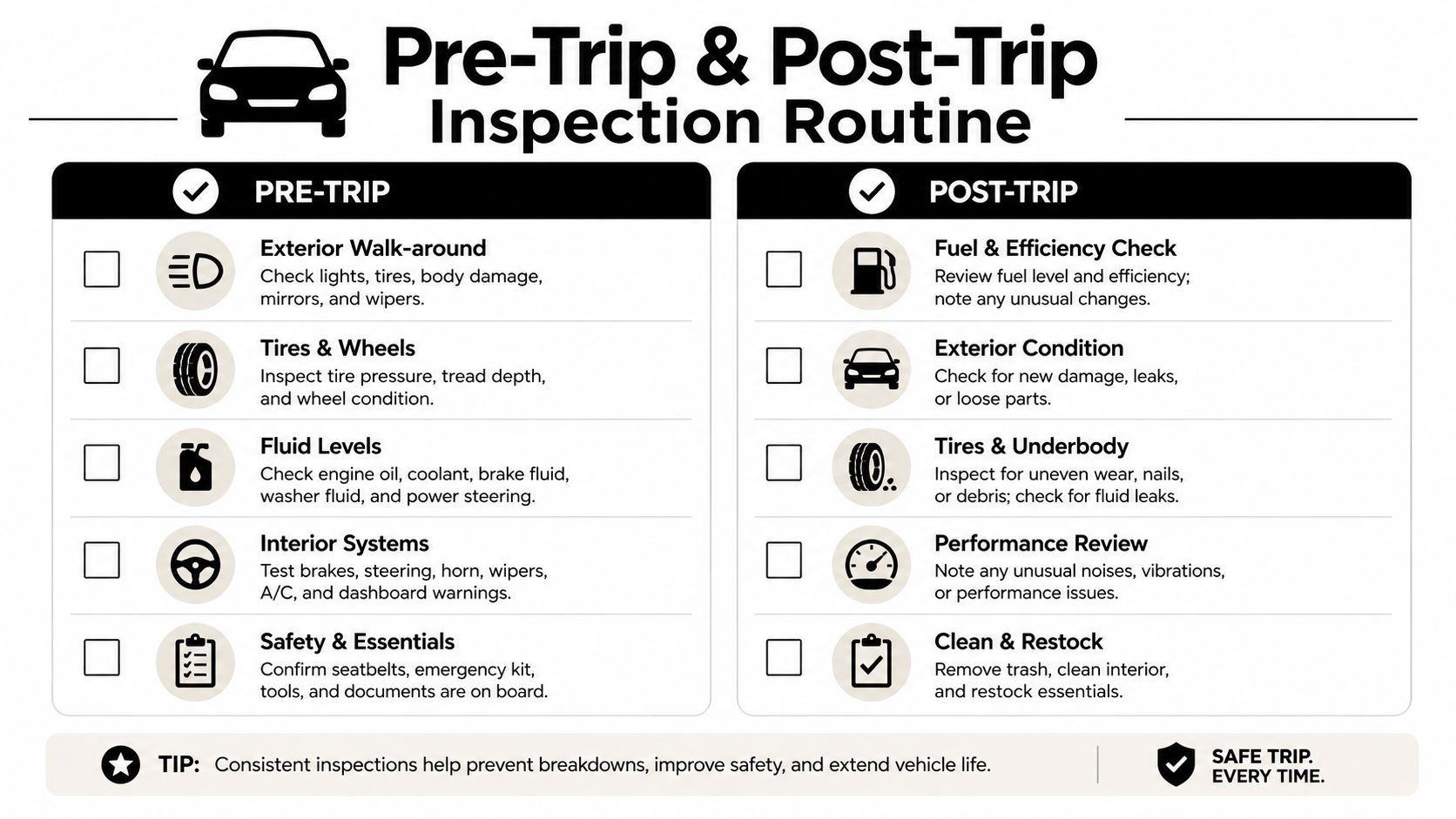
The pre-trip process should be methodical enough to catch defects but practical enough to complete before dispatch. A rushed checklist that records "good" for every line without looking closely is worse than a shorter checklist that drivers perform.
Start outside the vehicle
Walk around the vehicle in the same direction every time. Check for fresh body damage, loose trim, damaged mirrors, windshield chips, fluid on the ground, and anything that changed since the previous assignment.
- Tires and wheels: Look for visible damage, uneven wear, embedded objects, valve-stem issues, and pressure that appears inconsistent. Confirm that wheel hardware and valve caps are present.
- Brakes: During the initial movement, pay attention to pulling, vibration, grinding, unusual pedal travel, or a parking brake that doesn't hold as expected.
- Lighting: Test headlights, high beams, brake lights, turn signals, hazard lights, reverse lights, and license-plate illumination. Don't rely on a dashboard indicator alone.
- Fluids and leaks: Check the appropriate fluid levels and look beneath the vehicle for fresh leaks. A low reservoir or unexplained fluid mark deserves investigation before dispatch.
- Glass and visibility: Confirm that wipers clear the windshield, washer fluid sprays correctly, and the driver's view isn't obstructed by damage or contamination.
Verify the executive cabin
The interior inspection has two purposes, safety and service readiness. Confirm that seat belts latch and retract, seats are secure, doors lock and open correctly, and no warning message remains unresolved on the dashboard.
Then test the features clients depend on but standard fleet checklists often overlook. Check privacy partitions or curtains, charging ports, Wi-Fi if provided, climate-control zones, reading lights, refrigerator or refreshment equipment, and communication devices. A stocked cabin doesn't compensate for a vehicle that isn't mechanically sound, but a mechanically sound vehicle can still fail the assignment if its promised equipment doesn't work.
Use the same discipline for presentation. Remove personal items, inspect carpets and upholstery, clean touch points, and confirm that luggage space is available. A chauffeur shouldn't discover a forgotten object or a malfunctioning charging outlet after the passenger boards.
Close the loop after the trip
Post-trip inspections catch problems that weren't present at departure. The driver should record new damage, warning lights, tire changes, unusual odors, brake behavior, equipment failures, passenger spills, and any event that placed unusual demand on the vehicle.
A simple end-of-shift report should state what happened, where it happened, and whether the vehicle is safe to release. If a defect is found at 4 AM, the driver shouldn't improvise a repair decision alone. The escalation path should direct the issue to a fleet manager or approved maintenance contact, trigger a replacement decision, and preserve the original record.
Seasonal conditions require extra attention. Cold weather increases the importance of battery condition, washer fluid, defrosting, and tire condition. Hot weather places greater demands on cooling and climate systems. Special events call for earlier inspection, a confirmed backup plan, and a final check after staging. Detailed fleet maintenance best practices should support these routines rather than replace the chauffeur's direct assessment.
Navigating Inspection Requirements Across Jurisdictions
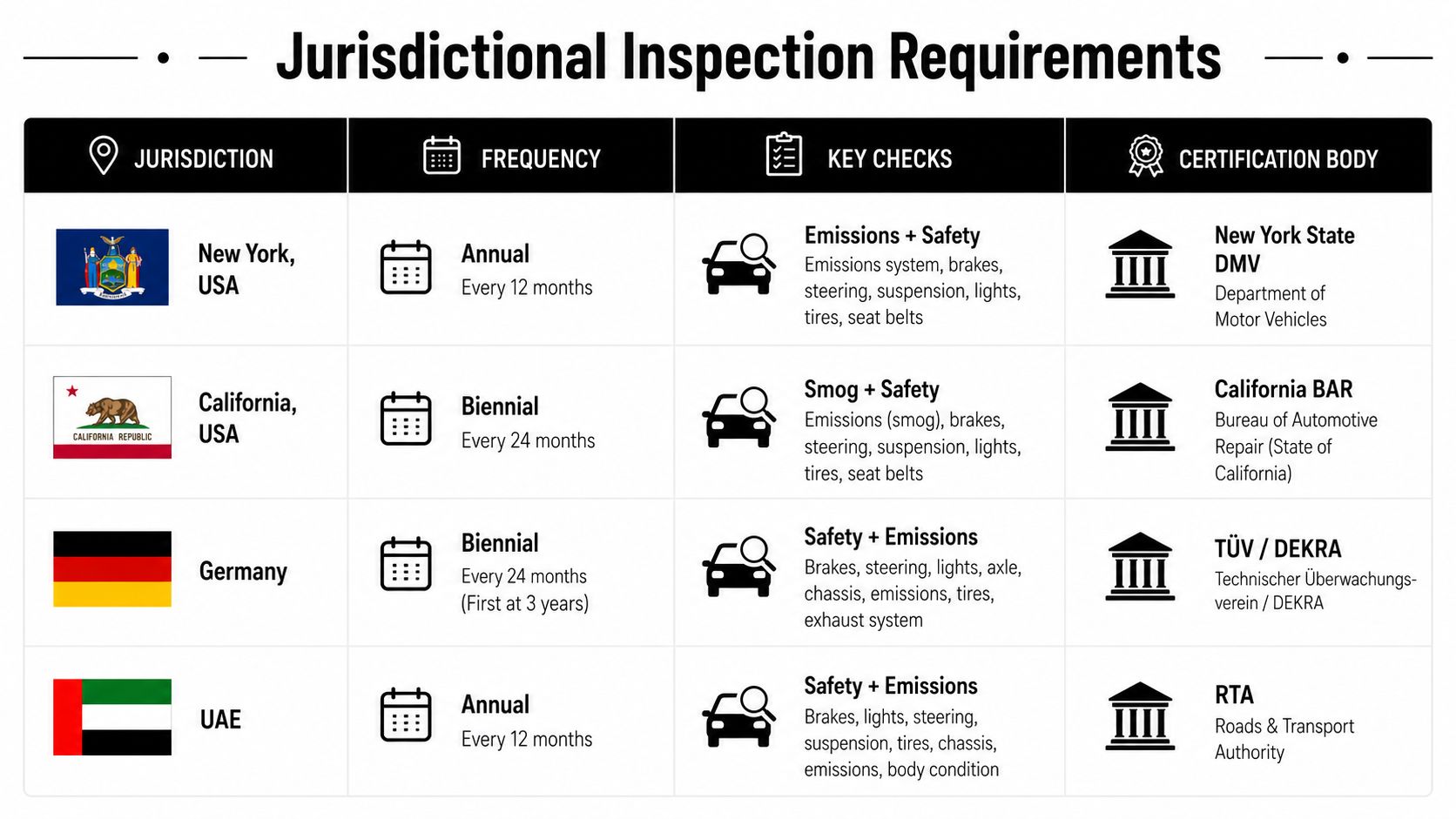
A vehicle can meet the legal requirement in one city and remain unsuitable for an executive assignment in the next. Rules differ by country, state, vehicle class, emissions policy, certification process, and enforcement practice. That variation creates a practical risk: an operator who manages only local deadlines may apply inconsistent controls to one client itinerary.
Regular vehicle inspections are prescribed in about 134 countries, according to DEKRA's 2025 Road Safety Report. The United States uses a more fragmented model. AutoCare material noted that 15 states had required periodic safety inspections at one point, while 14 states continued to mandate them in 2020. The figures are not a substitute for checking current local rules, but they show why an international operating manual cannot rely on one national assumption.
Build one internal standard
New York, California, Germany, and the UAE may set different inspection intervals, formal processes, and certification expectations. London and Tokyo add their own local requirements and operating conditions. A fleet serving these markets needs two controls: external compliance, which confirms that statutory obligations are met, and internal release approval, which determines whether the vehicle is fit for the specific assignment.
The internal standard should apply to every vehicle, regardless of registration location or trip origin. Define the required pre-trip checks, scheduled workshop inspections, defect categories, records, and conditions that require immediate vehicle substitution. That standard should be stricter where passenger profile, route exposure, or service demands justify it.
Compare the vehicle, not just the rule
A late-model sedan used for airport transfers has different operating demands from a luxury SUV carrying equipment or a premium van supporting group logistics. Vehicle class, passenger load, road conditions, mileage, idle time, and stop-start use should shape the internal inspection schedule.
The legal certificate must remain current, yet it should not be the sole release condition. Dispatch should show whether the vehicle is approved for the assignment, whether required documents are available, and whether an open defect affects passenger safety or service delivery.
Virginia data illustrates why inspection results deserve attention. In 2018, Virginia State Police data recorded 8,209,716 vehicles inspected and 1,634,740 failures due to critical safety defects, a failure rate of roughly 19.9%, as reported in AutoCare's Virginia inspection summary. A fleet should not treat the absence of a driver complaint, or a distant statutory deadline, as proof that the vehicle is ready for an executive passenger.
Digital Documentation and Compliance Logging
Paper forms fail in predictable ways. They get misplaced, completed after the fact, damaged by weather, or separated from the maintenance record. They also make it difficult to answer basic questions during an incident review, such as who inspected the vehicle, when the inspection occurred, what defect was observed, and who authorized the next action.
A digital workflow doesn't make an inspection accurate by itself. It makes the process easier to standardize and the evidence easier to retrieve. The person performing the check still has to examine the vehicle thoroughly.
Capture evidence that supports a decision
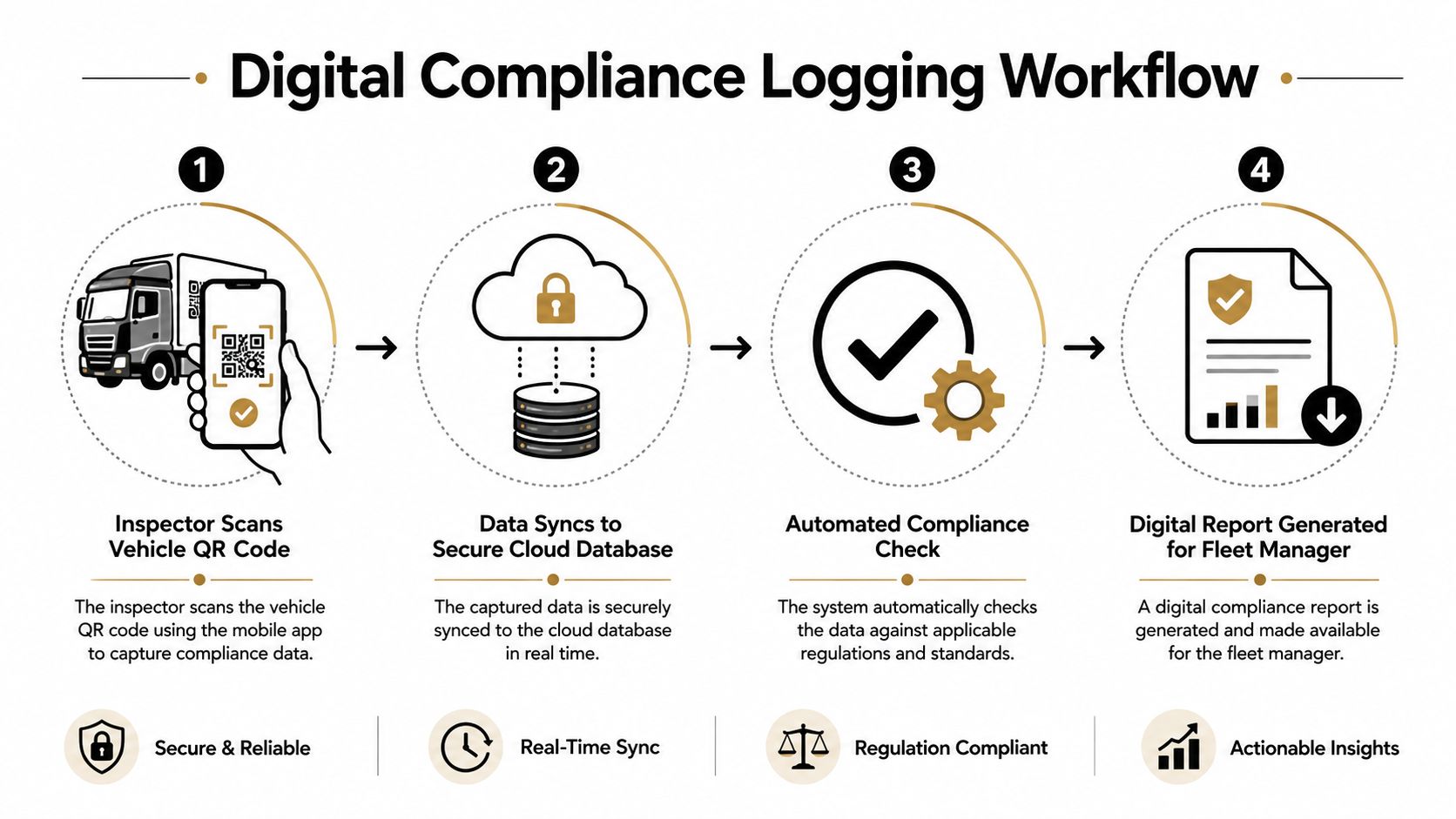
Every inspection record should identify the vehicle, inspector, date, time, location, odometer reading where relevant, assignment type, and inspection result. Defects need more than a checkbox. The record should describe the symptom, attach photographs when useful, classify the risk, and state whether the vehicle was released, restricted, repaired, or removed from service.
A useful record separates observations from approvals. “Front tire has visible sidewall damage” is an observation. “Vehicle removed from service pending tire replacement” is a control decision. “Fleet manager approved replacement vehicle” documents the response.
Use required fields for safety-critical items, but don't make every line unnecessarily complex. If the form takes so long that chauffeurs complete it from memory, the system has defeated itself. QR codes, vehicle-specific checklists, photo prompts, and automatic timestamps can reduce entry errors without replacing judgment.
Create an audit trail
Store inspection records beside maintenance actions, repair invoices, service notes, and release approvals. A fleet manager should be able to search by vehicle, date, defect type, location, or assignment and reconstruct the sequence without opening separate filing cabinets or messaging several people.
Set permissions carefully. Chauffeurs should be able to submit reports and photographs. Managers should be able to review, assign, and close defects. Maintenance personnel should see the technical information they need, while sensitive passenger details remain protected.
A fleet management platform makes sense when vehicles, cities, and workflows are complex. A smaller operation may begin with a secure mobile form and a controlled database, provided the system preserves records, restricts editing, and supports clear escalation. The important choice isn't the most impressive software. It's a workflow people use consistently.
The following video can help teams visualize a digital inspection process before selecting or configuring a platform.
Connect inspection records to real-time transportation visibility when dispatchers need immediate awareness of vehicle status, substitutions, or unresolved defects. The integration should make the safe decision easier, not just produce another dashboard.
Training Chauffeurs and Building Audit Processes
The chauffeur is often the last person who can stop an unsafe vehicle before a client enters it. That responsibility requires more than handing over a checklist. Drivers need to understand what failure looks like, why a small symptom matters, and what authority they have when the schedule is tight.
Experienced chauffeurs can resist new procedures when they believe the process questions their judgment. The solution isn't to lecture them about compliance. Use practical demonstrations, inspection photos, workshop feedback, and anonymized incident scenarios to connect each checkpoint to a real operational consequence.
Teach recognition and escalation together
Training should include a walk-around, cabin inspection, road-test observations, digital submission, and defect escalation. Supervisors can stage controlled examples, such as a damaged tire, a dim light, a warning message, or a loose interior fitting, and ask the chauffeur to describe the finding in operational language.
The chauffeur also needs a clear answer to three questions:
- Can I release this vehicle? Define defects that require immediate removal from service.
- Who do I contact? Provide one primary escalation route and a backup for overnight operations.
- What happens to the assignment? Explain how dispatch arranges a replacement without asking the driver to negotiate safety against the passenger's schedule.
A driver who knows the response will be supported is more likely to report openly. A driver who expects criticism or lost work may keep quiet until the defect becomes visible to the passenger.
Audit the process without punishing the reporter
Audits should test whether inspections happened properly, not merely whether forms contain completed fields. Managers can compare timestamps with dispatch activity, review photographs for recurring issues, check whether rejected vehicles were blocked from assignment, and sample vehicles across shifts and locations.
Use random spot-checks and scheduled reviews for different purposes. A spot-check shows whether the standard survives ordinary pressure. A scheduled review identifies trends in recurring defects, late submissions, missing evidence, or repeated use of the same vehicle beyond its intended assignment profile.
A useful distinction: Hold people accountable for hiding or bypassing a defect. Don't punish them for finding and reporting one.
When a chauffeur rushes or skips an inspection, address the cause first. The problem may be an unrealistic dispatch window, a confusing form, missing equipment, or a supervisor who rewards departure speed over preparation. Correct the system, retrain the individual, and escalate repeated noncompliance through a documented process.
Safety culture becomes credible when managers follow the same rule during a high-profile booking as they do during a routine transfer. If an executive's vehicle can be substituted for a safety reason without argument, chauffeurs learn that the standard is real.
Technology Integrations for Smarter Inspections
Technology should remove friction from a sound inspection process. It shouldn't create the appearance of control while leaving the core judgment unchanged.
A basic mobile checklist is often the best starting point. It can guide the chauffeur through the required sequence, require a response for critical items, attach photographs, and send a defect alert to the responsible manager. The advantage is consistency. The limitation is that the app can't confirm whether the person looked at the tire or just tapped the screen.
Match the tool to the operational problem
| Technology | Useful capability | Field limitation |
|---|---|---|
| Mobile checklist | Standardizes inspection steps and records submissions | Depends on honest visual checks |
| QR vehicle identification | Opens the correct vehicle record and reduces selection errors | Tags can be damaged or removed |
| Photo verification | Adds evidence for damage and defects | Photos need context and review |
| Telematics | Surfaces warning signals, mileage, harsh events, and vehicle status | Sensors can't identify every physical defect |
| Maintenance integration | Converts approved defects into service work | Poor configuration creates duplicate alerts |
Telematics is valuable for vehicles that generate actionable health data. It can help maintenance teams notice warning conditions, mileage triggers, battery concerns, or patterns that deserve inspection. It won't reliably identify every sidewall problem, interior safety issue, privacy-system failure, or cosmetic condition that affects VIP service.
Maintenance integration works when ownership is clear. A defect should move from inspection to review, then to a work order, repair confirmation, and release decision. If the system sends alerts without assigning responsibility, managers receive noise and chauffeurs stop trusting the process.
Avoid technology theater
A platform won't fix unclear defect categories or weak management follow-through. Before buying, test the workflow with actual chauffeurs during a busy shift. Ask whether they can complete it in poor connectivity, whether a replacement vehicle can be added quickly, and whether a manager can find an old record without technical assistance.
Use staged rollout rather than a fleet-wide launch built around a sales demonstration. Start with one vehicle group or operating location, observe where users hesitate, simplify the form, and confirm that alerts reach a person who can act. Technology delivers safety value when it shortens the distance between observation and decision.
Building a Safety Program That Exceeds Minimum Standards
A vehicle can pass its mandated inspection and still become unsafe before the next inspection date. Pennsylvania analysis of anonymized records estimated an initial light-duty vehicle failure rate of about 12% to 18%, while the final failure rate after repairs was below 0.1%. The figures show that inspection works as a screening and remediation process, not merely as a one-time pass or fail decision, according to the Pennsylvania vehicle inspection effectiveness study.
Vehicle age and operating conditions also deserve attention. A TÜV Association review of about 1.95 million commercial-vehicle inspections found that 19.6% failed the general inspection with significant or dangerous defects, rising to 27.9% for 7- to 8-year-old vans, as documented in the Pennsylvania program effectiveness study. Executive fleets should therefore adjust internal controls for age, mileage, duty cycle, and vehicle specialization. A late-model sedan used lightly does not present the same inspection exposure as an older van running dense urban routes, extended idle periods, and frequent passenger changes.
Set stronger internal controls
A practical program should:
- Segment inspection intensity: Apply closer scrutiny to older, higher-mileage, heavily used, or specialized vehicles.
- Prioritize high-yield defects: Review tires, brakes, lighting, steering, visibility, and leaks first.
- Use immediate removal rules: Keep a vehicle out of service when a defect creates a credible safety risk, regardless of its legal inspection date.
- Review patterns: Use inspection records to identify recurring failures by vehicle, location, model, or operating condition.
- Refresh training: Update coaching when audits reveal rushed checks, unclear reports, or repeated defect categories.
A Government Accountability Office review examined crash data across all 50 states and found no statistically significant difference in crash rates between states with vehicle safety inspection programs and states without them, according to the Pennsylvania program effectiveness study. That finding does not make inspections irrelevant. It shows why operators must control the work between mandated inspections, while accounting for enforcement, local driving conditions, and program design.
Set an internal release standard that exceeds the weakest jurisdiction in which the fleet operates. Audit recent records, identify defects that would stop a vehicle today, and give every chauffeur a clear escalation route. The inspection date should confirm readiness, not define it.