

Most advice about executive protection starts with the wrong question. It asks whether a leader needs a bodyguard, as if the choice were limited to visible personnel or no security at all. The more useful question is how much exposure the executive carries, where that exposure appears, and which controls can reduce it without damaging the person's ability to work.
Executive protection is an integrated risk-management program. It connects threat intelligence, travel planning, secure ground transportation, venue preparation, digital exposure awareness, and coordinated response. A professional team tries to identify uncertainty early, then changes routes, schedules, access arrangements, communications, or physical positioning before a threat becomes an incident.
The discipline has also become more institutionalized. A U.S. government review summarized in industry coverage found that, across fiscal years 1997 through 1999, agencies protected officials in 42 positions across 31 executive branch agencies, including all 14 cabinet secretaries. The review reported a 73% increase in full-time protective personnel and at least $73.7 million in protection spending during that period. Those figures describe a shift from ad hoc escorting toward formal leadership-risk management.
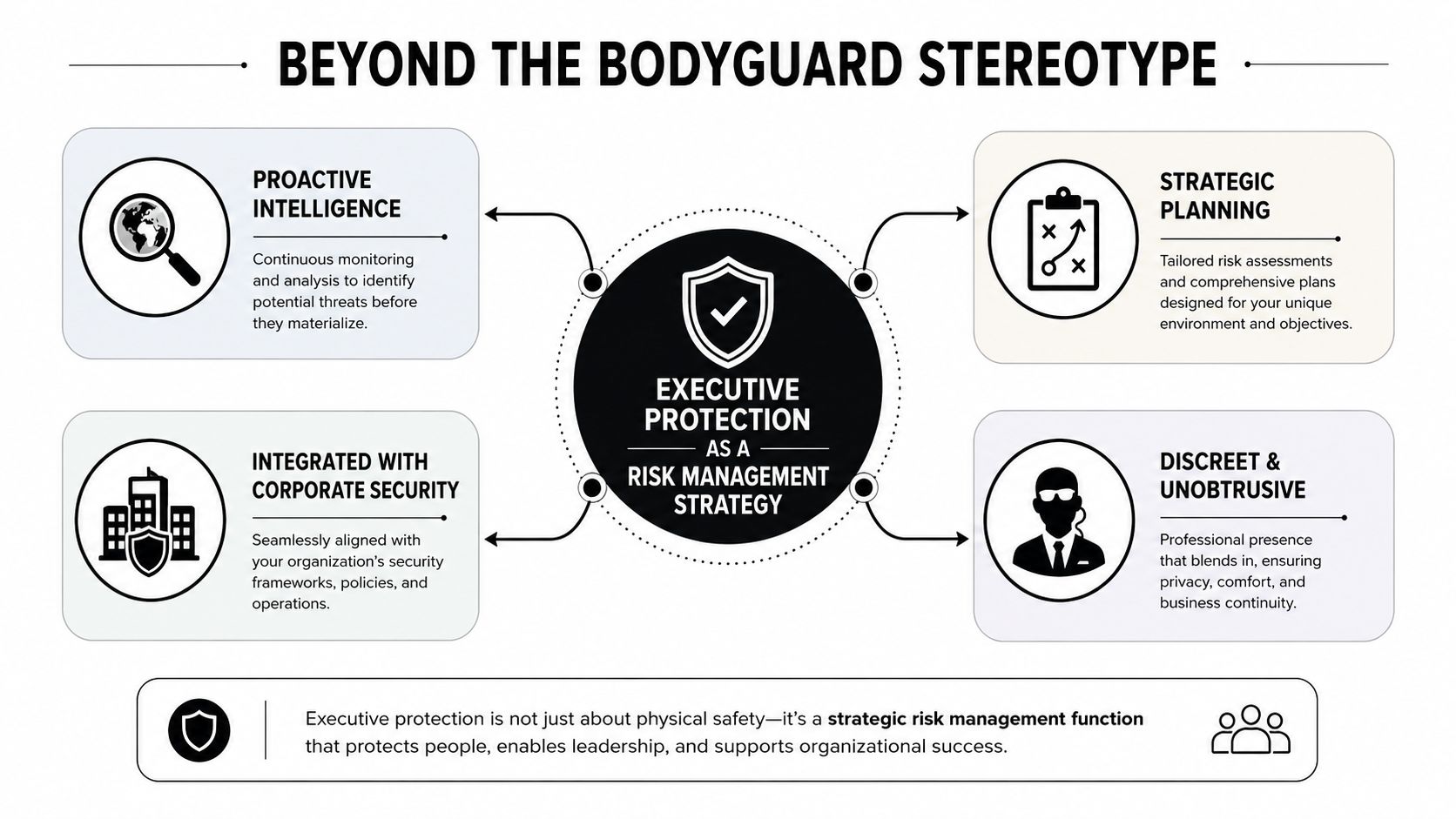
Beyond the Bodyguard Stereotype
Before a principal reaches the airport, hotel, boardroom, conference stage, or vehicle, the team may already be checking the arrival sequence, reviewing current reporting, confirming drivers, and testing alternate plans. If a route becomes exposed or a venue changes its access rules, the protection plan must change before the executive appears. The person beside the CEO is the visible endpoint of that work, not the whole program.
Executive protection is an integrated risk-management program. It connects intelligence, movement, advance logistics, digital exposure, and response so decisions remain coordinated. The team may review online hostility, assess the principal's exposure, evaluate a venue, brief the executive, coordinate with corporate functions, and prepare contingencies for changing conditions. The aim is to reduce exposure while preserving normal business activity, not to make the principal feel surrounded.
Protection starts before physical contact
The difference between basic guarding and professional EP is when the work begins. A guard may respond at the door. A mature program examines what could make the arrival predictable, exposed, or difficult to control, then adjusts the plan before the principal reaches the site.
That work can include:
- Intelligence review: Identify credible concerns, relevant actors, public exposure, and changes in the operating situation.
- Advance logistics: Examine arrival points, exits, waiting areas, elevators, meeting rooms, and alternate locations.
- Secure movement: Match vehicles, drivers, routes, staging points, and communications to the principal's schedule.
- Digital coordination: Treat doxing, harassment, impersonation, and exposed travel information as inputs to physical planning.
- Corporate integration: Coordinate with corporate security, HR, legal, communications, travel, and business continuity teams.
The Government Accountability Office guidance on threat assessment frames assessment around whether a person has the interest, motive, intention, and capability to attack a protectee. Visibility alone does not establish a credible threat. Teams need context and evidence before increasing protective measures, because unnecessary escalation can disrupt operations, signal concern, and reduce the principal's freedom of movement.
Why the field became professionalized
Executive protection grew from a narrow government function into a professional discipline serving corporate leaders, high-net-worth families, public figures, and close associates. A recent market analysis estimates the global executive protection service market at approximately USD 0.64 billion in 2026, projecting USD 1.53 billion by 2035 and a 10.1% compound annual growth rate. The same analysis gives other 2026 estimates, USD 0.65 billion or USD 1.20 billion, depending on scope and methodology.
The differing estimates support a practical buying rule. Corporate buyers should judge providers by whether they connect intelligence to movement, movement to logistics, and logistics to an adaptable response, rather than by market-size claims or a visible guard count.
Practical rule: If a provider describes EP only as a person assigned to stand beside the principal, the program is probably under-scoped.
Core Service Pillars of Executive Protection
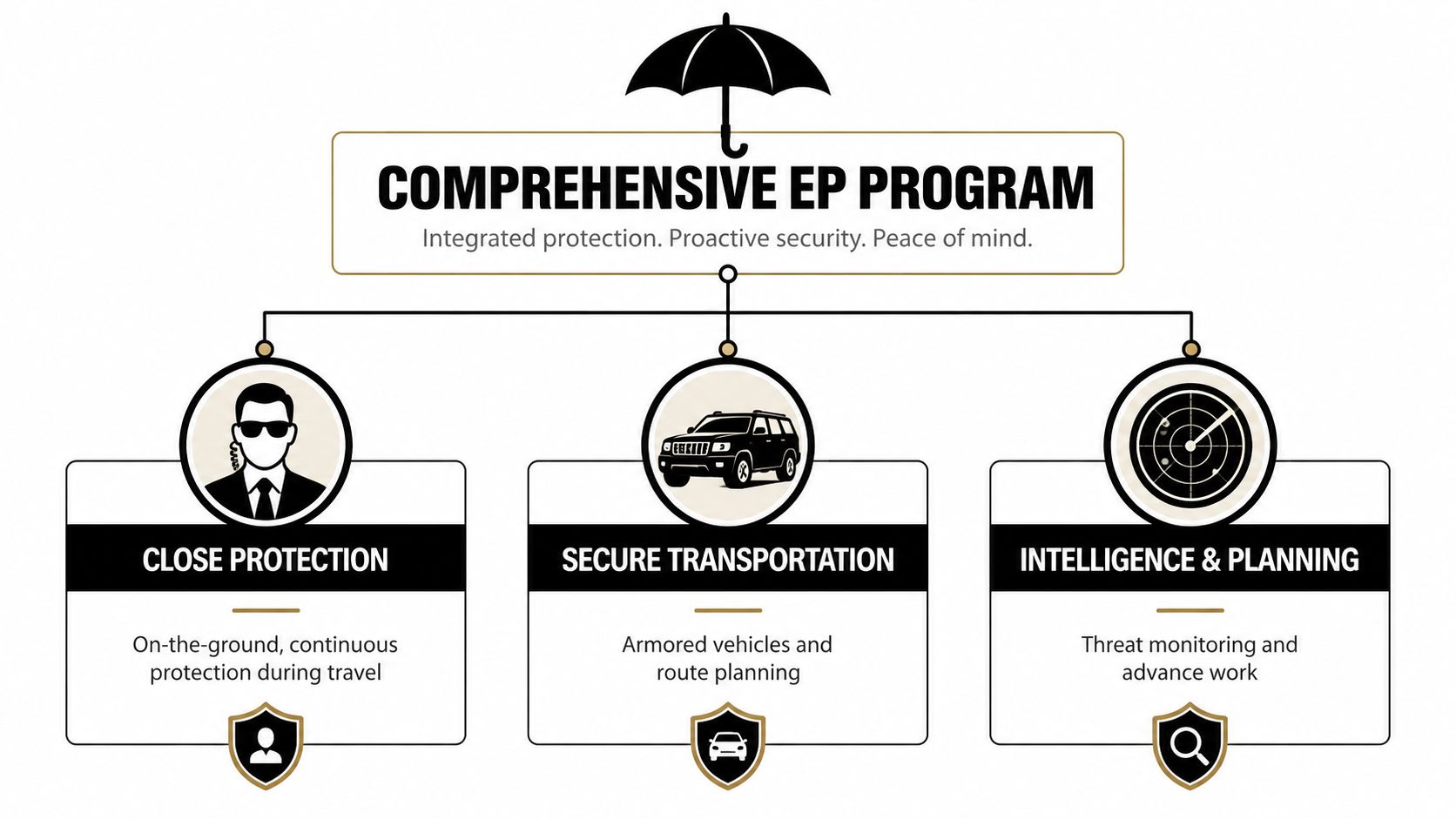
A professional EP program combines several capabilities under one operating plan. The mix depends on the principal, destination, itinerary, visibility, and current threat picture. A CEO attending a shareholder meeting may require discreet advance work and a controlled arrival. A family traveling internationally may need residential coordination, secure transfers, and procedures that account for children and household staff.
Close protection
Close protection officers provide the visible, mobile layer. They manage proximity, observation, movement through public areas, access decisions, and immediate response. Their duties can include walking formations, event positioning, hotel transitions, office visits, and coordination with local security personnel.
The strongest posture is often discreet rather than theatrical. A large visible detail may reassure some stakeholders, yet attract attention, disrupt meetings, or signal the principal's importance. Professional teams adjust staffing, positioning, and behavior to the environment and the executive's tolerance for operational friction.
Residential and site security
Residential security covers the places where the principal lives, works, or regularly receives visitors. Measures may include access procedures, visitor management, perimeter awareness, alarm coordination, household briefings, and liaison with local emergency services.
Executives spend substantial time outside controlled corporate facilities. Family members, contractors, deliveries, and domestic routines can create exposure that a traveling detail will not see. Residential controls should support daily life. A home should not become an obviously hardened compound unless the risk justifies that posture.
Advance work and intelligence
Advance agents examine the environment before the principal arrives. They confirm entrances, exits, parking and staging arrangements, elevators, private rooms, medical resources, local contacts, and alternate sites. Intelligence personnel add context by assessing threats, public activity, travel conditions, and changes that could affect the plan.
Advance work connects the other pillars. Without it, officers may arrive with a vehicle and schedule but lack a realistic understanding of the venue, access points, and weak points.
Secure transportation
Secure transportation covers driver selection, vehicle suitability, route planning, communications, staging, and contingency movement. The vehicle is one part of the protection chain, connecting the residence, airport, office, meeting, event, and return journey.
A corporate buyer evaluating secure transport companies should ask how the transport provider exchanges information with the EP team, who authorizes route changes, and how the driver handles an unexpected stop or schedule change. A low-profile vehicle may reduce attention, while a more capable platform may provide advantages in a higher-risk setting. The choice should follow the assessment, not a standard package.
An itinerary often crosses several operational boundaries. The provider must coordinate those handoffs without drawing attention, while preserving communication, discretion, and control.
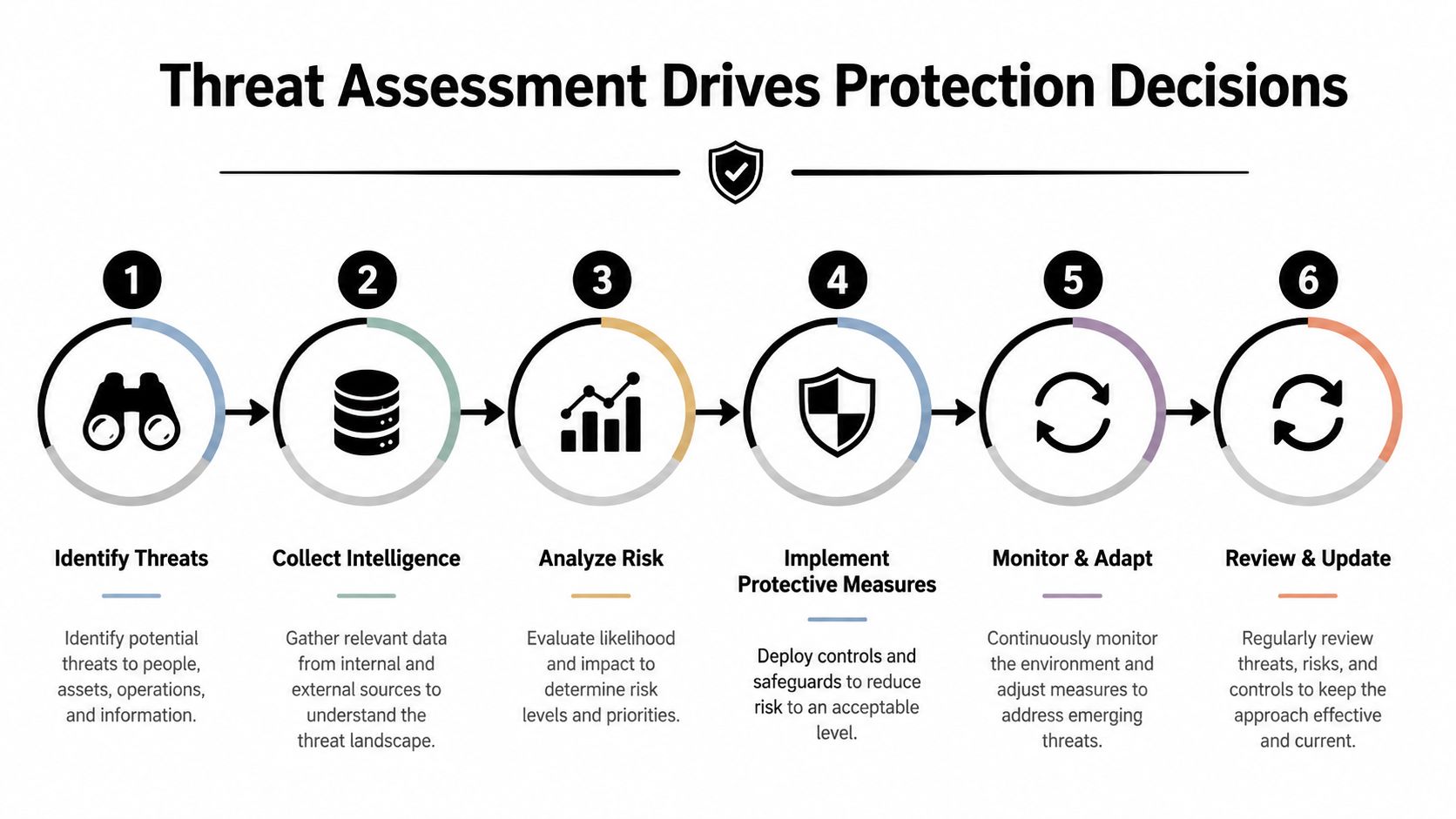
How Threat Assessment Drives Protection Decisions
Professional EP starts with a decision, not a package: what is the credible threat, and what does it mean for this person in this environment? The answer determines whether the program needs intelligence collection, route changes, venue controls, staffing adjustments, or a change to the schedule.
A threat assessment examines whether a person has the interest, motive, intention, and capability to attack a protectee. It differs from a vulnerability review and from a broader security-risk assessment. Each product answers a different operational question, and confusing them can produce the wrong protection response.
The assessment pipeline
- Identify the concern. Record the reported behavior, target, timing, source, and context instead of relying on an unverified label.
- Collect intelligence. Gather relevant information about the person or group, location, event, travel environment, and principal's exposure.
- Evaluate intent and capability. Anger or interest alone may not establish a credible threat. Analysts look for evidence connecting motivation with means and opportunity.
- Assess vulnerability. Review predictable routines, public appearances, access points, transportation, residences, venues, and communications.
- Convert findings into controls. Findings may change a route, arrival time, speaking location, access plan, vehicle staging, staffing posture, or schedule.
- Monitor and revise. Conditions change. A plan that was reasonable during pre-arrival planning may require adjustment when new information appears.
The separation between threat assessments, vulnerability assessments, security-risk assessments, and protection statements, described in the GAO threat-assessment guidance, gives corporate programs a useful operating model. The team should be able to show what it knows about the threat, what the environment exposes, and which controls the protection plan requires. A provider that delivers only a staffing count, without that reasoning, gives the buyer little basis for judging whether the response matches the risk.
When protection requires environmental redesign
Static guarding is not always the right control. If a credible line of sight, access path, or other attack vector cannot be secured, the team may need to change the environment rather than add another officer.
That can mean moving the speaking position, using a different entrance, placing visual obstructions, shortening time on site, removing fixed waiting positions, or selecting an alternate location. An attacker's opportunity often depends on visibility and dwell time, so reducing the opportunity window can provide more protection than relying on a fixed guard.
The analysis of executive protection decisions when a threat can't be secured presents environmental redesign as a practical response when a threat axis remains open. Corporate buyers should ask providers for examples of changing routes, venues, timing, or positioning when a risk cannot be fully neutralized.
Integrating Secure Ground Transportation and FBO Coordination
Executive protection often fails at handoff points. A protection officer may control movement from a hotel to a vehicle, while a chauffeur manages the drive, an FBO controls terminal access, and an aviation team manages the aircraft connection. Without a shared plan, the principal can face an exposure gap between otherwise capable services.
Secure mobility requires one operating picture from departure to destination. The EP lead should confirm vehicle staging, the receiving contact, access procedures, preferred routing, and the response if an aircraft, meeting, or road schedule changes. These details should appear in the operating brief, not remain informal assumptions between vendors.
The vehicle must match the assignment
Vehicle selection should reflect the route, passenger profile, local conditions, luggage requirements, and required discretion. A large visible convoy may be unsuitable for a low-profile business meeting, while one ordinary vehicle may not support a higher-risk movement. The decision belongs in the risk assessment rather than a generic fleet menu.
Driver standards matter equally. A professional driver needs route familiarity, disciplined communications, sound staging practices, passenger privacy, safe stopping decisions, and the ability to coordinate with the protection detail. Driving skill alone does not qualify someone to operate within an executive-protection plan.
For complex movements, FBO support and private aviation coordination should be managed as security logistics, not merely hospitality. The team may coordinate terminal access, curbside or airside transfers, baggage timing, vehicle positioning, and the precise transfer of responsibility between aviation and ground personnel.
Roadshows expose weak coordination
A multi-stop corporate roadshow tests scheduling, transport, access control, and communications at the same time. Principals move between offices, hotels, aircraft, and public appearances. Local drivers rotate, routes change, and each venue presents different access conditions. The protection team needs a common briefing process, reliable contact channels, route alternatives, and a controlled method for distributing changes without exposing sensitive itinerary details.
The strongest programs keep the executive experience simple. The principal finds the vehicle at the correct location, receives concise guidance, and follows the itinerary without repeated explanations. Behind that simplicity, EP, transport, aviation, venue, and corporate teams maintain current timings, named responsibilities, and agreed escalation procedures. Corporate buyers should test these arrangements through a sample movement plan and ask who owns each handoff when conditions change.
Selecting a Provider and Understanding Cost Drivers
Procurement teams often begin with licensing, insurance, and the number of armed personnel available. Those checks matter, but they don't tell you whether a provider can run an integrated protection program across jurisdictions and changing schedules.
Start with capability, then examine price. Ask providers to show how they conduct threat assessments, document advance work, brief principals, manage transport, coordinate affiliates, protect information, and review incidents. A polished proposal that omits those operating details may be cheaper because it leaves important work unpriced.
What to examine during due diligence
- Personnel standards: Review background screening, training, medical readiness, driving capability, communications discipline, and supervision.
- Intelligence capability: Ask who validates digital or physical indicators and how analysts convert findings into operational decisions.
- Advance methodology: Require a clear description of venue surveys, route planning, alternate arrangements, and local liaison.
- Jurisdictional readiness: Confirm licensing, legal authority, insurance, firearms compliance where relevant, and lawful data handling in each location.
- Affiliate control: Determine whether overseas partners follow documented standards or are selected informally for each assignment.
- Reporting and governance: Establish who receives plans, incident reports, after-action reviews, and performance information.
The service-level agreement framework can help buyers define response expectations, escalation routes, substitution procedures, confidentiality obligations, and reporting responsibilities before deployment.
Cost follows complexity
There isn't a universal EP price because the work changes with the assignment. The main cost drivers are team size, threat level, travel complexity, advance requirements, duration, vehicle needs, local staffing, and specialized intelligence or cybersecurity support.
| Service Tier | Included Services | Typical Use Case |
|---|---|---|
| Advisory and travel risk | Risk review, itinerary guidance, briefing, and coordination | Lower-exposure business travel |
| Discreet protective support | Close protection, advance work, secure vehicle coordination, and communications | Public meetings, conferences, and executive travel |
| Integrated protective program | Intelligence, residential or site security, multi-location advance work, transport, and coordinated response | Higher-exposure leaders, families, or complex international schedules |
A buyer should compare proposals by deliverables, not by headcount alone. Under-scoping may reduce the invoice while leaving no capacity for alternate routes, schedule changes, local liaison, or post-incident review.
Measuring Program Effectiveness and Overcoming Common Gaps
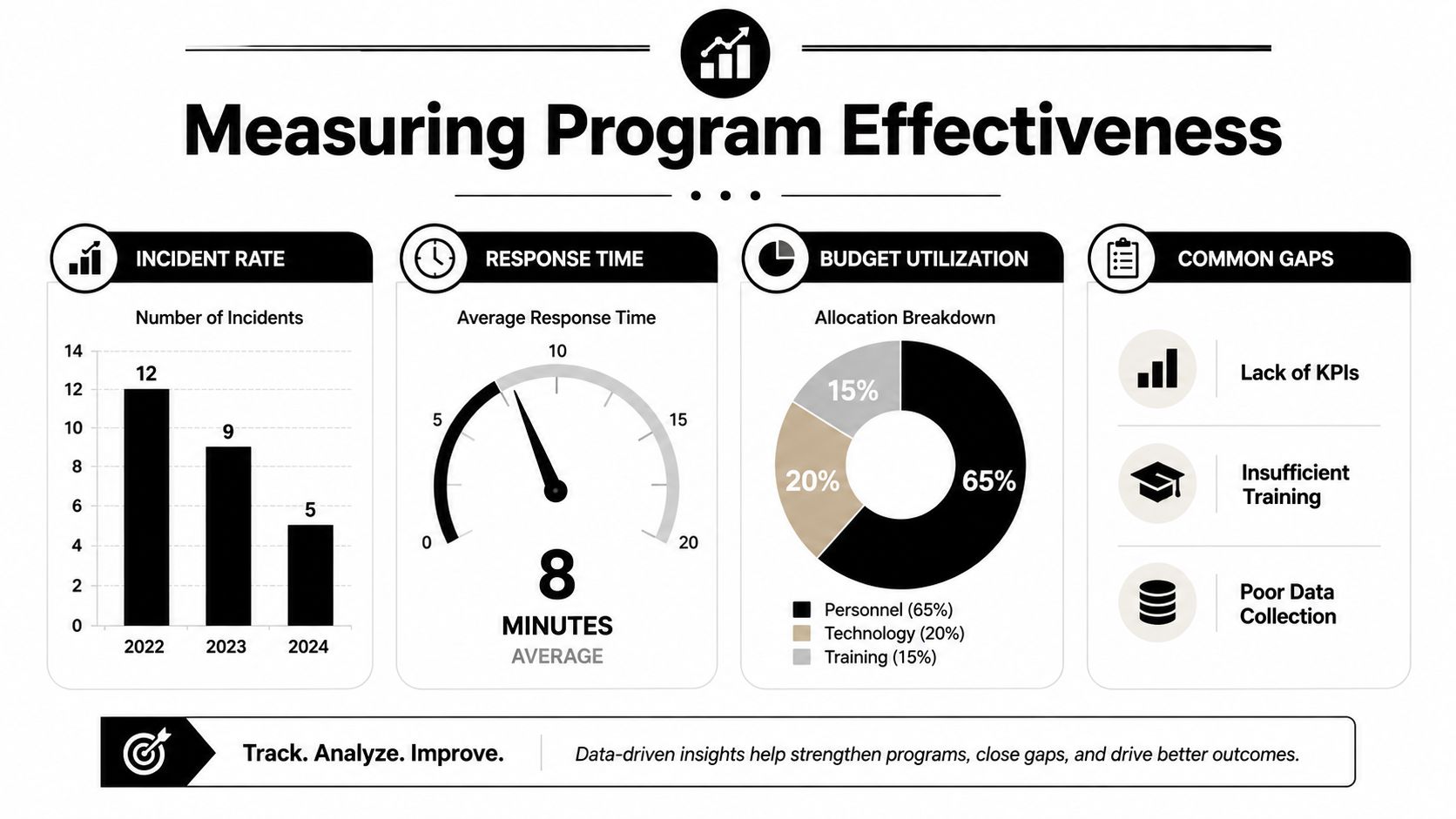
A protection program that reports only “no incidents” is difficult to govern. An absence of incidents may reflect effective deterrence, low exposure, incomplete reporting, or simple luck. Boards need evidence that the organization identifies risk, follows its controls, learns from deviations, and adjusts investment when conditions change.
The 2025 ASIS and Everbridge executive protection report identifies several execution gaps. Budget constraints are cited by 58% of security professionals, while 47% cite executive noncompliance. The report also records staffing and training limits as a challenge for 41%, no formal evaluation process for 34%, infrequent or absent pre-travel briefings for 26%, and programs still in planning stages for 12%.
Measure the controls, not only the incidents
A useful dashboard can include:
- Travel assessment coverage: Whether planned trips receive documented risk review before departure.
- Briefing completion: Whether principals and relevant staff receive concise, usable guidance.
- Route and venue readiness: Whether advance work is completed and alternatives are available.
- Compliance friction: Which protective procedures executives skip, and why.
- Response performance: How quickly the right people receive verified information and act.
- After-action closure: Whether incidents, near misses, and plan deviations produce assigned improvements.
The numbers should support decisions, not create decorative reporting. If executives ignore a procedure, the security director should identify whether the issue is inconvenience, poor communication, unnecessary restriction, or weak leadership sponsorship.
Budget discipline requires prioritization
A constrained budget doesn't justify an improvised program. It requires the team to prioritize the controls that reduce the principal's greatest exposure. That may mean funding intelligence and advance work before adding visible personnel, improving transport coordination before buying additional equipment, or reserving higher-intensity coverage for specific movements rather than applying it everywhere.
Real-time intelligence and technology-enabled monitoring can improve awareness, but technology doesn't replace judgment. Analysts still need to verify signals, explain relevance, and connect findings to a route, venue, schedule, or response decision.
A mature EP program makes security easier to follow because it designs controls around the executive's real schedule rather than asking the executive to work around security.
Practical Questions Corporate Executives Ask
When does an executive need EP instead of standard security?
Standard facility security may be sufficient when the risk is limited to controlled premises and predictable access. EP becomes more relevant when the principal's visibility, travel, public appearances, family exposure, schedule volatility, or credible threat information creates risk across multiple environments. The decision should come from a documented assessment, not from status or fear.
How do you handle an executive who resists protection?
Start with friction. A leader may reject protection because the vehicle is inconvenient, the briefing is too long, the detail is conspicuous, or the team interrupts meetings. Replace broad restrictions with specific behaviors, explain the operational reason briefly, and offer discreet alternatives where the risk allows.
A short pre-travel briefing, a familiar driver, and a well-planned arrival often gain more cooperation than a large visible detail imposed without context. Executive participation is a control, so security leaders should measure compliance and address the reasons behind resistance.
What authority does a protection team have?
Authority depends on the jurisdiction, employment structure, licensing, contracts, and whether personnel are working with public agencies. Private personnel generally don't acquire government powers by wearing a security uniform. The provider should explain local legal limits, escalation procedures, use-of-force rules, data responsibilities, and coordination arrangements before deployment.
How should EP work with corporate security and HR?
The EP lead should define responsibilities with corporate security, HR, legal, communications, travel, and business continuity. HR may manage workplace concerns, legal may address privacy and jurisdiction, communications may handle public messaging, and corporate security may control facilities. One incident lead should coordinate the response so the principal doesn't receive conflicting instructions.
MLR Worldwide Service provides executive chauffeur services, VIP secure transport, airport transfers, FBO support, corporate roadshow logistics, and coordination with personal protection teams when required. For organizations planning secure executive movement, visit MLR Worldwide Service to discuss transportation and ground-logistics requirements.