

The CEO lands at 9:47 p.m. The chauffeur booking still shows “confirmed,” but no driver has been assigned. The backup rideshare option is surging at 4.2 times its normal rate, and the first board-preparation session starts at 7:30 a.m., forty-three kilometers from the hotel. Nobody has decided whether the executive assistant, travel desk, security team, or local transport provider owns the recovery.
That hour after wheels-down is where many executive trips fail. The flight may arrive on schedule, yet customs, baggage, curbside coordination, hotel distance, and the first meeting's preparation requirements can still destroy the itinerary. Effective business travel planning treats those details as one operational chain, not as separate reservations.
This guide focuses on the handoffs that look minor in a spreadsheet but carry the highest recovery cost in the field. Use it to connect air travel, ground transport, accommodation, risk response, and reporting into a plan that remains usable when the original schedule breaks.
When a Smooth Executive Trip Comes Down to Ground Logistics
The first decision is to work backward from the first business-critical event. If the traveler must be ready for a board session at 7:30 a.m., the plan needs to account for arrival, immigration, baggage, transfer time, hotel check-in, sleep, breakfast, preparation, and the distance between the hotel and meeting site. A flight arrival time alone tells you almost nothing about readiness.
Practical rule: Treat the period from touchdown to the first meeting as a managed operating window, not as personal time.
The itinerary should show who owns each handoff. The chauffeur company owns flight monitoring and curbside contact. The travel desk owns rebooking authority. The executive assistant owns meeting changes. Security owns escalation when the traveler can't be located or the destination conditions change. If those roles aren't explicit, everyone assumes someone else is watching.

Close the arrival seam before departure
Confirm the terminal, baggage plan, meeting location, hotel entrance, vehicle access rules, and the driver's contact method. Secondary terminals and international arrivals often create more friction than the air segment because the traveler must move through several uncontrolled points before reaching the vehicle.
The hotel should be selected for the morning schedule, not only for loyalty status or room category. A property near the first meeting can protect sleep and reduce exposure to traffic, road closures, and late transfer failures. The same logic applies to corporate travel logistics for executives, where the movement between stops deserves as much attention as the booking itself.
A useful plan includes a live contact path, a backup vehicle, and a trigger for escalation. If the driver hasn't checked in by the agreed point before landing, the operator should activate the backup without waiting for the executive to ask. The traveler shouldn't have to troubleshoot a transport failure while carrying luggage after a long flight.
Why Business Travel Planning Now Operates at Trillion-Dollar Scale
Global business travel is no longer a small administrative category. The GBTA 2026 forecast projects US$1.71 trillion in global business travel spending in 2026 and more than 1.84 billion business trips worldwide. The same forecast projects spending growth of 7.2% in 2026, after global spending reached US$1.48 trillion in 2024, an increase of 11.1% that year.
Those figures change the planning problem. At this volume, a cheaper fare can matter, but the larger operational exposure sits in missed connections, unavailable vehicles, itinerary changes, security incidents, and executives arriving unable to perform. The cost isn't limited to the ticket. It includes staff time, replacement transport, lost meeting value, supplier penalties, and recovery work across several teams.
| Metric | Latest figure | Planning implication |
|---|---|---|
| Projected global business travel spending in 2026 | US$1.71 trillion | Planning must coordinate air, hotel, ground, risk, and reporting at scale. |
| Projected global business trips in 2026 | More than 1.84 billion | Exception handling needs defined owners and repeatable workflows. |
| Projected spending rise in 2026 | 7.2% | Travel programs need capacity for continued demand, not just cost suppression. |
| Global spending in 2024 | US$1.48 trillion | The market has moved beyond its pre-pandemic peak. |
| Increase in global spending during 2024 | 11.1% | Program controls must support expansion while protecting traveler productivity. |
Scale exposes weak handoffs
A travel program can tolerate occasional manual work when trips are simple. It struggles when executives, crews, roadshows, and multi-stop itineraries move across time zones and suppliers. The weak point is usually the handoff between systems and people. A booking tool confirms a reservation, but it doesn't automatically guarantee a driver, a room near the meeting, a cleared expense path, or a person equipped to reroute the traveler.
That's why expense control belongs inside business travel expense management, not in a separate post-trip exercise. Finance needs to understand the full landed cost of a trip, including recovery actions, rather than reviewing isolated receipts after the commercial opportunity has passed.
Once a company manages substantial recurring travel, execution quality becomes a stronger lever than fare class alone. The planning function should measure whether travelers reached the right place prepared, safely, and with minimal intervention. The lowest base fare is a poor result if the itinerary creates an expensive failure downstream.
Building the Pre-Trip Plan That Actually Holds Together
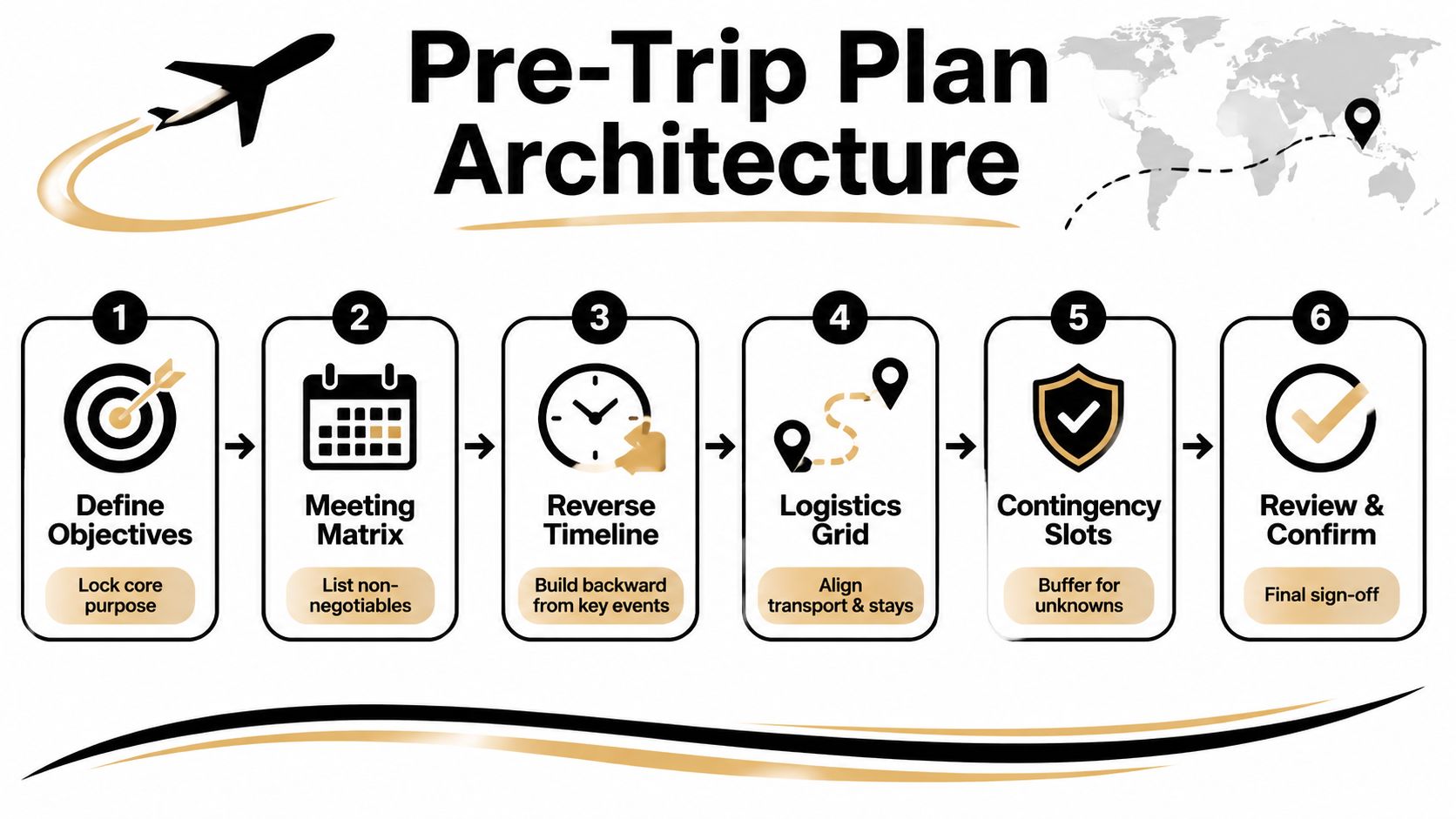
Start with the purpose of the trip. Identify the meetings that cannot move, the people whose attendance is essential, the locations that require physical presence, and the outcomes expected from each stop. Then build the itinerary backward from those commitments. Booking the cheapest workable flight first often forces the calendar to absorb the airline's limitations.
Build around the meeting matrix
Create one working matrix for each stop:
- Meeting priority: Mark the event as immovable, movable, or optional.
- Readiness requirement: Record preparation time, wardrobe needs, equipment, presentation access, and sleep constraints.
- Arrival requirement: Define the latest acceptable arrival and the latest acceptable departure from the previous location.
- Local movement: Include airport exit, hotel transfer, hotel-to-meeting travel, parking, security screening, and venue access.
- Decision owner: Name the person authorized to change the schedule when the original plan fails.
International-to-domestic connections need a deliberate buffer, not an optimistic connection shown by the booking engine. The right amount depends on airport layout, immigration, baggage, terminal changes, and the traveler's profile. A senior traveler with sensitive materials or a security escort shouldn't be planned like a passenger making a simple airside connection.
Reserve the recovery stack early
Ground transport should be checked before the air booking is treated as final. Reserve the primary chauffeur company, then document the backup black-car account, the approved rideshare allowance, and the hotel concierge option. Each fallback needs an owner, activation method, payment authority, and response expectation.
Hotel choice should favor meeting proximity when the agenda is dense. Loyalty benefits may help, but they shouldn't outweigh a long transfer before a high-stakes presentation. For roadshows, a hotel near the next morning's venue can protect the schedule more effectively than a property near the airport if the traveler has enough arrival margin.
Keep one controlled itinerary file for the traveler, executive assistant, travel desk, security contact, and transport operator. The file should show the current version, local times, phone numbers, vehicle details, meeting contacts, and contingency decisions. A practical executive travel itinerary template can provide the starting structure, but the operating rule matters more than the format. Reconfirm the entire chain before departure, and require every supplier to acknowledge the latest version.
Choosing Ground Transport and Airport Transfers for Executive Travel
Ground transport should be selected by failure behavior, not by vehicle photograph. Ask what happens when the flight lands early, the driver can't reach the curb, baggage takes longer than expected, the executive adds a stop, or the primary vehicle becomes unavailable. The answer separates a managed service from a reservation that only looks complete.
| Criterion | Chauffeur service | Premium rideshare | Rental car |
|---|---|---|---|
| Punctuality tolerance | Strong when dispatch monitors the flight and assigns a driver before arrival. | Variable, especially during demand spikes or terminal congestion. | Depends on pickup queues, vehicle availability, and the traveler driving. |
| Privacy and discretion | High, with a known driver and controlled vehicle environment. | Moderate, subject to driver assignment and platform operations. | High inside the vehicle, but the traveler manages the entire movement. |
| Baggage handling | Can be assigned as a service expectation. | Usually limited to the driver's willingness and vehicle capacity. | Traveler handles luggage from counter to vehicle and destination. |
| Multi-stop performance | Suitable when the operator has live itinerary oversight. | Less reliable for complex sequences and changing wait times. | Useful for independent regional travel, but adds driving and parking workload. |
| Failure recovery | Backup vehicle, dispatch escalation, and alternate driver can be written into the service plan. | Rebooking depends on live marketplace availability. | Recovery may require a new vehicle, roadside support, or a route change by the traveler. |
| Special configurations | Can accommodate security, family, equipment, child seats, and specialty vehicles when arranged in advance. | Requirements may not be consistently available at pickup. | Offers control, but the traveler carries responsibility for setup and compliance. |
Put the service level in writing
An airport-transfer SLA should define the expected curb-to-curb experience, the flight-tracking rule, the driver check-in point, and the backup activation window. It should also identify who contacts the traveler, who contacts the executive assistant, and who can authorize a replacement vehicle without waiting for approval.
Black-car coverage is particularly useful for roadshows and multi-stop days because the same dispatch team can monitor the sequence, preserve vehicle continuity, and adjust pickup timing. Premium rideshare can work for low-stakes, single-leg movements, but it shouldn't be the default recovery plan for a senior traveler with a fixed meeting schedule.
Vet the supplier beyond the fleet
Request current insurance certificates, confirm the operating entity, and understand whether drivers are W-2 employees or 1099 contractors. Review subcontracting terms and real sub-liability, especially when the booked brand may hand the ride to a local affiliate. Ask how the provider handles toll transponders, EV charging, child-seat requirements, after-hours staffing, terminal restrictions, and inaccessible pickup zones.
The vendor should also provide a 24-hour escalation number answered by a human. If the answer is an app notification or an inbox checked during office hours, the service doesn't match executive travel requirements.
Duty of Care and Risk Planning Beyond the Booking
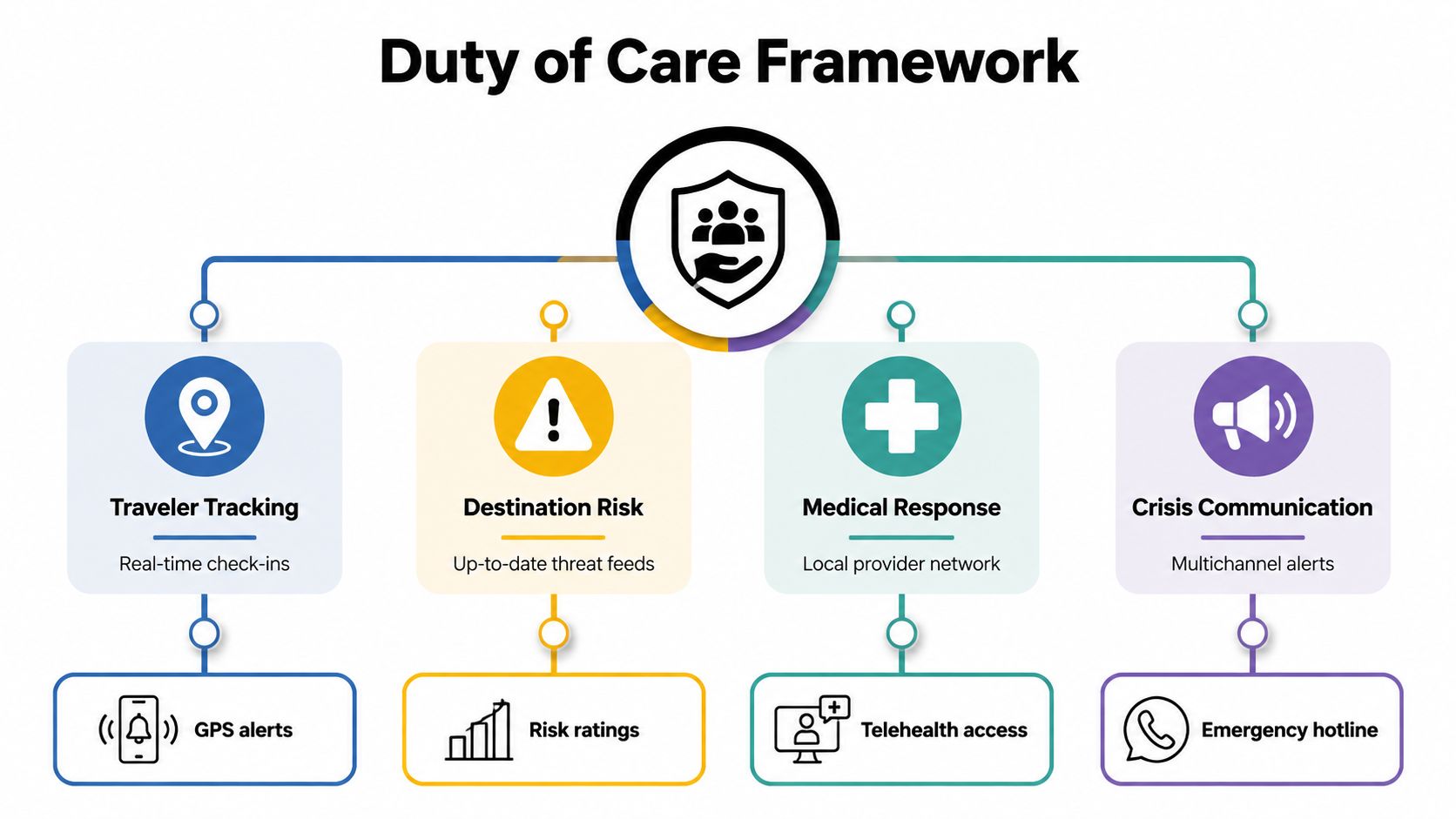
Duty of care starts before the reservation. A mature program connects traveler tracking, destination risk, medical response, and crisis communication to specific actions, owners, and escalation windows. General language about traveler safety doesn't help an executive stranded after a missed check-in.
Turn the four pillars into operating tasks
Traveler tracking requires a current traveler profile, itinerary sharing with the appropriate security team, emergency contacts, passport or document notes where policy permits, and a reliable check-in method. The security team should know when the traveler is expected to arrive, not discover the trip only after a problem is reported.
Destination risk should reflect the assignment, not just the country label. Research on employer business-travel risk management identifies seven risk categories, health, political, transport, natural, crime, technology, and kidnap, alongside destination profile, length of stay, travel mode, activities, and traveler profile. Use those categories to decide vehicle requirements, hotel location, route restrictions, local support, and whether the trip needs a higher approval level. The underlying framework is documented in this research on business-travel risk management.
For medical response, distribute the traveler's emergency card, identify local providers, confirm telehealth access where available, and record the assistance number in both the traveler-facing itinerary and the control file. Don't assume the traveler can search for care while ill, injured, or under pressure.
Crisis communication needs more than one channel. Define who sends the alert, who confirms receipt, who briefs the executive's chief of staff, and who speaks to family or corporate communications when necessary.
Assign the escalation chain
Write the chain in named roles:
- Within fifteen minutes of a missed check-in: The travel desk contacts the traveler and transport provider, while security checks the itinerary and last known movement.
- If contact isn't restored: The security lead informs the executive assistant or chief of staff and activates the local assistance partner.
- If transport or air recovery is required: The travel manager holds the alternate vehicle or routing option and confirms payment authority.
- If the destination risk changes: Security recommends continuation, shelter, relocation, or evacuation, while the executive sponsor approves business decisions.
- After resolution: The program records the incident, response time, supplier actions, and policy changes.
Review insurance separately from the corporate booking policy. Programs often need to examine kidnap-and-ransom, political evacuation, and accidental death and dismemberment coverage above employer limits. The broker, security lead, and legal team should confirm what applies to the traveler, assignment, destination, and activity before departure.
Designing Itineraries That Survive Disruption
Disruption planning should begin with evidence, not optimism. The Perk business travel disruption survey reports that 89% of global business travelers experienced at least one trip that failed to go according to plan during the prior twelve months. It also reports delays of more than an hour for 56%, cancellations for 36%, and missed connections for 26% of travelers.
The commercial consequence is direct. Twenty-eight percent of travelers said a disruption caused a missed business or sales opportunity, rising to 40% among C-level executives, while U.S. companies are estimated to spend more than $17 billion annually on additional travel expenses caused by cancellations and other disruptions. The same source estimates those costs at about 4% of annual U.S. business travel spend.
Build three schedules, not one
The primary schedule contains the preferred flights, hotel, vehicles, and meetings. The contingency schedule contains approved alternatives, including different airports, earlier departures, replacement vehicles, remote attendance options, and hotel extensions. The hard-stop schedule defines the point at which the traveler must stop trying to preserve the original plan and protect the most important meeting.
Every layer needs a trigger. A missed driver check-in should activate ground recovery. A cancellation should trigger the approved alternate routing list. A delay that removes the preparation window should force a meeting decision, not leave the traveler hoping the remaining connections work.
Use buffers where recovery is hardest
The most fragile point is often the connection between transport modes. A domestic flight can arrive on time and still produce a late meeting if the traveler assumes a driver will be waiting, baggage will be immediate, and the hotel will be close to the venue. Build margin around customs, baggage, terminal movement, road traffic, venue security, and vehicle replacement.
Avoid back-to-back international arrivals when the first meeting carries material commercial or governance importance. Avoid Friday-night departures after a full meeting day if the traveler must perform early the next morning. Avoid domestic connections that depend on a confirmed ground transfer at the other end unless the transfer has live monitoring and a defined replacement path.
Finance and security should approve the alternate routing list before the trip. Pre-approval removes debate during a disruption and gives the travel desk permission to act while seats, rooms, and vehicles still exist. The best recovery plan isn't the one with the most options. It's the one whose decision triggers and spending authority are already understood.
From Booking Problem to Program-Level Visibility
Many companies still define business travel planning as a transaction. An employee submits a request, a tool or agent issues a ticket, and the trip disappears into email until receipts arrive. That process can produce a reservation, but it can't reliably answer whether the traveler reached the meeting prepared, whether the vehicle failed, or whether a supplier repeatedly caused recovery work.
The evidence points to a visibility problem. GBTA's business travel innovation research reports that only 12% of buyers have a consolidated view from a single data source, while 61% find global travel management across regions challenging and 63% cite a lack of consolidated reporting as a top challenge. SAP Concur also reports that 89% of finance leaders want travel managers to improve how they justify travel's contribution to business goals.
Make every booking a data event
The booking is only the first event in the trip record. The program layer should connect:
- Itinerary data: Flights, hotels, vehicles, meeting locations, traveler identity, and real-time status.
- Expense data: Approved budget, actual spend, change fees, replacement transport, and reimbursement status.
- Incident data: Missed check-ins, delays, cancellations, vehicle failures, security events, and response times.
- Supplier data: Driver assignment, pickup performance, service failures, invoice accuracy, and escalation quality.
- Outcome data: Meeting completion, schedule changes, remote substitutions, and documented commercial purpose.
This structure lets finance see total landed cost rather than fare price. It lets security view the traveler manifest and escalation state. It lets procurement compare suppliers on reliability and recovery performance. It lets travel managers identify the routes, airports, hotels, and vendors that repeatedly create friction.
Measure what the traveler actually experiences
A dashboard should answer practical questions without opening several systems: Where is each traveler? Which arrival is at risk? Which vehicle is assigned? What is the cost of recovery? Which supplier failed? Did the traveler reach the meeting? What changed after the trip?
The GBTA buyer research identifies friction in several handoffs, including 57% reporting problems with online booking for unprofiled guest travel, 55% citing disruption management, and 50% citing both expense reporting and TMC servicing. Those findings reinforce a practical conclusion: the program should design for exception handling first, then optimize convenience.
Treat reporting as an operating control, not a retrospective presentation. Review failure patterns regularly, assign corrective actions to named owners, and update supplier requirements when the same handoff breaks repeatedly. That's how business travel planning moves from booking fulfillment to measurable travel operations.
MLR Worldwide Service supports executive corporate travel, airport transfers, FBO coordination, roadshows, group logistics, secure transport, and airline crew movements with 24/7 coordination for itinerary changes and last-minute requirements. Visit MLR Worldwide Service to discuss a ground-transport plan built around your travelers, meeting schedule, escalation path, and recovery needs.