

Your executive lands at 11:40 p.m. The rideshare queue is 45 minutes deep, the terminal pickup rules have changed, and the junior assistant has booked a sedan for five people with ski luggage. The confirmation exists, but the transfer is already failing.
That outcome rarely comes from one dramatic mistake. It comes from several small gaps between the reservation desk, dispatch team, chauffeur, traveler, and accounts department. Learning how to book airport transfers properly means managing the entire handoff, including the details that matter after the payment page disappears.
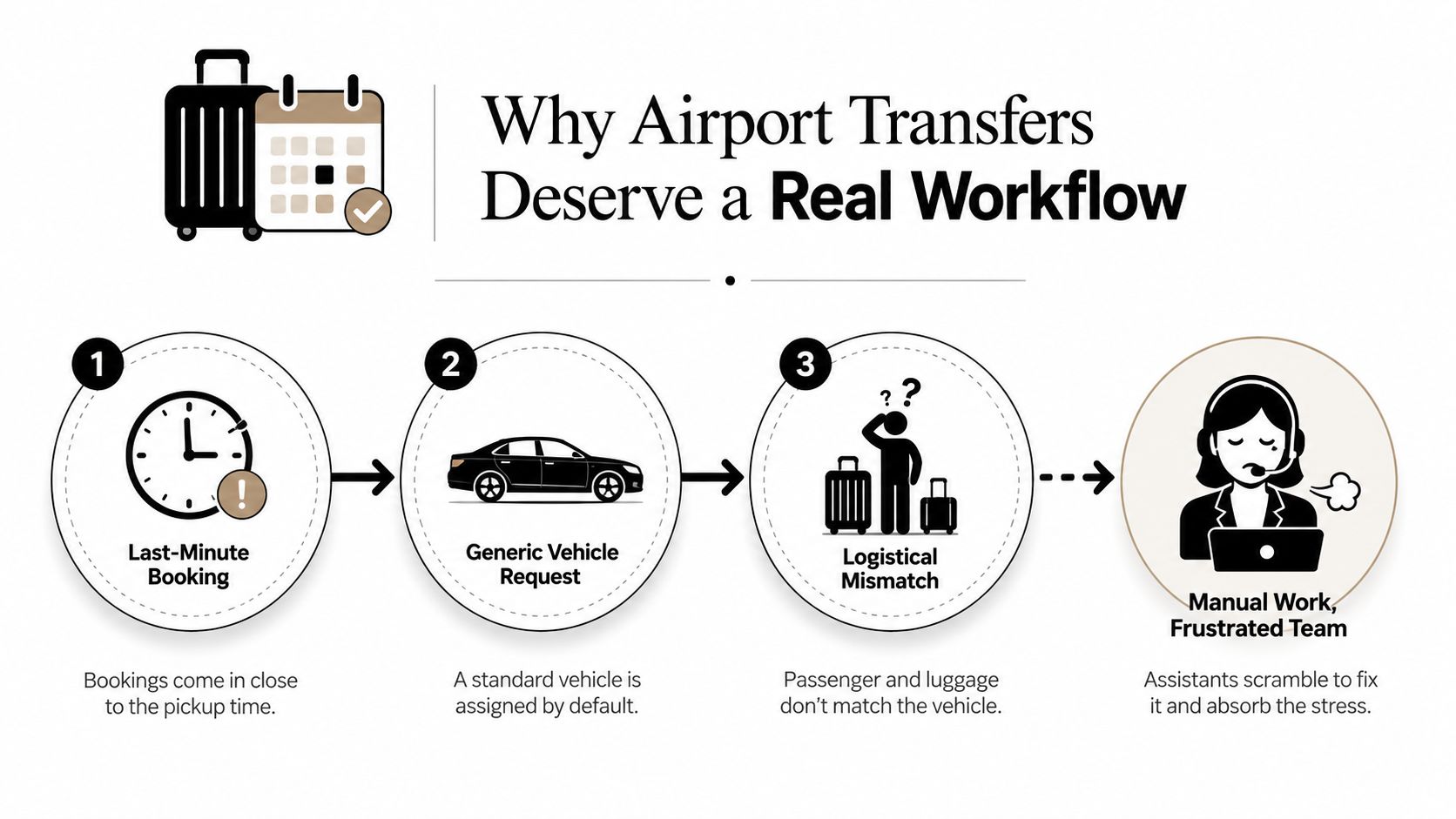
Why Airport Transfers Deserve a Real Workflow
An airport transfer is a coordinated movement, not a simple point-to-point purchase. The reservation captures the request, dispatch converts it into an assignment, the chauffeur executes the pickup, and the traveler needs clear instructions at the exact terminal where the vehicle is waiting.
Arrival-day problems usually expose weaknesses that weren't visible during booking. The traveler may receive a generic meeting instruction instead of a terminal-specific location. The provider may not have a usable flight number for monitoring. The booking may include waiting time without explaining when that clock starts. Finance may later receive a charge with no traveler, project code, or cost-center reference.
Digital booking has made this workflow more important, not less. One market estimate placed online channels at 64.8% of global airport transfer bookings in 2025, representing $18.37 billion, while another industry source put online and prepaid bookings at around 62%, compared with roughly 41% in 2019. The figures come from different sources and methodologies, but they point in the same direction: travelers increasingly reserve airport transportation before they reach the terminal. See this overview of what an airport transfer includes before selecting a provider or service tier.
The arrival-day failure points
A reliable process answers these questions before the traveler boards the aircraft:
- Which terminal applies: Confirm the terminal, concourse, arrival hall, and authorized pickup area.
- What vehicle is required: Match passengers and luggage, not just passenger names.
- Who monitors the flight: Record the airline, flight number, and origin so dispatch can adjust for delays.
- Who pays and how: Attach the correct card, account, purchase order, or project code.
- Who handles disruption: Give the traveler and coordinator a live escalation route.
- What happens after pickup: Reconcile the trip, record exceptions, and close the billing loop.
Airport ground transportation is segmented by market and airport. In the U.S. airport data summarized in this ground transportation appendix, Denver's 2016 ground-transport trips included TNCs at 31.8%, limousines at 20.2%, and taxis at 18.7%. At San Francisco International Airport, TNCs accounted for 68.5%, while taxis represented 11.7% and limousines 10.2%. The operational lesson is simple: don't assume a suitable vehicle will be available at the curb when you arrive.
The rest of the workflow comes down to matching the vehicle and service level, writing a complete request, securing the pickup handoff, controlling billing, and documenting contingencies. A repeatable SOP lets another coordinator take over without losing the details that protect the traveler.
Choosing the Right Service Level and Vehicle
The vehicle decision should start with luggage volume and trip purpose, not the number of passenger names entered into a form. A sedan can suit one executive with a carry-on, but it becomes a poor choice when several travelers bring full-size cases, equipment, garment bags, or winter sports gear.
Service level matters just as much. Point-to-point service works for a straightforward curbside handoff. A meet-and-greet assignment adds a person who can locate the traveler inside the terminal. Hourly charter gives the coordinator flexibility for multiple stops, while road-show and event support require a larger dispatch plan rather than an isolated pickup. For an executive movement, luxury airport car service should be evaluated against the itinerary and risk of disruption, not selected solely by vehicle photograph.
Vehicle and service tier comparison
| Vehicle / Tier | Passenger Capacity | Best For | Verify When Booking |
|---|---|---|---|
| Executive sedan | One or two travelers | Solo executives, short business trips, limited luggage | Trunk capacity, luggage count, curbside or inside meeting point |
| Premium SUV | Two to four travelers | Travelers with full luggage, family movements, longer journeys | Usable cargo space, child-seat needs, terminal access rules |
| Executive van | Five to seven travelers | Leadership groups, crews, airport group movements | Individual seat count, luggage capacity, loading procedure, vehicle height restrictions |
| Specialty vehicle | Varies by configuration | Armored transport, accessibility needs, child seats, high-profile movements | Certification or equipment, lead time, privacy requirements, replacement plan |
| Point-to-point | Based on vehicle | Direct airport to hotel, office, residence, or FBO | Fixed fare, pickup window, waiting terms, cancellation cutoff |
| Meet-and-greet | Based on vehicle and greeter | Unfamiliar airports, VIP arrivals, late-night or complex terminals | Greeter location, sign protocol, contact method, included waiting time |
| Hourly charter | Based on vehicle and hours | Multiple stops, flexible schedules, executive errands | Minimum duration, overtime rules, parking and toll treatment |
| Road-show or event support | Multiple vehicles | Investor tours, conferences, group logistics | Dispatch lead, vehicle staging, manifest control, escalation line |
When paying for a higher tier makes sense
A more expensive option earns its place when it removes a specific operational risk. A greeter is useful when the passenger may struggle to find a designated curb or when the airport has separate pickup zones. An SUV or van is justified when luggage failure would force a second vehicle. Hourly service is more practical than repeated point-to-point bookings when the itinerary can change throughout the day.
Specialty requirements need early validation. Confirm whether the provider can supply an approved child seat, accessible vehicle, discreet presentation, or armored vehicle in the actual airport market. Don't treat a preference field as proof that the equipment has been reserved. Ask for the confirmed vehicle class, not just “similar vehicle.”
Building the Booking Request With the Right Details
Treat the reservation request as an operational handover document. A dispatcher should be able to assign the trip without calling the booker to fill in basic gaps, and the chauffeur should receive enough information to identify the traveler without receiving unnecessary personal data.
Start with the movement itself. Enter the pickup date, local time zone, airport, terminal, and required pickup window. For an arriving passenger, the scheduled landing time isn't automatically the pickup time. Build in time for deplaning, immigration, baggage collection, and movement to the meeting point. For a departing passenger, work backward from the required terminal arrival time, check-in, security, and internal airport transit.
Practical rule: Always label the time as “flight arrival,” “ready for pickup,” or “airport departure.” A bare timestamp invites the wrong interpretation.
The fields that make a request dispatchable
Use a field-by-field intake rather than a short email such as “Please book a car from the airport to the office.”
- Flight details: Airline, flight number, origin, arrival or departure status, and terminal if known. The flight number enables monitoring and helps dispatch distinguish a schedule change from a missed pickup.
- Traveler details: Lead traveler name, mobile number, email address, and an alternate coordinator or assistant. Add a preferred contact method when the traveler may be unreachable after landing.
- Vehicle and passenger details: Passenger count, luggage count, oversized items, equipment, garment bags, sports gear, or mobility aids. “Five passengers” isn't enough if the group has several large cases.
- Pickup information: Airport name, terminal or FBO, arrival or departure designation, meeting preference, and any airport-specific instructions. A gate number may change, so identify the stable terminal and follow the provider's approved meeting procedure.
- Drop-off information: Complete address, building name, suite, loading dock, security desk, or FBO details. A chauffeur can't complete a controlled office arrival efficiently if the request only lists a street address.
- Special requirements: Child seat, accessibility support, discreet presentation, preferred chauffeur profile, language needs, or security instructions. Confirm which requests are available rather than assuming they're included.
- Commercial fields: Payment method, billing account, cost center, project code, purchase order, approver email, cancellation cutoff, and requested confirmation format.
The timing benchmark should reflect the trip class. Standard airport transfers may be accepted with a 24 to 48 hour minimum, but a benchmark cited in airport-transfer demand guidance found private-transfer bookings averaging about 37 days before pickup, with half booked one to four weeks out. That source also describes a practical rule of one to two weeks for familiar domestic itineraries and three to four weeks for holidays, school breaks, major events, or international movements.
The most common timing error is entering the departure time instead of the required pickup time. Put the pickup event in plain language, then include the flight time as a separate field. Before submitting, require a written confirmation containing the fare, vehicle class, pickup instructions, cancellation terms, payment method, and emergency contact.
Locking In Pickup Logistics and Flight Monitoring
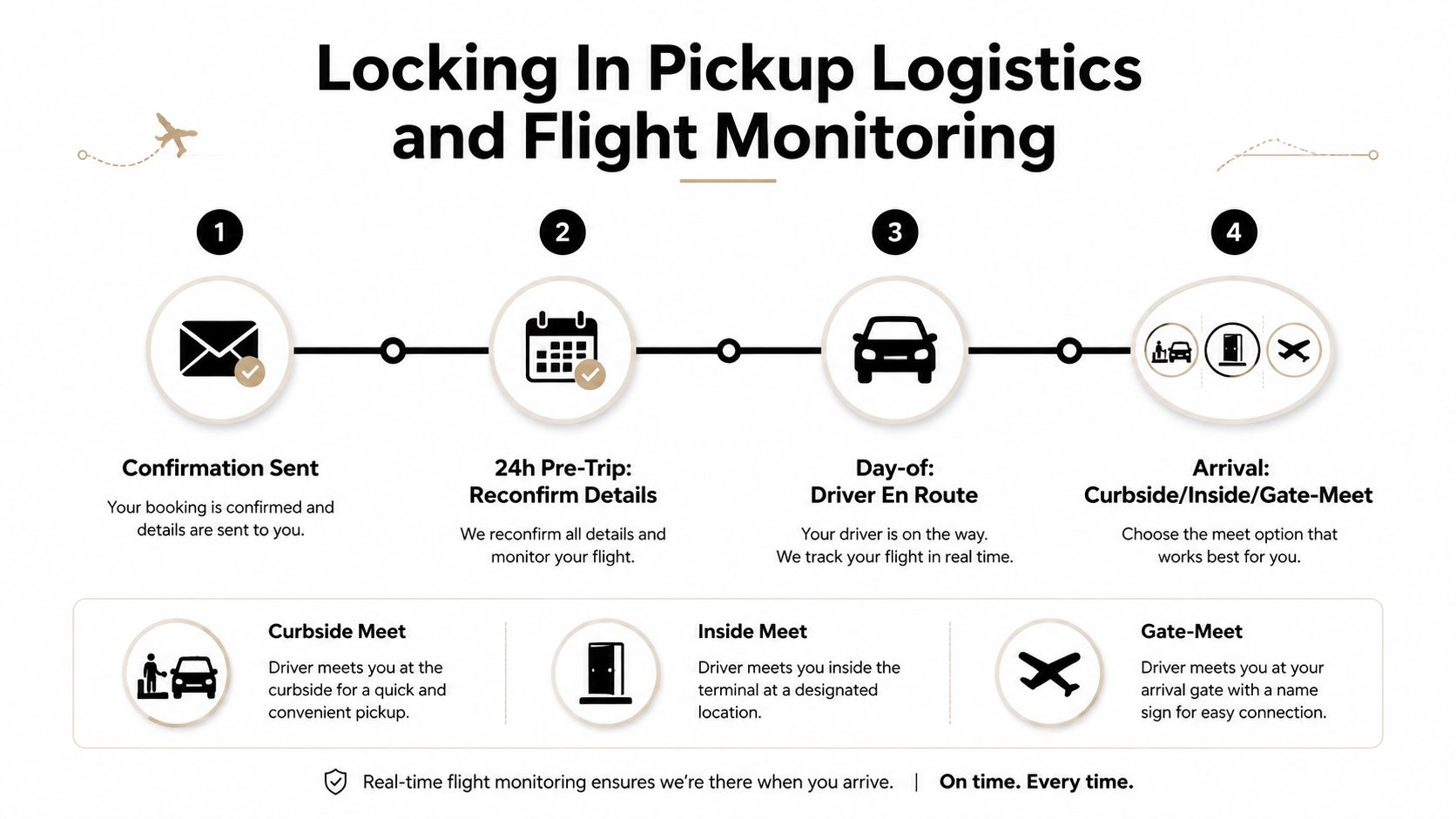
A reservation becomes dependable only when the arrival handoff is specific. “Driver will meet passenger at arrivals” isn't a meeting point. The confirmation should identify the terminal, concourse or arrival hall, approved pickup zone, and what the traveler should do after collecting bags.
The provider should also state the meeting type:
- Curbside pickup: The traveler exits to a defined commercial vehicle zone and looks for the assigned vehicle.
- Inside meet-and-greet: A greeter waits in an approved terminal location, usually with a name sign or agreed identification method.
- Gate meet: Staff meet the traveler at an aircraft gate or controlled access point where airport rules permit it. This requires separate validation and isn't available at every facility.
Waiting time needs careful reading. Confirm whether the clock starts at scheduled landing, actual touchdown, baggage claim notification, or the agreed ready-for-pickup time. Ask whether delayed baggage is covered by the included allowance, whether additional waiting is billed, and how the chauffeur stays in contact while the traveler is still inside the terminal. Recent airport-transfer guidance emphasizes exact meeting points, flight monitoring, and 45 to 60 minutes of free waiting time as details travelers should verify with reputable providers, as described in this airport-transfer guide.
What flight monitoring should trigger
Flight monitoring isn't just a status screen. Dispatch should use the flight number or tail number to compare the planned pickup against the actual movement, then update the chauffeur assignment when delays change the workable pickup window. The chauffeur shouldn't be dispatched only according to the original schedule if the aircraft is materially delayed.
For an arrival, use the following scheduling rule as a starting point:
- International arrival: Allow 60 to 90 minutes after scheduled landing for immigration, baggage, and movement to the meeting point.
- Domestic arrival: Allow 20 to 30 minutes after scheduled landing when the traveler has no unusual baggage or assistance requirement.
These are planning windows, not guarantees. Customs queues, checked baggage, mobility assistance, and terminal design can change the actual release time. The confirmation should include the dispatched chauffeur's phone number or lead contact, license plate, exact meeting point, provider escalation line, and instructions for a traveler who can't locate the vehicle.
The strongest airport-transfer workflow formalizes preferred suppliers, trip-specific spend thresholds, and approved booking data rather than relying on ad hoc messages. Ground-transport program guidance from FCM Travel also emphasizes validating operators through official airport ground-transport information and authorized pickup lists. That check protects the traveler from being directed to an unapproved vehicle or an incorrect terminal zone.
Setting Up Billing, Accounts, and Travel Policies
A corporate transfer program breaks down when every booking starts from a blank email. Set up the account before the next executive movement, then make the booking process enforce the information finance and dispatch need.
The account should have a named billing contact, authorized bookers, approved traveler or guest records, and clear limits by trip type or traveler level. A travel manager may permit a premium SUV for senior leadership while requiring pre-approval for specialty vehicles, hourly charter, or personal extensions. The policy should also define whether personal trips are prohibited, reimbursable, or handled outside the corporate account.
Corporate billing structures for executive transfers
| Structure | Best For | Key Considerations |
|---|---|---|
| Credit card on file | Occasional bookings and rapid dispatch | Card controls, receipt delivery, authorization failures, personal-use restrictions |
| Purchase-order invoicing | Projects, events, and controlled procurement | PO validity, approval ownership, change-order handling |
| Net-30 terms | Established corporate programs | Credit approval, invoice timing, dispute process, account reconciliation |
| Consolidated monthly statement | Frequent travel and multiple departments | Cost-center mapping, project codes, duplicate review, exception reporting |
Every booking should carry the commercial data before dispatch: traveler, department, cost center, project code, approver email, and billing method. If those fields arrive after the vehicle is sent, the accounts team must reconstruct the trip from emails and receipts. That creates avoidable disputes, especially when an itinerary changes or a second vehicle is added.
Account-level controls also improve operations. An established provider relationship can route requests to a dedicated account contact, identify duplicate reservations, flag missing codes, and challenge requests outside policy before dispatch. Those controls matter during peak periods, when preferred suppliers and confirmed vehicle inventory may be more useful than a last-minute search across unvetted options.
Use a written corporate travel policy template as a starting point, then adapt it to your organization. The policy should state who can book, which service tier applies, when approval is required, what information is mandatory, how cancellation is handled, and who owns after-hours decisions.
Privacy, Security, and Contingency Planning
A CEO, board member, family-office client, or high-profile guest needs more than a clean vehicle. The booking record itself can expose travel patterns, addresses, phone numbers, meeting locations, and timing. Security starts by limiting who sees those details and by giving each operational participant only the information required for the assignment.
Vet the people and control the record
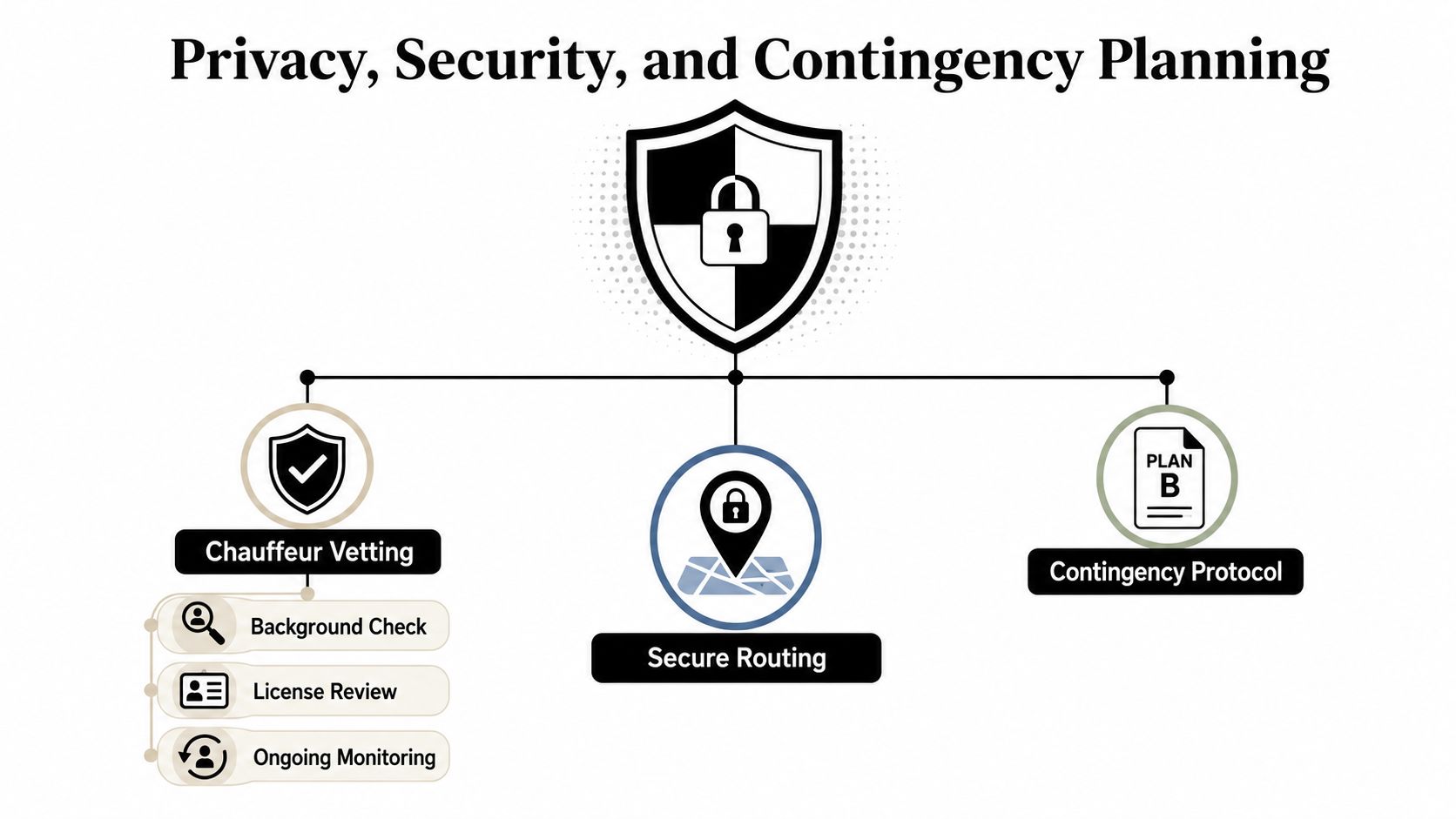
Ask how the provider handles chauffeur qualification. A serious process should include background checks, driver-record reviews, license verification, and ongoing monitoring where applicable. Confirm whether the assignment can use a uniformed chauffeur, a discreet presentation, or a specific identification protocol that won't draw attention in the terminal.
Data handling deserves the same specificity:
- Minimize personal information: Share only the traveler details required for dispatch and contact.
- Restrict itinerary visibility: Give the chauffeur the pickup, drop-off, and relevant service instructions without distributing the full travel schedule.
- Protect booking records: Ask how reservation data is stored and who can access it.
- Use confidentiality terms: Repeat assignments involving sensitive clients may require an NDA or equivalent confidentiality arrangement.
- Control communications: Keep sensitive itinerary changes on the designated dispatch channel rather than broad email threads.
Build the fallback before the disruption
Contingency planning should identify a replacement vehicle, an alternate route, secure parking options, and a direct dispatcher line. For a sensitive movement, the operator may stage a backup chauffeur or vehicle behind the primary assignment, but the coordinator must confirm what that means in the actual market and whether the backup carries a separate charge.
The escalation chain should be written into the confirmation and travel file:
- Call the dedicated dispatcher if the chauffeur is late or unreachable.
- Identify who can approve a vehicle swap, route change, or added stop.
- Define how the traveler reports a no-show without triggering automatic billing.
- Record who informs the executive assistant, security lead, or family-office contact.
- Require a post-incident note for any missed meeting point, vehicle change, or billing exception.
Don't rely on the main call queue during a high-risk movement. The booker should know the after-hours number, the dispatcher's name or role, and the exact information to provide when escalating. A contingency plan works only when the traveler can activate it without searching through old emails.
SOP, Sample Request, and Travel Team Checklist
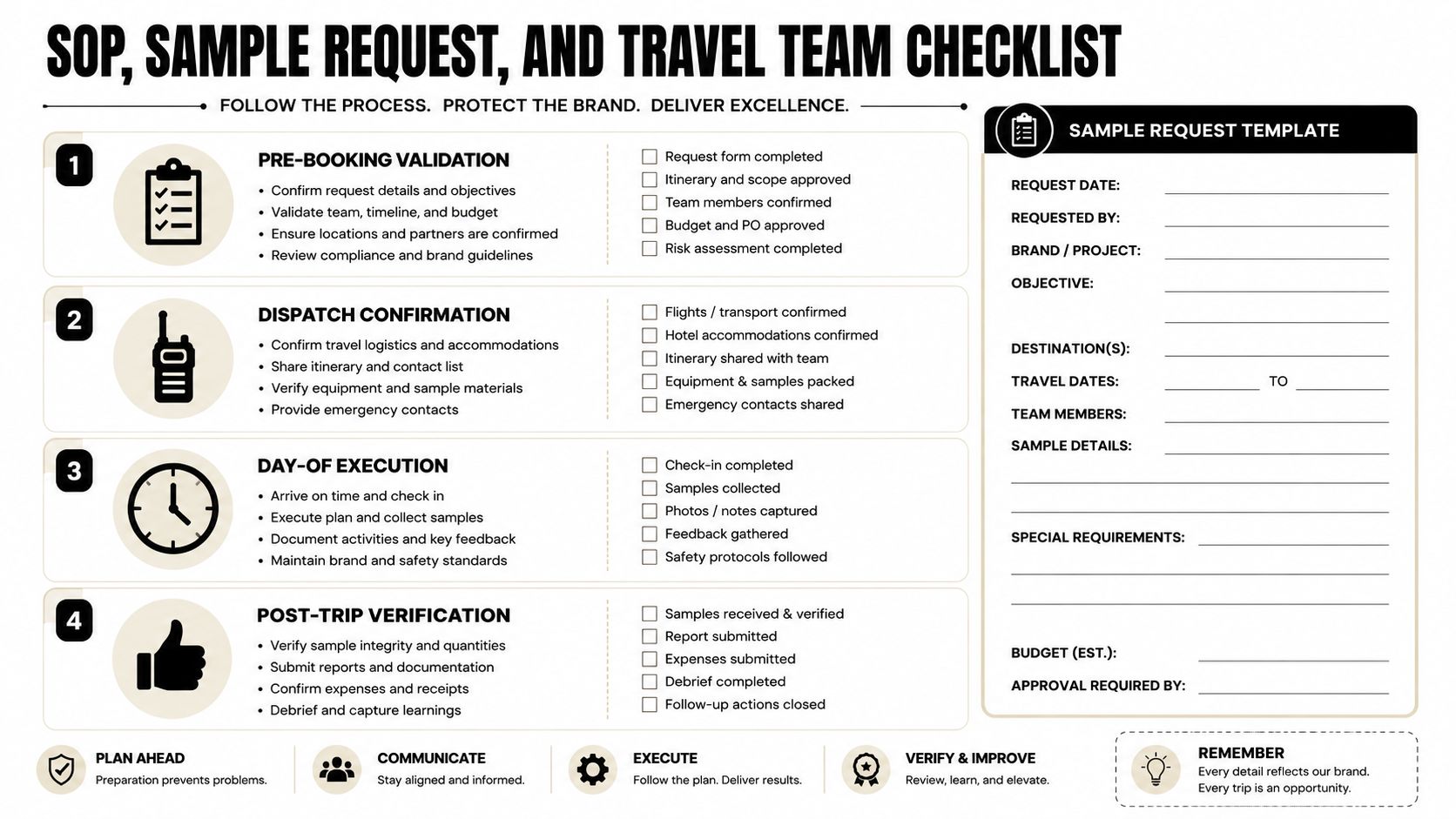
A useful SOP should fit on the screen a coordinator uses while booking. It should define the minimum data, the approval path, the dispatch confirmation, the day-of checks, and the final reconciliation. Put it in the corporate travel policy, TMC handoff document, or booking portal so the process survives staff changes.
Copy-paste booking request
Traveler:
Lead contact and mobile:
Alternate coordinator:
Date and time zone:
Airport, terminal, or FBO:
Flight number and origin:
Arrival or departure:
Ready-for-pickup time:
Drop-off address and access instructions:
Passenger count:
Luggage count and oversized items:
Vehicle class:
Service tier:
Child seat, accessibility, privacy, or security requirements:
Billing account, cost center, project code, or PO:
Cancellation cutoff:
Traveler-facing confirmation method:
Day-of escalation contact:
Vehicle swap approver:
The repeatable control points
- Booking: Validate date, time zone, flight, terminal, passenger count, luggage, service tier, addresses, special requirements, and billing code.
- Dispatch: Reconfirm the vehicle class, chauffeur assignment, flight-monitoring status, exact meeting point, waiting terms, plate, and escalation number.
- Pickup: Confirm the traveler has the instructions, the chauffeur has the correct contact, and dispatch can see the trip status.
- Return: Reconcile the actual pickup, vehicle, wait time, stops, changes, incident notes, and invoice against the original authorization.
The post-trip check closes the operational loop. Accounts payable should receive the approved invoice or statement with the traveler, route, date, cost center, project code, and any exception explanation. The travel manager should record repeated failures, such as unclear terminal instructions or missing flight monitoring, and correct the supplier workflow rather than treating each incident as an isolated mistake.
Adopt the SOP by testing it on ordinary transfers first. Then add separate rules for international arrivals, group movements, executive roadshows, FBO support, and last-minute bookings. Last-minute demand is real, and it isn't limited to one traveler profile. UK booking data cited by this transfer-booking analysis reported that 35% of bookings from travelers aged 31 to 45 and 25% from travelers aged 18 to 30 were made within 12 hours of travel. The same source reported that within-12-hour bookings included 48% couples and 33% families, so a policy that assumes families always book early will miss genuine demand.
For a last-minute request, keep the same fields and escalation standards. Short notice changes the availability conversation, but it shouldn't lower the information standard.
MLR Worldwide Service handles airport transfers and FBO support through portal, phone, or email intake, with pre-trip confirmation, pickup instructions, flight coordination, and key contacts for the traveler and booker. Visit MLR Worldwide Service to discuss executive transfers, corporate travel programs, VIP movements, crew logistics, and contingency-ready ground transportation.