
A travel manager usually reaches the same point in New York for the same reason. The itinerary looks manageable on paper, then reality shows up. Two executives land at different times, three more join from Midtown, one stop moves by half an hour, security wants tighter control of arrivals, and nobody wants a convoy of mismatched black cars pulling up to a client headquarters.
That's where luxury van rental in NYC stops being a lifestyle choice and becomes an operations decision. For board meetings, investor roadshows, media days, private aviation support, and event shuttles, the objective isn't just to move people. It's to protect timing, preserve discretion, keep the group together, and remove small failures before they become visible.
The mistake I see most often is starting with the vehicle photo and the hourly rate. Those matter. They're not the deciding factors. In New York, the actual difference between an acceptable van service and a premium one is the discipline behind it. Who vetted the chauffeur. How the fleet is maintained. How dispatch handles live changes. How the operator manages curb space, luggage, waiting time, and backup planning when the city refuses to cooperate.
The New Standard for Executive Group Travel in NYC
A C-suite team arrives in New York after a multi-city roadshow. They need airport transfer support, hotel coordination, three meetings in different parts of Manhattan, and a dinner transfer with no tolerance for delay. If you split that group across sedans or SUVs, the first problem isn't comfort. It's control.
One car gets delayed at arrivals. Another takes a different route. A principal wants to review talking points with the full team between stops, but half the group is in another vehicle. The client host sees staggered arrivals. The assistant starts fielding texts from four drivers instead of one dispatcher. That's how a simple transport plan becomes an operations burden.

A properly assigned executive van solves a different class of problem than a rideshare or standard black car. It keeps the principal party together, centralizes communication, and turns travel time into usable time. In practice, that means fewer handoffs, fewer missed messages, and less reputational exposure at the curb.
Where standard car service breaks down
The failure points are usually operational, not cosmetic:
- Fragmented arrivals: Separate vehicles rarely load and unload with the same timing.
- Lost decision time: Teams can't prep together when they're divided.
- Inconsistent service delivery: One strong chauffeur can't compensate for three weak ones.
- More moving parts: More vehicles means more billing lines, more dispatch touches, and more room for error.
A luxury van is often the cleanest answer when the assignment requires group cohesion, not just transportation.
What executives actually value
For corporate clients, the premium isn't about flash. It's about keeping the day intact. The vehicle becomes a controlled environment between high-stakes moments. That matters more in New York than in almost any other market because curb access, timing windows, and traffic variability can punish loose planning fast.
The strongest luxury van rental NYC programs are built for that reality. They're designed for schedule volatility, tight pickups, and passengers who expect the transition from air to ground to feel coordinated, not improvised.
Decoding Your NYC Fleet Options and Amenities
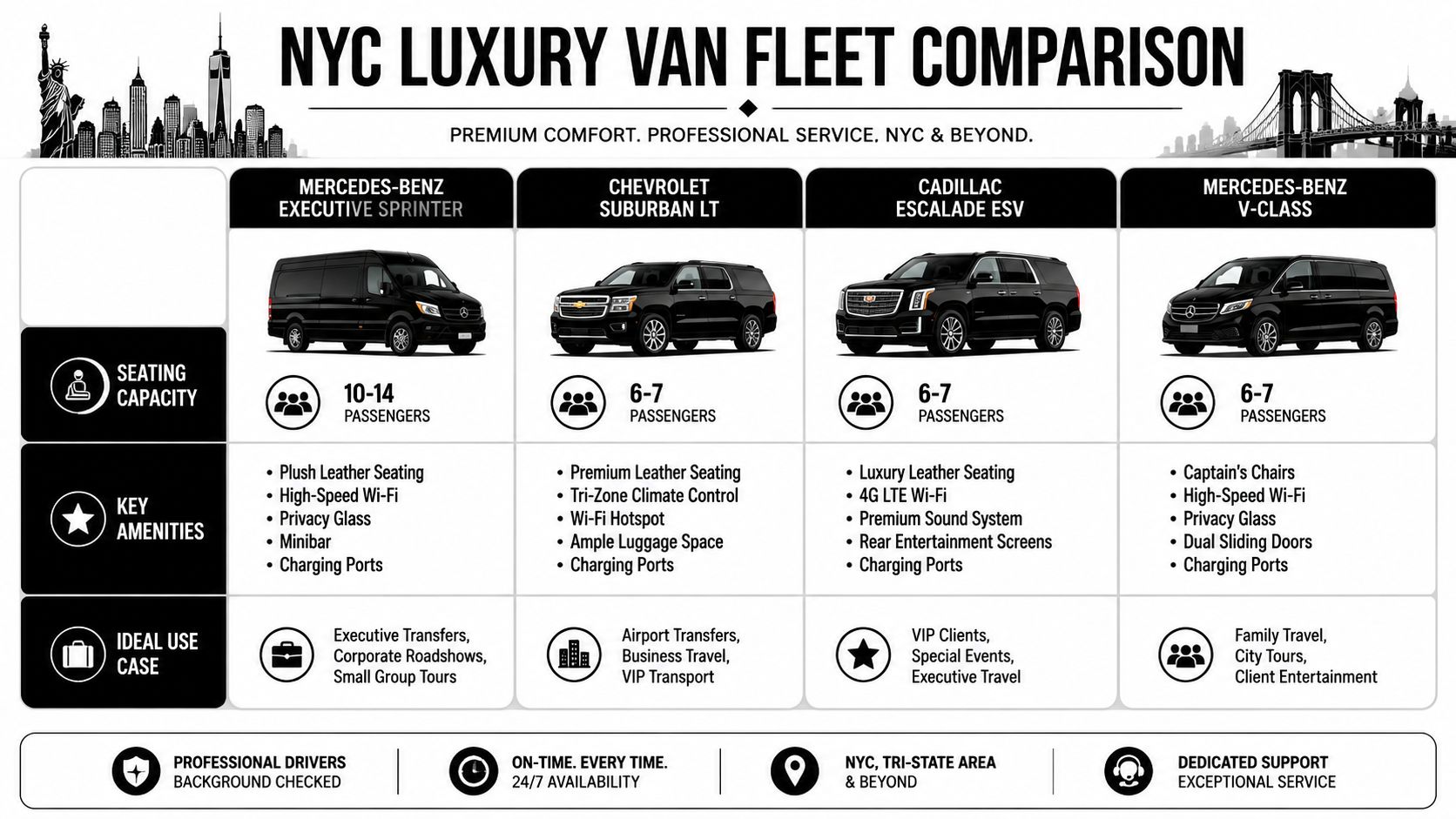
The market talks about “Sprinters” as if they're all the same. They aren't. The platform is common, but the use case changes based on seating layout, luggage demand, access requirements, and how formal the day needs to feel.
The Mercedes-Benz Sprinter platform became central to this category because it supports executive configurations of about 9 to 15 seats, with premium versions in the wider market often described as 12 to 15-passenger vans, as outlined by LA Coach USA's Sprinter pricing overview. That range is exactly why it works so well in New York. It covers the space between too-small SUVs and too-large minibuses.
Executive van versus limo-style van
An executive Sprinter is usually the right choice for corporate transport. It prioritizes function. Think forward-facing or conference-style seating, clean ingress and egress, luggage capacity, device charging, and an interior that supports conversation without feeling theatrical.
A limo-style van serves a different purpose. It's more suitable for entertainment, hospitality, celebrity movement, or client hosting where ambiance matters more than workability. Those builds can look impressive, but they often trade away practical luggage space and quick loading.
Use this rule:
| Vehicle style | Best fit | Watch out for |
|---|---|---|
| Executive Sprinter | Roadshows, airport transfers, board movement, conference shuttles | Verify real luggage capacity |
| Limo-style Sprinter | VIP hosting, nightlife, celebratory transport | Less practical for business itineraries |
| Premium SUV convoy | Small groups with separate schedules | Higher coordination burden |
| Minibus or shuttle | Larger group blocks | Less discreet, harder curbside handling |
A quick visual helps when comparing vehicle categories and use cases:
Choose by itinerary, not by brochure
The right van depends on what the day demands.
- Airport transfer with heavy luggage: Prioritize cargo area and clean rear access.
- Investor or legal roadshow: Prioritize quiet cabin, sightlines, charging, and work-friendly seating.
- Hospitality or client entertainment: Prioritize presentation and interior finish.
- Multi-stop event shuttle: Prioritize easy boarding, stable timing, and dispatch responsiveness.
Amenities that matter in practice
Some features sound premium but add little value. Others save the day.
What works:
- Charging access: Non-negotiable for executive groups.
- Wi-Fi: Useful if it's reliable. Ask whether it's available or just listed.
- Privacy glass: Helps with discretion during sensitive conversations.
- Wide aisle and easier standing clearance: Important for dignified entry and exit.
- Rear luggage space: Critical on airport and hotel transfers.
What doesn't consistently help:
- Overbuilt entertainment systems: Nice for leisure, rarely mission-critical for corporate use.
- Fancy interior lighting: Can look dated fast and adds nothing to operations.
- Max-capacity loading on paper: Usually a mistake once bags enter the equation.
Book the van for the itinerary you have, not the passenger count you hope will fit.
Understanding Luxury Van Rental Pricing and Fees
A corporate travel coordinator gets three quotes for the same Midtown to JFK transfer. One looks aggressive on hourly rate, one looks high, and one sits in the middle. By the end of the trip, the cheapest quote can easily become the most expensive if wait time, parking, tolls, airport fees, and overtime were never defined properly.
That is the pricing problem in the NYC van market. The rate card matters, but the billing method matters more.
You are not only paying for a vehicle and time on the road. You are paying for how the operator handles idle time, late changes, parking constraints, flight tracking, and duty-of-care expectations. Teams that book executive corporate chauffeur services usually find that invoice discipline separates a premium operator from a vendor that advertises a premium vehicle.
Why quotes for similar vans can land far apart
Price gaps usually come from service design, not from the van alone.
A one-way hotel transfer with a tight pickup window is straightforward to price. A roadshow, production movement, or executive day charter is not. The operator has to account for standby time, routing changes, legal parking, chauffeur scheduling, dispatch oversight, and the risk of the vehicle being tied up for most of the day with relatively little drive time.
Insurance structure also affects pricing. So does whether the company carries newer fleet units, keeps backup vehicles available, and builds preventive maintenance downtime into scheduling. Those costs do not always show up in a glossy quote, but they show up in service reliability.
Hourly, transfer, and day-rate pricing each solve a different problem
Hourly billing works well when timing is uncertain but the assignment is still compact. Airport arrivals, dinner movements, and a short sequence of Manhattan meetings usually fit this model.
Transfer pricing works best when the route and scope are defined in advance. It gives finance teams cleaner approval and fewer variables, provided the contract states what happens if the passenger is delayed or the destination changes.
Day rates make sense when the van needs to stay with the group. That often includes investor meetings, site tours, event support, and executive programs with gaps between stops. In those cases, a low hourly quote can lose its advantage quickly once waiting, repositioning, and chauffeur availability are billed separately.
Fees that deserve written clarification before approval
The invoice problems I see most often start with assumptions. Fix that by requiring each item in writing:
- Billing basis: Hourly, transfer, day rate, minimum hours, or packaged service
- Time calculation: Garage-to-garage, on-location only, or airport-meet timing
- Waiting time: Grace period, billable increments, and rate after the grace window
- Overtime: Trigger point, billing increment, and whether it rounds up
- Tolls, parking, and permits: Included, estimated, or passed through at cost
- Airport and FBO charges: Meet-and-greet, holding lot, ramp access, or handling fees where applicable
- Holiday or late-night surcharges: If they apply, they should be disclosed upfront
- Deposit and cancellation terms: Cutoff times, refund treatment, and rescheduling policy
A clean quote with no detail is not a clean quote. It is an incomplete one.
What sophisticated buyers look for
Experienced buyers do not ask only, "What is the rate?" They ask, "What will create variance from the quoted amount?" That question usually exposes whether the operator has a disciplined process.
Look closely at how the company explains schedule changes. NYC itineraries shift constantly. Flights slide, meeting end times move, and hotel curb access changes by the hour. If the provider cannot explain, in plain language, how those changes are billed, expect disputes later.
One more point is often missed. The companies that invest in documented maintenance schedules, backup coverage, and trained chauffeurs may not be the lowest bidder. They are often the operator that prevents a far more expensive failure, such as a vehicle substitution at the last minute, a breakdown during executive movement, or a chauffeur timeout that forces a schedule reset.
Practical rule: Approve the quote only after you can identify every likely extra charge and the exact event that triggers it.
That is how pricing becomes predictable. In executive ground transportation, predictability is usually worth more than a nominally lower base rate.
The Critical Difference Chauffeur and Safety Standards
Clients often overvalue the van and undervalue the operating culture behind it. That's backward. A polished Sprinter with weak chauffeur standards is still a risk. A disciplined chauffeur team with verified maintenance habits is what makes the service premium.
Verifying provider credentials in the market is not always easy. A 2025 National Safety Council report on group transportation in the Northeast U.S. found that 45% of luxury van operators in tri-state areas lack documented driver safety training records, while only 8% of rental websites provide verifiable proof of compliance, as cited in Checkmate Sprinters-related safety guidance. This disparity highlights the need for buyers to carefully vet potential providers.
What a professional chauffeur standard should include
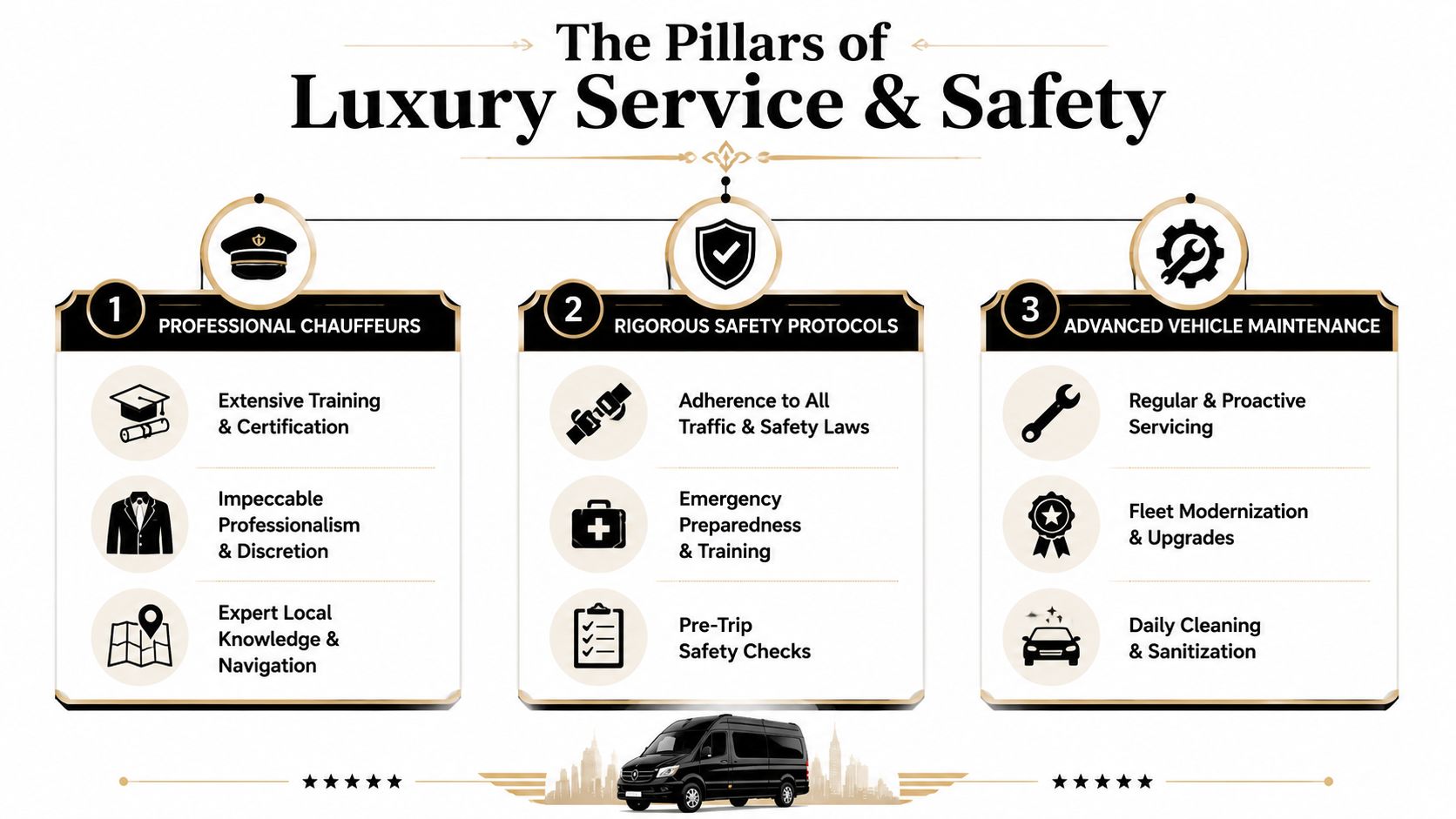
“Professional chauffeur” isn't a dress code. It's a documented operating standard.
Ask for evidence of:
- Driver qualification records: Not just a license, but formal onboarding and file maintenance
- Safety training documentation: Defensive driving, incident protocol, and refresher training
- Confidentiality expectations: Especially for executives, legal teams, and public figures
- Dispatch discipline: Chauffeurs should be supported by operations, not left to improvise
- Local execution knowledge: Midtown loading rules, hotel access, airport holding procedures, and FBO etiquette
The easiest way to evaluate a provider is to ask operational questions instead of marketing ones. Don't ask whether chauffeurs are experienced. Ask how the company documents training, what pre-trip inspection protocol exists, and who handles a same-day reassignment if the assigned chauffeur becomes unavailable.
Vehicle safety is a process, not a promise
A provider saying the fleet is “late model” tells you almost nothing. A premium operator should be ready to discuss maintenance cadence, cleaning standards, inspection routines, and how vehicle substitutions are managed.
That's why buyers who need corporate-grade accountability often compare operators that position service around managed chauffeur programs, such as corporate chauffeur services, instead of judging only by fleet photos.
Here's the practical test I use:
| Question | Weak answer | Strong answer |
|---|---|---|
| How are chauffeurs trained? | “They're experienced” | Documentation, refresher process, file verification |
| How are vehicles maintained? | “We keep them clean” | Scheduled service, inspection routine, backup plan |
| Can you prove compliance? | “Of course” | Certificates, records, or clear written confirmation |
| What happens if there's a day-of issue? | “We'll handle it” | Named escalation path and substitute vehicle protocol |
If a company can't produce proof, you should assume the standard is lower than advertised.
Mastering NYC Logistics Airport FBO and Curbside
New York ground transportation succeeds or fails at the pickup point. Not in the reservation system. Not in the brochure. At the curb, at the terminal, or on the private aviation side when the aircraft timing changes and the group wants to move now.
The most useful operational benchmark for executive vans is vehicle geometry. Sprinter-style executive vans are typically about 22 feet long and 9 feet tall, usually supporting 8 to 14 passengers with a large rear cargo area, according to True North VIP's Sprinter service specifications. Those dimensions affect route choice, curb approach, garage access, and where the vehicle can realistically stage.
Airport pickups need a different plan than city pickups
At JFK, LaGuardia, and Newark, the biggest issues are timing, passenger communication, and terminal-specific pickup coordination. If the arriving party has checked bags, international processing, or senior principals who shouldn't wander through rideshare chaos, your provider needs a clear meet point and active monitoring.
The most reliable process includes:
- Live flight tracking: So dispatch adjusts without waiting for the passenger to call
- Clear meeting instructions: Sent before landing, not after confusion starts
- Defined luggage assumptions: So the assigned van matches the load
- Single operational contact: One person who can resolve changes immediately
For travel teams managing broader itineraries through the region, pairing airport movement with local coordination near hubs like the Gateway Travel Centre can simplify handoffs between train, air, and hotel schedules.
FBO work requires tighter discipline
Private aviation support is its own operating category. FBO pickups are usually smoother than commercial terminals, but the expectations are higher. Manifest changes happen late. Wheels-down times move. Security and privacy matter more. The client notices every delay because the environment is quieter and more controlled.
That means the operator has to confirm:
- Correct tail-linked timing
- Exact pickup protocol at the facility
- Passenger count and baggage profile
- Backup communication if the principal changes aircraft or departure point
Curbside in Manhattan is where weak operators show themselves
City pickups sound easy until the building has no standing room, the doorman has another event arrival, and the van can't sit where the original planner assumed it could. At such times, local experience earns its keep.
A van that's roughly 22 feet long doesn't handle like a sedan. It needs cleaner approach planning and sharper stop management. Good operators account for building frontage, loading windows, side-street alternatives, and how quickly the group can board. Bad operators circle, block traffic, and force clients into rushed curbside decisions.
The Booking Process From Contract to Confirmation
A professional booking process should feel like risk management, not order taking. If the operator moves straight from “What date?” to “Here's the price,” you're probably not getting enough planning depth.
The stronger providers ask for the details that affect execution. Passenger names or at least passenger profile. Luggage assumptions. Building type. Sequence of stops. Airport or FBO protocol. Billing owner. On-site contact. Timing sensitivity. None of that is administrative clutter. It's what prevents service failure.
What to lock down before you sign
Start with the vehicle assignment and service scope. Not just “Sprinter van,” but the exact class of van, seating style, and intended use.
Technical details can also help separate a serious fleet from a generic listing. One executive Sprinter rental lists a 3.0L, 6-cylinder turbo-diesel engine, while another highlights Load-Adaptive Electronic Stability Program, a feature designed to help maintain tracking when the van is heavily loaded, as described in Sprinter Rentals' business class van overview. You don't need to become an engineer, but these details matter when the vehicle will carry executives, luggage, and a full-day schedule through stop-and-go New York traffic.
Review these contract points carefully:
- Assigned vehicle type: Confirm the actual class, not a “similar vehicle” placeholder
- Included service window: Know when billing starts and ends
- Change policy: How itinerary edits are handled on the day
- Cancellation terms: Especially for multi-vehicle or extended bookings
- Insurance proof: Request documentation if your organization requires it
- Substitution protocol: What happens if the original van becomes unavailable
Confirmation should tighten the plan, not repeat it
A good confirmation email does more than restate the date and time. It should reduce ambiguity.
I expect to see:
- Final pickup details with exact address and point of contact
- Passenger and luggage notes matched to the assigned vehicle
- Chauffeur or dispatch instructions for day-of communication
- Billing summary showing what has been approved
- Special handling notes for VIPs, security, or concierge requests
Some clients prefer operators that can fold this level of transport planning into broader itinerary support, such as luxury travel concierge services, especially when transport is only one part of a larger executive movement plan.
Confirmation isn't paperwork. It's the last chance to catch an assumption before it becomes a problem at pickup.
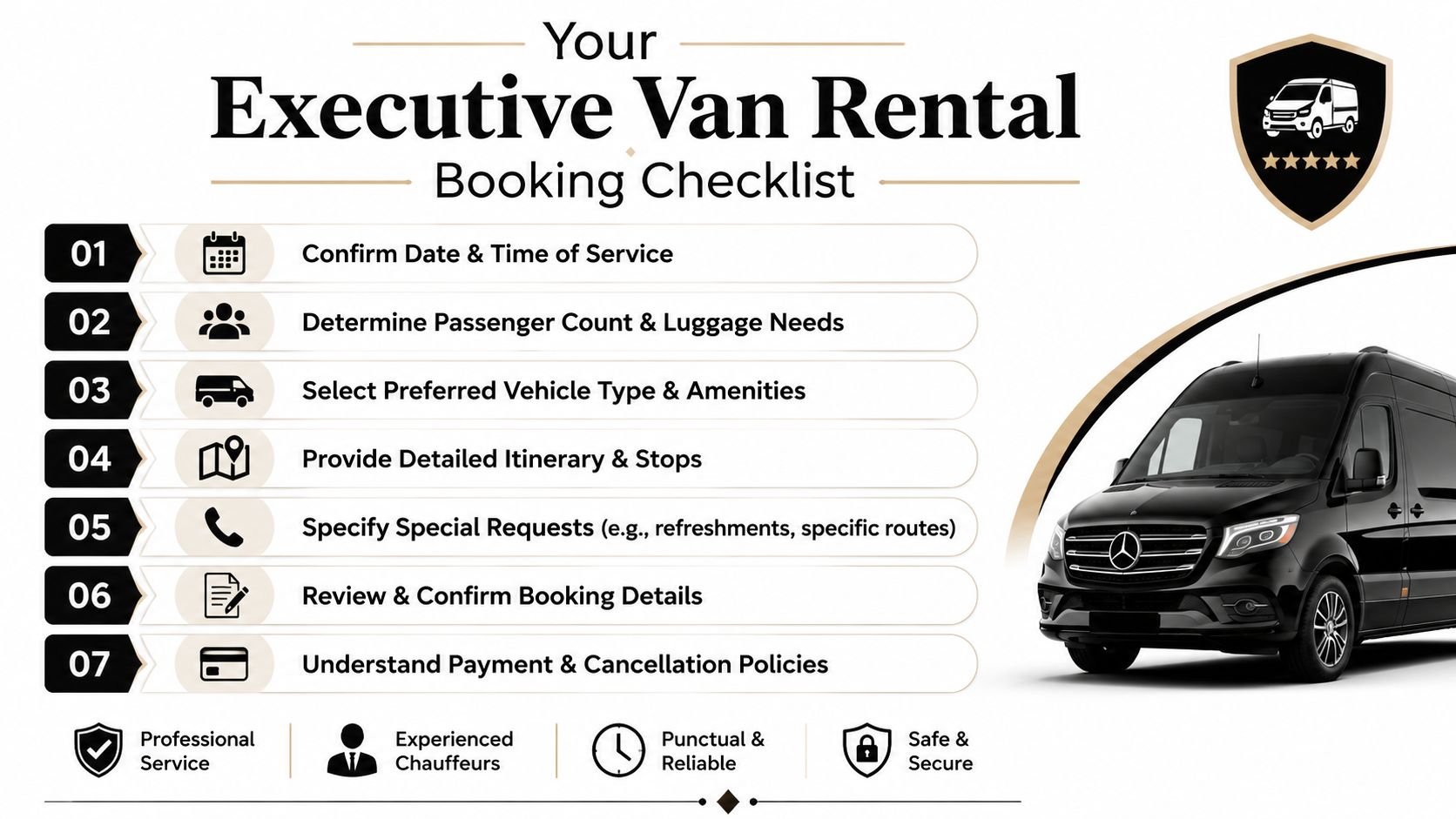
Your Executive Van Rental Booking Checklist
The easiest way to improve luxury van rental NYC outcomes is to standardize what you verify before every booking. Most service failures aren't dramatic. They're small omissions that stack up. Wrong luggage assumption. Weak curb instructions. Unclear billing terms. No proof of driver training. Late clarification on who the chauffeur should contact.
Use this checklist as an operating tool, not a courtesy list.
Pre-booking diligence
- Define the mission: Airport transfer, roadshow, event shuttle, private aviation support, or VIP hosting all require different planning.
- Match the vehicle to the load: Passenger count alone isn't enough. Include luggage, carry-ons, garment bags, and equipment.
- Vet the operator's safety culture: Ask for documented chauffeur training and maintenance process, not broad assurances.
- Check communication structure: Confirm whether you'll deal with one dispatcher or multiple contacts.
Contract and confirmation controls
Some checks belong in writing before the day begins.
| Checkpoint | What to verify |
|---|---|
| Vehicle assignment | Exact van class and seating style |
| Pricing structure | Base rate, waiting, tolls, parking, overtime treatment |
| Insurance and compliance | Certificates or written confirmation if required |
| Change handling | Same-day edits, delays, and additional stops |
| Cancellation terms | Deadlines and financial exposure |
Day-of execution items
- Reconfirm the live itinerary: Especially if meetings, arrivals, or passenger order changed overnight.
- Verify the day-of contact chain: Passenger, assistant, dispatcher, and chauffeur should all know who to call.
- Send meeting instructions early: Don't wait until the aircraft lands or the hotel party is already downstairs.
- Flag high-priority details: Security notes, privacy requirements, and preferred entrances should be visible to operations.
- Confirm luggage one more time: Luggage issues frequently compromise otherwise solid bookings.
The standard that matters
The market will always advertise leather seating, tinted glass, and executive interiors. Those are table stakes. The differentiator is whether the operator can prove disciplined chauffeur standards, maintain the fleet properly, and run the trip cleanly when New York changes the plan in real time.
That's what protects the client's schedule. That's what protects the principal. And that's what makes a luxury van feel premium in practice, not just in photos.
If you need executive van support, airport coordination, roadshow planning, or discreet group transportation in New York and other major markets, MLR Worldwide Service provides curated ground transportation with executive sedans, premium SUVs, luxury vans, and a 24/7 operations team for live itinerary management.