

If you're reviewing Gateway Travel because an executive trip is approaching, the first risk isn't service quality. It's misidentification. The search results combine different businesses under the same name, and that confusion can distort procurement decisions before anyone compares vehicles, support coverage, or traveler risk.
For a leisure traveler, that may be an inconvenience. For a chief executive, board member, private aviation passenger, or family office principal, it's a structural problem. Reviews only help when you know who wrote them, what they were reviewing, and whether their criteria match your operating reality.
Decoding Gateway Travel What the Reviews Reveal
The phrase Gateway Travel reviews doesn't point to one clean category. It points to at least two different businesses with different buyer relationships, different service models, and different review logic.

One entity is an Australian travel company established in 1972, with a 4-star Trustpilot rating based on 10 customer reviews as of 2024, as shown on Gateway Travel's Trustpilot profile. Another is a U.S.-based host agency for travel advisors that offers commission splits of up to 90%, according to Gateway Travel company information on ZoomInfo.
That distinction matters more than most readers assume.
Why the business model changes how you should read reviews
A traditional travel agency serves the traveler directly. A host agency mainly supports independent travel advisors who sell travel under the host's umbrella. The host provides infrastructure, training, supplier relationships, and back-office systems. The advisor owns the client relationship.
If you're evaluating executive transportation, that means many online comments are not assessing chauffeur punctuality, airport meet-and-greet discipline, or escalation handling during a diversion. They're assessing whether the host agency is a good commercial platform for the advisor.
A simple way to read the market is this:
| Entity type | Primary customer | What reviews usually measure |
|---|---|---|
| Direct travel agency | End traveler | Booking support, responsiveness, trip satisfaction |
| Host agency | Independent advisor | Commission, training, tools, payment process |
| Direct transport provider | Corporate traveler or travel manager | Service execution, accountability, fleet and driver standards |
That is why a search query can produce confidence without relevance.
The practical reading of Gateway Travel reviews
The U.S. host-agency version of Gateway Travel is the one that tends to generate discussion among advisors. Those reviews can still be useful. They tell you something about business infrastructure, advisor support, and platform maturity. They don't tell you enough about premium ground execution for a senior traveler with a narrow tolerance for service failure.
Reviews are only decision-grade evidence when the reviewer's objective matches your own.
For executives, the key question isn't merely whether Gateway Travel is reputable. It's whether the reviewed entity is even designed to control the service layer you need. If your requirement is direct, premium, vetted transport, a host-agency review set can easily answer the wrong question well.
If you want a broader explanation of the company identity issue, this breakdown of the Gateway Travel agency landscape is useful context.
Analyzing Agent Sentiment The Story Behind the Stars
Most favorable commentary around Gateway Travel's U.S. operation appears to come from agents, not end travelers. That's not a flaw in the reviews. It's a clue about the true meaning of the ratings.
The recurring positive themes are commercially rational from an advisor's perspective. Gateway Travel is described as offering up to 90% commission from day one, pays commissions on the 1st and 15th after client travel, and has a network of over 73 travel agent members, according to host agency details published by Find a Host Travel Agency. For an independent advisor, those are meaningful operational benefits.
What agent praise usually signals
When advisors praise a host agency, they're often evaluating four things:
- Economics: Higher commission retention can make an agency relationship attractive.
- Training quality: Newer or scaling advisors need support systems.
- Workflow flexibility: Independent advisors value control over schedule and sales approach.
- Administrative reliability: Payment cadence and back-office support matter.
None of those criteria are trivial. But none are the same as a corporate travel manager's standard for executive ground transport.
A host can have strong advisor economics and still leave major variability at the traveler level because the final service may depend on the individual advisor's sourcing choices, supplier discipline, and escalation habits.
The hidden issue inside positive reviews
The most important caution signal isn't visible in a star rating. It's misaligned incentives and uneven operational exposure.
Data cited in Gateway Travel reviews on Host Agency Reviews notes that 30% of agents report delayed payouts from various host agencies, while reviews for Gateway Travel often praise tools and training without placing that broader payment-reliability risk in context. For an executive traveler, that matters indirectly but materially. Financial friction in the advisor channel can pull attention toward internal administration when the traveler needs flawless service recovery.
Practical rule: Ask who benefits from the reviewed feature. If the answer is "the advisor," don't assume the traveler receives the same value.
Consider the difference in review criteria:
| Reviewer | Likely priority | Why it can mislead an executive buyer |
|---|---|---|
| Independent advisor | Commission split, support, training | Doesn't confirm transport execution standards |
| Leisure traveler | General booking satisfaction | Doesn't test board-level duty of care |
| Executive travel manager | Accountability, escalation, consistency | Closest match to actual risk exposure |
The star isn't the whole story. The subject of the review is the story.
The Host Agency Model Versus a Direct Service Provider
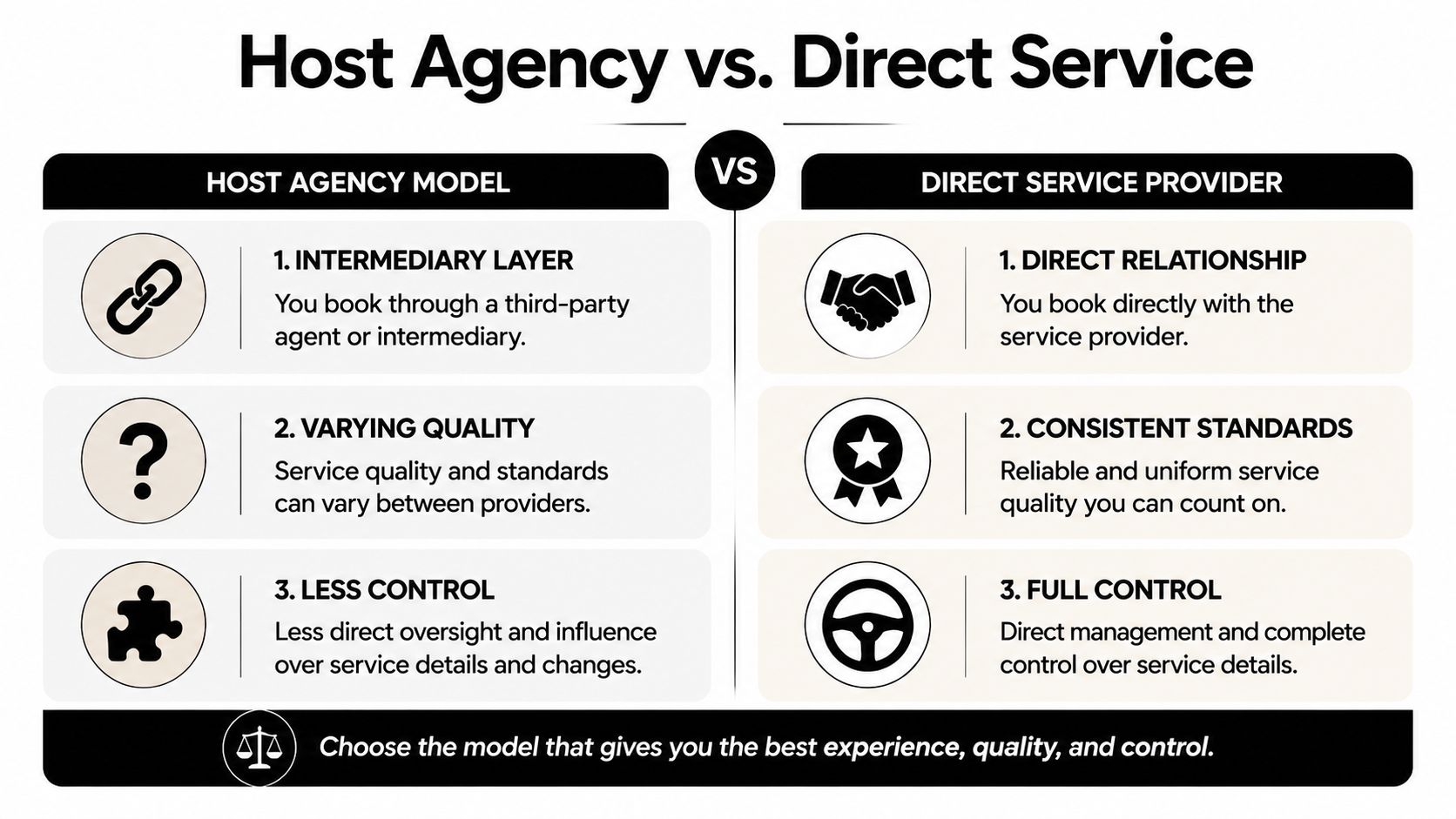
A host agency and a direct service provider solve different problems. One helps advisors run a travel business. The other owns and manages service delivery. For executive ground transportation, that distinction isn't semantic. It determines where accountability sits when something changes at the last minute.
A useful analogy
Think of a host agency like a general contractor who licenses a network of specialists. The contractor may offer purchasing power, templates, and commercial terms. But the final result depends on who performs the work.
A direct transportation provider is closer to a tightly managed in-house operations team. Booking, dispatch, chauffeur standards, service recovery, and billing sit inside one operating model or one controlled affiliate standard.
That difference changes four things immediately:
- Who owns the trip outcome
- Who answers when plans change
- Who enforces service standards
- Who carries operational memory across repeat bookings
Where technology helps, and where it doesn't
Gateway Travel's U.S. infrastructure includes a 2024 AI-powered Agent Portal designed to streamline itinerary management for affiliated agents, with an aim to reduce agent processing time by 35 to 40%, according to coverage of the Gateway Travel Agent Portal launch on Yahoo Finance.
That's useful technology. But the operational target is clear. It optimizes the agent's workflow. It doesn't, by itself, create a premium transport chain with unified chauffeur vetting, standardized vehicle presentation, or direct control over airport curbside execution.
Better advisor tooling can improve coordination. It doesn't replace direct ownership of the traveler experience.
Side-by-side implications for executive travel
| Operating question | Host agency model | Direct service provider |
|---|---|---|
| Who manages the advisor's business tools? | Host agency | Not the core proposition |
| Who directly controls chauffeur standards? | Often varies by sourced supplier | Controlled centrally or through tightly vetted network |
| Who handles irregular operations in real time? | Advisor plus external providers | Single accountable operator |
| Who owns quality assurance from booking through billing? | Shared across layers | Concentrated in one delivery chain |
For a vacation package, the layered model may be perfectly adequate. For a roadshow, airport transfer linked to private aviation, or time-sensitive executive meeting schedule, each extra handoff increases ambiguity.
The strongest takeaway from many Gateway Travel reviews is not that the company is weak. It's that the company appears built for advisor enablement, not direct premium ground execution. That's why review positivity can coexist with a service gap for corporate travelers.
For additional perspective on the U.S. entity and how buyers often misread its role, this overview of USA Gateway Travel Inc. helps separate infrastructure from end-service delivery.
Key Criteria for Executive Ground Transportation
An executive traveler doesn't need a pleasant booking experience alone. They need a transport partner that can protect schedule integrity, privacy, and decision-making time under pressure.

That requirement changes the evaluation framework. The vehicle matters, but the operating discipline behind the vehicle matters more.
Duty of care is operational, not decorative
A premium provider should be able to explain exactly how traveler protection works in practice. That includes chauffeur vetting, dispatch oversight, itinerary monitoring, contingency handling, and escalation paths when flights move or meetings run over.
For senior leadership, a missed pickup isn't a small service lapse. It can affect investor meetings, board sessions, security posture, and internal confidence in the travel program.
Consistency across cities matters more than luxury branding
Many providers can deliver one good ride. Fewer can deliver a reliable standard across financial centers, event markets, resort destinations, and private aviation gateways.
What executives need is repeatability:
- Chauffeur behavior: Discreet, briefed, and professionally presented.
- Vehicle readiness: Clean, late-model, and suitable for the itinerary.
- Communication discipline: Clear updates without forcing the traveler to manage the trip.
- Support continuity: Real people available when plans change.
A fragmented sourcing model can still produce excellent individual trips. What it often struggles to deliver is uniformity.
Premium transport is risk management
The cheapest acceptable transfer is rarely the lowest-risk choice. Executives create outsized downstream cost when transport fails. Assistants get pulled into recovery. meetings compress. Security assumptions change. Internal stakeholders lose trust in the travel plan.
Senior travelers pay for reduced operational uncertainty, not just for leather seats and bottled water.
A true premium class of service should also support the realities that standard leisure-facing models often miss:
- Tight turn times at airports and FBOs
- Multi-stop schedules with live revisions
- Confidential passenger identity
- Protocol-sensitive pickups for VIPs and family offices
- After-hours support without re-explaining the situation from scratch
These aren't extras. They're the service.
Procurement Guidance for Corporate Travel Managers
The practical mistake in reviewing Gateway Travel isn't choosing the wrong brand. It's using the wrong procurement lens. If your organization needs direct executive transport, then advisor-focused marketing and host-agency features should rank below operational control, support design, and service accountability.
A useful benchmark comes from outside the transport layer but points to the same problem. A cited example notes that the 2025 Host Agency Performance Index found only 42% of new agents achieve projected income with AI tools alone, as referenced in this discussion of agent-focused AI claims on YouTube. The executive takeaway isn't about advisor income. It's that promoted technology features don't automatically translate into measurable client benefit.
Questions that expose the real operating model
Ask these before approving any provider or intermediary:
- Who delivers the ride? If the answer is a rotating third-party network, ask who audits those operators and how often standards are checked.
- How are chauffeurs vetted? You want a concrete process, not a general assurance.
- Who monitors flights and live itinerary changes? The answer should identify a real operations function.
- How are service failures escalated after hours? If the process sounds informal, expect inconsistency.
- Can the provider support repeated executive preferences? High-end service depends on retained operating memory.
- Who owns billing accuracy and dispute resolution? Split accountability creates friction at the worst moment.
What strong answers sound like
A strong provider answers with process detail. A weaker provider answers with platform language, broad promises, or references to supplier relationships without naming oversight methods.
Use this quick screening grid:
| Procurement issue | Weak answer | Strong answer |
|---|---|---|
| Chauffeur standards | "We work with quality partners" | Specific vetting, training, and review process |
| Irregular operations | "We'll do our best" | Defined dispatch and escalation coverage |
| Service consistency | "We have broad coverage" | Standardized delivery and quality assurance method |
| Technology value | "We use AI tools" | Clear explanation of traveler-facing benefit |
If a vendor can't map a feature to a traveler outcome, treat the feature as marketing until proven otherwise.
For travel managers building or revising policy, this perspective on corporate travel management solutions is a helpful counterpart to supplier review reading.
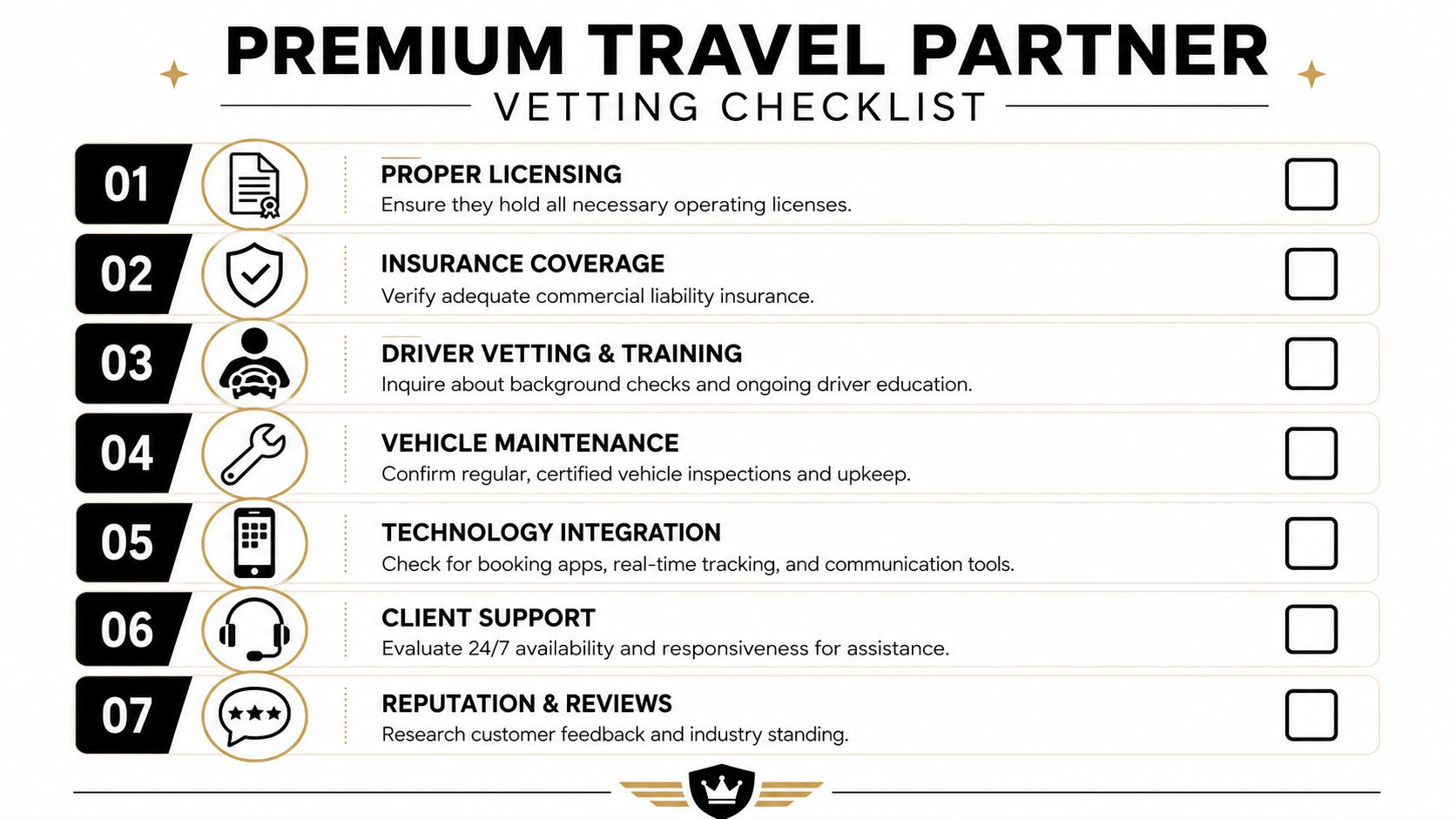
Your Vetting Checklist for a Premium Travel Partner
The right checklist should separate adequate transport from executive-grade transport. Gateway Travel reviews are useful once you interpret them correctly, but they shouldn't be your final decision tool for premium ground service.
Standard versus premium signals
Use this framework during supplier review:
| Category | Standard provider | Premium travel partner |
|---|---|---|
| Accountability | Shared across intermediaries | Single clear owner of service outcome |
| Chauffeur quality | Supplier-dependent | Vetted, trained, and monitored to consistent standard |
| Fleet control | Variable by market | Curated and quality-checked |
| Support model | Reactive | Proactive, live, and continuous |
| Communication | Booking-focused | Itinerary-focused and traveler-aware |
| Privacy handling | General | Discreet by design |
| Recovery capability | Case by case | Structured escalation process |
Seven questions worth keeping on your desk
Who is contractually and operationally responsible for the trip?
If responsibility is diffused, service recovery usually is too.What evidence exists of chauffeur and vehicle standards?
Look for process, not adjectives.How does the provider manage real-time disruption?
Flight shifts, venue changes, and schedule compression should be routine events, not exceptions.Can the provider support principal-level privacy?
Family offices and senior executives often need discretion embedded in the workflow.Is service consistency measurable across cities?
One successful market doesn't prove a global standard.Does the technology improve the passenger's experience or only the seller's workflow?
That distinction changes the entire value case.Would you trust this provider on the most visible trip of the year?
Annual meetings, investor roadshows, and private aviation arrivals expose every weak link.
Buy according to consequence, not according to category. Executive ground transportation isn't ordinary travel arranged at a higher price point. It's a separate operating requirement.
The central insight from Gateway Travel reviews is easy to miss. Positive reviews can be accurate and still be irrelevant to your need. If the reviewed entity is built to serve advisors, not directly manage premium transport, then strong sentiment doesn't close the gap between intermediary support and executive-grade execution.
If your team needs a transport partner built for direct accountability, discreet service, and real-time executive itinerary support, MLR Worldwide Service is worth evaluating. Its focus is premium ground transportation for executives, private aviation travelers, family offices, and corporate travel programs that can't afford fragmented service delivery.