

Your executive is boarding late in London, the connection into Dubai is now at risk, a dinner moved across the city, and the original car booking won't survive the revised arrival time. This is the point where weak travel coordination gets exposed. If the trip was built as a stack of bookings, everything starts to wobble at once.
Strong executive assistant travel planning looks different. The flight matters, but the flight is only one moving part. The core job is to protect the executive's time, energy, and attention from friction they should never have to see. That means planning the trip as an operating system, not a reservation list.
The assistants who become indispensable make that shift early. They stop measuring success by whether a ticket was issued correctly. They measure success by whether the executive moved through the trip without wasted decisions, missed handoffs, or preventable stress. That requires judgment, policy fluency, clean documentation, and contingency thinking that starts before the first booking is made.
A solid corporate travel management approach treats every leg of the trip as connected. Air, hotel, ground, meetings, security, recovery time, and communication all belong in one plan. When one element shifts, the rest needs to flex without drama.
Moving Beyond Booking to Strategic Travel Management
The difference between a junior travel coordinator and a strategic executive assistant usually shows up when something goes wrong.
A reactive assistant waits for the executive's text, then scrambles to solve the immediate issue. A strategic assistant has already mapped the fragile points in the itinerary, identified the likely failure modes, and lined up alternatives before anyone needs them. That's the difference between “I'll see what I can do” and “I've already moved the pickup, held a backup hotel, and updated your arrival brief.”
What booking gets wrong
Booking focuses on transactions. Lowest fare. Fastest click path. Basic car reservation. Standard confirmation email.
That mindset misses the true cost of business travel friction:
- Decision fatigue: The executive shouldn't be choosing between three airport pickup options from the back of a delayed aircraft.
- Energy loss: A technically valid itinerary can still be a bad one if it forces a long-haul arrival straight into a high-stakes meeting.
- Cascade risk: One weak handoff can ruin the next three commitments.
- Invisible labor: Cheap or disconnected vendors often create more work for the assistant during the trip.
What strategic travel management looks like
Strategic executive assistant travel planning starts with a different question. Not “How do I book this trip?” but “What does this executive need in order to perform well across this trip?”
That changes how you plan:
- You choose arrival timing based on readiness, not only fare.
- You treat airport transfers as mission-critical, not as an afterthought.
- You build communication around what the executive needs to know now, later, or never.
- You protect transitions between commitments, because that's where travel breaks down.
Practical rule: If the itinerary only works when everything runs exactly on time, it isn't a strong itinerary.
This work is operational, but it's also strategic. Done well, it protects the executive's output, keeps key meetings on track, and reduces the number of decisions they need to make while traveling. That's the standard rising assistants should aim for.
The Pre-Trip Blueprint and Policy Alignment
The best trips are usually won before anyone opens a booking tool.
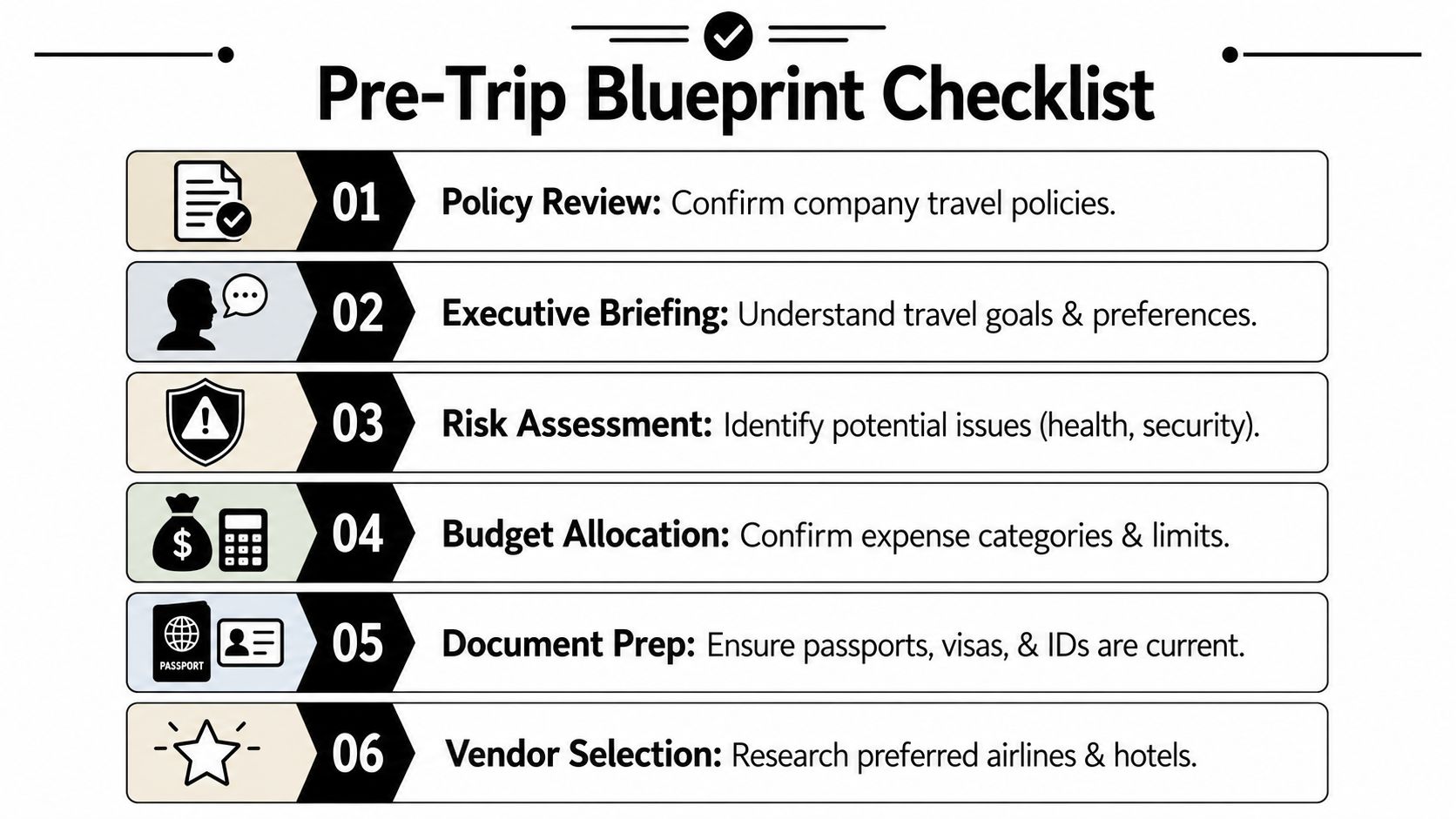
This is the phase where you align the executive's priorities, the company's travel policy, the trip's risk profile, and the practical realities of movement. If you rush through this stage, you'll pay for it later with rework, exceptions, and preventable surprises.
Start with the executive briefing
A proper briefing goes far beyond aisle or window. You need the business purpose, the essential meetings, the acceptable trade-offs, and the personal preferences that affect performance.
Ask for the details that change execution:
- Trip objective: Is this a board meeting, investor roadshow, site visit, client dinner series, or mixed-purpose trip?
- Success conditions: What has to happen for the trip to be considered successful?
- Personal operating style: Early arrival or tighter timing? Quiet hotel or flagship property? Time to reset before meetings or straight to work?
- Red lines: Connections they hate, room types they won't accept, airlines they avoid, times of day that drain them.
This is also where you clarify whether family, security, colleagues, or clients are joining any part of the trip. A “simple” trip often stops being simple once additional travelers enter the plan.
Build a traveler profile that saves you work later
The strongest assistants maintain a living traveler profile, not a folder full of old confirmations. It should be current, searchable, and usable under pressure.
A strong profile usually includes:
| Category | What to maintain |
|---|---|
| Identity and compliance | Passport details, visa status, known traveler IDs, loyalty numbers |
| Preference data | Seat choice, hotel floor preference, pillow or room setup requests, car type preference |
| Operational contacts | Security lead, family office contact, chief of staff, preferred local hosts |
| Friction points | Airports they dislike, transfer patterns that create stress, recurring vendor issues |
A profile like this shortens planning time and improves consistency. It also helps when someone else needs to cover the trip.
Know the policy well enough to use it intelligently
Travel policy is not paperwork. It's the operating boundary for every booking decision you make. Rising assistants often read policy as a list of restrictions. Senior assistants read it as a framework for making defensible decisions quickly.
Use the policy to answer practical questions early:
- Which cabin classes are allowed for this route?
- What approval path applies to exceptions?
- Which hotels, booking channels, or car providers are preferred?
- What documentation is needed for expense reconciliation later?
When policy language is vague, don't guess. Clarify before you commit spend. A strong corporate travel policy template can help standardize those decisions and reduce exception chaos.
Work from the right planning timeline
Timing is one of the easiest ways to tell whether executive assistant travel planning is mature or reactive. For international travel, assistants are required to plan between 4 to 6 weeks in advance, while domestic travel is typically planned up to 3 weeks ahead, according to Pro Assisting's executive travel guidance.
That timeline matters because international trips require more than a flight and hotel. You need time to verify that the passport has at least 6 months remaining beyond the travel date, secure any necessary visas, and clear documentation requirements before the trip becomes urgent.
The trip should feel easy for the executive because it was taken seriously by the assistant weeks earlier.
Run a pre-booking risk review
Before you issue anything, scan for known trip pressure points. Not every trip needs the same level of complexity, but every trip deserves a risk pass.
Review these areas:
- Health and entry requirements for the destination and any transit point.
- Schedule compression where travel and meetings sit too close together.
- Local movement complexity, especially in unfamiliar cities or multi-stop days.
- Recovery needs if the executive is crossing time zones or carrying a heavy meeting agenda.
At this point, the role starts to shift. You're no longer collecting requests. You're designing a trip that can hold up under pressure.
Mastering Flight and Ground Transport Logistics
Most assistants learn flight booking early. Fewer learn how to build a transport chain that stays intact when the day shifts.
That's where trips are won or lost. A polished air itinerary can still fail if the executive lands late, can't find reliable pickup, loses time in a bad transfer, or arrives rattled because the ground segment was treated as routine.

Choose flights for performance, not just price
The cheapest fare is often the most expensive choice once you account for fatigue, missed windows, and recovery time.
When I review flight options, I'm looking at the full operating picture:
- Arrival usefulness: Does the executive land ready for the first commitment, or barely in time for it?
- Connection risk: A connection may save money on paper while introducing more points of failure.
- Airport quality: Some hubs are easier to move through, especially after an international arrival.
- Flexibility: Can the itinerary absorb same-day changes if meetings move?
A “good” flight is the one that supports the executive's actual work. Sometimes that means paying more for a better arrival pattern. Sometimes it means arriving the night before, even when someone insists the same-day option is possible.
Ground transport is not a commodity
Many travel plans often stay too shallow. They list transportation details, but they don't treat ground movement as a strategic layer of the trip.
That's a mistake.
Airport pickups, FBO transfers, cross-city meeting runs, and roadshow days have different requirements. A standard app-based ride may be fine for low-stakes personal travel. It is not a strong default for executive movement where timing, discretion, and continuity matter.
Ground transport needs to match the mission:
| Travel situation | Better planning choice |
|---|---|
| Straightforward airport arrival | Confirmed airport transfer with detailed meeting instructions |
| Multi-stop business day | As-directed or dedicated service that can flex with schedule changes |
| Private aviation movement | FBO-aware coordination with exact terminal details |
| Sensitive or VIP travel | Vetted provider with clear communication protocols and professional standards |
Build backup transport before you need it
This is the blind spot I see most often. Assistants book the primary car and assume they've covered transport. They haven't.
According to a 2025 JetNet report, 38% of international business flights experienced delays or cancellations last year, yet 62% of executive travel plans lack pre-vetted, on-demand ground transport backups in secondary cities, as cited in this executive travel management checklist. The same source notes that this gap is especially acute in emerging markets where FBO and VIP ground transport must be pre-arranged through vetted networks.
That's the operational reality. The flight changes, but failure itself happens on the ground because no one built a backup handoff.
Don't ask, “Who's meeting the executive if the flight lands on time?” Ask, “Who's meeting them if the aircraft diverts, the arrival shifts, or the landing airport changes?”
What works and what doesn't
What works:
- Pre-vetted providers with local knowledge and real operations support
- Named contacts for day-of coordination
- Clear pickup protocols for airport and FBO arrivals
- Alternate transport options in the same city or nearby city pair
- One owner of the transport plan so communication doesn't fragment
What doesn't:
- A screenshot of an app confirmation with no backup
- A local vendor you've never used in a difficult market
- Tight transfer windows built on optimistic assumptions
- Separate car bookings for a fluid schedule that clearly needs as-directed service
Ground transport should protect the executive's energy, not consume it. If the executive has to think about where the car is, whether the driver understands the route, or how to adapt when the day changes, the planning wasn't finished.
Crafting the Dynamic Master Itinerary
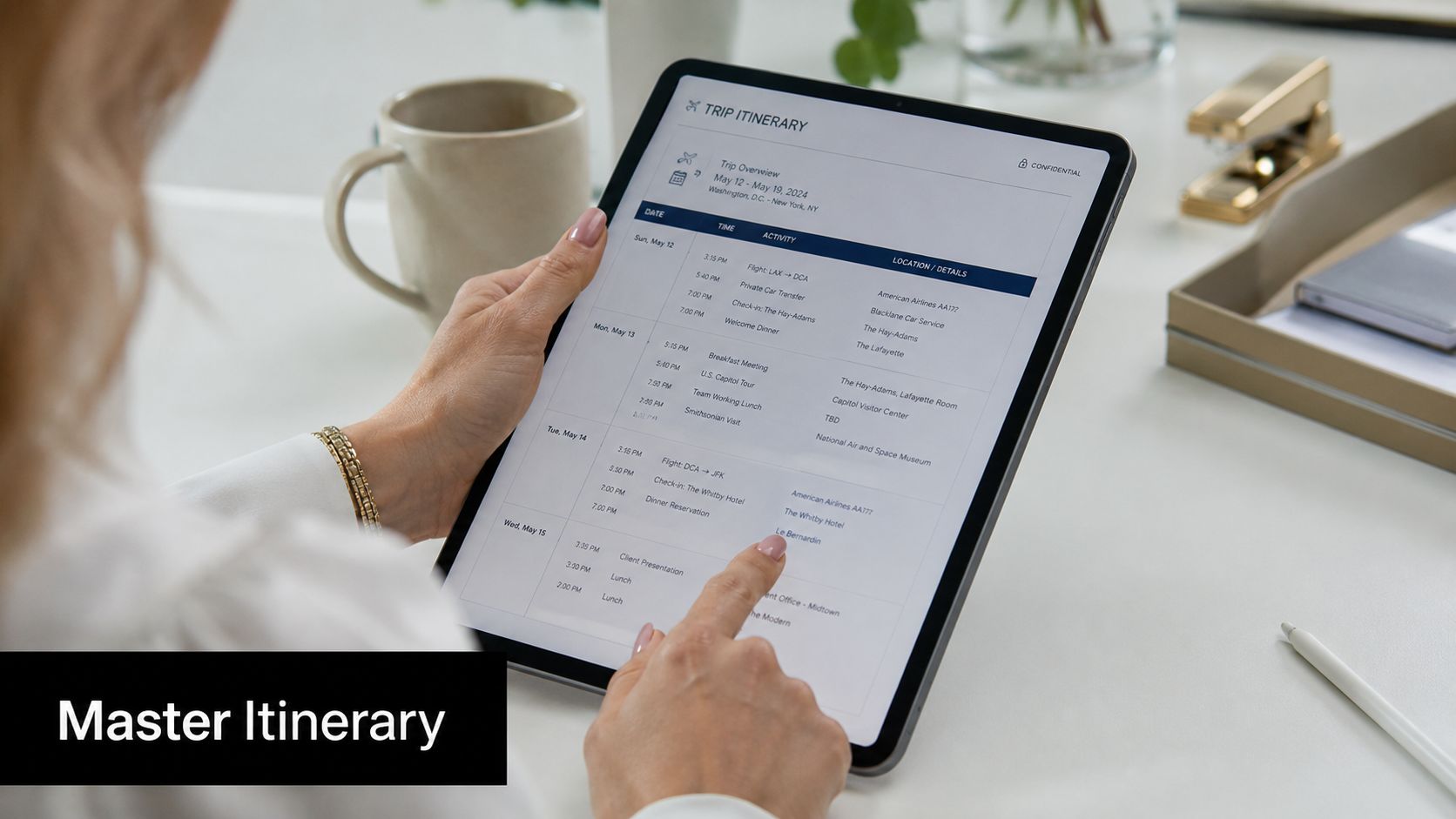
An itinerary should work like a field manual. If the executive loses signal, gets rerouted, or hands the document to a chief of staff, driver, or security contact, it should still answer the next question immediately.
That means your itinerary cannot be a pretty summary. It has to be a working document with enough detail to support movement without forcing the traveler to chase information.
What the document must include
A significant milestone in executive assistant travel planning is delivering the travel document package 48 to 72 hours before departure, including passports, visas, flight itineraries with e-tickets, hotel reservations, and transportation confirmations with all relevant confirmation numbers, according to this executive assistant travel checklist. That same guidance emphasizes the importance of “trip simulation” to catch logistical gaps before departure.
The best itineraries include more than the booking basics:
- Flights: Airline, flight number, departure and arrival times, terminals when available, record locators, seat assignments
- Hotels: Address, confirmation number, check-in notes, direct property phone number
- Ground transport: Pickup time, exact meeting point, provider name, vehicle note, chauffeur or dispatch contact
- Meetings: Contact person, mobile number, venue address, access instructions, purpose of the meeting
- Buffers: Time explicitly protected between airport, hotel, and meeting transitions
A good executive travel itinerary template gives you structure, but the value comes from tailoring it to the executive's actual trip logic.
Make it scannable under stress
The executive won't read the itinerary like a planner. They'll glance at it between calls, from a car, in an airport queue, or after a delayed arrival. Format matters.
Use a layout that makes answers obvious:
- Put each day on its own section.
- Keep local times clear and consistent.
- Surface confirmation numbers where the eye expects them.
- Separate “must know now” details from background notes.
- Highlight the next movement, not just the current one.
I also keep digital and printable versions aligned. If the phone battery dies or connectivity drops, the paper copy still works.
Use trip simulation to find friction
Trip simulation is one of the few habits that consistently separates polished travel management from average travel management. Read the itinerary from the executive's perspective and force yourself through the trip step by step.
Ask blunt questions:
- After landing, where exactly do they go?
- If the meeting runs long, what breaks first?
- Is every handoff supported by a contact and confirmation number?
- Would a substitute assistant understand the day without asking you follow-up questions?
A short visual walkthrough can also help when refining your process:
A clean itinerary reduces decision-making. A dynamic itinerary reduces failure.
The strongest document package feels almost excessive when you compile it. Then a gate changes, a car runs late, or a host sends a new entrance note, and suddenly that extra detail becomes the reason the day stays calm.
Managing In-Trip Changes and Contingencies
Travel always reveals whether the planning was superficial or resilient.
The common failure points are predictable. Flight schedules move. Meetings overrun. A host changes venue. An arrival is pushed from terminal service to FBO, or vice versa. The executive decides they want to leave earlier than planned. None of that is unusual. What matters is whether the itinerary was built to absorb change.
Where trips usually break
According to the cited industry benchmark in this executive travel discussion on contingency planning, over 60% of travel disruptions stem from unforeseen itinerary deviations or lack of proactive contingency planning. The same source says assistants who implement thorough contingency protocols and embed buffer time into schedules reduce travel-related stress incidents by up to 45%, while those who neglect buffer time or preference systems face a 30% higher rate of itinerary failure.
Those numbers track with what experienced assistants already know. The issue usually isn't the original booking. It's the lack of recovery design around the booking.
A practical contingency framework
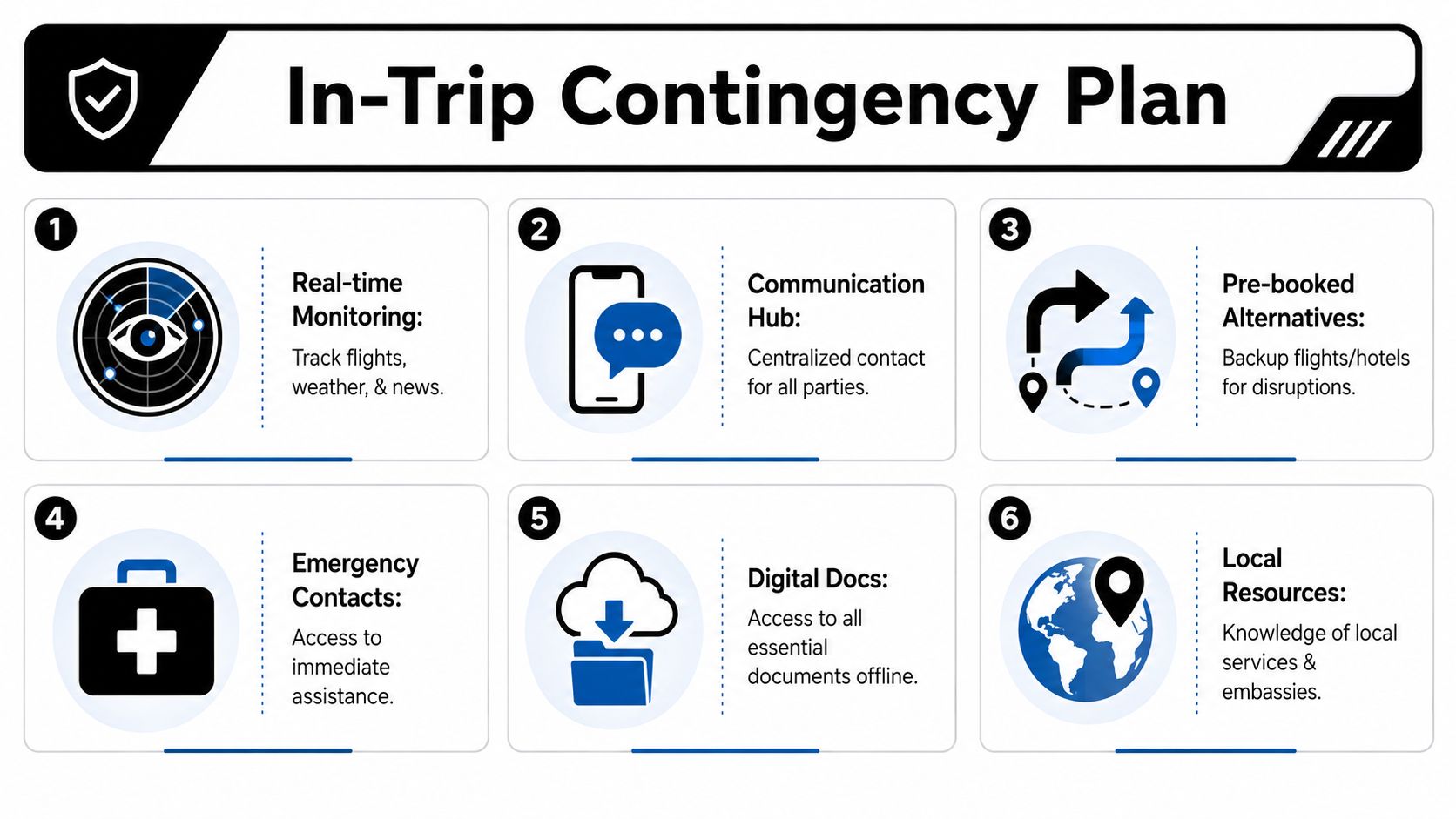
When a trip is live, I think in layers, not single fixes.
Layer one is monitoring
Track the trip continuously once departure day starts. Watch flights, weather, traffic conditions, and local developments that can affect movement. Don't wait for the executive to notify you of a delay you could have seen earlier.
Layer two is communication discipline
Not every issue deserves an executive update. Good communication protects attention.
Use this rule of thumb:
| Situation | Executive update |
|---|---|
| Minor issue with no impact on next movement | No immediate update |
| Change affects pickup time or meeting arrival | Short actionable update |
| Multiple elements are shifting | Send revised plan with only essential decisions |
The executive needs clarity, not a running commentary.
Layer three is pre-built alternatives
For critical trip elements, have at least one alternate path ready. That may include backup flights, secondary hotels, revised route sequencing, or another local contact who can gain access quickly.
Operational habit: Every high-value trip should have a visible Plan B for air, hotel, and ground. On the most exposed trips, build Plan C before departure.
Buffer time is not wasted time
Assistants sometimes remove buffers because the calendar looks too open. That's usually a mistake.
Buffer time serves several purposes at once:
- It absorbs delays without forcing a visible crisis.
- It gives the executive transition time between modes and meetings.
- It preserves the ability to make tactical changes without collapsing the day.
The same applies to geography. Group meetings by location when possible. Avoid crossing a city repeatedly because the calendar owner optimized for convenience when scheduling, not for movement. A clean sequence often matters more than squeezing in one more stop.
Keep the control center simple
When the day goes sideways, complexity becomes the enemy. Keep your operating stack lean:
- One master itinerary with current notes
- One primary communication channel with the executive
- One source of truth for who has the latest version
- One prioritized list of the next two or three decisions
The assistants who stay calm during disruptions usually aren't improvising better. They're working from a simpler system.
The Post-Trip Reconciliation and Feedback Loop
A trip isn't finished when the executive gets home. If you skip the closeout, you waste half the value of the experience.
Post-trip work does two jobs. It cleans up the administrative record, and it improves the next trip. The assistants who get stronger over time aren't relying on memory. They document what happened, what worked, and what should change.
Close the financial loop quickly
Expense work gets harder the longer it waits. Reconcile while the trip is still fresh and receipts are still easy to retrieve.
A simple closeout process works well:
- Collect the record set from email confirmations, folios, transport receipts, and card statements.
- Match charges to the itinerary so exceptions are easy to explain.
- Flag out-of-policy items early and document the business reason while it's still clear.
- Submit cleanly with supporting documents organized by category, not buried in one upload dump.
This is where good pre-trip organization pays off. If your confirmations, approvals, and vendor details were already centralized, reconciliation is faster and far less irritating.
Run a targeted debrief
Don't ask, “How was the trip?” That question produces vague answers and almost no operational value.
Ask for focused feedback instead:
- Which flight segment felt smooth, and which didn't?
- Was the hotel useful for this trip's schedule?
- Did the transport setup feel effortless?
- Were there points in the day that felt rushed or unclear?
- Would they repeat the same sequence next time?
Short, specific questions usually produce the best signal. If the executive is busy, gather observations from visible behavior too. Did they ask for more quiet time? Did they resist the hotel choice? Did one meeting sequence create unnecessary fatigue?
The strongest preference database is built from repeated observation, not only from what the executive says out loud.
Update the traveler profile immediately
Feedback only matters if it changes the system. After the trip, update the profile while details are fresh.
Capture items like:
- newly expressed airline or hotel preferences
- route patterns that worked well
- weak vendors or problematic handoffs
- meeting spacing that felt too tight
- local notes worth preserving for the next visit
This is how executive assistant travel planning gets sharper over time. Every trip becomes a source of operating intelligence. The work compounds. The executive notices that travel feels easier, even if they never see the database behind it.
If your executive travel program needs stronger ground coordination, cleaner airport and FBO handoffs, and a team that can support schedule changes without drama, MLR Worldwide Service is built for that standard. Their global chauffeur network, 24/7 operations support, and experience with executive, VIP, and multi-stop travel can help turn fragile itineraries into resilient ones.