
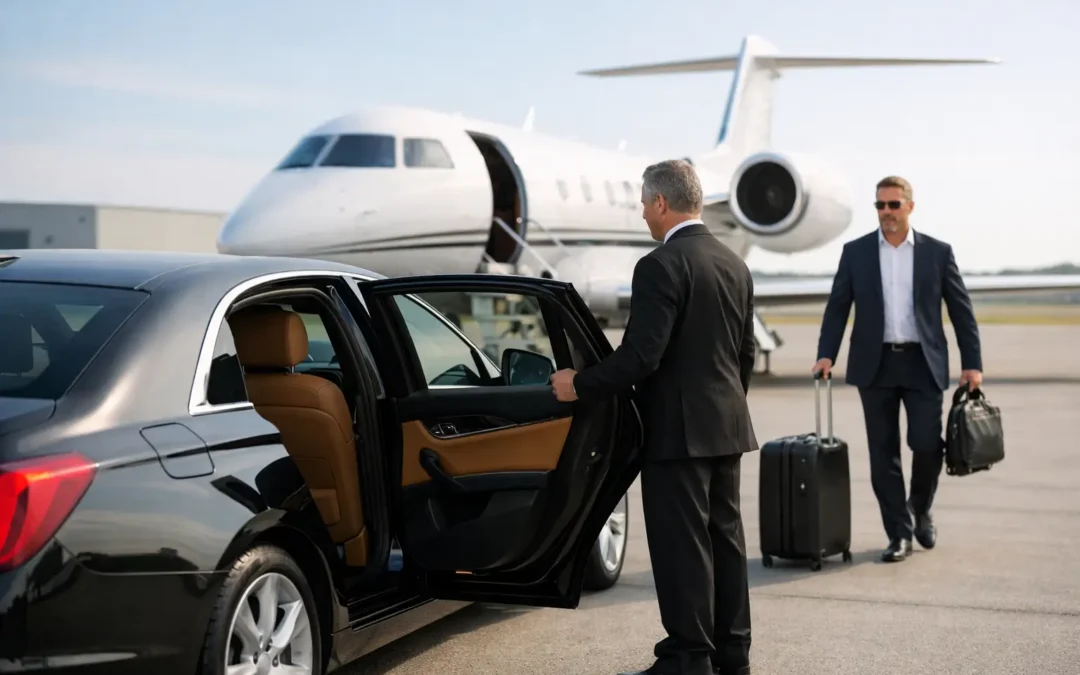
When an aircraft arrives at an FBO, the standard airport pickup model no longer applies. That is exactly why use FBO ground transportation becomes less of a luxury add-on and more of an operational necessity for private aviation travelers, executive assistants, and flight departments managing high-stakes itineraries.
An FBO transfer is not simply a car waiting near an airport. It is a coordinated handoff between private aviation and ground mobility, built around restricted access, exact timing, privacy requirements, and the reality that executive travelers cannot afford missed signals, confused pickups, or unnecessary exposure. For clients who value control, discretion, and punctuality, the difference is substantial.
Why use FBO ground transportation instead of a standard airport pickup
Commercial airport pickups are designed for volume. FBO pickups are designed for precision. That difference affects every part of the experience.
At a traditional terminal, passengers follow public traffic patterns, baggage claims, curbside congestion, and rideshare queues. At an FBO, travelers typically expect to deplane, transition quickly, and continue moving without friction. The vehicle may need to be positioned according to terminal rules, aircraft arrival updates, crew coordination, and security protocols that standard pickup providers often do not understand.
This is where many transportation plans fail. A provider may be excellent at airport transfers in general but still be unprepared for the pace and procedures of private aviation. FBO ground transportation requires advance coordination with the terminal, awareness of tail number tracking or schedule adjustments, and chauffeurs trained to operate in a more controlled environment. The value is not only comfort. It is continuity.
Time protection is the real advantage
For senior executives and private clients, the most expensive part of travel is rarely the vehicle. It is lost time.
FBO ground transportation protects time by reducing avoidable delays at the exact moment a traveler is most vulnerable to them. Aircraft arrival times can shift. Wheels-down does not always mean passenger-ready. A meeting may run long before departure, or a last-minute routing change may move an arrival from one facility to another. A transportation partner familiar with FBO operations plans for those variables instead of reacting to them.
That planning matters on both ends of the itinerary. On departure, the route, timing, and vehicle staging can be built around the private terminal process rather than the assumptions of commercial travel. On arrival, the handoff is faster and quieter. The traveler exits the aircraft environment and enters ground transportation with minimal interruption.
For executive assistants and travel managers, that reliability also reduces administrative burden. They do not need to spend the trip checking whether the chauffeur knows the correct terminal, understands aircraft timing, or can adapt if the schedule changes by thirty minutes. The right service partner handles those moving parts in the background.
Privacy is not a preference for many travelers
One of the clearest answers to why use FBO ground transportation is privacy. For many clients, privacy is not a branding exercise. It is a practical requirement.
Private aviation travelers often include C-suite leaders, public figures, family office principals, legal teams, investors, and individuals with elevated personal security concerns. Their transportation should reflect the same standards of discretion that led them to use private aviation in the first place.
An FBO-aware chauffeur service reduces unnecessary visibility. There is less public exposure, less confusion at pickup, and fewer moments where identifying information is spoken loudly or mishandled. Professional chauffeurs in this environment understand that discretion includes behavior, communication style, routing awareness, and respect for client confidentiality.
There is also a reputational component. A poorly handled pickup can undermine the professionalism of an otherwise well-managed trip. When VIP guests, board members, or international principals arrive through a private terminal, the ground experience should match the standard set by the flight.
Why use FBO ground transportation for security and control
Security in executive travel is often misunderstood as something reserved only for high-risk clients. In reality, many travelers benefit from tighter control even when the profile is low.
FBO ground transportation creates a more controlled transition point than public terminal pickup environments. Identity verification is clearer. Driver assignment is confirmed in advance. Vehicle details are known before arrival. Routing can be tailored to the client’s destination, timing sensitivity, or protective preferences.
This level of control is especially important for travelers carrying confidential materials, arriving for sensitive meetings, or moving between multiple appointments in unfamiliar cities. It is also valuable for families, principals traveling with staff, and airline crews operating under strict duty timelines.
That said, not every trip requires a security-forward protocol. Some travelers simply want a polished, efficient transfer. Others need layered coordination involving gate-side access rules, secure vehicle selection, or low-profile movement. A qualified provider understands the difference and scales service accordingly rather than applying the same formula to every booking.
The service quality is different when the logistics are different
The strongest transportation providers do not treat FBO work as a variation of an airport ride. They treat it as a separate operating standard.
That standard includes dispatch teams who monitor flights in real time, chauffeurs who understand private terminal etiquette, and communication processes designed for assistants, flight crews, and principals alike. It also includes vehicle presentation that aligns with the expectations of premium travelers.
There is a practical reason this matters. Travelers using private terminals are often moving on compressed schedules. They may be connecting to a board meeting, site visit, dinner engagement, roadshow, or onward helicopter transfer. They do not want to explain themselves at each step. They want the next movement already understood.
Well-executed FBO ground transportation creates that continuity. The chauffeur is informed. The vehicle is correctly positioned. Special requests are already noted. If the principal prefers a quiet cabin, a particular temperature setting, or a direct route with no unnecessary conversation, those details should already be embedded in the service.
When FBO transportation matters most
Not every traveler uses an FBO for the same reason, and that affects what the ground segment needs to accomplish.
For corporate leaders, the priority is often schedule protection and image. For high-net-worth travelers, privacy and personal comfort may take the lead. For executive assistants, the goal is a provider who can execute without repeated follow-up. For flight departments and crew coordinators, reliability and communication discipline are essential.
There are also scenarios where the stakes are higher than usual. Multi-city roadshows, major events, international arrivals, investor meetings, entertainment itineraries, and family office travel all create more pressure around timing and presentation. In these cases, the margin for error is small.
This is where a managed transportation partner stands apart from a basic booking platform. Technology can assign a car. It cannot always manage exceptions, interpret VIP expectations, or coordinate calmly when an itinerary shifts at the last minute. In premium travel, exceptions are not rare. They are part of the job.
What to look for in an FBO ground transportation partner
If you are evaluating why use FBO ground transportation, the next question is who should handle it. The answer should not be based on fleet photos alone.
Look for operational depth. That means 24/7 live support, proven experience with private aviation transfers, real-time dispatch oversight, and a service model that can communicate effectively with assistants, principals, and aviation contacts. It also means consistency across markets. A provider may perform well in one city and fall apart in another if its network is not carefully managed.
Chauffeur standards matter just as much. The right chauffeur is punctual, polished, discreet, and adaptable. They understand when to engage and when to remain silent. They know that the client experience begins before the passenger enters the vehicle.
It also helps to assess how the company handles change. Can it accommodate a revised arrival time, aircraft relocation, additional stop, or upgraded vehicle request without confusion? In executive travel, responsiveness is part of the product.
Providers such as MLR Worldwide Service are built around that expectation, treating each transfer as a coordinated mobility assignment rather than a point-to-point ride.
Why use FBO ground transportation in a global travel program
For organizations managing travel across multiple cities, FBO ground transportation is also a consistency decision. Senior travelers notice when standards vary from market to market. So do the people responsible for arranging their itineraries.
A dependable global transportation strategy gives travelers the same level of professionalism whether they arrive in New York, Miami, Los Angeles, London, or Dubai. The specifics of each terminal may differ, but the service principles should not. Clear communication, punctual vehicle placement, discreet chauffeurs, and confident execution should remain constant.
That consistency becomes more valuable over time. It reduces friction for the traveler, simplifies booking for internal teams, and lowers the risk of service failures in unfamiliar markets. For companies and private clients who travel often, that predictability is worth far more than the cost difference between premium service and a generic alternative.
The best reason to use FBO ground transportation is simple: private aviation only works as well as the ground experience that follows it. When the handoff is handled with precision, the traveler keeps momentum, privacy stays intact, and the itinerary remains under control. That is not extra service. For the people who move at this level, it is the standard that keeps everything else on schedule.