
A corporate travel manager is trying to keep a roadshow on schedule. Flights are booked through one preferred channel. Hotel benefits sit in another. The airport transfer to the FBO, the standby SUV for client dinners, and the late-night return to the hotel all sit outside that reward structure. The traveler notices. So does procurement.
That gap matters more in high-end ground transportation than many operators admit. In this market, the ride isn't an isolated transaction. It's one leg of a tightly managed executive journey where timing, discretion, service recovery, and partner coordination all shape account retention. If your loyalty offer lives in a silo, it won't influence behavior where decisions are made.
Loyalty program integration changes that. Done well, it aligns your service with the way corporate travel is bought and managed across airlines, hotels, private terminals, expense systems, and traveler profiles. Done poorly, it creates one more support burden for operations teams already dealing with schedule changes, VIP handling, and service exceptions.
Beyond Points The Strategic Case for Integrated Loyalty
A familiar pattern plays out every week. A travel manager secures preferred air and hotel rates, sets policy controls, and tries to give executives enough flexibility to move quickly. Then ground transportation enters the workflow as a separate booking decision, often through email, phone, or an unmanaged vendor portal. The trip still happens, but the experience feels fragmented.

In executive transport, that fragmentation has a cost. The assistant has to reconcile preferences manually. The traveler has to repeat status details. The operator loses visibility into the broader journey, which makes it harder to anticipate needs like meet-and-greet timing, extra luggage, security protocols, or a last-minute reroute from commercial terminal to FBO.
Why integrated loyalty changes the buying conversation
When loyalty is integrated into the wider travel stack, the transport provider stops competing as a commodity. It becomes part of the corporate travel architecture. A traveler can accrue value across the trip, and the company can support policy compliance without forcing people into disconnected booking behavior.
That matters because travel managers don't just buy cars. They buy reliability, consolidated reporting, service consistency, and fewer exceptions. A connected loyalty structure supports all four.
Practical rule: If your program only rewards completed rides, you've built a promotion. If it recognizes the traveler across the journey, you've built a retention tool.
A luxury ground operator can use integrated loyalty to support:
- Account stickiness: Corporate clients are less likely to split rides across unmanaged vendors when loyalty benefits align with their preferred travel ecosystem.
- Preference capture: Linked profiles surface useful context such as preferred vehicle class, terminal behavior, billing rules, and service notes.
- Experience continuity: The traveler feels recognized from air segment to curbside handoff, not treated like a fresh booking every time.
A strong corporate travel policy template usually tries to reduce unmanaged spend and booking friction. Integrated loyalty helps on both fronts because it gives travelers a reason to stay inside the approved workflow instead of working around it.
What executives actually value
Executives rarely care about points in the abstract. They care that the right car is waiting, the chauffeur knows whether the pickup is at an FBO or terminal, and the billing lands where it should. Loyalty becomes strategic when it reinforces convenience and recognition, not when it behaves like a generic rewards card.
That's the primary case for integration. In premium transport, value comes from reducing coordination friction across a multi-vendor trip.
Choosing Your Loyalty Business Model and Partners
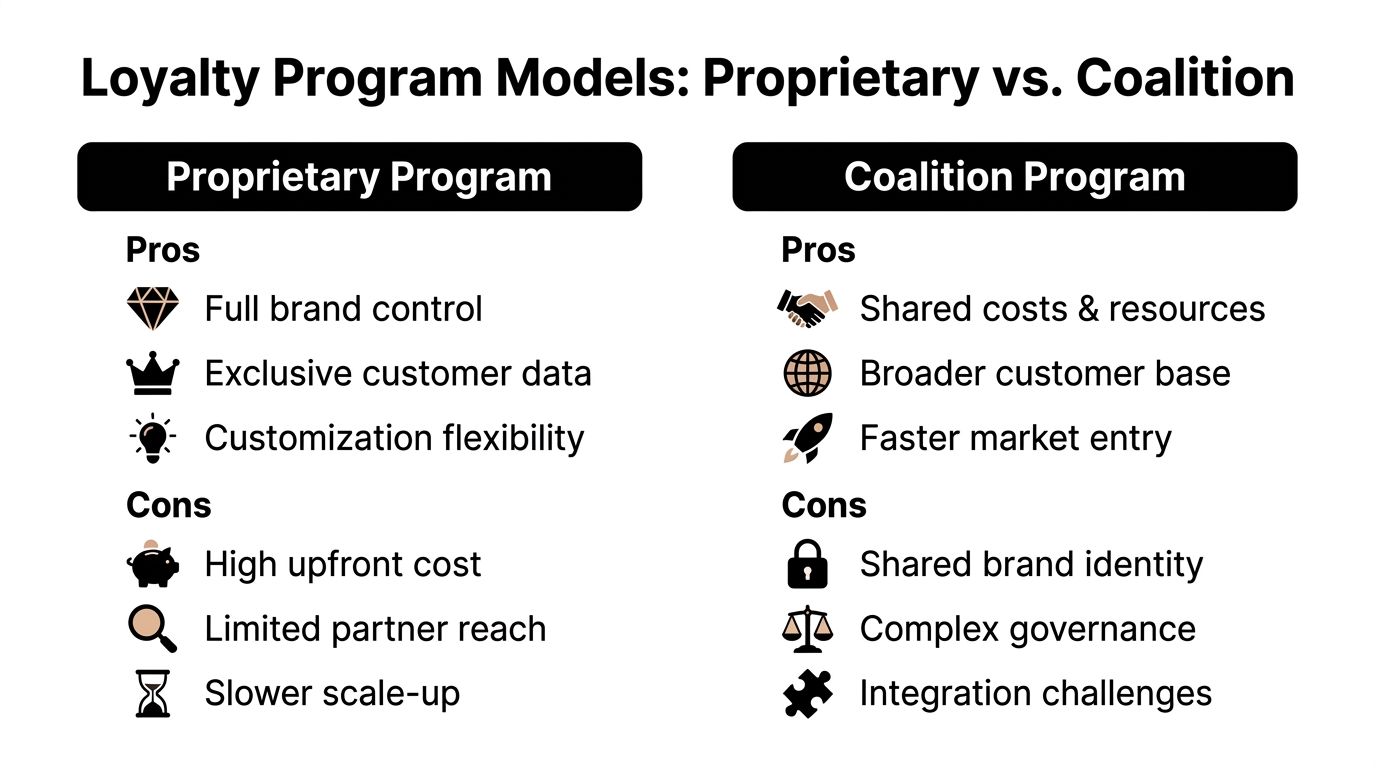
The first strategic decision is structural. You can build a proprietary loyalty program, or you can join forces with outside partners through a coalition or bilateral arrangement. Both approaches can work in executive transport. They solve different problems.
Proprietary program
A proprietary model gives you control over the rules, member experience, service tiers, and branding. That's attractive if your firm serves a concentrated base of corporate accounts, family offices, private aviation passengers, or event clients who already value exclusivity.
The upside is straightforward:
- You own the member relationship. No partner decides how your service appears to the traveler.
- You control benefit design. You can reward behavior that matters operationally, such as advance booking, roundtrip confirmations, or use of designated airport procedures.
- You protect premium positioning. Benefits can focus on priority handling, guaranteed standards, or concierge access instead of generic discounts.
The drawback is just as clear. A proprietary program needs operational discipline and patient adoption. Members must see enough recurring value to care, and internal teams must support the logic consistently. If your company still relies on manual rider notes, fragmented billing, and affiliate-by-affiliate service rules, a homegrown loyalty program can expose those weaknesses fast.
Coalition or partner-led program
A coalition model gives you reach. Instead of convincing travelers to join yet another rewards scheme, you connect to one they already recognize. In high-end ground transportation, that often means partnerships with airlines, hotel groups, luxury travel advisors, private aviation ecosystems, card-linked travel benefits, or corporate travel platforms.
This path is strongest when your business depends on frequent airport transfers, hotel traffic, event flows, or cross-border executive travel where partner visibility drives demand.
A coalition model works well when:
- Your brand benefits from association. Alignment with respected travel partners can strengthen credibility in new markets.
- You need faster adoption. Existing member bases reduce the education burden.
- Your offer complements another service. Airport transfer accrual tied to flight activity or hotel stay benefits can feel natural to the traveler.
But there are trade-offs. Shared branding can blur your distinct value. Partner governance can slow product decisions. And if the loyalty proposition is designed around mass-market redemption logic, it may not fit a premium chauffeur experience.
Don't choose a partner because the logo looks strong on a sales deck. Choose the partner whose customer journey creates the most natural handoff into your service.
A practical comparison
| Decision factor | Proprietary model | Coalition model |
|---|---|---|
| Brand control | Highest | Shared |
| Member acquisition | Slower | Faster |
| Data ownership | Stronger direct control | Often negotiated |
| Program flexibility | High | Constrained by partner rules |
| Operational complexity | Internal build burden | Cross-company coordination burden |
| Best fit | Distinctive premium brand with repeat direct clients | Operator seeking scale through travel ecosystem partners |
Which partners make sense in luxury ground transport
Not every partner category deserves integration effort. Start with the partners that shape the traveler's itinerary and influence procurement.
Three categories usually matter most:
Corporate travel platforms
These partners affect policy compliance, traveler booking behavior, and reporting. They're often the most important for managed corporate accounts.Hotels and private aviation touchpoints
Luxury hotels, residence clubs, and FBO-related workflows are operationally close to the pickup and drop-off moments where service quality is judged.Airline and premium travel ecosystems
These can drive volume, but they only make sense if your service standards, geography, and exception handling can match the partner's expectations.
If your operation is still stabilizing dispatch quality, affiliate consistency, or chauffeur standards, don't hide those issues under a coalition launch. Build the operational base first. A weak service model paired with a big-name partner creates disappointment at scale.
Designing the Technical Integration Blueprint
The technical side of loyalty program integration doesn't need to be mysterious, but it does need to be deliberate. In executive transport, the hard part isn't just passing data from one system to another. It's deciding which system is authoritative when schedules change, travelers swap vehicles, multiple passengers share one booking, or a trip moves from commercial terminal pickup to private aviation handling.
The four systems that must work together
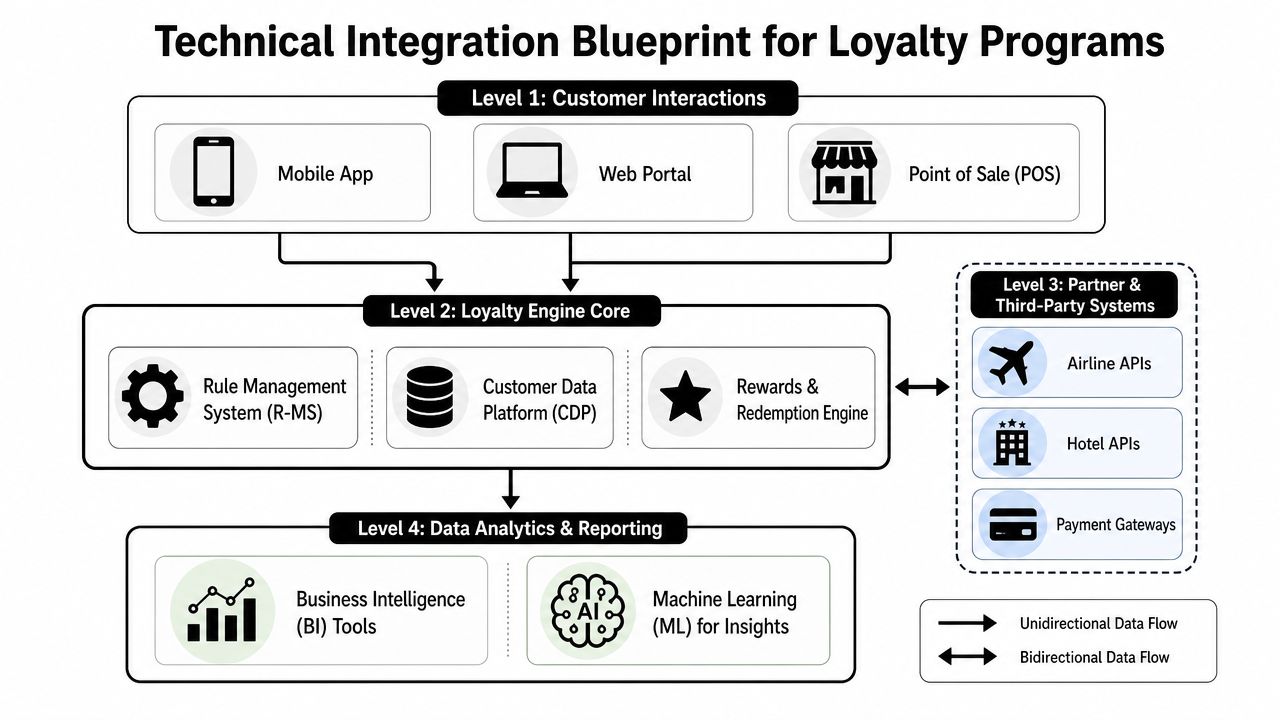
Most operators need four components aligned:
- Booking platform: The point at which a reservation originates or is received. It may be a direct booking portal, a corporate portal, a dispatcher console, or a connected travel tool.
- CRM or customer profile system: This stores traveler preferences, account details, billing instructions, and service notes.
- Loyalty engine: This applies accrual and redemption rules, validates member eligibility, and records program events.
- Partner interfaces and APIs: These connect your environment to airlines, hotels, travel management companies, payment tools, or partner loyalty platforms.
If those systems aren't aligned, the support team becomes the integration layer. That's expensive, slow, and risky for premium clients.
One useful benchmark comes from customer data integration more broadly. Companies that prioritize deep API integrations for customer data see a 25% higher customer lifetime value compared to those relying on manual data transfers, primarily due to enhanced personalization and reduced service friction, according to this API integration ROI study.
Identity mapping comes first
Before any points, perks, or status logic can work, the system has to know who the traveler is across environments. That sounds simple until you look at a real executive itinerary. An assistant books the ride. The passenger travels. The company pays. The loyalty account may belong to the traveler, the corporate program, or both under specific rules.
That's why identity mapping should be treated as a governed process, not a front-end field.
Use a layered approach:
- Primary identifier: A validated loyalty number or partner member ID.
- Secondary match data: Name, business email, approved mobile number, or account-level traveler ID.
- Account context: Who booked, who rode, and which corporate entity is responsible for billing.
If your team can't answer “Who earns the benefit on a shared booking?” before launch, the rules aren't ready.
A strong corporate travel management solution should help keep these identities aligned across booking, policy, and reporting instead of leaving operations to reconcile them after the ride.
Here's a helpful visual reference before going deeper into workflow design.
Build event-based transaction processing
In luxury transport, loyalty shouldn't trigger on booking creation alone. Too many variables still change. Flights delay. meetings run long. passengers no-show. route details shift. You need event-based transaction logic tied to operational truth.
A clean model usually includes these stages:
Booking created
The reservation captures eligibility data, but no final reward posts yet.Booking updated
Changes to passenger identity, vehicle class, or route can adjust eligibility.Ride completed
This is the primary event for final accrual or qualification.Ride adjusted or disputed
Post-service corrections handle exceptions without forcing manual partner reconciliation every time.
Design for exceptions, not just the happy path
Most failed integrations look good in demos because demos use perfect data. Real operations don't. Your blueprint must define behavior for:
| Scenario | Required system response |
|---|---|
| Multi-passenger booking | Determine eligible beneficiary and lock rule before completion posting |
| Cancellation | Reverse pending transaction or suppress accrual based on policy |
| Chauffeur reassignment | Keep loyalty eligibility tied to traveler and ride outcome, not internal staffing changes |
| Affiliate fulfillment | Preserve consistent event and status messages across local partner networks |
| Retroactive claim | Provide controlled review workflow, not ad hoc spreadsheet handling |
The best architecture is quiet. The traveler doesn't think about it, the assistant doesn't chase missing credits, and the operations desk only steps in for true exceptions.
Navigating Privacy Compliance and Data Security
In the luxury travel sector, privacy is part of the product. Executives, family offices, legal teams, and aviation stakeholders expect discretion before they ask for it. A loyalty integration that leaks unnecessary data, stores too much history, or sends traveler details into loosely governed partner systems will damage trust faster than any marketing campaign can rebuild it.
Treat data sharing as a brand issue
Many operators approach privacy as a legal review at the end of the project. That's backwards. The brand promise in executive transport includes confidentiality, controlled access, and disciplined information handling. Loyalty program integration tests all three because it expands who receives traveler data and why.
Ask the hard questions early:
- What data is necessary to verify eligibility and award benefits?
- Which partner needs which field, and for how long?
- Who can see sensitive itinerary details inside your own operation and inside the partner organization?
A premium service shouldn't send full passenger context when a tokenized identifier and transaction event would do the job.
The most secure data transfer is often the one you decided not to make.
Build privacy by design into the workflow
A practical privacy model for loyalty integration usually includes several controls working together.
- Explicit consent logic: Travelers should understand what's being shared, with whom, and for what purpose. That notice has to fit the booking journey, not hide in legal language no one reads.
- Data minimization: Don't transmit meal preferences, security notes, or detailed itinerary remarks when accrual only requires validated member identity and ride completion status.
- Tokenization and pseudonymization: Replace direct personal identifiers where the partner doesn't need them in plain form.
- Role-based access: Dispatchers, account managers, finance staff, and partner users shouldn't all see the same data.
- Retention discipline: Loyalty-related records should follow defined retention schedules tied to legal, billing, and service requirements.
Contracts matter as much as code
The API can be secure and the project can still fail if the contractual side is weak. Data processing agreements need to define permitted use, breach notification responsibilities, subprocessor rules, and deletion obligations. In cross-border service environments, that documentation becomes even more important because reservation data may move through multiple entities before the ride is complete.
A useful internal checklist includes:
- Partner due diligence: Security posture, incident handling maturity, and operating jurisdictions.
- Data flow mapping: Exactly where traveler data enters, moves, transforms, and rests.
- Audit readiness: Evidence that consent, access controls, and deletion practices are more than policy statements.
- Exception handling: A process for suspending data exchange if a partner system behaves unexpectedly.
For this clientele, compliance isn't a side requirement. It's proof that your service standards extend beyond the vehicle.
Executing a Seamless Rollout and Operational Launch
Most loyalty launches fail in operations, not strategy. The program looks attractive on paper, the integration passes a demo, and then the first real week brings schedule changes, affiliate edge cases, missing member IDs, and confused frontline staff. In executive transport, that's where reputational damage starts.
Start with a controlled rollout
A phased launch works better than a broad release. Choose a limited set of corporate accounts, routes, partner properties, or airport environments where your team already has strong operational control. Test the full cycle from booking to ride completion to accrual query to exception resolution.
Use internal User Acceptance Testing first, then expand to a small set of friendly clients who will give honest feedback without escalating every issue through procurement.
A practical rollout sequence looks like this:
- Internal scenario testing with dispatch, reservations, billing, and account management.
- Pilot with selected accounts that have predictable travel patterns and responsive stakeholders.
- Restricted production launch tied to specific channels or service types.
- Broader deployment only after support patterns are stable.
Train by role, not by department
Too many operators give everyone the same training deck. That doesn't work. Each role interacts with loyalty differently.
| Role | What they need to know |
|---|---|
| Chauffeurs | How to answer basic passenger questions, when to escalate, and how loyalty affects pickup expectations without discussing private account details |
| Reservations team | How to capture IDs correctly, verify eligibility, and explain partner-specific rules |
| Dispatch and operations | How event timing affects accrual, how to spot exceptions, and when manual intervention is appropriate |
| Finance and billing | How loyalty-related transactions appear in invoicing, credits, disputes, and account reporting |
| Account managers | How to position value for travel managers, executive assistants, and procurement teams |
Prepare the scripts before launch
Your team needs ready answers for common situations. Not generic customer service language. Specific, operationally correct scripts.
Examples include:
- Missing loyalty number after ride completion: Explain the retroactive claim path and expected review steps.
- Partner credit not posted yet: Confirm ride completion status before escalating to loyalty support.
- Assistant booked for executive traveler: Clarify whether the benefit follows the passenger, the booking profile, or the corporate account.
Launch day shouldn't be the first time your operations team sees an exception case.
Tailor communication to each stakeholder
Corporate travel managers want to know whether the program reduces unmanaged bookings, supports policy, and simplifies reconciliation. Executive assistants want less back-and-forth and fewer details to re-enter. Travelers care about recognition, convenience, and continuity.
That means your communication should split by audience:
- Travel managers: Focus on compliance, reporting clarity, and smoother supplier coordination.
- Executive assistants: Highlight easier profile reuse, fewer manual corrections, and faster issue resolution.
- Travelers: Show the practical benefit in plain language, such as effortless recognition across a premium trip.
Keep launch messaging concise. The more complicated the explanation, the more likely the program rules are too complicated.
Measuring Success and Refining Your Program
A loyalty program can generate activity without generating value. Executive transport firms need a tighter scorecard than “members enrolled” or “points issued.” The right measures tell you whether the integration is changing booking behavior, improving account retention, and reducing friction across service delivery.
Focus on behavior, not vanity
For this niche, useful indicators are operational and commercial at the same time.
Start with measures such as:
- Loyalty-influenced booking rate: How often booked rides include an eligible member or linked partner identifier.
- Account consolidation trend: Whether corporate clients are shifting more of their ground spend into your managed channel.
- Exception volume: How often credits fail, identities mismatch, or manual intervention is required.
- Premium service uptake among enrolled travelers: Whether engaged members choose higher-service options or more coordinated itinerary support.
- Retention pattern among participating accounts: Whether the program is helping preserve strategic relationships over time.
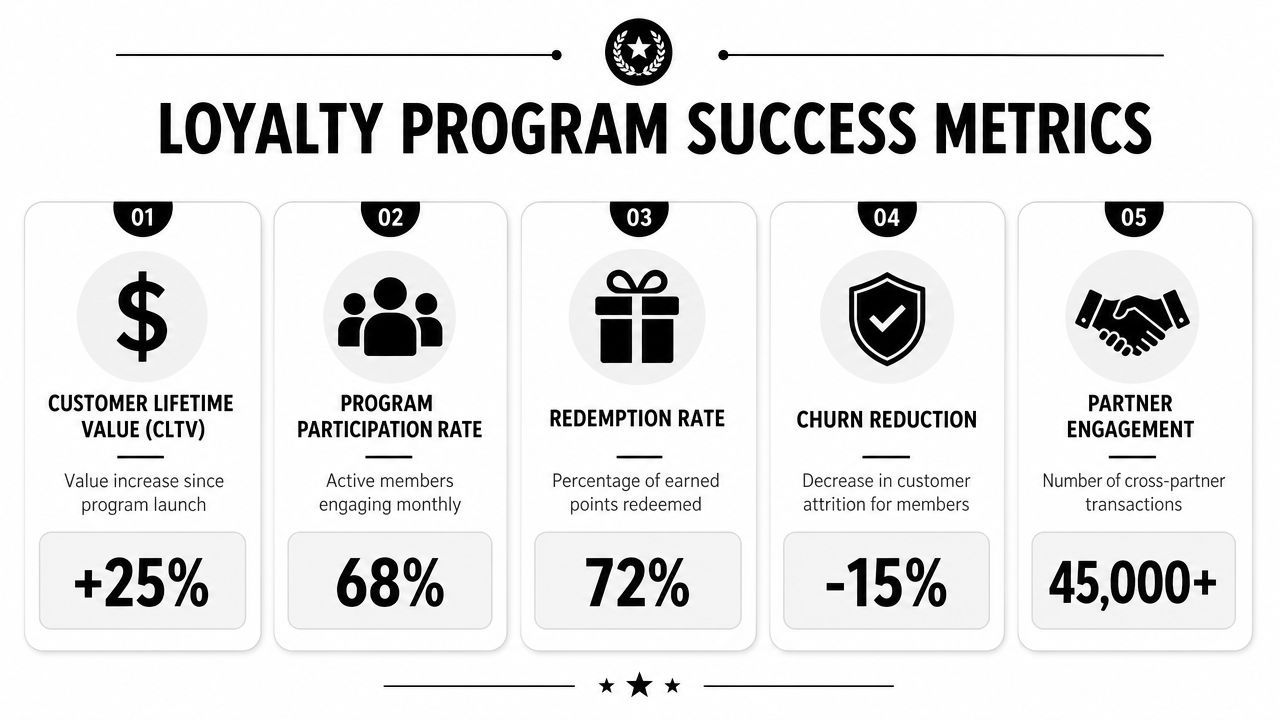
The one hard benchmark available on the integration side is still useful context. The infographic highlights customer lifetime value, and the only verified quantitative support in this article is the previously noted 25% higher customer lifetime value associated with deep API integrations for customer data in the cited study. For everything else, keep your assessment tied to your own dashboard and operating realities.
Build a living operating review
A loyalty integration needs maintenance discipline. Partner APIs change. Policy logic drifts. Bookers find loopholes. New traveler expectations appear.
A practical review cadence should cover:
- Monthly exception review: Identify repeat failure points in accrual, reversal, or member matching.
- Quarterly partner review: Validate service issues, governance questions, and program rule changes.
- Voice-of-customer loop: Capture direct feedback from travel managers, assistants, and frequent riders.
- Operational stress testing: Confirm what happens when a partner endpoint fails or an affiliate sends incomplete data.
A company with mature business travel expense management practices will usually spot loyalty friction faster because reconciliation issues surface early instead of hiding in scattered manual workflows.
A refinement checklist that keeps the program useful
- Retire weak rules: If a benefit creates support traffic but doesn't influence buying behavior, remove it.
- Tighten partner scope: Not every partner deserves a permanent place in the program.
- Review fulfillment consistency: Rewards lose value when the service experience differs by city, affiliate, or terminal type.
- Watch for misuse: Shared profiles, incorrect beneficiary claims, and booking workarounds can distort results.
- Keep the proposition premium: In luxury transport, recognition and service continuity often outperform gimmicky reward mechanics.
A loyalty program earns its place when operations can support it cleanly and clients can feel the difference without needing an explanation.
If your organization is evaluating loyalty program integration for executive transport, airport transfers, FBO coordination, or corporate roadshows, MLR Worldwide Service can help you think through the operational realities behind a premium ground travel experience. The right program doesn't just reward rides. It strengthens traveler recognition, account retention, and service consistency across the full journey.