
A senior executive lands after an overnight flight, clears the cabin, turns the phone back on, and is already behind. There's a board call in transit, a client lunch across town, and almost no margin for friction. The aircraft portion of the trip may have been booked perfectly, yet the day can still go sideways in the terminal pickup zone.
That's where most travel programs either protect the principal's time or waste it.
An airport transfer limousine service isn't just a nicer car at the curb. In practice, it's the control layer between air travel and the rest of the itinerary. For executives, family office principals, private aviation passengers, and anyone moving on a tight schedule, that final ground segment determines whether the day begins in order or in recovery mode.
Beyond the First Class Seat Your Journey's Final Mile
The weak point in many executive itineraries isn't the flight. It's what happens after arrival.
A principal can fly in a premium cabin, land on time, and still lose momentum in the terminal. The usual failure points are familiar. No clear pickup instructions. A driver who isn't where the confirmation said they'd be. A rideshare queue that looks manageable until it doesn't. A sedan that arrives, but not with the right luggage capacity, not with the right level of discretion, and not with a driver trained to handle a VIP arrival.
That's why experienced travel teams treat airport transfers as operational infrastructure, not cosmetics.
The broader market reflects that importance. The global airport transfer services market was valued at $28.4 billion in 2025 and is projected to expand to $45.8 billion by 2034, according to Market Intelo's airport transfer services market report. You don't see growth like that in a category people consider optional.
The difference shows up at the curb
A standard taxi or app-based ride solves one problem. It gets a passenger from one point to another.
A premium airport transfer solves several problems at once:
- Timing control: pickup is arranged before wheels down, not after baggage claim stress starts.
- Role clarity: the chauffeur knows who the passenger is, where they're going, and what matters on arrival.
- Environment management: the car becomes a quiet extension of the itinerary.
- Risk reduction: fewer variables are left to chance.
For a useful benchmark of what that service can look like in practice, see this example of a luxury airport car service.
The final mile isn't a minor detail. It's the handoff between travel planning and business execution.
When the handoff is clean, the executive stays composed, punctual, and usable. When it isn't, the rest of the day starts with avoidable damage.
What Is an Airport Transfer Limousine Service
An airport transfer limousine service is a pre-arranged, chauffeur-driven ground transportation service built around scheduled air travel. That definition sounds simple, but the key distinction is in how the service is managed.
Think of it as the difference between an off-the-rack suit and one that's custom-fit. Both cover the basic need. Only one is shaped around the person, the occasion, and the standard required.
You are booking logistics, not only a vehicle
New coordinators often focus first on the car type. That matters, but it's not the core purchase.
The core offering is coordinated execution. A proper provider confirms the booking in advance, aligns the pickup with the flight, assigns a professional chauffeur, and manages communication so the passenger doesn't have to improvise at arrival. The vehicle is only one component.
That distinction also explains why this category sits in a meaningful market segment. The global limousine services market was estimated at USD 25.12 billion in 2025 and is expected to reach USD 26.87 billion in 2026, according to 360iResearch's limousine services market intelligence. The same source notes that in major US hubs, corporate airport transfer fares for sedan service average between $85 and $145. Those rates reflect planning, staffing, and service controls, not just upholstery.
What separates it from a taxi or rideshare
A taxi is reactive. A rideshare is on-demand. A limousine transfer is scheduled and managed.
That produces several practical differences:
| Service element | Standard taxi or rideshare | Airport transfer limousine service |
|---|---|---|
| Booking model | Request after need arises | Reserved before travel |
| Driver assignment | Variable | Planned and briefed |
| Pickup process | Passenger-led | Service-led |
| Communication | Minimal or app-based | Coordinated with live support |
| Travel standard | Inconsistent | Structured around service policy |
The service also tends to be better aligned with the kinds of details executives care about but don't want to discuss repeatedly. Cabin quiet. Professional appearance. Proper luggage handling. No forced conversation. No improvisation around route or destination.
What should be included
When I review a provider for executive use, I expect the airport transfer limousine service to include, at minimum:
- Advance reservation management: confirmed date, flight, pickup point, and destination.
- Professional chauffeur assignment: not just a licensed driver, but someone who understands presentation and protocol.
- Arrival coordination: clear meet point instructions and active trip oversight.
- Vehicle fit: sedan, SUV, or van selected for passenger count, baggage, and context.
- Support for changes: the booking can be amended without turning into a chain of calls and confusion.
Practical rule: If the provider describes only the vehicle and not the operating process, they're selling transportation, not managed service.
That's the line new coordinators need to learn early.
Why Top Executives Rely on Professional Chauffeur Services
Senior travelers don't choose premium ground transport because they want a dramatic arrival. They choose it because unmanaged ground transport creates noise, and noise is expensive.
For top executives, the value sits in four areas: usable time, privacy, reliability, and representation.
Privacy is often the deciding factor
This point is usually underwritten in service descriptions, yet it matters more than the vehicle brochure.
According to Airport Limo Indy's discussion of 2025 airport limousine trends, high-net-worth and private aviation travelers prioritize privacy and professional discretion above all else, and the value of a silent chauffeur trained to anticipate needs without unnecessary interaction is a critical requirement for executives moving from private flights to ground transport.
That aligns with what travel teams learn quickly in the field. A principal doesn't always want hospitality in the form of chatter. Often they want a chauffeur who opens the door, confirms the destination once, handles the bags correctly, and then understands that silence is part of the service.
The soft skill most providers undersell
A silent chauffeur isn't passive. The role is active, observant, and controlled.
What good looks like:
- Reading the passenger correctly: some clients want a short confirmation and then quiet.
- Protecting confidentiality: no questions about itinerary, aircraft, company, or companions.
- Anticipating simple needs: temperature, route preference, charging access, and luggage handling are addressed without prompting.
- Maintaining social discipline: no overfamiliarity, no personal stories, no attempts to “entertain.”
What doesn't work is the driver who confuses friendliness with professionalism. Executives spend all day managing conversation. Many value one segment of the day where they don't have to.
Why the service functions as a business tool
A professionally managed transfer supports business continuity in ways a generic ride does not.
One reason is productivity. The vehicle becomes a controlled transition space where the passenger can call ahead, review notes, or recover enough to arrive composed.
Another is reliability. The principal isn't making transport decisions while standing curbside with luggage and messages coming in.
Then there's image. Not vanity. Signal. If a board member, investor, or senior client is being moved, the transport standard reflects how carefully the organization handles details.
A premium transfer earns its keep by removing decisions from the executive's plate.
That is especially true in private aviation environments. FBO passengers often require service that is almost invisible. The handoff from aircraft to vehicle should feel direct, discreet, and unremarkable in the best sense. No confusion, no crowd management theater, no need for the passenger to explain who they are.
The Anatomy of a Flawless Airport Transfer
A flawless transfer doesn't happen because the chauffeur is lucky with traffic. It happens because the provider has built a process that absorbs change.
The mechanics matter more than the marketing language.
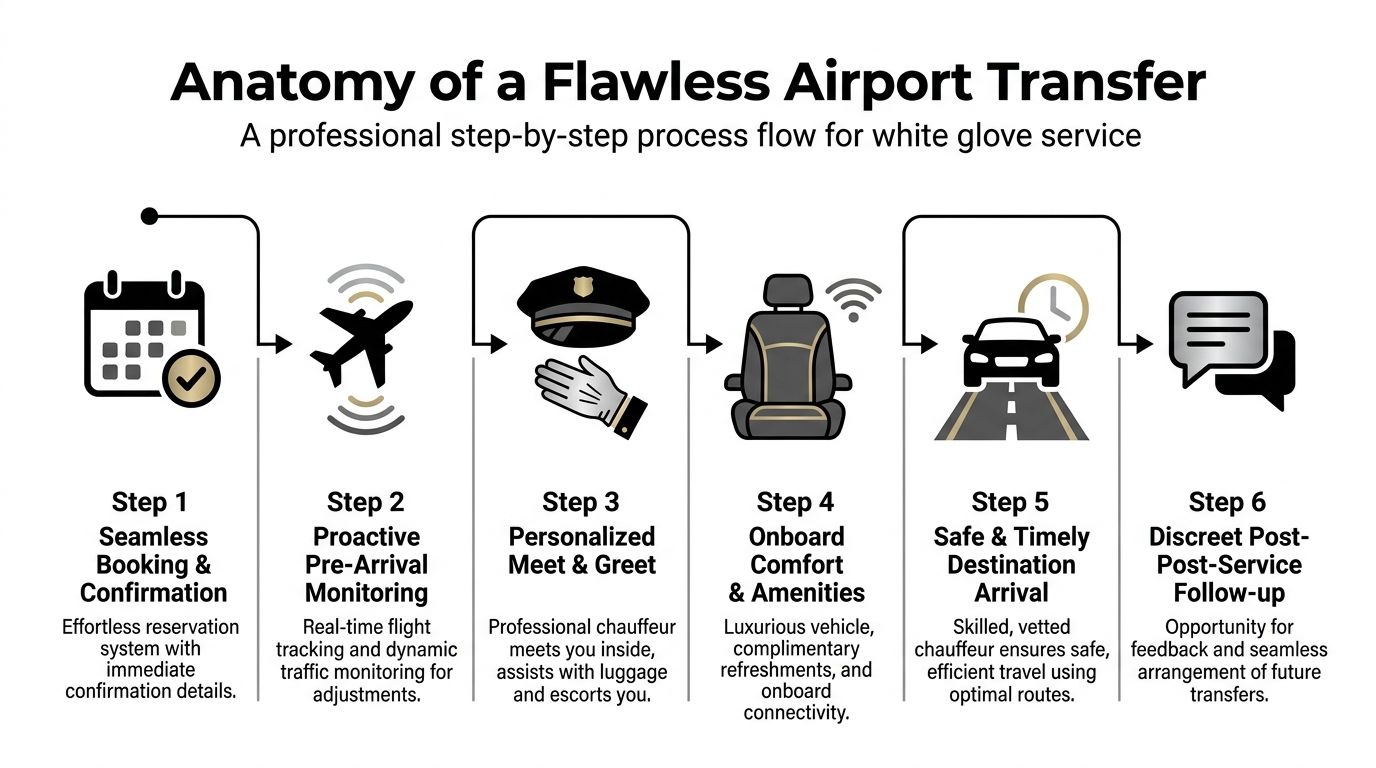
Early in the trip lifecycle, the service should establish the essentials: passenger name, flight details, terminal or FBO, destination, luggage profile, and any instructions that affect pickup protocol. That file then needs active monitoring, not passive storage.
To visualize that sequence, this workflow is useful:
Flight tracking must be operational, not decorative
This is one of the easiest areas to test. Many providers say they monitor flights. Fewer prove that the monitoring changes dispatch behavior.
According to Fort Lauderdale VIP Car Service's analysis of luxury airport limo operations, reliable service is built on real-time flight monitoring integrated with automatic schedule adjustment algorithms, and that technology reduces average passenger wait times by 15 to 20 minutes compared to static scheduling. That's a meaningful operational difference because it shifts the burden from passenger communication to system-led adjustment.
For coordinators managing executive schedules, this matters more than almost any in-car amenity.
A strong provider should also have a clear view of live route conditions. This overview of real-time route optimization shows the kind of operating mindset worth looking for.
The handoff points that define quality
The visible part of the transfer starts at contact.
That may be curbside, inside arrivals, at baggage claim, or at an FBO. The pickup method should fit the passenger, not the provider's convenience. For a fatigued executive with checked bags, meet-and-greet inside the terminal is often worth it. For a principal exiting private aviation, direct coordination with the FBO is usually the cleaner approach.
The next service markers are simple, but they reveal discipline fast:
- Signage and identification: the passenger should know immediately who is meeting them.
- Baggage handling: done confidently, without fuss and without disappearing.
- Vehicle staging: the car should be positioned so the transfer from terminal to vehicle is short and orderly.
- Cabin readiness: clean interior, correct temperature, and no need for setup after boarding.
Here's the operational benchmark I use. If the passenger has to ask multiple questions during pickup, the service was not prepared.
A short example helps. An executive lands early, checks one carry-on, and exits faster than expected. In a weak system, the chauffeur is still en route and the passenger waits, calling the coordinator. In a stronger system, dispatch has already recalibrated timing, the chauffeur has adjusted staging, and pickup happens without a single reactive message from the traveler.
Later in the service chain, follow-up still matters, but discreetly. A good operator records service notes for future bookings. A poor one sends intrusive post-trip messaging.
This short video gives a practical look at how a polished transfer experience should feel in motion.
How to Evaluate and Select Your Ground Transportation Partner
Most booking mistakes happen before the first ride. The provider is approved on presentation, price, or vehicle photos, and no one pressures the operating model.
That's the wrong sequence.
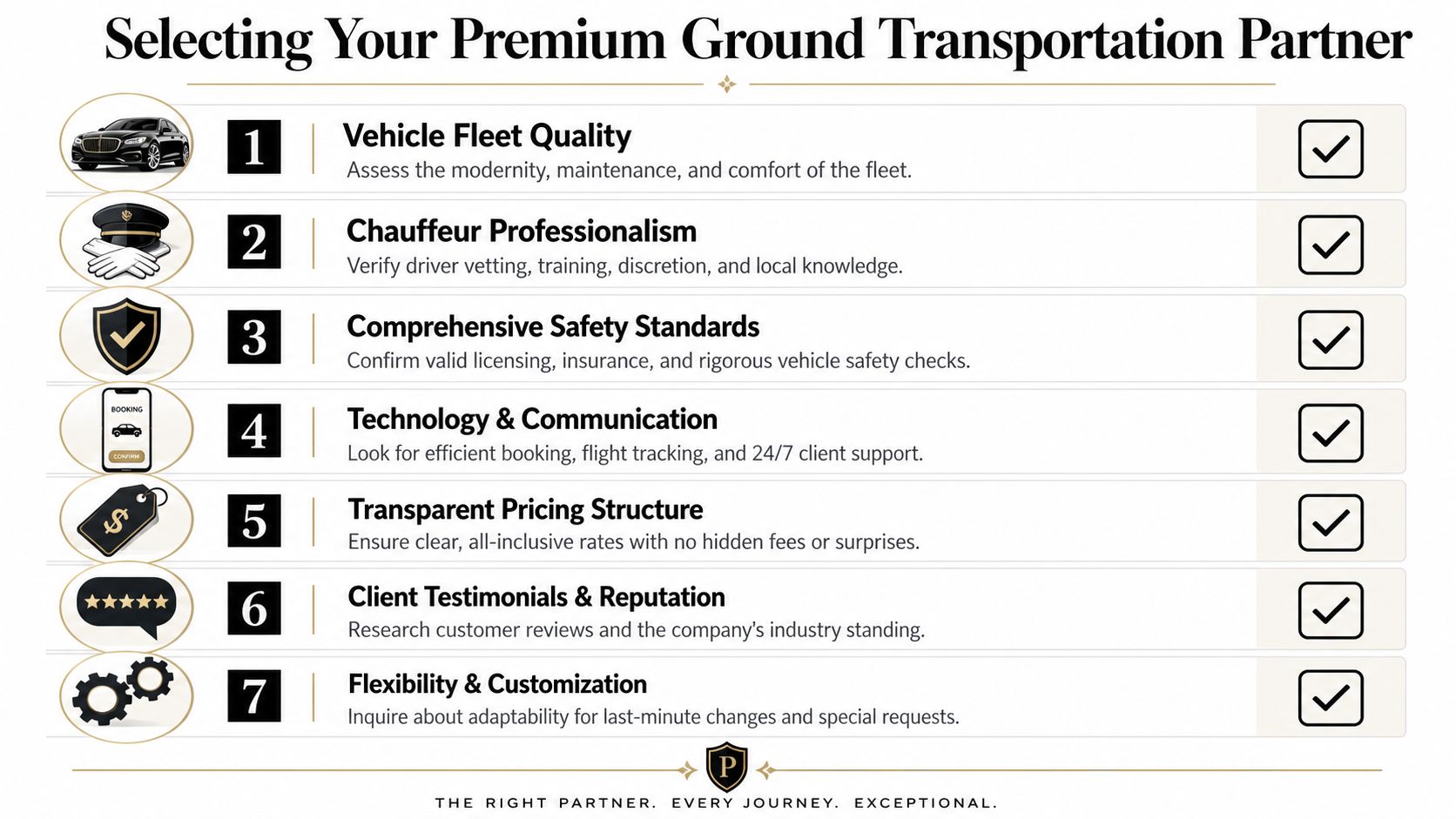
Start with risk. Then service consistency. Then booking convenience. If a company can't answer basic questions about staffing, licensing, service recovery, and trip oversight, the polished website doesn't matter.
Ask how chauffeurs are employed and managed
This is not a minor detail. It affects accountability on every trip.
According to Elite Lux Limousine's guidance on booking airport limousine service in Singapore, premium operators mandate that chauffeurs are full-time employees with at least 3 years of experience and proper licensing. That employment model supports consistent training, background checks, and accountability, and lowers operational risk compared with independent contractor models.
For procurement and travel teams, that should trigger a direct question set:
- Are chauffeurs employees or contractors
- What experience threshold is required before assignment
- What licensing standard applies in each operating market
- Who trains them on discretion, client handling, and service recovery
If the answers are vague, assume the service will be variable.
For a broader view of what to compare among providers, this guide to ground transportation companies is a useful reference point.
Use a practical evaluation grid
I recommend scoring providers against a small set of operational criteria rather than an abstract “luxury” impression.
| Evaluation area | What to verify | Why it matters |
|---|---|---|
| Chauffeur model | Employee status, training, licensing | Reduces service variance |
| Fleet standard | Vehicle condition, age profile, cleanliness | Protects client experience |
| Dispatch capability | Live oversight and support access | Improves issue handling |
| Airport competence | Terminal and FBO pickup protocols | Prevents arrival confusion |
| Communication discipline | Clear confirmations and updates | Lowers coordinator workload |
Red flags that deserve immediate caution
Some warning signs are subtle. Others are obvious.
- Overfocus on car photos: if the sales pitch is almost entirely visual, operating depth may be weak.
- No clear amendment policy: schedule changes are common in air travel. The provider should already know that.
- Inconsistent reply quality: if pre-booking communication is sloppy, service-day communication won't improve.
- No explanation of affiliate standards: for global bookings, local partner quality has to be controlled, not assumed.
Vet the operating system, not just the vehicle class.
One provider can have an impressive sedan and a fragile delivery model. Another can have a less theatrical brand presence and a much stronger service culture. The second option is usually the safer buy.
Mastering the Logistics of Your Global Ground Travel
Once you've chosen a provider, the next job is to make every booking easier to execute. Most transfer failures come from incomplete input, not dramatic breakdowns.
Start with the booking file. Give the provider the passenger's full name, mobile contact, flight number, arrival or departure timing, exact pickup location, destination, luggage count, and any service notes that change vehicle choice or handling protocol. If the traveler is a low-profile principal or private aviation passenger, say so plainly. The provider can't protect discretion they weren't told to plan for.
Build the trip around the traveler, not the route
A roadshow and a simple airport arrival shouldn't be booked the same way.
For multi-stop schedules, send the entire day pattern in one instruction set. Include meeting windows, likely overrun points, and whether the vehicle should remain on standby or recycle between segments. If the traveler's preferences are known, document them once and ask that they stay attached to the profile. Repetition creates avoidable errors.
Price clarity matters because exceptions multiply
The cleanest bookings are the ones where everyone understands the commercial structure before the wheels turn.
Ask these questions in advance:
- Is the rate point-to-point or hourly
- What triggers additional charges
- How are parking, tolls, and wait time treated
- Is gratuity built in or separate
- How are last-minute changes handled operationally and commercially
If the executive's schedule is unstable, don't optimize for the lowest quote. Optimize for flexibility and support.
The cheapest booking often becomes the most expensive one once changes begin.
For international programs, I also advise keeping one internal standard for instructions. One template. One naming format. One process for urgent amendments. Coordinators who standardize their own requests usually get more consistent service back.
The MLR Worldwide Service Standard for Airport Transfers
What matters in this category is not a promise of luxury. It's whether the provider has built a repeatable operating standard around executive movement.
That means several things working together. A chauffeur culture that values discretion over performance. A booking process that captures the details that affect service. A live operations function that can handle delays, terminal changes, road disruption, and last-minute itinerary edits without pushing the problem back to the passenger.
MLR Worldwide Service operates in that part of the market. The company provides airport transfers and FBO support, executive chauffeur service, event and group logistics, VIP secure transport, and crew movements through a managed service model and a vetted global affiliate network. In practical terms, that means the buyer isn't only sourcing a car. They're sourcing oversight, coordination, and a consistent standard across cities.

Why that model fits executive travel
For corporate leaders and private clients, the useful test is simple. Can the service stay calm when the itinerary stops being neat?
A provider aligned to executive travel should be able to manage:
- Airport and FBO arrivals: with the right pickup protocol for each environment
- Multi-stop business schedules: without repeated rebriefing from the coordinator
- VIP discretion requirements: especially when silence and low visibility matter more than amenities
- Cross-border consistency: so a traveler moving from one market to another doesn't encounter a different standard every day
That last point is often overlooked. Global travel programs fail when local service feels improvised market by market. A managed network matters because consistency matters.
The standard to look for
The right airport transfer limousine service should feel controlled, almost quiet in its execution. Confirmations are clear. Pickup is orderly. The chauffeur behaves like a professional custodian of time and privacy. Operations stays available without becoming intrusive.
That's the benchmark buyers should keep. Not whether the car looked impressive in a photo gallery, but whether the service protected the traveler's day.
If you're arranging executive arrivals, FBO pickups, corporate roadshows, or complex global itineraries, MLR Worldwide Service offers a structured option for managed ground transportation with 24/7 operational support, discreet chauffeur service, and coordinated airport transfer coverage across major international markets.