
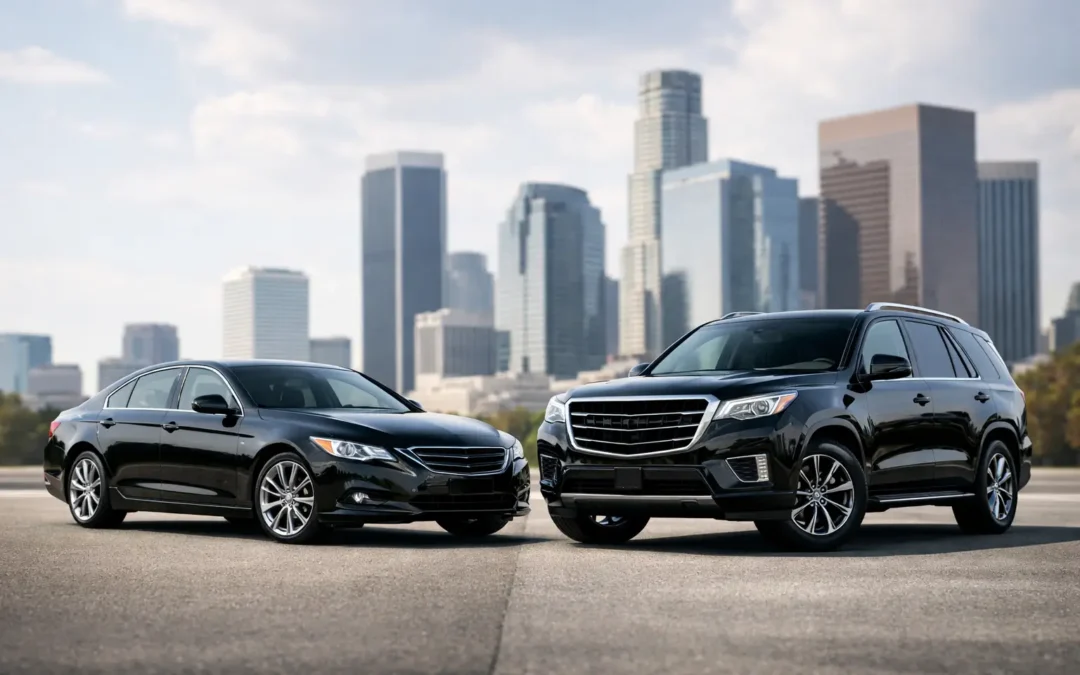
A vehicle choice can shape the first ten minutes of a board meeting, private aviation arrival, or client dinner. In the executive sedan vs luxury SUV decision, the better option is rarely about preference alone. It is about the passenger count, luggage profile, security expectations, road conditions, and the level of presence required at the curb.
For executive assistants, travel managers, and private clients, selecting the right vehicle protects the itinerary as much as it protects comfort. A professionally chauffeured sedan may be the ideal setting for a confidential one-on-one transfer. A luxury SUV may be the more intelligent choice when an FBO arrival includes several travelers and flight bags. The distinction matters because an otherwise excellent itinerary can feel poorly planned when the vehicle does not fit the moment.
Executive Sedan vs Luxury SUV: The Core Difference
An executive sedan is built around composed, private travel for one to three passengers. Its lower ride height, refined cabin, and understated profile make it particularly well suited to business districts, formal events, executive dinners, and airport transfers where a polished but restrained arrival is appropriate. For a single principal traveling with an assistant, it offers a focused environment with minimal distraction.
A luxury SUV adds capacity, elevated seating, and a more commanding road presence. It is commonly selected for travelers carrying multiple bags, families, security personnel, or small executive groups. Its higher ground clearance can also be valuable in mountain markets, inclement weather, rural estates, and destinations with less predictable road conditions.
Neither vehicle is inherently more premium. At the highest service level, both should be impeccably maintained, discreetly presented, and operated by an experienced chauffeur who understands timing, privacy, and route management. The question is whether the trip calls for intimacy and restraint or flexibility and additional room.
When an Executive Sedan Is the Better Choice
A sedan is often the strongest choice when the transfer is centered on a principal passenger and the schedule is tightly controlled. It creates a more personal cabin environment for quiet calls, final meeting preparation, or decompression after a long flight. The lower profile is also an advantage at certain corporate headquarters, private clubs, hotels, and evening venues where understated elegance matters.
For many corporate transfers, the sedan is the most efficient expression of executive travel. It is easy to position at a busy curb, generally quicker to load for light luggage, and well suited to dense urban routing. A chauffeur can often navigate downtown hotel districts and convention-area traffic with greater agility than a larger vehicle.
Sedans are particularly appropriate for a CEO traveling alone, an executive and one colleague, or a guest whose luggage is limited to a carry-on and briefcase. They also work well for a high-level client transfer where a calm, tailored arrival is more valuable than visual scale.
There are practical limits. Rear-seat space may become restrictive with three adults, especially on transfers longer than an hour. Luggage capacity can also tighten quickly with international-sized suitcases, garment bags, trade-show materials, or golf equipment. A sedan should not be selected simply because it appears more formal if the passenger and baggage profile says otherwise.
When a Luxury SUV Earns Its Place
A luxury SUV is the practical luxury choice when the itinerary involves more moving parts. It offers more room for passengers, carry-ons, checked luggage, and the incidental items that accompany executive travel: presentation cases, camera equipment, event materials, coats, and private aviation baggage. For airport and FBO transfers, that extra capacity often prevents a last-minute vehicle adjustment.
The SUV is also the right answer when an executive party needs to remain together. Keeping two or three senior travelers in one vehicle supports continuity, reduces coordination points, and avoids the risk of staggered arrivals. For families and high-net-worth travelers, the cabin space provides a more comfortable setting without compromising the level of service expected from a chauffeured experience.
Road and weather conditions deserve equal consideration. In markets affected by snow, heavy rain, uneven drives, or longer intercity routes, an SUV can provide useful confidence and comfort. It should not be treated as a substitute for professional route planning and trained chauffeur judgment, but it is often the better platform for variable conditions.
An SUV also presents differently. Its stature can be desirable for VIP movements, estate arrivals, and high-profile events where a more substantial vehicle supports the occasion. Yet greater presence is not always the objective. For a discreet principal who prefers to move without attracting attention, a sedan may communicate the right level of restraint.
Privacy, Presence, and Passenger Experience
Vehicle selection is part of executive hospitality. The vehicle should reflect not only where a passenger is going, but how they need to feel while getting there.
In a sedan, the passenger experience is close, quiet, and contained. For confidential calls or sensitive conversations, the compact rear cabin can feel intentionally private. The chauffeur’s role is central here: a polished professional understands when to engage, when to remain silent, and how to create an atmosphere of absolute discretion.
An SUV offers a different kind of privacy. The expanded cabin gives travelers more physical separation, which can be helpful for teams, family members, or an executive traveling with security. It may be more comfortable for extended transfers, but its larger interior can feel less intimate for a sole passenger. This is not a flaw. It is a trade-off that should align with the purpose of the ride.
Arrival presence also varies by occasion. A sedan signals classic executive formality. A luxury SUV suggests capability, flexibility, and a stronger visual footprint. For a roadshow, board meeting, or investor dinner, the sedan may align naturally with the setting. For a resort transfer, private terminal pickup, or event movement involving multiple guests, the SUV can be the more complete choice.
Luggage Is Often the Deciding Factor
Travel planners frequently know passenger counts but underestimate luggage volume. This is where otherwise thoughtful bookings can fail. Two passengers traveling domestically with carry-ons may fit comfortably in a sedan. Two passengers arriving from an international itinerary with large suitcases, garment bags, and personal items may not.
The same applies to private aviation. Travelers often bring luggage that is heavier, bulkier, or less standardized than commercial airline baggage. A luxury SUV offers useful margin, but a detailed manifest remains the best planning tool. If the itinerary includes skis, golf clubs, production equipment, mobility devices, or substantial event materials, a larger executive vehicle or separate luggage support may be required.
The professional standard is to confirm these details before dispatch, not to discover them on the apron or hotel driveway. Accurate passenger and baggage information gives the transportation team room to assign the right vehicle, stage additional support when needed, and protect the departure time.
How to Choose for Corporate Travel and VIP Itineraries
The most reliable selection process begins with the trip’s operational facts: number of passengers, number and size of bags, duration of the transfer, destination conditions, and any security or privacy requirements. From there, consider the social context. Is this a solo executive preparing for a presentation, a client delegation traveling together, or a family arriving at a private residence?
For multi-stop days, think beyond the first transfer. A sedan that works for a morning hotel departure may become impractical after an afternoon of shopping, event materials, or additional passengers. For roadshows, the vehicle should support the full day, including waiting time, venue access, and contingency routing. For VIP travel, the chauffeur should have clear instructions on pickup protocols, preferred communication channels, and discreet service expectations.
A capable transportation partner will ask the right questions without making the client manage the details. It will also recognize when the requested vehicle is not the operationally sound choice and offer a precise alternative. That is white-glove service: not simply providing a premium vehicle, but protecting the entire movement with careful planning.
The Best Vehicle Is the One That Removes Friction
Choose an executive sedan when the itinerary calls for understated sophistication, a focused cabin, and travel for a principal or small party with light luggage. Choose a luxury SUV when capacity, weather readiness, group continuity, or additional luggage creates a wider operational requirement.
The strongest decision is made before the vehicle reaches the curb. Share the full itinerary, passenger profile, and baggage needs with your chauffeur service early, then let thoughtful coordination turn a routine transfer into a confident, properly managed arrival.