
You're one flight change away from a mess. The car is confirmed, the driver is dispatched, and then the executive's arrival time moves by two hours, the terminal changes, the luggage count is wrong, and nobody can tell the chauffeur whether to meet curbside or inside. That's what usually breaks car service booking. Not the reservation button. The handoff between itinerary data, dispatch, and real-world coordination.
Treat this like operations, not convenience. A premium booking works when the provider has the right trip data, enough lead time, a vehicle that fits the job, and a live person who can absorb changes without making you start over. The market has already moved this way, too. Dealership service retention for vehicles under two years old fell from 72% in 2018 to 54% in 2025, while the two-to-five-year segment dropped from 70% to 51% over the same period, and Cox Automotive says dealerships handled 12% fewer service visits than in 2018 Cox Automotive ownership study. Booking behavior is clearly moving away from phone-first loyalty and toward digital, comparison-driven access.
Why Most Car Service Bookings Fail Before the Car Arrives
The failure usually starts before anyone sees a car. An executive lands late, the flight number changed mid-air, and the assistant assumes the chauffeur will “see the update.” The driver is waiting at the wrong terminal, the meet-and-greet note is vague, and the luggage count was never captured. The booking was technically confirmed, but the service was never operationally ready.
That's the wrong mental model. Car service booking is a coordination exercise, not a simple reservation. If you don't give dispatch the information it needs to predict delay, match the vehicle, and place the chauffeur correctly, you've just created a polite way to miss the pickup.
The real failure point is incomplete data
What breaks the booking is usually one of four things, wrong pickup details, missing flight data, unclear passenger count, or no instructions for the actual arrival point. A confirmation email doesn't solve any of that. The provider still has to assign the right person, the right car, and the right staging plan.
This is why online booking alone doesn't fix the problem. A 2025 CitNOW Group study of 100 leading dealers found only 27% of desktop sites let customers book a service by choosing a specific date and time, and that fell to 18% on mobile sites CitNOW Group study coverage. If a flow can't capture exact scheduling on mobile, it's not built for real executive travel pressure.
Practical rule: if the booking can't absorb itinerary changes and still keep the driver aligned, it's not a premium service workflow. It's a lead form with a car attached.
The strongest operators think ahead. They prepare for delay, not just confirmation. They expect the itinerary to change and make sure the booking format can survive it.
Choosing the Right Booking Channel for Each Trip Type
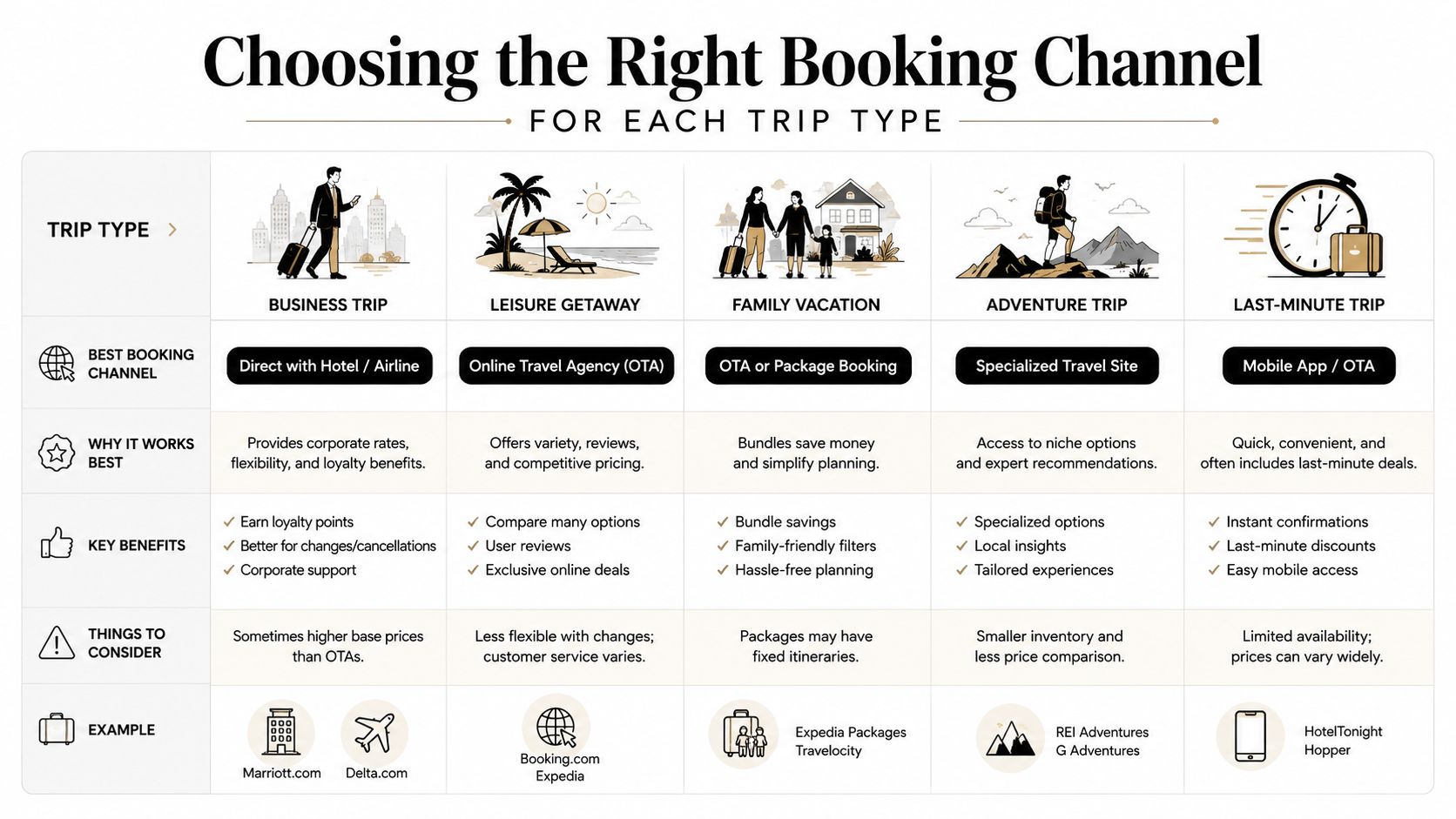
Not every channel deserves the same job. Use the wrong one and you'll waste time, force callbacks, or leave too much detail in the wrong hands. For corporate travel, the channel should match the complexity of the trip, not the habit of the person booking it.
Use online portals for volume and control
Online portals are best when you're handling repeat bookings, bulk reservations, or standard airport transfers across a team. They're useful for travel managers who need records, approval routing, and consistency. The downside is simple, portals often collect the basics but not the nuance.
That means they work well for known routes and routine movements, but they struggle when a booking has unusual pickup logic, security concerns, or a complex handoff point. If the trip is straightforward, a portal is fine. If the trip has ambiguity, it's not enough.
Use mobile apps for repeat, known routes
Apps win for speed. If the traveler flies the same route often, the app is the fastest path from request to confirmation. It fits common airport runs, same-day rebookings, and situations where the passenger can self-serve with minimal back-and-forth.
The weakness is depth. Most app flows are built to reduce friction, not to capture operational edge cases. When the trip involves a private terminal, a late aircraft change, or a driver who needs special access instructions, the app should be the starting point, not the final step.
Use phone or concierge for complex trips
Phone or concierge booking is the right answer for FBO arrivals, multi-stop itineraries, privacy-sensitive trips, and anything where the passenger can't afford a misunderstanding. A live coordinator can ask follow-up questions, confirm the pickup logic, and escalate the assignment before the car is staged.
A good operating rule is blunt. If the itinerary has more than one variable that could change, move out of self-serve and into live coordination. That's where reliability sits.
The Itinerary Details That Make or Break a Booking
A premium booking lives or dies on the intake form. If the form is vague, the dispatch is vague. If the dispatch is vague, the chauffeur is guessing. That's how you end up with a car that's too small, a meet point that doesn't work, or a driver waiting at the wrong door.
Collect the full trip picture up front
At minimum, capture the passenger name and direct contact, flight number and airline, arrival timing, terminal or FBO identifier, passenger count, luggage count, pickup style, destination address, and any secondary stops. Each field solves a different operational problem. Flight number lets dispatch track delays, luggage count helps match the vehicle, and the pickup style tells the chauffeur where to physically wait.
If the trip includes child seats, a multilingual chauffeur, a specific vehicle preference, or a security requirement, capture that before the booking goes out. These aren't special favors. They're standard trip inputs for executive work.
- Passenger identity and contact: The driver needs the right person, and dispatch needs a fallback if the itinerary changes.
- Flight or arrival reference: This is what allows real-time tracking instead of blind waiting.
- Luggage and passenger count: This prevents vehicle mismatch, which is one of the fastest ways to start a trip badly.
- Pickup method: Curbside, meet-and-greet, and inside-terminal pickup are not interchangeable.
- Destination precision: Gate, suite, or building-level detail matters more than a vague street address.
If the booking team has to chase missing details after confirmation, the workflow is already behind.
The internal standard should be simple. If one screen can't hold the trip data that matters, the channel isn't built for premium corporate use. Use a proper intake template instead, such as this executive travel itinerary template.
A useful video walkthrough is embedded below for teams training assistants and coordinators.
Timing Your Booking and Handling Last-Minute Requests
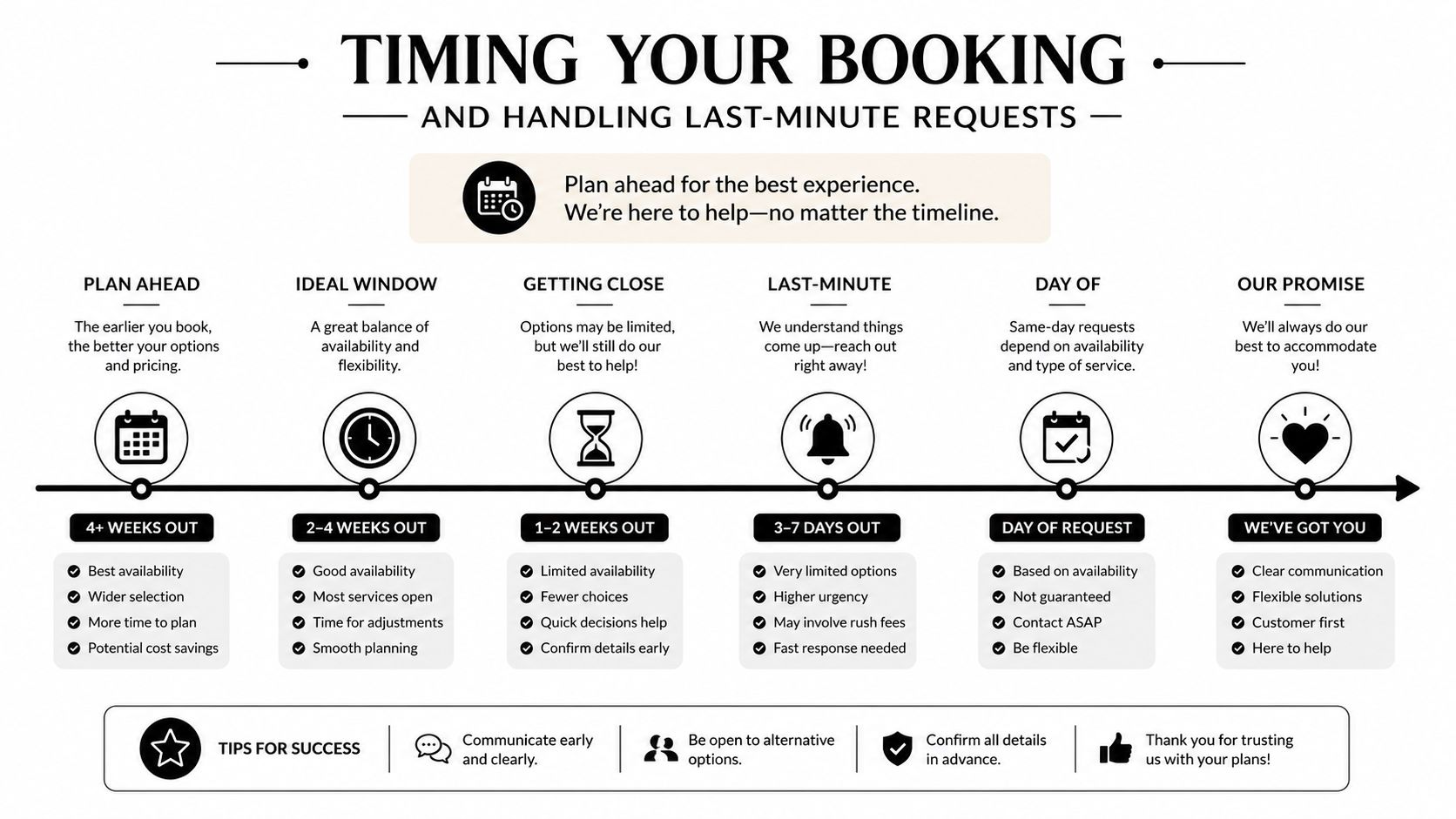
Lead time is a control variable. The more runway a provider has, the better it can assign the right chauffeur, stage the right vehicle, and absorb changes without drama. The less runway you give it, the more likely you are to get limited options, slower confirmation, or a workaround that costs you reliability.
Standard bookings need real runway
For ordinary corporate travel, book early and assume the schedule may shift. That gives the provider time to plan the assignment properly instead of filling a slot reactively. Use live coordination when the trip is time-sensitive, and escalate immediately if the itinerary is still moving.
The industry benchmark from service scheduling research is that systematic confirmation and reminder processes support 85 to 92% show rates, with same-day confirmation sent within 5 minutes of booking Rework service appointment scheduling. The point isn't just speed, it's discipline. Quick confirmation locks the booking in before details drift.
Same-day requests are a different workflow
Urgent bookings can still work, but only if you understand the trade-offs. You may get fewer vehicle choices, a narrower pickup window, and more questions from the coordinator before anything is confirmed. That's normal. The provider is protecting operational accuracy.
One benchmark recommends a 15 to 20% scheduling buffer and even translates 160 weekly technician hours into only 135 to 140 bookable hours to preserve flexibility for delays and emergencies Flai scheduling guidance. That logic applies here, too. Real service capacity needs slack.
| Workflow | Best Use | Operational Reality |
|---|---|---|
| Standard booking | Planned travel with stable itinerary | More vehicle choice, smoother assignment |
| Same-day booking | Late changes, disrupted flights, urgent pickups | Fewer options, tighter confirmation process |
| After-hours concierge | True emergencies across time zones | Live handling, but only if the provider is staffed for it |
The market is already acting like an always-on system. More than a third of bookings through a UK service and MOT platform were made for a date within a three-day window, and 27% were made outside traditional garage opening hours BookMyGarage update. That's the operating environment now.
Selecting the Right Vehicle and Amenities for the Trip

Stop defaulting to the cheapest car on the list. Executive ground transport fails when the vehicle does not match the passenger count, the luggage load, or the route. A sedan works for one traveler with light bags. The wrong choice creates curbside delays and forces last-minute fixes.
Match the fleet to the job
An executive sedan fits a solo airport run or a direct city transfer. A premium SUV is the better call when there is extra luggage, uncertain weather, or a passenger who wants more space and a higher seating position. A luxury van suits small group movement, while specialty vehicles belong in high-profile or secure transport scenarios.
Body style is only the starting point. Wi-Fi, phone chargers, bottled water preferences, privacy partitions, and temperature settings matter when the passenger is working or needs quiet. If those details are missing from the booking notes, the vehicle may arrive technically correct and operationally wrong.
For a closer look at what a premium SUV typically covers, that vehicle class is usually the safer choice whenever trip variables may shift.
Don't ignore chauffeur fit
The vehicle is only half the assignment. A chauffeur with the right language skills, security awareness, and familiarity with specific terminals or private aviation procedures can save the trip when conditions change. That matters more than a polished booking screen.
Coordination quality depends on the person behind the wheel as much as the car itself. MLR Worldwide Service is one option in this space, with executive chauffeur services, airport transfers, FBO support, roadshows, event logistics, and crew movements managed through a 24/7 operations team. That setup is built for handoffs, reroutes, and changing instructions, which is where weak booking data usually breaks down.
My position is clear: if the upgrade prevents even one failed pickup or awkward passenger handoff, it paid for itself.
Pricing Structures, Billing Options, and Cancellation Realities
Finance teams want one thing, predictability. Premium car service pricing usually isn't a single flat number, it's a stack of components that can move depending on the trip and the timing. If you don't understand the billing structure at the start, the invoice becomes a dispute later.
Know what sits inside the quote
The quote often reflects a base fare, distance or time component, meet-and-greet or airport handling, gratuity policy, and after-hours or holiday conditions. That's standard for this category, and it's why a quote that looks cheaper at first can become more expensive once the trip is amended or delayed.
Billing model matters just as much. Some teams want per-trip charges for tight control, while others need monthly aggregation for reconciliation and spend visibility. A managed account is usually the cleaner option for companies with steady volume because it reduces payment friction and makes exceptions easier to track.
| Billing Model | Best Fit | Key Advantage | Watch Out For |
|---|---|---|---|
| Per-trip card charge | Occasional bookings | Simple and immediate | Harder to reconcile at scale |
| Monthly aggregate | Regular travelers and assistants | Cleaner reporting | Needs strong account controls |
| Monthly cap | Predictable program volume | Budget discipline | Less flexible if demand spikes |
Treat cancellation terms as operational policy
Cancellation windows, no-show definitions, and amendment rules are not fine print. They decide whether a change is manageable or expensive. For accounts with steady volume, flexible terms can often be negotiated, but only if the provider sees you as a real operating partner rather than a one-off request.
The cheapest quote is rarely the cheapest outcome. Cancellation exposure, billing friction, and the cost of recovering from a miss usually matter more than the headline rate.
Coordinating FBOs, Crew Movements, and Event Logistics
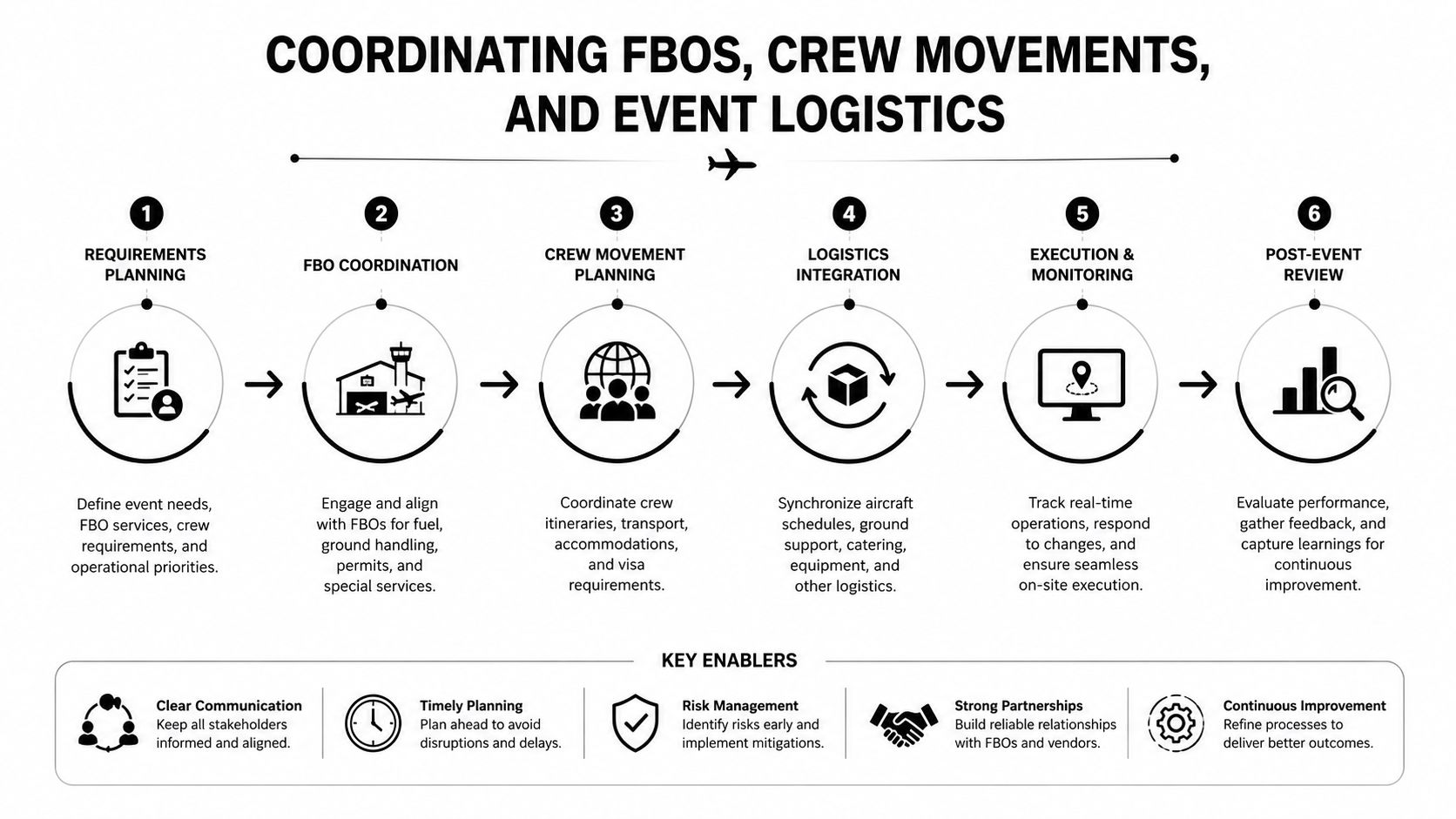
The moment you add an FBO, a crew rotation, or an event schedule, one booking becomes a system. You're no longer moving one executive from point A to point B. You're managing arrival windows, backup vehicles, named contacts, changing gate conditions, and dispatch instructions that have to survive real-time disruption.
Build the handoff around live operations
For private aviation arrivals, collect the full itinerary before dispatch. Include the flight number, passenger count, luggage load, pickup style, and destination plan so the chauffeur and coordinator can stage correctly. That coordination data matters more than the booking form itself, because incomplete inputs create failure risk even when the reservation is confirmed.
Crew movements need a different rhythm. Airline teams often work on tight turn windows, and event logistics can involve dozens of vehicles across multiple venues. A provider has to brief chauffeurs on names, access points, and timing, then keep a contingency vehicle ready if the arrival pattern shifts.
The same logic applies to roadshows. Three cities, two executives, and ten meetings in 48 hours is not a series of isolated rides. It's one moving operation with buffer vehicles, alternate chauffeurs, and a live comms channel. If the provider can't handle that, it can't handle executive travel.
Use a simple control tower model
The corporate travel manager owns the brief. The provider's concierge desk owns confirmation, dispatch, and amendment handling. The on-the-ground coordinator owns the actual pickup, staging, and fallback execution.
That division keeps everyone from improvising at the curb. It also prevents the classic failure where five people know part of the plan, but nobody owns the live itinerary.
A provider should be able to handle that handoff cleanly, and a reference point for larger travel coordination is Gateway Travel Centre, especially where routing, scheduling, and account management need to stay aligned.
Monday morning tools
Use this intake sequence before you book anything, passenger name, direct contact, flight or arrival reference, terminal or FBO, passenger count, luggage count, pickup method, destination, and special instructions. If even one of those items is missing, pause the booking and get it.
For amendments, use a direct script. State the new arrival time, the new pickup point, and what must stay unchanged. Ask the coordinator to repeat the updated assignment back to you before you close the call.
For a chauffeur no-show, escalate immediately to the live desk, request the assigned vehicle status, and ask for a replacement unit rather than waiting for the original driver to appear. If the flight diverts mid-air, send the new landing details the moment the crew has them and confirm whether the pickup instruction needs to move from curbside to meet-and-greet.
A provider deserves ongoing account status when it can take a full itinerary, respond through a live coordinator fast, and keep the trip intact when the schedule changes. If you can't hand over the full plan and reach a real person within five minutes, you're not using a premium service. You're using a reservation system.
If you want this handled without the usual scramble, work with a provider that treats every booking as an operations problem, not a transaction. MLR Worldwide Service arranges executive chauffeur services, airport transfers, FBO support, roadshows, crew movements, and event logistics with 24/7 coordination. Visit the site and use a team built for last-minute changes, multi-stop schedules, and the kind of reliability executive travel requires.