

Airport VIP services are not really about luxury. They are about reducing coordination risk when the airport, the border, the car, and the clock all have to line up at once. That matters more now because the market has moved into the mainstream premium-travel category, with global VIP airport services valued at $8.2 billion in 2025 and projected to reach $15.4 billion by 2034, a 7.4% CAGR over the forecast period. The same source says 43% of premium-cabin business travelers globally and 68% of ultra-high-net-worth individuals used dedicated VIP airport services in 2025, which tells you this is no longer a novelty for people who can't afford friction. The planning question is simple, does the service reduce failure risk enough to justify the spend? MarketIntelo's VIP airport services market report
Why Airport VIP Services Are Really About Risk Control
Airport VIP services are a control layer. They reduce the chance that a small airport problem turns into a trip problem. If a principal misses a connection, gets stuck at immigration, or arrives exposed in a crowded terminal, the cost is not confined to the service fee. It shows up as lost time, reputational drag, operational disruption, and sometimes a chain reaction across the rest of the itinerary.
Three failure modes matter most. Queue variability is the first, because public terminals run on shared bottlenecks and no one outside the system controls the wait. Handoff friction is the second, where the traveler moves from curb to terminal to security to border to car and every transfer creates room for delay. Document or language error is the third, and it becomes a real risk when a traveler is under pressure, changing plans, or crossing borders with a local host waiting on the other side.
Practical rule: buy airport VIP services for fragile itineraries, not for superficial status signaling.
That standard also explains why the service belongs in the toolset of people who are not traditional luxury travelers. Family office principals, senior executives, private-aviation travelers, and crew coordinators pay to compress uncertainty. Procurement should judge the service on how much exposure it removes from missed handoffs and messy arrivals, not on whether the lounge looks impressive.
The operational logic becomes clearer if you compare it with the ground-transport layer in MLR Worldwide Service's VIP transportation service overview. The test is simple. Does the service reduce enough coordination risk to protect the schedule and the people attached to it?
How a Modern VIP Airport Flow Works
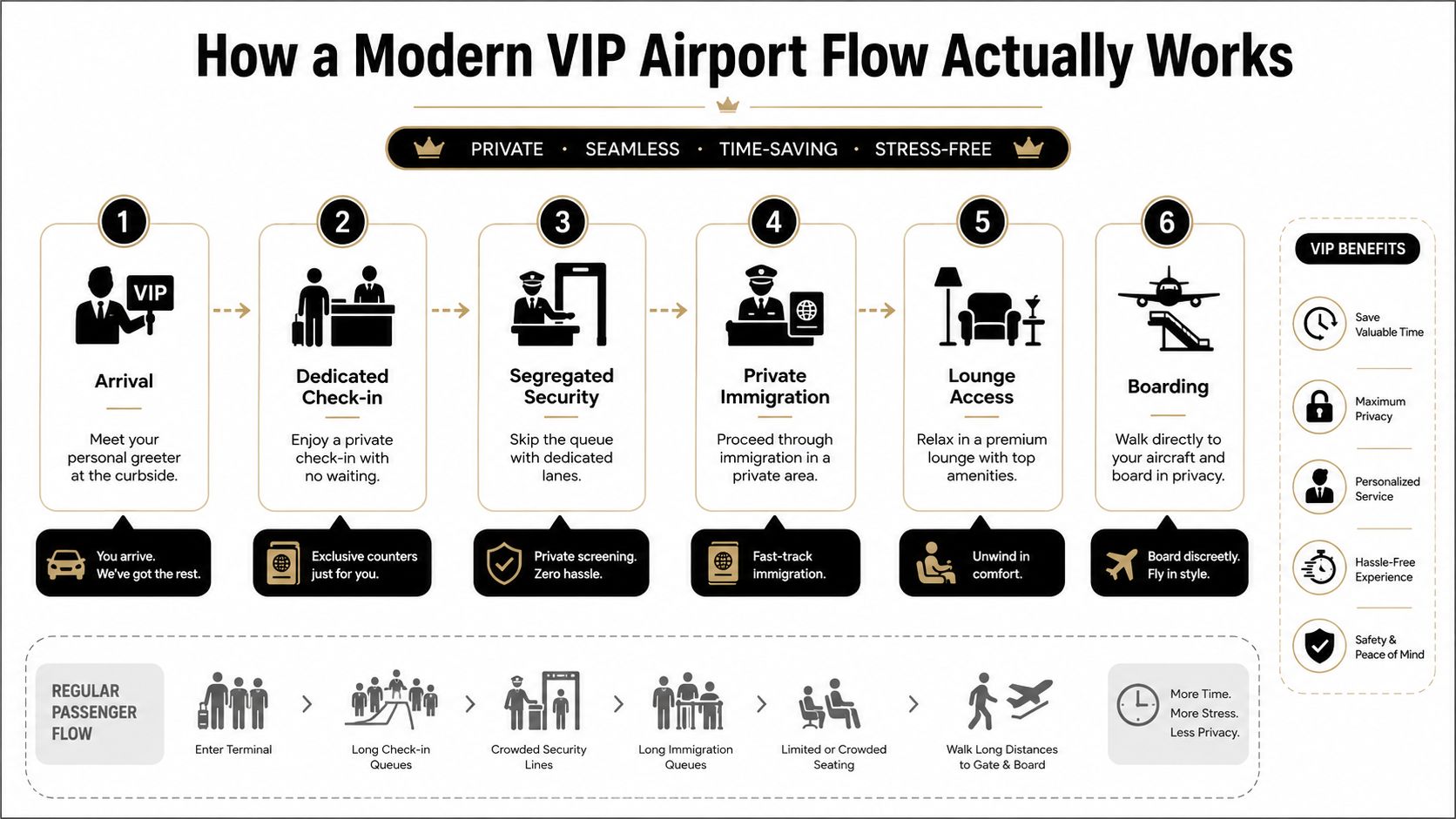
A real VIP flow depends on segregated processing paths. Priority handling inside a shared line still lives with the same crowding, the same congestion spikes, and the same upstream delays as everyone else. A genuine VIP arrangement uses dedicated check-in, fast-track or segregated security, private immigration where available, porter handling, and escorted movement to a lounge or directly to the aircraft.
What the operator coordinates
The operator is coordinating three moving parts at once. The airport handler clears the traveler through controlled access points. The ground team times the curbside arrival and vehicle release. The VIP agent keeps documents, luggage, and route changes aligned so the traveler does not become the message carrier between parties. That is why these services feel smooth when they work, because the traveler is not doing the coordination work.
The most advanced setups go further and function like a miniature terminal system with separate passenger, staff, and luggage paths, dedicated agents, and private lounge or suite spaces for checks and waiting. Recent airport infrastructure examples also show the digital layer that supports this, including 4K displays, high-speed internet, professional sound systems, microphones, streaming capability, and video telephony in VIP terminal environments used for private handling and high-end events. The point is not the electronics. The point is that the site can absorb last-minute document changes and schedule changes without collapsing into confusion. Fraport's description of new luxury spaces and VIP terminal infrastructure
What to verify before you buy
A proposal should tell you exactly where the traveler exits the public flow, who owns each handoff, and whether the lane is separate or just a priority queue dressed up in nicer language. If the seller cannot describe the check-in point, security path, immigration point, and boarding handoff in one clean sequence, the product is probably thinner than the brochure suggests.
The airline-crew model is the best mental analogy. Crew handling works because access is controlled, the process is repeatable, and the operator knows who is responsible at every step. Airport VIP services should look like that, even if the branding is more polished.
For a ground-transfer counterpart, see MLR Worldwide Service's VIP airport transfer page. If the airport vendor and the chauffeur vendor cannot coordinate in real time, the whole flow degrades fast.
Main Service Types and Which Travelers They Fit
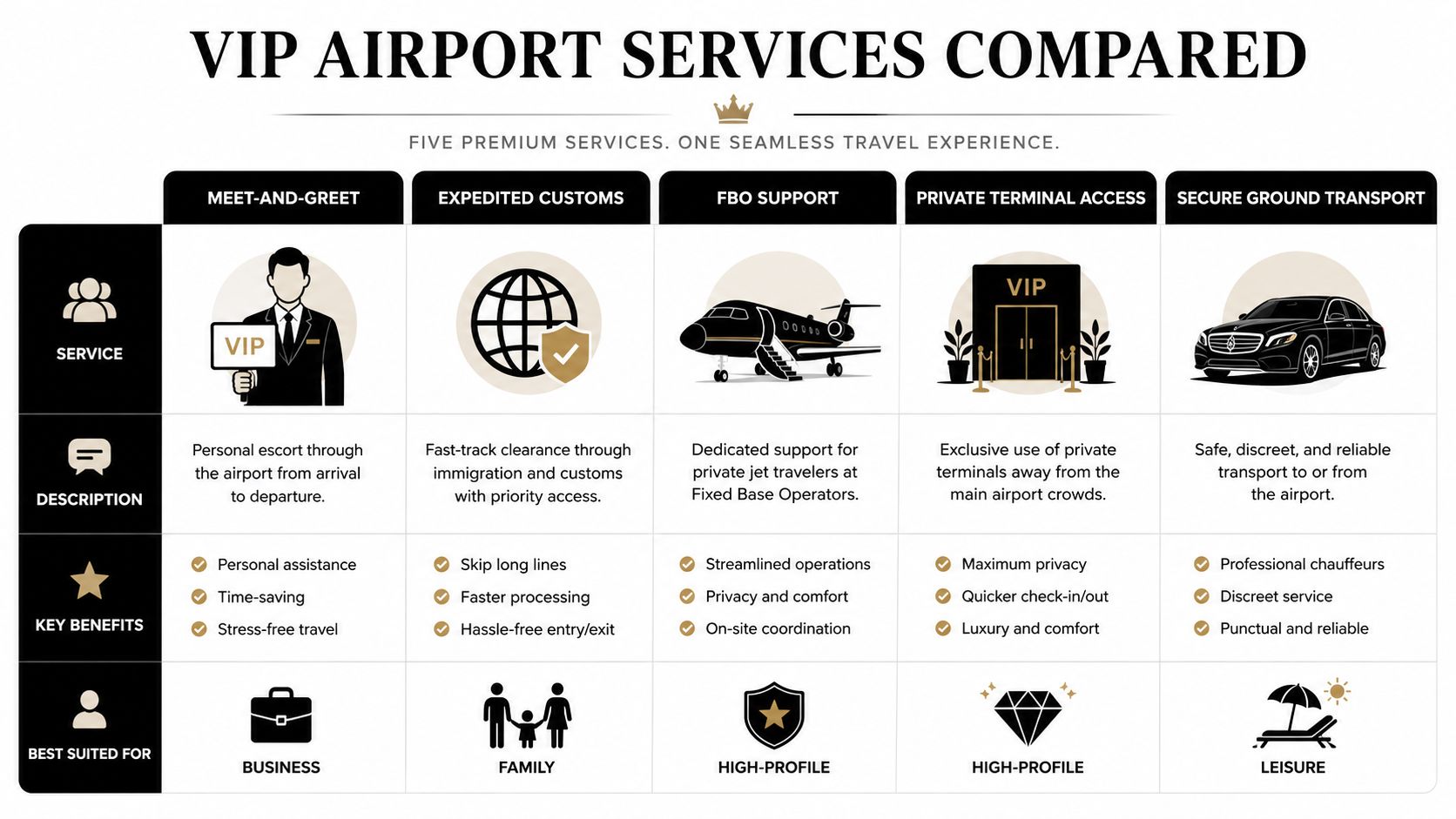
The market uses a lot of overlapping language, but the product menu is fairly stable. Buyers should separate the service into five buckets, because each one solves a different problem and each one breaks in a different way.
The five formats
Meet-and-greet is the lightest option. A greeter meets the traveler, helps with check-in, bags, directions, and escorting them to the next point. It fits business travelers, families, and frequent flyers who want help but don't need a fully controlled terminal environment.
Expedited immigration and customs is more specific. It makes sense for cross-border arrivals, transfer-heavy itineraries, and principals who don't want a complicated border process to consume the whole arrival window. It is only as reliable as the airport's local process design.
FBO and private-terminal support is the private-aviation version of the same idea. It fits travelers arriving on business aircraft, crews, and principals who want direct handling between aircraft, lounge, and car. Commercial-terminal assumptions often fail here, because FBO operations are closer to aviation coordination than consumer concierge work.
Secure ground transfer sits at the other end of the chain. It's the service that protects the last mile after landing or before departure. For high-profile travelers, that leg can matter as much as the airport itself.
Dedicated airline-crew services are a separate category, even if vendors package them inside VIP language. Crews need punctuality, turnaround discipline, and clean handoffs, not pampering. The right provider treats them as operational passengers, not leisure clients.
The fit question is simple. If the itinerary is public-terminal and time-sensitive, start with meet-and-assist. If it's cross-border or private-aviation heavy, buy the higher-control option.
A buyer should also stop treating commercial-terminal VIP and FBO handling as interchangeable. They overlap in appearance, but the work is different. Commercial VIP is about compressing the public terminal. FBO support is about making aircraft-side movement, document processing, and ground release happen cleanly.
For the ground side of the equation, MLR Worldwide Service's luxury airport car service page is a useful reference point because the airport product is only half the stack.
Pricing Factors and Realistic Cost Bands
Airport VIP pricing is messy because you are not buying one uniform product. You are buying a chain of labor, access, timing, and local airport permissions. That is why two proposals that look similar on paper can land very differently once the airport, the service tier, and the operating hours are clear.
The published market guidance is blunt enough to be useful. Consumer coverage says basic meet-and-assist can sit around $100 to $200, while full VIP terminal experiences can run $500+ depending on airport and tier. Treat those as directional, not universal, because the actual quote depends on local labor, airport access, and how much of the journey is bundled. Condé Nast Traveler's airport concierge coverage
Key Pricing Variables for Airport VIP Services
| Variable | Impact on Price | Buyer Watch-Out |
|---|---|---|
| Airport and region | Local access rules, labor costs, and terminal structure change the quote materially | Don't compare hubs and secondary airports as if they're the same product |
| Service tier | Meet-and-greet, private terminal, FBO handling, and secure transfer are not priced alike | Make sure the line item includes the actual path, not just the greeting |
| Traveler count | Single travelers are simpler than families or escort groups | Ask whether accompanying guests are included or billed separately |
| Time of day | After-hours or peak-window handling usually requires more staff coverage | Check for nighttime or weekend surcharges |
| Aircraft type | Private-aviation handling depends on the aircraft and ramp logistics | Confirm whether ramp-side support is included |
| Ground transport bundle | Bundled cars can make the quote look cleaner, but not always cheaper | Split airport handling from chauffeur service when benchmarking |
The hidden costs are the ones that hurt first-time buyers. After-hours surcharges, remote-terminal fees, and extra guest charges can change the economics quickly. So can special handling that turns out to be outside the initial scope. The cleanest procurement move is to normalize every quote by asking what exactly is included, who is covered, and what triggers a change order.
If you are comparing bids across cities, don't anchor on the headline number. Anchor on the path and the labor. That is what changes.
Procurement Checklist and Questions to Ask Operators
Airport VIP buyers get into trouble when they accept branding instead of accountability. The right vendor should answer operational questions in plain language and without evasiveness. If they can't, they're probably reselling access rather than controlling the flow.
Service-level guarantees
- What exactly is guaranteed, and what is best-effort only?
You need to know whether the operator is guaranteeing escort, document support, or a specific path through the airport. - What happens if immigration or security is backed up anyway?
This separates an operator with real escalation from one selling comforting words.
Escalation and 24/7 coverage
- Who answers at 2 a.m. when a schedule changes?
A real operation has named coverage, not a voicemail loop. - Can the concierge team re-route the booking in real time if the flight changes?
That matters for delayed arrivals, swapped aircraft, and missed connections.
Chauffeur and ground transport
- What vehicle class and driver standard are included?
If the airport side is premium but the car side is vague, the transfer still fails. - How do you coordinate curbside timing with the driver?
Good vendors track the handoff. Bad ones ask the traveler to call a car they can't see.
Contract and compliance
- Are the local affiliates vetted, licensed, and insured?
This is essential for multi-country use. - What is the cancellation and change policy?
Airport VIP service is often scheduled around unpredictable travel. Flexibility has to be written down.
Buyer discipline: ask each operator to map the full handoff from curb to gate or aircraft in writing. If they won't, don't assume the service exists.
For organizations that need recurring airport and chauffeur coordination, one practical option is a provider that combines airport handling with ground transport and 24/7 dispatch, such as MLR Worldwide Service. The relevant test is not the logo. It's whether the operator can own the transfer chain without passing the traveler between disconnected vendors.
Real Scenarios That Put the Service Stack to Work
A multi-city executive roadshow is where the value becomes obvious. The traveler lands late, has a short gap, and must switch from plane to car to meeting without absorbing terminal friction. In that case, the useful stack is meet-and-greet plus secure ground transfer, with the airport team pre-alerted and the chauffeur staged for a fast release. The failure mode avoided is simple, a perfectly good schedule getting eaten by a bad handoff.
A high-stakes first arrival is different. The traveler may have document complexity, a language barrier, or a host waiting outside the terminal. The better stack is expedited immigration support, a greeter who can manage baggage, and a driver who is already briefed on the timing. Here, the service is not about image. It is about preventing the arrival from turning into a coordination problem at the exact moment everyone is watching.
A 24-hour airline crew rotation through a hub airport is the most operational use case. Crews need predictable movement, clean timing, and someone who understands that the next leg starts the moment they clear the terminal. The vendor stack should look like crew handling, not customer pampering. If the operator can't keep the crew moving with minimal back-and-forth, they are not built for aviation schedules.
The pattern across all three is the same. The service works when it removes handoffs, compresses decision points, and keeps the traveler from becoming the coordinator.
Global Coverage, Standards, and Where the Market Is Heading
VIP airport service quality still varies sharply by region, and buyers should treat any provider claim as unproven until the operation is checked. The strongest markets are the ones with mature private-terminal and FBO infrastructure, because the physical setup already supports segregation, document control, and direct vehicle transfer. In other markets, the website may look polished while the actual delivery depends on local partners who may not work to the same standard.
A global affiliate network only has value if it produces the same result in every city. If it cannot, it is just a sales story. The test is whether the provider can keep the airport, the car, and the escort in one operating rhythm, even when the itinerary crosses time zones and the handoffs get messy.
Market design is shifting toward more direct procurement. The same MarketIntelo report cited earlier also notes that online bookings now account for 58% of reservations, up from 31% in 2019. It also points to more segmented offers, including arrival-only, transfer-only, and multilingual meet-and-assist products, which matches what serious buyers want, control over the move, not marketing language.
Procurement teams should favor operators that can prove control, not operators that describe elegance. Ask for airport-side segregation, ground-side coordination, and evidence that the network still works when the schedule breaks. If a vendor cannot show that, the service is decoration, not risk control.
Frequent Questions From Executives and Travel Managers
Are VIP fast-track lanes separate? Sometimes yes, sometimes no. True airport VIP service uses dedicated, segregated processing paths, while weaker offerings are just priority queues dressed up as premium access.
How far in advance do I need to book? It depends on the airport and the operator. Some services require 24 to 72 hours' notice according to independent guidance, so last-minute use is possible in some markets but not something to assume everywhere. The Points Guy's VIP concierge guidance
Does it help during irregular operations or immigration backups? A strong operator can still help with rerouting, document handling, and escalation, but they can't repeal airport congestion or border processing. If the provider makes promises that sound absolute, they're overselling.
Can you structure multi-city or recurring itineraries? Yes, and that's where good vendors earn their keep. Recurring airport VIP service is usually managed as a controlled workflow, with repeat traveler details, billing rules, and escalation contacts already in place.
If you want airport VIP services tied to real ground coordination, not brochure language, MLR Worldwide Service handles executive airport transfers, FBO support, secure transport, and crew movements with 24/7 coordination. Visit MLR Worldwide Service to review the service stack and see how it can be aligned to your next airport arrival, transfer, or recurring travel program.