

You've got the meeting on the calendar, the hotel is booked downtown, and the photo moment is already in your head. The only question left is whether an exotic car rental in Indianapolis, Indiana is the right move, or whether it'll turn into a paperwork drag before you ever touch the steering wheel. In this market, that distinction matters more than the badge on the hood.
Why Exotic Rentals in Indianapolis Feel Different
A senior executive lands at Indianapolis International, checks a phone full of messages, and needs to be downtown fast, polished, and on brand. The instinct is simple, rent something exotic and make the arrival look intentional. The trip doesn't start with the car, it starts with timing, insurance, and who's handling the handoff.
Indianapolis is a real premium-rental market, not a novelty stop. KAYAK lists average luxury car rental pricing at $95 per day in Indianapolis, with airport pickups averaging $85 per day, and says 25% of users found a luxury rental for $73 or less. It also shows January around $142 per day, which tells you the market has clear seasonality and that short-notice pricing pressure is real. Those are the numbers that matter when you're trying to move a client, a board member, or yourself through the city without delay, as shown in KAYAK's Indianapolis luxury rental data.
Indianapolis has the infrastructure, not just the demand
The broader state market backs up the availability story. IBISWorld estimates Indiana's car-rental market at $551.7 million in 2026, with 172 businesses and 1,218 employees, and reports 2.5% average annual growth from 2021 to 2026. That doesn't mean every exotic is sitting curbside ready to go, but it does mean the commercial base is deep enough to support premium logistics, according to IBISWorld's Indiana car-rental market view.
The local inventory also isn't just theoretical. Enterprise lists an Exotic Car Collection location at 7801 Col. H. Weir Cook Memorial Dr. with daily operating hours, and exotic vehicle groups also appear at IND in market listings. That combination matters because it shows the city can support both airport-based and neighborhood-based premium mobility.
Practical rule: If your Indianapolis trip depends on a same-day handoff, don't start with the car choice. Start with who can get the vehicle, the documents, and the return window aligned without wasting your afternoon.
That's the core difference here. In Indianapolis, the decision isn't really about whether you can find an exotic. It's about whether you can absorb the friction that comes with it.
How Indianapolis Exotic Pricing Really Works
Headline pricing is the easy part, and travelers often overvalue it. A quote that says luxury car rental at about $95 per day looks manageable until the rest of the stack appears. In this market, the cost is built from rate, insurance, deposit, mileage rules, delivery or pickup logistics, and what happens if your schedule changes midstream.
The hidden line items drive the real cost
Start with location. The airport number in KAYAK's data is lower than the citywide luxury average, which is what you would expect when a provider is trying to move inventory through a high-volume pickup point. That does not make airport pickup automatically cheaper in practice, because the final bill can still rise once the provider adds policy friction, verification time, and any delivery premium tied to your itinerary. The gap still matters, because it shows downtown convenience and airport convenience are priced differently.
Seasonality matters too. January is the expensive month in the KAYAK data, and that matters for corporate travelers because many trips are not planned around leisure demand. If your visit lines up with a busy week, an event surge, or a short-notice arrival, the quote you saw yesterday may not be the quote you get today. A “starting at” number is not the same as a usable trip budget.
The hidden line items drive the real decision
The biggest mistake is comparing an aggregator teaser to a real rental contract. Aggregators often show an attractive daily rate, but the final total can be shaped by the provider's insurance requirements, deposit rules, mileage controls, and return conditions. The more exotic the car, the more likely those rules matter.
| Line Item | Typical Range or Rule | Why It Matters |
|---|---|---|
| Daily rate | About $85 to $95 per day in the Indianapolis luxury market, depending on source and pickup point | Sets the base price, but not the true trip cost |
| Seasonal spike | January around $142 per day in KAYAK's Indianapolis data | Tells you when short-notice planning gets expensive |
| Airport pickup | About $85 per day on KAYAK's airport view | Often better for logistics, not always for the final bill |
| Security deposit | Varies by vehicle and provider rule | Ties up capital and can delay release |
| Insurance | Must meet provider requirements | The trip can stop here if coverage is not verified |
| Mileage and return rules | Provider-specific, often strict on premium vehicles | Affects whether the rental fits your itinerary |
| Delivery or handoff fees | Depends on pickup method and location | Can erase any apparent savings from a lower daily rate |
The right way to think about it is blunt. If the trip is short, highly scheduled, and tied to a client-facing appearance, the cheapest-looking quote is often the most fragile one. You do not need the lowest rate. You need the lowest risk of a failed handoff.
Chauffeured Versus Self-Drive and Which Fits You
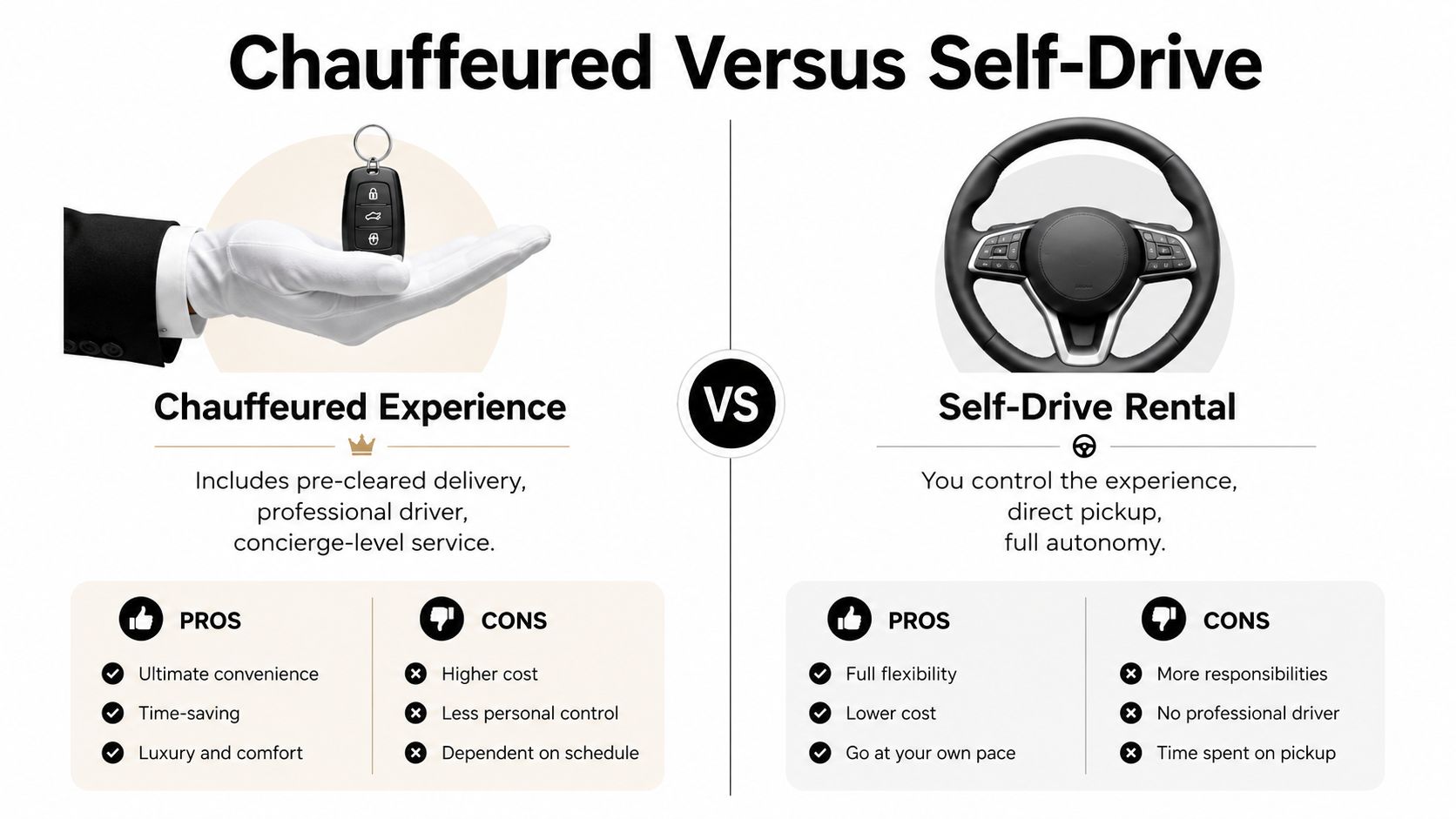
A white-glove chauffeured model handles the handoff, coordinates with your itinerary, and keeps the day from getting knocked off schedule by counter hours or missing paperwork. That matters in Indianapolis, where one delayed pickup can ripple through a client meeting, an airport transfer, or an event arrival. If the trip has liability pressure, a tight agenda, or no room for documentation mistakes, this is the cleaner choice.
What chauffeured service really buys you
The operational control is the key. The provider can line up the vehicle, manage the handoff, and keep the travel plan moving without forcing your team to stand in a rental queue or chase down one more document. For board travel, investor visits, airport-to-hotel transfers, and event schedules, that removes friction at the exact point where trips usually break.
Self-drive gives you the wheel and gives you the risk. If the insurance does not satisfy the provider, the deposit is a problem, or the pickup window slips, the trip sits on your desk instead of the vendor's. That might be acceptable for a leisure driver who wants the experience. It is the wrong trade for a corporate principal who needs the itinerary to hold.
Match the model to the traveler, not the car
- Corporate roadshow principal: Choose chauffeured service. The presentation value of the car matters, but schedule control matters more.
- Family-office leisure trip: Self-drive can work if the day is slow, the documents are in order, and nobody is depending on a perfect handoff.
- Private aviation client arriving at an FBO: Chauffeured delivery usually makes more sense because the ground transfer has to sync with the aircraft, not the counter.
- Event-driven rental: Either model can work, but only if the delivery timing and return plan are already locked in.
For clients who want the vehicle experience without absorbing the operational burden, private chauffeur services are the better fit, especially when the day has multiple stops and no room for check-in friction. MLR Worldwide Service fits that use case because it takes documentation, timing, and insurance coordination off the client's plate before the day starts.
Bottom line: The same exotic car can be two different products. In self-drive, you buy access. In chauffeured form, you buy certainty.
Airport, FBO, and Hotel Coordination Mechanics
If you are landing at IND and expecting to roll straight into an exotic, the handoff matters more than the badge on the grille. Airport counter pickup, neighborhood delivery, FBO transfer, and hotel valet coordination all solve the same problem in different ways. Pick the wrong one and you burn time before the trip even starts.
Airport, FBO, and hotel handoffs are not interchangeable
At the airport counter, the timing is fixed by the provider's desk operation. That matters in Indianapolis because a late arrival, a changed meeting, or a missed connection can leave the car waiting while your schedule slips. The risk is not the vehicle. It is the gap between your arrival and the moment the keys are ready.
FBO handoff gives you more control, but only if the provider already knows who is receiving the car and what aircraft timing looks like. Hotel delivery can be useful for late dinners, photo stops, or a next-day departure, but only when valet staff and the rental side are working from the same plan. If they are not, you end up managing three schedules at once.
The vehicle class also shapes the logistics. Hertz lists an Indianapolis luxury option in the Porsche Panamera class at about 22 mpg with 4 seats and 2-3 bags, while a Mercedes CLA250 class option is listed at about 29 mpg with 5 seats and 2-3 bags, on Hertz's Indianapolis luxury inventory page. That is not just a spec-sheet detail. It tells you whether the car fits a principal-plus-one move or a slightly larger executive transfer.
Sequence your day around the handoff, not the other way around
Set the handoff after the arrival chain is stable. If you are coming through IND, the provider, luggage plan, and meeting window need to line up before the car becomes your responsibility. If you are arriving by private aviation, the FBO option removes some friction only when the ground contact already knows who is taking delivery and when that happens.
That is where a chauffeured affiliate earns its value. A source like a guide to multi-stop ground coordination matters because it has to turn a moving itinerary into a real transfer plan, not a vague promise. MLR Worldwide Service is useful in that role because it can absorb timing, documentation, and insurance coordination before the day turns into a series of handoff problems.
Hotel deliveries work best when the car is part of a controlled schedule, not when the client is improvising between meetings. If you add a dinner stop, a suite change, and a return at a different location, the trip needs one person owning the sequence from start to finish. Otherwise, the trip becomes a chain of calls, not a transfer plan.
The practical lesson is simple. In Indianapolis, pickup location decides whether the day stays under control or gets eaten by logistics before the exotic even leaves the lot.
Contracts, Inspections, and Questions to Ask
The contract is where the trip turns into a liability decision. If you do not understand the paperwork, you do not control the trip. You are accepting whatever risk the provider has written into the rental. Exotic rentals are unforgiving here because the rules decide whether a same-day plan stays usable or turns expensive.
Ask the questions that expose liability
Start with insurance. Enterprise's exotic rental rules require renters to be at least 25, present a valid driver's license, a major credit card, and verified fully transferable insurance, with security deposits varying by vehicle selection. That is the kind of rule set that looks routine until a client tries to book late in the day and learns the paperwork is not ready.
Ask about mileage caps, geographic restrictions, fuel policy, damage claims, and after-hours returns. Those are not side notes. They define what you can do with the car. If the plan includes dinner, a hotel change, and a photo stop, the contract has to support that route without forcing anyone to guess at the limits.
Ask this directly: What happens if the car is late, the insurance is not accepted, or the return window changes after I have already started the day?
Inspect like the claim will be disputed
Before you drive off, do a full walk-around. Photograph every panel, wheel, and visible scuff. Check the tires, the interior, the windshield, and the infotainment screen. If the provider pushes for speed, keep the inspection efficient, but do not skip it.
A short checklist keeps the conversation focused:
- Insurance & Liability: Confirm coverage, deductible exposure, and whether your policy is accepted in writing.
- Mileage & Restrictions: Get the caps, blackout zones, and return rules before you sign.
- Vehicle Condition: Document pre-existing marks, tire wear, and cabin condition with time-stamped photos.
That discipline sounds basic, but it is where most avoidable disputes start. For a closer look at how written commitments should track the trip you are buying, how service-level agreements protect your trip matters because the provider's promises need to match the travel day, not just the marketing copy.
The right provider answers these questions quickly and in writing. MLR Worldwide Service is useful here because a chauffeured affiliate can absorb timing, documentation, and insurance coordination before a same-day exotic rental turns into a counter problem. If the answers are vague, move on.
How MLR Integrates Exotic Rentals Into Executive Itineraries
The cleanest way to use an exotic in Indianapolis is often not to self-drive it at all. A chauffeured affiliate can handle the handoff friction, verify the timing, and keep the trip from collapsing under documents, insurance, and counter-hour constraints. That matters most when the car is part of a broader executive movement plan, not a standalone toy.
The itinerary problem is bigger than the vehicle
Take a simple high-stakes day. A client arrives through an FBO, heads downtown for a meeting, wants an exotic for an evening appearance, then needs a late hotel return. On paper, that sounds like one rental. In practice, it's four logistics problems wrapped into one: arrival sync, meeting punctuality, appearance timing, and return control.
That's where a ground partner can reduce the risk. MLR Worldwide Service provides executive chauffeur services, airport transfers, FBO support, corporate roadshow coordination, event logistics, VIP secure transport, and a 24/7 concierge operations team. Used correctly, that means the itinerary gets built around the rental instead of the rental getting forced to carry the itinerary. For clients who want the look and feel of an exotic without owning the check-in burden, that's the better trade.
A worked example is straightforward
A client lands at the FBO, meets the chauffeur, and moves downtown for the first meeting in a separate executive vehicle. The exotic is then staged for the evening segment once the schedule is clear and the documentation is already handled. After the photo opportunity or dinner, the return is coordinated back to the hotel without forcing the client to deal with after-hours surprises or pickup confusion.
That model works because it separates movement from presentation. The executive ride stays discreet and reliable. The exotic shows up when it adds value, not when it introduces delay.
If you're managing a corporate principal, a family office client, or a private aviation traveler, the smart answer isn't always “rent the car.” Sometimes it's “let the operator absorb the friction and deliver the moment.” That's the difference between a nice idea and a usable transport plan.
Booking Timeline and When to Outsource
The best time to book an exotic in Indianapolis is before the trip becomes urgent. Availability may exist, but the verification and handoff process can still make a same-day plan fragile. The more moving parts you have, the earlier you should lock the provider, the insurance, and the delivery window.
Use a simple timeline
- 3 to 4 weeks out: Research providers, compare airport versus neighborhood pickup, and confirm whether the vehicle class fits the passenger count and baggage.
- 2 weeks out: Finalize the contract, verify insurance acceptance, and make sure the security deposit and driver requirements won't create a surprise.
- 1 week out: Confirm delivery details, counter hours, hotel coordination, or FBO handoff, and re-check the return window.
- Day of: Complete the inspection, document the condition, and don't let anyone rush the walk-around.
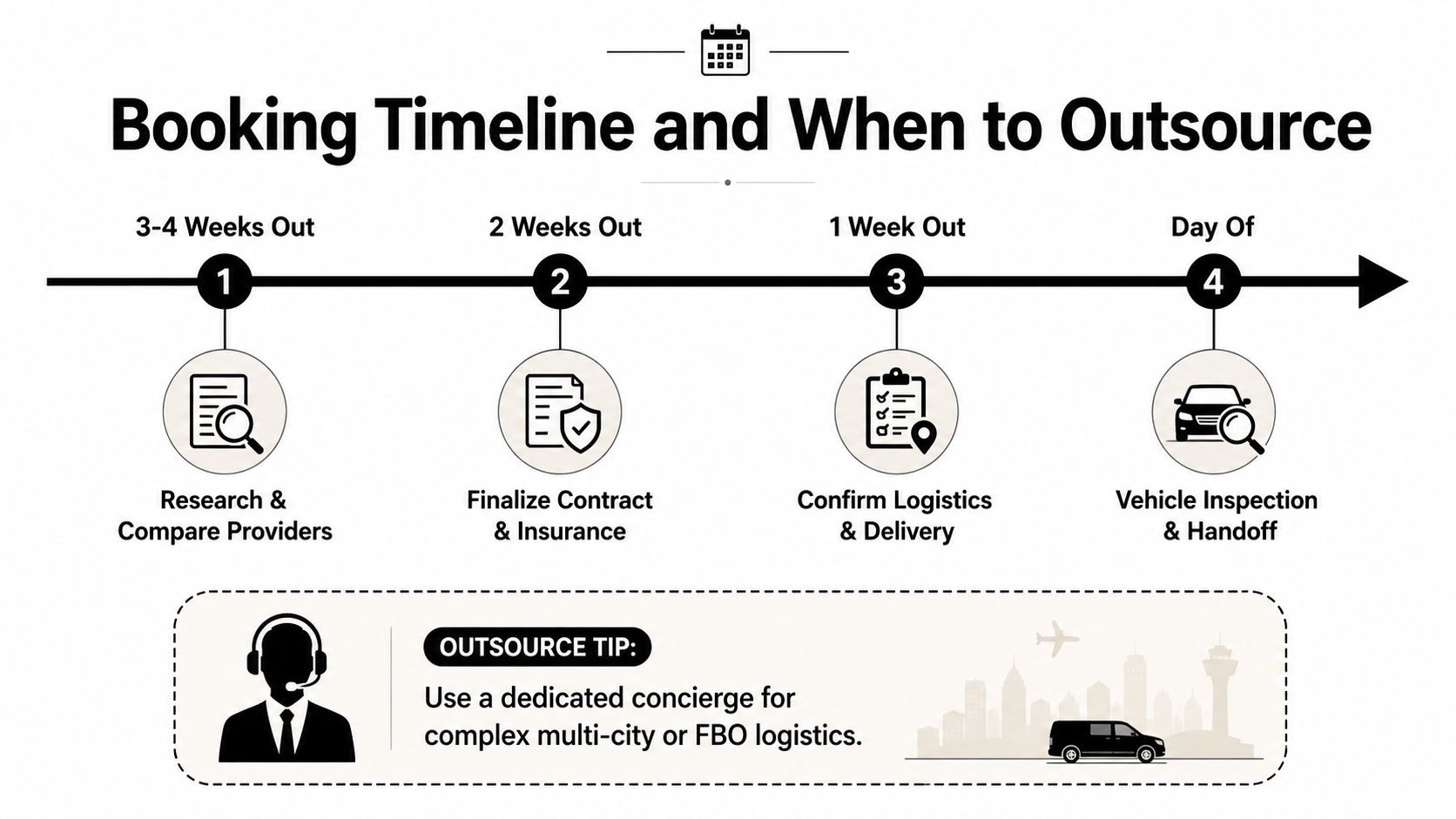
The outsource decision is simpler than it seems. If the trip involves an FBO arrival, a multi-stop day, or any same-day need with strict timing, hand it to a dedicated concierge and stop trying to make self-drive solve a logistics problem. If the trip is slow, local, and fully documented in advance, self-drive can work.
Where self-drive gets risky
It gets risky when the plan depends on the provider being flexible, because premium rental rules are rarely generous. It gets riskier when the trip is tied to a client-facing appearance, because a late handoff can blow up an otherwise clean day. It gets riskiest when the traveler hasn't pre-cleared insurance and can't afford to lose time at pickup.
A well-run Indianapolis exotic experience in 2026 should feel controlled, not improvised. The vehicle should arrive when promised, the paperwork should already be solved, and the day should stay focused on the meeting, the dinner, or the photo opportunity. If the rental can't do that, it's the wrong product for the trip.
If you need a ground partner that can absorb the timing, documentation, and itinerary risk behind a high-end Indianapolis move, visit MLR Worldwide Service and ask for an executive transport plan that fits your arrival, meeting, and return schedule. Their team handles chauffeur service, airport and FBO coordination, and multi-stop VIP logistics, which is exactly the support layer that keeps an exotic rental from becoming a liability problem.