
A corporate travel manager is watching the clock. The CEO's aircraft has arrived at a private terminal, the chauffeur should already be in position, and the dispatch line has been silent for nine minutes. No one knows whether the vehicle is waiting, whether the driver received the updated arrival time, or whether the passenger should move to another pickup point.
That silence is the customer support response time problem. It isn't merely the time between an email and a reply. It's the gap between a client's need and a qualified acknowledgment that confirms someone owns the next action. In executive transport, that gap can determine whether a carefully planned journey feels controlled or fails at the curb.
The operational standard should be simple: measure speed by channel, urgency, and ownership, then build staffing and escalation around those conditions. A respectable blended average won't protect a VIP traveler if the critical message is sitting in the wrong queue.
What Customer Support Response Time Really Means
Customer support response time starts when the client reaches out, not when a coordinator happens to notice the message. For a delayed VIP pickup, the first useful reply might confirm the chauffeur's location, verify the terminal, and state who is coordinating the recovery. A generic automated receipt can reduce uncertainty, but it doesn't prove that a qualified person has taken ownership.
The benchmark gap is already severe. A SuperOffice response-time benchmark summarized by Ringly found that 62% of businesses never respond to customer emails, while responding companies take an average of 12 hours and 10 minutes. The same benchmark reports that 89% of customers expect a reply within one hour, so a transport operator serving executives and private aviation clients should treat an hour as a ceiling for routine email, not an aspiration for live disruption.
Three clocks belong on the dashboard
First response time measures how quickly the customer receives the first acknowledgment from a human or an AI-assisted workflow. In a high-stakes operation, the response must do more than say “received.” It should identify the issue, name the owner, and give the next expected update.
Average response time measures the average gap between subsequent exchanges while the issue remains active. A team can post an excellent first reply and then disappear for hours. That produces a strong first-response figure and a poor experience.
Resolution time runs from the opening contact to a confirmed fix. For a transport request, resolution might mean the replacement vehicle is confirmed, the driver has the new instructions, the FBO coordinator has been notified, and the client knows the recovery plan.
Practical rule: Acknowledgment starts trust. Ownership sustains it. Resolution completes the promise.
Use the concierge test
Think of the three measures as stages in a luxury hotel. First response is the doorman opening the door. Average response is the concierge returning with updates instead of leaving the guest to search for answers. Resolution is the moment the full request has been handled.
A missed pickup, a flight delay, and a routine invoice question shouldn't share the same urgency. The correct response-time design follows the criticality curve of the trip. As a journey moves from planning to active movement, a small change can become operationally urgent, especially across terminals, time zones, and provider handoffs.
Why One Response Time Number Is Never Enough
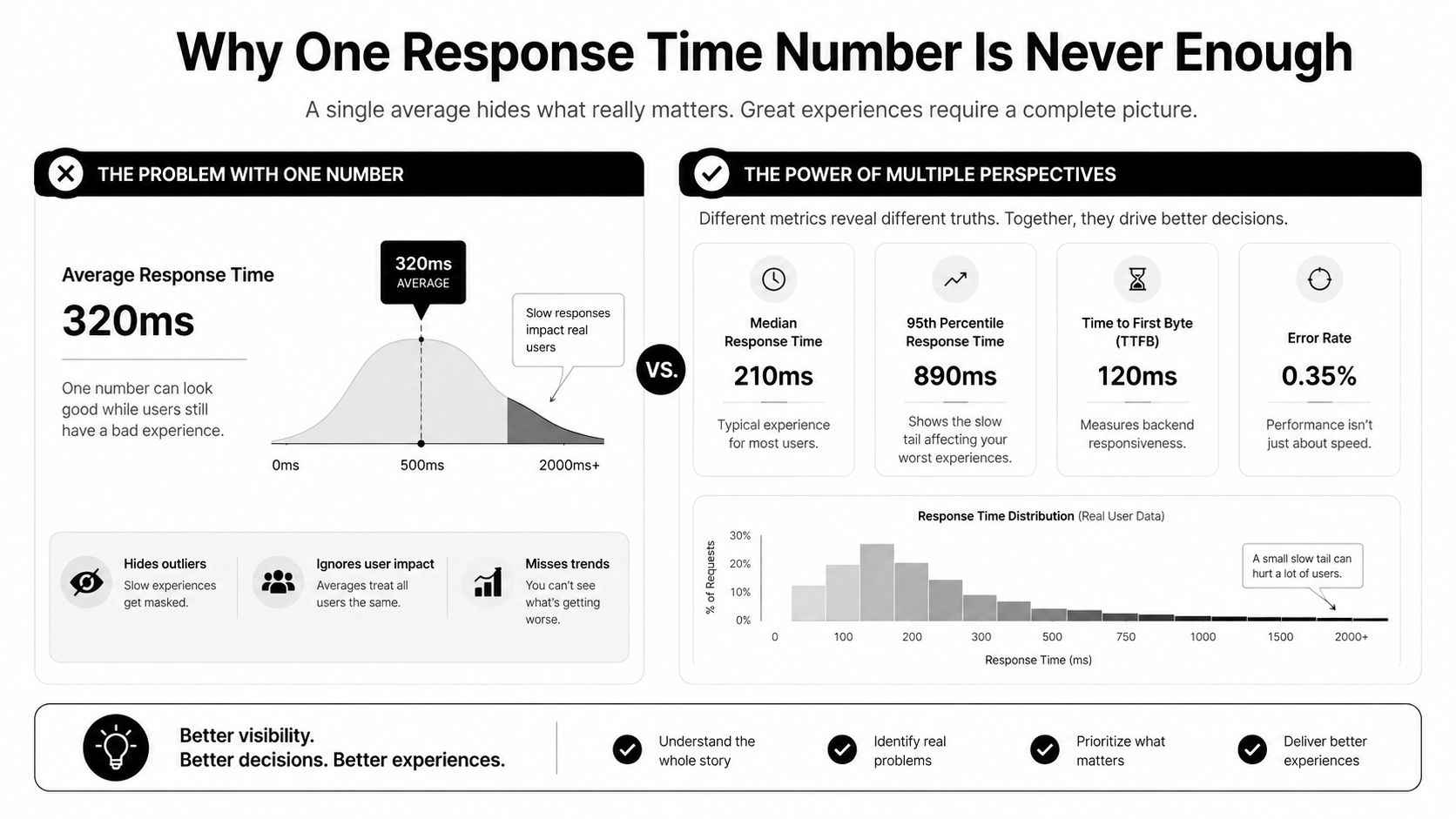
A single customer support response time KPI creates false confidence because every channel carries a different expectation. Email can tolerate a longer queue than live chat. A phone caller has already chosen an immediate interaction. A WhatsApp message from a passenger in transit may look informal, but its operational meaning can be urgent.
The published benchmarks show the spread clearly. Industry summaries reviewed by Visionary Marketing place live-chat first responses at roughly 47 seconds to 1 minute 35 seconds, while email remains around 12 hours and social media often sits at 4 to 5 hours. Treating those channels as one service line makes the report neat and the diagnosis useless.
Consider three common failures:
- The average hides a live breach. A blended 12-minute result might look healthy after overnight email backlog is included, even though a live-chat customer waited four minutes during an airport rush.
- The queue ignores consequence. VIP trip-critical messages can sit behind low-priority billing questions because the system sorts by arrival time instead of trip impact.
- The channel hierarchy is backwards. A social direct message from a high-net-worth traveler may wait longer than a routine website form because the operator never assigned social messages to the active dispatch queue.
Report risk, not comfort
The appropriate reporting model is a channel-and-criticality matrix. At minimum, separate email, phone, live chat, social messaging, and WhatsApp. Then overlay trip status, such as pre-booking, en route, or post-trip, and client priority.
A global average can remain as a capacity indicator, but it shouldn't be the CEO's primary service measure. The honest question isn't “What is our average?” It's “Which urgent requests waited too long, on which channel, and why?”
Channel-by-Channel Benchmarks for 2026
Strong performers now operate against different clocks for different channels. The 2026 benchmark summary from TextExpander reports that 89% of email customers expect a reply within one hour, 31.2% want one within 15 minutes, and best-in-class live-chat teams answer in under 30 to 40 seconds. Those figures describe broad customer expectations, not a universal promise for every chauffeur company, but they establish the direction of travel.
For luxury ground transport, targets should be stricter when the booking is active or the request affects a passenger's next movement. Use the following as operating targets, then validate them against actual demand and staffing capacity.
| Channel | Routine Target | VIP / Trip-Critical Target | Off-Hours Target |
|---|---|---|---|
| Under 1 hour | Under 15 minutes | Acknowledgment immediately, owner assigned promptly | |
| Live chat | Under 45 seconds | Under 30 seconds | Active coverage or clear escalation |
| Phone | Under 20 seconds | Immediate priority answer | Live dispatch coverage |
| WhatsApp Business | Under 5 minutes | Under 1 minute | Under 5 minutes for active bookings |
| Social DMs | Under 30 minutes during business hours | Route immediately to operations | Monitor or redirect to live support |
These are targets, not guarantees. The operational point is the spread. An email queue and a live-chat queue can't share staffing assumptions, alert thresholds, or escalation rules. A call from a known executive assistant should not force the caller through a long menu, while a social message about a future inquiry can move through a monitored service queue.
Match the channel to the consequence
Email is appropriate for quotes, itinerary documentation, and non-urgent account questions. Live chat works for active website visitors who need quick confirmation. Phone, WhatsApp, or another monitored messaging channel should carry the greatest weight during live travel, FBO coordination, chauffeur changes, and crew movements.
Operators should also publish a fallback. If a trip-critical WhatsApp message isn't acknowledged within its target, the system should alert a dispatcher and place an outbound call. If a live chat ends without ownership, the conversation should create an operations task rather than disappear with the chat window.
For an example of how online chat fits into a broader transportation workflow, review MLR Worldwide Service's online chat resource. The principle is practical: channel availability creates an obligation to staff and monitor that channel. Offering chat without fast coverage is worse than directing the customer to a channel the team can manage.
How to Measure and Report Response Time
A response-time number is only as reliable as its starting timestamp. If one report starts at ticket creation and another starts when a coordinator manually claims the request, management may compare two different operational realities without realizing it.
Capture three timestamps:
- Ticket creation: when the platform records the request.
- First inbound message: when the customer sends the message.
- Manual pickup: when a coordinator accepts responsibility.
The safest approach is to retain all three and label the metric clearly. For customer-facing performance, start with the first inbound message. For workflow diagnosis, compare it with ticket creation and manual pickup to expose routing or notification delays.
Tag the context before chasing speed
Every interaction should carry enough context to explain why it was urgent. At minimum, tag:
- Channel: email, phone, live chat, WhatsApp, or social.
- Trip status: pre-booking, en route, or post-trip.
- Client tier: Standard, Priority, or VIP.
- Operational category: booking, dispatch, flight change, FBO, crew movement, billing, or general inquiry.
A dashboard should show first response and resolution time separately. Segment both by channel and client tier, then review weekly trend lines. Monthly averages can smooth over the exact Friday-night failure that cost a client confidence.
The real-time transportation visibility guidance from MLR Worldwide Service is relevant to this measurement design because support performance depends on operational context. A coordinator can't judge urgency from message text alone if the system doesn't show whether the passenger is still planning, en route, or already waiting.
Review exceptions, not vanity averages
During the weekly operations review, pull every interaction that exceeded its SLA ceiling. Sort the list by cause:
- Routing failure.
- Unmonitored channel.
- Staffing gap.
- Missing escalation.
- Incomplete customer or trip data.
Assign an owner and a corrective action to each recurring cause. A dashboard should help management decide whether to change a queue, add an alert, revise a script, or move authority closer to the dispatcher. It shouldn't exist merely to display a favorable average.
Business Impact on VIP Clients and Repeat Bookings
A flight change exposes the value of a luxury transport operation. The client may have a late-model vehicle, discreet chauffeur, clean cabin, and planned route, yet experience the service as unreliable if nobody confirms the new movement.
A SuperOffice benchmark reported by Ringly found that customers expect a reply within one hour, while responding businesses average 12 hours and 10 minutes. For an executive traveler, that gap signals whether the operator is present when conditions change. The benchmark is not a VIP retention forecast, but it sets a clear operating standard: acknowledgment must precede uncertainty.
Silence changes the meaning of an incident
During an FBO arrival, a client who receives no update cannot tell whether the chauffeur is moving, the vehicle remains assigned, or the flight delay has been reviewed. A silence of 15 minutes can trigger repeated calls, a second vehicle request, or a switch to another operator for the next movement.
The commercial risk is specific:
- NPS feedback: A detractor comment may read, “I called three times about the flight delay and no one confirmed the chauffeur was moving.” The complaint identifies missing ownership, not a poor cabin or vehicle.
- Repeat bookings: If the operator eventually resolves the issue but leaves the client uncertain during an active transfer, the account manager must treat that trip as a retention risk.
- Competitive switching: An executive assistant or travel manager may award the next airport transfer to the provider that confirmed the action first.
Do not publish a universal VIP repeat-booking rate without verified internal data. Use an account-level example instead. Suppose an operator records a VIP client's 15-minute FBO silence, a second call from the assistant, and a later complaint about unclear ownership. That account should enter a retention review, with the next booking, recovery contact, and service outcome tracked separately from routine trips.
Track the moments that threaten the relationship
Connect response records to flight changes, FBO arrivals, failed pickups, replacement vehicles, crew movements, and post-trip feedback. A five-minute delay confirming chauffeur arrival can carry more relationship risk than a longer delay on a routine billing question.
Report results through a criticality-adjusted view, not a single average. Compare active executive movements with future inquiries, and separate first acknowledgment from the action that restored control. If a client had to ask twice during a live transfer, record the lapse even when the final resolution succeeded. Recovery protects the account. It does not erase the silence that caused the client to question whether anyone was managing the trip.
Sample SLA Language for a Luxury Chauffeur Operator
A generic SLA treats every customer and request as interchangeable. A luxury chauffeur operator needs a tiered agreement that binds the clock to the trip, the channel, and the consequence of delay.
Use three service levels. Standard covers routine inquiries and future planning. Priority covers confirmed bookings approaching service. VIP Trip-Critical covers live journeys, FBO arrivals, flight disruptions, crew rotations, and any request where silence can interrupt movement.
The following language is designed for an operations manual or service agreement. Adapt the channel names to the tools your team monitors.
Copy-ready service levels
| Tier | Email First Response | Phone | Chat / WhatsApp | Resolution Target |
|---|---|---|---|---|
| Standard | Under 1 hour | Prompt response during coverage | Under 5 minutes | Same business day where practical |
| Priority | Under 15 minutes | Priority queue | Under 1 minute | Confirmed plan within the active service window |
| VIP Trip-Critical | Immediate acknowledgment and owner | Immediate escalation | Under 30 seconds for chat, under 1 minute for WhatsApp | Action plan immediately, continuous updates until closed |
Standard service language
“For routine inquiries, including future bookings, general availability, and account questions, we'll acknowledge your request within the stated email or messaging target. We'll provide a substantive response or identify the responsible coordinator as soon as the required information has been confirmed.”
Priority service language
“For confirmed bookings approaching service, our operations team will prioritize your request, acknowledge it within the Priority target, and provide an update if resolution requires coordination with a chauffeur, affiliate, airport, or flight schedule.”
VIP Trip-Critical service language
“For active trips, FBO arrivals, flight disruptions, crew movements, and other trip-critical requests, contact our live operations channel. We'll acknowledge the request immediately, assign an owner, and communicate each material action until the issue is resolved or a documented recovery plan is accepted.”
Define the fallback
Every SLA needs a failure path. If the primary channel isn't acknowledged within the VIP target, the coordinator should escalate to the live dispatch channel and attempt an outbound call. If a request can't be resolved immediately, the team should send an update that states what has been confirmed, what remains open, who owns it, and when the next update will arrive.
For a broader framework on structuring service commitments, see MLR Worldwide Service's service-level agreement guidance. The agreement should reflect actual coverage. Don't promise a response window that no manager monitors during overnight operations.
Final Checklist and What Most Operators Get Wrong
A thirty-day audit will reveal more than a polished service dashboard. Review the promise, the staffing, the routing, and the recovery process as one system.
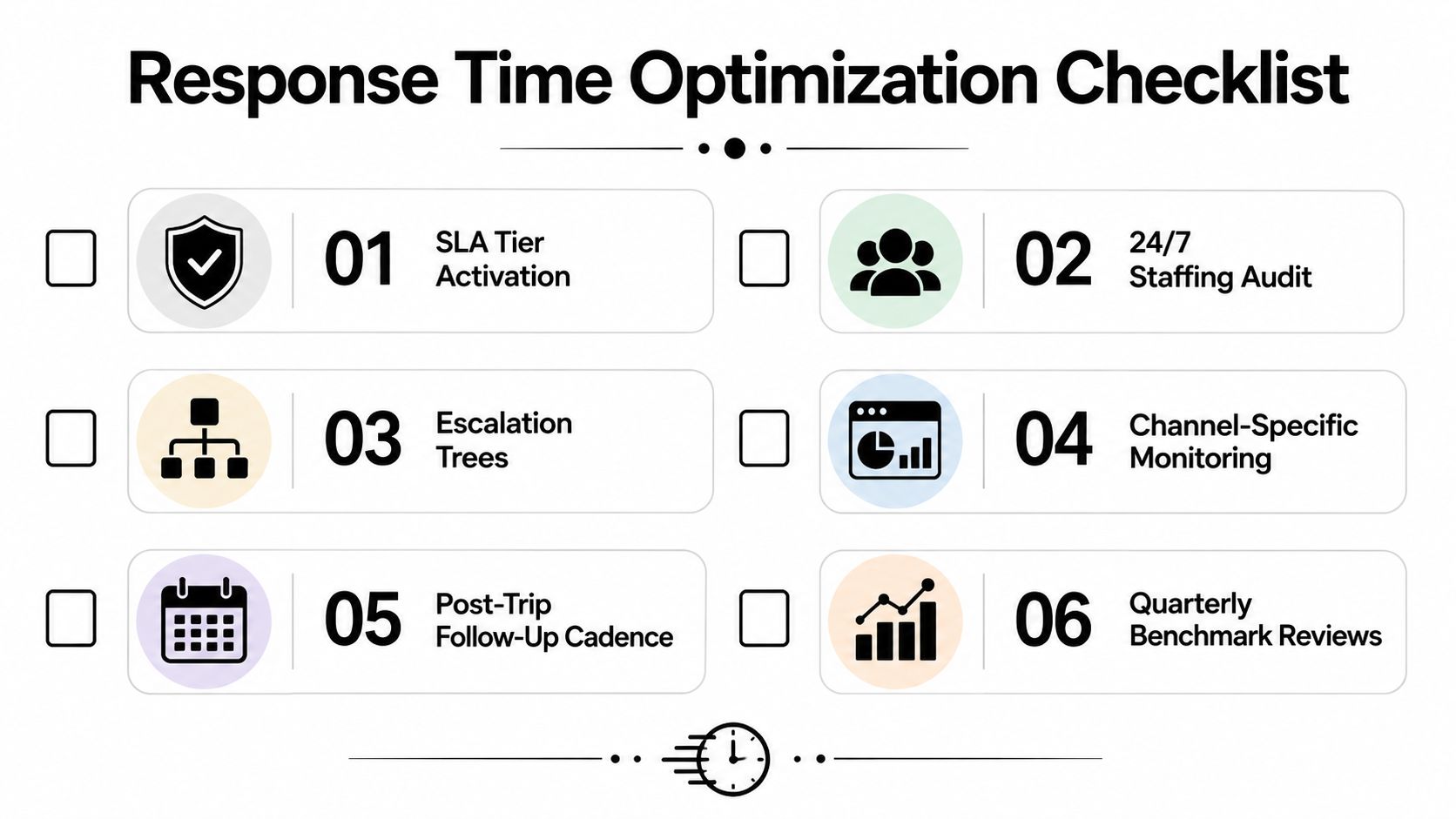
Run the audit in this order
- Activate SLA tiers: Apply Standard, Priority, and VIP Trip-Critical rules to real requests, not theoretical categories.
- Audit 24/7 coverage: Map every hour and time zone against actual live demand, especially for private aviation and crew movements.
- Test escalation trees: Send controlled alerts and verify that an unanswered message reaches a named dispatcher.
- Monitor each channel: Report email, phone, chat, WhatsApp, and social separately.
- Set post-trip follow-up cadence: Confirm that the client receives a useful follow-up after disruption, not only after a flawless journey.
- Review benchmarks quarterly: Recalibrate targets when customer behavior, channel mix, or operational coverage changes.
Five mistakes deserve immediate correction
Operators publish SLAs that nobody monitors. They report average response time instead of first response and resolution separately. They treat crew transport as a local-time operation even when flight schedules cross borders. They classify WhatsApp as informal and low priority, despite clients using it during active travel. They close a ticket when the message is answered, not when the customer confirms that the operational problem is handled.
A missed SLA is rarely just a delayed reply. In executive transport, it can leave a chauffeur waiting at an FBO while the passenger searches for certainty elsewhere.
The standard you claim should match the system you run. Audit the queues, test the handoffs, inspect the outliers, and ask one direct question for every failure: who owned the next action, and how long did the client wait to know it?
If your operation needs response-time discipline across executive transfers, FBO coordination, itinerary changes, or crew movements, visit MLR Worldwide Service to discuss 24/7 live coordination and global ground-transport support. Build the channel-and-criticality model before the next urgent request exposes the gap.