
A CEO lands late from London. Their first meeting moved up. The investor lunch address changed because of a security hold. The assistant is texting from the terminal, the travel manager is watching the calendar slide, and every missed minute now affects three more commitments behind it.
That's the moment when executive ground transportation stops being a line item and becomes operating infrastructure.
Corporate travel managers and executive assistants usually inherit this category after something has already gone wrong. A missed pickup. A driver who can't locate the passenger at an FBO. A local vendor who performs well in one city and falls apart in the next. The lesson is always the same. If you treat executive transportation like a commodity purchase, you get commodity outcomes. If you manage it like a controlled service with standards, accountability, and reporting, you protect time, reduce friction, and make senior travelers more productive.
The High Stakes of the Last Mile in Corporate Travel
A flight lands on time, but the schedule still breaks at the curb.
That failure point shows up fast in executive travel. The aircraft can recover from a delay. The calendar usually cannot. If the vehicle is not staged correctly, the chauffeur has incomplete notes, or dispatch misses a terminal change, the executive loses time immediately and the rest of the day starts slipping with it.

Where the highest exposure sits
Travel managers often get credit for negotiating airfare, hotel rates, and policy compliance. Senior leadership notices something more immediate. Did the traveler arrive ready for the meeting, with privacy protected and no operational noise spilling onto the principal?
That is why executive ground transportation belongs in the same conversation as business continuity and traveler support. The service protects meeting readiness, confidentiality, duty of care, and schedule control during the part of the trip where plans tend to change by the minute.
For corporate travel managers and executive assistants, the procurement mistake is treating this category like basic local transport. It is closer to a managed service. Vendor selection, service standards, escalation paths, billing accuracy, and reporting quality all affect the outcome. A lower rate can disappear quickly if your team spends hours chasing receipts, resolving service failures, or explaining to leadership why a board member was left waiting outside an FBO.
A general ground transportation service overview is useful as a starting point. In practice, the last mile matters more because it is where itinerary complexity, traveler expectations, and vendor execution all meet in real time.
Executive travelers rarely judge this category by price first. They judge it by whether the day stayed on track.
Why consumer-grade options break down
App-based transport works for low-coordination trips. It weakens when the assignment includes meet-and-greet, named chauffeurs, manifest notes, multiple stakeholders, airport monitoring, or centralized billing.
The trade-off is straightforward. Consumer platforms optimize for immediate availability and broad coverage. Executive programs optimize for control, accountability, and response when something changes. If your traveler is a CFO on earnings week, a legal team arriving for a sensitive matter, or a founder moving between investor meetings, those differences are operational, not cosmetic.
From a management standpoint, this is also where ROI becomes visible. A properly managed program reduces missed connections between air and ground, shortens the back-and-forth between dispatch and assistants, gives finance cleaner billing, and gives procurement a service model that can be measured. Those gains are harder to see on a rate card, but they are usually what determine whether the program holds up under pressure.
What Truly Defines Executive Ground Transportation
The easiest way to explain executive ground transportation is this. A commercial flight and a private jet can both get a passenger to the same city. What changes is control.
That same gap exists between a professional chauffeured program and standard app-based transport. One is built for predictability. The other is built for convenience at scale. If you're supporting executives, investors, legal teams, private aviation guests, or VIP clients, control is usually the thing you're buying.
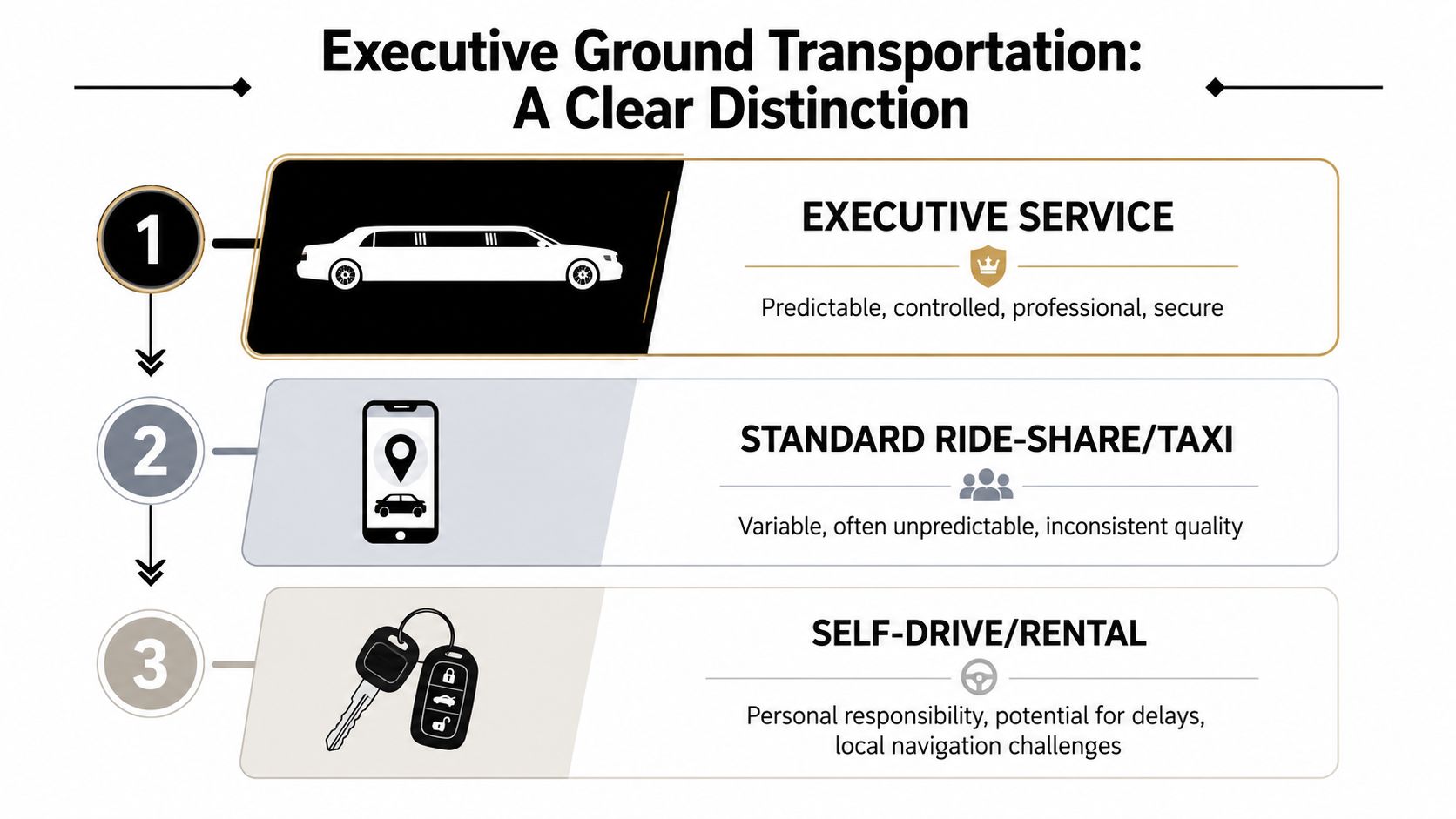
For a baseline definition, this overview of what ground transportation includes is useful. In practice, the executive tier is defined less by the vehicle and more by the operating model behind it.
Reliability comes from design, not promises
Reliable service doesn't happen because a provider says punctuality matters. It happens because the operation is engineered to reduce variability.
Providers using real-time GPS tracking, instant confirmations, early driver arrival, and contingency route planning can protect schedule reliability because delays in airport transfers and roadshows tend to cascade across the rest of the itinerary, as outlined in this review of service-design controls in luxury ground transportation.
That's the first pillar. A serious provider confirms details early, watches flights, briefs chauffeurs properly, and has dispatch ready before the traveler notices a problem.
Discretion and safety are part of the product
The second pillar is discretion. Executives don't always need visible security, but they do need privacy habits. That includes what the chauffeur says, what the chauffeur doesn't say, how names are displayed, how pickup procedures are handled, and how itinerary details are shared internally.
The third pillar is safety. Travel buyers should expect vetted chauffeurs, maintained vehicles, and an operator that can describe its standards without resorting to vague language.
Professionalism is visible in small moments
The fourth pillar is professionalism. This is the category many buyers undervalue until they see the contrast.
A chauffeur is expected to know the route, the alternate route, the arrival procedure, the property entrance, the likely delay point, and the client preference if the principal takes calls in transit. They also know when to engage and when to stay silent.
Practical rule: If a provider talks only about luxury vehicles and not about dispatch, confirmations, chauffeur standards, and exception handling, you're not evaluating executive service. You're evaluating a nicer car.
A Portfolio of Executive Transportation Services
Most corporate buyers don't need one service. They need a menu they can deploy depending on trip purpose, traveler profile, and risk level.
That matters because airport transfers, roadshows, group moves, and secure VIP movements look similar on an invoice but operate very differently on the ground. A provider that's excellent at one can be average at another.
Airport and FBO transfers
This is the entry point for many programs, but it's also where weak operators get exposed.
A proper airport or private terminal transfer includes flight monitoring, clear arrival instructions, chauffeur positioning, and a dispatch team that can respond if the traveler exits from an unexpected door or the aircraft arrives early. For commercial arrivals, meet-and-greet can remove friction at crowded terminals. For FBO movements, timing and protocol matter even more because the traveler expects a smooth handoff from air to ground.
A simple use case: your general counsel lands after a delayed inbound flight and still needs to make a board dinner. The service has to absorb the schedule change without creating new work for the EA.
Corporate roadshows and as-directed service
Roadshows are where executive ground transportation earns its keep.
A roadshow or as-directed assignment isn't one trip. It's a managed block of time with multiple moving pieces, shifting stop lengths, live calendar changes, and zero tolerance for missed timing. The chauffeur needs route intelligence. Dispatch needs eyes on the whole day. The account team needs to understand who can authorize changes.
For travel managers, this is usually the category where service quality either builds trust fast or destroys it fast.
VIP and secure transport
Some travelers require more than premium service. They require controlled exposure.
That can include public figures, high-net-worth families, senior executives in sensitive negotiations, or travelers moving through unfamiliar markets. In these cases, the transportation plan may include restricted information flow, tighter pickup protocols, or coordination with protection teams.
The mistake buyers make here is assuming every black car provider can handle discreet transport. Many can't.
If the traveler profile carries reputational, legal, or personal-security sensitivity, ask how the provider manages information access, chauffeur briefing, and last-minute location changes.
Group, event, and crew movements
This category shifts from individual service to logistics management.
Events, leadership off-sites, conference transport, and airline or private aviation crew moves require staging plans, manifest control, dispatch discipline, and communication workflows that work across larger groups. The service standard still matters, but coordination matters more.
One reason this category has become more programmatic is scale. Executive ground transportation has grown from fragmented local service into coordinated networks. One established provider reports service in more than 1,000 cities worldwide with 24/7 assistance, and Hartsfield-Jackson Atlanta International Airport lists more than 200 limousine-service companies serving the airport and surrounding area, which you can see on the airport's ground transportation directory.
That tells travel managers two things:
- Supply exists in major markets. Finding a car isn't the hard part.
- Quality control is the hard part. In crowded markets, procurement discipline matters more than vendor count.
Anatomy of a Premium Fleet and Professional Chauffeur
Buyers often start with vehicle class. That's understandable, but it's incomplete. The fleet matters because it shapes comfort, image, luggage fit, and meeting readiness. The chauffeur matters more because that person carries your brand, your schedule, and your traveler's confidence.
What the fleet should actually do
Executive sedans work well for solo travelers and pairs who need a quiet cabin and efficient city movement. Premium SUVs add luggage capacity, easier ingress, and a stronger arrival profile. Luxury vans are often the right answer for small teams, mobile work sessions, or airport movements where carry-ons multiply fast.
The wrong fleet decision usually shows up in one of three ways:
- The vehicle is too small. Luggage spills into seating space and the traveler starts the day frustrated.
- The vehicle is too large for the route. Urban pickups become slower and less discreet.
- The cabin isn't business-ready. Cleanliness, charging access, temperature control, and basic amenities were treated as optional.
Maintenance discipline sits underneath all of this. A polished vehicle means little if the operator doesn't back appearance with process. Buyers who want to evaluate that side of the business should look at practical markers such as inspection routines, downtime handling, and replacement standards. This guide on fleet maintenance best practices is a good example of what to ask about.
Why chauffeur quality changes the whole experience
A driver completes a trip. A chauffeur manages an experience.
That difference shows up before pickup. The chauffeur checks notes, monitors timing, understands the property layout, and arrives early. During the trip, they balance professionalism with restraint. After the trip, they close out details cleanly so billing, reporting, and service follow-up stay accurate.
Industry benchmarks show that leading corporate providers report 98.7% on-time performance, and the same market report says 34% of corporate car-service fleets include EVs, with projections rising to 65% by 2030 as corporate buyers push ESG requirements, according to this 2026 corporate ground transportation trends report.
That shift affects procurement in two ways. First, punctuality remains the clearest operational indicator clients care about. Second, fleet composition is no longer just a brand question. It's becoming a reporting question.
A short visual illustrates how premium service standards show up in the field:
Navigating Global Operations and Affiliate Networks
At 11:40 p.m., an assistant in New York gets a text from an executive who has just landed in Frankfurt. The chauffeur is late, the local dispatcher is unreachable, and the meeting starts in 90 minutes. In that moment, global coverage means very little. Accountability is what matters.
That is a true test of an international ground program. A provider may perform well in its home market and still fail once trips start passing through affiliate partners. For corporate travel managers and EAs, the question is not whether a vendor has dots on a coverage map. It is whether the operating model stays controlled when service leaves the provider's own garage.
What an integrated network looks like
Strong affiliate programs are built around governance. Reservations move through one system, or at minimum one controlled workflow. Trip remarks, airport instructions, and traveler preferences carry over correctly. Billing follows one standard. If a service failure happens in Tokyo, Singapore, or São Paulo, your team still has one escalation path and one accountable owner.
That structure reduces admin work in ways procurement teams feel quickly. It limits duplicate approvals, cuts billing disputes, and makes post-trip review possible because data is captured in a consistent format. For a travel manager, that matters more than how many cities appear in the sales deck.
Ask direct questions. How are affiliates approved. Who audits them. How often are standards reviewed. What happens after a missed pickup, a vehicle substitution, or a chauffeur complaint. Providers that run a controlled global transportation service should be able to answer those questions without hesitation.
What a loose affiliate directory feels like to the client
A weak network usually reveals itself through small inconsistencies first. Confirmations arrive in different formats. Chauffeur dress standards vary by market. One city sends clean invoices in your required format, another sends a local receipt that finance cannot process. During a disruption, your team hears, “We're waiting to hear back from the local operator.”
That model shifts work back to the buyer. EAs start reconfirming details manually. Travel managers spend time cleaning up charges and chasing service explanations across time zones. Executives notice the inconsistency, even if they never see the back-office failure behind it.
The procurement risk is straightforward. A fragmented affiliate network makes service quality hard to predict, hard to measure, and hard to enforce. A governed network gives you something much more useful: one service standard, one reporting structure, and one partner that owns the outcome across markets.
The best global program is the one where your traveler does not notice they crossed an operating boundary.
The Travel Manager's Playbook for Vendor Selection and SLAs
Good procurement in this category isn't about finding the lowest quote. It's about buying down operational risk while preserving executive time and service consistency.
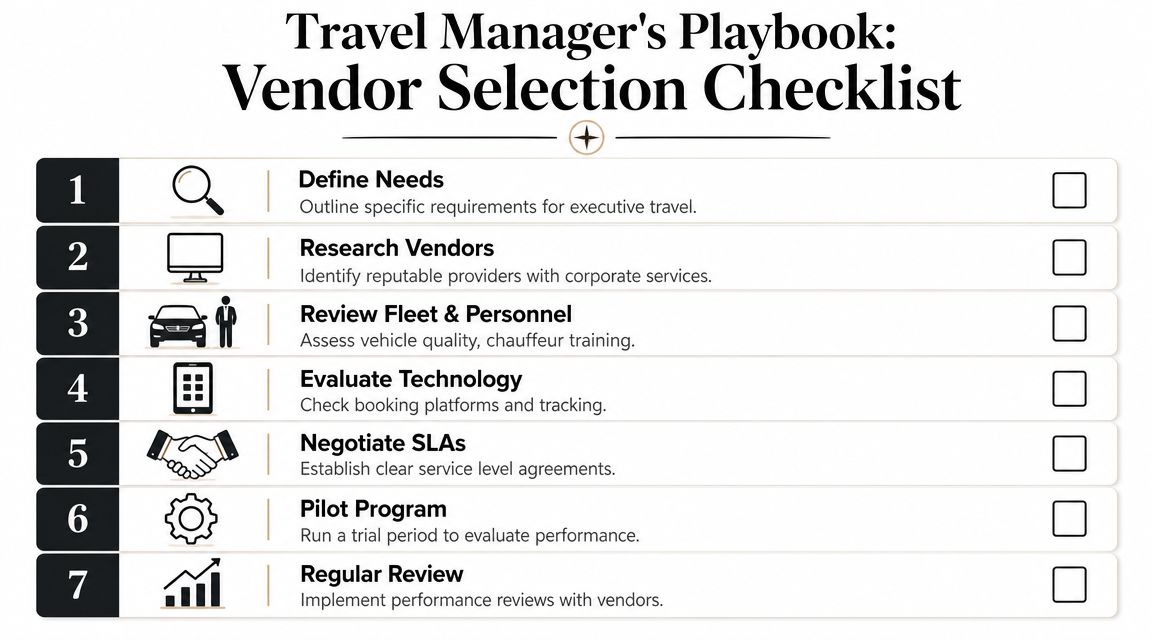
That starts with a simple mindset shift. You're not selecting a car provider. You're selecting a managed service partner that will represent your company in front of senior travelers, clients, candidates, investors, and board members.
Vet the operation, not just the fleet
Many RFPs spend too much time on vehicle photos and rate sheets. Start with controls instead.
Ask the provider to walk you through how a reservation is booked, confirmed, monitored, updated, and closed. Ask who owns after-hours response. Ask what happens when the traveler is delayed, unreachable, or diverted. If the answers are vague, the problems will be expensive later.
I'd evaluate providers across these areas:
- Safety and compliance: Require clear documentation on insurance, licensing, incident escalation, and chauffeur vetting.
- Dispatch capability: Confirm there's real human coverage for live trip management, not just an app and an inbox.
- Technology workflow: Review the booking platform, traveler profiles, tracking visibility, and reporting outputs.
- Communication quality: Confirm how updates are sent to the booker, the traveler, and any internal stakeholders.
- Financial and operational stability: A provider handling executive traffic should be able to support peaks, irregular operations, and credit terms without service erosion.
One option some buyers evaluate in this category is MLR Worldwide Service, which provides executive chauffeur service, airport and FBO transfers, roadshows, group logistics, VIP transport, and 24/7 coordination through a global affiliate network. The value of that type of provider depends on whether its workflows, service scope, and reporting fit your travel program.
Build SLAs around observable behavior
An SLA should describe service in measurable, reviewable terms. If your SLA says “premium service” or “high quality,” it won't help you during a failure review.
Use standards tied to events you can verify. Confirmation timing. chauffeur arrival expectation. vehicle condition. chauffeur presentation. escalation response. service recovery process.
Here's a practical sample structure.
| Category | Metric/Standard | Example Target |
|---|---|---|
| Booking confirmation | Reservation acknowledgement after submission | Confirm promptly with complete trip details |
| Pre-trip communication | Final trip confirmation to booker and traveler | Sent before pickup with chauffeur and vehicle details |
| On-time execution | Defined pickup punctuality standard | Chauffeur arrives early and is ready at scheduled time |
| Flight monitoring | Active monitoring for airport and FBO arrivals | Adjust pickup timing based on live flight status |
| Chauffeur standards | Dress, etiquette, discretion, and route readiness | Professional presentation and client-appropriate conduct |
| Vehicle condition | Cleanliness, maintenance, amenities, and class match | Clean, correctly assigned vehicle in excellent condition |
| Exception handling | Escalation path for delays or service failures | Immediate dispatch response and documented recovery steps |
| Reporting | Monthly service review and issue log | Regular performance reporting with actionable review notes |
Run a pilot before broad rollout
A pilot tells you more than a polished sales process ever will.
Test the provider on different trip types. An airport arrival, an early-morning departure, a multi-stop day, and a high-visibility VIP move if appropriate. Review not just whether the trip happened, but how much management effort it required from your team.
Watch for these practical signals during the pilot:
- The reservation team asks useful questions. That usually predicts fewer service misses.
- Dispatch communicates proactively. Silence is often the first sign of weak control.
- Billing matches the trip record. If invoicing is messy during a pilot, scale will make it worse.
- The provider handles changes cleanly. That's where mature operators separate themselves.
Treat sustainability as a procurement question
In this area, many vendor evaluations still fall short.
A provider may market itself as eco-friendly, but corporate buyers increasingly need evidence that supports ESG reporting and internal compliance. Independent industry coverage notes a gap between sustainability claims and auditable reporting, especially on items like fleet electrification rates and trip-level emissions, as discussed in this industry article on the next generation of chauffeured rides.
That doesn't mean every provider must already have perfect reporting. It does mean your RFP should ask direct questions:
- Can you document the composition of your fleet, including EV availability?
- Can you provide reporting that helps our travel or procurement team support internal sustainability reviews?
- How do you handle compliance requests tied to traveler safety, duty of care, and vendor documentation?
Don't reward polished sustainability language. Reward usable reporting.
Putting Your Executive Transportation Strategy in Motion
The companies that manage executive transportation well don't book it ad hoc forever. They turn it into a program.
That program has a preferred provider strategy, defined trip types, service standards, escalation rules, and review cadence. It also has a clear owner inside the company, usually a travel manager, procurement lead, EA team leader, or operations partner who can enforce consistency.
What to do next
Start with an audit of current spend and booking behavior. Look at how many rides are being booked outside policy, how often senior travelers use unmanaged options, and where service failures create rework for assistants or travel staff.
Then evaluate your current providers against practical questions:
- Can they support your actual trip mix? Not just simple transfers, but roadshows, VIP moves, and group logistics.
- Can they operate consistently across your key markets?
- Can they give you service visibility, not just invoices?
- Can they support compliance and sustainability questions with something stronger than marketing copy?
The shift is straightforward. Stop treating executive ground transportation as a fragmented convenience purchase. Start managing it as a controlled service that protects executive productivity, reduces travel friction, and supports your company's standards in every city where business gets done.
The travel manager who masters this category usually becomes more valuable inside the organization. Not because transportation is glamorous. Because reliable movement keeps everything else on schedule.
If your team is reviewing providers, rationalizing unmanaged bookings, or building a more consistent executive travel program, MLR Worldwide Service is one company to evaluate for executive chauffeur service, airport and FBO transfers, roadshows, VIP transport, and coordinated global ground support.