
A board chair lands at 4:10 p.m. The first meeting starts downtown at 5:00. There is no room for a missed pickup, a driver who cannot find the terminal, or a last-minute vehicle swap that no one disclosed.
That is the setting black car service is built for.
Black car service is a pre-arranged premium transportation service centered on professional chauffeurs, dispatch oversight, and a service standard designed to keep a schedule intact. The car matters, but the operating model matters more. A polished sedan without coordination is still just a ride. A true black car operation works like a flight department on the ground. The trip is assigned in advance, details are confirmed, timing is monitored, and responsibility is clear if plans change.
You are likely here because an ordinary ride option feels too uncertain for the trip in front of you. The traveler may be an executive flying in for a board meeting. The assignment may involve several stops with tight handoffs between airport, hotel, office, and dinner. Or you may be the person who gets the call when transportation fails.
The term itself also has a real regulatory history, not just a marketing one. In New York, the state's Black Car Operators' Injury Compensation Fund grew out of the Black Car Law, which formalized part of the industry around affiliated, prearranged for-hire transportation rather than street-hail taxi service. The legal framework is documented by the New York State Workers' Compensation Board at https://www.wcb.ny.gov/content/main/BlackCarFund/BlackCarFund.jsp.
That history helps explain the category. Black car service is defined less by paint color than by control. The buyer is paying for confirmed coverage, trained chauffeurs, managed logistics, and accountable support behind the scenes.
When pickup execution breaks down, the effect spreads fast. The traveler starts calling from the curb. The assistant starts searching for a backup. The host begins adjusting the agenda before the meeting has even started. If you're comparing service types more broadly, this guide to ground transportation options is useful background.
Value is peace of mind created by process. Black car service exists to reduce failure points, protect timing, and keep high-stakes travel calm, controlled, and professional.
Introduction
A common scenario in business travel looks simple on paper. An executive lands in a major city, has one hour to get from the airport to a critical meeting, then needs to move across town for a second appointment before dinner with investors. The itinerary fits. The margin for error doesn't.
If the first ride fails, everything downstream gets stressed. The traveler starts making apology calls from baggage claim. The assistant has to source a backup. The meeting host starts wondering whether this is going to be one of those days. Transportation becomes the weak link in an otherwise expensive, carefully planned schedule.
That's where black car service earns its place. It isn't a decorative upgrade over a standard ride. It's a professional system for handling time-sensitive movements where reliability, privacy, and presentation matter.
The problem most buyers are actually solving
People often ask, “What is black car service?” and expect a vehicle description. They picture a black luxury sedan, a suited driver, and bottled water in the rear console. Those details may be part of the experience, but they don't explain the category well enough.
A better question is this: what outcome is the client buying?
In most corporate and VIP use cases, the buyer is purchasing confidence. They want to know the car is assigned, the chauffeur is prepared, the route has been thought through, and someone is accountable if the schedule changes.
Operational view: A black car booking isn't just transportation from point A to point B. It's a managed movement with a service standard attached to it.
Why this category still matters
Black car service developed long before app-based rides became common. The category emerged in the early 20th century in New York City, where chauffeur-driven black luxury vehicles became a preferred option for executives and dignitaries. The term became firmly established in the 1970s, and New York's 1999 Black Car Law formally classified and regulated the industry. By 2010, chauffeur services and black car firms were estimated to employ over 100,000 workers nationwide, with annual revenues in the tens of billions, showing how firmly the sector had become tied to corporate travel and premium tourism (history of black car service and the New York legal framework).
That history matters because it explains the mindset behind the service. Black car operations weren't built around convenience first. They were built around trust, discretion, and control.
What Truly Defines Black Car Service
The cleanest definition is operational, not cosmetic. Black car service is defined by pre-booked dispatch rather than on-demand hailing. That means the ride is scheduled in advance so the operator can assign a vetted chauffeur, confirm the vehicle, and coordinate timing before the traveler ever steps outside (pre-booked dispatch as the defining model of black car service).
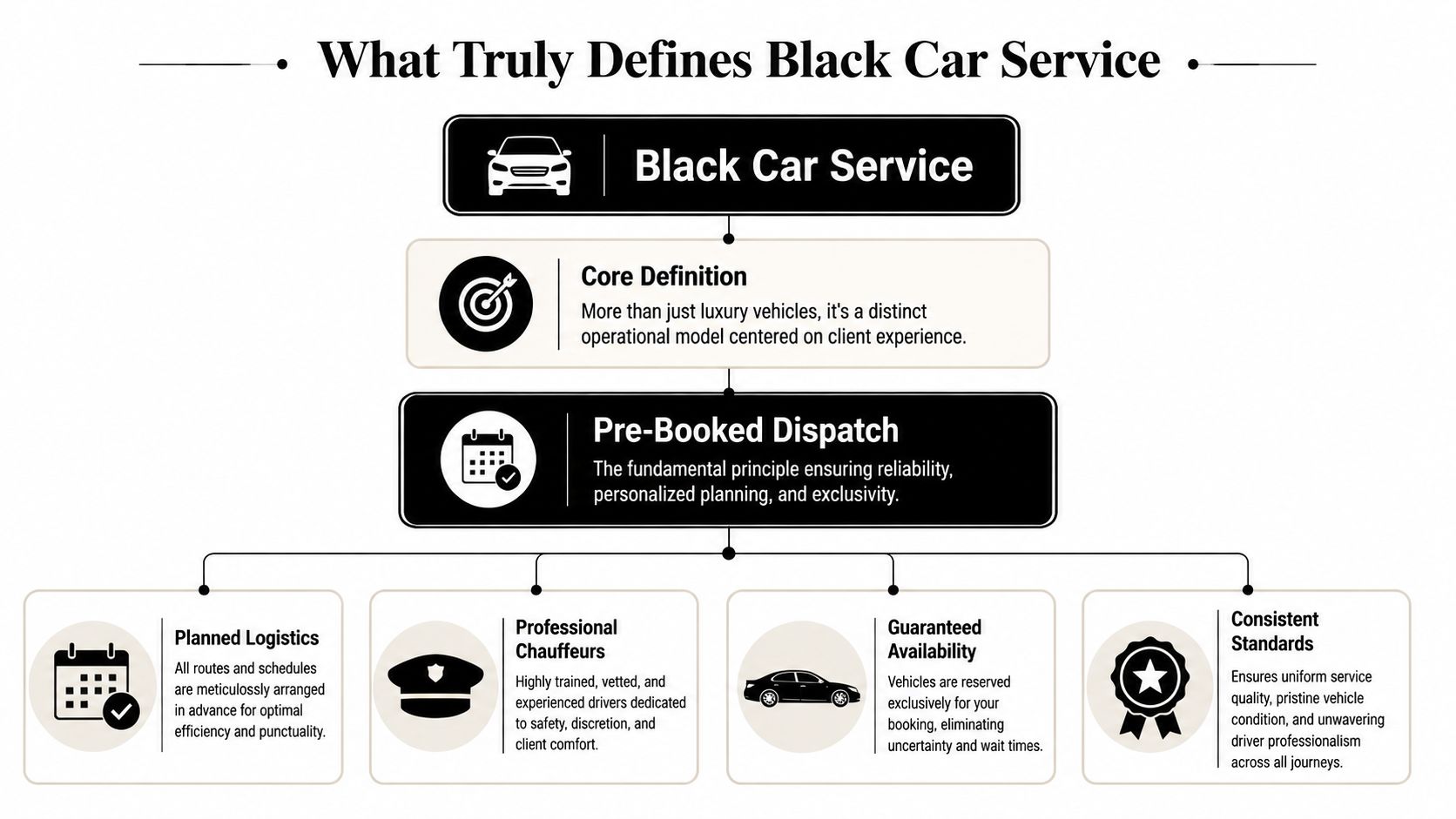
That one distinction changes everything.
In an on-demand model, the system tries to find any available driver near the passenger at the moment of need. In a black car model, the trip is built ahead of time. The provider knows who the passenger is, where they're going, what vehicle is appropriate, and what timing constraints matter.
Why pre-booking creates reliability
Pre-booking gives the operator time to do the work that clients rarely see but always feel.
That includes things like:
- Chauffeur assignment: The trip isn't left to whoever happens to be nearby.
- Vehicle preparation: The car can be cleaned, inspected, fueled, and staged properly.
- Itinerary review: Pickup instructions, route logic, and special requests can be confirmed in advance.
- Timing control: Airport arrivals, event schedules, and multi-stop movements can be coordinated with less guesswork.
A traveler may only notice that the experience feels smooth. From an operations perspective, smoothness is the result of planning.
The car matters, but the system matters more
Readers often find this aspect confusing. They assume “black car” refers mainly to the color or class of vehicle. Historically, that association is real. But the vehicle alone doesn't define the service.
A luxury sedan used in an app-based marketplace isn't automatically black car service just because it looks premium. A traditional chauffeur company using executive sedans and SUVs, with commercial standards and dispatch oversight, fits the category more accurately because the service is structured around accountability.
The best way to understand black car service is this: the car is the visible part, but the operating discipline is the product.
What buyers should listen for
When a provider describes its service, the strongest signals aren't about leather seats or curb appeal. They're about process.
Listen for language like:
- Confirmed pickup windows
- Dedicated dispatch support
- Chauffeur vetting
- Airport coordination
- Commercial transportation standards
- Managed itinerary changes
Those details tell you whether you're dealing with a real chauffeured operation or a premium-looking ride with less control behind it.
Black Car Service vs Rideshare vs Limousine
Most buyers don't need a philosophical definition. They need a practical one. Which option fits the trip, and what tradeoffs come with it?
A black car service sits between rideshare convenience and traditional limousine formality. It's usually the business-grade choice when the priority is controlled execution rather than the lowest price or the most ceremonial vehicle.
For a deeper executive-focused comparison, see this guide to chauffeur service versus rideshare for executives.
Transportation Service Comparison
| Criterion | Black Car Service | Premium Rideshare (e.g., Uber Black) | Traditional Limousine |
|---|---|---|---|
| Booking Model | Pre-arranged and dispatched in advance | Usually requested on demand through an app | Usually reserved in advance |
| Chauffeur vs. Driver | Professional chauffeur assigned to a scheduled trip | Driver availability depends on marketplace supply | Chauffeur service, often event-oriented |
| Vehicle Standards | Executive sedans, SUVs, and similar premium vehicles with fleet consistency | Premium category, but consistency can vary by driver and vehicle | Often larger luxury vehicles, including stretch formats |
| Service Focus | Reliability, discretion, airport work, roadshows, business transport | Fast app-based access to a premium vehicle | Ceremonial events, celebrations, formal arrivals |
| Regulatory Compliance | Commercial transportation model with company oversight | Platform-based model with variable operator structure | Commercial chauffeured model, often event-centered |
Where rideshare wins and where it doesn't
Rideshare is useful when timing is flexible and the trip is straightforward. If you're going to dinner, heading home from the office, or moving around casually, it may be perfectly adequate.
But a premium rideshare and a black car service are not the same purchase. The rideshare model prioritizes immediate availability. The black car model prioritizes trip control.
That distinction matters in situations like:
- Airport arrivals with tight schedules
- Client pickups where presentation matters
- Multi-stop executive itineraries
- Trips requiring live oversight from a dispatcher
- VIP movements where discretion is expected
Why limousine isn't always the same thing
People also mix up black car service and limousine service. There is overlap, because both can involve chauffeurs, advance reservations, and commercial transportation standards.
The difference is usually about the mission of the trip.
A traditional limousine booking often emphasizes occasion. Think weddings, proms, gala arrivals, or a visible luxury statement. A black car booking usually emphasizes execution. Think airport transfers, meetings, site visits, board dinners, and all-day roadshows where no one wants transportation to become the story.
If the trip needs to feel polished without feeling theatrical, black car service is often the better fit.
The easiest rule of thumb
If you're asking, “Will a car show up?” you're probably thinking in rideshare terms.
If you're asking, “Who is managing this movement, and what happens if plans change?” you're thinking in black car terms.
That's the operational distinction corporate buyers care about.
The Anatomy of a Premium Experience
A premium trip is built the way a good flight operation is built. The passenger sees the cabin. The core work happens in maintenance, crew standards, dispatch, and communication. Black car service works the same way. The outcome people want is simple: the traveler is met on time, moved without friction, and protected from avoidable problems.
Fleet standards
The vehicle is the visible part of the promise. It signals whether the operator treats transportation like a managed service or a loose collection of cars.
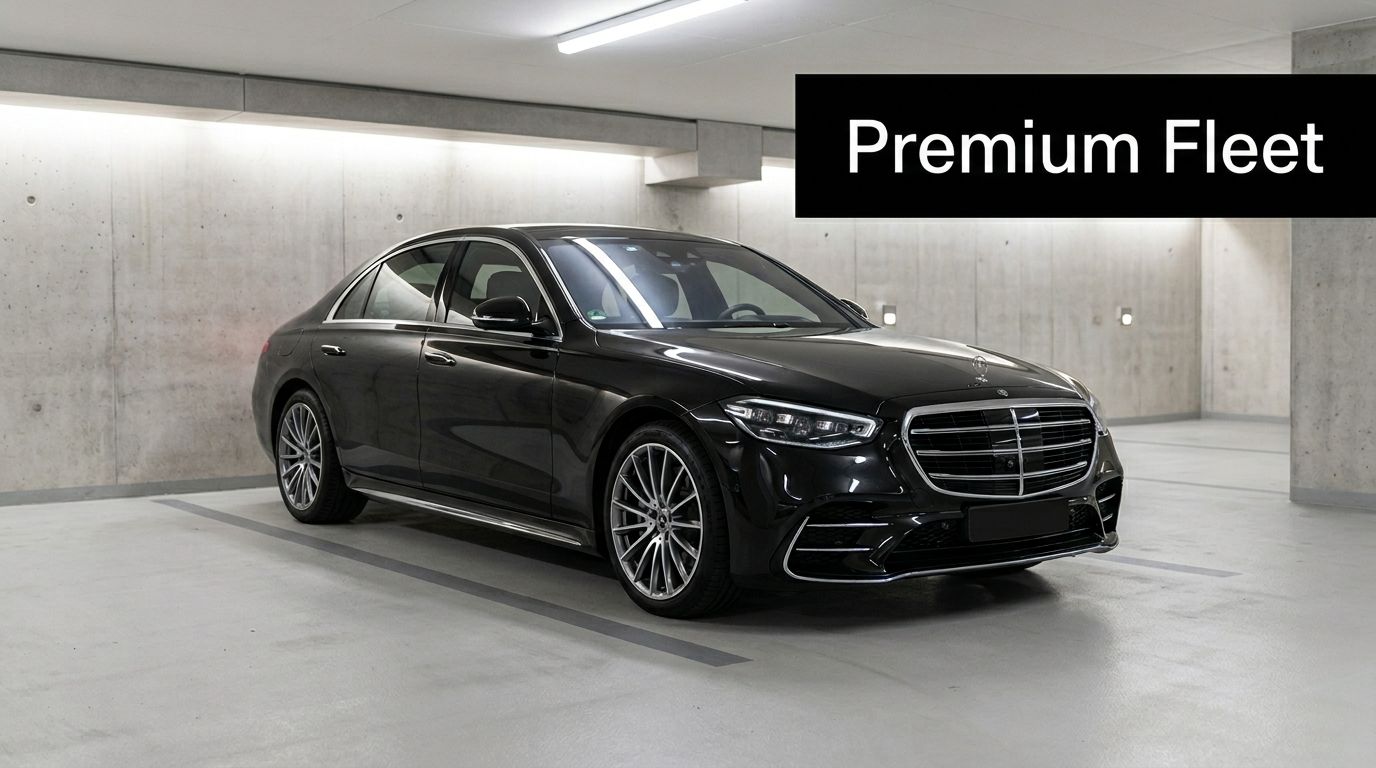
Serious black car fleets usually center on late-model executive sedans and premium SUVs, then back that up with inspection schedules, cleaning routines, and planned replacement policies. Industry groups such as the National Limousine Association publish operating and fleet guidance that reflects this professional standard, including attention to vehicle age, condition, and preventive maintenance (National Limousine Association).
That matters because a newer, well-maintained vehicle does more than look polished. It reduces the odds of mechanical delays, keeps the cabin consistent from trip to trip, and gives the traveler one less variable to worry about.
Chauffeur standards
A chauffeur is not just a driver in formal attire. The role combines safety, judgment, discretion, and timing under pressure.
The best chauffeurs make small decisions that protect the client's day. They know when to step in and when to stay in the background. They handle luggage without creating a scene in a busy curb lane. They read the passenger correctly, because one client wants a quiet ride to prepare for a board meeting and another wants a concise update on timing and route.
A strong chauffeur usually does five things well:
- Manages presence: polished and attentive without being intrusive
- Handles luggage smoothly: especially at airports, hotels, and office towers
- Reads the client: conversation when invited, silence when preferred
- Works with timing pressure: waits, moves, and confirms details at the right moment
- Protects privacy: confidential calls and sensitive discussions stay private
Clients remember this layer of service because it affects how the trip feels minute by minute.
Airport and FBO support
Airport work tests the operation. A downtown transfer is mostly point A to point B. An airport pickup adds flight tracking, terminal changes, baggage timing, curb access rules, and traveler communication.
Commercial terminals and private aviation pickups also run on different procedures. At an FBO, the handoff has to match the fixed-base operator's access rules and the aircraft's arrival pattern. At a commercial terminal, the challenge is often congestion, changing pickup zones, and keeping the traveler informed without making them manage the process themselves.
Here's a useful visual on how premium ground transportation is typically delivered in practice.
Dispatch and live operations support
Dispatch is the control tower.
First-time buyers often focus on the car and the chauffeur because those are visible. Reliability usually comes from the operations desk monitoring the trip before the passenger ever notices a risk. If a flight lands early, if a meeting runs late, or if an assistant changes the sequence of stops, dispatch absorbs that change and adjusts the plan.
A live operations team can:
- Update trips when flights change
- Coordinate chauffeur timing with evolving itineraries
- Handle same-day revisions
- Serve as a single point of contact for assistants and planners
- Escalate issues before the passenger feels them
On the ground, reliability usually starts in dispatch and then shows up in the chauffeur's execution.
Account structure and special handling
For executive assistants, travel managers, and event planners, the ride is only part of the service. The administrative side has to be clean. Clear booking records, consistent service notes, consolidated billing, and stored preferences turn repeat transportation into a controlled process instead of a fresh coordination exercise every time.
Special handling matters too. A board member, public figure, legal team, or confidential guest may need tighter communication rules, limited trip visibility, or carefully managed pickup instructions. Good providers treat those requests as operating procedures, not last-minute favors.
That is the anatomy of a premium experience. The car is the surface. The standard behind it is what makes the trip dependable.
Why Executives and Planners Choose Black Car Service
It is 6:40 a.m. A CEO's flight lands early, the first meeting starts downtown at 8:00, and an assistant is already managing three schedule changes from the hotel. In that moment, ground transportation is not a hospitality extra. It is part of the day's control system.
That is why executives and planners choose black car service. They are buying a managed outcome. The goal is a trip that arrives on time, protects attention, and does not create new work for the people coordinating it.
For the executive in the back seat
Senior travelers often use the ride as working time.
A well-run black car trip gives them a clean handoff between obligations. The cabin is quiet, the pickup is orderly, and the route is handled without discussion or improvisation. That matters because an executive is rarely judging the trip by the leather or the badge on the grille. They are judging whether they can review notes, return messages, or arrive composed and ready to make decisions.
A good vehicle supports that experience. A disciplined operation protects it.
For the assistant or travel manager
The coordinator's standard is different. They are not looking for a nice car. They are looking for fewer failure points.
Black car service works like a controlled supply chain. The booking is documented, the traveler's preferences are attached to the reservation, the chauffeur receives clear instructions, and one provider remains accountable if the itinerary changes. That reduces the small frictions that consume a coordinator's day, such as repeated status checks, unclear pickup details, and last-minute troubleshooting.
The highest-value trips usually share the same pattern:
- Airport arrivals tied to fixed meeting times
- Multi-stop schedules with little room for delay
- Client or board-level guest movements where timing reflects on the host
- Travelers who expect discretion and consistent execution
The real benefit for the booking party is not style. It is fewer variables to manage.
For VIP travelers and principals
Privacy has practical value.
Some passengers need a chauffeur who understands low-visibility pickups, direct communication, and when silence is part of the job. Others need consistency from trip to trip so the process feels controlled rather than improvised. That consistency lowers stress, especially for principals who travel often and notice small breaks in procedure immediately.
For event and meeting planners
Events multiply every transportation problem. Arrivals come from different airports, schedules shift by the hour, and one missed pickup can affect speakers, sponsors, or an entire run of show.
In that setting, black car service is useful because it gives planners a repeatable operating standard across many individual movements. Cars matter, but coordination matters more. The planner needs timing discipline, clear reporting, polished guest handling, and a provider that can support VIP movements with the same care used for executive travel. This overview of luxury private car service standards adds helpful context if you are comparing service levels.
Why the premium can make business sense
Business travel remains a major operating expense. The U.S. Travel Association notes that domestic and international inbound business travel spending in the United States totals hundreds of billions of dollars annually (business travel spending data from the U.S. Travel Association). In that environment, transportation decisions should be judged the same way companies judge any support function. By reliability, control, and the cost of failure.
A missed pickup can shorten a client meeting, force an assistant into rescue mode, or start an executive's day behind schedule. A well-managed black car service costs more than the lowest-priced option because it is built to reduce those risks. For routine errands, that premium may not be justified. For airport runs tied to investor meetings, board sessions, roadshows, confidential guest movements, or tightly staged events, it often is.
How to Select Your Black Car Service Provider
Your CEO lands at 10:40 a.m. The board meeting starts at noon. If the pickup fails, the problem is not the sedan. The problem is the provider's operating system.
That is the right way to choose a black car service. Start with the outcome you need, then work backward into the company's process for delivering it. A polished vehicle matters, but polished equipment without disciplined dispatch, trained chauffeurs, and clear contingency handling is just appearance. If you are comparing providers at a higher service level, this overview of luxury private car service standards helps frame what good execution looks like.
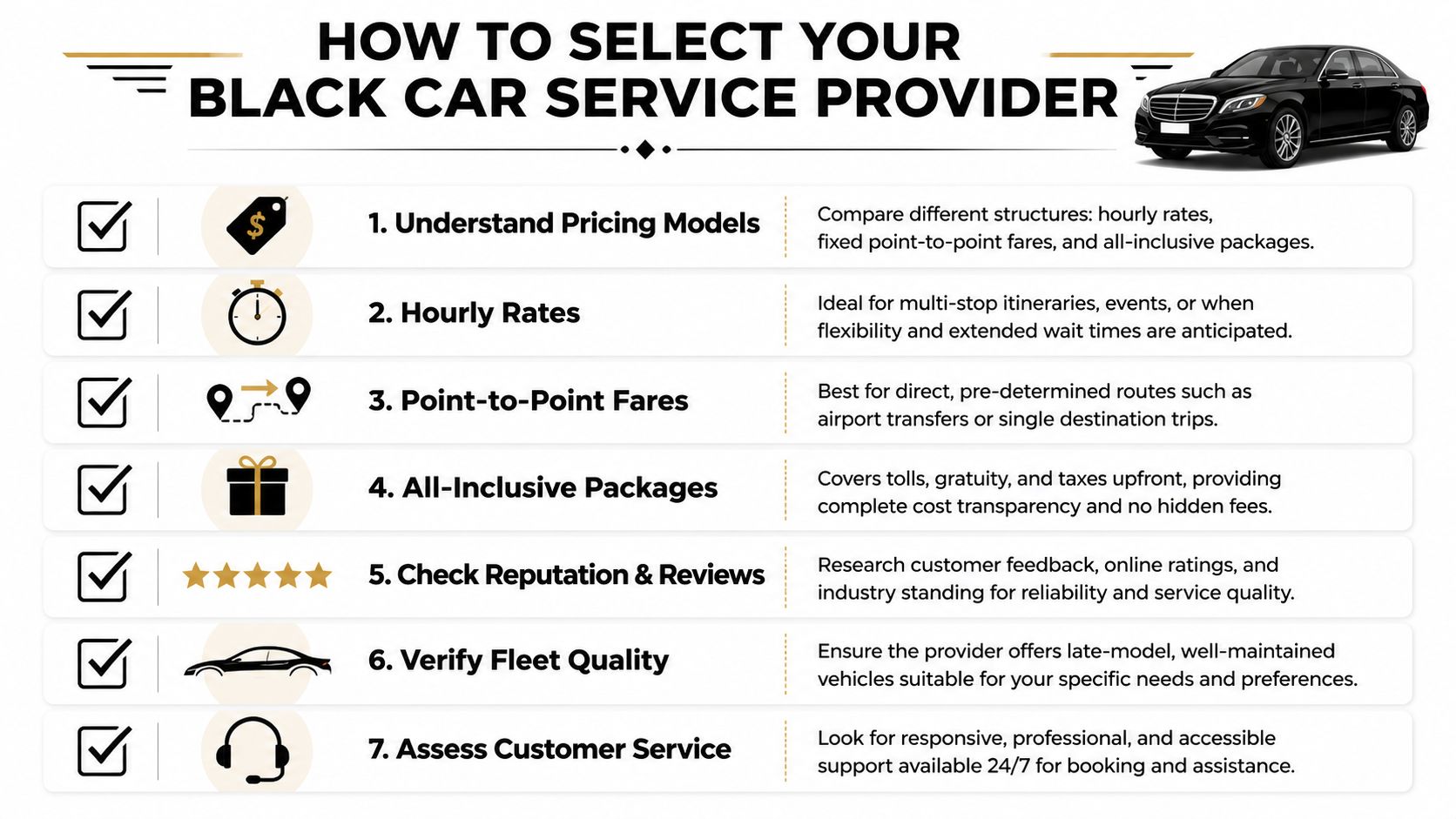
Pricing still matters, but treat it as a scope question, not a shortcut to quality. Black car service is commonly sold as point-to-point transfers or hourly service. What separates one quote from another is often the operating detail behind it: wait time policy, airport monitoring, after-hours dispatch coverage, vehicle class, billing clarity, and how schedule changes are handled once the trip is live.
What to check before you book
A strong provider should answer direct questions with direct answers.
Use this checklist:
- Licensing and insurance: Confirm the company operates legally as a commercial ground transportation provider and can explain its coverage clearly.
- Dispatch and live support: Ask who monitors active trips and whether a live person is available outside normal office hours.
- Fleet fit: Match the vehicle class to the passenger count, luggage load, and tone of the trip.
- Chauffeur management: Ask how chauffeurs are screened, trained, briefed, and evaluated after service.
- Communication standards: Look for precise confirmations, chauffeur contact instructions, and timely updates when plans change.
- Service reach: If your company books in multiple cities, ask how the provider keeps standards consistent across markets.
Questions that reveal quality fast
A short conversation can tell you a great deal. The best questions test control, not marketing language.
Ask:
- Who is watching my trip on the day of service?
- How do you handle delayed flights, early arrivals, or last-minute meeting changes?
- Can I reach a dispatcher after hours, and how?
- How do you assign chauffeurs and maintain vehicle condition?
- What is included in the quote, and what triggers extra charges?
One answer often tells the whole story. A provider that speaks clearly about procedures usually runs clearly as well.
Practical rule: Choose the company that can explain its service model in operational terms, not just luxury terms.
Read the offer the way an operator would
A proposal should read like a control document. You should see the trip details, service type, billing structure, included time, cancellation terms, and any likely extras without having to guess.
Clarity is a reliability signal. Vague wording usually leads to vague accountability.
A professional provider also leaves room for reality. Flights move. meetings run long. Guests call the wrong number. The right company has a process for those moments and can explain it before you book. That is what you are really buying. Predictable execution under normal conditions, and competent recovery when the day changes.
Black Car Service Frequently Asked Questions
Is black car service only for executives
No. Executives are common users, but the service also fits airport transfers, client hospitality, event transportation, private aviation support, and travelers who want a more controlled experience.
Can I request a specific vehicle type
Usually, yes. Most providers let you request a sedan, SUV, van, or another suitable class based on passenger count, luggage, and the tone of the trip. Exact vehicle availability depends on the operator and timing.
Can I request the same chauffeur again
Often you can, especially if you travel regularly and the company manages repeat client preferences. It's smart to ask at the time of booking rather than assume.
How far ahead should I book
Earlier is better when the trip matters. Advance booking gives the provider more room to assign the right chauffeur and vehicle, especially for airport runs, events, and multi-stop schedules.
What about tipping
Tipping policies vary by company. Some quotes include gratuity, and some don't. Ask before the ride so your accounting team and traveler both know what to expect.
What if my flight or meeting changes
That's one of the main reasons people choose black car service. A professionally managed operator should be able to adjust timing, update the chauffeur, and help protect the rest of the itinerary when changes happen.
If your travelers need dependable executive transportation, airport coordination, VIP handling, or multi-city ground logistics, MLR Worldwide Service provides professionally managed black car service built around punctuality, discretion, and live operational support.