
You're usually not searching for a chauffeur service near me on a casual day. You're doing it when timing matters. A board meeting starts in less than an hour, a private flight has a tight wheels-up window, or a principal's itinerary has three moving parts and no room for improvisation.
That's where the difference shows. Commodity transportation is built around availability. Professional chauffeur service is built around execution. One reacts when you request a car. The other plans the movement, confirms the details, monitors changes, and closes gaps before they become problems.
Your Guide to Finding a Reliable Chauffeur Service
A common scenario looks simple on paper. An executive lands, has a meeting downtown, then needs to continue to an FBO for an evening departure. On a ride-hailing app, each leg becomes a separate gamble. Will the next driver know the terminal? Will the car match the expectation? Will the pickup point turn into a phone-call scavenger hunt?
A real chauffeur operation handles the day as one assignment. Pickup instructions are clear. The chauffeur is staged early. Dispatch is already tracking the flight and watching traffic conditions. If the client exits from a different door or the schedule shifts, the operation adjusts without drama.
That's why this category keeps expanding. The global chauffeur service market was valued at $45.6 billion in 2023 and is projected to grow to over $68.2 billion by 2030, and online booking platforms now account for 72% of all U.S. reservations according to chauffeur industry market data compiled by WorldMetrics. People aren't using premium ground transportation only for status. They're using it because reliability has operational value.
For clients comparing options, it also helps to understand the broader role of private car logistics inside business travel. This overview of ground transportation planning and service types gives useful context on how airport transfers, executive movements, and managed itineraries fit together.
Working rule: If a failed pickup would cost you a meeting, a charter slot, or a client relationship, you don't need the cheapest car. You need the most controlled process.
Initial inquiries for 'Chauffeur service near me' often focus on geography. The more important consideration, however, is operational. This includes who manages the trip, what standards are enforced, and what happens when the day changes at the last minute?
The Difference Between a Driver and a Chauffeur
A driver gets you from one place to another. A chauffeur manages the movement around your schedule, your standards, and your risk tolerance.
The easiest analogy is hospitality. A line cook can prepare food. A private chef plans the meal, times the courses, works around preferences, and handles presentation. A professional chauffeur works the same way. The vehicle is only part of the service. The actual product is judgment, consistency, and preparation.
What the service model changes
With a ride-hailing app, the platform's job is to match a nearby car to a request. That can work for low-stakes trips. It breaks down when the client needs airport meet-and-greet, discreet handling, route planning around congestion, or a chauffeur who understands executive protocol.
Traditional taxis sit somewhere in the middle. They're useful for immediate local transport, but they usually don't operate with the same advance coordination, vehicle standards, or white-glove expectations as an executive chauffeur provider.
A professional chauffeur is expected to think ahead. That includes confirming locations, understanding venue access, allowing buffer time, and handling changes without exposing the client to friction.
Chauffeur service vs ride-hailing vs taxi
| Attribute | Professional Chauffeur Service | Ride-Hailing App (e.g., Uber/Lyft) | Traditional Taxi |
|---|---|---|---|
| Service model | Prearranged, managed service with dispatch oversight | On-demand algorithmic matching | Street hail or dispatched local transport |
| Driver standard | Career professional trained for hospitality, discretion, and schedule management | Varies by driver and market | Varies by operator and local fleet |
| Trip planning | Route, timing, access points, and special instructions are reviewed in advance | Mostly reactive after booking | Usually point-to-point with limited preplanning |
| Vehicle consistency | Fleet standards are defined and monitored | Vehicle condition can vary widely | Vehicle condition depends on local operator |
| Airport and FBO handling | Built for terminal coordination, flight monitoring, and executive handoffs | Possible, but inconsistent | Can work for basic airport pickups |
| Accountability | Human dispatch and company-level responsibility | Platform plus independent driver model | Local company or medallion-based accountability |
| Pricing structure | Usually transparent prearranged rates | Variable pricing, including demand-based shifts | Metered or local flat-rate rules |
| Client experience | Quiet, discreet, polished, and schedule-focused | Functional, but inconsistent | Practical, usually less curated |
A good chauffeur doesn't just arrive. They remove uncertainty before the client ever sees it.
What works and what doesn't
What works is a service built on standards. Named chauffeur. known vehicle class. live dispatch. clear confirmation process. direct accountability.
What doesn't work for executive transport is treating every trip like a simple pickup. High-value movements fail in small ways first. The wrong entrance. A chauffeur who doesn't know the FBO procedure. A vehicle that's technically acceptable but wrong for the client. That's the gap between a transportation app and a professional operation.
Safety Standards and Driver Professionalism
When clients ask what separates a premium operator from a polished website, I look at the chauffeur file first. Vehicle photos are easy. Standards around people are harder to fake.
Elite chauffeur services require a minimum of 10 years of professional driving experience and encyclopedic knowledge of local routes, with 99.8–99.9% on-time arrival rates, plus annual multi-state criminal background checks and training in defensive and evasive maneuvers, according to this guide to luxury chauffeur service standards from Sedanz. Those are operational standards, not marketing language.
What to verify before you book
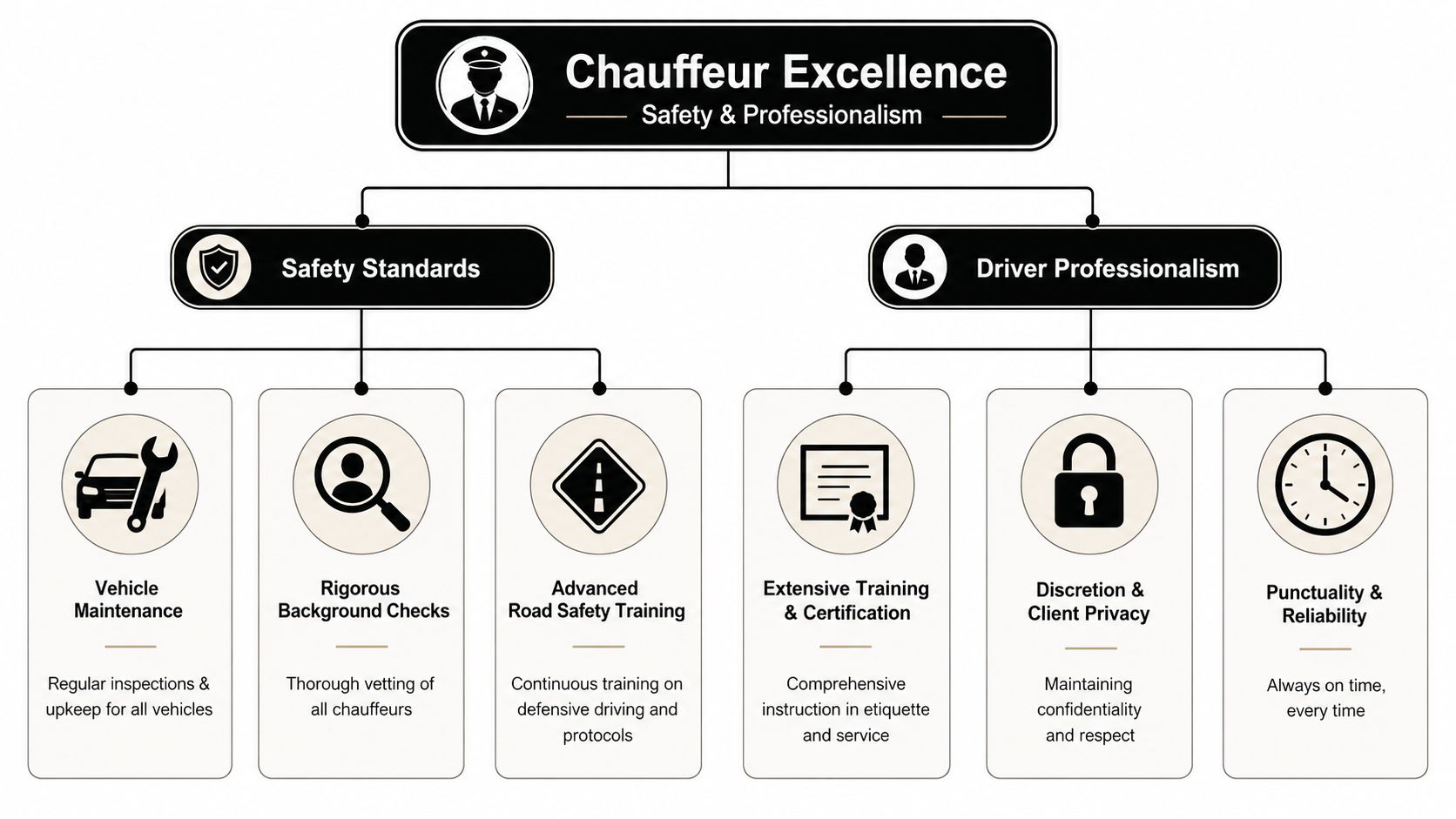
If you're hiring for an executive, family office principal, or private aviation traveler, ask direct questions:
- Experience level: How long has the chauffeur been working professionally, and are they assigned based on trip type?
- Screening protocol: Are background checks current, and are they handled on a recurring basis?
- Training depth: Does the company train beyond basic road compliance, including defensive driving and client-facing standards?
- Local competence: Can the chauffeur move through terminals, venues, and alternate routing without relying entirely on a phone?
- Operations support: Is there a live team monitoring service, or is the chauffeur carrying the whole assignment alone?
Why gig variability becomes a risk
A ride-hailing model can produce a perfectly fine trip. It can also produce a rushed driver in an unfamiliar vehicle with no prior context for the passenger. That variability is the core issue.
A professional chauffeur operation narrows the margin for error by setting a repeatable baseline. The client shouldn't have to wonder who's arriving, whether they understand protocol, or how they'll handle a disruption.
Operational test: Ask what happens if the flight is early, the gate changes, or the pickup point moves. The quality of that answer tells you more than the vehicle list.
A Fleet for Every Occasion
Choosing the right vehicle isn't just about style. It affects timing, comfort, baggage capacity, security posture, and how the client presents on arrival.
The strongest operators match vehicle type to the assignment. A solo airport transfer for a senior executive has different requirements than a family office roadshow, a legal team moving between meetings, or a private aviation pickup with luggage and support staff.
How to match the car to the trip
For many business movements, an executive sedan is the right answer. It's efficient, discreet, and well suited to airport runs, city meetings, and point-to-point transfers where a low-profile arrival matters.
A premium SUV works better when the client wants more cabin space, a higher seating position, or extra room for baggage. It's also practical when weather, security preferences, or multi-passenger comfort changes the equation.
Luxury vans fit group logistics, corporate events, and airport transfers involving assistants, family members, or additional equipment. They're also useful when keeping everyone on one vehicle reduces coordination risk.

The fleet standard that matters
According to this overview of luxury chauffeur vehicle and operations standards, the industry benchmark is for luxury chauffeur vehicles to be less than three years old and detailed before each service, with chauffeurs holding commercial licenses, operating as accountable employees, and supported by 24/7 human-led dispatch.
That last point matters more than most clients realize. A late-model vehicle is good. A late-model vehicle backed by active dispatch, maintenance discipline, and assignment oversight is what protects the trip.
For buyers comparing providers, these fleet maintenance best practices for professional transportation operations are a useful lens. Ask how often vehicles are rotated, inspected, and detailed. If the answer is vague, the service probably is too.
Signs the fleet is being managed correctly
- Vehicle age is controlled: You shouldn't see tired interiors, warning lights, or obvious cosmetic neglect.
- Presentation is consistent: Clean glass, spotless cabin, fresh detailing, and no last-trip residue.
- The fleet fits the mission: The company can explain why a sedan, SUV, or van is right for your movement.
- Backup exists: If a vehicle issue appears, operations can substitute without scrambling the client.
Corporate Transport and Airport FBO Services
Corporate travel drives this industry for a reason. Approximately 60% of total global chauffeur service volume comes from corporate travel, and the U.S. corporate ground transportation market is valued at $31.2 billion in 2026, with demand concentrated in major business hubs such as New York City, according to chauffeur and corporate ground transportation market data compiled by WiFiTalents.
That demand isn't about luxury for its own sake. It's about protecting schedules that have downstream consequences. One delayed pickup can affect a meeting start, a site visit, an investor dinner, or a private departure slot.

Where professional service earns its keep
Airport and FBO work exposes weak operators quickly. Terminal congestion, changing arrival times, and access rules leave no room for guesswork. A proper chauffeur provider coordinates pickup instructions in advance, monitors inbound travel, and knows where to stage without forcing the client into a series of calls and texts.
The same applies to roadshows and multi-stop executive itineraries. A chauffeur isn't just moving the client. The operation is managing dwell times, venue sequencing, reroutes, and communication with assistants or travel teams.
For companies that need recurring support, corporate chauffeur services for executive and business travel are typically structured around account management, repeat preferences, and operational consistency rather than one-off bookings.
What real coordination looks like
The difference is often invisible to the passenger because the work happens upstream:
- Flight and schedule monitoring: Dispatch tracks movement and adjusts timing when plans change.
- Venue access planning: Chauffeurs know the correct entrance, loading area, and standby point.
- Stakeholder coordination: Executive assistants, FBO staff, and event contacts stay aligned.
- Contingency handling: If a meeting runs long or the client exits early, the car is already positioned for the next step.
This short video gives a useful visual sense of executive ground transport expectations in practice.
In corporate transport, the best trip is the one nobody has to think about once it's booked.
How Chauffeur Service Pricing and Booking Works
A client lands at 11:40 p.m., clears the FBO ahead of schedule, and needs to be in a hotel suite within minutes because the next call starts at midnight. In that situation, price matters less than whether the booking was built to hold under pressure. That is the true difference between a chauffeur reservation and an app-based ride.
Professional chauffeur pricing reflects planned execution. App pricing reflects live market conditions. One model is built around assigned responsibility, dispatch oversight, vehicle standards, and schedule protection. The other is built around immediate driver availability. For routine personal travel, either can work. For executive itineraries, airport transfers with timing exposure, or events where a missed pickup creates downstream problems, they are not equivalent purchases.
What goes into the rate
A proper quote is based on the assignment, not just mileage. An airport transfer with meet-and-greet, a two-hour standby, and a six-stop roadshow may all cover similar distances but require very different levels of staffing and control.
Common pricing factors include:
- Vehicle class: Sedan, SUV, and van service carry different operating costs and fit different traveler profiles.
- Service format: Point-to-point, hourly, as-directed, and multi-stop reservations are priced differently because the work behind them is different.
- Schedule exposure: Early departures, late-night arrivals, venue restrictions, and live itinerary changes increase the coordination load.
- Included items: Flat quotes often include wait time parameters, flight tracking, tolls, or chauffeur standby terms. That matters because it reduces billing surprises later.
The practical question is not whether the number is higher than an app estimate. The practical question is what risk is included or excluded from that price.
A cleaner booking process
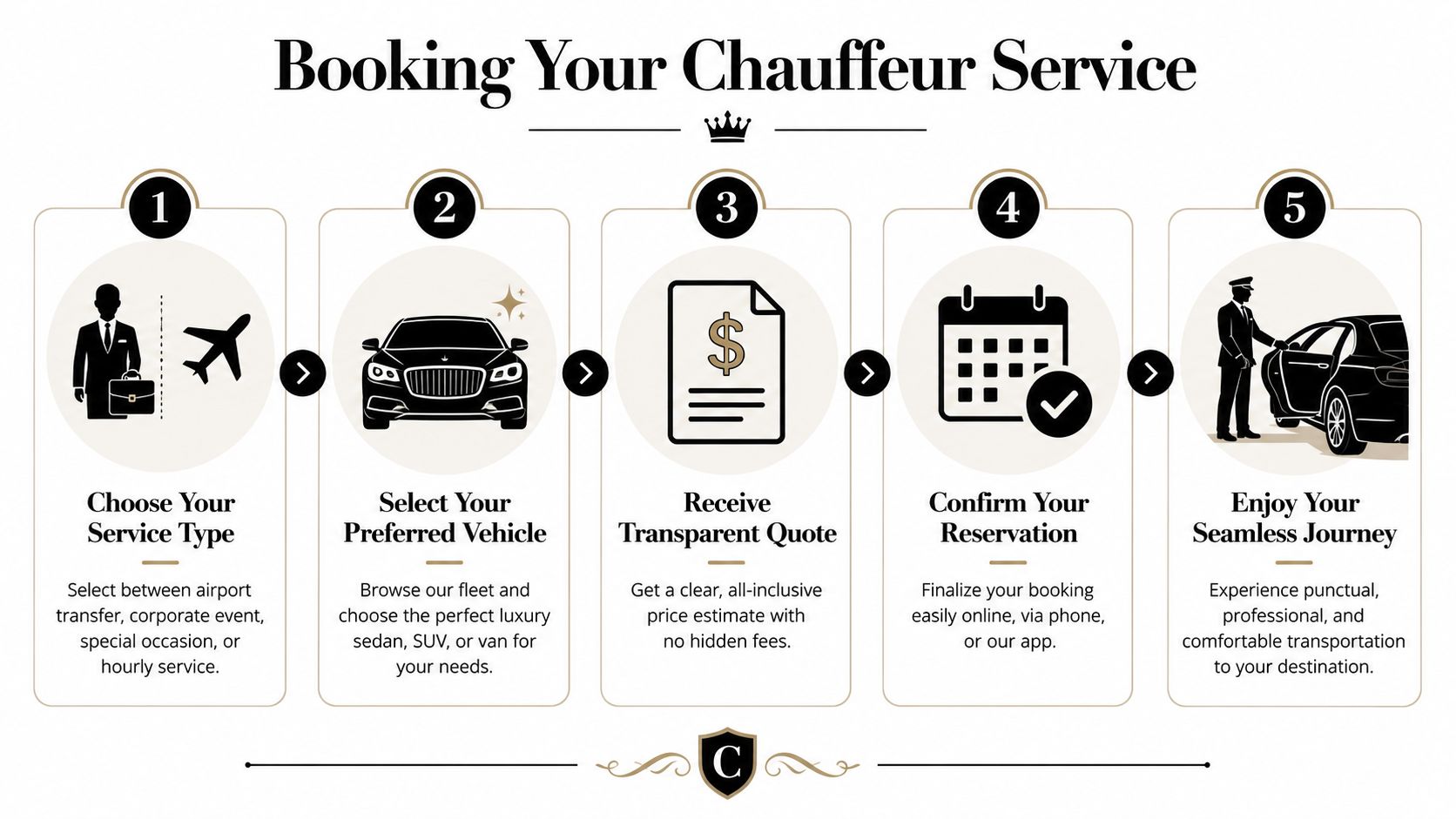
Good booking systems are structured. They collect the details that affect execution before the reservation is confirmed, not after something goes wrong on trip day.
- Submit the full brief. Include date, time, passenger count, baggage, flight details, child seats if needed, and any security or access instructions.
- Match the vehicle to the assignment. The lowest-priced option can be the wrong choice if luggage volume, client profile, or standby requirements call for a different class.
- Read the quote line by line. Check waiting time rules, cancellation terms, overtime handling, and how schedule changes are approved.
- Get confirmation in writing. Pickup address, contact numbers, vehicle class, and pickup procedure should all be documented.
- Expect operational follow-through. A professional service keeps managing the trip after booking. A gig platform typically hands the trip to whichever driver accepts it.
MLR Worldwide Service is one example of a provider operating in this category, with executive chauffeur service, airport and FBO support, roadshows, and managed group transportation handled through a 24/7 operations model.
Common Questions About Hiring a Chauffeur
A common failure point is simple. An assistant books ground transport for a board arrival, the flight lands early, and the person behind the wheel is juggling app rides across town instead of working from a dispatch plan. That is usually the moment clients stop searching for the cheapest ride and start asking better questions.
How far in advance should I book?
For airport transfers, executive travel, and event movements, book as soon as the schedule is stable enough to hold a reservation. More lead time gives the operator time to assign the right vehicle, brief the chauffeur, and flag any access or timing issues before trip day.
Short-notice requests can often be handled. The difference is that a professional service will tell you what can be confirmed, what is still in motion, and where the operational limits are.
Do chauffeur services only make sense for VIPs?
No. They make sense for any trip where timing, discretion, or accountability matters.
That includes executives, legal teams, private aviation passengers, family offices, event planners, and corporate travel managers. It also includes families managing important travel days, where a missed pickup creates a chain reaction of delays and calls. The value is not status. The value is control.
Is tipping included?
That depends on how the service bills. Some operators include gratuity in the quoted rate. Others list it separately.
Get that answer before approval, especially if an assistant, travel arranger, or office manager is reconciling the invoice later. Clear billing avoids awkward handoffs and payment disputes at the curb.
What should I ask before hiring?
Ask questions that reveal whether the company runs a professional operation or merely brokers rides.
- Are the chauffeurs employees or trip-by-trip contractors? Career chauffeurs usually work to a service standard, dress code, and reporting structure.
- Who monitors the trip in real time? A staffed dispatch desk handles delays, reroutes, and pickup changes better than an app notification chain.
- What vehicle is being sent? Confirm class, luggage capacity, model range, and presentation expectations.
- How are schedule changes handled after booking? That answer tells you how the company performs under pressure, not just at the point of sale.
- What is the pickup procedure? Meet-and-greet, curbside protocol, FBO access, and after-hours contact steps should all be clear.
Do chauffeur services surge during major events?
This comes up often because ride-hailing rates can change fast when demand spikes. As noted earlier, 78% of searchers ask about surge pricing during events, according to event pricing data from Detailed Drivers.
Professional chauffeur services often quote flat rates for booked work instead of algorithmic event pricing. That does not mean every provider prices the same way. It means the pricing structure should be explained in advance, in writing, before the vehicle is dispatched.
Reliability starts before pickup. It starts with clear standards, accountable people, and an operator that treats each reservation like a live assignment, not an app request.
MLR Worldwide Service is one example of a provider operating in this category for executives, private aviation travelers, family offices, and travel managers who need structured chauffeur support, airport and FBO coordination, and managed ground logistics across business and leisure markets.