
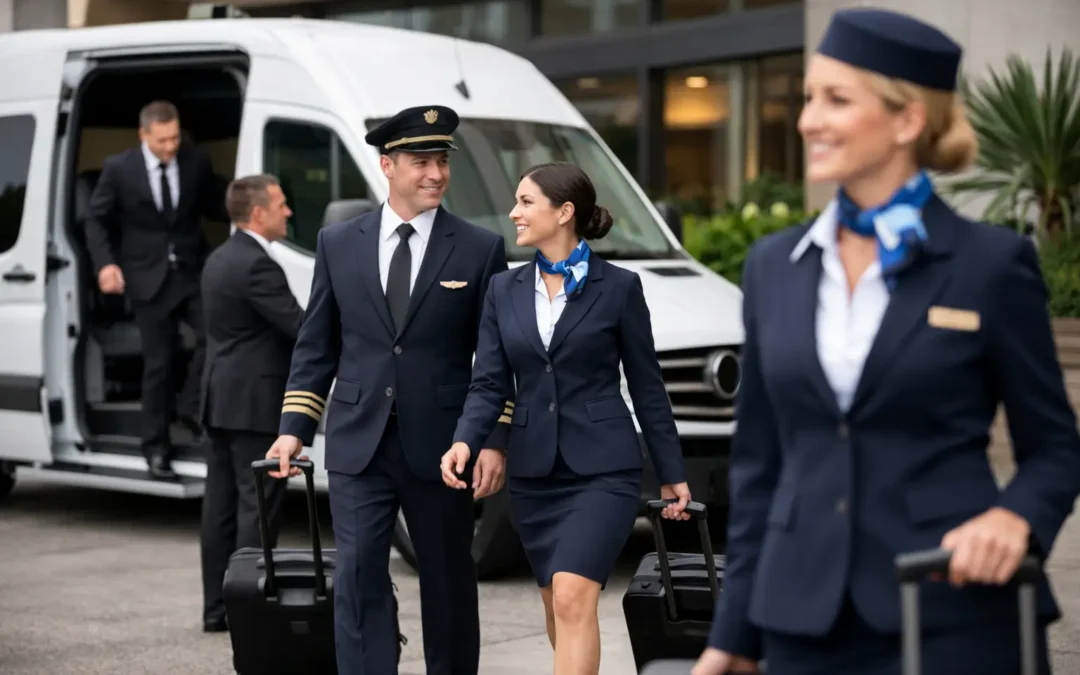
A delayed van at 1:40 a.m. can ripple into a missed report time, a fatigued crew, and an avoidable disruption that costs far more than the transfer itself. That is why airline crew hotel transfers are not a routine ground movement. They are a time-critical part of flight operations, where punctuality, safety, and disciplined communication matter as much as the ride.
For airline operations teams, travel managers, and station coordinators, the standard is straightforward: the vehicle arrives when promised, the driver is properly briefed, the route is planned, and the crew reaches the hotel or airport without friction. Yet in practice, crew transportation sits at the intersection of irregular operations, duty time limitations, hotel coordination, security concerns, and changing manifests. That complexity is precisely why the right ground partner becomes operational support, not just a vendor.
What airline crew hotel transfers actually require
At a glance, the assignment sounds simple. Pick up a crew from the airport, take them to the hotel, and return them for sign-in. But airline crew hotel transfers operate under conditions that make ordinary passenger transportation unsuitable.
Crews often arrive outside standard service hours. Delays push arrivals deep into the night. International sectors create unfamiliar routing requirements. Last-minute aircraft swaps or schedule changes can alter pickup times with little notice. In some cases, deadheading crew members, augmented crews, or repositioning teams may need separate handling from the operating crew.
The service must absorb those variables without introducing new ones. That means real dispatch oversight, precise manifest management, and a process built to respond quickly when flight times shift. A transfer provider that treats crew movement as a commodity booking may handle a calm day adequately. During irregular operations, that same model tends to break down.
Why precision matters in airline crew hotel transfers
The cost of a poor transfer is rarely limited to customer dissatisfaction. When airline crew hotel transfers are mishandled, the impact can reach scheduling, compliance, and service recovery.
A late vehicle can compress legal rest windows or create report-time issues. Confusion at curbside can leave crews waiting in unsecured or poorly organized pickup zones. Inconsistent service standards across cities can force operations teams to micromanage local arrangements instead of focusing on broader network demands. None of this is acceptable when crews are already working under pressure.
There is also the human factor. Flight crews are responsible for safety, service, and regulatory compliance. After a long duty day, they should not need to chase drivers, confirm addresses, or navigate unclear instructions in an unfamiliar city. Ground transportation should reduce cognitive load, not add to it.
That is where premium execution has practical value. White-glove service in this context is not about appearance alone. It is about disciplined timing, experienced chauffeurs, properly maintained vehicles, and calm coordination that protects the crew’s rest, privacy, and readiness.
The difference between a ride and an operational solution
The strongest providers approach airline crew hotel transfers as a managed logistics function. That distinction matters.
A basic ride service typically reacts to a booked time and location. An operational transportation partner tracks the moving parts around the assignment. It confirms flight activity, monitors schedule changes, prepares backup planning, and keeps communication tight between dispatch, chauffeur, hotel, and airline contact when needed.
This is especially important in high-volume crew movements or multi-stop scenarios. A single layover movement may involve pilots, cabin crew, language-qualified crew members, and supervisory personnel arriving at slightly different times. If the wrong vehicle size is assigned or the manifest is outdated, delays start immediately. If the chauffeur lacks proper briefings, the handoff becomes uncertain. If no one is actively managing the transfer, the operations desk inherits the problem.
For premium travelers, predictability is part of the service. For airline crews, it is part of operational integrity.
What to look for in a crew transfer partner
Not every transportation company is built for airline crew hotel transfers, even if it offers airport transfers generally. The difference shows up in process, not marketing.
First, 24/7 live support is essential. Crew schedules do not stay within business hours, and disruptions rarely happen at convenient times. A provider must be reachable by real people who can make decisions quickly.
Second, dispatch discipline matters as much as chauffeur quality. Crews need accurate pickup timing, correct vehicle allocation, and clear contingency handling if flights arrive early, late, or at a different terminal. Strong dispatching prevents most failures before they reach the curb.
Third, consistency across markets matters. Airline networks are not local. If service quality changes from city to city, internal teams end up compensating for that inconsistency with extra oversight. A provider with global coordination and vetted local execution offers a different level of reliability.
Fourth, privacy and professionalism should be non-negotiable. Crew transportation often involves recognizable personnel, sensitive schedules, and high-visibility environments. Chauffeurs should understand discretion, and vehicles should reflect professional standards suitable for airline and executive travel.
Finally, flexibility is not optional. Operations change. Crew counts change. Hotel assignments change. The right provider can adjust without creating confusion or requiring repeated intervention from the airline team.
Common pressure points and how strong providers handle them
Most service failures in airline crew hotel transfers come from a short list of recurring issues. The first is poor communication during delays. If dispatch is not actively tracking the flight and updating the pickup, the chauffeur may arrive too early, too late, or not be positioned correctly when the crew is ready.
The second is weak location management. Airports can be chaotic, especially during weather events or late-night congestion. Crews need precise meeting instructions and chauffeurs who know the airport, not vague pickup assumptions.
The third is insufficient surge capacity. Irregular operations can create a sudden need for multiple vehicles across several hotels. Providers that depend on ad hoc availability struggle here. Providers with managed networks, dispatch controls, and established standards can scale more effectively.
The fourth is a lack of service recovery. Even strong systems occasionally face road closures, flight diversions, or local disruptions. What matters is how quickly the provider responds. Calm escalation, backup vehicle access, and concise communication can contain a problem before it affects the next duty period.
This is where experience becomes visible. A well-run transportation partner does not promise a perfect operating environment. It builds for the reality that conditions change and prepares accordingly.
The role of service standards in crew welfare
Airline crew hotel transfers are operational by nature, but they also influence the crew experience more than many planners realize. After long-haul sectors, delays, weather holds, or challenging passenger loads, the transfer to the hotel is the first moment the crew can begin to decompress.
A clean, quiet, professionally driven vehicle supports that transition. So does a chauffeur who understands when to assist and when to give space. Small details such as efficient luggage handling, climate-controlled interiors, and direct routing are not luxuries in this context. They help protect rest quality and reduce unnecessary friction.
For airlines, that standard also reflects brand discipline. Crews notice when transport is handled with care and when it is treated as an afterthought. Over time, the difference affects trust in the overall operation.
Why global coordination changes the equation
Domestic crew transport can be demanding enough. International operations raise the stakes. Different airport layouts, local regulations, language barriers, vehicle standards, and city traffic patterns all introduce variables. A fragmented approach often leaves airline teams managing these details one supplier at a time.
A globally coordinated model simplifies that burden. Instead of rebuilding procedures in every destination, operations teams work with one service standard, one communication framework, and one accountability structure. That does not eliminate local complexity, but it does place that complexity where it belongs – with the transportation partner.
For companies such as MLR Worldwide Service, the value of a managed network is not just geographic reach. It is the ability to deliver executive-level consistency in markets where the margin for error is slim and expectations remain high.
Choosing the right level of service
Not every airline requires the same transfer model. A standard overnight layover may need efficient group movement with disciplined timing. Premium cabin crews, executive flight teams, and private aviation crew movements may call for a more tailored approach with elevated vehicle classes and tighter privacy controls. Some operations prioritize cost control above all else, while others prioritize reliability and minimal oversight.
That is the trade-off to evaluate honestly. Lower-cost transportation can work in stable, low-complexity environments. But when report times are critical, service failures carry downstream costs, and crew welfare matters, premium ground coordination often proves more economical than it appears on paper.
The right question is not whether a transfer can be booked. It is whether it can be trusted without supervision.
When airline crew hotel transfers are handled with precision, crews arrive rested, operations stay protected, and internal teams spend less time solving preventable problems. That is the standard worth building around.