

Your lead executive lands in Atlanta late. The arrival time slips. Two passengers need to go directly to Buckhead, the rest need a hotel stop first, and the principal traveler doesn't want to wait curbside while someone sorts out baggage, routing, and vehicle placement. That's usually the moment when a simple vehicle booking stops being enough.
For executive travel, luxury Sprinter van rental in Atlanta isn't really about renting a van. It's about controlling handoffs, protecting schedules, and giving senior travelers a calm, private space between the airport, the hotel, the boardroom, and the evening agenda. The vehicle matters, but the execution matters more.
Atlanta is a strong market for this format because the city regularly supports corporate shuttles, business travel, airport transfers, and major event movements. The right Sprinter setup can move a compact leadership team, a client delegation, or a family office group without breaking the party into multiple cars. That keeps communication cleaner and arrivals more polished.
The challenge is that not every provider operates at the same standard. Some are built for ordinary airport pickups and simple date-based reservations. Others can handle complex work: concierge coordination, late changes, multi-stop routing, and private aviation logistics that don't fit standard terminal workflows. That difference is what separates a pleasant ride from a dependable executive transport program.
Beyond Rental The Executive Ground Transport Experience
At an FBO, the vehicle is only one part of the handoff. The critical work involves timing the ramp clearance, confirming the tail number, aligning with the assistant or flight desk, and having a chauffeur in position before the cabin door opens. Executive and private aviation clients do not need a basic reservation. They need ground transport that is already integrated into the day's operating plan.
That changes the standard rental equation. A self-drive or simple point-to-point booking leaves too many details sitting with the client's team: driver responsibility, staging, passenger sequencing, luggage handling, route changes, and after-hours contact. In executive service, those details belong with the transport provider.
A properly managed Sprinter program gives one accountable team control of the movement from pickup through final stop. The chauffeur is briefed in advance. Dispatch is tracking schedule changes. The route is built around actual meeting times, security preferences, hotel access points, and airport procedures, including private terminal coordination when the trip runs through an FBO. For clients comparing options, a luxury Sprinter van rental with driver usually makes more operational sense than handing a large party over to separate vehicles and ad hoc updates.
What executive clients are paying for
The strongest value is operational, not cosmetic.
- Schedule control: One vehicle plan keeps the party aligned and reduces missed handoffs between airport, hotel, office, and dinner service.
- Discreet transit: Sensitive conversation stays inside one cabin instead of getting split across multiple cars.
- Lower workload for assistants and flight teams: One dispatch contact handles revisions, staging notes, and arrival changes.
- Better FBO execution: The provider can work directly with private aviation staff on release timing, pickup location, and late-night arrivals that fall outside standard terminal routines.
The trade-off is straightforward. A higher service level costs more than a simple rental, but it removes the administrative drag that usually follows executive movement. That matters most when the principal traveler is on a compressed schedule or the group needs to stay together between stops.
One rule holds up in practice. If timing, privacy, or internal communication matters, keep the party in one managed vehicle and assign the logistics to a team that handles executive ground transport every day.
What fails is predictable. Vague staging instructions, unanswered after-hours calls, drivers who were not briefed on the principal, and providers who treat private aviation pickups like standard commercial curbside work. Those mistakes rarely look dramatic from the outside. They show up as waiting, repetition, and avoidable exposure for the client.
Inside Your Mobile Boardroom Atlanta Fleet Features
The best Atlanta Sprinter configurations don't feel like oversized vans. They feel like a mobile boardroom with enough comfort to handle a full day of movement without wearing the group down.
The interior needs to support real use
A luxury upfit only matters if it improves the trip. In executive work, that usually means seating comfort, visual privacy, cabin quiet, and enough onboard capability for passengers to stay productive or recover between meetings.
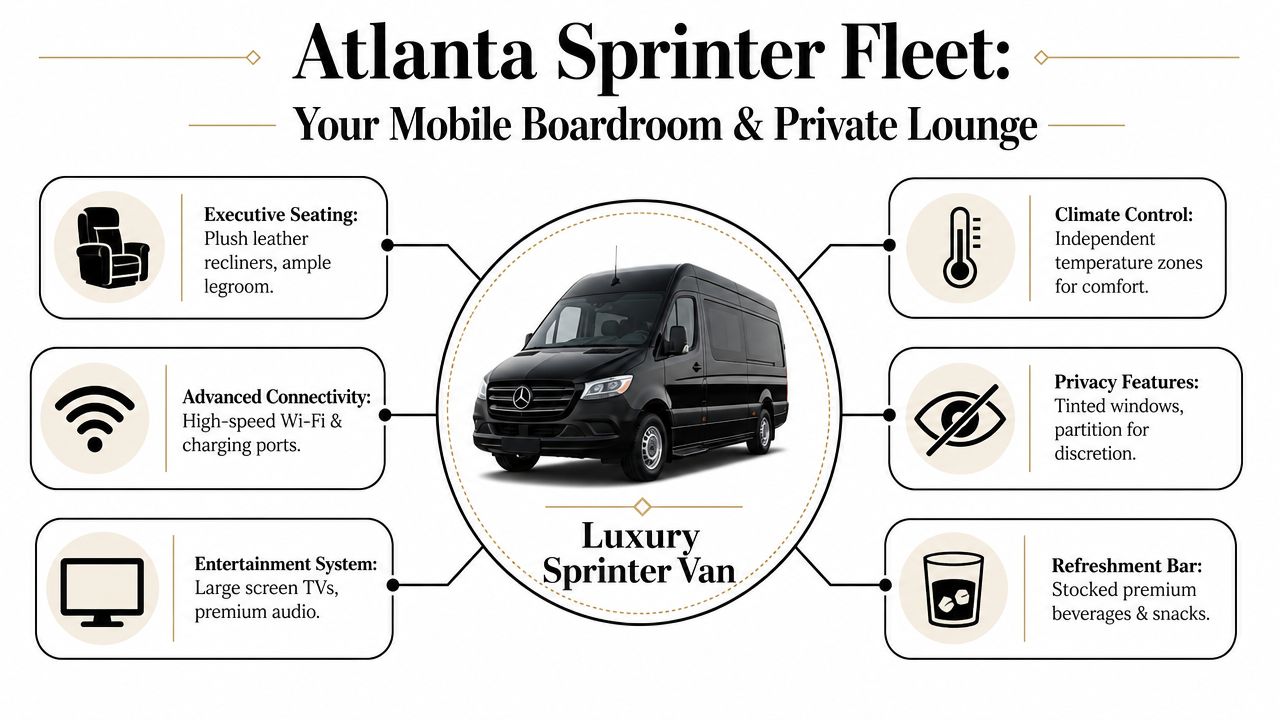
The Mercedes-Benz Sprinter 3500 Extended with a 170-inch wheelbase used in Atlanta luxury service is offered with a full-leather upfit, 15 captain seats, a 32-inch HDMI/AV-integrated TV, and ambient lighting, powered by a 4.5L diesel engine with 188 hp and 413 lb-ft of torque for stable transport, as outlined in this Sprinter 3500 Extended vehicle profile.
That matters because executive groups don't use the cabin the same way leisure groups do. They spread out, open laptops, take calls, review notes, and reset between appointments. The seating layout has to support posture and personal space, not just capacity.
Features that carry operational value
The strongest fleet setups usually deliver value in these ways:
- Executive seating: Leather captain chairs give each passenger a defined seat and cleaner ingress than bench-heavy layouts.
- Climate consistency: Dual-zone climate control matters on longer service windows and during Atlanta's warmer months.
- In-cabin presentation capability: A large integrated screen is useful for briefing content, event prep, or passive downtime.
- Ambient lighting and finish quality: These details shape first impression more than most operators admit.
A good reference point for service style is a luxury Sprinter van rental with driver because the vehicle and chauffeur function as one product, not two separate decisions.
Here's a quick visual summary of what clients should expect from a premium setup:
How to evaluate a Sprinter before booking
Don't start with the glamour shots. Start with use.
| What to check | Why it matters | What to ask |
|---|---|---|
| Seating layout | Determines comfort across the full itinerary | Are these true captain seats or mixed seating? |
| Media integration | Useful for executive prep and longer transfers | Is the TV integrated and working with HDMI/AV input? |
| Cabin finish | Signals quality to passengers immediately | Is the upfit full leather or partial trim? |
| Ride character | Important on longer Atlanta service days | Which Sprinter model and wheelbase is being assigned? |
A premium van should reduce fatigue, not just move people. If the cabin can't support work, privacy, and comfort at the same time, it's not executive-grade.
Strategic Use Cases for Your Luxury Sprinter Van
A principal lands at an Atlanta FBO ahead of schedule. Two associates are arriving commercially at Hartsfield Jackson. A hotel check-in needs to happen before a dinner in Buckhead, and one schedule change will affect everyone. That is the kind of day where a luxury Sprinter earns its place.
The vehicle matters, but the operating value is in control. A Sprinter is the right choice when one itinerary has to hold together across changing arrival times, baggage loads, security considerations, and executive expectations. If the movement is simple and the party is small, a sedan or SUV may be the cleaner answer. If the day involves a leadership team, family office, flight department, or private aviation desk coordinating several variables at once, a Sprinter reduces handoffs and protects timing.
Where it performs best
This format is strongest in assignments where the ground plan has to support more than transportation.
| Use Case | Why clients choose it | What the Sprinter solves |
|---|---|---|
| Executive aviation arrivals | Keeps passengers, luggage, and ground timing under one plan | Direct FBO pickup, controlled loading, private group movement |
| Corporate roadshows | Holds the team together between stops | One route, one chauffeur, one timing standard |
| Hotel and meeting transfers | Preserves presentation and arrival order | Single-vehicle arrival, easier guest management |
| High-profile events | Handles holding time and schedule drift better than split vehicles | Dedicated standby service and flexible routing |
| Production and talent movement | Provides privacy between locations | Quiet cabin, controlled access, room for support items |
For aviation clients, the biggest advantage is coordination. The right Sprinter assignment can stage at the FBO, monitor updates from the flight desk, absorb early or delayed arrivals, and move the full party without dividing people across several cars. That matters for executives who want discretion, and it matters even more for assistants and schedulers who need the ground segment to stay stable while the air segment moves around it.
Roadshows are another strong fit. One chauffeur runs the sequence, the team stays together, and no one loses ten minutes trying to find the second vehicle at each stop. On a day with multiple meetings, those small recoveries add up.
Event work is a different calculation. A Sprinter gives planners a controlled base during long service windows, especially when venue access is tight and pickup timing keeps shifting. Clients booking hospitality, golf outings, concerts, and sponsor programming usually care less about the van itself than about whether the transport plan can absorb real-world friction without creating a new problem.
A luxury Sprinter also works well for family office and concierge-led itineraries that combine airport pickup, retail appointments, dining, hotel transitions, and late-night returns. That kind of movement benefits from one point of control, which is why many clients pair the vehicle with high-touch luxury travel concierge support rather than treating transportation as a separate booking.
The decision logic behind each use case
Use a Sprinter when group timing matters more than pure vehicle count.
For executive airport work, especially private aviation, the priority is usually privacy, baggage handling, and coordinated arrival flow. One properly assigned van can do that better than a cluster of smaller vehicles, particularly when the passenger list includes a principal, security, staff, or family members with different service needs.
For corporate programs, the gain is operational discipline. Everyone departs together, arrives together, and works from the same timeline. That simplifies route planning and cuts down on the constant check-ins that happen when cars split up across Atlanta traffic.
For production, media, and talent movement, the cabin becomes a buffer. Wardrobe, personal items, devices, and core personnel stay in one controlled environment instead of getting scattered across multiple pickups.
What not to do
Do not book a Sprinter just to make the arrival look bigger. Book it when the day has enough moving parts that one vehicle, one chauffeur, and one control point will protect the schedule.
The opposite mistake is underbooking. If the itinerary includes FBO coordination, executive guests, luggage volume, or a full day of stop-and-wait service, trying to piece the movement together with smaller cars usually creates more calls, more confusion, and more exposure than clients expect.
The Concierge Difference The Booking Process
The booking process tells you a lot about the service you're about to receive. If the only interaction is an online calendar and a rate box, you're probably buying a vehicle slot, not an executive transport operation.
That distinction matters most when the trip isn't simple. Executive bookings often involve changing arrivals, named passengers, intermediate stops, building access notes, hotel coordination, and preference handling. Those details rarely fit neatly inside a generic checkout form.
What a professional booking flow should include
A modern luxury rental process may require a 20% refundable deposit, secure license upload, and full payment 72 hours before the trip, with 24/7 concierge service and GPS tracking supporting the booking flow, as described in this Atlanta luxury Sprinter rental guide.
That process is useful because it creates structure without losing flexibility. The deposit secures the assignment. The document flow reduces last-minute administrative friction. The concierge layer gives the client an actual point of contact when plans move.
A high-touch model looks more like luxury travel concierge services than a standard rental checkout. The client gives the outline, operations pressure-tests the itinerary, and the final confirmation reflects the actual day.
What clients should expect before the trip
Strong operators usually confirm details that many travelers forget to raise on their own:
- Passenger sequence: Who must be dropped first, and who cannot be delayed.
- Luggage profile: Executive luggage is different from event collateral or production gear.
- Property access: Hotels, private clubs, offices, and venues all stage vehicles differently.
- Communication chain: One point of contact prevents cross-thread confusion.
The best concierge teams don't just confirm your booking. They remove ambiguity before the wheels turn.
What doesn't work is leaving these decisions until the day of service. That's when avoidable mistakes show up. A polished booking process should feel quiet, clear, and complete.
Atlanta Airport and Private FBO Coordination
The biggest gap in the Atlanta market isn't vehicle quality. It's FBO coordination.
Many providers can handle a standard airport pickup. Fewer can support private aviation movements where the traveler is arriving through a private terminal, the timing can shift quickly, and the pickup point isn't a public curb. That's where executive ground transport either proves itself or fails.
Why FBO work is different
There is a documented content gap around last-minute executive availability and FBO coordination in Atlanta. Many providers focus on standard ATL terminal pickups and don't address the 24/7 concierge and vehicle readiness required for smooth transfers from private aviation terminals, as noted by Atlanta Sprinter van rentals market observations.
That gap is real in practice. Private aviation clients don't want to decode where the chauffeur will wait, whether the vehicle can be staged correctly, or how updates will be handled if the aircraft lands early or late. They expect those handoffs to be solved before arrival.
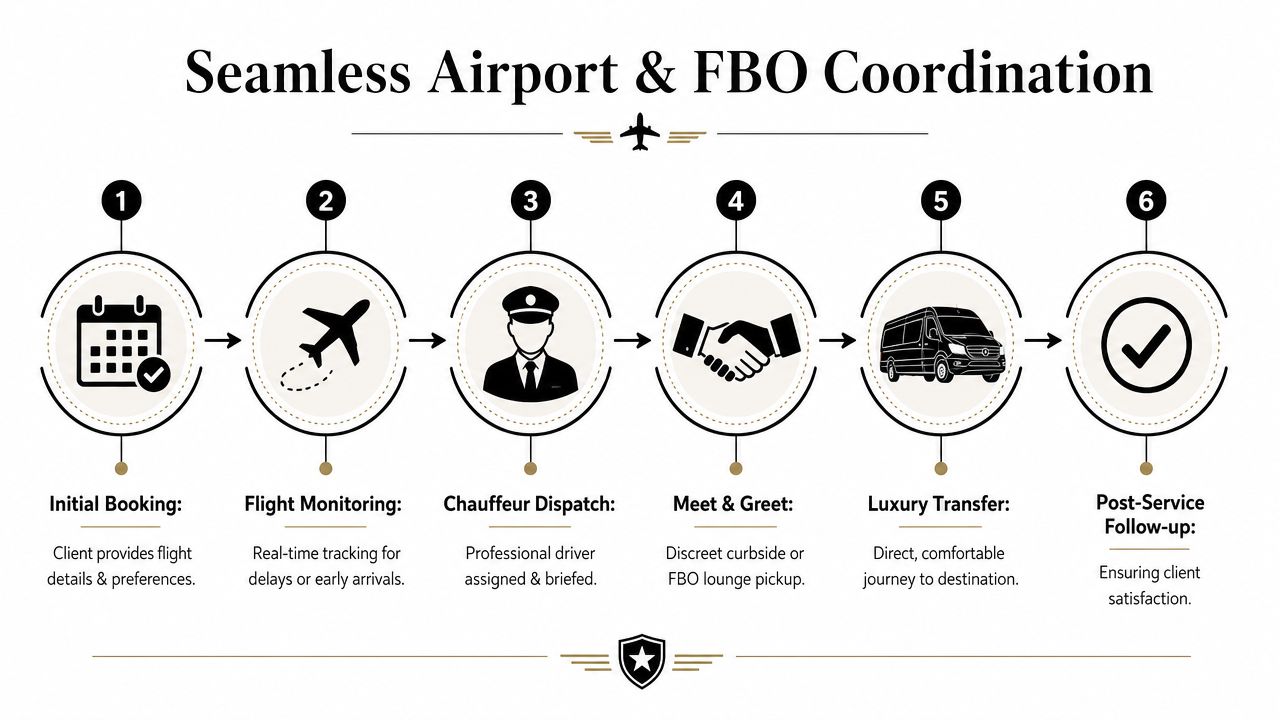
What effective airport and FBO coordination looks like
A proper setup includes several moving parts managed at once:
- Live flight awareness: Operations monitors the arrival and adjusts chauffeur timing without burdening the client.
- Terminal-specific planning: Public terminal pickup and private terminal pickup are not the same assignment.
- Direct communication: FBO staff, assistants, chauffeurs, and operations need one clean chain.
- Readiness outside standard hours: Executive travel doesn't stop at conventional booking windows.
Clients working through private terminals often need broader routing support after landing. That may include city transfers, hotel coordination, or onward intercity transport. For travelers connecting through larger support ecosystems, a resource like Gateway Travel Centre reflects the kind of integrated planning mindset that helps airport and ground segments run cleanly.
The most common mistake
The most common mistake is assuming a provider that serves ATL well can automatically handle FBO logistics at the same standard. That isn't always true. Private terminal work depends on communication discipline, staging precision, and around-the-clock response.
If a client asks, “Can you cover a late-night FBO arrival without uncertainty?” the answer needs to be operational, not promotional.
That's the benchmark. Not a luxury label. Execution.
Understanding Pricing and Corporate Accounts
Pricing for a luxury Sprinter in Atlanta makes sense when you break it into operating components. Clients often focus on the vehicle first, but the rate usually reflects a bundled service standard: vehicle assignment, chauffeur time, dispatch support, route planning, and the service environment that keeps the day stable.
What shapes the rate
Several factors typically influence the final quote:
- Vehicle configuration: A higher-end upfit changes the service class and the replacement cost profile.
- Service duration: Longer bookings often require more detailed planning and scheduling discipline.
- Routing complexity: Multiple stops, waiting periods, and shifting agendas add operational load.
- Pickup environment: Airport and private aviation work often requires tighter coordination than simple point-to-point transfers.
The Atlanta market is also benefiting from more access and better positioning. New van rental facilities have opened near Hartsfield-Jackson Atlanta International Airport, and some operators now offer nationwide service, helping position Atlanta as a key hub in the luxury Sprinter network, according to Master's Transportation's Atlanta Sprinter rental page.
That matters because availability improves when supply, staging, and support infrastructure improve. For clients, it can mean faster assignment and cleaner logistics around airport-related service.
Why corporate accounts are worth setting up
Corporate accounts are less about discounting and more about repeatability.
A well-managed account can streamline approvals, centralize trip preferences, and reduce the back-and-forth that slows down urgent bookings. It also gives the transportation provider a clearer picture of traveler expectations, security preferences, property instructions, and recurring city patterns.
A useful corporate account should provide:
| Account advantage | Operational benefit |
|---|---|
| Consolidated billing | Fewer payment frictions across multiple trips |
| Stored travel preferences | Faster booking with fewer repeated instructions |
| Priority handling | Better response for urgent or complex itineraries |
| Consistent service notes | Cleaner execution for repeat passengers |
The best way to judge value is simple. Ask whether the quote covers a managed service or only a vehicle reservation. For executive travel, that difference is where most of the value lives.
Frequently Asked Questions
How many passengers can a luxury Sprinter handle in Atlanta
Atlanta luxury Sprinter vans are commonly configured for 6 to 19 passengers, depending on the layout and use case. For executive groups, capacity alone shouldn't drive the decision. Seating style, luggage needs, and privacy requirements matter just as much as the headcount.
Is a chauffeured Sprinter better than booking multiple SUVs
Often, yes. A single Sprinter keeps the group together, simplifies timing, and creates one communication line between the client and the chauffeur team. Multiple SUVs can still be the right answer for certain VIP movements, but they create more coordination points and more room for schedule drift.
Can these vehicles handle longer service days
Yes, many executive and event bookings in Atlanta are structured around extended service windows. Some event-oriented operators specifically note 10 to 14-hour minimum service blocks for major movements, as covered earlier in this guide.
What should I ask before confirming a booking
Focus on execution details, not marketing language.
- Vehicle assignment: Ask which Sprinter model and seating layout you're getting.
- Service scope: Confirm whether the quote includes chauffeur service, wait time handling, and itinerary support.
- Arrival management: For airport or FBO work, ask how flight changes are monitored and communicated.
- After-hours support: Make sure there's an actual operations contact if plans shift.
Are last-minute executive bookings possible
They can be, but success depends on vehicle readiness, chauffeur availability, and whether the operator can support the pickup environment. This is especially important for private aviation arrivals, where standard terminal-based processes don't translate well.
What's the clearest sign of a strong provider
The provider asks detailed operational questions before the trip. That usually means they're planning the movement, not just reserving a van.
For executives, private aviation travelers, and travel managers who need more than a vehicle, MLR Worldwide Service delivers discreet, concierge-led ground transportation with the precision high-stakes travel demands. From Atlanta airport transfers and FBO support to multi-stop executive itineraries, the team manages each detail with around-the-clock coordination, professional chauffeurs, and a global standard built for smooth operation.