

Your team is landing at different times. One executive is coming through a private terminal. Another needs to take a confidential call on the way to the hotel. A client is joining for dinner before tomorrow's board presentation. On paper, this looks like a simple vehicle booking. In practice, it's an operations problem.
That's where many bookings go wrong. People focus on the van, the seats, the photos, the rate card. They don't focus enough on the parts that determine whether the day feels controlled or chaotic. A true luxury Sprinter van rental with driver isn't just premium transport. It's coordinated movement, protected time, and fewer failure points when the schedule is tight and the passengers matter.
The difference becomes obvious the moment plans shift. Flights move. meeting locations change. A principal decides they want to stop en route. The provider either absorbs that friction, or your assistant, travel manager, or security point person absorbs it instead.
The Difference Between Travel and Transport
A multi-city roadshow exposes weak ground transportation faster than almost anything else. If each executive is handled separately through app-based rides or loosely managed local vendors, small misses stack up. One driver can't find the pickup point. Another arrives in the wrong place. Someone leaves a bag in the trunk. The team gets to the first meeting already distracted.
Handled properly, the day feels completely different. One chauffeured Sprinter is staged where it needs to be, the chauffeur has already reviewed the manifest and sequence of stops, and dispatch is tracking live changes in the background. The vehicle becomes less of a ride and more of a controlled environment where the team can reset, prep, and arrive composed.
That distinction matters most when the travelers are expensive to interrupt. Senior leadership, revenue teams meeting key accounts, family office principals, and private aviation passengers don't need “a car.” They need continuity.
Travel gets people from one address to another. Transport protects the schedule between those addresses.
A luxury Sprinter works especially well when the group needs to stay together without sacrificing comfort or discretion. Instead of splitting into multiple sedans and multiplying coordination risk, one vehicle keeps the itinerary unified. Conversations continue. Last-minute briefing changes happen in one place. No one is chasing receipts or texting location pins to five separate drivers.
The broader point is simple. Ground transportation sits inside your operational plan, not outside it. If you're reviewing what ground transportation includes in a modern travel program, the distinction begins to matter. The right provider doesn't just supply a vehicle. They remove uncertainty from a day that can't afford it.
When to Choose a Luxury Sprinter Van
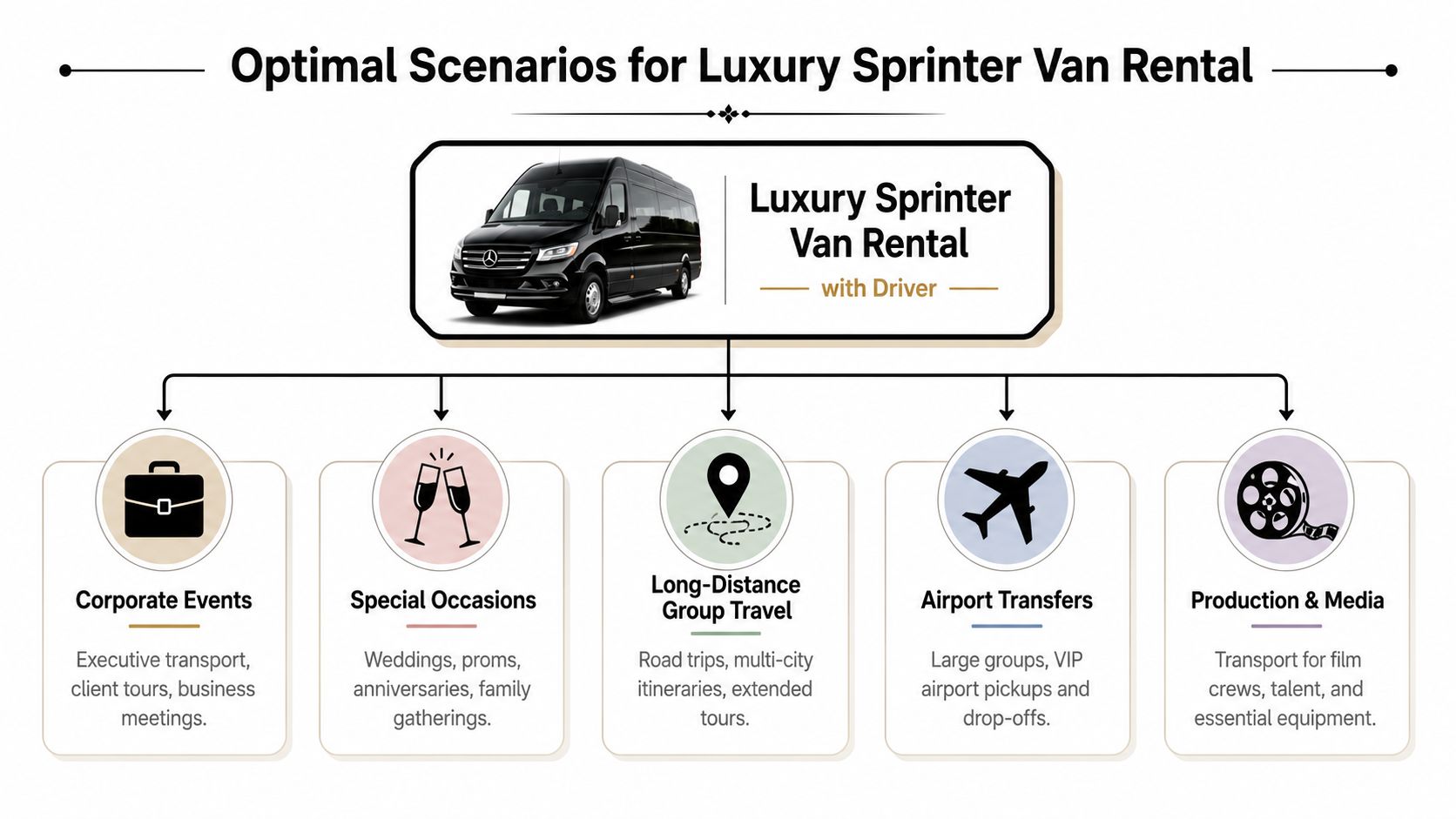
A Sprinter isn't the answer for every trip. Sometimes a sedan is cleaner. Sometimes a motorcoach is more efficient. The best use case sits in the middle, where a group is large enough to benefit from staying together, but important enough that comfort, privacy, and timing can't be treated casually.
Corporate movement that needs one command point
For roadshows, investor visits, property tours, and executive site inspections, a luxury Sprinter often outperforms splitting the party across multiple vehicles. Everyone moves on the same clock. Materials stay consolidated. The lead assistant or coordinator has one primary point of contact instead of several.
Configuration matters. According to the configuration comparison for luxury Sprinter service, Executive Sprinters achieve 92% client satisfaction for corporate groups under 10, while the 8-passenger Jet Sprinter reaches 95% satisfaction for VIPs when the group size stays at 8 or fewer. The same source notes that overfilling hurts the experience, which matches what operations teams learn quickly: comfort disappears the moment you book to theoretical capacity instead of practical capacity.
A useful rule is to book for the mission, not the maximum seat count.
Airport and FBO transfers with executive expectations
Airport work is another strong fit, especially when the party has luggage, staggered arrivals, or private terminal coordination. One vehicle reduces curbside confusion and gives the team a controlled handoff from air to ground. This is especially valuable after long-haul flying or when the travelers need to move directly into meetings.
The best outcomes happen when the van is treated as part of the arrival sequence, not an afterthought. Passenger names, tail or flight details, greeter instructions, luggage assumptions, and stop order all need to be finalized early.
For a broader look at scenarios where premium van service makes operational sense, see this guide to luxury van rental for executive and group travel.
VIP comfort, family office use, and event days
There's also a category of trips where the value is less about logistics and more about control of environment. High-net-worth travelers, family groups, artists, speakers, and VIP event guests often prefer a luxury Sprinter because it offers a quieter, more contained space than a larger shuttle and more shared comfort than separate SUVs.
A Jet-style configuration is usually the better choice for this type of work, especially on longer transfers where reclining seating and a more private interior shape the experience. By contrast, an Executive Sprinter is often the stronger operational tool for team movement, hotel transfers, or conference service.
A short visual overview can help clarify the fit:
A simple decision test
Use a luxury Sprinter when these conditions apply:
- The group should stay together: One arrival, one departure, one communications channel.
- Time in transit has value: The passengers need to work, decompress, or maintain confidentiality.
- The itinerary has moving parts: Multiple stops, live schedule shifts, or airport coordination.
- The arrival itself matters: Client-facing, VIP-facing, or brand-sensitive transport.
- The vehicle configuration can be matched properly: Don't force a larger group into a setup designed for comfort-first travel.
If those boxes are checked, a luxury Sprinter with driver is usually the right middle ground between executive car service and larger group transport.
How to Evaluate a Provider Beyond the Fleet
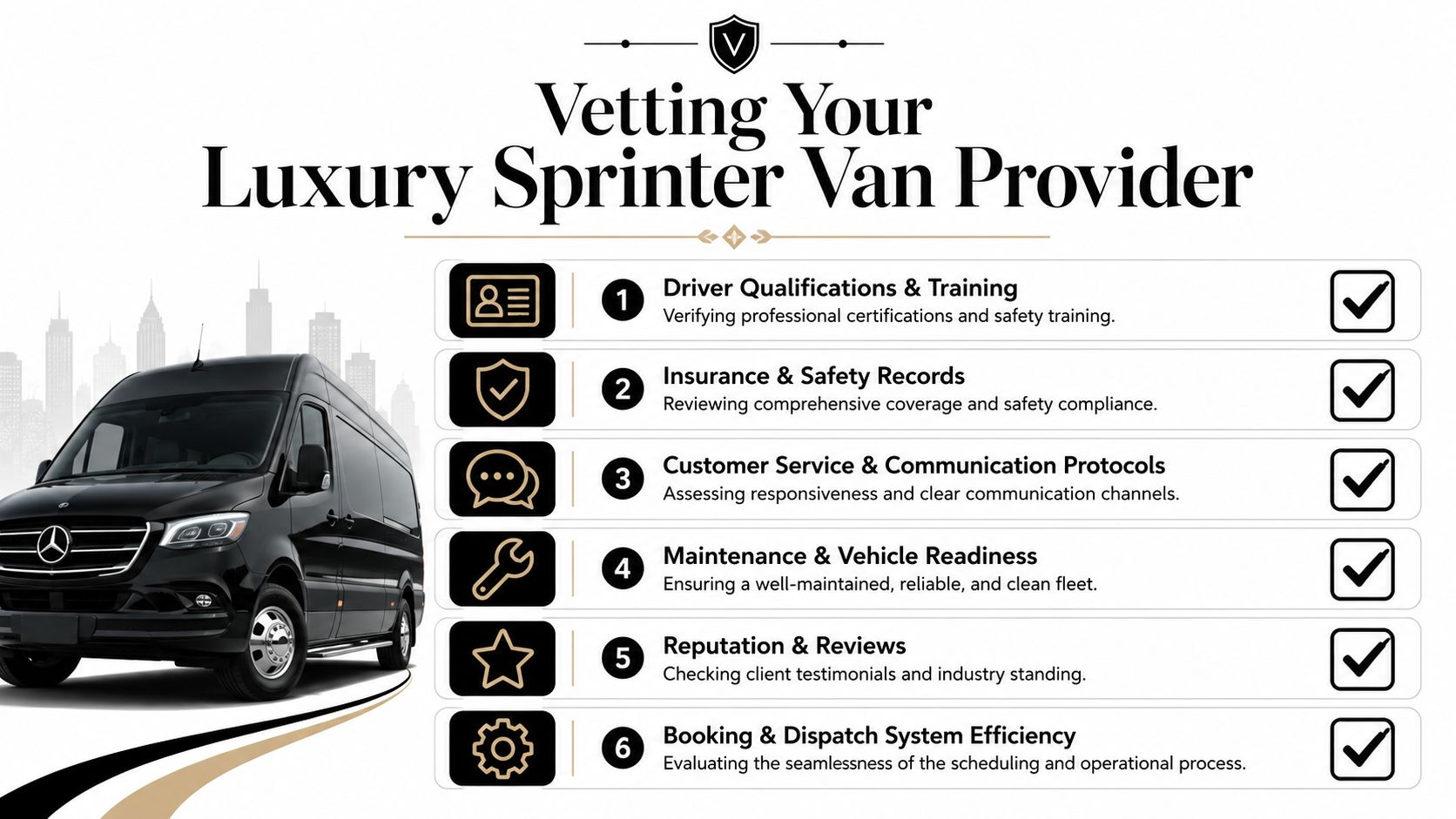
The mistake new buyers make is thinking the fleet tells the story. It doesn't. A polished van at the curb can still be backed by weak dispatch, poor chauffeur briefing, and loose communication standards. What protects your trip is the operating system behind the vehicle.
Ask how the service is run when things change
Itinerary changes aren't the exception. They're routine. A meeting runs late. A plane lands early. A principal adds a stop with no notice. The provider needs a live operations function that can absorb those changes without turning the chauffeur into the dispatcher, scheduler, and client communicator all at once.
When vetting a company, ask practical questions:
- Who monitors the trip in real time: Is there actual dispatch coverage, or is the chauffeur handling updates alone?
- How are changes confirmed: By text, app, email, or a dedicated operations contact?
- What happens after hours: If your principal lands late or diverts, who is accountable?
- How are multi-stop itineraries briefed: A serious provider should have a written run sheet, not a vague booking note.
A provider with disciplined operations sounds calm and specific when answering these questions. A weak one stays general.
Scrutinize chauffeur quality, not just driver availability
The chauffeur is the visible face of the service, but the qualification standard behind that person matters even more. This is especially true for private aviation work. According to this analysis of Sprinter van rental pricing and chauffeur qualifications, 54% of private aviation travelers require FBO liaison support, and a chauffeur who lacks FBO coordination knowledge can cause delays of 30 minutes or more.
That's a serious operational gap. If your passengers are using private terminals, ask directly whether chauffeurs understand FBO procedures, customs pre-clearance workflows, and tarmac-side coordination protocols where applicable.
Practical rule: If the provider can describe the vehicle in detail but can't describe chauffeur training in detail, keep looking.
A strong chauffeur profile usually includes more than clean driving. You're looking for discretion, route judgment, polished client interaction, situational awareness, and the ability to communicate changes without creating friction for the passengers.
Review vehicle readiness like an operator
Luxury interiors matter, but fleet integrity is what keeps the day intact. Ask how often vehicles are cycled through inspection, how cleaning is handled between assignments, and how onboard features are checked before departure. WiFi, charging ports, climate control, entertainment systems, and luggage assumptions should all be verified before the pickup, not discovered curbside.
A simple comparison helps.
| Area | Weak provider behavior | Strong provider behavior |
|---|---|---|
| Dispatch | Reactive, hard to reach | Proactive, confirms live changes |
| Chauffeur briefing | Basic pickup details only | Full itinerary, contacts, contingencies |
| Vehicle prep | Cleaned generally | Checked for trip-specific readiness |
| Client privacy | Assumed but undefined | Clear confidentiality practices |
| Multi-stop support | Managed informally | Managed through operations |
If you're comparing premium operators, this is the level to examine. The article on corporate chauffeur services is useful background because it frames chauffeurs as part of executive travel risk management, not just transportation labor.
Test for privacy and discretion
Corporate clients and high-net-worth travelers rarely ask enough about confidentiality. They should. You're often sharing passenger names, hotel details, tail numbers, contact numbers, event schedules, and occasionally sensitive locations. A provider should have a clear process for limiting who sees what.
Look for these signs:
- Need-to-know handling: Passenger data isn't broadcast unnecessarily to multiple staff members.
- Professional communication: Chauffeurs don't overshare client details in group chats or open channels.
- Discreet arrival behavior: No unnecessary conversation, no attention-seeking curb presence.
- Controlled affiliate use: If another market is involved, standards should transfer cleanly.
The best providers make the trip feel uneventful. In this business, uneventful is a very high standard.
Understanding Pricing Models and Contract Terms
Luxury Sprinter pricing makes sense once you separate trip type from vehicle type. Buyers often compare a flat airport transfer to an hourly as-directed booking as if they're interchangeable. They aren't. One is a controlled move between defined points. The other keeps the vehicle, chauffeur, and operations team committed to your schedule for an open-ended block of time.
What the rate is actually buying
According to Fortune Business Insights on the luxury van market, pricing is clearly tiered by service level. A standard Executive Sprinter with WiFi might be a flat $175 per itinerary for a corporate transfer, while a Jet Sprinter with reclining seats could be $378 flat or $275 to $500 hourly, depending on the service profile and configuration.
That spread tells you something important. You're not only paying for transportation. You're paying for cabin setup, amenity level, presentation standard, and the provider's ability to support a more demanding use case.
Flat rate versus hourly
For most clients, the distinction works like this:
- Flat rate service: Best for airport transfers, hotel moves, event arrivals, and other defined itineraries.
- Hourly service: Better for roadshows, dinners, site tours, meetings with uncertain end times, and any day where the passengers may need to pivot.
- Premium configuration pricing: Higher because the vehicle itself is built for a different experience, not just a different body style.
The cheapest quote usually assumes the simplest day. Your actual day may not be simple.
Contract terms that deserve a close read
The contract is where value is protected or lost. Before approving a booking, review the language around waiting time, overtime, stop changes, cancellation windows, and how extra time is measured. A premium provider should be able to explain these terms plainly.
Focus on these areas:
Service window definition
Confirm when billable time starts and stops. For airport pickups, ask how flight tracking affects timing.Overtime handling
Ask how additional time is authorized and billed if a dinner runs long or the final stop changes.Included items
Fuel, tolls, parking, airport fees, and gratuity should be clarified up front. If the quote says “all-inclusive,” confirm what that means in writing.Vehicle substitution terms
If the assigned Sprinter becomes unavailable, what replacement standard applies?Liability and responsibility
Make sure property handling, lost items, and service disruption language is clear enough for your internal team to approve.
The best contract isn't the shortest. It's the one that leaves the fewest assumptions in play.
Your Pre-Travel Booking and Coordination Checklist
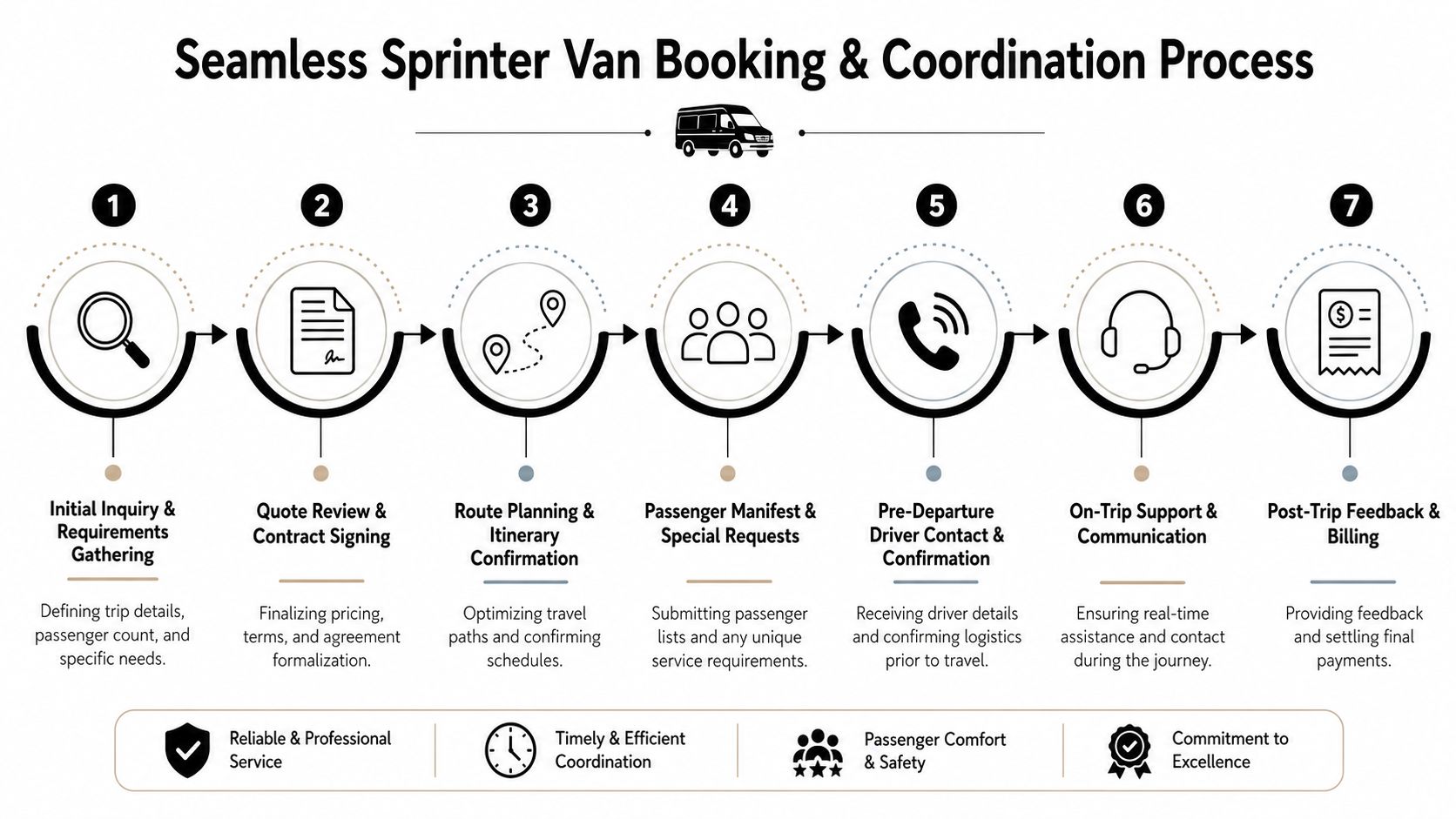
Even the best provider can only execute the information they receive. Most service failures begin upstream, with partial manifests, loose timing, or a booking request that says “airport pickup for executives” and not much else. Precision in the handoff saves time later.
Before you request the quote
Start with the operational basics. Don't send only passenger count and dates. Send the trip as it will be lived.
Include:
- Passenger makeup: Executive team, clients, family members, assistants, security, or guests.
- Luggage assumptions: Cabin bags only, checked luggage, presentation materials, garment bags, or equipment.
- Service style: Airport transfer, roadshow, standby service, event shuttle, or dinner transfer.
- Privacy expectations: Silent ride, business discussion likely, no branding, discreet curbside approach.
- Known constraints: Tight turnarounds, VIP entrances, loading docks, credentialed venue access, or private terminal coordination.
This is also the stage to state preferences that people often mention too late, such as preferred seating, charging needs, or whether a principal wants the front cabin interaction kept minimal.
Build the itinerary for execution, not approval
An itinerary that looks neat in an email can still be hard to operate. What dispatch and chauffeur teams need is a sequence that removes ambiguity.
Use a structure like this:
| Item | What to provide |
|---|---|
| Pickup point | Exact address, entrance, terminal, or FBO name |
| Timing | Requested pickup time and any hard latest-arrival time |
| Contact chain | Primary booker, on-site contact, passenger lead |
| Stop sequence | Every address in order, with known dwell time |
| Special handling | Meet-and-greet, signage, luggage support, security protocol |
Send the itinerary the way you'd brief a substitute who has never seen the day before.
For multi-stop work, identify which times are fixed and which are flexible. If the first meeting must begin on time but the return to hotel is fluid, say that directly. Providers can adapt well when they know where elasticity exists.
Confirm the final brief the day before travel
The most useful pre-travel checkpoint happens the day before service. At that point, review the final run sheet and clear up any soft spots.
Ask for confirmation of:
- Assigned vehicle type
- Chauffeur contact protocol
- Dispatch contact for live changes
- Pickup instructions for each location
- Manifest accuracy
- Any special requests already loaded into the trip notes
Airport and FBO details should be rechecked carefully. Flight numbers, tail numbers, terminal changes, and arrival sequencing should be current. If multiple passengers are arriving separately, clarify whether the van is handling a sweep, staging for the principal first, or rotating between pickups.
Manage day-of changes cleanly
When plans change, clients often create confusion by messaging too many people at once. One person texts the chauffeur. Another emails the booking contact. A third updates a group thread. That's how stops get crossed.
Use one chain of command. Ideally, the booker or designated coordinator communicates changes to dispatch, and dispatch updates the chauffeur. If a passenger must contact the chauffeur directly, keep the message narrow and practical.
Good day-of practice looks like this:
- Name the change clearly: “Dinner venue changed” works better than “plans shifted.”
- Send the full replacement detail: New address, contact name, expected departure time.
- State who approved it: This matters on corporate accounts.
- Avoid partial updates: Don't send fragments over multiple messages unless there's no alternative.
A smooth trip usually reflects disciplined communication more than heroic recovery.
Advanced Considerations and FAQs
How are multi-day or cross-state itineraries handled properly
The strongest operators plan these trips as managed sequences, not oversized single bookings. Vehicle readiness, chauffeur scheduling, hotel positioning, parking strategy, and route timing all need to be reviewed before departure. For the client, the key question is whether the provider treats each day as its own live operation with nightly reset and next-day confirmation.
Ask who owns the itinerary once the first day begins. If the answer is unclear, the trip is carrying avoidable risk.
What if the passengers require a higher level of discretion or security
Say so early. Don't wait until the final confirmation. Enhanced privacy requests can affect pickup procedure, chauffeur briefing, vehicle staging, routing, and communication protocol. Some clients want low-profile arrivals. Others need coordination with household staff, executive protection, or venue security.
The provider doesn't need every backstory. They do need enough information to shape the service correctly.
How do affiliate networks maintain consistent standards in other cities
Consistency depends on vetting, briefing, and oversight. A good global operator does not pass your reservation to a local company and hope for the best. They define service expectations, control communication standards, verify vehicle class, and keep central oversight on the trip. If your travel spans several markets, ask who remains accountable from beginning to end.
What should an executive assistant or travel manager do after the trip
Close the loop while details are fresh. Note whether timing held, whether the vehicle fit the mission, whether communication worked, and whether any recurring preferences should be stored for future bookings. Good providers improve when clients give specific operational feedback, not just “everything was great.”
The smartest repeat bookers build a travel profile. They don't restart from zero every time.
If you're arranging executive, VIP, private aviation, or complex multi-stop transportation, MLR Worldwide Service provides the kind of coordinated, discreet ground support that keeps high-stakes travel running cleanly. Their team handles chauffeur service, airport and FBO transfers, corporate roadshows, event logistics, and global itinerary management with the operational discipline serious clients expect.