
The World Health Organization states that more than 1.3 billion people live with a significant disability. For a luxury transport provider, that is not a niche audience or a compliance footnote. It is a core service population with high expectations, complex travel requirements, and little tolerance for operational failure.
Accessibility requirements should be managed as one end-to-end operating standard across booking, dispatch, fleet selection, chauffeur protocol, entrances, waiting areas, and in-vehicle experience. VIP travelers do not judge your company in departments. They judge the full journey.
That distinction matters.
A booking form that captures wheelchair dimensions but does not pass them accurately to dispatch creates liability. A properly equipped vehicle paired with an inaccessible lounge entrance creates service failure. A polished chauffeur who cannot support a traveler using assistive technology creates friction at the point where premium service should feel controlled and deliberate.
Luxury operators should treat accessibility the same way they treat security, confidentiality, and punctuality. As a required discipline that protects revenue, reputation, and duty of care.
This article takes the practical view many competitors miss. Digital accessibility and physical accessibility are the same service promise. If those two systems are not connected, your brand is making commitments your operation may not be able to keep.
Beyond Compliance The Business Case for Accessibility
Accessibility protects revenue before it protects reputation.
In luxury ground transportation, service failure rarely stays isolated. One inaccessible booking flow can block a high-value reservation. One missed mobility note can force a last-minute vehicle change. One inaccessible entrance at pickup or arrival can turn a well-managed trip into a client escalation. For operators managing executive travel, family office movement, or international ground transportation for VIP clients, accessibility should be treated as a commercial control, not a courtesy.
The business case is simple. Clients with disabilities, and the assistants, travel managers, concierges, and aviation teams who support them, reward providers that deliver certainty. They also abandon providers quickly after preventable friction. In premium service categories, trust compounds. So does failure.
Why the commercial risk is higher in luxury service
Luxury operators face a harsher standard because the buyer is paying for control. A family office expects accurate execution without repeated explanations. A corporate travel manager expects the booking detail entered online to match the dispatched vehicle, the chauffeur briefing, and the physical conditions on site. An FBO or hotel partner expects your team to protect their guest experience, not create recovery work for theirs.
That has direct business consequences:
- Accessible digital booking protects conversion. If a traveler or assistant cannot complete a request, confirm needs, or trust the information presented, the booking does not proceed.
- Accessible physical operations protect retention. The right lift, securement system, boarding support, entrance route, and waiting area determine whether the first trip becomes a standing account.
- Accessible service execution protects referral channels. Executive assistants, concierges, and aviation coordinators recommend operators who make them look prepared.
If a client states an accessibility requirement once, your systems should carry it through the entire trip.
Accessibility is a service design standard
Executives who treat accessibility as a narrow legal issue miss the operational point. The actual requirement is alignment between what the client can request digitally and what your fleet, facilities, and staff can deliver in real conditions.
That means the booking path must capture usable detail. Dispatch must receive it in a format that drives vehicle selection and staffing decisions. Chauffeurs must see the right instructions before arrival. Pickup and drop-off sites must support the promised service level. If any link breaks, the failure becomes visible to the client immediately.
This discipline improves the broader operation. Clearer booking paths reduce reservation errors. Better notes improve dispatch accuracy. Better site checks reduce delays. Better chauffeur protocols improve confidence for every principal, not only travelers with disabilities.
The right management question is not how to satisfy a rule. It is how to prevent mismatch between digital promise and physical delivery. That is where luxury providers protect margin, reduce liability, and earn long-term trust.
Understanding Global Regulatory Mandates
Multinational accessibility exposure rarely starts with the vehicle. It starts at the first digital touchpoint. If a traveler cannot search, disclose a mobility need, complete payment, or confirm assistance online, your operation has already failed before dispatch assigns a car.
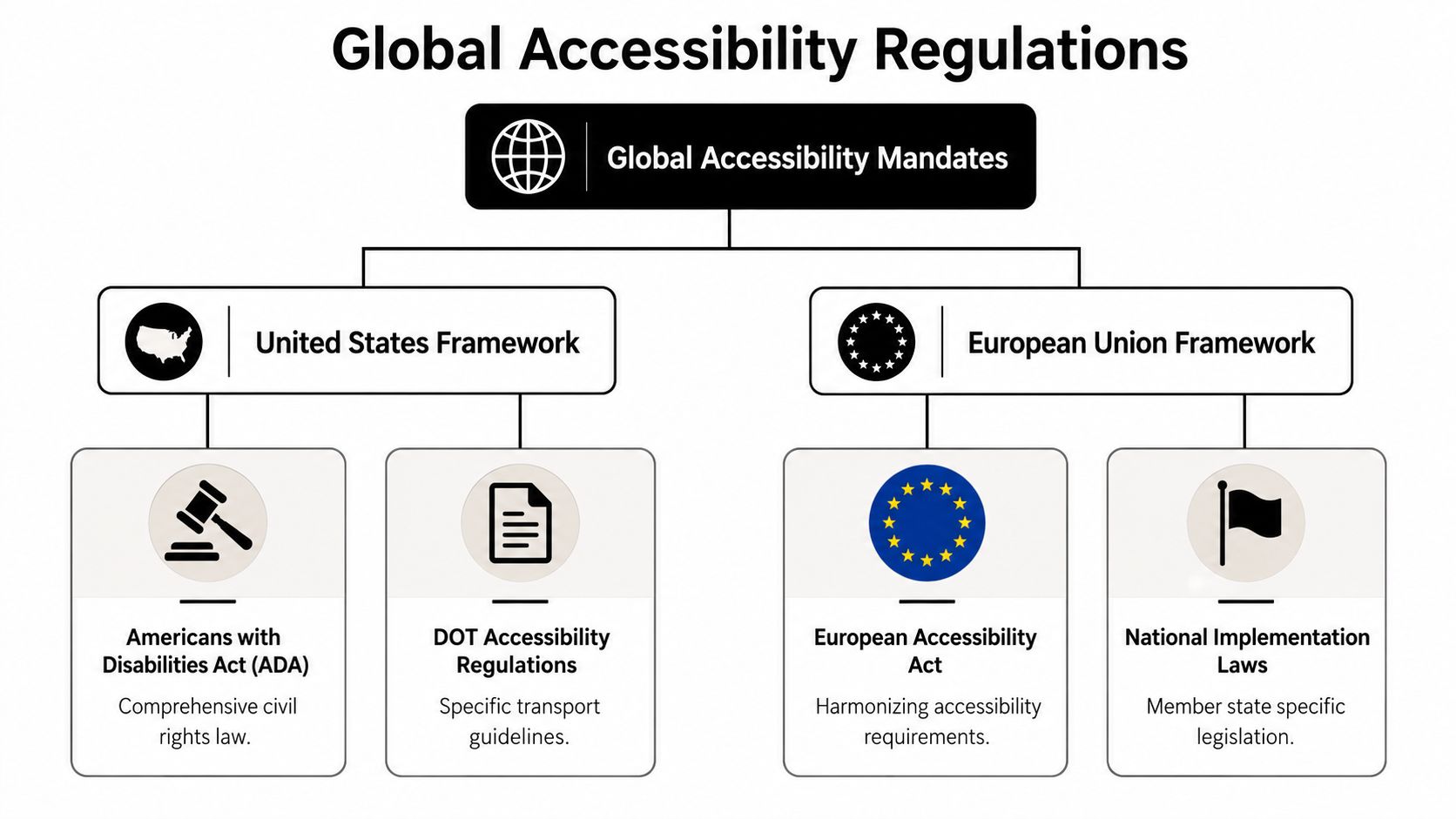
For cross-border operators, the practical answer is standardization. Set WCAG 2.1 Level AA as the default rule for booking platforms, mobile apps, client portals, and digital communications. That gives legal, product, procurement, and operations teams one standard to enforce across markets instead of a patchwork of local interpretations. The rationale is outlined in Be My Eyes' accessibility standards overview, which explains why WCAG 2.1 Level AA is the reference point behind major accessibility frameworks in the United States and Europe.
What executives actually need to know
Treat regulation as an operating requirement, not a legal memo.
Your teams need a clear decision standard for every customer-facing tool. Can a traveler with a disability book, modify, and receive trip information independently, and can that information carry into dispatch and service delivery without manual repair? That is the standard that protects brand reputation and reduces claim risk.
Use this executive summary:
| Framework | What matters operationally | Management implication |
|---|---|---|
| United States | ADA enforcement increasingly expects digital access to core services | Review websites, apps, payment flows, and vendor tools as part of risk control |
| European Union | EN 301 549 applies WCAG-based digital requirements across regulated services | Build one implementation standard for all EU-facing digital assets |
| Global operations | Accessibility obligations affect every handoff, including booking, confirmation, and support channels | Make accessibility part of procurement, QA, release management, and service design |
The management mistake is separating digital compliance from physical delivery. A booking flow that allows a client to request wheelchair boarding assistance, extra transfer time, or step-free access creates an operational obligation to deliver exactly that service in the physical world.
The technical rules that matter most
Executives do not need to memorize every success criterion. They do need to know where failures create immediate exposure.
Color contrast is one example. As noted earlier, the standard requires sufficient contrast for text and interface elements. If your booking experience uses faint fare details, low-visibility confirmation buttons, or hard-to-read form labels, clients make mistakes, abandon the process, or call for manual help. In a luxury environment, that is not a design flaw. It is a service failure.
Keyboard access matters just as much. Date pickers, login screens, payment fields, and confirmation pages must work without mouse-only interactions. Screen reader compatibility matters too, especially for form labels, error messages, and status updates. If a traveler can request an accessible vehicle only by calling your reservations desk because the online path breaks under assistive technology, your digital system is out of alignment with your service promise.
Ask one reporting question at the leadership level: Can a client independently book the right trip, communicate an accessibility requirement, and receive a confirmed service plan through accessible digital channels?
Build governance around the full journey
Accessibility obligations do not end at launch. Every redesign, third-party widget, payment integration, app update, and regional microsite can introduce new failure points.
That matters even more in international service models, where booking, dispatch, affiliate coordination, and on-the-ground delivery may sit across multiple vendors. Leadership teams responsible for international ground transportation strategy should require accessibility review at each handoff, not only on the public website.
The strongest policy is simple. One digital standard. One intake method for accessibility requirements. One operational process that converts those requirements into vehicle assignment, site readiness, and chauffeur instructions. Competitors often miss that connection. You should not.
Vehicle and Facility Accessibility Specifications
Digital promises are worthless if the physical experience breaks on arrival.
That's where many transport providers fail. They may have a polished booking interface and attentive reservation agents, but they haven't translated the client's requirements into vehicle readiness, pickup site suitability, or terminal support. The result is operational embarrassment and avoidable risk.
The physical standards you can't ignore
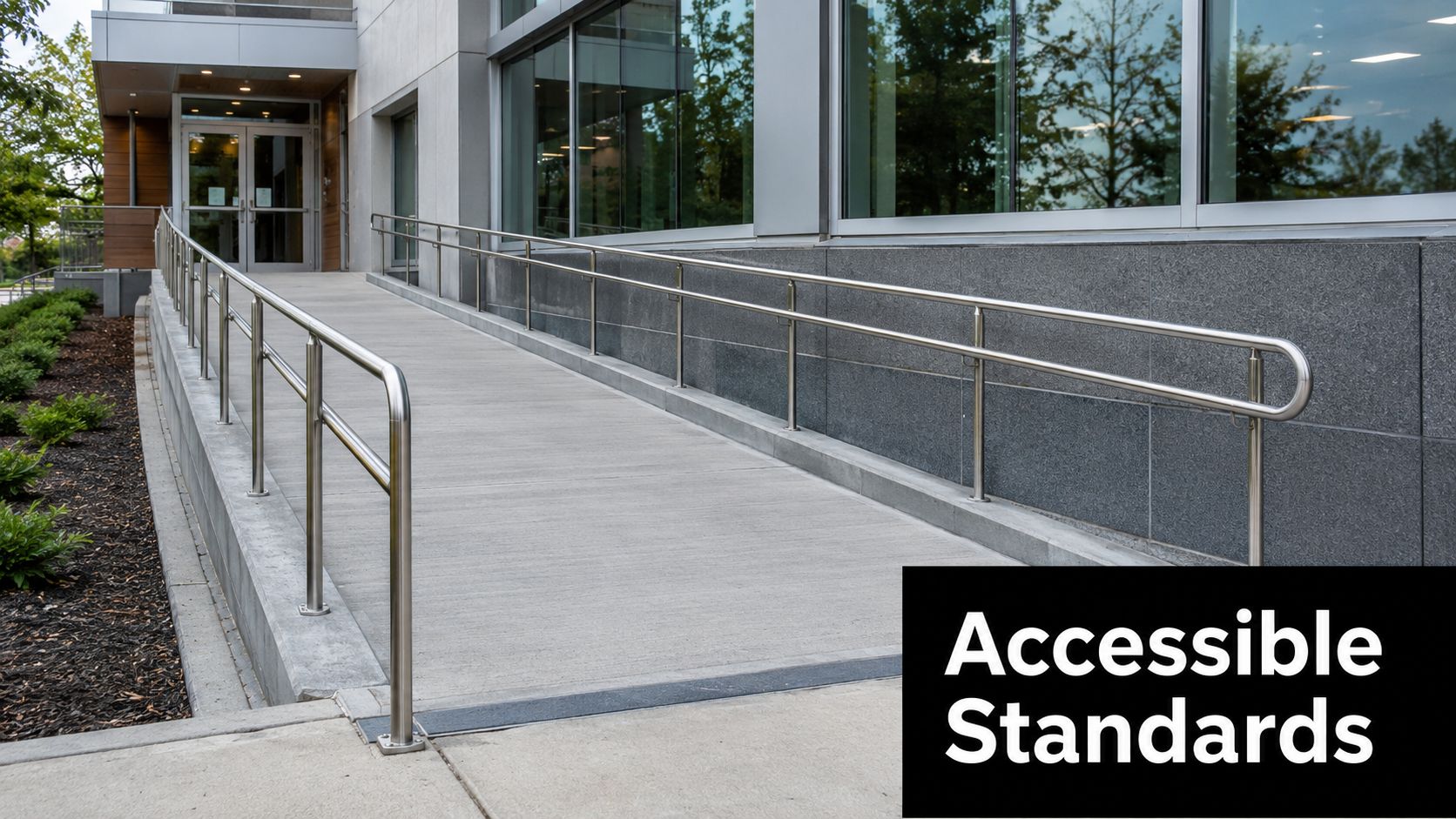
Physical accessibility codes and digital standards are often treated as separate systems, yet building guidance includes concrete requirements such as 1:12 ramp gradients and walkway widths from 1050mm to 1500mm, while there is no standardized metric linking those physical requirements to the digital ability to book a matching service, as outlined in the Hong Kong Architectural Services Department universal access guidance.
That gap matters in real operations. A traveler may need:
- A vehicle with wheelchair access: not merely a large SUV, but an actual configuration that can support boarding safely.
- Adequate curbside or terminal space: enough room to deploy a ramp or assist a passenger without improvisation.
- A compliant path through private facilities: entrances, washrooms, waiting areas, and handoff points must be navigable.
A reservation tag that says “accessible vehicle requested” is not enough. Dispatch needs operational detail. Can the client transfer independently? Are they traveling with a power chair? Is there a service animal? Is the pickup site constrained? Can the receiving venue handle the arrival properly?
What to inspect in vehicles and passenger spaces
Luxury operators should build a physical accessibility review into fleet and site readiness.
| Area | What to verify |
|---|---|
| Vehicle entry | Boarding method, step height, ramp or lift condition, door clearance |
| Interior use | Safe maneuvering space, seating arrangement, securement capability where relevant |
| Passenger comfort | Climate control reach, lighting, communication with chauffeur, storage for mobility aids |
| Facility approach | Clear pathway, entrance access, restroom access, waiting area usability |
| Transfer points | Space for curbside support, FBO coordination, weather-protected access where possible |
This shouldn't live only in a compliance binder. It belongs in daily readiness routines, maintenance inspections, and affiliate quality reviews. That aligns directly with broader fleet maintenance best practices because an accessible feature that isn't functioning at pickup isn't a feature. It's a liability.
Self-service environments need the same scrutiny
Many VIP journeys involve more than the car itself. Airport kiosks, terminal check-in points, in-vehicle tablets, and private facility interfaces all shape the client experience.
Here's a useful reference point on how accessible environments should function:
The operational mistake is assuming that physical accessibility begins and ends with a ramp. It doesn't. It includes wayfinding, handoff timing, dwell time, communication, and the ability to move through each touchpoint without confusion or strain.
If your team can't verify the vehicle, the path, and the destination handoff in one workflow, you don't have an accessible service. You have a partial promise.
Service Protocols for an Inclusive Journey
The difference between compliant service and excellent service is usually human behavior.
A polished chauffeur can make a complex trip feel effortless. An untrained chauffeur can turn a routine transfer into a stressful negotiation. That's why accessibility requirements have to show up in scripts, etiquette, dispatch notes, and escalation procedures, not just in policy documents.
What good service looks like in practice
A principal arrives at an FBO using a mobility aid. The chauffeur doesn't grab equipment without asking. He introduces himself, confirms the destination, asks how the client prefers to be assisted, and makes sure the route from terminal door to vehicle is clear before movement begins. That's professionalism.
A deaf traveler is met at a private terminal. The chauffeur doesn't rely on shouted greetings across the curb. He uses the passenger name display, maintains eye contact, confirms the itinerary visually, and avoids creating confusion during boarding. That's competence.
A traveler using a service animal boards a premium SUV. The team has already noted the accommodation, arranged adequate space, and briefed the chauffeur. Nobody treats the situation as unusual. That's service maturity.
Training needs to be specific
Generic “awareness training” won't carry a luxury operation. Staff need repeatable protocols they can use under pressure.
Focus training on these points:
- Ask before assisting: Staff should never assume how a traveler wants help with a wheelchair, cane, or walker.
- Confirm, don't improvise: Dispatch notes must identify requested accommodations clearly before the vehicle is assigned.
- Protect discretion: Accessibility needs are service details, not conversation topics.
- Use clear communication: Chauffeurs should know how to communicate with clients who are deaf, hard of hearing, blind, or low vision without becoming awkward or overly familiar.
Operations advice: Train chauffeurs to lead with one question: “How would you like me to assist you today?”
Don't overlook self-service touchpoints
Accessibility also applies to passenger-facing technology in the journey itself. The U.S. Access Board's ICT guidance makes clear that self-service technology such as kiosks or in-vehicle tablets must support functions like audio output via headphones and compatibility with assistive devices so users with sensory or motor disabilities aren't excluded.
That has direct implications for premium transport environments. If you provide an in-vehicle control screen, entertainment tablet, check-in kiosk, or digital concierge interface, it needs to work for more than one type of user. The right question isn't about the feature's elegant design. It's whether the passenger can use it independently.
The best operators script accessibility into service culture the same way they script meet-and-greet etiquette, secure transport protocol, and client privacy.
Connecting Digital Booking to Physical Reality
Most accessibility failures happen before the vehicle moves. The booking platform captures the wrong information, captures it unclearly, or captures it without pushing it into operations.
That's the central weakness in many transport businesses. Digital teams optimize forms. Operations teams manage vehicles. Neither owns the end-to-end accessibility outcome. The client pays for that disconnect.
A booking form is an operations instrument
Treat your website and app as dispatch tools, not marketing assets.
If a client needs an accessible vehicle, the system should capture that request in a structured way. If the traveler has a service animal, sensory accommodation, or communication preference, those details should move to the operational record without manual re-entry. If a request requires confirmation, your team should trigger that follow-up before assignment, not after the chauffeur is en route.
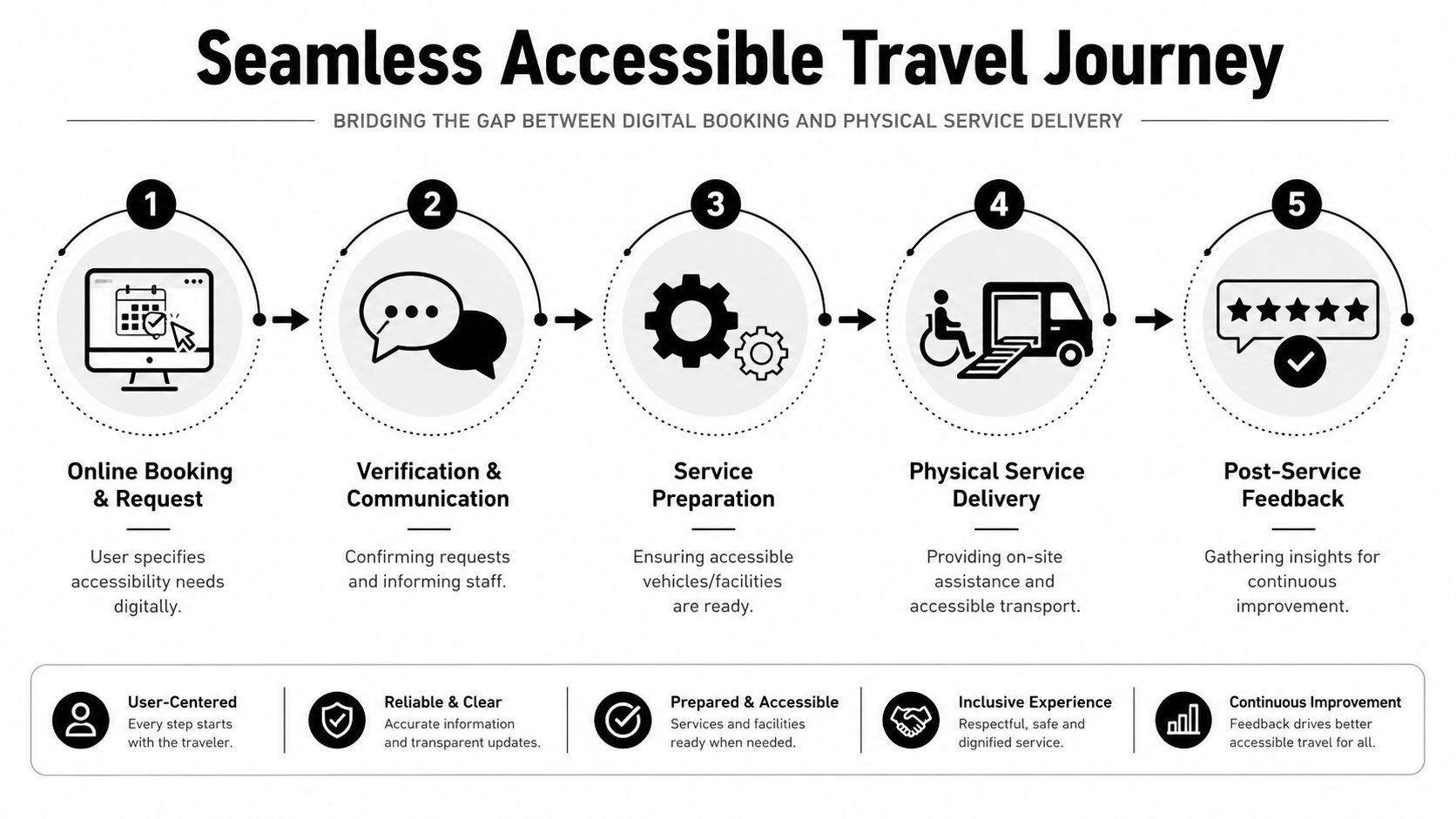
Here's the operating model that works:
- Collect the need clearly in the booking interface.
- Validate the request through trained reservations staff when necessary.
- Map the request to an actual asset and qualified chauffeur.
- Confirm the fulfillment plan with the client or assistant.
- Close the loop after service so errors become process fixes.
This is where real-time data matters. The transport business already depends on execution visibility. Accessibility data should feed the same command structure used for asset allocation and service status, especially in programs built around real-time transportation visibility.
Use custom interfaces carefully
Private luxury providers often want bespoke booking experiences for family offices, executive assistants, and concierge partners. That can be smart. It can also create risk.
The relevant nuance is Equivalent Facilitation. As explained in the NDRN accessibility guidelines discussion, private firms may use alternative designs if they deliver substantially equivalent or greater usability. That doesn't mean “we built something custom, so normal rules don't apply.” It means your custom interface must work at least as well for people with disabilities.
That's a demanding standard. If your private booking app uses unconventional navigation, hidden controls, nonstandard gestures, or visual-only booking cues, you could make the experience worse while believing you've made it more premium.
A luxury interface isn't successful because it looks exclusive. It's successful because the client can complete the task easily, independently, and without confusion.
The integration standard executives should require
Ask your teams five direct questions:
| Question | Why it matters |
|---|---|
| Can a traveler request accessibility accommodations without calling support? | Independence is part of accessibility |
| Does the data flow into dispatch automatically? | Manual re-entry creates failure points |
| Can operations verify the right vehicle and chauffeur before confirmation? | Promise and fulfillment must match |
| Are affiliate partners held to the same standards? | Accessibility breaks at handoffs |
| Do post-trip reviews track accessibility execution separately? | You can't improve what you don't isolate |
If the answer to any of those is no, fix the process before investing in design polish. Inaccessible elegance is still inaccessibility.
An Operational Checklist for Service Excellence
Most organizations don't need another accessibility policy. They need a management checklist that forces consistency.
The right checklist should sit across legal review, digital product, fleet readiness, facility coordination, chauffeur training, and quality assurance. If one department owns accessibility alone, the program will underperform.
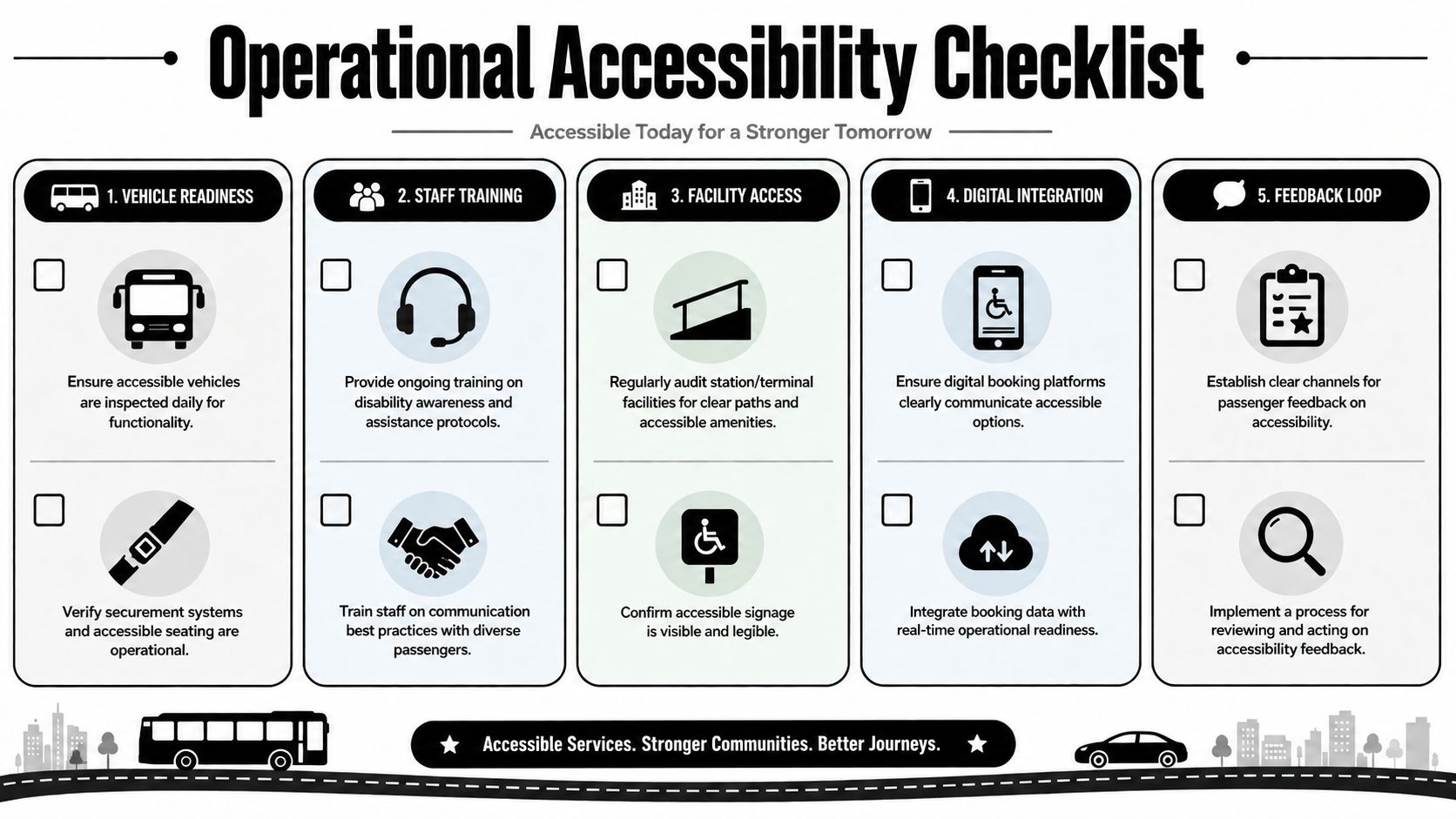
Executive audit points
Use this as a live operating checklist, not a presentation slide.
- Digital standard locked: Your public website, booking forms, and mobile experiences should be reviewed against WCAG 2.1 Level AA and tested whenever content or functionality changes.
- Accommodation capture defined: Reservation flows should collect accessibility requirements in structured fields, not buried free text.
- Dispatch translation verified: The accommodation request must appear in chauffeur and operations records in usable language.
- Vehicle readiness confirmed: Assigned assets should be checked for the accessibility features promised at booking.
- Facility path reviewed: Pickup, waiting, and drop-off environments should be assessed for navigability and handoff practicality.
Team and vendor controls
Accessibility fails quickly when affiliates, contractors, or front-line staff improvise. Put controls around the human layer.
| Control area | What leadership should require |
|---|---|
| Training | Chauffeurs, reservations, dispatch, and concierge staff receive role-specific instruction |
| Affiliate governance | Partner standards include accessibility expectations, not only punctuality and vehicle age |
| Incident handling | Accessibility failures trigger review, corrective action, and client follow-up |
| Procurement | New software, kiosks, and in-vehicle technology are reviewed before rollout |
| Feedback | Client comments on accessibility are logged distinctly and reviewed by operations leaders |
The standard to hold
Accessibility requirements should be judged by one outcome. Can the passenger move from booking to destination with dignity, independence where possible, and professional support where needed?
If not, the process needs redesign.
That means leadership should audit for three kinds of mismatch:
- Digital mismatch: The platform accepts a request the operation can't fulfill.
- Fleet mismatch: The vehicle assigned doesn't match the traveler's actual need.
- Service mismatch: Staff behavior undermines an otherwise compliant setup.
Fix those three issues and most accessibility failures become preventable.
The strongest accessibility programs don't rely on heroic staff intervention. They rely on disciplined systems that make the right outcome routine.
If your organization needs executive-level support designing accessible booking workflows, strengthening chauffeur protocols, or aligning vehicle readiness with client-specific travel needs, MLR Worldwide Service can help you deliver a more reliable and inclusive VIP transport experience without sacrificing discretion, service quality, or operational control.