
You know the call before you answer it. It comes after hours, from dispatch or security, and it starts with a sentence no operator wants to hear: a laptop is missing, a booking account looks wrong, or a VIP client's itinerary may have been exposed. In executive transport, the problem is never just the file. It's the location trail, the pickup window, the name on the manifest, the flight connection, and the trust that a discreet service depends on every day.
That's why data breach notification can't be treated like a paperwork exercise. In the United States, breach notification volumes reached record levels in 2024, with the Identity Theft Resource Center reporting 1.35 billion victim notification letters and 3,158 U.S. data compromises that same year, which shows how common disclosure has become as an operational and legal obligation rather than a rare exception (BrightDefense summary of 2024 breach statistics). For a transport business handling high-profile client data, that reality changes the crisis posture immediately.
The Inevitable Call Responding to a Data Breach
The first call rarely arrives with complete facts. A chauffeur may have left a tablet in a lounge. A coordinator may notice an unfamiliar login to a booking system. A client may ask why an itinerary that should have been private is suddenly circulating in the wrong place. At that point, the question is not whether the issue feels serious. The question is whether the organization can move fast enough to protect people and preserve evidence.
For executive transport, the exposure often sits in ordinary workflow data. Itineraries reveal meetings, hotel transfers, airport timing, and patterns of movement. VIP client profiles can include direct contact details, travel preferences, assistants' names, and other personal data that becomes far more sensitive when paired with timing and location information. Once that data leaves your control, the breach is no longer theoretical.
Practical rule: treat every suspected incident as both a security problem and a communications problem. One team's delay can become another team's failure.
The scale of modern notification matters because it changes expectations. Regulators, clients, insurers, and business partners now assume that a serious incident will be documented, investigated, and disclosed on a tight clock when required. The businesses that handle this well do not improvise. They already know who decides, who investigates, who speaks, and who documents every step.
Understanding Data Breach Notification Beyond the Legalese
A good way to think about data breach notification is a vehicle recall. The point isn't to shame the manufacturer. The point is to tell the owner that a defect exists, explain the risk in plain language, and give instructions that are helpful. If the notice is vague, people can't respond. If it's late, the damage can spread. If it's confusing, the organization may technically comply and still fail the customer.

In practice, a breach notice serves three jobs. It tells affected people what happened. It tells them what the company has done. And it tells them what they should do next, if anything. That is especially important in executive transport, where a notice might need to explain exposure involving a travel calendar, client contact record, or real-time location data without creating unnecessary panic.
The trigger is not always the same across jurisdictions. Some incidents are security events that never rise to a legal breach. Others become reportable because the exposure creates risk to individual rights, identity, or privacy. The distinction matters because over-notifying creates noise, but under-notifying can create legal and reputational damage that lasts far longer than the incident itself.
A useful internal test is simple.
- Could the exposed information help someone identify, track, contact, or impersonate a client? If yes, the matter deserves immediate legal review.
- Would a traveler or assistant need to take any protective action? If yes, the notice should say so directly.
- Would a vague explanation leave the recipient guessing? If yes, the draft needs revision before it goes out.
The most important point is this. Notification is not just a legal endpoint. It's part of the company's duty to reduce harm after a failure has already happened.
The Global Web of Notification Laws
A breach involving itineraries, pickup locations, or client contact records can trigger more than one legal regime at once. That is the practical problem for executive transport operators. A single incident may touch privacy law, security obligations, and client trust in several countries at the same time.
The EU's GDPR set the tone for faster disclosure expectations. It took effect in May 2018, and the enforcement record shows how quickly notification failures can turn into expensive regulatory action. For global operators, the lesson is direct. Slow or thin reporting can compound the damage long after the incident itself.
Under GDPR, the standard is risk-based. Controllers notify the supervisory authority unless the breach is unlikely to risk individuals' rights and freedoms, and they notify affected people when the breach is likely to create high risk. If exposed data was rendered unintelligible through strong encryption and the key was not compromised, individual notice may not be required (EDPB breach notification guidance). In practice, that makes encryption part of the notification decision, not just a security control.
In the U.S., the rules vary by state. Massachusetts requires notice to regulators and residents as soon as practicable and without unreasonable delay once the organization knows or has reason to know of a breach, and the notice must include the nature of the breach, the approximate number of affected residents, and remediation steps. That same standard reflects the operational reality that legal review and forensic review happen in parallel, especially when a client's travel history or location data may be involved (Massachusetts breach notification requirements).
GDPR vs. Common U.S. State Law Notification Requirements
| Requirement | GDPR (EU) | Typical U.S. State Law, such as Massachusetts, California |
|---|---|---|
| Trigger | Notify unless the breach is unlikely to risk individuals' rights and freedoms | Notify when personal information is breached under the state's legal standard |
| Timing | Rapid disclosure expectation under a risk-based standard | As soon as practicable, without unreasonable delay, or a state-specific deadline |
| Notice to regulators | Required in qualifying cases | Often required, depending on the state and the affected population |
| Notice to individuals | Required when high risk to individuals is likely | Required when statutory triggers are met |
| Effect of encryption | Strong encryption can remove the need for individual notice if the key stayed uncompromised | Encryption can matter, but state rules vary and may still require analysis |
| Core mindset | Risk severity and mitigation | Timeliness, documentation, and state-specific content rules |
Cross-border incidents create the hardest judgment calls. One breach can trigger different thresholds, different notice forms, and different timing obligations. For an operator serving high-profile clients, the jurisdiction check belongs at the start of the response, not after the draft notice is already moving through approvals. The same is true for the travel manager or operations lead who has to coordinate facts quickly, a point that aligns with broader travel manager responsibilities.
Your Incident Response Team Roles and Responsibilities
A breach response works only when the right people have the right authority. In a white-glove transport model, that means legal, technical, operational, and client-facing functions need defined lanes before the incident happens. Otherwise, the first two hours get burned on routing decisions instead of containment.
Start with a clear command structure
One person should own the incident, and that person should be able to make calls quickly. Legal counsel should determine notice obligations and preserve privilege where appropriate. The IT or security lead should isolate systems, collect logs, and decide what evidence must be protected. Communications should handle the internal and external message architecture so the story doesn't become fragmented.
A client-centric business needs one additional role that many generic plans overlook, a Client Relations Lead. In a premium service environment, VIP clients do not want a call center script. They want a calm, discreet, informed contact who can explain what is known, what is still under review, and what the company is doing next. That role is especially important when the exposed data includes itineraries or location-sensitive information that raises anxiety even when the underlying risk is still being assessed.
The operating principle is straightforward.
- Incident Commander: makes the final call, keeps the response moving, and resolves conflicts between teams.
- Legal Counsel: interprets notification duties and reviews every draft before release.
- IT/Security Lead: contains the breach, preserves evidence, and documents scope.
- Communications Lead: keeps internal and external messaging consistent and controlled.
- Client Relations Lead: handles direct client contact with discretion and speed.
- HR Lead: manages employee issues and internal communications when staff data or conduct is involved.
The fastest response teams are not the ones with the most people. They're the ones with the fewest unanswered ownership questions.
For transport operators, the best planning habit is to connect this team structure to the actual workflow of bookings, dispatch, chauffeur communications, and client support. A useful reference point is travel manager responsibilities, because breach response in this sector often starts where travel planning and client service overlap.
An Actionable 72-Hour Response Timeline and Checklist
The first 72 hours are about control, not perfection. For executive transport firms, that means stabilizing the environment, preserving evidence, deciding whether notice is required, and preparing communications that reflect the facts as they are known. If those steps happen out of order, the response becomes harder to defend and easier to criticize.
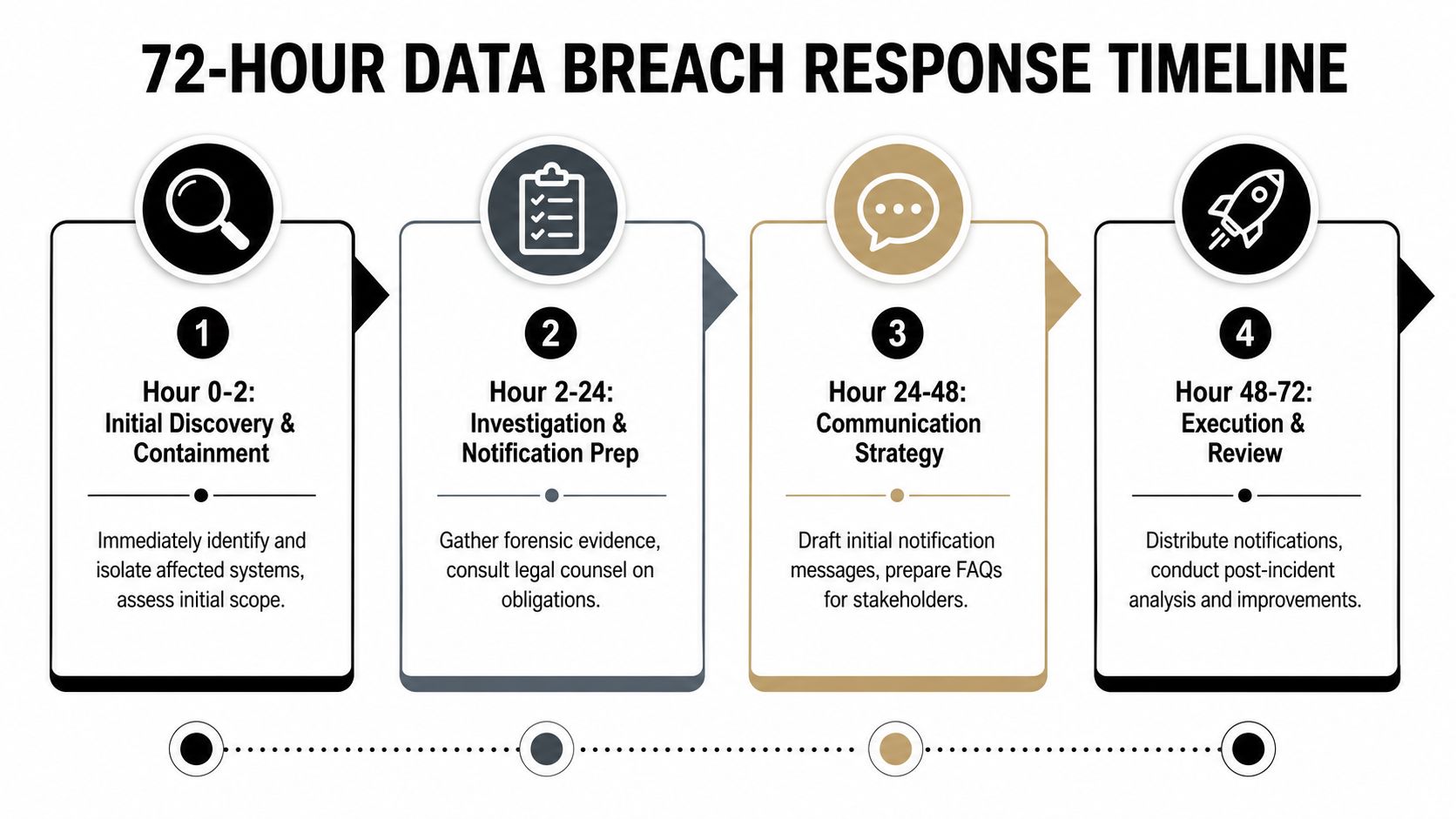
Hours 0 to 2, contain and confirm
Start by isolating affected systems, accounts, or devices. Lock down access, preserve logs, and tell staff not to delete messages or clean up records. If the event involves a chauffeur device, booking platform, or dispatch portal, treat ordinary operational access as part of the risk until you have stopped it.
Hours 2 to 24, investigate and document
Bring legal counsel and the forensic lead in together. A prompt, disciplined investigation should identify source, scope, and likely exposure while preserving the evidence you may need later. That is especially important in VIP transport, where itineraries, pickup locations, route notes, and client contact details can create harm even when the breach looks limited at first. The point is not to form a theory quickly. The point is to build a record that can support a notification decision, a client-facing explanation, and any later review by regulators or business partners.
Hours 24 to 48, decide on notice
Assess who was affected, what information was involved, and whether the data was protected in a way that changes the notice obligation. The jurisdiction map matters here. A breach involving a traveler's itinerary may not be treated the same way under every law, and an overly broad notice can create unnecessary anxiety for high-profile clients. A targeted, factual decision memo should be ready before any external communication leaves the company.
Hours 48 to 72, execute and review
Finalize the notice, send it through the required channels, and prepare client support scripts. Confirm that frontline staff know where to route calls and what they can say. Then document what happened, what was learned, and what control changes are needed so the same failure does not repeat.
If you want a practical reminder of how service operations and disclosure discipline intersect, the best example is often real-time client coordination, not legal theory. A useful operational parallel is real-time transportation visibility, because the same discipline that tracks a trip accurately also helps track an incident accurately.
Writing a Clear and Effective Notification for VIP Clients
The notice itself can either reduce harm or deepen the problem. FTC research found that 70% of notices used hedge terms about whether recipients were affected, and 40% used a “no evidence of misuse” formulation, which can leave people unsure what to do next (FTC PrivacyCon slides). In a VIP context, that kind of language reads as evasive, even when the legal team thinks it sounds careful.

What good notice actually does
A strong notice is direct. It says what happened in plain English. It says what information was involved, without burying the answer in legal qualifiers. It says what the company has done, what the recipient should do, and where to get help.
That structure matters even more for high-profile clients because their tolerance for uncertainty is low. They don't want reassurance without substance. They want a clear statement that respects their time and privacy while giving them enough detail to act intelligently.
Write for the recipient, not for a regulator reading between the lines.
The draft should also match the service culture. If a client is used to discreet, responsive communication, the breach notice should feel equally disciplined. That means no self-congratulatory tone, no overexplaining, and no vague promise that “security is our top priority.” The message should explain the facts, acknowledge the concern, and provide a clean path to response.
A strong review process helps here. Legal should vet accuracy. Communications should test clarity. Client relations should ask a blunt question, “If I were receiving this, would I know what to do in the next ten minutes?” If the answer is no, the notice needs another pass.
A helpful reference point for notice design and vendor coordination is preferred vendor agreements, because the same discipline that governs trusted service partners also governs who gets involved during a crisis.
Conclusion Preparing for the Inevitable
A breach response plan is only useful if people can execute it under pressure. The companies that handle notification well do three things consistently. They decide quickly. They communicate clearly. They document every material choice. That combination protects clients, reduces regulatory friction, and preserves trust when the pressure is highest.
For executive transport, that trust is the product. The itinerary, the contact list, and the location data are not side issues. They are part of the service itself. Treat data breach notification as a core operating function, rehearse it before the crisis, and make sure your team can respond with the same discretion and precision your clients expect every day.
A CTA for MLR Worldwide Service.