
You've just come off a long-haul flight, your phone is already lighting up, and someone on your calendar expects you in central London soon. In that moment, the transfer you choose from Heathrow isn't a small logistics detail, it sets the tone for the rest of the trip. A clean, pre-booked car service from Heathrow to London gives you control, privacy, and a quiet cabin to reset. A bad one gives you queueing, uncertainty, and a first impression you'll spend the next meeting trying to undo.
Heathrow sits about 26 kilometers from London in Uber's airport routing estimate, but the road journey is what matters, not the straight-line idea of distance. Typical private car transfers run 45 to 75 minutes, and peak commuting periods can push that to 90 minutes or more according to operator guidance and London transfer planning, with off-peak road journeys often around 40 to 55 minutes Uber airport routing estimate. That gap is why executive transport is a planning problem, not a transportation problem.
Why Your Heathrow Transfer Choice Sets the Tone for the Entire Trip
A tired executive lands at Heathrow after an overnight flight, checks messages at the gate, and sees a morning packed with calls, a client lunch, and a dinner that can't be moved. At that point, the transfer isn't about getting from A to B, it's about whether the first hour in London protects the rest of the day or drains it. The wrong choice usually means standing around, sorting bags yourself, and hoping a random vehicle shows up when it should.
The hidden cost of a bad first leg
Standard taxis and on-demand rides can work when you're flexible and lightly loaded. They fall apart when you're time-sensitive, carrying more than a cabin bag, or trying to hold a professional posture after a red-eye. That's why premium travelers don't just buy a vehicle, they buy predictability, flight tracking, and staging before touchdown.
Heathrow-to-central-London transfers are a classic case of short distance, high friction. The airport sits close enough to feel simple, but the urban road network and terminal exit delays make the corridor one of the most operationally sensitive in the world. If your transfer vendor doesn't plan for that, you're the one absorbing the delay.
Practical rule: if your first meeting is important, treat the Heathrow transfer like part of the meeting schedule, not a ride between appointments.
The better service level is the one that removes decisions when you're least able to make them. That means fixed routing, advance dispatch, and a chauffeur who's already in position when you emerge. The vehicle matters, but the operational discipline matters more.
Transfer Options from Heathrow to Central London Compared
A first trip into London exposes the difference between a transport booking and an operational plan. If you are paying for convenience, pay for the part that removes friction after landing. If you are keeping costs down, accept the trade-off clearly, because the cheapest fare rarely gives you the smoothest arrival.
Compare the realistic choices
| Transfer Type | Typical Cost | Door-to-Door Time | Privacy Level | Best For |
|---|---|---|---|---|
| Black cab | Variable | Variable, often tied to traffic and queue time | Moderate | Travelers who want curbside pickup and do not mind paying as they go |
| Rideshare | Variable | Variable, depends on driver availability and terminal pickup logistics | Moderate | Flexible travelers who can wait and tolerate uncertainty |
| Pre-booked private car | £49-£57 for standard saloon/private car in published market pricing Blackberry Cars | Roughly 20-40 minutes in lighter traffic for some centrally routed trips | High | Travelers who want fixed booking and clearer expectations |
| Executive chauffeur service | £140-£180 for executive sedans, £180-£290 for larger luxury SUVs JAF Executive Travels | Engineered around a 45- to 75-minute window | Very high | C-suite travelers, VIP guests, and anyone who values reliability over lowest fare |
| Heathrow Express plus onward ground transport | Rail fare varies, plus last-mile transport | Fast rail segment, but total time depends on onward connection | Low to moderate | Light packers who can tolerate a two-step journey |
A black cab works when you are traveling light, have time to spare, and are comfortable with a curbside pickup that still depends on traffic and queue conditions. Rideshare has the same basic limitation, and it adds another layer of uncertainty because terminal pickup logistics and driver availability can change the wait at the point when you want control most. The train helps if your final stop sits near the rail line and you are willing to manage your own bags.
For a C-suite traveler, the better choice is usually a pre-booked executive car. It removes the need to improvise after landing, and that matters more than a small difference in headline fare. The right provider should spell out wait time, meet-and-greet, luggage capacity, and VAT treatment before you confirm the booking. For a plain-language explanation of how an airport transfer is structured, see this descriptive airport transfer service guide.
A premium transfer earns its price when it stages the chauffeur in advance, tracks the flight, and handles the handoff without asking you to manage details at the terminal. Budget options save money only if your schedule is loose and your expectations are low. If the arrival sets the tone for the day, the transport choice is part of the trip, not an afterthought.
Understanding Journey Times and the Congestion Factor
Heathrow to London looks straightforward on paper. In practice, the trip changes with terminal exit timing, chauffeur staging, route choice, and whatever the road network is doing that day. A transfer that seems routine at booking can turn into a slow, stop-start run if the operator treats it like a standard pickup and ignores the operational details.
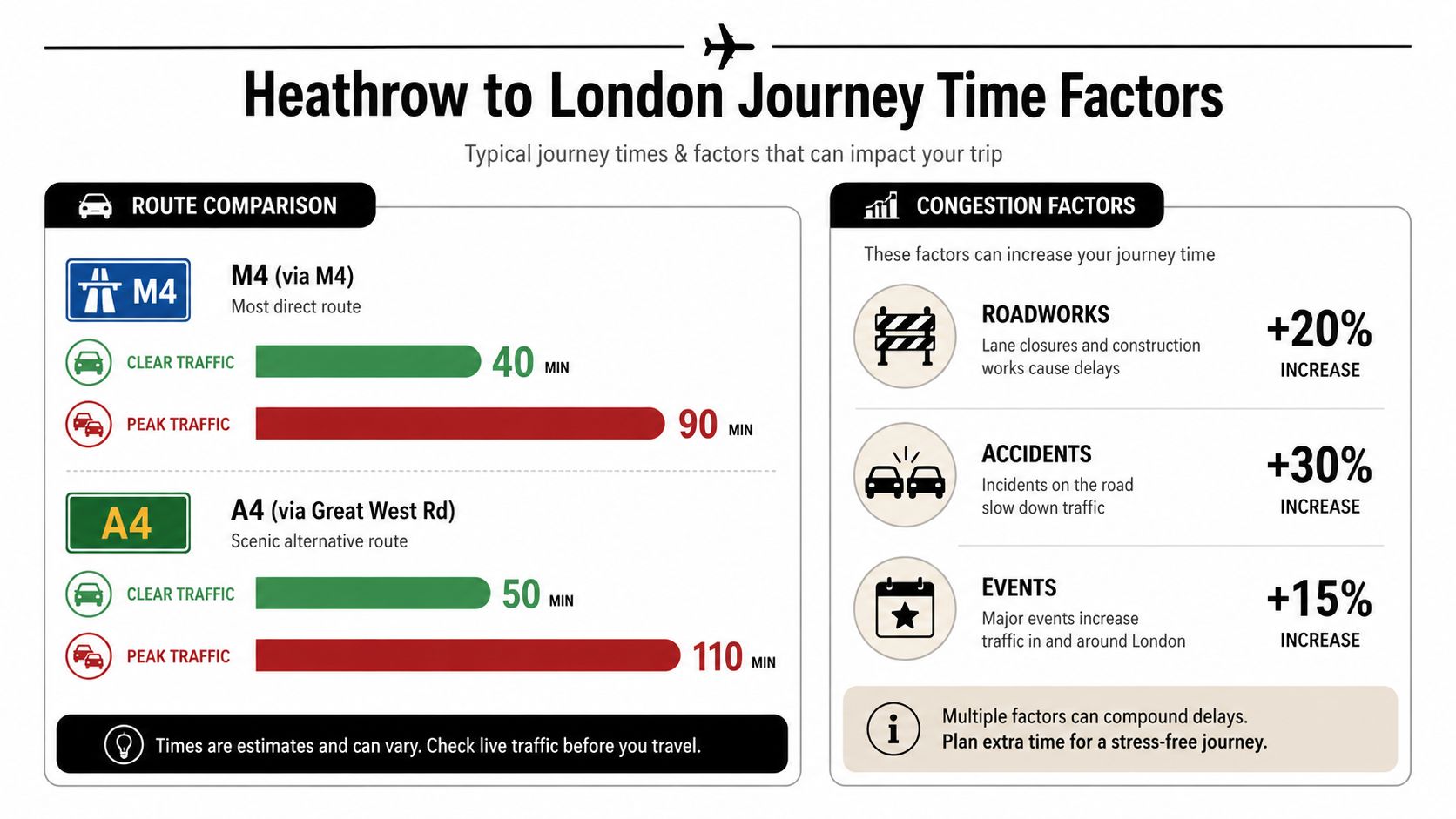
Key factors affecting journey time
Distance is not the issue. Variability is. Typical private transfers sit in the 45 to 75 minute range, and peak commuting periods can push the journey to 90 minutes or more Uber airport routing estimate. Off-peak road time is often closer to 40 to 55 minutes, which is why the same route can feel manageable at one hour and messy at another Uber airport routing estimate.
The difference comes from how the operator manages the arrival. A true executive transfer starts before touchdown, with pre-booking, fixed routing, and flight tracking built into the service. The chauffeur should already be staged, the vehicle should be positioned for a clean handoff, and the pickup should happen without a scramble at the terminal curb.
Operational delays that change the clock
The M4 corridor and the A4 corridor do not behave the same way once congestion builds. The practical difference is not just traffic speed, it is how each route reacts to airport exits, local bottlenecks, and the time it takes to clear the terminal before the car can even move.
Terminal exit timing matters more than many travelers expect. A busy arrival can add delay before you reach the car, especially if you are waiting for bags, dealing with a crowded meet point, or trying to find a driver who was not staged properly. That is why an executive service pays attention to the pickup sequence, not just the drive itself.
Operational rule: if a provider cannot explain how they handle flight delays, terminal handoff, and car staging, they are selling transport, not transfer management.
Ask the provider directly how they monitor the flight, when they dispatch the chauffeur, and where the meet point sits inside the terminal. Those answers show whether the company understands Heathrow operations or just hopes traffic behaves.
How to Choose the Right Service Level for Your Travel Profile
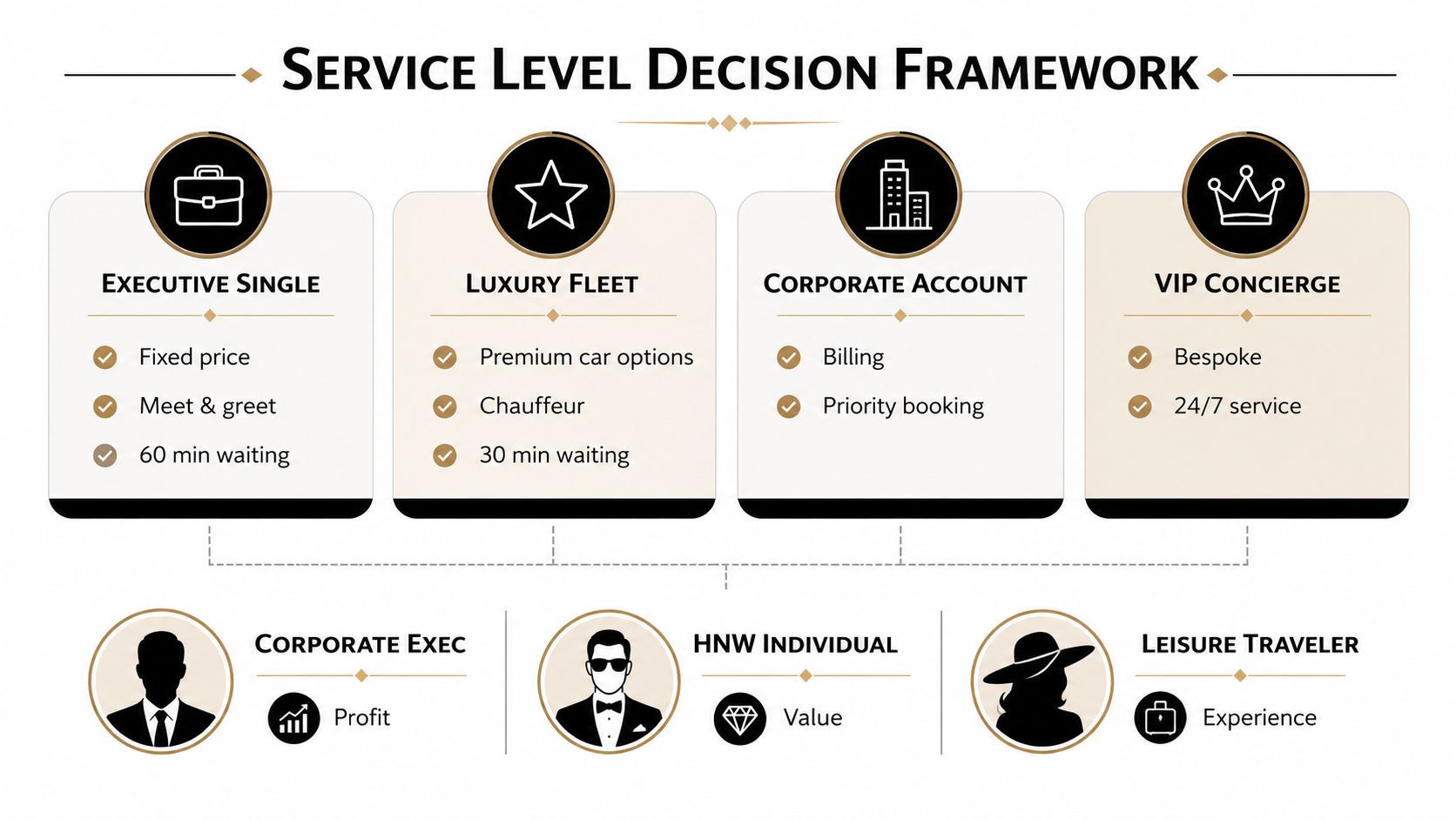
The right service level depends on what you're protecting. If you're protecting time, choose operational certainty. If you're protecting privacy, choose a chauffeur setup that stays discreet from terminal to destination. If you're moving a team or a lot of luggage, choose a vehicle and provider that can absorb the load without improvisation.
Match the service tier to the traveler
- Corporate executive: Pick a fixed-price executive sedan with meet-and-greet, direct invoicing, and clear wait-time policy. This is the right choice when your calendar matters more than the fare difference.
- High-net-worth individual: Choose a premium chauffeur service with discreet handling, low-friction pickup, and a vehicle class that keeps you out of public taxi queues. Privacy and consistency matter more than headline pricing.
- Private aviation traveler: Use a provider that understands FBO timing, ground-side coordination, and handoff discipline. Airport-style assumptions don't work well when the airside-to-roadside transfer is the key bottleneck.
- Event planner or travel manager: Prioritize fleet availability, multi-vehicle coordination, and one billing stream. A provider that can't handle staggered arrivals will create downstream chaos.
For a service framework that maps these tiers to package structure, see MLR Worldwide Service car service packages.
The biggest trap is comparing only the headline fare. A cheaper booking can become expensive if it includes little or no wait time, no luggage help, no meet-and-greet, or messy invoicing. If you're booking for an executive, you want a service that behaves like an extension of your office, not a loose collection of drivers.
Your Booking Checklist and Pre-Arrival Timeline
The cleanest Heathrow transfer is booked before you need it. Leave it until landing, and you're negotiating under pressure with your bags in hand and your next meeting already drifting. Book it early, send the right flight details, and make the operator do the coordination work before you step off the plane.
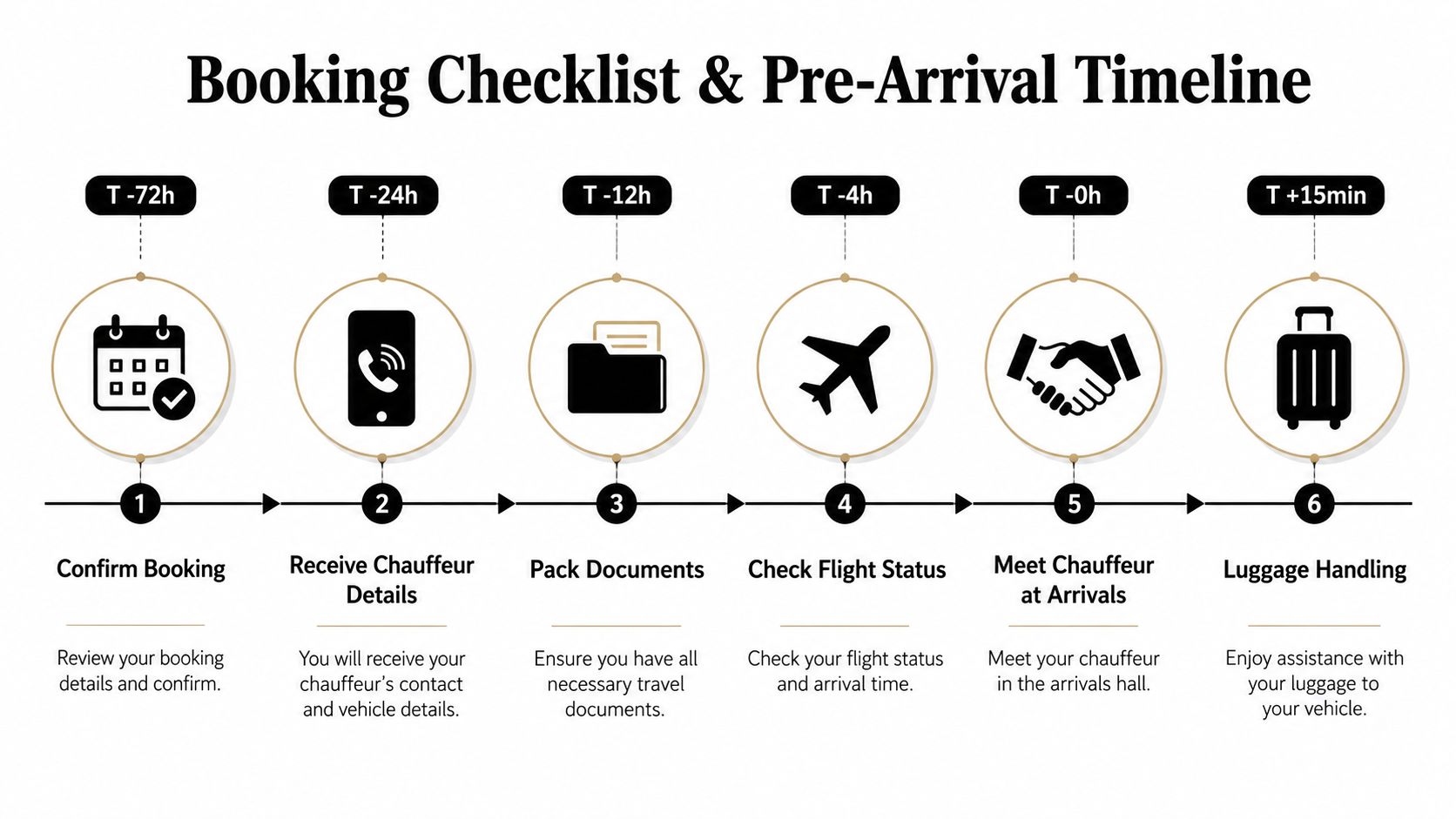
The checklist that avoids preventable friction
- At 72 hours out, confirm the booking. Give the operator the flight number, destination address, vehicle preference, and any invoice details if this is a company trip.
- At 24 hours out, receive chauffeur details. You want the name, direct contact method, and pickup instructions locked in before travel day.
- At 12 hours out, pack documents and load notes. Keep your passport, boarding paperwork, and any hotel or meeting address where you can access them quickly.
- At 4 hours out, check flight status. If anything changes, the operator should know before you land.
- On arrival, meet the chauffeur at the agreed location. Don't assume a generic terminal exit. Use the exact meet point the provider specified.
- After pickup, confirm luggage handling. This is the moment where a proper chauffeur service earns its keep, especially with multiple bags or fragile items.
The details matter because they eliminate the small delays that become big ones. If you travel often, keep this information in one template and reuse it every time. That's how travel managers keep Heathrow from becoming a recurring problem.
Meet-and-Greet Services and Luggage Handling Explained
The difference between a standard pickup and a proper executive transfer shows up the moment you clear arrivals. A standard driver may wait somewhere vague, expect you to call them, and leave you sorting bags while standing in public traffic flow. A professional chauffeur is already positioned, visible, and ready to take control of the handoff without making you hunt for the car.
What good meet-and-greet looks like
A proper meet-and-greet starts with the chauffeur inside the arrivals area, not circling outside. They should be easy to identify, carry the agreed name board if that's part of the booking, and know exactly where to guide you once baggage claim is done. That's a bigger deal than it sounds, because tired travelers lose time trying to locate the right person.
The service is judged in the first two minutes after landing, not after the car is moving.
That same discipline matters for luggage. Executive services are built for awkward baggage, extra pieces, garment bags, golf clubs, and fragile equipment that a typical saloon can't comfortably absorb. Families and delegations also benefit because the chauffeur can manage loading without turning the curbside handoff into a scene.
If anonymity matters, the standard should be discretion. That's where a white-glove approach differs from a generic ride, and the practical meaning of that phrase is covered in this explanation of white-glove service. In high-profile cases, the chauffeur coordinates discreetly, avoids unnecessary conversation, and keeps the movement as invisible as possible.
Three simple use cases
- Solo executive: A clean handoff, one suitcase, and no wasted time between arrivals and the back seat.
- Family arrival: Extra bags, child items, and a vehicle that can hold everything without compromise.
- Corporate delegation: Multiple passengers, staggered exits, and a team that needs one point of coordination instead of three separate pickups.
That is why premium pricing can be justified. You're paying for a controlled terminal experience, not just a nicer car.
Sample Executive Itineraries Showcasing Premium Transfer Features
The value of executive transfer service becomes obvious when you look at the trip the way a travel manager does, from touchdown to final drop-off. A good booking doesn't just move people. It compresses uncertainty, protects schedule integrity, and keeps the traveler in work mode instead of queue mode.
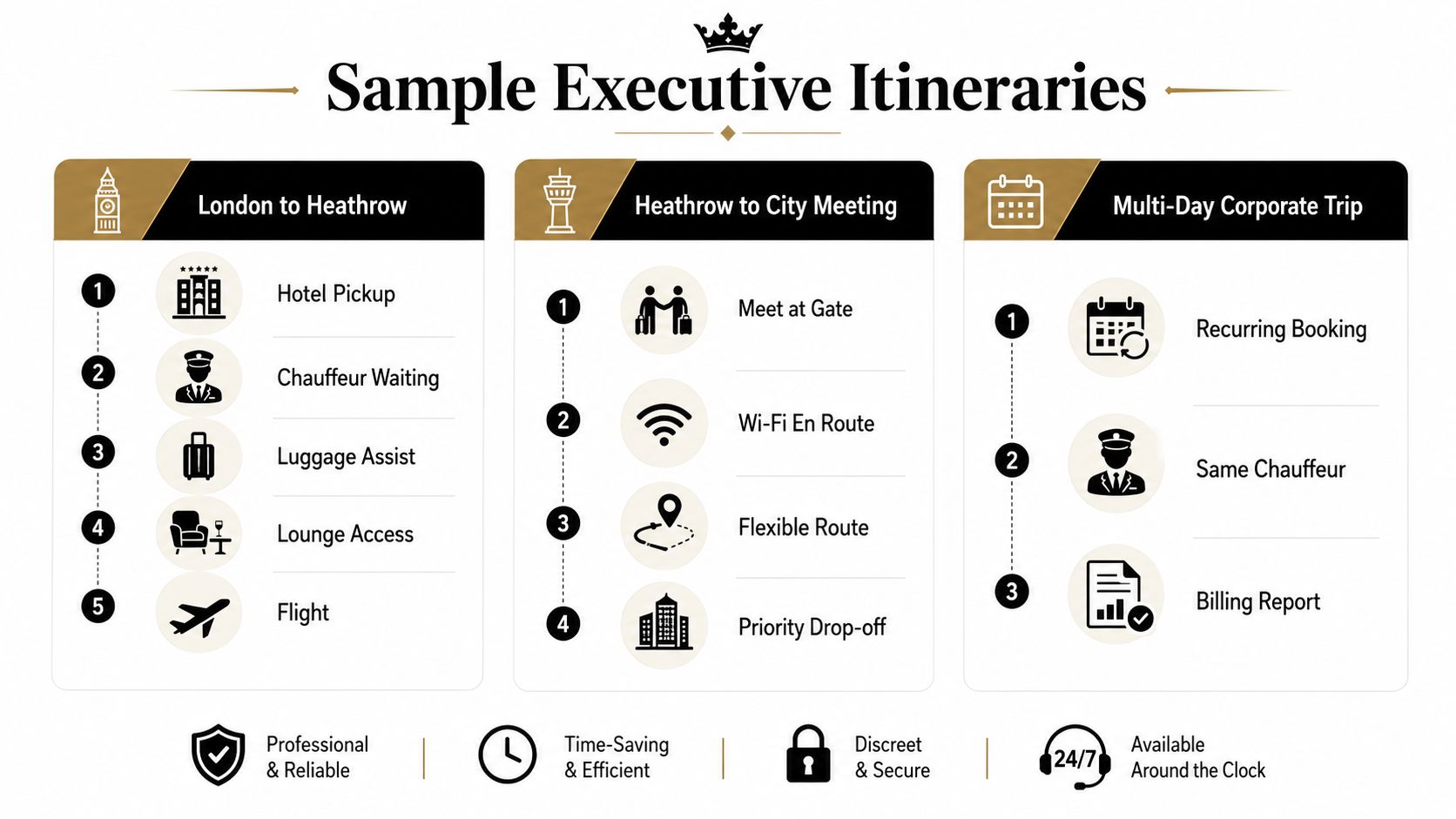
A solo CEO with a board meeting in the City
The flight lands, the chauffeur has already tracked the arrival, and the pickup happens at the agreed terminal point. The CEO gets into a quiet car, takes the first call, and uses the ride as a buffer between the overnight flight and the meeting room. That's the correct use case for a premium transfer, because the transfer itself becomes productive time.
A family office principal arriving by private aviation
The arrival sequence is different at an FBO, but the logic is the same. Ground transport needs to be waiting where the aircraft-to-car handoff happens, not where a generic airport pickup would normally occur. In this scenario, the transfer works because the operator understands the airside-to-roadside transition and doesn't force the passenger to manage it.
An event planner moving eight executives across two flights
Good ground transport proves its value here. One flight lands early, the other is delayed, and the provider coordinates multiple pickups without breaking the schedule. Multi-vehicle management, one billing stream, and clear contact points matter more than vehicle vanity.
The point is simple. If your trip involves time pressure, privacy, baggage complexity, or group movement, a true executive transfer is the right tool. If none of those are true, you can choose a lighter option and keep the expectations modest.
Key Takeaways for a Seamless Heathrow to London Transfer
Treat Heathrow transfer planning as part of the trip, not an afterthought. The road distance is short, but the journey is highly sensitive to congestion, terminal timing, and the quality of the operator's dispatch process Uber airport routing estimate. That's why premium pricing is only worth it when it buys you flight tracking, chauffeur staging, meet-and-greet, and luggage handling that doesn't need supervision.
Your decision should be simple. If you need the lowest possible fare, pick the budget option and accept the trade-offs. If you need reliability, privacy, and a controlled arrival, book the executive tier and insist on the details before you pay.
The biggest mistake is treating every car service as interchangeable. They're not, and Heathrow exposes the difference quickly.
MLR Worldwide Service handles executive chauffeur transport, airport transfers, and FBO support for travelers who need the air-to-ground connection managed properly. If you want a transfer plan built around your flight, luggage, and schedule, visit MLR Worldwide Service and arrange the Heathrow pickup before you land.