
You're probably looking at a rate sheet right now and thinking the same thing most buyers think, the headline price looks manageable, the vehicle class looks right, and the sales rep is pushing you to “lock it in” before the schedule changes. That's exactly where bad car service packages get sold, not because the service is useless, but because the contract is vague enough to hide the real cost until the third invoice lands.
The right package is not the cheapest one. It's the one that still works when the principal relocates, the calendar gets ugly, and the itinerary moves from one city to another without warning. If a provider can't explain portability, transfer rules, coverage limits, and what gets billed separately, you're not buying control, you're renting surprises.
What an Executive Car Service Package Actually Is
A chief executive lands at a hotel at 7:10 a.m., goes straight to a private terminal by late morning, then finishes the day at a dinner venue with two more stops in between. In that kind of schedule, a one-off black car booking is a weak tool because each new leg triggers another decision, another dispatch, and another chance for timing to slip. A car service package exists to remove that friction by reserving capacity in advance, not just vehicles on demand.
That's why the best packages usually look less like a random ride menu and more like a transport operating model. You're buying prepaid hours, committed capacity, dedicated chauffeurs, or priority dispatch, depending on how often you move and how predictable those moves are. If you want a clean definition, a package is any structured arrangement that bundles repeat ground transport into a controlled booking framework, rather than handling each trip as a separate transaction.
The three buying motions that matter
The first motion is point-to-point booking. It fits simple airport transfers, single meetings, or occasional trips where the timing is known and the vehicle disappears after drop-off.
The second is dedicated hourly service. This is the workhorse for executive travel, because the chauffeur stays with the passenger and the car stays available for detours, unscheduled stops, and last-minute changes.
The third is a standing program or retainer. That works when a travel desk, family office, or executive assistant needs predictable capacity across a month or quarter, especially for roadshows, recurring board meetings, or repeated airport work. If your calendar includes same-day changes and chained stops, that's the tier to start with, not the cheapest point-to-point option.
For readers who want a broader frame on ground transport itself, this ground transportation overview is a useful companion reference.
Practical rule: if the car needs to wait for the passenger, you're not buying a ride anymore. You're buying availability.
The Core Package Tiers Every Buyer Should Know
Most operators sell the same basic logic under different labels. The wrapper changes, but the structure usually falls into three usable tiers, and you should price them that way instead of comparing a menu of brand names that sound impressive but mean very little.
Point-to-point and executive sedan
This is the entry tier. It usually covers one pickup, one destination, and a clean handoff, which is fine for airport transfers, hotel-to-office runs, or direct city movement. The key questions are simple: does the provider guarantee the sedan class you want, and what happens if the trip becomes a wait-and-return?
This tier is cheap only when the trip stays simple. The minute the passenger adds a second stop or delays the pickup, the invoice stops being tidy.
Premium SUV and family-office transport
A premium SUV makes sense when luggage, security posture, or discretion matters more than saving a little on the rate card. This is the practical tier for principals who travel with assistants, golf bags, presentation cases, or family members who shouldn't be split across multiple cars.
It also tends to be the safer choice when the itinerary is fuzzy. If the passenger may stay longer than planned or divert mid-route, the SUV tier gives you more operational margin without having to reset the booking.
Dedicated hourly and retainer programs
Serious transport programs rely on dedicated hourly service. The chauffeur stays assigned for the block, making it ideal for board visits, roadshows, and multi-stop days. A retainer goes a step further by reserving committed capacity over a longer period, often with response expectations and recurring usage assumptions built in.
The difference between these tiers is not cosmetic. It changes minimum hours, vehicle availability, chauffeur assignment, and how much pressure your team feels when the itinerary moves. If your week includes repeated hotel, office, airport, and dinner transfers, price the hourly or retainer model first.
Don't ask providers for “their best package.” Ask them which tier they recommend for your actual weekly pattern, then make them defend it.
What Is Typically Included and What Quietly Is Not
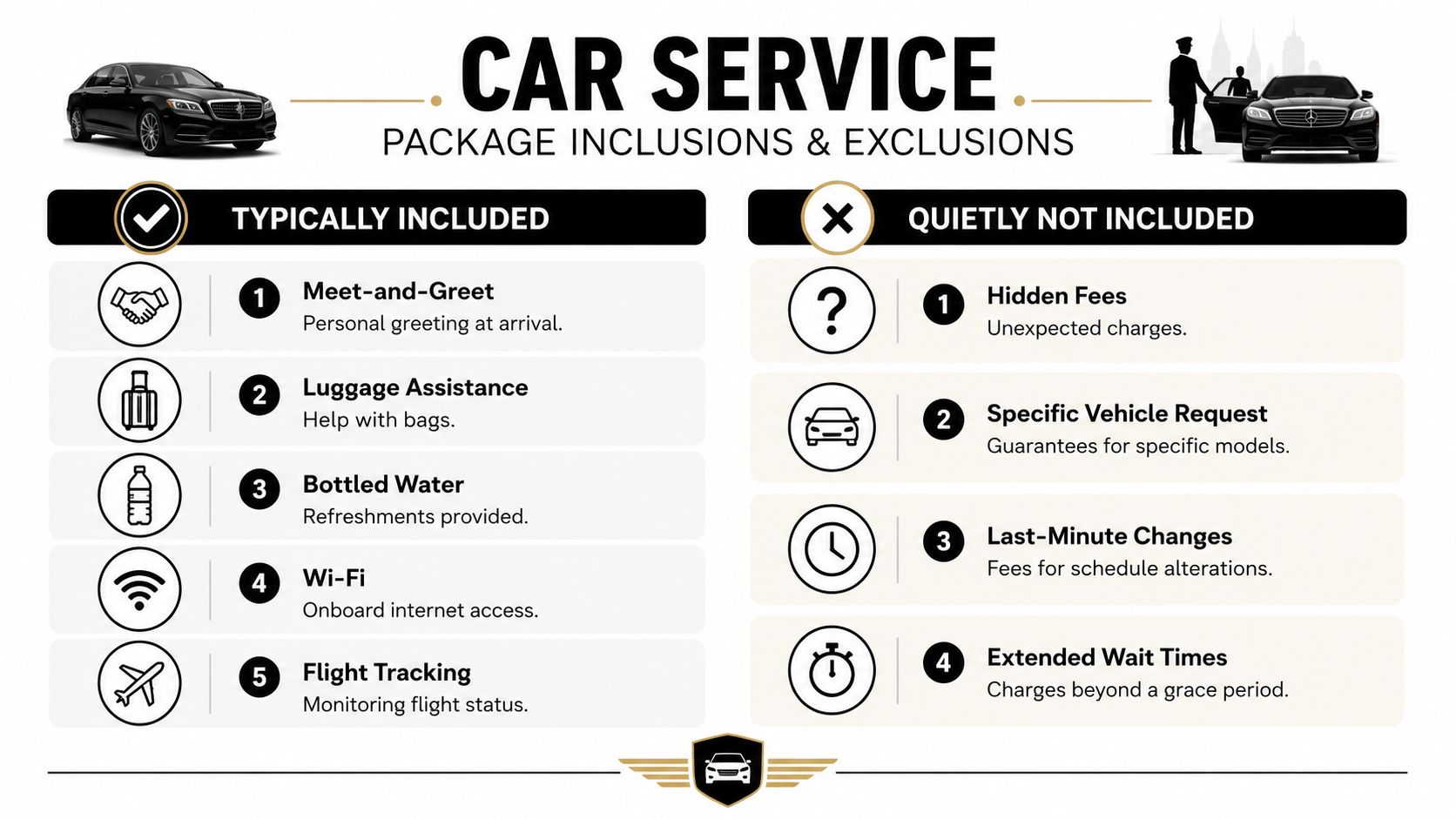
The advertised bundle usually sounds generous, and sometimes it is. Meet-and-greet, luggage assistance, bottled water, Wi-Fi, and flight tracking are common expectations in premium transport, especially for airport work and executive transfers. Those are the obvious items, the ones the sales deck highlights because they make the package look polished.
The hidden cost sits in the fine print. Once the grace period ends, wait time starts to matter. Once the passenger changes the pickup point, point-of-origin pricing can turn a simple move into a more expensive one. Once the route includes toll roads, airport access, parking, or FBO handling, the “all-inclusive” story gets thinner.
What to verify in writing
Use a written checklist, not a verbal promise.
- Grace period rules: Ask how long the chauffeur waits before extra charges begin.
- Access and terminal fees: Confirm whether airport, FBO, or fixed-base operator charges are included or passed through.
- Vehicle specificity: Ask whether a requested model is guaranteed or only “subject to availability.”
- Schedule changes: Get the rules for late changes, cancellations, and re-dispatch in writing.
- After-hours support: Confirm whether evenings, holidays, and peak-event windows carry a premium.
The maintenance analogy matters here. A full car service is the annual or 12,000-mile interval baseline in many markets, and it goes beyond a cursory check by replacing items like the oil filter and often the air filter while inspecting brakes, steering, suspension, belts, fluids, and A/C operation, as explained in this full-service breakdown. Good transport operators work the same way, they don't just move people, they manage routine checkpoints so failures don't surface mid-trip.
If a provider can't tell you exactly what's included, assume the most expensive version of the trip is still waiting to be billed.
Matching Packages to Executive Roadshows, FBO Support, and Events
Different use cases reward different package structures. Buyers get into trouble when they treat roadshows, private aviation support, and event logistics like the same product with a different logo.
| Use Case | Recommended Tier | Key Requirements |
|---|---|---|
| Executive roadshow | Dedicated hourly or retainer | Continuous chauffeur assignment, multi-stop routing, backup vehicle access, itinerary control |
| FBO support | Point-to-point with premium add-ons, or dedicated hourly for tight schedules | Terminal familiarity, flight tracking, meet-and-greet, luggage handling, ramp or curb coordination |
| Event logistics | Retainer or coordinated hourly fleet program | Multiple vehicles, signage, staggered arrivals, lead coordinator, passenger grouping |
Executive roadshows are the most demanding. They punish any package that resets after each stop because the schedule rarely behaves like a simple A-to-B trip. If your team is planning roadshow movement, a group transportation service framework is useful because it forces you to think in coordinated legs, not isolated bookings.
FBO support needs credentialed execution
Private aviation support is less about luxury and more about precision. The operator needs to know the terminal, the passenger handoff, and how to coordinate with aviation staff without wasting time. If the provider can't explain how it handles tail-number changes, arrivals that move early, or quick departures, the package is too thin.
Events need control, not just cars
Shareholder meetings, product launches, and sponsor hospitality need a different mindset. You're not buying one clean transfer, you're buying a movement system. That usually means vehicle staging, clear signage, a dispatcher who sees the whole picture, and enough flexibility to absorb late arrivals without throwing the entire plan off.
The wrong package for an event looks cheap until the first wave lands late and the queue breaks.
The Hidden Cost Most Buyers Discover Too Late
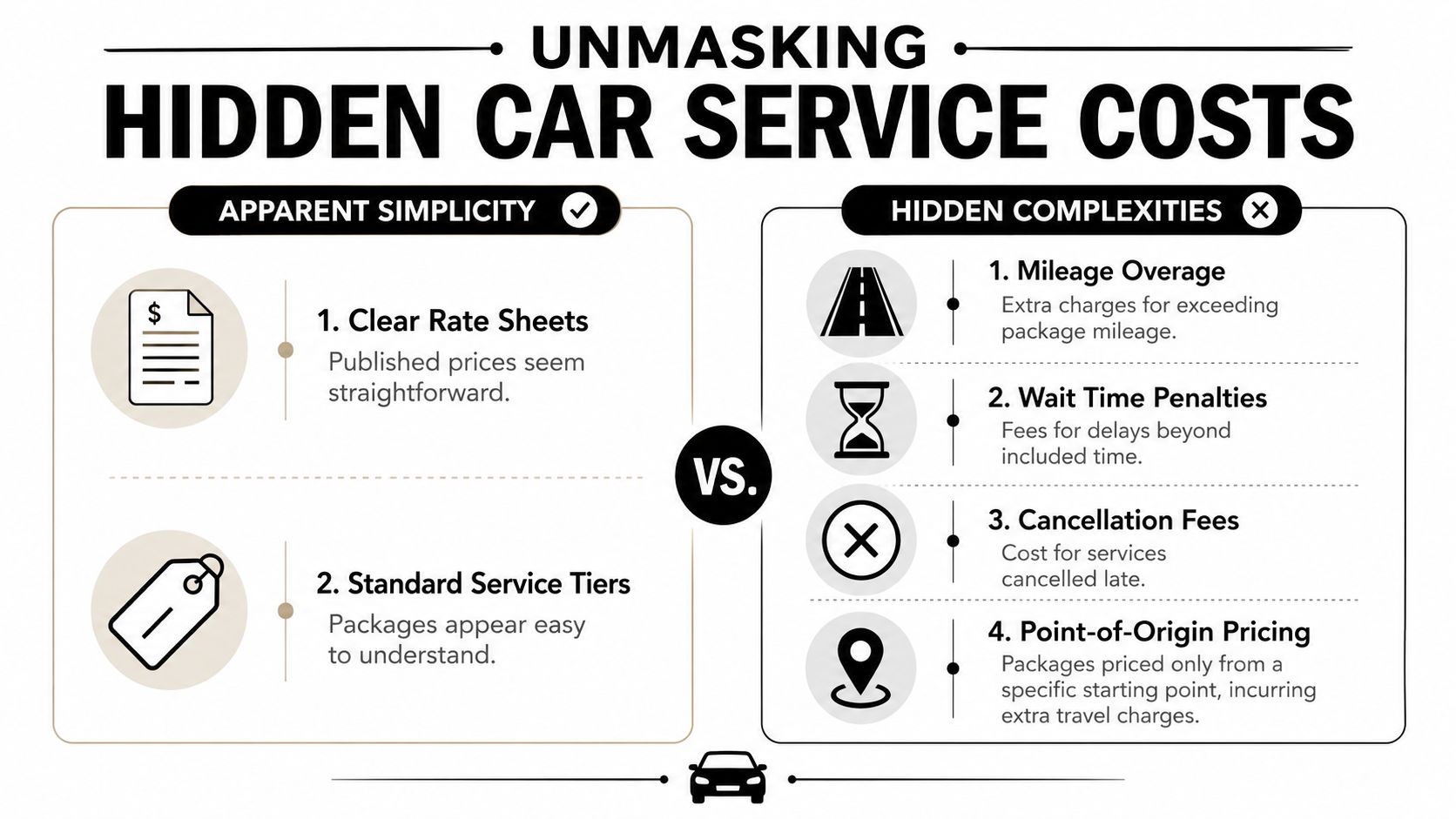
The low headline price usually comes from a narrow assumption, that the vehicle will operate only where the sale happened and only under the exact conditions in the brochure. That's not how real travel works. Principals relocate, assistants book from different cities, and itineraries get moved around without asking the contract for permission.
The most painful surprise is usually geographic. A package sold at one dealership, one depot, or one city can become awkward or unusable once the passenger is elsewhere, and the consumer-facing advice around prepaid maintenance already flags portability as a question buyers should ask before they sign. That same logic applies to transport, because a package that is valid only in one market can be a false bargain for executives who travel widely or split time across homes and offices.
Exclusions that quietly drain value
Service-plan style contracts often look broad but still exclude wear-and-tear items such as tires, brake pads, batteries, wipers, and clutch friction parts, even when they cover labor and standard parts. The result is predictable, the buyer feels protected until the first repair cycle shows what was never really covered.
The contract structure itself matters too. As outlined in this service-plan explanation, service plans generally cover manufacturer-recommended services, labor, and standard parts, but exclude wear items and often require approved OEM dealerships. That makes them controlled-cost arrangements, not blanket repair protection. If your transport package has a similarly narrow definition of coverage, the savings are mostly cosmetic.
Bottom line: the cheapest package often wins the bid and loses the year.
Peak travel windows are another trap. Blackout dates, event surcharges, and last-minute premiums turn a clean quote into a layered invoice. By the time you've paid the extra charges, the “premium” package that looked expensive at signing can be the cheaper operational decision.
Pricing, Contracts, and the Terms That Actually Matter

Rate cards are the easy part. Contracts are where the power lives, because that's where the provider defines the rules for delay, rebooking, vehicle substitution, and unused capacity. If you don't negotiate terms, you're accepting the provider's operating assumptions as your own.
The terms I'd never ignore
- Minimum hours per booking: If the provider requires a block, make sure the block matches your actual use.
- Billing increments: Ask whether time is rounded in small increments or billed in larger chunks.
- Cancellation windows: Late changes should be spelled out before the first trip, not argued about afterward.
- Fuel, tolls, and parking: Confirm whether these are included or passed through separately.
- Gratuity policy: Don't let the team assume one thing and the invoice assume another.
- Backup vehicle SLA: Know how fast a replacement can be deployed if the first car fails.
- Chauffeur model: Clarify whether the same driver stays assigned or the operator rotates staff.
Standing programs are where many buyers lose value. A committed monthly spend can work well if unused hours roll over in a sensible way, but a rigid structure creates waste fast. If the provider can't explain rollover rules and what happens to unused capacity, the retainer is too provider-friendly.
The earlier section on preferred vendor agreements is relevant here because the same negotiating discipline applies, define the service terms first, then decide if the price is worth them.
Compare proposals on equal footing. Strip each one down to vehicle class, hours, inclusions, exclusions, cancellation language, and geography. If a provider refuses to normalize the offer, that usually means the proposal is only attractive when you don't read it carefully.
A Sample Package Template You Can Adapt

A strong template keeps the buying conversation disciplined. Use one document with three modules, then force the provider to price each module separately so you can see where the cost sits.
Module structure
Executive Roadshow Support. Define the itinerary shape, the chauffeur assignment model, the vehicle class, the billing block, and the backup plan. If the roadshow crosses cities, say so in the document, don't leave “door-to-door” open to interpretation.
FBO Support. State the airport terminals, arrival and departure handling, flight monitoring expectations, and whether the vehicle should stage curbside or be repositioned for a quick departure. The smaller the wording gap, the fewer disputes later.
Event Logistics. List the passenger groups, lead contacts, signage needs, arrival windows, and any VIP separation rules. A good event clause prevents the provider from guessing who matters most when several vehicles land at once.
Use this rule: if the provider can't price the template cleanly, the scope is too vague.
Keep the document tight enough for finance and operations to compare, but specific enough that dispatch can execute it. That's the difference between a clean transport plan and a sales brochure with a signature line.
Questions to Ask Before You Sign Anything
Don't sign until you've asked five questions. Is the package portable across cities or countries? What exactly is included, and what gets billed separately? What's the backup vehicle response time? How are peak dates and blackout windows handled? Are the chauffeurs in-house or contracted?
If the provider can't answer those clearly, keep shopping. Good car service packages are built on coverage clarity, geography, and execution discipline, not on a polished rate sheet. Take this checklist into the next vendor meeting, and make them explain the terms in plain English before you accept the offer.
If you need a transport partner that treats executive movement like an operating system, not a commodity, MLR Worldwide Service is built for that standard. They support executive chauffeur programs, airport and FBO transfers, roadshows, event logistics, and VIP secure transport with the kind of coordination that keeps schedules intact. If your current package looks cheap but keeps failing in practice, it's time to compare it against a provider that understands the cost of missed timing.