
You're trying to move a group that can't afford to scatter. One car is on time, another is stuck at the curb, the third is waiting at the FBO because someone changed the tail number, and now the dinner table, the boardroom, and the aircraft slot all start slipping at once. That's the reason group transportation service exists, it's not about upgrading the vehicle, it's about keeping an itinerary from breaking apart when multiple people, multiple stops, and multiple handoffs all have to land cleanly.
A serious operator treats this as an operations problem, not a booking problem. The difference shows up fast in a day with a Midtown breakfast, a Teterboro arrival, and a Greenwich dinner. A string of black cars can cover each leg, but it can't reliably manage the connections between them, and that's where the risk lives. If you need a practical benchmark for why organized passenger movement has become a real market, not a side service, look at the projected growth of the global corporate employee transportation service market from USD 42.37 billion in 2026 to USD 54.87 billion by 2031, a 5.31% CAGR over that period, per Mordor Intelligence (market projection).
When One Car Is Not Enough
The schedule looks clean on paper. Breakfast meeting in Midtown, flight arrival at Teterboro, hotel drop, then board dinner in Greenwich. In reality, each handoff creates a failure point, and a late car is often the least damaging problem. Damage starts when one delayed pickup causes a missed arrival window, which pushes the next stop, which forces a rewrite of the whole day.
That's why a group transportation service exists in the first place. It gives you one coordinated plan for people who need to move together, arrive together, and stay tied to the same timetable. If the morning starts with a roadshow team, an FBO pickup, or a client delegation, the business question isn't which sedan looks nicer. It's whether someone owns the full sequence from door to door.
A good operator works like a flight operations desk with wheels. One dispatch point, one live view of the itinerary, one decision-maker when the aircraft lands late or the venue releases guests early. That's the mental model to use.
Practical rule: if the trip has more than one stop, more than one arrival stream, or more than one person responsible for the schedule, you need coordinated group mobility, not a loose pile of reservations.
For readers who still think of this as a vehicle issue, the best next step is to compare a true service model with the usual ad hoc rental mindset. A useful reference point is this luxury van rental overview, because van capacity is often where the planning conversation begins, even though it should end with the itinerary.
What a Group Transportation Service Actually Is
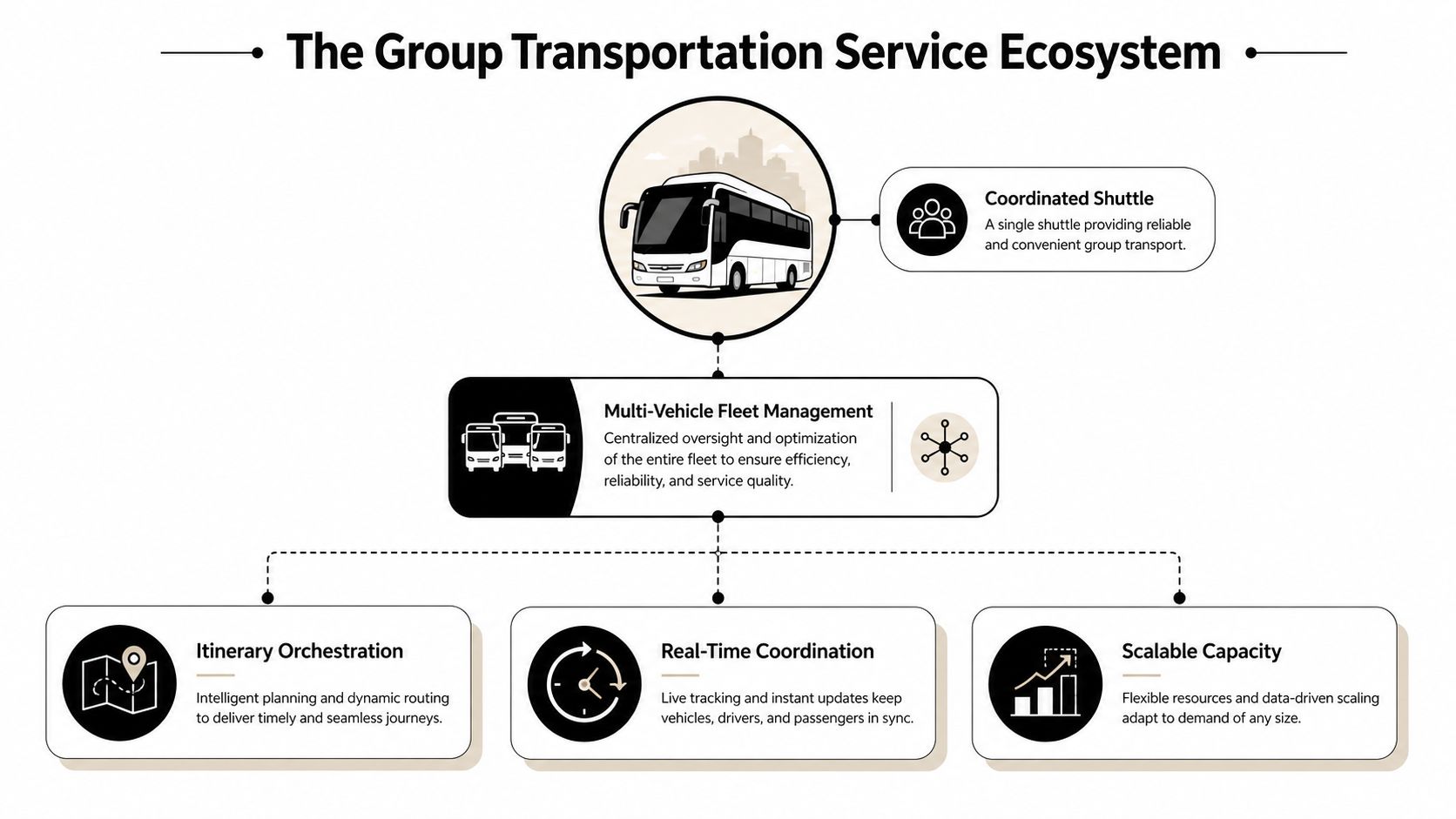
A real group transportation service is a contracted mobility arrangement where a provider plans the move, dispatches the right vehicle or vehicles, and stays accountable until the last passenger is dropped. That can mean one shuttle for one team, or a coordinated fleet for a day with multiple pickups, multiple release times, and changing stop order. The defining feature is not the vehicle size. It's the fact that someone is managing the whole sequence.
Crew movement on an aircraft schedule. A taxi company sells a ride. A group provider manages timing, backup, arrival order, and handoff risk. Those are different jobs, and clients feel the difference the moment a flight delays, a venue changes access, or a board member asks to add one more stop.
Core idea: a true group service owns the itinerary, not just the wheels.
That distinction matters because the service can be built in layers. The simplest version is a scheduled shuttle between one pickup and one drop-off. A more mature version adds dispatch coverage, backup vehicles, route changes, and communication across drivers, coordinators, and passengers. The most capable version treats the move as a live system, with an operator responsible for keeping every passenger on the same plan.
A useful way to spot the difference is this. If you're being quoted for several individually booked cars with one invoice, that's not a coordinated group service. It's just consolidated billing. If the operator can explain how they'll handle a late aircraft, a split pickup, or a venue change without improvising, you're dealing with a real service model.
Fleet Options and the Passenger Count Threshold
The fleet choice is where many planners get the first decision wrong. They start with comfort, but the control point is passenger count, because the legal and operational structure changes as the group grows. In Michigan, for-hire passenger vehicles with 8 passengers or less, including the driver, are covered under the Limousine, Taxicab and Transportation Network Company Act, while vehicles with 9 passengers or more, including the driver, are regulated as motor buses under the Motor Bus Transportation Act (Michigan MDOT FAQ). That threshold is a technical dividing line, not a styling preference.
What the vehicle class tells you
For small executive moves, sedans and premium SUVs are fine because the group is small and the itinerary is simple. Once you get into luxury vans, minibuses, and motor coaches, the conversation shifts to boarding flow, route structure, and regulatory category. A vehicle that looks “bigger” isn't automatically the better answer if the access point is tight or the trip has several stops.
A government procurement document also uses a passenger van baseline of 3 to 7 passengers and centers that service on a single official pickup and drop-off point (procurement specification). That's a useful operational clue. Once your group moves beyond that size, you're usually no longer buying a simple transfer. You're coordinating a movement with timing, staging, and handoff logic.
| Vehicle Class | Typical Passengers | Regulatory Regime |
|---|---|---|
| Executive sedan | Small executive parties | Chauffeured car service regime |
| Premium SUV | Small groups with luggage | Chauffeured car service regime |
| Luxury van | Small teams | Depends on capacity and local rules |
| Minibus | Medium groups | Often crosses into bus-style planning |
| Motor coach | Larger groups | Motor bus regime when seating reaches the threshold |
The important point is operational, not cosmetic. Once you cross the passenger threshold, licensing, insurance, dispatching, and route planning change with it. For planners comparing a van strategy with a larger shuttle strategy, this sprinter van rental with driver guide is a useful reference because it sits right in the middle of the small-group decision zone.
Three Real World Use Cases You Should Know
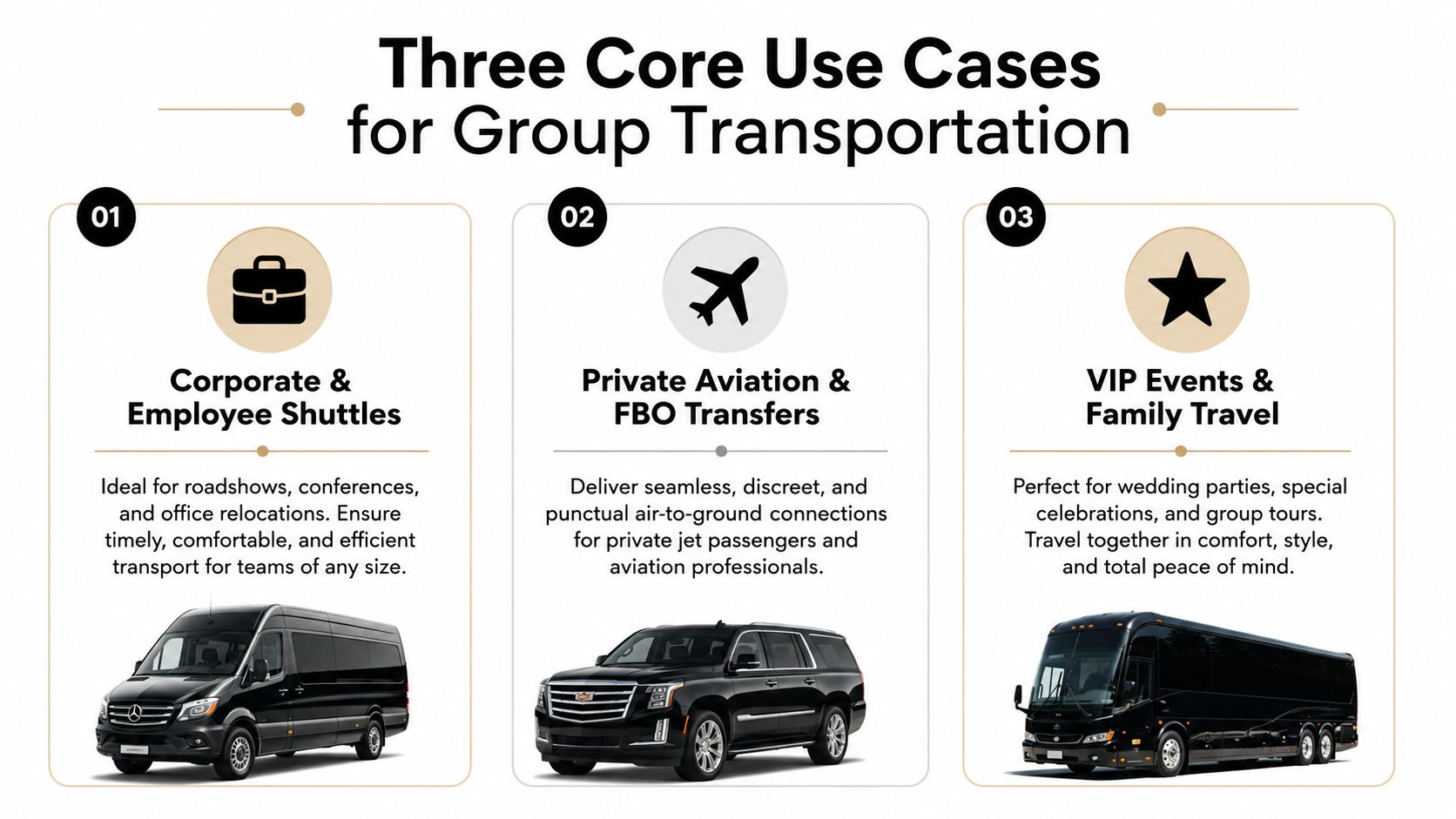
The same service model solves very different problems depending on who's moving.
Corporate roadshows and employee shuttles
This is the classic use case. Teams move between offices, client sites, hotels, and event venues, often with a schedule that leaves little margin. The buyer isn't just renting a vehicle. They're buying consistency, punctuality, and a way to keep a group synchronized across several stops.
The pressure point is timing discipline. One late pickup doesn't just inconvenience one passenger, it shifts the whole day. That's why route order, pickup windows, and a single accountable dispatcher matter more than the upholstery.
Private aviation and FBO movements
FBO work is different because the ground move is only one leg of a higher-stakes chain. The aircraft lands, the crew or passengers clear the handoff, and then the ground provider has to absorb whatever the flight schedule did to the plan. The buying decision here is about smooth air-to-ground continuity, not just transportation.
This is where last-minute changes hurt most. A strong operator can handle a late arrival, a gate change, or a revised destination without turning the transfer into a scramble. That's also why MLR Worldwide Service is relevant in this space, it specializes in executive chauffeur services, airport transfers and FBO support, corporate roadshows, event and group logistics, VIP secure transport, and airline crew movements.
VIP events and family office logistics
For weddings, private dinners, gallery nights, family office travel, and hosted outings, the priorities are privacy, continuity, and controlled arrival order. Guests don't want to think about the logistics, and they shouldn't have to. The service needs to feel invisible while still being tightly managed.
Group travel for high-trust clients should look effortless from the curb and heavily managed behind the scenes.
The common thread across all three use cases is the same. The client is not buying miles, they're buying control over a moving schedule.
Operational and Security Considerations

The operational stack is what separates a premium provider from a pretty website. You want dispatch software, real-time GPS, a documented backup vehicle protocol, and people who can adjust the plan when a flight slips or a venue changes the loading door. If the provider can't tell you who monitors the trip after hours, they're not prepared for serious group movement.
Security is the other half of the equation. For executive and VIP work, the basics matter, background checks, secure communications, confidentiality expectations, and chauffeurs who understand discretion. If the itinerary includes private aviation, board members, or family office travel, the operator also needs a clean contingency plan for route changes, delays, and split arrivals.
A useful test is simple. Ask what happens if the inbound aircraft is late, the dinner runs long, or the first vehicle has a mechanical issue. If the answer sounds like “we'll figure it out,” move on.
Minimum questions to ask before you sign
- Who tracks the trip live? You need a named operations function, not a general inbox.
- What's the backup plan? Ask whether there's a secondary vehicle and how fast it can be activated.
- How are chauffeurs vetted? Background checks and training should be standard, not optional.
- How are itinerary changes handled? Look for 24/7 coverage and direct communication.
- What's the privacy protocol? Secure comms and confidentiality expectations should be explicit.
For buyers who want to see how secure transport is framed in a provider context, this secure transport companies overview is relevant because it sits close to the risk profile that often overlaps with group and executive movements.
The strongest operators don't just move people, they manage exceptions. That's what keeps an 11 p.m. flight delay from becoming a midnight customer-service mess.
How to Evaluate and Contract a Provider
A serious procurement process should feel boring in the best way. You are not buying charm, you are buying repeatability. In group transportation, the central question is whether the operator can execute the itinerary cleanly when the plan changes, the passenger count shifts, or the handoff moves from a hotel curb to an FBO. Buyers should treat this like procurement, not casual travel booking, because the wrong structure creates avoidable failure points.
What to score in the RFP
Build the scorecard around fleet age and mix, chauffeur training, technology and transparency, and safety and compliance. Those four buckets tell you far more than a polished sales deck does. Ask for the actual vehicle classes they can deploy, how they vet drivers, what tracking tools they use, and how they document insurance, maintenance, and incident response.
The passenger count threshold matters here too. Once you move from one car to a legal and operational group move, usually around the 8/9-seat line depending on the jurisdiction and vehicle class, the provider has to show that it understands the regulatory and dispatch structure behind the trip. That is where weak operators fail. They sell a vehicle, but they cannot explain how they will stage it, swap it, or coordinate it when the itinerary moves across terminals, venues, or cities.
You also need to ask about global affiliate reach if your itinerary crosses cities or countries. A provider that only works in one metro area may be fine for a local transfer, but it is the wrong fit for roadshows, private aviation chains, or multinational executive travel. If the trip depends on an FBO handoff, a same-day city change, or a backup vehicle in another market, the provider has to prove that the handoff process already exists.
Questions that cut through the sales pitch
- What vehicles do you operate? Owned fleet or brokered inventory changes accountability.
- How do you handle deadhead and waiting time? Cheap hourly rates can hide expensive coordination.
- What is your backup vehicle policy? Do not accept vague promises.
- Can you support multi-city itineraries? Cross-border or cross-city logistics need real coordination.
- What comparable clients do you serve? Ask for references that match your use case, not generic testimonials.
Ask one more question before you sign. Who owns the itinerary when the plan breaks? You want a named operations team with authority to reroute, reassign, and communicate directly, not a general inbox that forwards problems after the vehicle is already late.
The pricing trap is simple. If you only compare a per-vehicle-hour quote, you miss the cost of deadhead mileage, waiting time, after-hours coverage, and multi-stop coordination. A provider with better dispatch and tighter timing often costs less in the only way that matters, fewer failures. That is the difference between buying transportation and buying a workable move.
Pricing Structures and the Real ROI
Pricing usually comes in three forms, hourly charter, point-to-point flat rate, and dedicated day or week retainer. Hourly works when the itinerary is uncertain, flat rate works for a clean transfer, and retainers make sense when the group moves all day or across multiple stops. Pick the model that matches the schedule, not the one that looks cheapest at first glance.
The line items that move the total are deadhead, waiting time, after-hours coverage, and multi-stop coordination. Those are not “extras” in a real group move, they're the cost of making the itinerary work. If your trip includes an FBO handoff or a venue pickup where the bus can't just sit and wait, that complexity has to be priced in somewhere.
The ROI conversation is where buyers usually think too narrowly. The invoice only shows transportation cost. It doesn't show the value of a board member arriving together with the rest of the team, or the cost of a delayed flight crew missing the handoff, or the reputational damage from a roadshow delegation splitting up at the curb.
A better lens is total trip risk. If one managed itinerary prevents a cascade of missed connections, you've already moved the discussion beyond rate shopping. That's the primary advantage of a coordinated service model, it reduces the number of things that can go wrong in transit.
Bottom line: pay for coordination when the trip is complex. Pay for simplicity only when the trip is actually simple.
Planning Checklist and Two Short Case Studies
Use this checklist before you book anything:
- Final headcount: Confirm the passenger count, not the hopeful one.
- Vehicle threshold: Check whether the move crosses the 8/9-seat regulatory line.
- Pickup point: Lock the exact curb, terminal, or FBO handoff location.
- Stop order: Sequence the itinerary so the day doesn't fight itself.
- Security needs: Decide whether privacy, confidentiality, or secure comms matter.
- Contingency plan: Define what happens if a flight slips or a stop runs long.
- Post-trip review: Capture what broke, what held, and what needs tightening.
The first case is an eight-executive roadshow across multiple city stops. The mistake would be splitting the group into separate cars and assuming the invoice makes it coordinated. It doesn't. One delayed passenger changes the cadence of the whole day, and the operational risk compounds with every stop.
The second case is a private aviation movement that links two airports, a hotel, and a private dinner. That itinerary fails if the ground leg is treated as an afterthought to the flight. The handoff has to be managed as a single chain, with the airport transfer, hotel drop, and dinner arrival all built into one live plan.
What both cases prove is simple. Group transportation service isn't a vehicle booking. It's itinerary engineering.
If you're planning executive travel, an FBO connection, or a multi-stop group day, contact MLR Worldwide Service and ask for a ground-transport plan built around your actual schedule, not a generic car quote.