

At 1:17 a.m., the phone lights up. A flight is in, a chauffeur is tied up on a drop, two crew members have swapped live ETAs, and someone on the desk is trying to make a tired roster look like it can survive one more handoff. That's usually the moment leaders discover that shift rotation scheduling isn't a spreadsheet problem, it's a service-continuity problem.
The pressure is familiar in 24/7 operations because the work never pauses for the calendar. Large labor markets have carried rotating and non-day schedules for decades, with the U.S. Bureau of Labor Statistics showing 17.7% of wage and salary workers on alternate shifts in May 2004, including 2.7% on rotating shifts, and still 16.4% on non-day schedules with 2.4% on rotating shifts in the 2017-2018 release (BLS analysis). That persistence matters because the scheduling model you choose shapes fatigue, morale, overtime exposure, and whether clients trust the desk when the night gets messy.
Continuous coverage is the core design problem
A broken rotation rarely announces itself with a dramatic collapse. It usually shows up as a missed pickup, a chauffeur who gets double-booked after a late reposition, or a crew member who looks alert on paper but is running on fumes in the cab and at the gate. In executive transport and crew logistics, the problem is not just coverage. It is whether the person taking the handoff is still sharp enough to absorb the change.
Continuous coverage is the core design problem
Many teams start by asking who can work nights. The better question is how the desk stays stable when demand shifts across time zones, cancellations, delays, and last-minute VIP changes. Shift rotation scheduling is the operating system underneath that stability. It decides who carries the fatigue burden, who gets the least popular blocks, and how often the desk relies on heroics instead of design.
The labor pattern is not a niche one. Rotating and other non-day schedules remain common in sectors that run all day and all night, including transportation, healthcare, retail, and manufacturing, as noted in the BLS analysis. If your business depends on live coverage, the choice is how intelligently to rotate people through the work.
Practical rule: if a schedule only works when everyone is fresh, it does not work.
What gets damaged first
The first casualty is usually judgment. Fatigue makes handoffs sloppier, escalation slower, and exception handling more brittle, especially when the desk is juggling airline times, airport traffic, and client preferences at once. After that comes trust, because staff notice when the same people always eat the worst nights while others avoid them.
Hiring also gets harder. A rigid or chaotic roster pushes good people away, while a predictable one helps them plan around family, sleep, and second jobs. That is why this subject sits at the intersection of operations, retention, and client experience, not just HR policy.
A practical rotation program has to answer four questions at once. Who covers the ugly hours, how often do they cover them, how much recovery do they get, and how visible is the logic to the team? If those answers are not clear, the desk will eventually pay for it in errors, turnover, or both.
Fixed Versus Rotating Patterns and When Each One Wins
The fixed-versus-rotating decision usually comes down to operating reality, not theory. A 24/7 chauffeur or crew desk has to decide whether consistency matters more than spreading difficult coverage across the team, or whether uneven demand makes rotation the cleaner way to protect the roster. In practice, many desks need a mix of both.
A side-by-side view
| Criterion | Fixed Pattern | Rotating Pattern |
|---|---|---|
| Coverage continuity | Strong when demand is stable and roles are specialized | Strong when the desk must share nights, weekends, and holidays across the team |
| Fatigue exposure | Easier for individuals to settle into, but the same people can end up carrying the hardest shifts | Fatigue burden is spread around, but the schedule has to be designed carefully |
| Predictability | Very high, staff know what to expect | Moderate to high if the rotation is simple and published early |
| Fairness perception | Can feel uneven if unpopular blocks stay with the same people | Usually feels fairer when difficult shifts are spread sensibly |
| Small-team resilience | Works well for narrow roles if one person owns one pattern | Weak if the team is too small to absorb exceptions |
| Demand volatility | Less flexible when volume swings by season or event | Better fit when demand shifts across the week or month |
A fixed pattern works best when the work is highly specialized, the team is small, and predictability matters more than exact equity. A rotating pattern works best when the desk needs wider resilience, especially across nights, weekends, and holiday coverage.
Why hybrids are common
Many global transport and crew operations end up with a hybrid because the workload is uneven. A morning airport team may stay fixed for speed and familiarity, while a night core rotates so no one is stuck in the least desirable block forever. That kind of split respects continuity and fairness at the same time, and in a live service environment that balance often holds up better than a pure model.
A schedule can be efficient, or it can be humane. The best rosters try to be both, then use a simple structure to keep exceptions from swallowing the rule.
The hidden cost of staying fixed shows up when demand changes and the pattern no longer fits the load. The hidden cost of rotating shows up when the team is too small, because every exception creates a ripple and every ripple makes the roster harder to read. The decision should follow the work, not habit.
For desks that need a reference point on fatigue controls and rotation design, this crew fatigue management guide is a useful next step.
Designing the Rotation Pattern That Respects Fatigue
The healthiest rotation patterns go beyond alternating bodies on a calendar. They follow the way sleep debt builds, the way recovery works, and the fact that a schedule can look manageable on paper while still punishing the same people every time the night block rolls around. A desk that ignores those limits gets brittle fast.
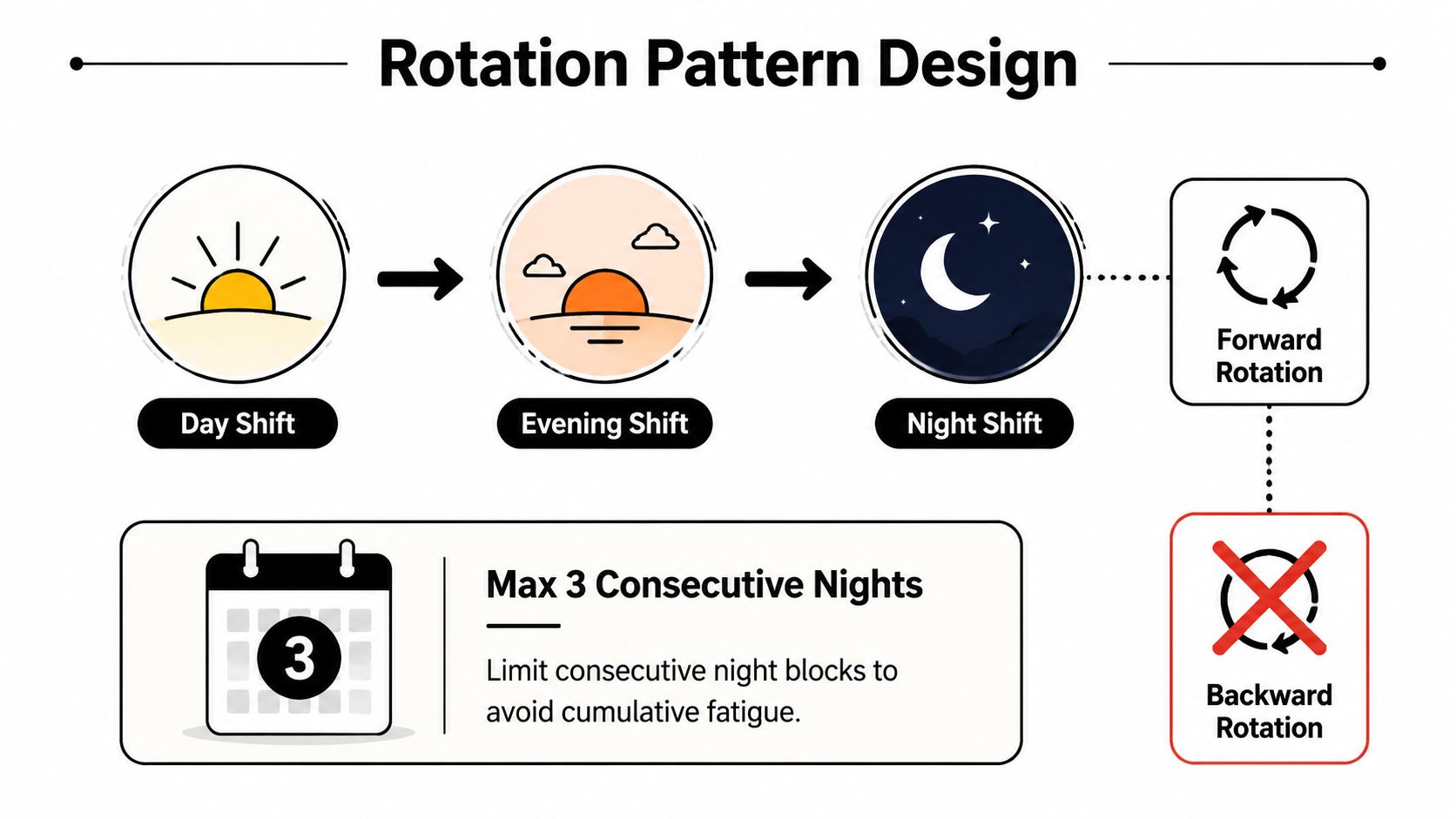
Forward rotation is the pattern that survives real life
Clinical guidance points in the same direction as field experience. A review in the National Library of Medicine notes that night-shift workers sleep 25% to 33% less on average than day or swing-shift workers, and workers commonly lose 1 to 4 hours of sleep per night for about 3 days after rotating shifts (National Library of Medicine review). The same source recommends clockwise rotation, day to evening to night, limiting schedules to no more than 3 night shifts in a block, followed by 3 recuperative days off (National Library of Medicine review).
That advice survives contact with operations because backward rotation feels neat in a planner and rough in real life. A worker who moves from late to early keeps carrying sleep loss forward, which is how a coverage plan turns into chronic fatigue and a jumpy handoff at the worst time.
A sample pattern that's actually usable
A practical four-team template can look like this:
- Team A: days, then evenings, then nights, then recovery.
- Team B: evenings, then nights, then off days, then back into days.
- Team C: nights, then off days, then days, then evenings.
- Team D: off days, then days, then evenings, then nights.
The exact spacing depends on the desk, but the working rule stays the same. Keep the direction forward, keep night blocks short, and do not let the pattern create a day-one, day-two, day-three illusion while hiding a brutal day-four.
For implementation, set a minimum rest window between the end of one block and the start of the next. If the desk cannot protect that gap, the pattern is too tight for the work it is asking people to do. That is where crew fatigue management becomes a practical reference, especially for teams splitting time between airport operations, chauffeur dispatch, and repositioning work.
Handling Time-Zone Handoffs and Cross-Border Crew Rest
A roster that works in one city can fall apart the moment a crew crosses time zones. The usual failure is straightforward. The desk treats a reposition as if body clocks reset at landing, then stacks a local-night assignment on top of a long-haul arrival as if travel fatigue were just another cell in the schedule.
Local time should drive the rest decision
The cleaner rule is to let destination-local recovery set the pace. If a chauffeur lands at LHR at 06:00 local after a transatlantic reposition, that arrival should trigger a recovery buffer, not a same-day 22:00 assignment by default. The body does not care that the home office calendar still shows open space.
That matters for cross-border crew logistics too. A shift that looks normal on paper can continue fatigue in the body, especially when the team has already crossed several time zones in a short cycle. A safe handoff asks a simple question, whether the person is starting fresh in local time or carrying forward the strain from the last leg.
A simple working model for multi-city cycles
For a NYC, DXB, LHR rotation over three days, the roster should build in three things.
- Arrival buffer: do not place the next heavy assignment immediately after landing.
- Local rest window: use destination time, not home-base time, to judge readiness.
- Role continuity check: if the crew member is handling a sensitive VIP or aircraft movement, the handoff needs more margin than a routine transfer.
That model will not memorize every jurisdiction for you, but it does keep the desk away from the most common mistake, treating every clock as if it meant the same thing. On a calm week, the error is invisible. On a Tuesday night at JFK, it is the difference between a handoff that holds and one that starts slipping before the next call even lands.
If the body has crossed oceans, the schedule has to admit it. A clean local handoff is worth more than a perfect-looking roster line.
For global movement planning, a guide to global crew logistics helps because the same handoff logic shows up in executive travel, hotel timing, and aircraft-side coordination. Rest should follow geography as much as payroll considerations.
Forecasting Demand and Building Rostering Templates
A rotation pattern that ignores demand will fail on the busiest day of the week, which is exactly when the desk can't afford failure. The roster should start with volume reality, not with the prettiest shift shape on the board.
Build the template from coverage needs, not preference
Start by mapping demand by hour and by day. Morning airport runs, late-night arrivals, FBO slot windows, and event surges don't behave the same way, and a desk that staffs to average demand usually discovers the gap when the queue is already forming. The roster has to cover peaks first, then use slower periods to restore balance.
That means the template should answer two questions before it's published. Which hours must never go dark, and where can the desk tolerate thinner staffing without breaking service? Once those are clear, shift structure becomes a response to reality instead of a compromise between competing preferences.
Two templates that fit different desks
For an 8-hour continuous-coverage desk, the cleanest model is usually three daily bands, with one person or lane owning each band and a planned overlap at the handoff. This keeps the desk readable and reduces confusion during live changes, especially if dispatch and client services share the same roster logic.
For a 12-hour pattern, the most reliable approach is often a fixed daytime skeleton with a rotating night core. That works because daytime demand tends to be more predictable, while the night block absorbs the fatigue trade-off more evenly if the rotation is built correctly.
A practical validation test is simple. Run the template against a real busy week before publishing it. If the template looks fine only after you smooth the peaks away, it's understaffed.
What to watch before rollout
- Peak overlap: make sure the handoff periods have enough people to manage late changes.
- Event alignment: check the roster against concerts, conferences, flight banks, and holiday movements.
- Recovery spacing: confirm that the night team isn't being asked to absorb a second hard block too soon.
- Exception load: count how often the template breaks when a single person is off, then see whether the desk can absorb that absence.
A template should hold under pressure, not just in a clean simulation. If it can't survive a Friday night with delays, it's not ready for the year.
Measuring Fairness and KPIs That Catch Real Problems
Equal shift counts are not the same thing as fairness. A roster can hand out the same number of shifts and still concentrate weekends, holidays, or ugly night blocks on the same people. In practice, that's where resentment starts.
Track distribution, not just totals
The missed metric in a lot of teams is how the bad work is distributed. If one person always gets the Sunday night block and another always gets the cleaner Friday day, the schedule may look balanced on paper while feeling lopsided in real life. Fairness has to include weekend shifts, holiday concentration, unpopular night blocks, and recovery-day balance.
That's also where participatory scheduling becomes interesting. In a hospital study, introducing a participatory scheduling tool changed working-hour characteristics, increasing compressed hours and longer shifts, while adding a schedule-evaluation tool moderated those effects and was associated with different sickness-absence patterns (hospital study on participatory scheduling). The lesson for operations is straightforward. Involving staff can improve acceptance, but without a measurement layer it can also shift the unfairness around instead of removing it.
KPIs that belong in the weekly review
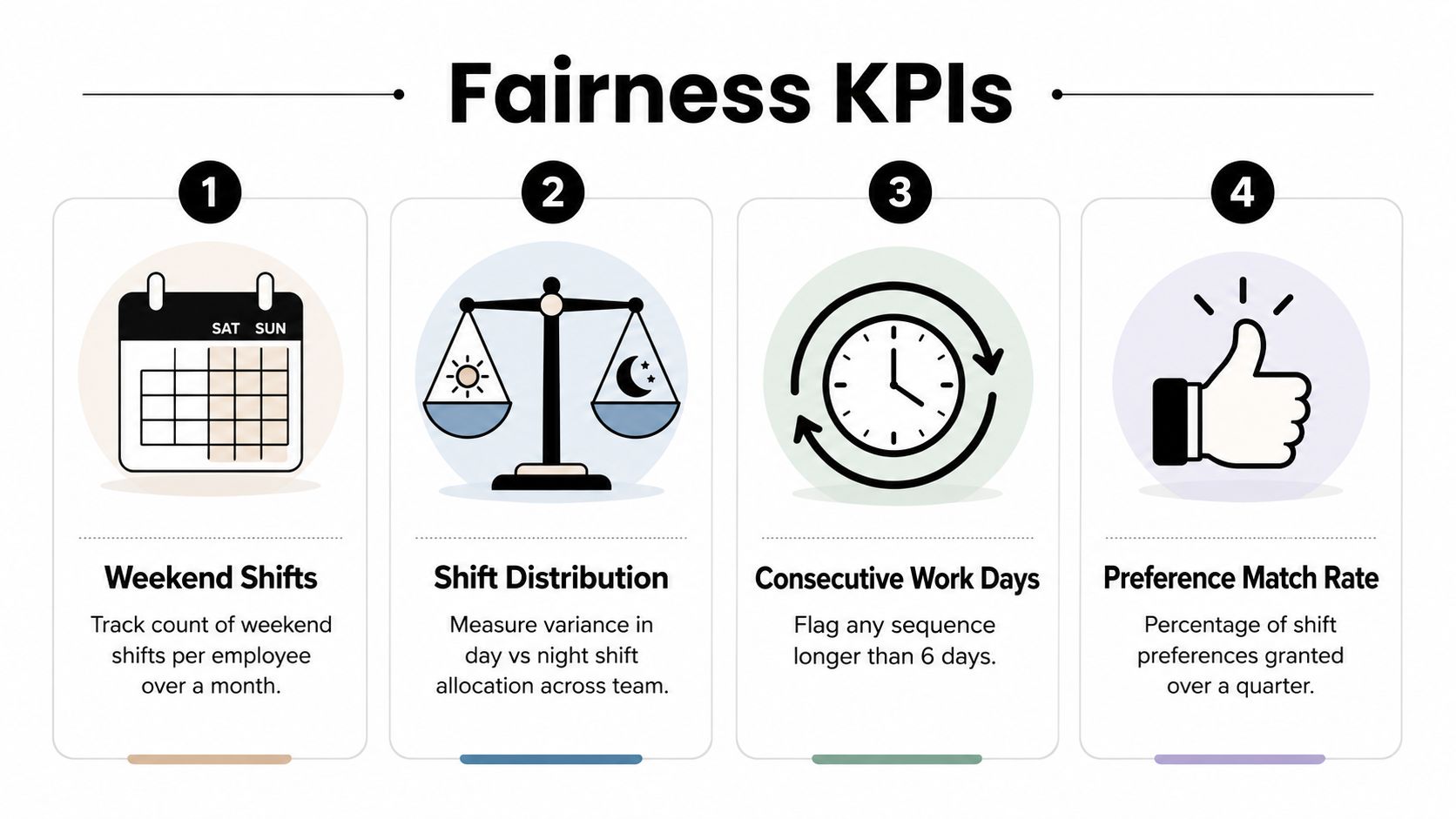
A practical review pack can include:
- Coverage hit rate: did the desk fill the required blocks without last-minute scrambling.
- Fatigue-risk score per worker per month: which people keep getting the worst combinations of nights, quick returns, and long blocks.
- Fairness index: how unevenly the unpopular shifts are distributed across the team.
- Schedule-change lead time: how much notice people got before the roster changed.
None of those numbers matter if they sit in a dashboard no one reads. A weekly ops review should ask which person got squeezed, which block created the most churn, and whether the pattern is repeating.
Fairness is not symmetry. It's the ability to explain, with evidence, why one person had to carry one hard block and why that burden won't keep landing on the same shoulders.
Software Workflow and Automation Without Losing Control
A roster can be built quickly in software, and bad logic can look polished at the same time. Automation pays off only after the constraints are right, and only if someone still checks the output against operational reality before it goes live.
The solver is fast, the constraint logic still matters
A decomposition heuristic for rotational workforce scheduling solved more than 90% of 1,322 feasible instances in under 0.1 seconds and 97.7% within 1 second, which shows that modern optimization can generate near-real-time rosters at scale (RWTH Aachen thesis). Speed is not the issue. The central question is whether the solver understands the transition rules that matter in your desk.
The same source describes a practical failure mode. Mathematically valid schedules still break when transition constraints are ignored. In one automated scheduling implementation, night/day rotation conflicts fell from 0.7 to 0.3 per intern, and first-choice assignment rates improved from 69.4% to 96.0% for interns and from 30.5% to 80.5% for residents once the transition logic was handled correctly (RWTH Aachen thesis). The point is not that numbers solve everything. The point is that workflow design changes real outcomes.
Validate before the roster goes live
A good automation workflow has three gates.
- Constraint gate: confirm the software respects recovery, night-block limits, and any local exclusion rules.
- Human gate: have a scheduler review the output for obvious fairness problems, especially in small teams.
- Ops gate: compare the roster against real demand, delayed flights, and expected coverage spikes.
If any one of those gates is skipped, the roster can look complete while still being fragile. That fragility usually shows up after the first delay cascade, not before.
I've seen the best tools fail when they were treated like final authority instead of decision support. The schedule still needs a human who knows which handoff is hard, which exception is recurring, and which “fair” assignment will be resented by Friday.
Keep the system visible
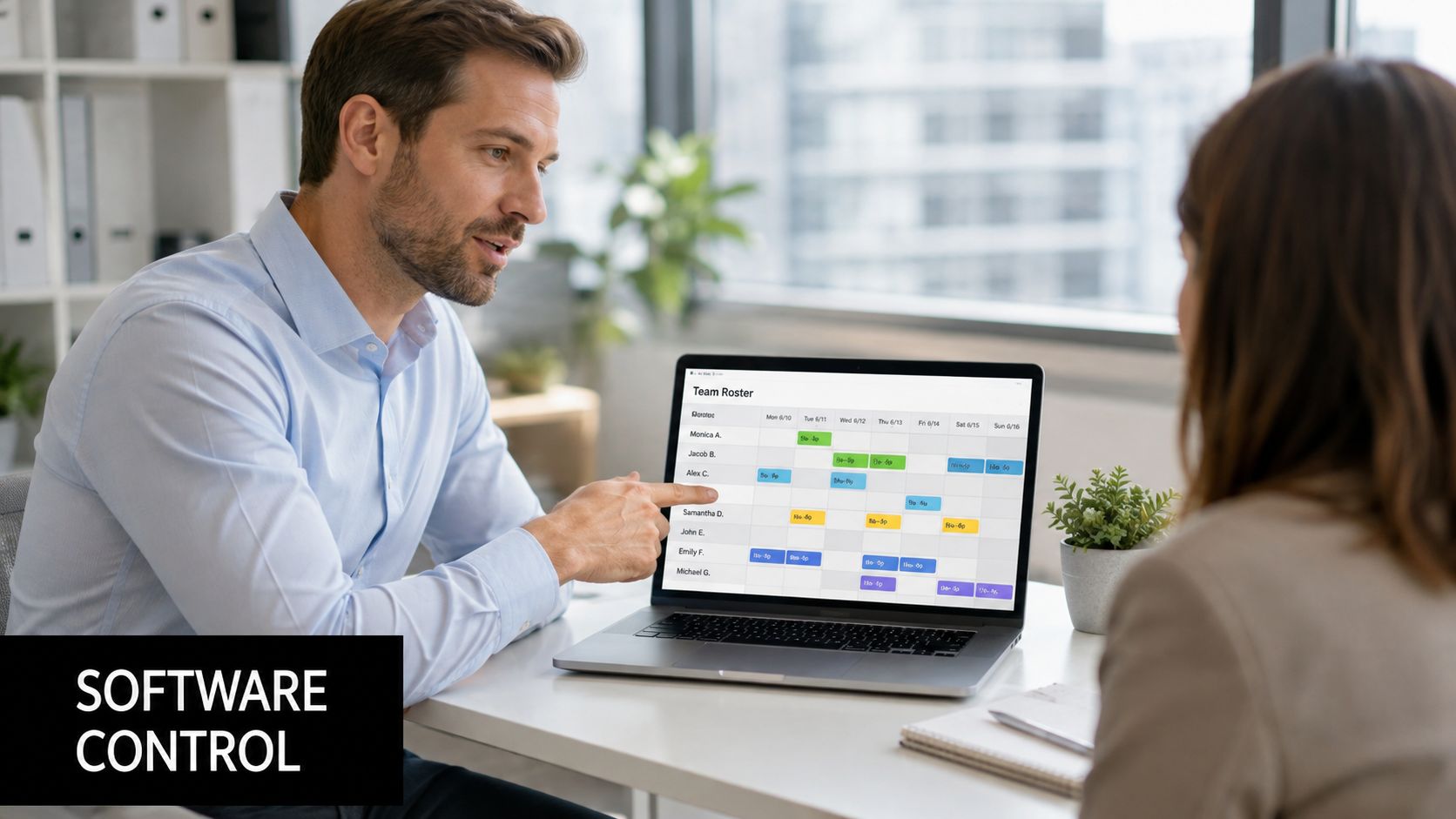
A useful control layer is live visibility between dispatch, staffing, and whoever owns the roster. That matters when a desk is tracking reassignments in real time and cannot afford stale handoff data. The internal piece on real-time transportation visibility fits here because software only helps when the operational picture stays current.
The roster should end up as a living control system, not a static PDF. When it does, shift rotation becomes a tool for reliability instead of a weekly argument.