
A clean criminal record doesn't tell you much about whether a driver is safe with passengers, property, and schedules. In one widely cited screening report, 36% of driving records showed at least one violation or conviction, while 46% of employment and reference checks differed from what applicants presented, which is exactly why driver background checks have to look past the obvious paperwork report. For executive transport, that gap matters more than most operators admit, because one bad hire can affect client safety, discretion, and service continuity at the same time.
The mistake I see most often is treating screening as a compliance checkbox instead of a risk filter. A chauffeur who looks polished in the interview can still carry hidden issues in driving history, safety performance, or alcohol and drug data, and those are the records that predict whether a passenger-facing assignment is a good idea. When the client is a CEO, a family office principal, or a VIP arriving on a tight itinerary, “good enough” screening isn't good enough.
Why Driver Background Checks Matter More Than You Think
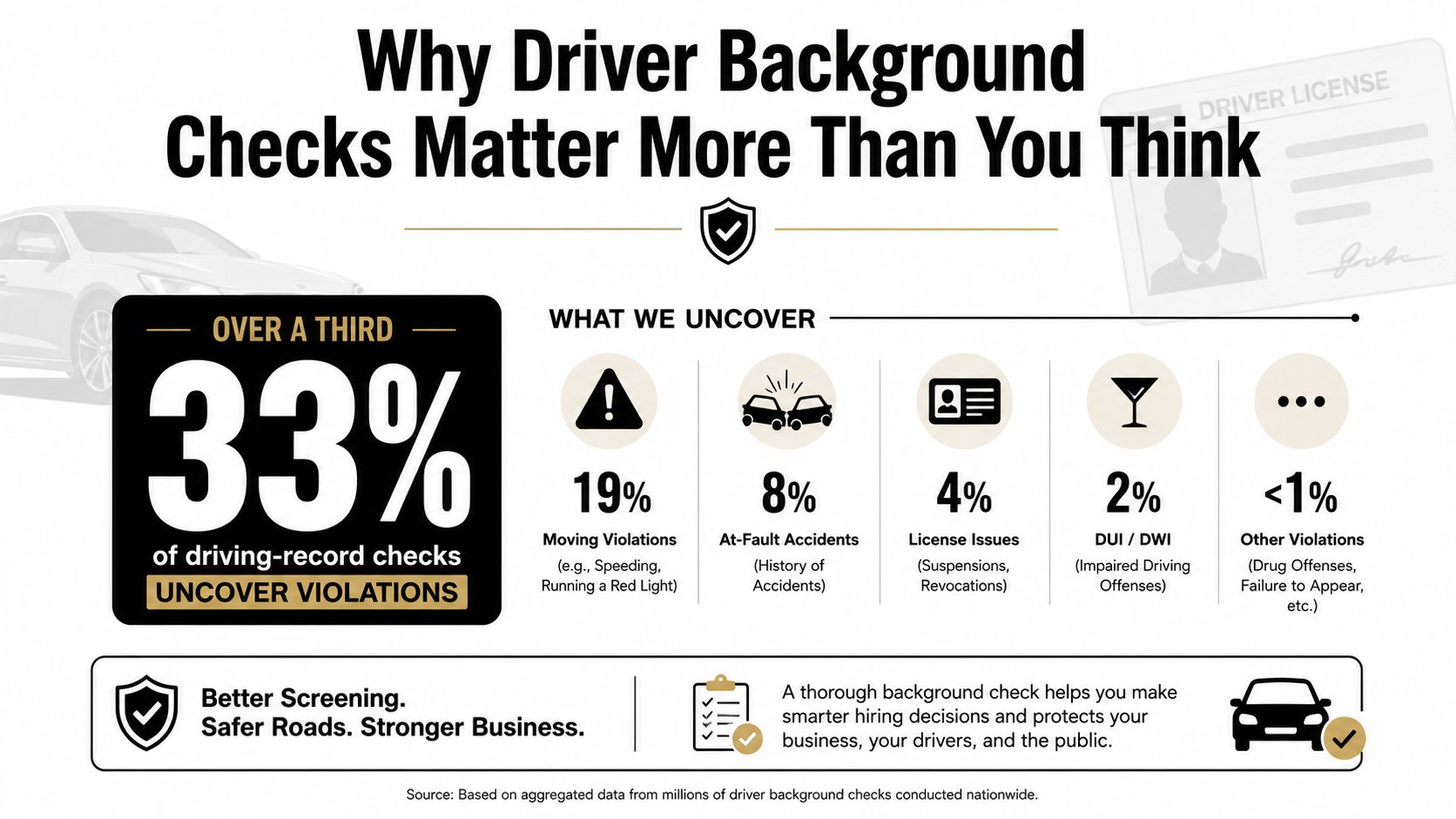
The first number that should change how you think about hiring is not the one many operators expect. In the background screening data, 36% of driving records revealed at least one violation or conviction, and 9% of all background checks produced some kind of adverse record report. That means a candidate can look clean on paper and still carry the kind of history that matters when the job is to move another person safely through traffic, weather, airport constraints, and public scrutiny.
Passenger-facing driving is a trust role. It depends on whether a person can keep timing tight, make sound decisions, and stay composed when a pickup runs late or a route changes without warning. A chauffeur can pass a casual interview and still fail the checks that expose suspensions, violations, or conflicts between what they said and what prior records show.
For executive transport, the higher stakes stem from discretion, punctuality, and flawless safety performance. Clients expect a driver who protects privacy, keeps to the itinerary, and performs under pressure without drawing attention to the disruption. That is why the background check has to work as a safety control, not a paperwork exercise. For more detail on the standards behind that approach, see our chauffeur safety standards guide.
The regulatory direction also makes the point plain. A 2024 Government Accountability Office review found 45 states plus Washington, D.C. required criminal background checks for prospective ridesourcing drivers, and 10 states required them for prospective taxi drivers GAO report. Those rules exist because transportation work puts the public in direct contact with the driver, and that contact deserves more than a superficial screen.
Practical rule: if your screening only tells you whether someone can be hired, but not whether they should be put behind the wheel of a client vehicle, it's incomplete.
The Seven Essential Check Types for Professional Drivers
A proper vetting file is built from multiple sources because no single check tells the whole story. For commercial and executive transport, the useful question is not whether a candidate has “a background check,” but whether the file covers the signals that predict risk in a driving role.
Start with the records that match the job
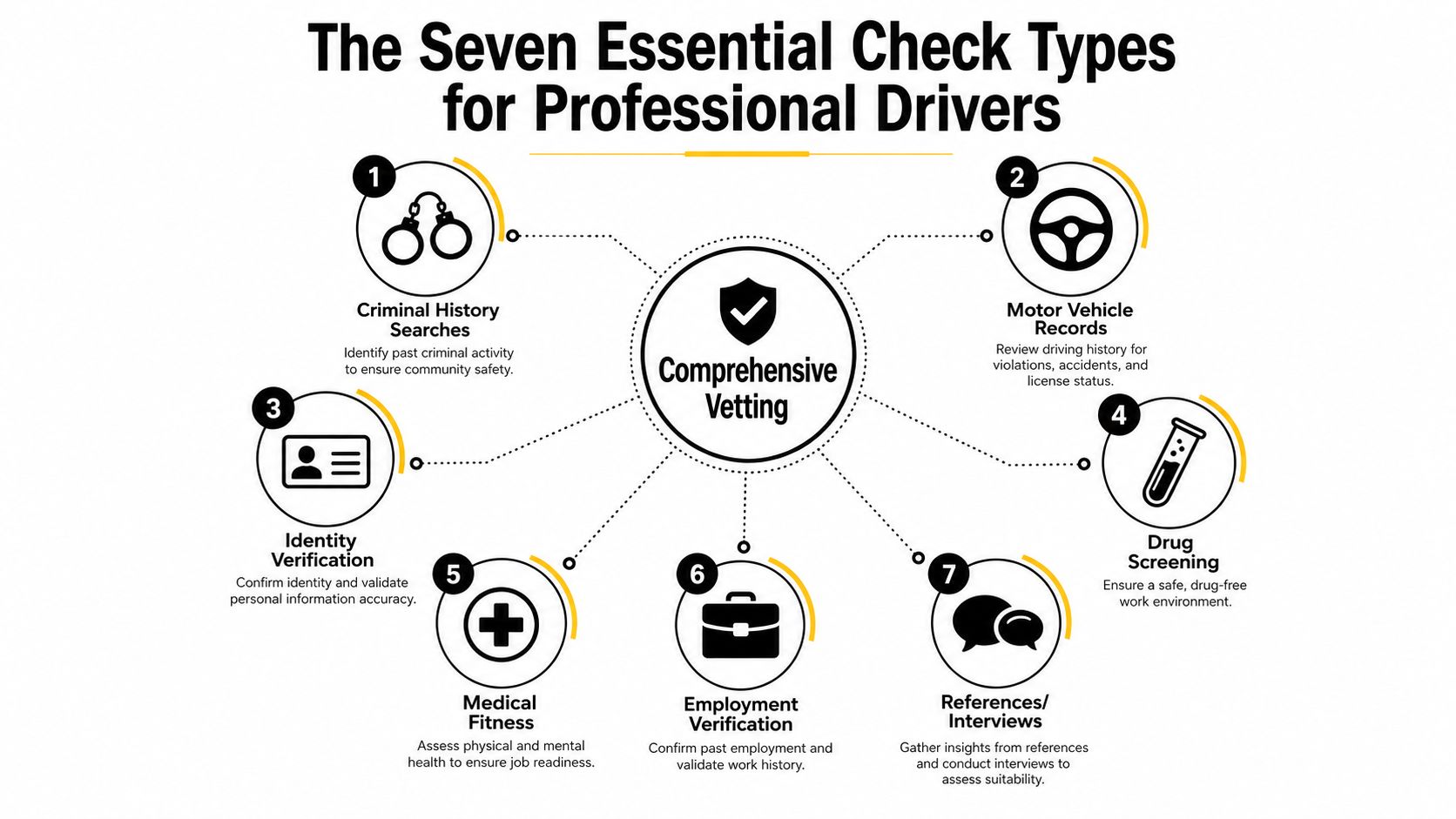
Criminal history searches matter, but they're only one layer. They help identify disqualifying offenses and patterns of poor judgment, yet they won't tell you whether someone has a suspended license or a recent driving violation. That's why motor vehicle records belong near the top of the list for any passenger transport role.
Identity verification keeps the rest of the process anchored to the right person. If the identity is wrong, every downstream check becomes unreliable. Employment verification confirms whether the driver held the safety-sensitive roles they claim, which matters because job history in transportation often carries licensing, routing, and incident exposure that doesn't show up elsewhere.
A full program also needs drug screening and, where the role requires it, the relevant medical fitness review. Under DOT and FMCSA rules, a commercial-driver file isn't a single criminal search, it includes Motor Vehicle Records from every state where the applicant held a license in the prior three years, verification of three years of safety performance history from each DOT-regulated employer, a query of the FMCSA Drug & Alcohol Clearinghouse, and a pre-employment drug test for CDL drivers 49 CFR Part 391, Subpart C.
A clean court record doesn't erase a license suspension, a failed drug test, or a reportable safety event.
For executive transport, the last two layers often get underused. Right-to-work documentation belongs in the file because it protects the employer from downstream eligibility problems, and sanctions screening matters when your service crosses borders or supports clients with international movement patterns. If a company operates globally, that final layer stops being optional and starts becoming part of basic operational control.
Executive Transport Vetting vs Standard Rideshare Screening
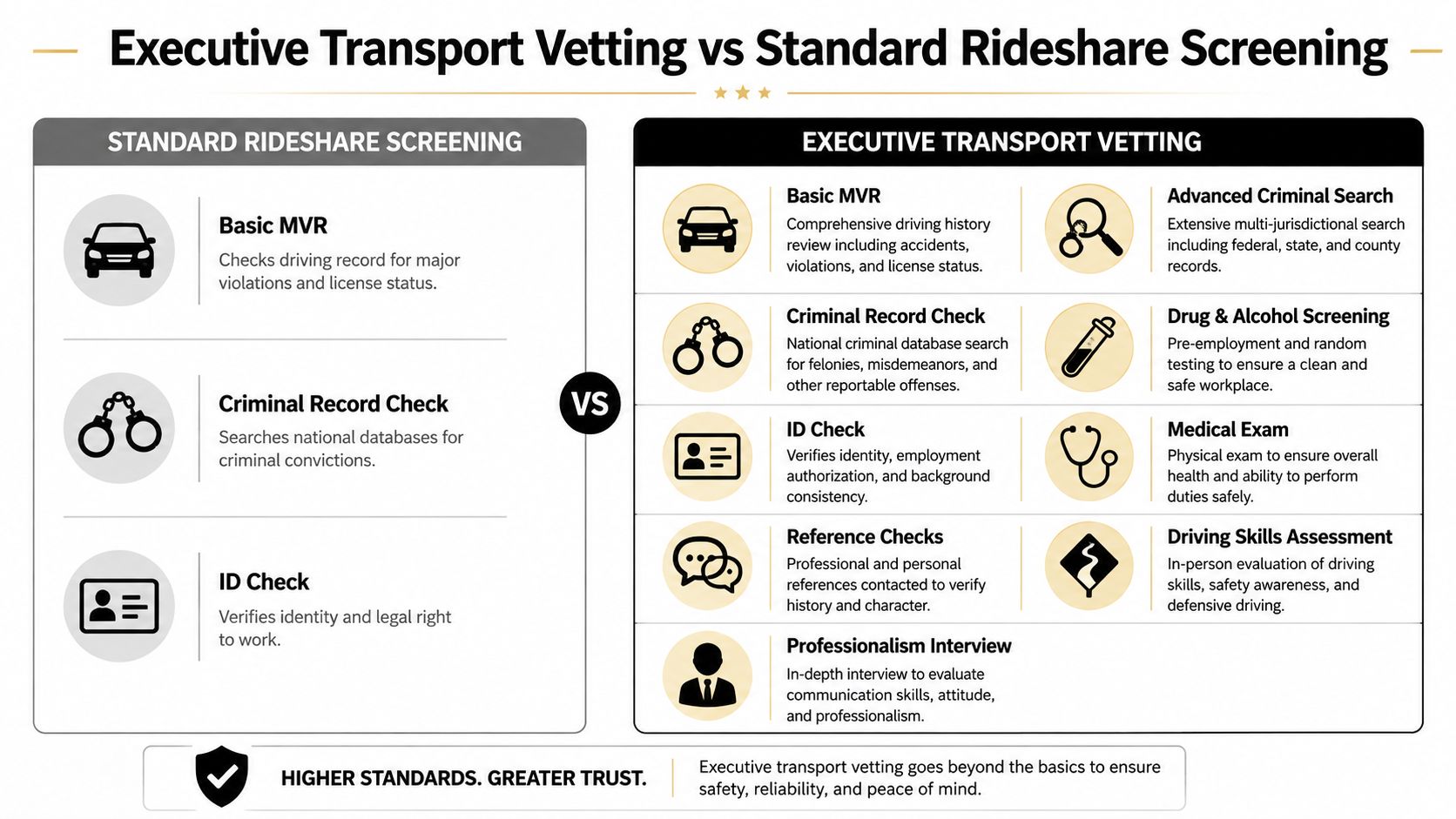
A clean rideshare screen is a starting point, not a finish line. Executive transport vetting has to uncover the risks a client will feel, long before a driver opens a door at the curb or steps into a private terminal pickup. In a high-touch operation, the file has to show judgment, reliability, and discretion, not only that the driver cleared a basic admissibility check.
Minimum checks versus role-specific proof
Standard rideshare screening usually focuses on the obvious basics, and that approach works for a platform built around volume. Executive transport has a much lower tolerance for surprise. A chauffeur assigned to an FBO pickup, a multi-stop roadshow, or a family office principal needs a file that reaches into safety history, behavior patterns, and service readiness.
Short lookback thresholds and behavior-based rules matter more than generic verification. The screening benchmark that references three moving violations in three years or disqualifying convictions within seven years shows why executive transport companies should work from operational thresholds instead of relying on a simple yes or no answer screening eBook. Those thresholds help operators separate a licensed driver from a driver who is ready for passenger-facing work.
Why discretion changes the standard
Executive clients need safe driving, but they also need calm judgment, professionalism, and confidentiality. Interview notes, reference calls, and real-world observations from prior assignments carry more weight in that environment than they do in a lower-touch fleet. A candidate can clear a platform-style screen and still be the wrong fit if they get rattled under pressure or are careless with sensitive information.
I have seen the gap most clearly when companies assume a clean criminal search finishes the job. It does not. Chauffeur operations ask the driver to do more than move a client from one point to another, because the person behind the wheel is part of the client experience and often the first face a VIP sees on arrival.
That is why comparison matters. Use the same rigor you would apply to a secure service review, and compare our approach with industry standards here, secure transport companies.
Navigating Legal Requirements and Cross-Border Compliance
Driver screening rules vary in ways that trip up even experienced operators. In one state, the timing of a search or the scope of a report can be tightly defined. In another, the same file can raise questions because privacy rules, local transportation licensing, or employer-use restrictions work differently.
The legal risk is usually in the timing
The biggest mistake is collecting too much too early or relying on information longer than policy allows. Background screening has to line up with employment law, disclosure rules, and any jurisdiction-specific limits on what an employer can consider. That becomes more complicated when a business works across state lines, because a file that is acceptable in one place may need different handling somewhere else.
The U.S. ridesourcing sector shows how broad compliance has become. The GAO review found 45 states plus Washington, D.C. required criminal background checks for prospective ridesourcing drivers, with 10 states requiring them for prospective taxi drivers GAO report. That breadth matters because companies often assume “transportation screening” is uniform. It isn't, and a one-size-fits-all policy creates avoidable gaps.
Cross-border work needs tighter record control
If your operation supports international travelers, the compliance problem expands beyond state rules. Data protection standards, consent handling, and record-retention limits may differ by market, and those differences affect what screening vendor you can use and how you can store the result. A global chauffeur program needs a written rule for what gets collected, who can review it, and how long it stays accessible.
Massachusetts is a useful reminder that prior private screening doesn't always settle the question. After reviewing about 70,789 drivers, the state rejected 8,206 drivers, roughly 11%, for issues ranging from suspended licenses to violent crimes and sexual offenses GAO report. That doesn't mean every company should mirror the state's process, but it does show that meaningful disqualification can emerge even after earlier checks.
Compliance habit that saves time: keep one master policy, then document jurisdiction-specific exceptions instead of improvising case by case.
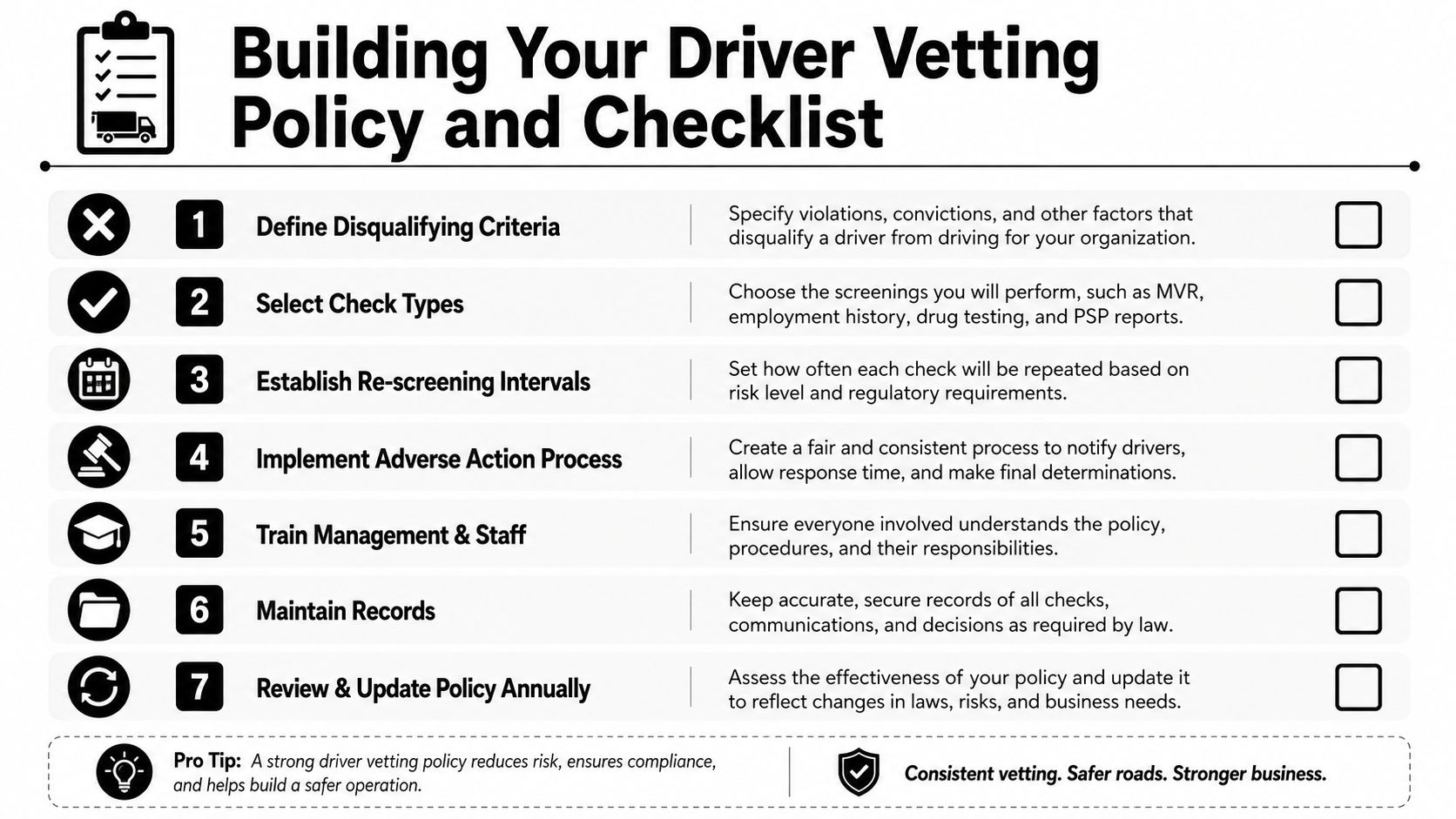
Building Your Driver Vetting Policy and Checklist
A good vetting program starts with a written policy, not a stack of vendor reports. The policy should say which offenses are disqualifying, which checks are required for each role, how far back you look, and who owns the final decision. Without that structure, managers make inconsistent calls, and inconsistency is where both safety misses and discrimination claims start.
Make the decision rules explicit
The strongest policies distinguish between roles. An executive chauffeur shouldn't be screened the same way as a non-driving office hire, and a CDL driver shouldn't be screened the same way as a sedan-transfer driver. That tiered approach keeps the process proportional to risk while making sure the most sensitive assignments get the deepest review.
A workable checklist is straightforward:
- Define disqualifying criteria. Spell out which license issues, safety violations, criminal categories, and drug or alcohol outcomes trigger denial.
- Select the right check types. Match criminal, MVR, identity, employment, and drug screening to the job's actual exposure.
- Set lookback periods. Use a written rule so reviewers don't improvise from case to case.
- Document candidate consent and disclosures. Keep the process compliant and traceable.
- Apply adverse action steps consistently. If you deny a candidate, follow the required notice process every time.
- Train managers and dispatch leads. A well-written policy fails if the people assigning trips don't understand it.
- Review the file before assignment. No chauffeur should be placed on a premium run before the screening result is complete.
Keep the process defensible
Conditional offers work well in transportation because they let you complete screening before assignment without pretending the job is finalized. If the candidate disputes a record, the file should pause until the issue is resolved, not move forward on a hunch. That protects the client, the company, and the person applying.
The point isn't to reject more people. It's to make sure every yes is defensible and every no is consistent. When a vetting program is documented properly, it becomes easier to explain decisions to clients, regulators, and internal stakeholders alike.
Selecting the Right Background Check Vendor
The wrong vendor can make a good policy look sloppy. Some providers aggregate database hits, while others verify records at the source, which is the difference between a screen you can rely on and a screen you can't defend when a file is challenged.
Demand primary-source quality
If you're screening professional drivers, ask where each record comes from and how current it is. A vendor that pulls from outdated or incomplete datasets may return something that looks useful but misses the issue that matters most, such as a recent license event or an employment record tied to safety-sensitive work. That problem gets worse when the vendor can't explain how it handles jurisdiction differences.
Vendor selection should also include compliance capability. For transportation employers, the provider has to support Fair Credit Reporting Act processes, handle adverse action timing properly, and maintain records in a way that won't create privacy issues later. The operational question isn't just “can they run a report,” it's “can they support a defensible hiring file across the markets where we operate?”
The internal procurement conversation should also be tied to preferred-vendor governance. If your team already manages contracts and service levels centrally, the screening provider should fit that discipline instead of creating a side process that nobody reviews preferred vendor agreement guidance.
Ask the questions that expose hidden friction
A good vendor conversation goes beyond turnaround time. Ask how they handle applicant disputes, how they support multi-jurisdiction searches, what kind of customer service response you get when a file is unclear, and whether their workflow integrates cleanly with your applicant tracking process. If they can't answer those questions clearly, expect operational drag later.
Vendor test: if the provider can't explain how a contested record is handled from first review through final decision, keep looking.
For executive transport companies, reliability matters as much as price. A cheap screening package that misses a critical driving issue is expensive in the only way that matters, because it can put a client in the wrong vehicle with the wrong person.
Continuous Monitoring and Ongoing Risk Management
A day-one screen doesn't protect you from what happens on day 90. License issues, new offenses, and drug or alcohol problems can arise after hiring, which means a responsible program has to keep watching the risk profile instead of freezing it at onboarding.
Ongoing review catches what the first screen never could
In commercial transportation, the safest model is continuous or recurring review tied to the role's exposure. FMCSA-aligned practice already depends on maintaining current safety performance history and clearinghouse data, not just reviewing a file once and filing it away 49 CFR Part 391, Subpart C. That same logic applies to executive transport, even when the job doesn't require a CDL.
The most practical approach is a layered one. Annual re-screening works for some teams, while more active monitoring is better for high-value or high-visibility routes. The right choice depends on how often the driver interacts with clients, how much discretion the role requires, and how fast your operation needs to react if something changes.
Match monitoring to the risk profile
Continuous monitoring is most useful when it focuses on the records that change the job's suitability. New driving violations, new criminal events, and failed drug or alcohol results should prompt immediate review, not a delayed audit. That's especially important in VIP transport, where a driver's status can change between assignments without any visible warning.
MLR Worldwide Service builds around that principle by combining vetted chauffeurs, real-time coordination, and a service model designed for privacy and reliability across markets. That's the right mindset for any executive transport provider, because trust isn't created at hiring, it's maintained every time a client gets into the vehicle.
If you're building or tightening a chauffeur vetting program, MLR Worldwide Service applies the same discipline to executive transport, airport transfers, VIP secure movements, and multi-stop corporate schedules. Visit MLR Worldwide Service to see how discreet, professionally managed ground transportation supports the kind of safety and consistency this topic demands.