

The standard advice is simple: take a train or bus from Dublin, see Belfast, and return the same evening. That advice is incomplete. The key decision isn't transport. It's whether a same-day visit gives you enough time, control, and resilience for the reason you're travelling.
The Dublin to Belfast corridor is short enough to make a day excursion possible, roughly 103 to 105 miles, or 166 to 169 kilometres. Yet a published journey time doesn't include boarding, local transfers, traffic, meeting overruns, or the consequences of missing the return service. If you're planning around a flight, cruise call, executive meeting, or fixed dinner reservation, a theoretically convenient itinerary can become operationally fragile very quickly.
Why Most Belfast Day Trip Advice Gets It Wrong
Belfast is close to Dublin, but that does not make every same-day itinerary sound. A day trip works when the objective is narrow, the departure point is convenient, and the return has enough protection against delay. It becomes fragile when the plan includes several landmarks, a fixed appointment, premium dining, or a connection that cannot absorb a missed service.
The operational mistake is treating published journey time as usable sightseeing time. Boarding, local transfers, traffic, meeting overruns, and the consequences of missing the return can consume the margin that a standard itinerary quietly assumes. Set the return first, then build the Belfast program backward from it.
An overnight stay often delivers better value. Northern Ireland recorded an estimated 5.1 million overnight trips in 2025, while visitors from the south reached 1.3 million trips and spending rose to £317 million, according to the cross-border tourism analysis. The pattern supports fuller visits rather than treating Belfast as a quick stop between transport connections.
Visit Belfast has reported limited day-trip data, including a figure of 250,000 in its business material. That limitation matters operationally. Overnight travelers can dine without watching the clock, schedule cultural experiences at a measured pace, and move meetings away from the pressure of a fixed evening departure.
When a same-day visit makes sense
Choose a same-day tour Belfast from Dublin when the Belfast objective is specific. A focused Titanic Quarter visit, one pre-booked meeting, or a short city-center program can work if the return is protected from the start.
Departure-point selection also changes the risk. A group already near the relevant station or coach stop has more usable time than one crossing Dublin before departure. Airport-origin coaches can be faster than city-origin services, while the Enterprise train connects Dublin Connolly with Belfast Grand Central. The route is practical, but it is not a flexible day for spontaneous exploration.
Executive rule: If missing the return service would damage a flight, event, or commercial commitment, book the return first and design Belfast around that constraint.
When an overnight is the better decision
Stay overnight when Belfast forms part of a broader Northern Ireland program, when premium dining matters, or when the group wants political history, museums, and city-center time without compressing every stop. An overnight also suits travelers who need to work between appointments or cannot guarantee a disciplined departure from Dublin.
The stronger itinerary matches the trip's purpose. A rushed same-day visit can create less value than a slower overnight schedule, especially for executives and high-value travelers whose time carries a commercial or personal cost. A private chauffeur can improve control, but it cannot remove the underlying risk of trying to fit too much into one return window.
Comparing Transport Options for the Dublin to Belfast Corridor
The corridor offers three credible choices, but they solve different problems. The Enterprise train is the cleanest public option for direct city-center movement. Cross-border coaches can offer lower fares and useful frequency, particularly from Dublin Airport. A private chauffeur transfer provides the most control when the itinerary includes several locations or sensitive timing.
The wider ground-transport category includes vehicles and services designed to move people between locations, as explained in this overview of what ground transportation includes. For Belfast planning, the important distinction is control over the entire journey, not merely the advertised line-haul time.
| Transport Mode | Journey Time | Daily Frequency | Privacy Level | Best For |
|---|---|---|---|---|
| Enterprise train | About 2 hours 15 minutes | 8 weekday departures | Low | Direct city-center travel and predictable public schedules |
| Cross-border coach | About 2 hours 20 minutes from Dublin city, with fastest airport runs around 1 hour 45 minutes | Multiple daily departures, with some services roughly hourly | Low | Price-sensitive travelers and airport-origin journeys |
| Private chauffeur | Dependent on pickup, routing, and stops | By reservation | High | Executives, families, multi-stop programs, and schedule-sensitive travel |
Enterprise train
The Enterprise train between Dublin Connolly and Belfast Grand Central runs eight times daily on weekdays and takes about 2 hours 15 minutes, according to Visit Belfast's transport guidance. It offers a direct city-center journey, a usable working environment, and straightforward luggage handling once you're onboard.
Its limitation is schedule rigidity. You still need to reach Connolly, board on time, and accept the published return departure. The train is a strong choice for a defined city-center agenda, not for a coastal detour or a program that may change during the day.
Cross-border coach services
Coach services typically take about 2 hours 20 minutes from Dublin city, while the fastest Dublin Airport runs can take about 1 hour 45 minutes, based on current Dublin to Belfast coach timings. One market aggregator lists 126 daily buses on the corridor, and airport services can operate up to 35 coaches per day.
That frequency creates flexibility, but the low fares, which generally start around £8 to £13 one way and average roughly £18, also reveal a commoditized market. Coaches can be the right answer when price and departure choice matter more than privacy. They become less attractive when a multi-stop city pickup, traffic exposure, or a late return would threaten the purpose of the trip.
Private chauffeur transfers
A chauffeur removes the station or coach-terminal transfer from the equation. The vehicle collects the group at the relevant Dublin address, manages luggage, and can adapt the routing to Belfast hotels, offices, attractions, or airport connections.
The premium is justified when door-to-door control, confidentiality, and itinerary flexibility matter more than the ticket price. It also makes the departure point a strategic choice. A group already near Dublin Airport may save more operational time by starting there than by crossing the city for a cheaper or more familiar service.
Three Itinerary Models for Different Travel Priorities
There isn't one correct way to tour Belfast from Dublin. The right model depends on how much of Belfast you need to experience, how fixed your return is, and whether the group values breadth or calm.
The Express Day Model
This model suits an executive with one major Belfast objective. Book the earliest practical direct departure, arrive with the key appointment or attraction already reserved, and keep the Belfast program concentrated around one area.
A workable structure is:
- Early departure from Dublin. Choose the first practical direct train or coach, with airport-origin service considered when it materially improves door-to-door timing.
- Focused Belfast window. Schedule one primary commitment, then allow time for a nearby meal or short city-center walk.
- Protected return. Set the return departure before booking any optional afternoon activity. Leave a substantial gap between the final commitment and the station or coach pickup.
This model doesn't support casual touring across Belfast. If the group wants Titanic Belfast, a political history tour, premium lunch, and coastal sightseeing, the schedule has already outgrown the express format.
The Immersive Overnight Model
The overnight model is the correct choice for travelers who want Belfast to feel like a destination rather than a checkbox. Travel north at a comfortable pace, check into a centrally located hotel, and reserve the evening for dining or a guided cultural experience.
The following day can hold the attractions that are difficult to appreciate under return pressure. You can place a Titanic Quarter visit, political history, shopping, or a restaurant booking into separate windows instead of forcing them into one compressed sequence.
This is also the best format for leadership groups conducting meetings. Participants can arrive settled, conduct business without watching the clock, and leave Belfast after the program rather than abandoning a discussion to protect a public departure.
For teams building formal schedules, this executive travel itinerary template can help separate fixed commitments from flexible experiences.
The Bespoke VIP Model
A private vehicle supports the broadest Belfast program. Start with a direct Dublin pickup, visit the Titanic Quarter, continue to a political history experience, pause for lunch, and add a carefully selected coastal or heritage stop if the day allows.
The driver shouldn't just follow a list of attractions. A professional coordinator should sequence the route around opening times, group preferences, vehicle access, walking tolerance, and the protected return window. The value lies in removing unnecessary backtracking and allowing the itinerary to change without abandoning the whole day.
A same-day VIP itinerary still needs discipline. Private transport gives you more control, but it doesn't repeal traffic or extend attraction opening hours. Build the day around one essential experience, then treat the coastal detour as conditional.
Timing Risks and Buffer Strategies for Same-Day Returns
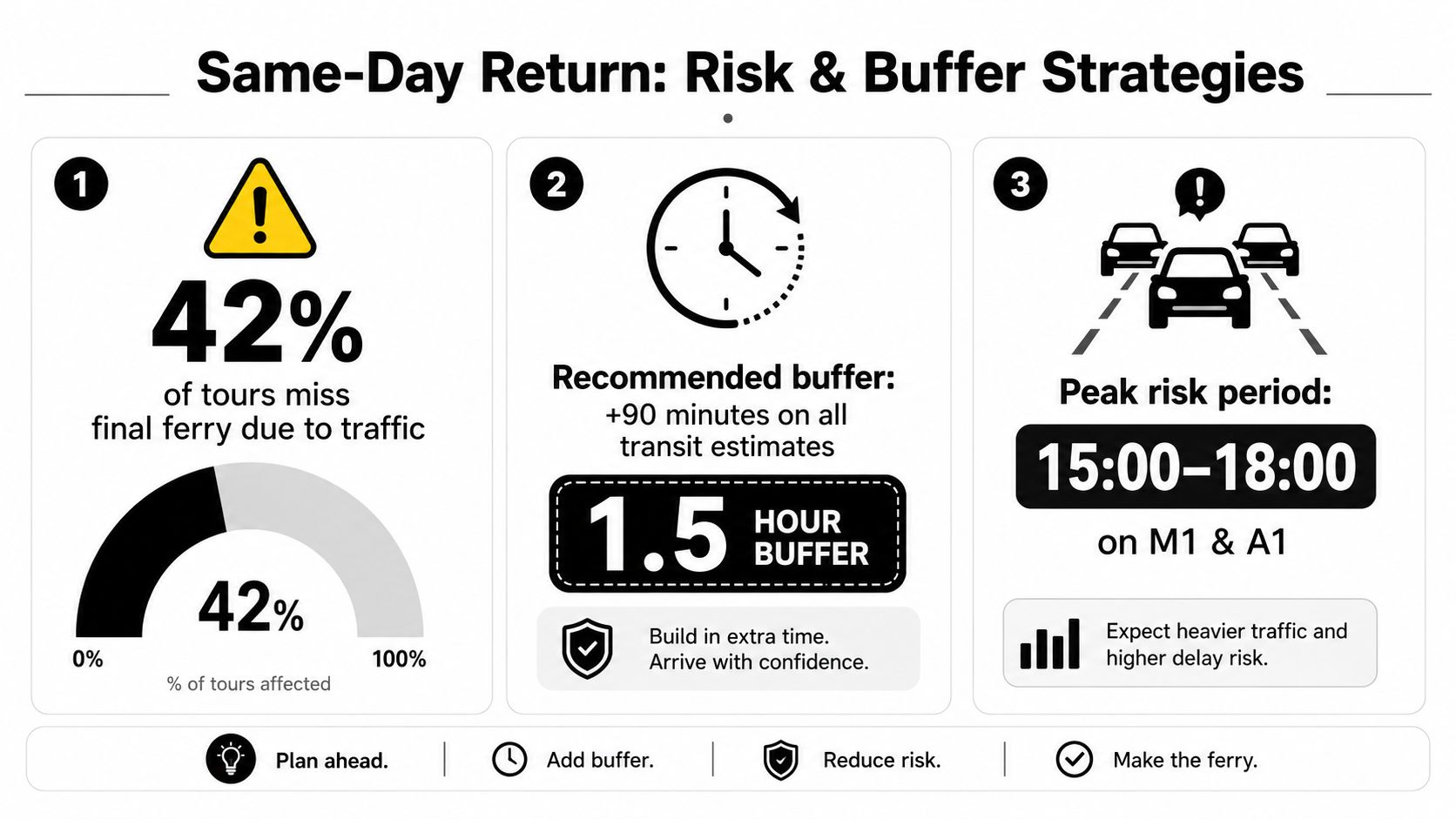
The published journey time is only the middle of the calculation. Boarding, city transfers, traffic, event-related congestion, and a meeting that runs over all consume time before the traveler reaches the return platform or pickup point.
Published schedules also vary by departure point and day. CheckMyBus route guidance reports fastest travel of about 1 hour 45 minutes from Dublin Airport, compared with roughly 2 hours 20 to 2 hours 35 minutes from Dublin city. The same source reports more than 374 daily coach movements on Saturday, compared with 148 on Friday, showing why frequency should be checked for the actual travel date rather than assumed from a generic weekday listing.
Use a return-first calculation
For a same-day schedule, work backward from the Dublin arrival requirement.
- Set the hard deadline. Identify the flight, ferry, dinner, meeting, or hotel check-in that cannot move.
- Select the return service first. Don't leave the return open while filling the Belfast agenda.
- Protect the departure point. Finish the final Belfast commitment well before the required station or pickup arrival.
- Remove optional stops when the margin narrows. A coastal detour is the first element to cut, not the return buffer.
A city-origin coach listed at 2 hours 35 minutes can become longer once boarding and local transfers are included. That combination can push the practical journey beyond three hours each way, which makes a full-day excursion vulnerable to even a modest delay.
Practical rule: Never use the fastest airport timetable as the baseline for a city-center itinerary. Optimize for where the traveler starts, not for the most attractive number in a search result.
The risk is higher when a return leg connects to a cruise call, flight, or executive meeting. In those cases, a missed service may not be recoverable through the next departure. Direct express services are preferable to multi-stop alternatives because each additional handoff introduces another point where the schedule can slip.
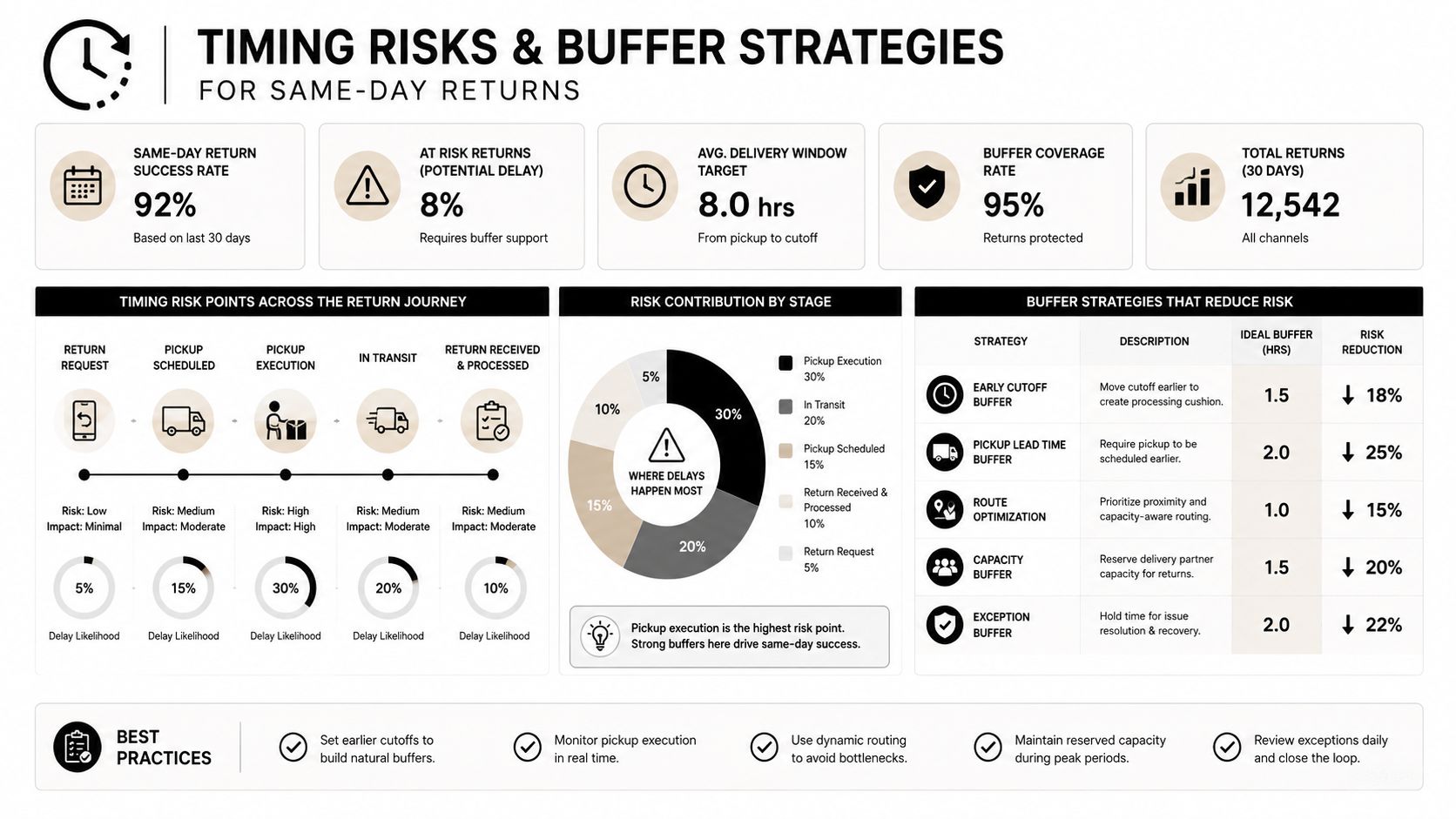
Peak travel periods deserve a separate review. Belfast tourism momentum is expected to continue, with Visit Belfast forecasting around 2 million visitors in summer 2026 after 1.5 million trips in 2025 and nearly £493 million in spend, according to its 2025 to 2026 business plan. That projection doesn't guarantee disruption, but it supports a conservative approach to peak dates, major events, and heavily booked attractions.
Private Chauffeur and Concierge Options for Premium Travelers
Public transport works when the schedule is simple. It becomes a constraint when the group needs privacy, multiple stops, confidential calls, or the ability to change plans without losing the day.
A private chauffeur transfer turns the Dublin to Belfast journey into a controlled operating window. The vehicle provides door-to-door collection, secure luggage handling, and a quiet environment for calls or work. A coordinator can also monitor the itinerary and adjust pickup timing when a meeting changes or an attraction takes longer than planned.
What the upgrade actually provides
The strongest benefits are practical:
- Origin control: Collect travelers from a hotel, office, residence, airport terminal, or FBO instead of requiring a separate transfer to a public departure point.
- Route flexibility: Combine Belfast city-center appointments with the Titanic Quarter, a historical tour, or a selected coastal stop.
- Confidentiality: Keep executive conversations inside a private vehicle rather than in a shared carriage or coach.
- Luggage continuity: Leave bags in the vehicle between stops instead of moving them through stations and terminals.
- Live coordination: Use a 24/7 operations desk for late bookings, itinerary changes, and cross-border scheduling.
Luxury travel concierge services are most useful when transport is only one part of the program. The coordinator can align vehicle movements with restaurant reservations, meetings, attraction slots, and onward travel.

When the premium is justified
Don't upgrade because a private car sounds pleasant. Upgrade when time lost, privacy risk, or itinerary failure costs more than the transport premium. That usually includes a critical business meeting, a family event, private aviation coordination, a leadership roadshow, or a group whose members can't afford to manage luggage and transfers themselves.
When evaluating a provider, ask who manages the journey after booking. Confirm that the operator can coordinate across jurisdictions, provide the appropriate vehicle for the group, handle last-minute changes, and maintain communication throughout the route. A polished booking form isn't enough. The operational desk and chauffeur standards determine whether the service remains dependable when the original plan changes.
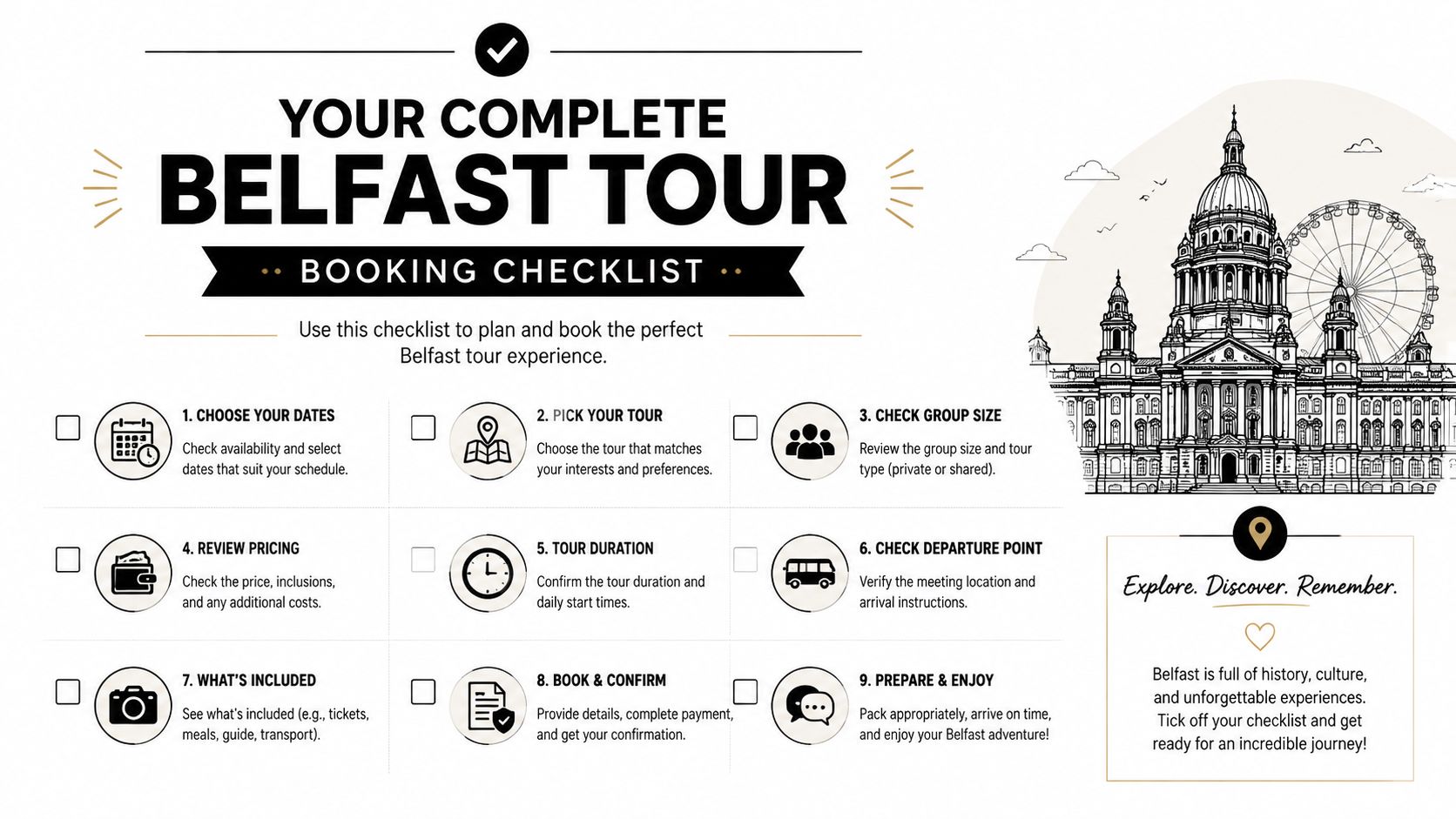
Your Complete Belfast Tour Booking Checklist
Use this checklist before you commit to a same-day tour Belfast from Dublin.
- Choose the trip format: Decide whether the objective fits a focused day visit or deserves an overnight. Select the overnight option if dining, meetings, or several major experiences are central to the trip.
- Map the starting point: Compare Dublin city and Dublin Airport departures. Airport-origin services can be materially faster, while city-origin travel may be simpler if the group is already near Connolly or central hotels.
- Secure the return first: Select the return service before adding optional Belfast activities. If the preferred return is sold out, change the itinerary rather than hoping another connection will solve the problem.
- Use direct services: Favor the Enterprise train or a direct express coach when schedule reliability matters. Avoid building a high-stakes program around the fastest advertised run.
- Reserve fixed commitments: Book meetings, attraction entries, guides, and dining before filling the flexible portions of the day.
- Create a buffer: Allow for boarding, local transfers, traffic, and border-adjacent variability. A nominal city-origin coach time of 2 hours 35 minutes should never be treated as the full door-to-door requirement, as noted in route planning guidance from CheckMyBus.
- Plan the fallback: Identify which attraction or stop will be removed first if the Belfast schedule slips. Protect the return and onward connection.
- Recheck the date: Review weekend schedules, public holidays, events, and attraction availability shortly before departure.
- Escalate when stakes are high: Use a private chauffeur and concierge operation when privacy, multi-stop routing, or punctuality outweighs the low friction of a public ticket.
For a carefully coordinated Dublin to Belfast journey, MLR Worldwide Service can arrange executive chauffeur transportation, airport and FBO support, multi-stop routing, and 24/7 itinerary coordination. Visit MLR Worldwide Service to discuss a private transfer or VIP Belfast program built around your required return window.